The Russian press is reporting a massive military exercise by Russian forces in Western and Central Russia. Sergey Shoigu, Russia’s Defense Minister, claimed that: “The drills are not connected with events in Ukraine at all.” Of course, no one believes Shoigu, and the exercise is regarded as sabre-rattling by Russian President Putin. Anti-government protesters in Ukraine are certainly concerned by the Russian moves, but the important constituency to watch are the Russian supporters in Eastern Ukraine. Will they be encouraged by the Russian moves to push to restore Yanukovich to the Ukrainian Presidency?
US Secretary of State Kerry issued some very strong language when he characterized a possible Russian military move in Ukraine as a “grave mistake.” Kerry is walking a very fine line, trying to convey the strongest US opposition to a possible Russian military action without making a formal commitment by the US to respond militarily. Both the US and Russia are engaged in a very dangerous game.
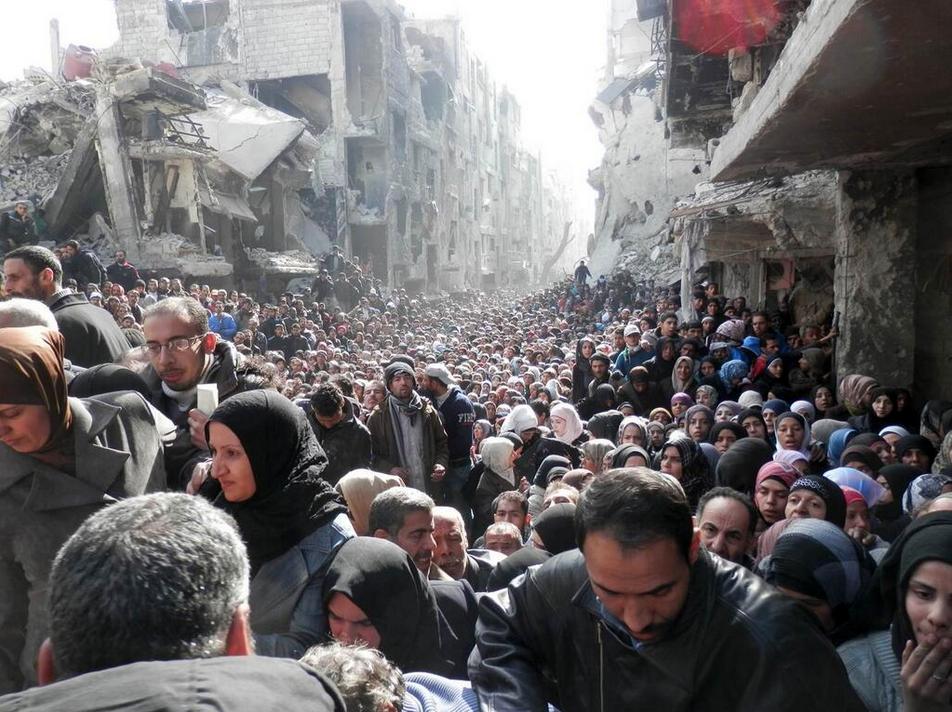
The situation in Syria has not improved at all for the civilians trapped in the violence of the civil war. The photograph below is from a refugee camp in Yarmouk, south of Damascus. These are civilians lining up to receive humanitarian food supplies.
For the first time in 13 years, the US is considering a defense budget that does not include funds for an ongoing war. The defense budget will actually decrease in real terms, continuing a trend that extends back three years. The budget cuts do reflect a clear reduction in the commitments of the US, and will likely cause some degree of apprehension among American allies. It is unlikely, however, that the Congress will implement all these cuts–there are well organized lobbies that will fight to restore weapons funding.
The world may be entering a “post-automobile” world. By 2050 there will be more than 9 billion people living in cities, and it is difficult to imagine that these many people could travel effectively with private automobiles (forgetting the environmental hazards of so many cars). There are two major issues of concern that stem from this emerging reality: what industries will replace automobiles, and can those industries employ nearly as many people as automobile factories? And what alternative means of transportation exist that could handle that many people comfortably and conveniently? All transitions are difficult to imagine, but this one in particular seems virtually intractable.
Social media plays a huge, but unquantifiable, role in protest movements today. Governments who wish to repress protests try to block these outlets, but the guerrilla war between users and the governments never yields a clear-cut winner. One social app, Zello, is currently playing a significant role in Venezuela, as it did in Ukraine and Turkey as well. The cat and mouse game is a whole new front in cyberwar, and one that should be followed very closely.
It is rare to be able to identify visually the differences among countries, but this night photograph of the Korean peninsula is quite dramatic and very telling. North Korea is truly different from South Korea and China as far as electrical usage is concerned.
Ugandan President Museveni signed into law severe anti-homosexual laws today. There are currently 10 countries in the world where homosexuality is punishable by death, and there are many more in which homosexuality is against the law. Human rights are far from universal in the world.
We are getting a better sense of the tragedy unfolding in the Central African Republic as more information becomes available. The scale of the misery is country-wide, and Muslims are fleeing the country in significant numbers as the world witnesses yet another example of cleansing. Muslims accounted for about 15% of the CAR population, and also filled some important economic roles in the society. It is hard to imagine any measure of stability in the country if the cleansing process continues.
As we watch the protests unfold in Ukraine, Thailand, Venezuela, Turkey and many other countries, it is important to remember that all protest movements are firmly rooted in local issues. Nonetheless, there are systemic pressures that are transmitted by the forces of globalization that tend to make these local affairs true manifestations of a much larger process. The protests we are witnessing are all spearheaded by firmly entrenched middle class groups, raising very traditional middle class issues. And all of these protests are occurring in what are regarded as democratic polities. In the abstract, we may be witnessing the erosion of legitimacy of liberal values, closely akin to the similar erosion in the early 20th century.
Ukrainian President Yanukovich claims to still be in Ukraine (presumably in the pro-Russian eastern part of the country), and the protesters and the outside world are struggling to figure out what the next steps might be. Chief among the worries are the Russian response to the governmental collapse. Russia has always considered Ukraine to be an essential part of Greater Russia, and its strategic and economic importance for Russia is difficult to overstate. Now that the Olympics are over, we can be certain that President Putin feels much less constrained to articulate Russian interests.
An innovative software/think tank called New England Complex Systems Institute developed a model several years ago predicting violent protests due to high food prices. It has proven to be highly accurate over the years. Violent protests always have many and varied causes, but the theorists argue that high food prices seems to serve as the “spark” for violence. The chart buttressing their conclusions seems to be quite persuasive. The fact that the very high price for food in 2013 will likely go down in 2014 is a somewhat encouraging note.
In a rare breakthrough, the UN Security Council has finally passed a resolution demanding that the Syrian government allow humanitarian aid to be introduced into the country. The resolution was not vetoed by either Russia or China because is contained no reference to enforcement if the Syrian government refuses to allow the aid in. Rather, the UN Secretary-General has to report to the Security Council about the success of the aid mission, at which point the Council must decide what action to take if the aid is refused. Needless to say, the resolution is a very weak one, but the best that could be passed. It does open a small window of possible help if enough public pressure can be brought to bear on the Security Council.
Ukraine President Yanukovich has left Kyiv, and the government is effectively leaderless right now. The assumption is that the agreement to call for new elections and to rewrite the constitution back to its 2009 form are still in force, but there is now way to verify that conclusion. In an extraordinary turn of events, protesters has essentially taken over Yanukovich’s private residence about 12 miles outside of Kyiv and are protecting it as a way of illustrating the corruption of his regime. The opulence in which Yanukovich lived was jaw-dropping, as suggested by some of the photographs from the site.
A truce has been brokered between the Ukraine government and the protesters, but it is soon to tell whether it will hold. The truce calls for new elections and a sharp curtailment of Presidential powers. The truce came about after the situation had deteriorated into an outright civil war. The protests are no longer about whether Ukraine will orient itself toward Russia or the EU; it is now a struggle over the legitimacy of the Ukrainian government itself.
Meanwhile, the situation in Venezuela has also deteriorated into a civil war. In this case, however, the government of President Maduro seems intent on organizing private militias to carry out attacks against the protesters. Maduro has revoked the credentials of the foreign press, so we can only get information through unvetted conduits such as social media. Venezuela, like Ukraine, is rapidly running out of foreign exchange reserves, so both countries will need outside assistance if they are to continue to import necessary items. In both cases, however, the major sources of outside capital are all deeply suspicious of the corruption in both countries, making the process of getting aid very difficult.
There is always news that makes me scratch my head in bewilderment. Today’s prize goes to the Israeli arms dealers who were shipping fighter plane parts to Iran. The scam was reported by the Greek press which is not well known for its hard-hitting investigative reporting. And it boggles the mind that the Israeli intelligence service, the Mossad, was not aware of such significant transactions. I guess everyone has to make a buck.
The National Security Agency obviously can’t take a joke. It sued the manufacturer of tee-shirts and other paraphernalia that used the NSA logo in this way:
The Office of Homeland Security also sued because of this logo:
Someone should remind the Agencies what they are trying to protect, namely the freedom of speech.
The situation in Ukraine has exploded today, with nine people dying in protests. There is a live video feed from Kyiv (below–remember that the time difference is none hours) and it appears as if the protesters have been completely energized. Talks over a new constitution have broken down, and President Yanukovich has signed an aid agreement with Russia. The agreement forestalls a sovereign default by Ukraine, but it also burns Ukraine’s bridges to the European Union.
Four people were killed in protests in Bangkok, Thailand as government opponents have seized government buildings in an attempt to prevent the government from conducting its business. Security forces tired to reclaim some of these buildings which led to the violent clashes. The standoff in Thailand seems no closer to resolution, and the Thai economy continues to deteriorate as a result.
China has rejected the UN report accusing North Korea of crimes against humanity. China called the report “unreasonable criticism” and rejected claims that it was complicit in the crimes by sending defectors back to North Korea rather than granting them asylum. The Chinese position makes it extremely unlikely that any effective action can be taken against the Korean regime.
Ordinarily I do not blog about aircraft hijackings, but an Ethiopian jet was hijacked by its co-pilot and diverted to Switzerland. The co-pilot waited for the pilot to use the lavatory and then locked him out of the cockpit. The Italians and the French scrambled their air force as the plane went over their territory and accompanied the jet to Switzerland. But the Swiss did not send fighter planes when the jet entered Swiss territory. The explanation? “… the Swiss airforce is only available during office hours. These are reported to be from 8am until noon, then 1:30 to 5pm.” On the one hand, it is great to see one of the richest countries in the world taking such a relaxed attitude toward terrorism. On the other hand, why does the Swiss air force need such a long lunch period?
Venezuela has expelled three US diplomats, accusing them of fomenting violence against the government. The protests against the Maduro government do not seem strong enough to topple it, but the unrest is rooted in the inflation and food shortages that have been created by poor government policies. It is not at all likely that the US diplomats were involved in the protests, but accusing the US of complicity in anti-government activities is a common tactic of previous Venezuelan governments.
Members of the extremist group, Boko Haram (the name means “Western Education is Evil”), have massacred citizens in the northern part of Nigeria. The group has been active for many years and have been leading an effort to create an Islamic state in Nigeria: the country is divided into a primarily Christian south and a primarily Muslim north. The conflict is mostly about how the oil wealth of the country is divided, but the violence over the years has been horrific.
The European Union has threatened Switzerland with the loss of significant financial assistance because of its vote to impose quotas on immigrants. Switzerland does considerable business with the EU although it is not a member of the Union. But the Swiss position on immigration contravenes the free movement of labor which is a keystone of the Union. The anti-immigrant sentiment within many European states is becoming increasingly inconsistent with the economic policies of the major EU countries.
Uganda has passed legislation to criminalize homosexuality, and President Museveni has indicated that he will sign the bill into law. US President Obama has indicated to Museveni that the law threatens US-Ugandan relations. The law is similar that the one passed by Russia last year. The divergence between many states in the West and other states in the world on the issue of homosexuality is an indication of how difficult it is to formulate rules for a single global polity.