The Ebola virus has created quite a stir in the US–quite unnecessarily, since it is not a highly contagious disease. But the US Defense Department has long worried about people transforming the virus into a weapon, and it has sponsored research into a vaccine and treatment for a number of years. Indeed, the serum that has been used by the two Americans who were infected was developed partially through public funds. The future development of biological weaponry is a true nightmare for world politics since there is no way for such a weapon to be used for specific tactical purposes other than to kill people. Killing people is not a useful political objective.
US Secretary of State, John Kerry, has had a very difficult few months. To his credit, he has not given up despite all the setbacks, but American foreign policy as a whole lacks clarity and focus. In large part, this malaise is due to the fact that many countries are trying to take advantage of what they perceive to be a vacuum in the world order. But the problem is that the US does not really know what to do with its power, nor does it have a vision of how the world order should be shaped. This problem is not one simply for the US; it is, indeed, a problem for the whole world.
We will be assessing the Gaza War for some time, and it would be a serious mistake to come to any conclusions too soon. The Economist has long been one of the staunchest supporters of the state of Israel and it is well known for its substantive analysis of contemporary events. It offers a tentative assessment of the effects of the war on global attitudes toward Israel. American attitudes toward Israel are hardly representative of other views in the world.
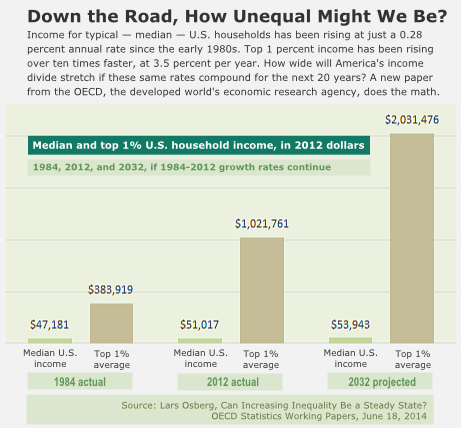
Professor Lars Osberg of Dalhousie University has written a paper under the auspices of the OECD which takes current trends of income inequality in the US and extrapolates them to the year 2032. The results are quite sobering:
The important message of Professor Osberg’s paper is intuitively obvious:
The ‘new normal’ of the United States, Canada and Australia is ‘unbalanced’ growth – specifically, over the last thirty years the incomes of the top 1% have grown significantly more rapidly than those of everyone else. The paper asks if auto-equilibrating market mechanisms will spontaneously equalise income growth rates and stabilise inequality. It concludes that the more likely scenario is continued unbalanced income growth. This, in turn, implies, on the economic side, consumption and savings flows which accumulate to changed stocks of indebtedness, financial fragility, and periodic macroeconomic crises; and, on the social side, to increasing inequality of opportunity and political influence. Greater economic and socio-political instabilities are therefore the most likely consequence of increasing income inequality over time.
Growing inequality is both economically and politically unstable. And there is no market mechanism to reduce growing inequality–only political intervention can redress the imbalance.
The Lebanese army has moved against the Islamic State which has taken over the town of Arsal. The battle represents yet another spillover from the Syrian civil war. The article from the Tehran Times has some interesting points to note. It makes sure that the Lebanese army commander is a Sunni Muslim (since the Islamic State is a Sunni Muslim organization and Iran is ruled as a Shia Islamic Republic), and the article identifies the Islamic State as ruled by “hardline takfiri militants.” Takfiri is a term to denote those who follow an apostate version of Islam. Iran wants to make sure that the enemy is properly identified. Meanwhile, Kurdish forces are also battling the Islamic State in Iraq. Although they share the same enemy, it is unlikely that Iran and the Kurds will ally–Iran fears the creation of a Kurdish state since it believes that such a state would be used by Israel and the US in their conflicts with Iran.
The Guardian has run an article asking the question of how biased Western media reports have been in their coverage of the Ukrainian crisis. The newspaper asked several analysts to ponder the question, and their answers are quite diverse. There is little question that the Russian side of the story has not been covered by the Western press–the real question is to what extent this omission is deliberate or based upon clear reasons to discount the interpretation.
UN Secretary General Ban Ki-moon declared that an Israeli attack on a UN-run school constituted a “gross violation of international law”. The United States said it was “appalled” by the “disgraceful”shelling. The harsh language is unusual in diplomacy and an index of the extent to which Israeli actions have alienated many in the world. There was also a large demonstration in Washington, DC in which protesters assailed Israeli policy in front of the White House, as well as protesting the coverage of the Washington Post and the activities of Caterpillar in selling equipment to the Israeli Defense Forces. In response to this criticism, Israel announced a unilateral seven-hour humanitarian truce.
The situation in eastern Ukraine remains volatile, but there are indications that the Ukrainian government is making progress in regaining control of the area (albeit at a very high cost–there are reports of a large number of deaths). But it also seems as if Russian President Putin might be looking for a way out of the stalemate. His current situation is quite difficult: Western sanctions have begun to alienate some of his strongest supporters in Russia, but he has also ignited a strong nationalist sentiment within the country that he might not be able to control. It seems as if Putin might be prepared, however, to jettison his support for the separatists in Ukraine if the evidence proves that they were responsible for the downing of the Malaysian airliner.
Another front has been opened in the conflict in Iraq. Iran’s Revolutionary Guards have been deployed to fight the Islamic State that has seized control of Iraqi and Syrian territory. The struggle now reflects the regionalization of the struggle between Sunni and Shia governments. Interestingly, the US finds itself allied with the interests of Iran. Whether the US or Iran will try to solidify that alliance of interests remains to be seen.
More information is being brought to bear on the question of which side broke the 72-hour cease-fire proposed by the UN and the US. The accepted view is that Hamas broke the cease-fire in a tunnel-searching activity that resulted in the killing of two (and, more likely, three) Israeli soldiers. Virtually all the information about the event came from the Israeli military. There are some interesting questions about that narrative. Unfortunately, it is highly unlikely that we will ever know the actual facts behind the event.
The same problem affects our understanding of the shoot-down of the Malaysian airliner in Ukraine. All the information we have access to is provided by the US, and it is difficult to get any consistent information from the Russian-speaking separatists about how and why the plane was shot down. Again, however, there are some questions that remain unresolved at this point.
In contrast to the usual disinformation that pervades world politics, US President Obama openly admitted what many of us have suspected for a long time: that the US tortured individuals in the so-called “war on terror” in the aftermath of the attacks of 11 September 2001. Obama’s admission was hardly voluntary–the US Senate is scheduled to release the results of its investigations on US interrogation techniques. We still do not know how much of that report will be edited for public consumption, but the report apparently does not mince words when talking about the abhorrent tactics used during the Administration of President George W. Bush.
Much has been made of the right of self-defense in the current Gaza conflict. Self-defense is not an abstract concept, but it does require a context which has been sadly missing from most of the media presentations of the current fighting. The most relevant bit of information concerns the status of the people living in the Gaza: since 2009, they have been living under an Israeli Blockade and Closure Policy. Blockades are acts of war, so the people of the Gaza have been living in a state of war since that time. In short, they have had the right to invoke the right of self-defense since that time.
Today has been a particularly confusing day. The 72-hour cease fire broke down quickly in Gaza, and the American media has decided that Hamas “broke” the cease-fire, and US President Obama blamed Hamas as well. But the agreement was the strangest cease-fire in diplomatic history. Apparently, the cease-fire was a cease-fire “in-place”, meaning that all military forces were to remain where they were and were not to fire against their enemies. But the cease-fire gave Israel the right to conduct search operations for tunnels. The incident today where two Israeli soldiers were killed and another presumably kidnapped involved Israeli forces going to a house in Rafah to search for a tunnel entrance inside the house. According to the Israeli military (and we have no independent confirming source), Hamas soldiers emerged from a tunnel inside the house and one of the Hamas soldiers blew himself up, killing the two Israeli soldiers.
Assuming that these facts are accurate, then one can reasonably ask whether there was a cease-fire. Allowing one side to conduct active military operations is an odd circumstance within a cease-fire. And I am not certain how soldiers should behave when they surprise each other in the context of an active military operation. Imagine the confusion when a fully-armed soldier enters a house and encounters another fully-armed soldier. Can we expect both sides to remain passive because there is a cease-fire? Or will they react defensively to protect themselves and their colleagues?
The issue is important because Israel is using the breaking of the cease-fire as a reason to resume intense military actions in Gaza, and as testimony to the impossibility of being able to work with Hamas. I think that if the parties involved were really interested in peace, then the breakdown of the cease-fire would have been interpreted as singularly unfortunate, but not a reason to resume fighting.
The situation in Gaza continues to deteriorate, and there really is no possibility of a genuine cease-fire for at least a few days. Let’s hope that cooler minds will prevail.
But there is a reason for cheer. Today is Jerry Garcia’s birthday!!!
The Imam of the largest mosque in the Xinjiang Province of China was murdered by three assailants. Jume Tahir was a government-appointed Imam, and the suspicion is that the killers wanted to make a statement about Chinese domination of a province largely populated by Uighur Muslims who wish to protect their identity from the Han Chinese who rule in China. The unrest against Beijing rule is long-standing, but has flared up significantly in recent months.
Israel is coming under increasing criticism for what many see as the disproportionate use of force in the Gaza conflict. In particular, several UN sponsored schools have been bombed, leading to the deaths of many civilians. Israel defends its actions by pointing out that Hamas missiles have been found in UN schools that were empty. It is not clear how this argument justifies the bombing of schools that were occupied, particularly since the UN informs Israel which schools are being used for refugees. The Commissioner of UNRWA issued the following statement after the most recent bombing:
STATEMENT BY UNRWA COMMISSIONER-GENERAL PIERRE KRÄHENBÜHL
Jerusalem
Last night, children were killed as they slept next to their parents on the floor of a classroom in a UN designated shelter in Gaza. Children killed in their sleep; this is an affront to all of us, a source of universal shame. Today the world stands disgraced.
We have visited the site and gathered evidence. We have analysed fragments, examined craters and other damage. Our initial assessment is that it was Israeli artillery that hit our school, in which 3,300 people had sought refuge. We believe there were at least three impacts. It is too early to give a confirmed official death toll. But we know that there were multiple civilian deaths and injuries including of women and children and the UNRWA guard who was trying to protect the site. These are people who were instructed to leave their homes by the Israeli army.
The precise location of the Jabalia Elementary Girls School and the fact that it was housing thousands of internally displaced people was communicated to the Israeli army seventeen times, to ensure its protection; the last being at ten to nine last night, just hours before the fatal shelling.
I condemn in the strongest possible terms this serious violation of international law by Israeli forces.
This is the sixth time that one of our schools has been struck. Our staff, the very people leading the humanitarian response are being killed. Our shelters are overflowing. Tens of thousands may soon be stranded in the streets of Gaza, without food, water and shelter if attacks on these areas continue.
We have moved beyond the realm of humanitarian action alone. We are in the realm of accountability. I call on the international community to take deliberate international political action to put an immediate end to the continuing carnage.
A 72-hour truce has been declared by the UN. It is likely that the truce had been approved by both Israel and Hamas, but it remains to be seen if it will hold. The truce is a cease-fire in place, and it is unclear what that means for the people of Gaza. Israel has effectively destroyed a 1.8 kilometer perimeter around the Gaza Strip to provide a buffer zone to eliminate the threat of tunnels being dug into Israel. Unfortunately, that perimeter contains about 44% of the Strip.
The world has witnessed a steady retreat from the commitment to liberal values and institutions that formed the bedrock of the world order for the last five centuries (despite the challenges posed by fascism and communism in the 20th century). But the early 21st century has seen growing dissatisfaction with those institutions (market capitalism, representative democracy, and human rights) and experimentation with alternatives such as state capitalism (China) and the union of church and state (Iran). In Europe, Hungarian Prime Minister Viktor Orban has explicitly called for a movement toward an “illiberal” state, the definition of which remains unclear. The move parallels the rise of right-wing movements throughout Europe.
Much has been made of the movement by the US to reduce its commitments abroad, raising the question of whether a functioning world order requires a hegemon to enforce the rules of interaction among states. Some authors are asking the question of whether the world should be looking for a new hegemon, and the implicit assumption of that question is that the US cannot and will not continue in that role. Given the disarray in the world order that we are currently witnessing, the question is taking on greater urgency.
Argentina went into a “technical” default today by missing key payments on its sovereign debt. The country is about $200 billion in debt, and was supposed to make an interest payment of $13 billion today on the total debt. However, Argentina has restructured some of its bonds with some holders willing to take 10 cents for every dollar of debt. A small group of hedge funds (Argentina calls them “vulture” funds) bought some of those reduced-value bonds and is insisting on getting full value back, and a US judge ruled that if the hedge fund holders are not paid, then none of the bondholders can be paid. The deadline for payment is midnight, 30 July, but an “official” default depends upon a ruling by a private agency known as The International Swaps and Derivatives Association (ISDA). If a default is declared, then the losses should be limited simply to those holders of Argentinian bonds. However, if bondholders of other sovereign debt become “spooked” by the default (fearing that other countries will default as well), then the crisis could be more widespread.
Just as there are anti-Jewish lunatics in the world, there are anti-Arab lunatics as well. In protest of a (much larger) left-wing pro-Palestinian demonstration, some right-wing Israelis held a counter-protest in which the deaths of Palestinian children was celebrated. The video of the counter-protest is below. As analysts, we all need to keep certain things in perspective. First, there are always irrational people involved in any political movement and it is crucial that their influence is not amplified by our sense of outrage–generally speaking, the fringe elements have limited power but they always get press attention. Second, anti-Arab sentiments are pervasive in many places in the world over many time periods, but no ethnic or religious hatred has the horrific legacy of anti-Jewish sentiment. For many reasons, we should be especially vigilant when anti-Jewish sentiment arises.
There is increasing evidence of a growing rift between President Obama and Prime Minister Netanyahu. Today, Channel 1 in Israel published a transcript of an alleged telephone conversation between the two leaders. Both the US and Israel have condemned the leak and denied that the transcript is accurate. It is highly likely that the transcript does not fairly represent the total tenor of the conversation, but the published excerpt is highly credible given what we know about the publicly stated positions of the two states. The excerpt is as follows:
Barack Obama: I demand that Israel agrees to an immediate, unilateral ceasefire and halt all offensive activities, in particular airstrikes.
Benjamin Netanyahu: And what will Israel receive in exchange for a ceasefire?
BO: I believe that Hamas will cease its rocket fire — silence will be met with silence.
BN: Hamas broke all five previous ceasefires. It’s a terrorist organization dedicated to the destruction of Israel.
BO: I repeat and expect Israel to stop all its military activities unilaterally. The pictures of destruction in Gaza distance the world from Israel’s position.
BN: Kerry’s proposal was completely unrealistic and gives Hamas military and diplomatic advantages.
BO: Within a week of the end of Israel’s military activities, Qatar and Turkey will begin negotiations with Hamas based on the 2012 understandings, including Israel’s commitment to removing the siege and restrictions on Gaza.
BN: Qatar and Turkey are the biggest supporters of Hamas. It’s impossible to rely on them to be fair mediators.
BO: I trust Qatar and Turkey. Israel is not in the position that it can choose its mediators.
BN: I protest because Hamas can continue to launch rockets and use tunnels for terror attacks –
BO: (interrupting Netanyahu) The ball’s in Israel’s court, and it must end all its military activities.
The position of the US is quite consistent with the leaked Kerry proposal for a cease-fire that was referred to in an earlier blog post (27 July 2014). Even if President Obama is adopting a harder line with respect to Israel, there is no evidence that the US Congress is changing in any way its strong support for Israel. And the 22 July CNN poll, the evidence is that the American people also strongly support the state of Israel. I suspect, however, that Israel would not change its policy even if the US decided not to support it in the current conflict.
On 28 July 1914, the Austro-Hungarian Empire declared war on Serbia after Serbia refused to capitulate to all of the Austro-Hungarian demands following the assassination of the Archduke Ferdinand and his wife in Sarajevo. On this, the 100th year anniversary of the beginning of the war that signaled the beginning of the end of the modern period and European domination of the world, The Economist, re-published the article it published after the event indicating its opposition to the war. There was no automatic alliance between the UK, France and Russia on that date, and many in Great Britain were inclined to stay out the continental war. Nonetheless, British leadership on that date was lacking, and those voices were lost in the political firestorm that followed.
On a happier note, today is the 146th anniversary of the 14th Amendment to the US Constitution. The Amendment was necessary to protect the civil rights of the African-American population, and it represents a major milestone in human history–a right whose enforcement had to wait for the Civil Rights Act of 1965–, codifying the right of all individuals to participate in their political governance. Constant vigilance, however, is necessary to make sure that the commitment to these rights is not eroded.
The recent spread of the Ebola Virus in West Africa has terrified health officials, and several care-givers have been infected and died as a result. Governments in the region have responded with quarantines which have proven difficult to enforce, and there is a deep suspicion among the population of health workers which limits the possibility for effective treatment. ABC News has posted a good primer on the disease and outlines the steps that have been taken so far. Further spread of the disease would completely overwhelm the health infrastructure of the countries in West Africa.
One of the truly troubling aspects of the Gaza conflict is the re-emergence of virulent anti-semitism in many of the pro-Gazan protests. There is absolutely no connection between Judaism and the current policies of the government of Israel in the Occupied Territories: the conflicts between indigenous peoples and dominant cultures (think Russia/Chechnya, China/Uighur, English/Scotch/Irish/Welsh, Tutsi/Hutu, Sunni/Shia are just a few examples) are ubiquitous in world politics. Religion is nothing more than a rationalization for what is always a political conflict over control and power.
Income inequality is one of the most economically and politically destabilizing trends in the world today. It is, however, difficult to appreciate fully what income inequality actually means–very few of us have any meaningful contact with the ultra-rich. One way to appreciate the divide between the typical person and the very rich is to think about what buying a house means to an average person: it is by far the most expensive purchase most people will make in the entire lives. Yet, for the very, very rich, buying a house may be a trivial act. Check out the people who could buy every single house in certain cities in the US: