Chrystia Freeland is a very perceptive analyst, and she has written an op-ed piece on Ukraine that merits a close analysis. As a cease-fire is announced, we are still uncertain of its terms and many doubt that it will last. But the 5 month-old conflict has been beset by confusion, misleading statements, and outright falsifications. In world politics, we should assume that most diplomatic statements should be only loosely interpreted and that the words are generally a cover-up for other activities. It is always best to pay closer attention to actions rather than the rhetoric.
At the close of the NATO summit in Wales, US President Obama announced the creation of a “core coalition” of ten countries who are prepared to fight the Islamic State, initially in Iraq. The countries in that coalition include the US, Britain, France, Germany, Canada, Australia, Turkey, Italy, Poland and Denmark, but only one of the ten (Turkey) is a Muslim country. The coalition is not prepared yet to fight the IS in Syria since that would be implicit support for the Assad regime which the coalition countries oppose. Additionally, the coalition did not announce any plans to work with Iran which also opposes the Islamic State. The traditional alliances in the Middle East are slowly changing very dramatically.
A few weeks ago, Brazilian President Dilma Rousseff seemed assured of re-election. But when one of her opponents died in a plane crash, he was replaced by Marina Silva who is a noted environmental activist in Brazil. Since that time Silva has steadily climbed in the polls, largely on a platform of anti-corruption and transparency. Silva is hard to categorize: she is an activist who has emphasized the free market in an attempt to allay the fears of corporations in Brazil. The election will be held in October, and right now the race is very tight.
I often read essays that are intelligent but whose conclusions are hard to accept. Such is the case with the essay by Thomas Mahnken in Foreign Policy (for my Mount Holyoke students, you will have to read this on a College computer–the College has a subscription to the Journal). His use of von Clausewitz in his analysis rings true, but he forgets the most important proposition articulated by the noted military strategist: was is nothing more than politics carried out by other means. Thus, when Mahnken argues at the end that the US should “go to war” with the Islamic State, I am uncertain what the political objective would be: would it be some sort of settlement, or would it be the extermination of all IS adherents? The former is difficult to conceive; the latter is slaughter, not war.
People in Scotland will be voting on whether Scotland should break away from the United Kingdom and become an independent state on 18 September. The vote is currently too close too call, and there are reasons to be concerned about the move. Regardless of the consequences, however, the case study is intriguing. Secessionist movements are occurring all over the world right now (the Kurds, Russian speaking people in Ukraine, the Uighurs in China). By and large, these movements have a degree of violence. The Scottish case is interesting because the possible secession is proceeding in a perfectly peaceful manner. The division between the nation and the state is rarely accomplished in such a leisurely fashion.
The slowing European economy has forced the European Central Bank to take the unprecedented step of purchasing assets with money not necessarily backed up by tax revenues. The process is called Quantitative Easing and it is the official policy of the US, Japan, and the Bank of England. It is a risky policy because it contains the seeds of inflation (although under current conditions, those seeds will likely fall on barren soil). But inthe case of Europe, the policy may in fact break European Union law since it prohibits the European central Bank from lending directly to banks (it is supposed to lend only to sovereign governments). We’ll see whether Germany, which has a rabid fear of inflation given the history German hyperinflation in 1923, decides to contest the policy.
The rebel advances in Ukraine have been recently stemmed by forces loyal to Kyiv. But there is evidence that the separatists are once again regaining the intiative, thanks to support from Russia. What seems to be the most likely objective of the rebel advances is the city of Mariupol which would be an essential component of a land-bridge from Russia to Crimea. The city seems to be held primarily by forces loyal to Kyiv, but the majority of the population also speaks Russian. We should focus on the how quickly the separatists seem to be that that strategic city.
US President Obama’s speech in Estonia did not mince any words. It is rare for a statesperson to be so blunt. While he did not use the word “invasion” (which would have amounted to a declaration of war which is why the US is so reluctant to use the word), President Obama identified Russia as the source of the problems in Ukraine:
It was not the government in Kyiv that destabilized eastern Ukraine; it’s been the pro-Russian separatists who are encouraged by Russia, financed by Russia, trained by Russia, supplied by Russia and armed by Russia. And the Russian forces that have now moved into Ukraine are not on a humanitarian or peacekeeping mission. They are Russian combat forces with Russian weapons in Russian tanks. Now, these are the facts. They are provable. They’re not subject to dispute.
More importantly, President Obama rejected any possibility that the US would accept a decision imposed on Ukraine by force, and he identified the tactics of Russia as being unacceptable in the 21st century:
Let’s also be clear where we stand. Just as we refused to accept smaller European nations being dominated by bigger neighbors in the last century, we reject any talk of spheres of influence today. (Applause.) And just as we never accepted the occupation and illegal annexation of the Baltic nations, we will not accept Russia’s occupation and illegal annexation of Crimea or any part of Ukraine. (Applause.)
We now must wait for two things: President Putin’s response to Obama’s speech and the decision by NATO after the meeting on Thursday. The current thinking is that President Putin will back off slightly, but not give up any of the gains he has made in eastern Ukraine right now.
The US launched an attack on a suspected al-Shabab location, hoping to kill Ahmed Abdi Godane. Godane has been implicated in a devastating attack on a shopping mall in Kenya, an attack that was termed “retaliation” for Kenyan participation in an African Union operation that forced the terrorist group out of Mogadishu, the capital of Somalia. Al-Shabab is an offshoot of al-Qaeda, and part of a growing number of similar groups that have emerged since the 1990s. Godane is a very high-ranking person in the organization, and his death would be a serious blow to the group. There has been, however, no confirmation that Godane was killed. The US is centrally involved in a number of ongoing anti-terrorist operations simultaneously, a very heavy intelligence and logistical burden.
NATO is going to meet this Thursday and the Islamic State and Ukraine are going to be the priority items for discussion. NATO recently announced that it was reviewing plans to create a high-readiness rapid reaction force to counter the Russian threat in Ukraine, as well as possible future threats to the Baltic states and Poland. In response, Russia announced that it would review its military plans to counter such a force. There is, however, a split within NATO about which threat is more urgent. The British and the Americans wish to focus on the Islamic State. The other members of NATO (the continental powers) are more concerned with Russian moves in Ukraine. It is likely to be a highly contentious meeting (although it is doubtful that NATO will air its dirty laundry in public).
The The Palestinian Center for Policy and Survey Research conducted a survey of Palestinians and found that Hamas is overwhelmingly popular in both the Gaza and the West Bank and would likely win any election pitted against its rival, Fatah which is currently led by Mahmoud Abbas. The poll found that the Palestinians prefer the Hamas strategy of armed struggle over Fatah’s strategy of negotiations. The poll reflects Palestinian perceptions of the outcome of the recent Gaza conflict, and it signals a sharp setback for the US preference for a negotiated peace.
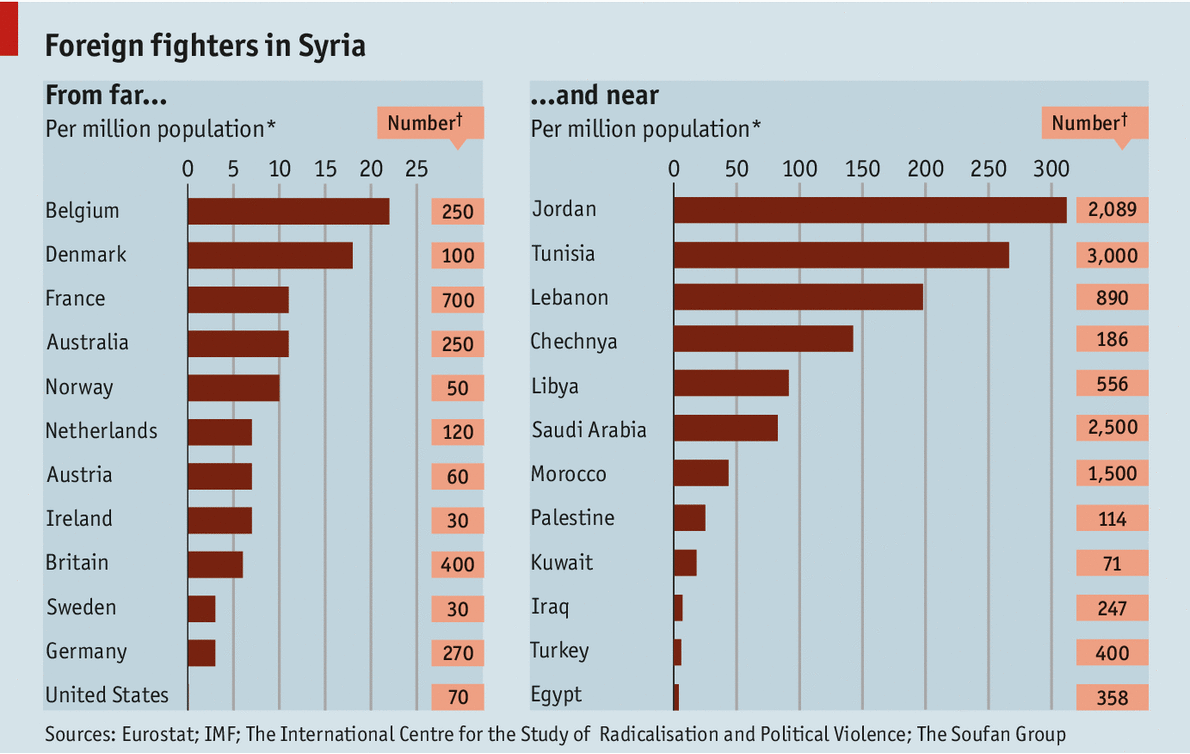
As the drumbeat for war grows louder in the West, the Islamic State continues to attract followers from all over the world. Information about the people who have flocked to support the Caliphate is sparse, but we are beginning to get some concrete data about them. The important aspect of this dimension of the IS appeal is that it reflects loyalty to a non-nation-state. Even though the foreign fighters have national passports (and from that fact lies one of the West’s apprehension), their loyalty is to a supranational idea. As such an appeal grows internationally, the support for a change in the international system also grows.
The civil unrest in Pakistan is growing in intensity. Protesters grabbed Pakistan Television’s English language station for a brief period of time, and then the Pakistani military criticized the government’s excessive use of force in restoring order. About 70,000 protesters have been roiling Islamabad since 15 August and it does not appear as if the government is making progress in settling things down. Some believe that the Pakistani military is involved in order to force a change in government.
In order to spur action against climate change, the World Meteorological Organization, in conjunction with global media agents, has created a weather report from the future (2050). I suspect that some of the forecasts are unlikely (122 degrees Fahrenheit in Bulgaria?), but the general thrust of the video is consistent with the projections made by the UN Intergovernmental Panel on Climate Change (IPCC).
The Chinese cnetral government in Beijing has ruled that only persons nominated by it will be allowed to run in the Hong Kong elections of 2017. The decision was met by protests from dissidents who identify as “Occupy Central” who believe that civil nominations should be allowed to allow greater freedom of choice. The decision, however, was hailed by the Central government which claimed that “the step is a sharp contrast to the past 156 years when there was no democracy for Hong Kong people under British rule.”
Israel has expropriated almost 1000 acres (400 Hectares) of land in the West Bank to build more settlements. The Israeli government claims that the expropriation is in retaliation for the murder of three Israeli teenagers earlier in the year. It is a substantial expropriation and will undoubtedly complicate any possible negotiations for a negotiated peace between Israel and the Palestinian Authority. Israel has moved almost 550,000 settlers into the West Bank and East Jerusalem in which 2.4 million Palestinians live.
Peter Beinart is an analyst worth reading. He has parsed President Obama’s foreign policy and come up with an explanation for his limited but aggressive engagement with the world. Beinart calls it a minimalist foreign policy, but it resonates strongly with a realist approach–Obama only intervenes when he is convinced that American lives are at stake. That approach contrasts sharply with the more open-ended approach suggested by both George W. Bush and Hillary Clinton.
In a follow-up to the last post, Anne Applebaum of The Washington Post, has an op-ed entitled “War in Europe is not a Hysterical Idea.” Needless to say, the essay is grim and one that will likely not resonate with most American readers. But, having perused several European newspapers today, I will confess that European assessments are quite different from what most Americans are reading. The situation is far more volatile than most suspect, and both Russia and Ukraine are both backing into a corner with no exits.
The United Nations Committee on the Elimination of Racial Discrimination (CERD) grilled US officials on what the committee believed was persistent racial discrimination in the US. The Committee cited patterns in jobs, housing, education and the criminal justice system to raise questions about the US commitment to ending racial discrimination. There is no doubt that recent high profile events in the US, such as the killing of Trayvon Martin, Jordan Davis, and Michael Brown increased the urgency of the questioning.
The protests in Pakistan led by Imran Khan and anti-government cleric Tahirul Qadri have erupted violently as the protesters marched on the Prime Minister’s house. The protesters argue that Prime Minister Nawaz Sharif won the 2013 election through massive fraud, an allegation not supported by the international observers present at the election. The political dispute is incredibly complicated, and involves allegations concerning the role of the media and the military in Pakistani politics. Initially, it did not appear as if the protests were gaining much traction, but the situation is now much more fluid.
The European Union has given Russia one week to scale back its operations in Ukraine or face further sanctions. The rhetoric over the conflict in Ukraine has become significantly more heated over the last week as evidence of direct Russian intervention has accumulated. Ukrainian President Petro Poroshenko’s statement after the EU announcement was particularly pointed:
“We are very close to the point of no return, the point of no return is full-scale war, which is already happening in the territories controlled by the separatists….Today we are talking about the fate of Ukraine, tomorrow it could be for all Europe.”
The language matches the language used by Russian President Putin when he spoke to a youth camp yesterday:
“Russia’s partners … should understand it’s best not to mess with us. Thank God, I think no one is thinking of unleashing a large-scale conflict with Russia. I want to remind you that Russia is one of the leading nuclear powers.”
It is often difficult to sort out the rhetoric in a crisis situation, but we should all hope that both Presidents are engaging in political hyperbole.
The United Kalavrvta is an oil tanker that was carrying about $100 million worth of oil from the Kurdish region of Iraq. The Kurds have been trying to sell the oil from their territory, but the central government of Iraq claims that the oil belongs to Iraq and does not recognize an independent state of Kurdistan. Currently the Kurds receive about 17% of the value of the oil pumped from its territory. Apparently, the Kurds decided to keep all the revenues because the Kalavrvta has disappeared from the electronic tracking system used by the US Coast Guard. It is likely that the tanker will eventually reappear but without any oil. We’ll see how the Iraqi government decides to pursue the matter. If the Kurds can sell their own oil, it will be a huge step forward in their bid for their own state.
The Thomson Reuters Foundation conducted an interview with various regional experts on the question: “Is the Islamic State a Flash in the Pan?” The answers, some of which are inconsistent with each other, are quite thoughtful and revealing. Generally, however, the answers tend to emphasize the problems the Islamic State is going to have governing such a large swath of territory in both Syria and Iraq. The interview offers a good perspective on the power of IS which everyone should keep in mind as world leaders tend to focus on emphasizing the threat from the new organization.
Poland denied the right of the Russian Defense Minister’s airplane to fly through its airspace when Russia declared the flight as a military flight. When Russia changed the characterization of the flight to a “civilian” flight, Poland allowed the flight to proceed. Poland has been sharply critical of Russian actions in Ukraine, and the denial was an attempt to communicate to the Russians Poland’s displeasure. Needless to say, the Russians were angered by the move.
There is an incredible amount of confusion about whether Russia has in fact “invaded” Ukraine. We usually don’t have this type of problem in world politics–the infiltration of guerrilla forces are always difficult to identify, but regular troops are usually easily identifiable. The Washington Post has an article listing the evidence that we currently have about Russian troops in Ukraine. Unfortunately. none of the evidence is “definitive.” The Russians adamantly deny that there are Russian troops in Ukraine. I doubt, however, that this uncertainty will last much longer. In response to the map tweeted by the Canadians on “Russia/Not Russia”, the Russians published today a map which clearly identifies Crimea as part of Russia. For the Russians, but not for the rest of the world, the matter is closed.
The province of Kashmir has been disputed by India and Pakistan since both states achieved independence in 1947. Since that time, there have been occasional violent conflicts over the province, but since 2003 an uneasy truce has prevailed. In recent weeks, however, it appears as if the conflict is heating up once again. Both Pakistan and India have control over parts of the province, but they are divided by a “Line of Control” which serves as a de facto border. Given the recent election of the Hindu nationalist, Modi, to the office of Prime Minister of India, and the recent political volatility in Pakistan, it is difficult to anticipate whether this crisis might blow up into something significant.
Islamic State militants have seized United Nations’ Peacekeepers in the Golan Heights, adding a high degree of unpredictability to an already dangerous situation. Not only is the act an egregious violation of international law, it also directly involves Israel in the Occupied Territory that belonged to Syria prior to 1967. There is no question that Israel would feel highly threatened by the presence of the IS so close to its borders.