Author Archive
One of the more vexing questions in world politics concerns the authenticity and integrity of the idea of human rights. There is little question that every society that has ever existed has held ideas about what constitutes human rights. But in the contemporary world, it is difficult to separate the current articulation of human rights from the power position of the former European powers, including the United States. There are very legitimate questions about how human rights might be defined if somehow they could be articulated without the element of power.
I continue to fret over US policy in Syria. The Washington Post is reporting that there is sentiment in the State Department and the Pentagon for what are described as “kinetic” actions (a euphemism for blowing things up). Apparently, some members of the Administration believe that deserting the “moderate” rebels in Syria will drive them into the hands of the Islamic State and al-Qaeda. That possibility is real, but I am not certain how the US can “save” the moderate rebels as long as Russia, the Syrian government, and Iran are committed to destroying any opposition to the Assad regime. The real danger to the US is that by not intervening the US will leave the civilians of Syria vulnerable to the destruction these states are willing to inflict on them. That failure will forever be a stain on the reputation of the US, but I cannot conceptualize any actions that the US could take at this time to protect those civilians.
We have witnessed a sharp rise in nationalist sentiments all over the world in the last 15 years. The rise is in many respects a backlash against globalization and is comprehensible in that context. But one interesting feature of globalization is the degree to which citizens develop a sense of commitment to people all over the world and not just to their fellow citizens. Some of these people define themselves as “citizens of the world.” Global Scan conducted an 18 nation survey of attitudes toward people of other countries, races, and ethnicities. The results of the survey are fascinating as one of the charts from the survey (below) indicates. I highly recommend the site.

I rarely post about natural events like hurricanes, but Haiti is currently being pummeled by Hurricane Matthew. Haiti is one of the poorest countries in the world and has never recovered from the devastating earthquake of 2010. The government of Haiti is not capable of addressing the problems that the people of Haiti will likely face, and the international community has not done nearly enough to support the long-suffering population. Haiti is particularly vulnerable to a natural catastrophe like a hurricane because the country has been so deforested that heavy rains inevitably cause mudslides, disease, and destruction. We should do everything to encourage the international community to come to Haiti’s aid as quickly as is possible.

Philippine President Rodrigo Duterte told US President Obama to “go to hell” as he accused the US of refusing to sell advanced weaponry to the Philippines. He also said that Russia and CHina were willing to supply the Philippines with advanced weaponry and that he would go to them for help. The growing rift between the US and the Philippines is intriguing because it comes at a time when the Philippines is contesting China’s role in the South China Sea and it needs US support to advance its interests. It could be the case that Duterte believes that he can reach a mutually acceptable agreement with China on the South China Sea, but he does so at the risk of alienating the other Southeast Asian countries involved in the dispute.
Iraq and its allies, including the US, Iran, and Turkey, are getting close to launching a major battle to take back the city of Mosul from Daesh (the Islamic State) control. The city symbolizes the apex of Daesh power as it was able to rout Iraqi forces from the city. The battle will be conducted in phases and will likely take several months. As always, the civilians stranded in Mosul will likely be the ones that will suffer the most from the siege. One can only hope that the combatants will allow the civilians to flee the city before the battle intensifies.

India has signed the Paris climate change agreement. It is the 62nd country to do so and the signature is significant. The agreement was designed so that it would not come into effect until 55 countries signed it and only when those 55 countries account for 55% of the emission of greenhouse gases. India’s accession brings the total emissions up to 52% of the global amount, not yet enough to activate the agreement, but close enough to inspire hope. If India had not signed, there was probably no way for the agreement to come into effect. Now the pressure is on the countries that have yet to sign on.
Iraq is the first country to respond to the passage of the Justice Against Sponsor of Terrorism Act (JASTA) which allows American citizens to sue Saudi Arabia for damages incurred in the attack on 11 September 2001. Stephanie Ross DeSimone has initiated a suit against Saudi Arabia for the death of her husband who was on the flight that was crashed into the Pentagon. A group in Iraq has asked the Iraqi Parliament to pass a similar law which will allow Iraqi citizens to sue the US government for the 2003 invasion of Iraq. The can of worms has definitely been opened.
The US has broken off diplomatic discussions with the Russians, and the question is whether the rupture signals a decision by the US to step up its efforts to support the rebels opposing Syrian President Assad. The Russians certainly believe this to be the case. If the US does intend to more openly oppose Assad, then a confrontation with the Russians will be hard to avoid. On the other hand, the decision not to deal with the Russians may simply indicate that the US has decided not to become more involved in Syria and to accept President Assad. The latter course of action would undoubtedly be view as a defeat for the US and a victory for the Russians. But much depends on how one defines the US national interest in Syria. As long as the Russians continue the fight against the Islamic State, then that objective can be served. But the humanitarian objective of defending the Syrian people against Assad would be completely lost. A third objective could simply be to thwart Russian objectives in the Middle East, and that interest would also be lost. Which of these three considerations is most important to President Obama?
The referendum in Colombia has been defeated. It is impossible at this point to know what happens next.
There was violence at a festival near a sacred lake in the town of Bishoftu in Ethiopia and as many as 100 people died. Every October Ethiopia’s Oromo people hold the Irreecha thanksgiving festival at the end of the rainy season. The Oromo make up about a third of Ethiopia’s population, but the ethnic group feels marginalized, particularly at the hands of another ethnic group, the Tigray. Feyisa Lilesa, a silver medal winner at the Summer Games in August, demonstrated solidarity with the Oromo people by holding his arms in an X when he crossed the finish line of the Men’s Marathon. Apparently, the crowds at the festival held their hands in a similar fashion, leading the police to fire tear gas at the celebrants.

Colombians are going to the polls today to vote in a referendum to end the longest guerrilla war in Latin America. The Colombian government had been fighting the Fuerzas Armadas Revolucionarias de Colombia (FARC) since 1964. It has been a bloody and treacherous war with both political and criminal objectives. The government has promised to initiate an ambitious economic development plan in areas once controlled by the FARC and the FARC has promised to disarm, clear landmines, and get out of the cocaine business. But the contentious part of the peace agreement revolves around the promise of amnesty if FARC members confess to their crimes before a special tribunal. We shall see how the people of Colombia resolve this conflict.
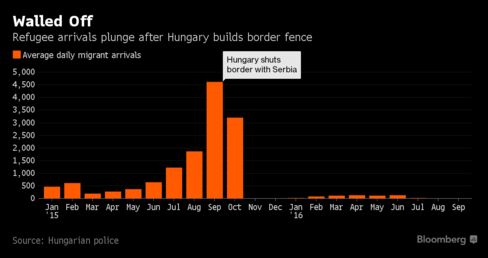
Voters in Hungary cast their ballots in a referendum sponsored by Prime Minister Viktor Orban to repudiate the European Union’s policies on refugees. Voters were ask to vote on the following question: “Do you want the European Union to be able to order the mandatory settlement of non-Hungarian citizens in Hungary without parliament’s consent?” The vote received 98.2 percent “no” votes, but the turnout for the referendum was only 39.7%, short of the 50% required to constitute a valid vote. The outcome is curious. 3 million Hugarians voted to repudiate the EU, but many more refused to participate in the vote. A difficult outcome to assess.
Russia has responded to the US declaration that it would not coordinate its activities with Russia in Syria any longer. The Russians apparently believe that the declaration signals a US intention to take armed action against its ally, the Syrian government. That outcome is a possibility, but not the one that I believe is likely. More likely is that the US will step back from Syria and let Russia try to create a viable outcome. But the Russians left no doubt how they would respond to US attacks against the Syrian government. According to the Reuters: “Russian news agencies quoted Foreign Ministry spokeswoman Maria Zakharova as saying that a U.S. intervention against the Syrian army ‘will lead to terrible, tectonic consequences not only on the territory of this country but also in the region on the whole.'” The language is unusually strong.

Joachim Kebschull, the mayor of Oersdorf in the German state of Schleswig-Holstein, was attacked by a group opposed to his efforts supporting refugees. According to the Telegraph: “Hours before the attack, he received a threatening letter which contained the phrases ‘He who will not listen will have to feel’ and ‘Oersdorf for the Oersdorfers’.” The violence reflects the deepening hostility toward the refugee policies of Chancellor Merkel.
Shares of Deutsche Bank recovered today, but the bank continues to suffer a crisis of confidence as major hedge funds have pulled out their investments. The recovery is due to a rumor that the US Department of Justice may reduce the $14 billion fine it levied on Deutsche Bank for marketing fraudulent financial products prior to the financial crisis of 2008. Interestingly, the US government seems willing to cut the bank some slack even at the expense of the harm done to its citizens. It would be hard, however, to quantify the potential harm that may ensue if the full fine did in fact cause Deutsche bank to collapse. The speculation is a clear example of how politics and economics are completely intertwined. Nonetheless, Germany’s second largest bank, Commerzbank, announced that it was laying off nearly 10,000 workers and suspending its dividend. Chancellor Merkel had earlier announced that the German government would not bail out Deutsche Bank as the US government bailed out its banks in 2008, but it is hard to believe that the government would let the bank collapse. But the rest of Europe would be bemused as the paragon of financial rectitude bent the rules for its own banks–another example of the strong interpenetration of politics and economics.
The Internet began as a US Department of Defense program shortly after the moon landing in 1969. Since that time the Internet Corporation for Assigned Names and Numbers (ICANN) has organized domain names for the internet. From the beginning, the US government has had a central role in supporting ICANN but that authority lapsed today. The organization of internet addresses will now be controlled by a private corporation representing various constituencies in the world. The change will not be noticeable nor will it likely lead to any significant changes in the running of the internet.
Not only has the cease-fire in Syria collapsed, it now appears that American policy in Syria has collapsed as well. The Russians are stepping up the bombing of Aleppo, apparently free from any diplomatic constraints. The Russians have decided that the US has no policy in Syria, and that is also has no back-up plan. There is no evidence for what has happened, but a safe bet would be that President Obama has decided that Russia now owns Syria and that it will have to clean up the mess it has created. Obama’s withdrawal leaves the people of Syria without any options other than to accept President Assad, and there are many in Syria that will not accept that outcome. Syria seems condemned to a perpetual civil war.
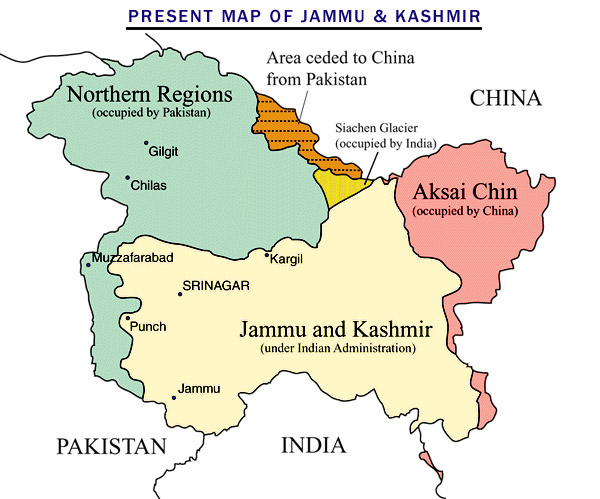
Indian troops crossed into Pakistani-controlled Kashmir to kill suspected militants. The move comes as tensions between India and Pakistan over Kashmir continue to escalate after the killing of a Pakistani militant last July. There has been a cease-fire in place since 2003 between India and Pakistan which seems to be slowly disintegrating. The two countries have fought three major wars over Kashmir since the division of the British colony of India into India and Pakistan in 1947. Kashmir is populated primarily by Muslims but parts of Kashmir are controlled by India which has been experiencing a resurgence of Hindu nationalism since the election of Narendra Modi in 2014.
It appears as if the planet has passed a very significant climate milestone: it seems likely that the atmosphere will experience carbon dioxide concentrations of at least 400 parts per million permanently. The rise assures that climate change will occur and that it is almost exclusively related to human activity: “the atmosphere has warmed the world about 1.8°F since the start of the industrial revolution.”

The Economist‘s most recent issue includes articles on globalization and reflect the magazine’s strong commitment to liberal economics. One article in particular is a very thoughtful analysis of the recent development of populist politics which seriously question the virtues of free trade, free capital flows, and the free flow of labor through migration. The article acknowledges the potency of these questions but still comes down hard in favor of market capitalism.
The US Army operates the John F. Kennedy Special Warfare Center and School at Fort Bragg, NC which publishes a journal called Special Warfare. The October 2015 issue ran an article by Capt. Philip Kapusta entitled “The Gray Zone”. The article discusses the intrinsic difficulties of conflict situations which “fall between the traditional war and peace duality, are characterized by ambiguity about the nature of the conflict, opacity of the parties involved, or uncertainty about the relevant policy and legal frameworks.” (p. 20) These conflicts, which fall short of the formal definition of war, seem to be the more likely context for interactions among both states and non-state actors.
The Senate has voted 97-1 to override Obama’s veto of the Justice Against Sponsors of Terrorism Act and the House followed with a 348-77 vote. The bill paves the way for American citizens to sue the Government of Saudi Arabia for damages suffered during the terrorist attacks of 11 September 2001. The bill waives the sovereign immunity of Saudi Arabia in US courts for these damages. Now we will wait to see if other governments pass similar legislation to waive the sovereign immunity of the US government for their citizens for damages they may have suffered in events such as drone attacks.
A Dutch-led criminal investigation into the 2014 downing of Malaysia Airlines Flight 17 has found that the missile that brought down the civilian airplane in Ukraine was fired by either Russian or Russian-supported rebels in Ukraine. According to Reuters:
“….the plane was hit by a Russian-made Buk-9M38 missile; the missile was fired from the rebel-held village of Pervomaysk in eastern Ukraine; and the launcher was transported into Ukraine from Russia.”
Russia has vehemently denied being involved.

For about a year, Saudi Arabia has been waging a relentless economic war against Iran by refusing to cut its oil production and thereby forcing oil prices to fall significantly. The economic war is simply Saudi Arabia’s response to the growing influence of Iran in Middle Eastern affairs. But the war also imposes heavy costs on Saudi Arabia. Long known for its generosity toward those who work for the Saudi Government, Saudi Arabia has been forced to do an about face and has reduced government salaries by 20%. The Saudi game may be becoming too risky to pursue.
Nigeria has been wracked by the terror activities of Boko Haram in the northeastern corner of the country, as the group tries to impose its own version of Islam on the population. Nigeria has also experienced a sharp upswing in violent acts by the population in the southern delta region, as that population has become more demanding for a fairer share of the country’s oil revenues. A third zone of conflict has recently developed as a nomadic people known as the Fulani have been forced out of their traditional habitats by the violence perpetrated by Boko Haram. Nigeria does not seem to be able to stabilize its diverse and dynamic populations.
A highly simplified ethnic map of Nigeria

The International Monetary Fund under the leadership of Christine Lagarde has gone through a very interesting transformation. Ordinarily, the IMF has always been viewed as an unabashed supporter of neoliberal economic policies. But the IMF has begun to publish studies which seem highly critical of the support of harsh economic policies. The most recent publication of the IMF on trade suggests that some of the staff at the IMF have a very critical view of the benefits of free trade.

