Author Archive
Great Britain has formally initiated the process of leaving the European Union. Prime Minister Teresa May’s letter to the EU triggering Article 50 of the EU Treaty which allows departure can be found here. It seems as if the tone of the letter suggests that May has softened her earlier position from a “hard” Brexit, indicating that she is open to discussions about how Britain can maintain some relationships with the EU as a whole. There is little question that this is an historic moment for the Union and the future of Europe. The Brexit negotiations have a time limit of two years, and it will be interesting to see the pace that Great Britain and the EU decide upon.
The US has admitted that it may have been involved in an attack in Mosul, Iraq which killed perhaps as many as 200 civilians. Non-governmental groups claim that the US military activities have killed about 3,000 civilians in Iraq and Syria since 2014, but the US military puts the figure at closer to 220 civilians. The new information gives special urgency to review whether the military has changed the rules of engagement in the two countries which may put the lives of civilians at greater risk. Civilian casualties undermine the very effort to displace daesh (the Islamic State) from the region.
Last December, the UN General Assembly voted to begin to “negotiate a legally binding instrument to prohibit nuclear weapons, leading towards their total elimination“. The vote in favor of these negotiations was 113 for and 35 against, with 13 abstentions. Forty countries have refused to participate in these negotiations, including the United States, Britain, China, Russia, North Korea, India, Pakistan, Albania, South Korea, and France. The states in favor of the treaty are led by Austria, Brazil, Ireland, Mexico, South Africa, and Sweden. Even though all nine of the currently nuclear-armed states oppose the treaty, this discussion is long overdue.

We are getting more information about the protests in Russia. Apparently there were protests in about 90 cities all over the country, and some of them were quite large. The majority of the protests were conducted without permits and young people were the largest demographic in the the protests. These attributes suggest that despite polling number signalling approval in the 80 percentiles, there is significant discontent against President Putin in the country. The media in Russia did not cover the protests and it appears as if social media was the determining factor in supporting the protests. Alexey Navalny is the face of the protests and he was jailed for 15 days for protesting. We will have to see how the discontent in Russia is addressed, and whether it has any staying power.

US President Trump has signed an Executive Order that calls into question the commitment of the US to limit its greenhouse gas emissions in accordance with its Paris Agreement commitments. According to CNN:
“Tuesday’s order initiates a review of the Clean Power Plan, rescinds the moratorium on coal mining on US federal lands and urges federal agencies to ‘identify all regulations, all rules, all policies … that serve as obstacles and impediments to American energy independence.'”
It is hard at this point to measure the significance of the Order since there are a number of laws that constrain environmental damage that cannot be overridden by an Executive Order. But it seems clear that the Trump Administration does not regard climate change as a serious problem.

The National Bureau of Economic Research (NBER) has published a study on the impact of automation on employment and its conclusions are troubling. According to a report on the research by Matthew Rozsa:
“A new study by the National Bureau of Economic research has shown that every fully autonomous robot added to an American factory has reduced employment by 6.2 workers…..The study also found that for every fully autonomous robot per 1,000 workers, the employment rate declined 0.18 to 0.34 percentage points and wages dipped 0.25 to 0.5 percentage points.”
These effects are likely to grow as automation and robotization become more pervasive. The world needs to think seriously about how it defines labor and the types of work that merit an income.
Eurofound has released a new study on income inequalities and employment in Europe before and after the Great Recession of 2008-2009. The study demonstrates the steady erosion of the European Middle Class since 2009, a finding that correlates strongly with the growth of right-wing parties in Europe. According to the analysis:
“The Great Recession has resulted in the reduction in the size of the middle class between 2009 and 2014 (income referring to 2008-2013) in all Member States apart from Latvia, Luxembourg, Poland and Lithuania. This has been especially relevant in some of the peripheral Member States hardest hit by the crisis – several Mediterranean countries (Cyprus, Greece and Spain especially) and some countries in the eastern part of the EU (Estonia, Hungary and Slovenia) . Nevertheless, significant reductions in the middle class have also been registered in some countries where its size was relatively large initially, such as the Scandinavian countries.”
The study suggests that this decline will not be reversed until robust economic growth returns to Europe, an outcome that does not yet seem to be on the horizon.
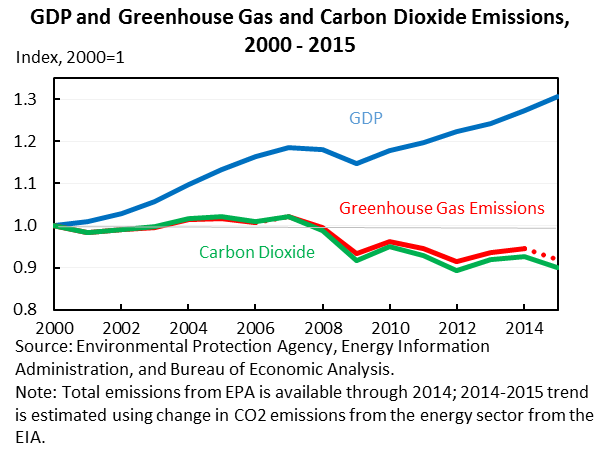
Addressing the issue of climate change is often cast as a question of protecting the environment at the cost of economic growth–the problem is often referred to as decoupling environmental damage from economic activity. The answer to the question of whether decoupling is possible is complicated. The US and China have made progress in reducing their emissions of CO2 while maintaining levels of economic growth. But whether other countries, such as India, can manage this decoupling at their current level of development is not known and those countries have made clear that they will not sacrifice economic growth because their problems of poverty are severe. We need to start asking the question of whether economic growth is the only way to reduce poverty and whether high levels of economic growth are necessary for a high standard of living.
There are reports that the US is thinking about increasing its support for Saudi Arabian efforts to defeat Houthi forces in Yemen. The US and Saudi Arabia believe that Iran is aiding the Houthis in an effort to expand Iranian influence in the Middle East. Yemen is a very poor country which has been ravaged by war since the overthrow of the government in 2014 by Houthi forces. Control over Yemen also gives control over the Bab al-Mandab strait through which large amounts of oil flow. If these reports are true, then it means that the US is stepping up its military activities in Iraq, Syria, and Yemen–virtually without any public discussion or debate.

As we debate the fate of the American-made liberal world order, it may be useful to think about other historical periods when he world order was up for grabs. One such point was the end of World War I when the imperial powers of Europe were too depleted to maintain the balance of power world order of the 19th century. Anton Fedyshin has written an essay about two visionaries of that period–Woodrow Wilson and Vladimir Lenin– who actually had two profoundly different conceptions of the world order that should have been implemented in 1918. Both failed at that time, but their visions reverberated throughout the 20th century.
Carrie Lam has been elected as Hong Kong’s fourth Chief Executive. Lam was the clear candidate of the central government in Beijing and had opposed the Umbrella Movement in 2014 which had demanded greater autonomy for the former British colony. The victory assures that the Communist Party will continue to impose its control over the city which has a number of citizens who would prefer to hold on to the political freedoms guaranteed to them by the agreement signed between China and Great Britain in 1997 promising “one country, two systems.”
Carrie Lam

Although it is very difficult to tell, it appears as if there were very large, unsanctioned protests against corruption in Russia. The protesters had been warned by the government that the protests were illegal and it is impossible to know exactly the size of the protests. But the protesters were certainly aware of the severe consequences for their actions, and one cannot help but be impressed by their courage. According to the Washington Post:
“The privately owned Interfax news agency reported on rallies across Siberia and in Russia’s Far East, where it said two dozen protesters had been detained. The agency cited police as saying that about 7,000 protesters gathered in Moscow, but the crowd, which lined Moscow’s main artery, Tverskaya Street, on both sidewalks for more than a mile, and crammed the spacious Pushkin Square, appeared to be much larger than that. “
Even though there are signs that the Russian economy is beginning to grow again, it is clear that the last few years have seen a dramatic drop in the standard of living for most Russians.

The US is investigating the deaths of about 100 civilians in Mosul, Iraq. The deaths occurred in an area where the US had dropped bombs in an assault on a suspected Daesh (Islamic State) site. Iraqi and other forces have been trying to wrest Mosul for Daesh control for the last several months. There is, however, a suspicion that the rules of engagement for allied forces have been loosened since the election of President Trump in the US and that these laxer rules have resulted in higher civilian casualties. There are non-governmental groups on the ground investigating the strike and we will have to wait for the results of the investigations before any conclusions can be reached.
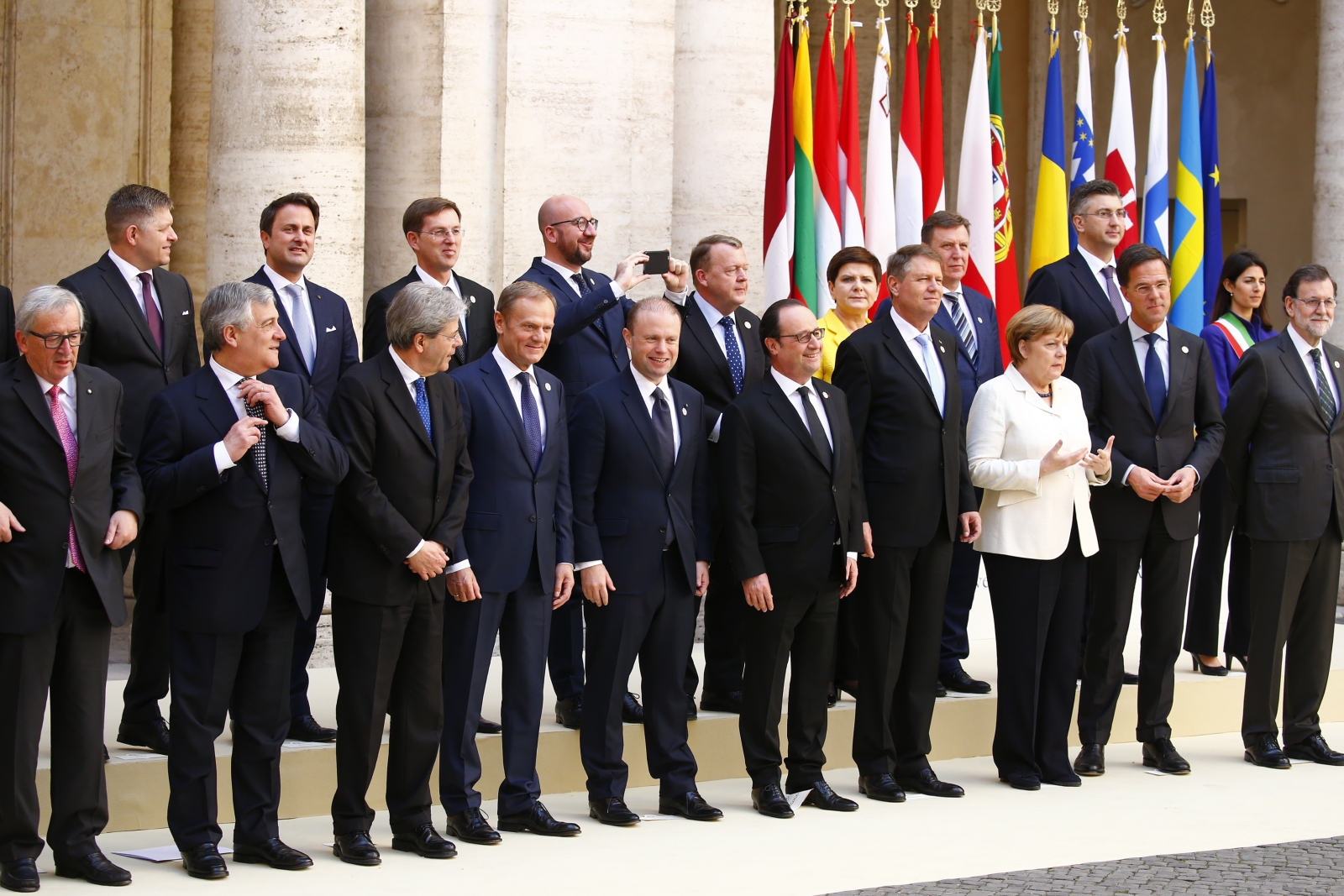
The European Union (EU) celebrated its 60th anniversary today. In 1957, six European nations signed the Treaty of Rome and the EU now consists of 27 members. The celebration was not especially joyous as the EU has been confronted with all sorts of challenges over the last 9 years: the sovereign debt crisis, a large influx of refugees, the expected departure of Great Britain from the Union, and the rise of anti-EU parties in European politics. There were demonstrations against and in support of the EU throughout Europe.
For the first time since satellites have been able to take accurate measurements, the amount of sea ice in both the Arctic and Antarctic is at the lowest level ever recorded. Temperatures in the Arctic have been unusually warm for the last two years and those temperatures account for the decline of sea ice at the North Pole. But the dynamics of sea ice in the Antarctic are less well understood and the decline at the South Pole is troubling. Climate change is the most likely explanation for the declines.

Anne Case and Angus Deaton have been pioneers in documenting the health effects of deteriorating economic circumstances. This issue seems to be intuitive, but is devilishly difficult to document. Their analysis of the deterioration of the life expectancy of rural white male Americans is quite sobering:
“While midlife mortality continued to fall in other rich countries, and in other racial and ethnic groups in the US, white non-Hispanic mortality rates for those aged 45-54 increased from 1998 through 2013. Mortality declines from the two biggest killers in middle age—cancer and heart disease— were offset by marked increases in drug overdoses, suicides, and alcohol-related liver mortality in this period. By 2014, rising mortality in midlife, led by these “deaths of despair,” was large enough to offset mortality gains for children and the elderly (Kochanek, Arias, and Bastian 2016), leading to a decline in life expectancy at birth among white non-Hispanics between 2013 and 2014 (Arias 2016), and a decline in overall life expectancy in the US between 2014 and 2015 (Xu et al 2016). Mortality increases for whites in midlife were paralleled by morbidity increases, including deteriorations in self-reported physical and mental health, and rising reports of chronic pain.”
There are serious consequences to ignoring the economic hollowing-out of the American middle class. Those consequences are not simply the rise of right-wing political sentiments and demand redress.
/cdn0.vox-cdn.com/uploads/chorus_asset/file/8205429/Fig1.5_0317.png)
Just a few days after New Zealand declared its Whanganui river a “living entity”, a court in India has followed suit and declared that the Ganga and Yamuna rivers are also living entities. The declaration allows human guardians to be appointed to protect the vitality of the rivers and gives those guardians legal status to sue those who degrade the rivers. The decisions marks incredibly important steps in environmental protection as well as a dramatic shift away from the perspective that humans have the right to exploit natural resources without regard for the sustainability of those resources.

It is a serious mistake to think that imperialism fades away once the once-colonized peoples achieve independence. No where is this more obvious than in the Middle East which continues to be rattled by the territorial lines drawn by the British and French in the middle of World War I. The secret agreement, known as the Sykes-Picot Treaty, divided up the crumbling Ottoman Empire into French and British Zones without regard for the political, ethnic, and religious identities of the people living within those territories. To this day, the territorial lines contribute to the conflict that exists in the region as many nations reside within the political control of states they regard as illegitimate.

The Paris Agreement on Climate Change plots out a path to limit global temperature increases due to human activity to no more than 2°C, and aspires to a 1.5°C increase. The objective is incredibly important, but few are aware of the necessary steps to meet it. The Agreement calls for dramatic decreases in CO2 emissions, changes in land use from agriculture to reforestation, and as-yet untested technologies for removing CO2 from the atmosphere. The chart below gives an idea of when these three steps need to be realized. Given how dramatic these steps are, it is hard to explain why policy makers are not moving more aggressively to protect the global environment.
/cdn0.vox-cdn.com/uploads/chorus_asset/file/8206869/Screen_Shot_2017_03_22_at_6.02.30_PM.png)
US President Trump issued a draft executive order last January that would reduce US contributions to the UN by 40%. Such a significant cut would cripple most of the UN’s activities and it is difficult to imagine other countries picking up the slack. It is also not clear how such a cutback would serve US national interests given that US interests would abide even in the absence of a UN presence. The most immediate effect would be to mute the American voice in global affairs.

The US military has a truly global presence with troops deployed in 177 countries. In many respects, much of this global presence is symbolic but it requires 800 military bases abroad and requires very large sums of money to maintain. There are no real competitors to the US in terms of global reach; most other countries are genuinely regional powers.

There was a violent attack at the Palace of Westminster in which several people were killed. At this time, the information about the attack is quite limited and to call it a “terrorist” attack is not yet justified on the basis of the information that has been substantiated. Nonetheless, the violence will be incorporated into the ongoing discussions about how liberal societies should address the issue of terror. The Guardian ran an editorial on the basis of the preliminary news report of the attack which was quite insightful, and the editorial concludes in this manner:
“Today’s attack has long been anticipated. It is not an act of war. It must not be allowed to divide us one from the other. Terror’s purpose is to spread hate and division. The first protection against it must be solidarity.”
Those words should be taken to heart. But there are contrary views to this approach, and John Gray has written an essay for the New Statesman which argues for a more robust policy toward terrorism. The essay places the issue of terrorism within the framework of a Hobbesian world. While I have reservations about Gray’s position, his argument is strong and deserves careful attention.
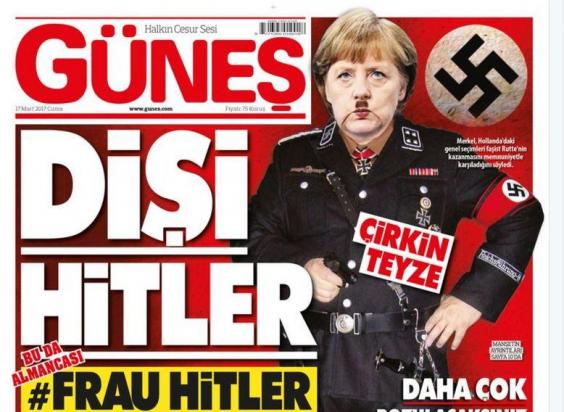
Turkish President Erdogan escalated his sharp rhetoric against Germany and the Netherlands for their refusal to allow Turks to enter their countries to speak in favor of a proposed referendum in Turkey to expand the powers of the President. Erdogan is reported to have said that “Europeans across the world will not be able to walk the streets safely if they keep up their current attitude towards Turkey.” Erdogan has referred to the European measures as comparable to “Nazi” tactics, a charge that has caused considerable resentment in Germany. But the image below suggests how rancorous the dispute has become.
A Turkish tabloid depiction of Angela Merkel
Daniel Twining works for the German Marshall Fund of the United States and he has written an essay on the danger of abandoning the liberal international order that has been in place since 1945. Twining’s concern is that in the absence of the liberal order the world will revert back to a “spheres-of-influence” framework that characterized the 19th century world order. The argument is persuasive and well-documented.
The visualization of global population is extraordinary. The map below shows an area in red which has the same population as the areas in blue. The red area is Bangladesh and three provinces in India and the territory involved is only 160,000 sq. mi, an area smaller than the US state of California. And the second image below shows the rate of urban population increase per hour which indicates that the population densities will only increase dramatically in the future.


The World Meteorological Organization has released its annual report on the global climate for 2016. Its summary is straightforward and stark:
“Warming continued in 2016, setting a new temperature record of approximately 1.1 °C above the pre-industrial period, and 0.06 °C above the previous highest value set in 2015. Carbon dioxide (CO2) reached new highs at 400.0 ± 0.1 ppm in the atmosphere at the end of 2015. Global sea-ice extent dropped more than 4 million km2 below average – an unprecedented anomaly – in November. Global sea levels rose strongly during the 2015/2016 El Niño, with the early 2016 values making new records.”
The report suggests that the warming trend will likely continue into 2017 despite the fact that the el Niño of 2016 has dissipated.

14 years ago today the US invaded Iraq. The invasion was justified by the assertion that Iraq had weapons of mass destruction and that its leader, Saddam Hussein, would give those weapons to al Qaeda, the radical group that attacked the US on 11 September 2001. According to polls at the time, 63% of the American people approved of military action against Iraq. By 1 May, President George W. Bush announced the end of combat operations in Iraq. Today, American troops are still fighting in Iraq and the political situation in Iraq remains highly precarious. The number of civilian casualties in Iraq since 2003 is unknown, but the most conservative estimate is 165,000. US combat casualties numbered about 4,000. And the total cost of the war for the US was about $1 trillion by the most conservative estimate. And the US still has no idea of what it wishes to see in Iraq.
The Guardian has published an article that asserts that 17 British Banks, including some of the largest in the world, have been systematically involved in money laundering schemes with Russian individuals. The amounts could be as large as $80 billion and covered transactions that occurred between 2010 and 2014. According to the newspaper:
“Investigators are still trying to identify some of the wealthy and politically influential Russians behind the operation, known as ‘the Global Laundromat’.
They estimate a group of about 500 people were involved. These include oligarchs, Moscow bankers, and figures working for or connected to the FSB, the successor spy agency to the KGB.”
There have been half-hearted attempts to stop the process of money laundering which simply allows the money obtained criminally to be disguised and used for non-criminal activities. But the states of the world are quite reluctant to stop this hemorrhage of money from taxation and control.
US President Trump suggested after his meeting with German Chancellor Merkel that Germany “owed” the US large sums of money for defense. Mr. Trump was referring to the pledge that all NATO members make to spend about 2% of their GDP on defense, indicating that Germany does not spend that percentage on its own defense. Very few members of NATO spend that percentage on national defense, and it may be a useful activity to discuss why that situation exists. But the Germans have repudiated the Trump charge, suggesting that the charge itself is a serious misunderstanding of how NATO works.
The world continues to overuse fresh water resources, particularly underground aquifers. According to the Asian Development Bank:
“Today, about 30% of the world’s liquid freshwater comes from subterranean aquifers. And one-third of the 37 largest aquifers studied by the University of California between 2003 and 2013 were severely depleted, receiving little or no replenishment from rainfall. Some of the most stressed aquifers are in the driest regions, including Asia, up to 88% of which is water-stressed.”
These aquifers are not easily replenished, and if they are exhausted, it means that millions of people who rely upon the water will lose access precipitously. How the world will react to such a scenario is difficult to imagine: shipping water over long distances is a very expensive and difficult process.

