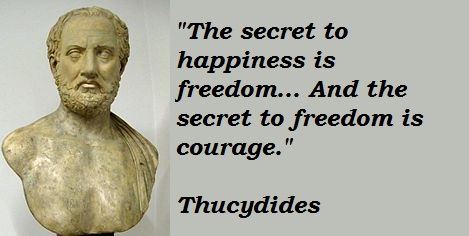
Robert Zaretsky has written a great op-ed essay for the New York Times entitled “What Would Thucydides Say About the Crisis in Greece?” which uses the Melian dialogue as a foil to discuss the current crisis in Greece. It is an instructive essay on how to use history to enlighten. My only complaint is that the photograph accompanying the essay identifies Thucydides as a “philosopher.” There is no doubt that all people who explore the realm of ideas are philosophers. But Thucydides was first and foremost a general who then became a historian.
Greece is technically in default, but the IMF has decided to assert simply that the Greek debt is “in arrears.” The distinction is political and psychological–default is considered to be a term to avoid in order to prevent panic. But at some point the term will not be avoided if Greece does not begin to pay down its debt. Sovereign default is not typical, but it has happened in the past; indeed, Germany has defaulted 4 times in modern history. There is no template for sovereign default: some countries have had a miserable time while others have navigated the storm fairly well. The Washington Post has a good article on historical sovereign defaults.

The deadline for the completion of an agreement between the P5+1 and Iran has been extended until 7 July. The principal negotiators are in Vienna and all sides appear to be committed to finalizing the interim agreement. The International Atomic Energy Agency has confirmed that Iran has met the interim deadline for conversion of about 4 tons of enriched uranium into an oxide form that is less useful in the construction of a nuclear bomb. That verification is a very important step toward the final agreement.


Leave a comment