Israel has continued to bomb Gaza and to restrict the flow of vital supplies into the Strip even though there is little evidence to suggest that there is any organized threat to Israel after two years of incessant bombardment. The unwillingness to reach a ceasefire in the Gaza stems from the desire of the Netanyahu government to expel the Palestinian population from Gaza to annex the territory. Arwa Mahdawi, writing for The Guardian explains:
“Omer Bartov is an Israeli-American historian and one of the foremost scholars on genocide in the world. He has spent over 25 years teaching a class on the subject. He deals with atrocities for a living, analyzing some of the very worst things that human beings are capable of. And yet even Bartov has said he can’t bear looking at some of the excruciating images coming out of Gaza any more.
What’s happening, Bartov says, is unprecedented in the 21st century. ‘I don’t know of any comparable situation. Recent estimates show that about 70% of the structures in Gaza are either completely destroyed or severely damaged,’ Bartov says. ‘The argument that the IDF [Israel Defense Forces] is conducting a war in Gaza is simply cynical, there is no war in Gaza. What the IDF is doing in Gaza is demolishing it. Hundreds of buildings are being bulldozed every week. This is not a secret, but mainstream media coverage has been insufficient.'”
“The consequences of the conditions of life created by Israeli state organs in Gaza are so predictable they are almost banal, in Hanna Arendt’s sense of the term. Israel’s blockade restricts access to fuel required to pump and clean water, equipment to restore damaged systems, and even bottled water. Bombing water infrastructure contaminates drinking water with raw sewage. This causes diarrheal disease like dysentery, which leads to malnutrition and increased vulnerability to further illness. Forced crowding into displacement camps and the spread of antimicrobial resistance worsen the cycle. As a result, many Palestinians have resorted to drinking salty water, damaging their kidneys. This past week alone, over 10,000 new cases of acute watery diarrhea (more than half in children under 5) were added to nearly one million cases, along with 90 new cases of Acute Jaundice Syndrome.”
We have virtually no first-hand reports on conditions in the Gaza Strip. Israel does not allow journalists into the Gaza, notwithstanding its reputation as the only “democracy” in the Middle East. There is no reason to deny access to those who would report on the conditions facing the civilian population other than to limit criticism of Israeli policy. Israel claims that it is permitting supplies into Gaza through the Gaza Humanitarian Foundation (GHF), an institution created by Israel and the US (although the funding of the foundation is totally opaque). There are serious criticisms of the GHF, but the most important aspect of the foundation is that it is clearly structured in a way to concentrate the Gaza population in the southern part of the Strip. +972, a website devoted to providing information about Palestine, argues that the GHF is a step toward the ultimate expulsion of the Palestinians from Gaza:
“The location of the four centers is no less important. One is in the central part of the Strip along the Netzarim Corridor, and three in the south, west of Rafah. A quick look at the map is enough to understand: there is no connection between the locations of the “distribution centers” and the needs of the people.
“Instead, the goal is to promote “moving the population” southward, ideally into the “concentration zones.” Since this constitutes a crime against humanity, Israel employed concealment tactics: first expelling established aid groups that could provide aid efficiently, then outsourcing distribution to opaque entities like the U.S.-backed Gaza Humanitarian Foundation (GHF).
“As early as May 11, Benjamin Netanyahu reportedly stated in a secret session of the Foreign Affairs and Defense Committee that ‘receiving aid would be conditional on Gazans not returning to the places from which they came to the aid distribution sites.’ This policy’s underlying logic was confirmed by Dr. Tammy Caner, a lawyer and director of the Law and National Security Program at the Institute for National Security Studies (INSS), a think tank with close ties with the Israeli military.”
I had a hard time accepting the possibility that Israelis would support the expulsion of Palestinians from the Gaza Strip, but a poll conducted by the Israeli Newspaper, Ha’aretz, was shocking:
“The survey, conducted in March and published by Haaretz newspaper on Thursday, found that 82 percent of Israeli Jews support the forced expulsion of Palestinians from the Gaza Strip.
“Meanwhile, 47 percent of Israeli Jews answered yes to the question: ‘Do you support the claim that the [Israeli army] in conquering an enemy city, should act in a manner similar to the way the Israelites did when they conquered Jericho under the leadership of Joshua, ie to kill all its inhabitants?’ The reference is to the biblical account of the conquest of Jericho.”
If Israel does take over the Gaza, then I expect that it will then take further steps to expel Palestinians from the West Bank. Even if that does not happen, Israel will forever bear the shame of committing a crime against humanity. And it will not enhance its security in any meaningful way. The US should stop supporting Israel, militarily and financially. It should also take active steps to organize harsh sanctions against Israel.
This morning’s headline for the online version of the New York Timeswas “U.S. enters War Against Iran”. The headline is misleading. The more accurate headline would have been “US President Trump Declares War on Iran”. The actual headline ignores the fact that the US has been engaged in coercive diplomacy against Iran since 2018 when President Trump withdrew the US from the Joint Comprehensive Plan of Action (JCPOA) which was considered by most analysts as an effective check on any nuclear ambitions that Iran might have held, although there was no evidence at the time (nor two days ago) that Iran had made a decision to build a nuclear weapon:
“More than three years of Iran’s compliance with the JCPOA from January 2016-May 2019 demonstrated its nonproliferation benefits. Taken together, the array of restrictions on uranium enrichment ensures that Iran’s capability to produce enough weapons-grade uranium sufficient for one warhead would be approximately 12 months for a decade or more. The JCPOA also effectively eliminated Iran’s ability to produce and separate plutonium for at least 15 years. Just as importantly, the JCPOA mandates unprecedented international monitoring and transparency measures that make it very likely that any possible future effort by Iran to pursue nuclear weapons, even a clandestine program, would be detected promptly.”
Israeli Prime Minister Netanyahu had held for a long time that Iran’s nuclear program represented an “existential threat” to Israel. Indeed, he warned about the Iranian nuclear program when he was just a member of the Knesset in 1992:
“Since 1992, when Netanyahu addressed Israel’s Knesset as an MP, he has consistently claimed that Tehran is only years away from acquiring a nuclear bomb. ‘Within three to five years, we can assume that Iran will become autonomous in its ability to develop and produce a nuclear bomb,’ he declared at the time. The prediction was later repeated in his 1995 book, Fighting Terrorism.
“The sense of imminent threat has repeatedly shaped Netanyahu’s engagement with United States officials. In 2002, he appeared before a US congressional committee, advocating for the invasion of Iraq and suggesting that both Iraq and Iran were racing to obtain nuclear weapons. The US-led invasion of Iraq followed soon after, but no weapons of mass destruction were found.”
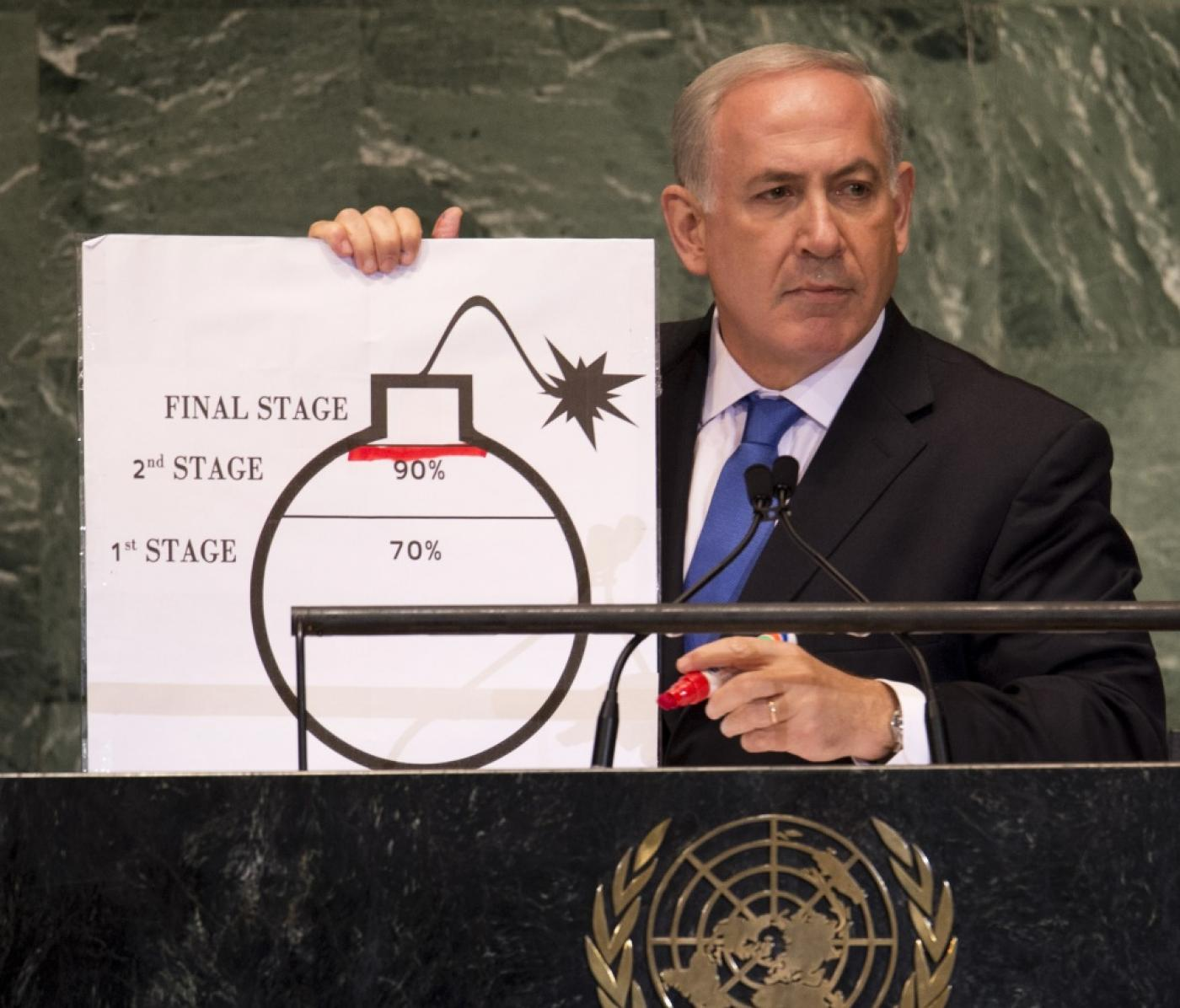
Netanyahu has worried about Iran for 33 years and yet the Iranians never developed a nuclear bomb, even though it clearly had the expertise and means to do so. Instead, Iran adhered to its commitment to the Non-Proliferation Treaty and refused to take that path, despite being surrounded by nuclear powers: Russia to the north, China to the east, India and Pakistan to its southeast, Israel to its west, and US air and sea forces parked in the Mediterranean, the Persian Gulf, and in bases in Oman and Bahrain. Netanyahu went so far as to bring a visual aid to the UN General Assembly to communicate his fears about Iran.
We should be clear about what Netanyahu regards as an “existential threat”. Does Netanyahu actually believe that Iran would drop a nuclear bomb on Israel, killing millions of Palestinians in the process? One cannot dismiss the possibility that at some point there will be an Iranian regime that would commit such a heinous crime. But one would have to offer more evidence of Iranian indifference to human life to persuade me that such an outcome was likely. There are currently nine nuclear powers in the world and some of them engaged in reckless propaganda (“godless communists” and “capitalist running dogs” are two of my favorites) that is roughly comparable to Iranian propaganda (“America is Satan”). But none of these states, except for the US, has ever dropped a nuclear bomb
The existential threat that Netanyahu fears is the possibility of Israeli self-deterrence in the face of a nuclear Iran. Nuclear threats are taken seriously by civilian populations and are effective even when palpably implausible. The US threatened nuclear war against China in 1956 over two insigificant islands (Quemoy and Matsu) which were controlled by the Republic of China, now known as Taiwan. Similarly, the US refrained from arming Ukraine with advanced weaponry after Russian President Putin started referring to Russian nuclear capabilities. Israel currently has a free military hand in Lebanon, Syria, the Gaza Strip and the West Bank, and it has used that advantage to its benefit after the attacks of 7 October. A nuclear-armed Iran, however, might restrain Israeli military power just by posing the possibility of a nuclear attack, forcing the Israeli people to ask the question “Is dropping more bombs on the Gaza Strip worth risking nuclear annihilation?” States are reluctant to gamble on their existence, even when the odds are in their favor. An Israeli government may not want to be constrained by an Israeli population afraid of a nuclear attack. And that fear is the real existential threat to Israel.
The last few weeks have been confusing. There were statements that the US wanted to restart the negotiations to revive the JCPOA, but refused to entertain the possibility that Iran would be allowed to enrich Uranium, a right guaranteed by the Non-Proliferation Treaty and the JCPOA. The precipitating event for the Israeli attack on Iran was the Iranian decision on 13 April to enrich its Uranium far beyond the traditional limit of 20% which is considered essential for civilian nuclear power purposes (Iran believes that it makes more money selling its petroleum rather than burning it for energy purposes). But the Stockholm International Peace Research Institute interpeted this decision quite differently than one designed to build a nuclear bomb:
‘On 13 April, Iran announced its intention to enrich uranium to 60 per cent U-235. This was characterized by Iran as a response to a sabotage of its vast underground enrichment cascades at Natanz two days before. The move comes against the backdrop of sensitive negotiations happening in Vienna aimed at rescuing the 2015 Iran nuclear deal, the Joint Comprehensive Plan of Action (JCPOA), and bringing the United States back into compliance with the deal…
“Uranium enriched to 60 per cent cannot be used to make a useful nuclear explosive device, and Iran has no other realistic use for this material.
“Nevertheless, 60 per cent was not an arbitrary choice. Cascades of centrifuges are designed to enrich uranium in steps; Iran’s centrifuges are likely set up to enrich up to 20 per cent, from 20 to 60 per cent, and from 60 to 90 per cent. Assuming the 60 per cent-enriched uranium is stored in the form of uranium hexafluoride (UF6) gas—and there would be no point in Iran converting it to any other chemical form—the enrichment step from 60 per cent-enriched to weapons-grade uranium is very short.
“This strongly suggests that Iran’s decision was intended to send a political message: ‘We have gone as far as we can go in response to provocations without producing weapons-grade uranium.’”
One needs to appreciate the position of Iran after Trump pulled the US out of the JCPOA: it was placed under punishing sanctions which have severely damaged the Iranian economy and was not offered any way to remove those sanctions without giving up its right to enrich Uranium. The question we need to answer is whether the decision to enrich Uranium to 60% actually signaled an intent to build a nuclear bomb. Trump’s Director of National Intelligence, Tulsi Gabbard, was explicit on this question: “In March, Gabbard testified on Capitol Hill that the U.S. ‘continues to assess that Iran is not building a nuclear weapon and Supreme Leader Khamenei has not authorized the nuclear weapons program he suspended in 2003.'” Trump insisted that Gabbard was wrong, but that is not the first time he has disagreed with his own intelligence services.
We should also think about Trump’s decision to declare war on Iran in the context of the US Constitution. Only Congress has the right to declare war: “Article I, Section 8, Clause 11 states that Congress has the power to declare war. Initially, the draft of the Constitution granted Congress the power to make war. There were suggestions to give this power solely to the President, solely to the Senate, or to both the President and the Senate. However, the Framers decided that involving both the President and Congress addressed their concerns. They didn’t want just one person to decide something so significant, nor did they trust a single branch alone.” The wisdom of the writers of the Constitution has been lost. Iran did not attack the US, so the US claim of self-defense is hollow. Nor does Iran have any ability to hit the US mainland with a nuclear bomb or any conventional bomb. Iran does pose a threat of terror attacks on US citizens, but such threats are better dealt with by local officials and not the US military.
Now the US and Iran are in a state of war. Iran does not need to declare war on the US for a state of war to exist–the US attack on Iranian territory constituted a state of war. For example, the US declared war on Japan after the Pearl Harbor attack, but Roosevelt wanted to focus on fighting Germany immediately (he didn’t have much choice since the US fleet was at the bottom of the Pacific and therefore didn’t have the ability to fight Japan immediately). Foolishly, Hitler declared war on the US first, relieving the US of the need to make a decision about declaring war against Germany. Now that the US has created a state of war, it is imperative to ask the question: What are the US war objectives?
The US is still committed to preventing the Iranians from developing a nuclear bomb. We have yet to see whether the US attack effectively destroyed Iranian capabilities. Trump declared that the facilities had been “completely and totally obliterated” but we have no way to confirm that assessment (it’s not clear on what evidence he based this assertion). More importantly, there is no way for the US to destroy the knowledge that Iran has about building a bomb. That knowledge will endure if the Iranians want it to endure. At best, the US and Israel have gained some time derailing Iran nuclear intentions, but to maintain that respite, Israel and the US will have to keep bombing Iran anytime there is a suspicion that Iran is engaged in nuclear-related activities.
Unless, of course, that the Israeli and US intention is to force regime change in Iran in order to prevent any government that would attempt to build a bomb. The US has often forced regime change (Iran 1953; Guatemala, 1954; the Dominican Republic in 1965; Grenada, 1983; Panama, 1989; and Iraq in 2003). One would be hard pressed to assert that these efforts genuinely served the US national interest. And it is more likely that the Iranian people will want a more aggressive regime given the humiliation inflicted on them by the Israeli and US attacks. They may welcome a new regime that is less stringent in terms of personal conduct. But given the obvious failures of the current regime to prevent the wholesale leakage of Iranian secrets, it is more likely that Iranians would support greater scrutiny (how else does one explain the precision Israeli attacks against specific military and scientific individuals in early June? Someone was telling the Israelis names, addresses, and times, and it is likely that the Iranians will direct most of their efforts to uproot those spies).
I suspect that the Iranians will do two things. First, they will announce their withdrawal from the Non-Proliferation Treaty which allows states to abrogate the treaty after 90 days of warning. Since Israel and the US did not believe that Iran was adhering to the treaty, the repercussions of such a move would be small diplomatically. There will, however, a great deal of negative press for the Iranians, but both the US and Israel have muzzled the press on this matter already. Leaving the NPT would end the pretense that a nuclear weapon is not necessary for national defense against nuclear powers. Iraq proved that nuclear weapons are the only way to prevent an invasion, and North Korea proved that breaking the NPT does not preclude engagement with nuclear powers. Furthermore, the Iranians do not have a choice unless they wish to submit to the dictates of Israel–their previous strategy of relying on proxies and air defenses was an abject failure. Israel has forced the Iranian hand on this matter.
Second, Iran will likely make noises about shutting down the Strait of Hormuz, a narrow channel through which 40% of the world’s exported petroleum passes. Noises could go from verbal threats to actually blocking the channel with sunken vessels. The threats are probably sufficient to force insurance rates for oil-carrying cargo shops to skyrocket. That alone would focus the attention of India, Europe, and China on finding a better solution to this state of war. Moreover, it would force Saudi Arabia and the Gulf States to gauge their interests less in alignment with the interests of the US. Finally, a spike in oil prices would doom Republican chances in the mid-term elections in 2026.
For me, the most unfortunate aspect of this remarkable event is that allowing this war to be declared unilaterally by the President has insulated US foreign policy from democratic processes. Foreign policy has almost always been determined by small groups of people (did you notice that as Trump delivered his speech at the White House announcing the bombing, he was flanked by Hegseth, Rubio, and Vance?), and moving foreign policy in the democratic process was an arduous and difficult process which began with the Vietnam War. That process was never completed and today it seems to be unattainable.
While the world is focused on the economic turmoil caused by President Trump’s abandonment of the free trade regime developed by the US and its allies in 1945, Israel has decided to take greater control of the Gaza Strip. First, is has imposed a total blockade of food, water, electricity, and medicine to the Strip, asserting that that blockade will remain in place until all the hostages held by Hamas are released. Second, it has seized direct control of significant parts of the Gaza. According to the BBC:
“The UN says 69% of the territory is now under active Israeli military evacuation orders, within a ‘no-go’ zone running along the borders with Israel and Egypt and the Wadi Gaza valley south of Gaza City, or both. Some 500,000 people have been newly displaced or uprooted once more, with no safe place to go, it estimates.
“The Israel Defense Forces (IDF) has said it has killed ‘”‘hundreds of terrorists’ in strikes while troops have advanced into several areas in the north and the south. It has established a new corridor that cuts the southern city of Rafah off from neighbouring Khan Younis and has designated 30% of Gaza as an ‘operational security perimeter’.”
The Israeli military continues to bomb the Gaza, forcing families to move several times, despite the promise of a cease-fire which the Israelis no longer support. Mondoweiss reports:
Since the resumption of the Israeli assault on Gaza, the UN Office for the Coordination of Humanitarian Affairs (OCHA) has said that the humanitarian situation in Gaza is now “the worst it has been” since the war began 18 months ago.
“Israel not only resumed airstrikes across the strip at the same rate as the days before the ceasefire entered into force, but has also sealed it off through a complete blockade of humanitarian aid, closing all crossing points into Gaza and provoking the return of famine conditions, a critical shortage of medicine, fuel, and skyrocketing prices.
“’It has now been a month and a half since any supplies were last allowed through the crossings into Gaza – by far the longest such halt to date,’ OCHA said”
The total blockade is flatly illegal under international humanitarian law since it makes no effort to distinguish between combatants and non-combatants. The use of the word “blockade” is a misnomer and euphemism–it is more properly termed a siege. The Foreign Ministers of Germany, Great Britain, and France have issued the following statement:
“Palestinian civilians – including one million children – face an acute risk of starvation, epidemic disease and death. This must end. We urge Israel to immediately re-start a rapid and unimpeded flow of humanitarian aid to Gaza in order to meet the needs of all civilians. During the last ceasefire, the UN and INGO system was able to deliver aid at scale. The Israeli decision to block aid from entering Gaza is intolerable. Minister Katz’s recent comments politicising humanitarian aid and Israeli plans to remain in Gaza after the war are unacceptable – they harm prospects for peace. Humanitarian aid must never be used as a political tool and Palestinian territory must not be reduced nor subjected to any demographic change. Israel is bound under international law to allow the unhindered passage of humanitarian aid.”
The toll on the civilian population in the Gaza is impossible to measure since no relief agencies or media outlets are allowed to report on conditions there. The United Nations Relief and Works Agency (UNRWA) has been banned by the Israeli government and it has been the primary source of aid to the Gaza Strip. Its most recent report on conditions is dire: the words used are “catastrophic” and “desperate”.
To make matters worse, the Netanyahu government has announced plans for a more intensive war effort, including the call-up of about 10,000 military reservists. Reuters reports:
“Israeli Prime Minister Benjamin Netanyahu said on Monday an expanded offensive against Palestinian militant group Hamas would be “intensive” after his security cabinet approved plans that may include seizing the Gaza Strip and controlling aid….
“Israeli troops have already taken over an area amounting to around a third of Gaza, displacing the population and building watchtowers and surveillance posts on cleared ground the military has described as security zones, but the new plan would go further.
“One Israeli official said the newly approved offensive would seize the entire territory of the Gaza Strip, move its civilian population southward and keep humanitarian aid from falling into Hamas’ hands.”
The forced removal of Palestinians from northern Gaza, and perhaps the entire Gaza Strip eventually, is unquestionably a war crime. It is curious that Netanyahu has made this announcement now since US President Trump is visiting the Middle East next week. Trump has been pursuing the normalization of Saudi Arabian-Israeli ties, but I doubt that bin Salman will be willing to make any commitments because of the treatment of Palestinians. The timing also makes it obvious that Trump has approved the Israeli actions since it is doubtful that Netanyahu would jeopardize US aid by embarrassing Trump with a surprise.
It is long past time for the US to suspend all aid to Israel. The US has already compromised itself by its steadfast support for Israel despite obvious and continued war crimes. The continued refusal to support the right of self-determination for the Palestinian people will only perpetuate the violence and bring shame to those who refuse to condemn the Israeli war of conquest.
In what will surely be regarded as the ultimate in chutzpah in diplomatic history, President Trump argued today that Russia is making a concession to Ukraine by not taking it over completely. According to The Hill:
“President Trump said Thursday that Russia would be making a concession toward peace if it agrees not to take over Ukraine, as the U.S. president has struggled to negotiate even a limited ceasefire deal between Moscow and Kyiv.
Speaking to reporters in the Oval Office during a meeting with Norway’s prime minister, Trump was asked what concessions Russia has ‘offered up thus far to get to the point where you’re closer to peace.’
“’Stopping the war, stopping from taking the whole country, pretty big concession,’ Trump responded.”
President Trump must surely be aware of the fact that Ukraine has been fighting desperately against the Russians in a war that most analysts (as well as Russian President Putin) thought would be over in three days. To add insult to injury, Trump also suggested that Ukraine should accept Russian control over Crimea. A Financial Times editorial assesses this gambit without mincing words:
“Donald Trump’s ultimatum to Kyiv to accept a peace deal that includes US recognition of Russian sovereignty over Crimea makes a mockery of Washington’s supposed negotiation to end Russia’s war against Ukraine. Trump’s election campaign boast that he could strike a peace deal in 24 hours beggared belief. So has the incompetence and cynicism of his administration as it scrambles to land a settlement at any price.
“Now Trump and his officials are threatening to walk away from the talks unless Ukraine swallows terms written without it. Trump’s comment on Wednesday that he thought he had a deal with Vladimir Putin but now needed to get one with Volodymyr Zelenskyy was telling. This has never been a proper three-way negotiation.
“Trump says Zelenskyy has no cards to play. In fact, Trump has taken cards away from Ukraine and handed them to Russia. Through amateurism or naivety, US officials gave away important leverage before talks even began. They ruled out Ukraine’s membership of Nato or the prospect of regaining any occupied territory. Trump’s neophyte special envoy Steve Witkoff has been seduced by the Kremlin’s flattery and swallowed its talking points about the causes of the war.”
Moreover, Trump is flatly contradicting the position his administration took on the issue of Crimea in 2018. That policy was articulated by Secretary of State Pompeo and is known as the Crimea Declaration which Trump approved.
“Press Statement Michael R. Pompeo Secretary of State Washington, DC July 25, 2018
“Russia, through its 2014 invasion of Ukraine and its attempted annexation of Crimea, sought to undermine a bedrock international principle shared by democratic states: that no country can change the borders of another by force. The states of the world, including Russia, agreed to this principle in the United Nations Charter, pledging to refrain from the threat or use of force against the territorial integrity or political independence of any state. This fundamental principle — which was reaffirmed in the Helsinki Final Act — constitutes one of the foundations upon which our shared security and safety rests.
“As we did in the Welles Declaration in 1940, the United States reaffirms as policy its refusal to recognize the Kremlin’s claims of sovereignty over territory seized by force in contravention of international law. In concert with allies, partners, and the international community, the United States rejects Russia’s attempted annexation of Crimea and pledges to maintain this policy until Ukraine’s territorial integrity is restored.
“The United States calls on Russia to respect the principles to which it has long claimed to adhere and to end its occupation of Crimea. As democratic states seek to build a free, just, and prosperous world, we must uphold our commitment to the international principle of sovereign equality and respect the territorial integrity of other states. Through its actions, Russia has acted in a manner unworthy of a great nation and has chosen to isolate itself from the international community.”
It is impossible to imagine a more confused, inconsistent, and worthless foreign policy than Trump’s 2nd term Ukraine policy. A leader who cannot even remember what he has done in the past and who shamelessly depreciates the sacrifices by the Ukrainian people in the face of ruthless aggression is unworthy of the role. There are few historical events that even come close to this level of treachery.
We now know the Trump tariff proposals and the President’s comments in the Rose Garden revealed his intentions. The tariffs have very little to do with actual trade and are primarily structured to change tax policy. The most revealing comment in the presentation was as follows:
“Then in 1913, for reasons unknown to mankind, they established the income tax so that citizens, rather than foreign countries, would start paying the money necessary to run our government. Then in 1929, it all came to a very abrupt end with the Great Depression, and it would have never happened if they had stayed with the tariff policy, it would have been a much different story.”
The quote reveals astonishing ignorance but it also highlights Trump’s aversion to the personal income tax. “(f)or reasons unknown to mankind” is ridiculous: the income tax was initiated precisely because the US reliance on tariffs was extraordinarily regressive since the poor paid most of the tariffs. When the personal income tax was introduced it exempted those who made less than $3000 a year for an individual or $4000 for a family. In 1913, that exempted 60% of the population. The income tax was designed specifically to gain revenue from the “rich”. And those exemptions are roughly comparable to those allowed today. The only real change is that the rich now have options to disguise their income (such as offshore accounts or shell companies) that were not available in 1913 so that many rich avoid paying any taxes. According to ProPublica:
“To capture the financial reality of the richest Americans, ProPublica undertook an analysis that has never been done before. We compared how much in taxes the 25 richest Americans paid each year to how much Forbes estimated their wealth grew in that same time period….
The results are stark. According to Forbes, those 25 people saw their worth rise a collective $401 billion from 2014 to 2018. They paid a total of $13.6 billion in federal income taxes in those five years, the IRS data shows. That’s a staggering sum, but it amounts to a true tax rate of only 3.4%.
“It’s a completely different picture for middle-class Americans, for example, wage earners in their early 40s who have amassed a typical amount of wealth for people their age. From 2014 to 2018, such households saw their net worth expand by about $65,000 after taxes on average, mostly due to the rise in value of their homes. But because the vast bulk of their earnings were salaries, their tax bills were almost as much, nearly $62,000, over that five-year period.”
The US now has tariff levels that are greater than the Smoot-Hawley tariffs that aggravated the Great Depression. There are two types of tariffs imposed by Trump. The first are reciprocal tariffs, which are presumably designed to compensate for non-tariff barriers such as health and safety regulations which impede the free flow of goods and services. Those tariffs are those on the poster that Trump held up at the Rose Garden ceremony. The list was remarkable in many respects (including the uninhabited Heard and and McDonald Islands, Svalbard, and Jan Mayen Islands which had no trade with the US, as well as leaving off Russia and North Korea from the list) but its most outstanding feature was the incredible assumption that such non-tariff barriers could be quantified. The Office of the US Trade Representative posted information about how these figures were derived and I challenge anyone to figure out what the process was. One can try to read the defense, but it is based on some fanciful assumptions that are quite literally picked out of the air.
But the second type of tariff, the flat 10% tariff on every imported item, is clearly designed to produce revenue. The World Bank asserts that the US imported $3.5 trillion of goods and services in 2024. That works out to a revenue flow of $350 billion, a substantial amount of money which will be amplified when the reciprocal tariffs are factored in (I lack the ability to figure out that amount given the opaque nature of its calculation). I suspect that when the Federal budget is finally passed by Congress (which may be delayed until September of this year), President Trump will use these tariff amounts to justify the inclusion of permanent tax cuts for the rich. The question is whether the American people will consider these tariffs as what they really are: a profoundly regressive tax falling hardest on the poor.
There are two additional points which should be made about these tariffs. First, the legal authority for Trump to raise these tariffs is included in the following legislation:
Section 232 of the Trade Expansion Act of 1962: This allows the president to impose tariffs if imports are deemed a threat to national security.
Section 301 of the Trade Act of 1974: This enables the president to take action against unfair trade practices by other countries.
International Emergency Economic Powers Act (IEEPA): This grants the president broad authority to regulate economic transactions during a national emergency.
Note that these are emergency powers which Trump has unilaterally declared. There is no trade emergency of which I am aware–the trade patterns have been consistent over time. Nor is the US at war or facing some sort of contagious disease that requires bottlenecks at trading ports. The only national emergency of which I am aware is the singular ignorance and incompetence of the Trump Administration. The Congress should declare that the US is not in an emergency. Trump would undoubtedly veto such legislation, but it is nonetheless important for the question to be raised. It is important for the Congress to reassert its authority over tariffs and trade: Article I, Section 8 of the U.S. Constitution vests the power to lay and collect tariffs with Congress. Trump’s abuse of emergency authority makes this action imperative.
Second, the world will soon confront Trump’s deal-making. The tariffs give him incredible power when negotiating with other states and with corporations. Pema Levy outlines how tariffs are particularly prone to corruption:
With tariffs, Trump is poised to trade a strong economy for one run on loyalty and retribution. Trump, a president who rules like a mob boss while claimingvastnewpowers, is transforming the government into a tool of reward and punishment. Already, prosecutions against Trump’s friends are being dropped, while those who have crossed him find themselves the target of vindictive executive orders. Media critical of Trump are underinvestigation by a weaponized Federal Communications Commission, while universities are being bullied into shutting down free speech. Tariffs will scale this weaponization across the entire economy. Viewed in this light, Trump’s willingness to sacrifice the economy in exchange for control over it makes perfect sense.
Even those close to Trump see this trade for what it is. ‘Tariffs are a tool the president enjoys because it’s personal power,’ Rep. Ryan Zinke (R-Mont.), who served in Trump’s first-term cabinet, toldHuffPost Tuesday. ‘It’s personal―he doesn’t have to go through Congress. He can exercise personal power.’”
We will see how many exceptions Trump grants to people and corporations. Undoubtedly, he will use this power to enrich himself immensely despite the havoc and misery his polices will engender. The Economist summarizes Trump’s policies with precision and force:
“Almost everything Mr Trump said this week—on history, economics and the technicalities of trade—was utterly deluded. His reading of history is upside down. He has long glorified the high-tariff, low-income-tax era of the late-19th century. In fact, the best scholarship shows that tariffs impeded the economy back then. He has now added the bizarre claim that lifting tariffs caused the Depression of the 1930s and that the Smoot-Hawley tariffs were too late to rescue the situation. The reality is that tariffs made the Depression much worse, just as they will harm all economies today. It was the painstaking rounds of trade talks in the subsequent 80 years that lowered tariffs and helped increase prosperity.
“On economics Mr Trump’s assertions are flat-out nonsense. The president says tariffs are needed to close America’s trade deficit, which he sees as a transfer of wealth to foreigners. Yet as any of the president’s economists could have told him, this overall deficit arises because Americans choose to save less than their country invests—and, crucially, this long-running reality has not stopped its economy from outpacing the rest of the G7 for over three decades. There is no reason why his extra tariffs should eliminate the deficit. Insisting on balanced trade with every trading partner individually is bonkers—like suggesting that Texas would be richer if it insisted on balanced trade with each of the other 49 states, or asking a company to ensure that each of its suppliers is also a customer.
“And Mr Trump’s grasp of the technicalities was pathetic. He suggested that the new tariffs were based on an assessment of a country’s tariffs against America, plus currency manipulation and other supposed distortions, such as value-added tax. But it looks as if officials set the tariffs using a formula that takes America’s bilateral trade deficit as a share of goods imported from each country and halves it—which is almost as random as taxing you on the number of vowels in your name.
“This catalogue of foolishness will bring needless harm to America. Consumers will pay more and have less choice. Raising the price of parts for America’s manufacturers while relieving them of the discipline of foreign competition will make them flabby. As stockmarket futures tumbled, shares in Nike, which has factories in Vietnam (tariff: 46%) fell by 7%. Does Mr Trump really think Americans would be better off if only they sewed their own running shoes?”
President Trump has announced that tomorrow will be “Liberation Day” as he levies new tariffs on imports into the US. The road to this day has been littered with many inconsistencies and incoherent explanations, so tomorrow will afford an opportunity to assess his real intent. He claims that other countries have used tariffs to aid their own industries at the expense of US products. If these claims are valid, the US always has the option of bringing a case to the World Trade Organization to redress the wrong suffered. But Trump has studiously avoided any appeal to any international organization and instead relied upon unilateral US action.
Trump has also chosen the tactic of deliberate ambiguity in a pathetic attempt to gain an advantage against the countervailing tariffs that other states will impose on US products–an outcome that is all but inevitable. That outcome is the main reason most economists think that raising tariffs will reduce global economic growth as happened in the 1930s when the US imposed the infamous Hawley-Smoot tariffs. Alexi Guagas assesses the impact of those tariffs:
“The Hawley-Smoot Tariff Act raised tariffs on over 20,000 goods, intending to protect struggling sectors like farming and manufacturing. Instead, it sparked a global trade war, with countries around the world retaliating by imposing their own tariffs. By the mid-1930s, global trade had plummeted by more than 65%. Far from boosting the U.S. economy, the tariffs deepened the economic downturn, worsening the effects of the Great Depression. Hawley-Smoot remains a defining example of how protectionist policy, in a globally connected economy, can have far-reaching negative consequences.”
I am certain that Trump is aware of this negative outcome, so his persistent support for tariffs must have another motive. Tomorrow’s announcement will give us all an opportunity to discern Trump’s intent. Right now, there appears to be an emphasis on the revenues that tariffs will bring in, particularly if the tariffs imposed are universal: on all products from all countries. Peter Navarro has bandied about a figure of $6 trillion over ten years as a likely outcome (perhaps in a fevered dream as he languished in a prison cell for contempt of Congress). Moreover, Trump links the tariff plan to a rebirth of US manufacturing since he anticipates that companies will choose to build their factories in the US in order to avoid the tariffs. The Washington Post reports:
“One option would raise import duties on products from virtually every country, rejecting more targeted approaches that have been publicly outlined in recent days by some of Trump’s senior advisers. It cites as its legal justification the 1977 International Emergency Economic Powers Act, which grants the president broad powers to regulate international transactions, the people said.
“One person familiar with the administration’s thinking said the White House believes it would, combined with additional tariffs on sectors such as automobile and pharmaceutical imports, raise more than $6 trillion in new federal revenue and amount to the biggest tax hike in decades.”
If these possibilities are what is motivating Trump, then it is important to recognize that they have nothing to do with unfair trading practices. Rather, they reflect a desire to completely restructure the US economy and its taxation system. If the figure of $6 trillion over ten years is a prominent motive, then one has to consider that Trump is thinking about replacing the personal income tax with tariff revenues. $6 trillion over ten years would pay for Trump’s tax cut extensions that overwhelmingly favor the rich. It would fit nicely with Trump’s clear intent to eviscerate the Internal Revenue Service, a political move with tremendous power for his supporters. But just using tariff revenues would punish the poor and middle classes since it is essentially a sales tax on products.
A far more insidious motive would be to use tariffs to induce companies to build their factories in the US. That goal sounds laudable, but it is highly unlikely that tariffs alone would be a sufficient inducement to most companies. But the heavy use of tariffs would immiserate large numbers of workers, perhaps enough to compel them to accept lower wages or to end their support for unions. Significantly lower labor costs would be a powerful incentive for companies to bring their factories back to the US. That strategy would allow the rich to enjoy greater profits. The price, however, would be the impoverishment of millions of workers in the US and would likely drag down wages globally.
So, we should listen carefully to the rhetoric of “Liberation Day”. If it turns out that the tariffs are not focused on specific products or countries and are generally uniform across countries, then it is a safe bet that they have the purpose of a radical restructuring of the American economy. Making most people much poorer, and enriching the small number of people with capital enough to manage the turmoil of such a restructuring.
The video below is chilling, and I honestly could not believe it when I first saw it. According to The Guardian:
“Rumeysa Ozturk, a doctoral student in Boston detained on Tuesday by federal immigration agents in response to her pro-Palestinian activism, was on Wednesday evening being detained at the South Louisiana Ice processing center, according to the government’s Immigration and Customs Enforcement (Ice) detainee locator page.
“The transfer of Ozturk, a PhD student at Tufts University, appeared to violate a federal court order from Tuesday, which directed the Department of Homeland Security (DHS) and Ice to give the court 48 hours’ notice before attempting to take her out of Massachusetts.
“After Ozturk’s transfer to Louisiana emerged from the online locator, the federal judge ordered DHS and Ice to respond to an emergency request in court on Wednesday to produce Ozturk, by 9am ET on Thursday.”
The article cites an ICE official who claimed that Ozturk’s student visa (she is a Fulbright scholar at Tufts) was revoked because of her purported support of Hamas and not because she had committed any crime.
The thuggish nature of this action was clearly calculated to intimidate. The message is clear: if a student shows any sympathy for Palestinians, she cannot assume that she will be afforded the right of free speech. This action is not isolated and it is consistent with the Trump Administration’s conflation of anti-semitism with support for the right of self-determination for the Palestinian people.
The video should provoke outrage among those who believe in the First Amendment. So far, it has been overshadowed by the firestorm over the critical security failure of the Trump foreign policy team. But we should all imagine ourselves in Ozturk’s shoes and how dangerous the deportation policy is to the freedoms of citizens and non-citizens.
It was a discouraging week and I haven’t had the will to make sense of it. But there are three issues that are of real concern.
First, there were no Republicans (as far as I could tell) who honored their oath to defend the Constitution. Trump’s invocation of the Alien Enemies Act was cluttered with all sorts of questions: Has the US been invaded by a state? Were all those who were deported really members of a gang? And why do the Republicans simply say that Trump was elected to get rid of people despite the guarantees demanded by the Constitution? And did Trump really sign the proclamation? Or is he so senile that he cannot remember?
Second, the Netanyahu government is clearly conducting ethnic cleansing in the Gaza Strip. Why else would Israel continue aerial bombardments and deny the introduction of necessary food, water, and medicine? It has become clear that many Palestinians are refusing to leave the Strip despite the horrific conditions because they fear a second Nakba. So, Israel will simply continue to punish those who remain in hopes that Palestinian resolve can be crushed. Israel will claim that the surviving Palestinians in the Gaza are going to leave the Gaza “voluntarily”. As I have stated before, this is a war of conquest, not a war of self-defense.
Third, Trump has extorted Columbia University to submit to intolerable conditions, including placing one of its Departments into receivership. It’s not clear to me that the Columbia campus is a hotbed of antisemitism (Columbia continues to attract Jewish students who comprise 20% of the student body–the highest percentage in the Ivies) or that Trump understands what antisemitism is or that he even cares. The capitulation of the University to crime gang tactics is a horrible lesson for higher education in the US. And the effect on free speech is catastrophic. Roy Cohn is watching (from hell) his star pupil conduct a witch hunt of historic measure.
So, I retreat into music. I can think about these matters for a period of time, and then I simply have to turn it all off. I am more convinced than ever that Trump’s term in office will not extend to 4 years (at some point the Republican Party will have to realize that it is digging its own grave). But waiting for the corrupt house of cards collapse is draining. The first three songs are done by Playing for Change. I played one of these songs in my lecture on globalization when I taught World Politics. I explained that globalization had all sorts of problems, but also some extraordinary opportunities. To choreograph these songs in a manner that compressed time and space was an important insight. Until the very recent past, such an enterprise was impossible. But Playing for Change was able to take simple songs and to unite people from all over the world to send the same message, even though the instruments and the language were all different. More importantly, Playing for Change was able to prove that there are brilliant artists who work the streets every day, and that the glitter and rouge of pop culture is nothing more than a very unfortunate distraction from the real meaning of music.
The Trump Administration has begun a full-fledged assault on freedom of speech and has focused on colleges and universities and the issue of Palestinian rights. It has singled out Columbia University for its handling of pro-Palestinian protests. The protests were directed against Israel’s war in the Gaza Strip and the widespread deaths and destruction that were designed to “eliminate” Hamas for its actions on 7 October 2023. The scale of destruction undermines Israel’s claims of self-defense: while remnants of Hamas still exist, it is difficult to imagine that the organization poses any substantial risk to the Israeli state.
“Several agencies sent a joint letter demanding disciplinary changes and the right to monitor an academic department as a precondition to restoring $400 million in federal funding. Deputy Attorney General Todd Blanche said the Justice Department is investigating Columbia not only for civil rights violations but also for ‘terrorism crimes.’
“Administration officials, including Trump, have been vague about what constitutes antisemitism. But the crackdown fulfills multiple campaign promises: a pledge to stand with American Jews, whom he heavily courted for their votes in November; a promise to combat ‘anti-American’ behavior on liberal campuses; and, perhaps his top policy priority, the deportation of noncitizens living in the United States illegally.
What is clear is that Trump is willing to use the full power of the federal government, including its purse strings, to dramatically change behavior — by both students and administrators — on college campuses. Trump applauded the detention of Columbia University graduate student Mahmoud Khalil and called it ‘the first arrest of many to come.’”
The Trump Administration has not defined what it means by antisemitism. It refers to a hopelessly vague statement made by the Working Definition of Anti-Semitism by the European Monitoring Center on Racism and Xenophobia. That definition reads:
“Anti-Semitism is a certain perception of Jews, which may be expressed as hatred toward Jews. Rhetorical and physical manifestations of anti-Semitism are directed toward Jewish or non-Jewish individuals and/or their property, toward Jewish community institutions and religious facilities.”
Note that the working definition does not mention the state of Israel. It only refers to Jews. The relationship between Israel’s identity as a Jewish state and its obligations as a secular state in the international system is fraught with peril. Does supporting the right of self-determination of the Palestinian people attack or denigrate Judaism? For some in Israel, the expansion of Israeli borders to those roughly comparable to the covenant made by God to the Jewish people is such an offense. But secular international law does not recognize the Bible (or the Koran) as authoritative. Moreover some living in the contested regions trace their heritage to a period of time before Jews even arrived in the region. Indeed, the very name, “Jerusalem” means “City of Shalem” (a non-Jewish deity).
The current danger is that the Trump Administration conflates antisemitism with any attack on the state ot Israel. Some attacks on Israel are clearly antisemitic–calls for the elimination of the state of Israel are unquestionably antisemitic. But are calls for recognizing the right of self-determination for Palestinians necessarily antisemitic? My own opinion is that as long as those calls are restricted to areas not recognized by a majority of states in the system as part of Israel (the Gaza Strip, the West Back, and the Golan Heights), they do not represent an attack on the state of Israel. It is a fine, but defensible, distinction and one worth protecting.
But fine distinctions are often lost in protest movements–they are often a messy amalgam of people with very different agendas. In my own experience in protests against the Vietnam war, the movements were populated by some who genuinely thought that US policy was morally indefensible; some thought the war was impossible to win; some joined the protests because they supported North Vietnam; some supported North Vietnam because they were socialists or communists; and some joined the movement in search of rock and roll, sex, and drugs. The same is true of the protests against Israeli actions in the Gaza Strip.
We still do not know what Mahmoud Khalil did or said in the Columbia anti-Israel protests. He certainly was a central figure in the movement, but his proposed deportation by the Trump Administration was justified because he participated in “activities aligned to Hamas.” He was in the US legally as a student at the Columbia School of International and Public Affairs (I have a degree from that school) and thus was protected by the US Constitution. At some point we deserve to hear more specific details about what Khalil’s “activities” were that were not protected by the First Amendment. I sincerely doubt, however, that Khalil will be found to have done nothing more than to forcefully advicate for the rights of the Palestinian people.
The decision to punish Khalil was accompanied by punishments against Columbia University for its failure to prevent antisemitic acts on campus. Those punishments are outlined in a letter to Columbia sent by the Trump Adminstration. That letter can be viewed below
The scale and scope of these punishments are extraordinary and represent a ruthless threat to all colleges and universities in the US. The arrogance of asking for all these changes to be detailed in 7 days is breathtaking. It represents a very direct intervention by the state into the curriculum of Columbia by putting various departments in “receivership”. Finally, by not carefully articulating the charges against Khalil, the Trump Administration has created a huge grey zone in which academics might fear to express their true thoughts for fear of jeopardizing their institution. These moves mimic the actions of the Nazi Government as described in an article in Nature:
“The problem originated in 1933, when the Nazi government issued a law that stripped those who had decided to leave Germany because of persecution not only of German citizenship but also of academic qualifications, mostly doctorates.
“Soon after, the law was extended to any German resident exhibiting ‘antisocial behaviour’ — a move targeted at Jewish, communist and dissident academics.
“Each university was ordered by the ministry of education to alter its rules to facilitate the derecognition of doctorates. Although the 31 universities then in Germany differed in the extent to which they applied the law, by 1945 an estimated 1,000 academics had lost their titles in this way.”
The problem originated in 1933, when the Nazi government issued a law that stripped those who had decided to leave Germany because of persecution not only of German citizenship but also of academic qualifications, mostly doctorates.
Soon after, the law was extended to any German resident exhibiting ‘antisocial behaviour’ — a move targeted at Jewish, communist and dissident academics.
What makes this position of the Trump Administration so galling is that it does not hold itself to the same standards. One of Trump’s key adivsors, Elon Musk, retweeted this post, which is unquestionably anitsemitic: “Stalin, Mao and Hitler didn’t murder millions of people. Their public sector workers did.” The Trump Administration should immediately cancel all of Musk’s contracts with the Federal Government if it does not want to contradict its own policies.
“The Ministry of Peace concerns itself with war, the Ministry of Truth with lies, the Ministry of Love with torture and the Ministry of Plenty with starvation. These contradictions are not accidental, nor do they result from from ordinary hypocrisy: they are deliberate exercises in doublethink” ― George Orwell, 1984
“I have instructed my Secretary of Commerce to add an ADDITIONAL 25% Tariff, to 50%, on all STEEL and ALUMINUM COMING INTO THE UNITED STATES FROM CANADA, ONE OF THE HIGHEST TARIFFING NATIONS ANYWHERE IN THE WORLD…The only thing that makes sense is for Canada to become our cherished Fifty First State…This would make all Tariffs, and everything else, totally disappear.”
These justifications are ridiculous. One needs to remember that it was Trump himself who negotiated the trade agreement between the US, Mexico, and Canada in July 2020, and at that time he posted this celebratory message: “BIGGEST TRADE DEAL EVER MADE, the USMCA, was signed yesterday and the Fake News Media barely mentioned it. They never thought it could be done. They have zero credibility!” Canada made no changes to its tariffs between 2020 and the recent struggle over tariffs rates. Moreover the flow of fentanyl over the US Canadian border is miniscule. According to Newsweek:
“According to U.S. Customs and Border Protection (CBP) data, around 43 pounds of fentanyl were intercepted coming from Canada into the U.S. last year, whereas Canadian authorities intercepted about 11 pounds going the opposite way during the same period.
“The Canada Border Services Agency (CBSA) reported six fentanyl seizures last month alone, all originating from the U.S. In one of the seizures, 56.1 grams of fentanyl were discovered by agents at the Windsor-Detroit Tunnel port of entry, including 20 fentanyl pills and 23 grams of a substance suspected to be fentanyl, all brought in by a pair U.S. citizens.
“Taken together, these seizures represent a tiny fraction compared to the more than 21,000 pounds seized at the U.S.-Mexico border over the course of 2024.”
All these justifications for the tariffs are spurious. But that begs the question. Trump has advisers that unquestionably have told him that American consumers will be paying higher prices for these products. Trump persists, however. Why?
Trump has announced the creation of something he calls the External Revenue Service to collect the tariff revenues. Such a new agency would require an act of Congress, so it is still a pipe dream. Right now, the tariff revenues are collected by the US Commerce Department and US Border and Customs Protection. Trump wants this revenue to offset the budget deficits that he will unquestionably aggravate with his proposed tax cuts for upper-income citizens.
The proposed tariffs will cost US families significantly more. Estimates range from $2,600 to $4000 increases per family. This is actually a tax increase on US families, and it is a tax increase not approved by Congress. Trump’s authority to raise tariffs comes from Congressional legislation that authorizes such power in case of an emergency. I actually see no emergency warranting these tariff increases–the closest “emergency” may be fentanyl, but the amounts from Canada do not warrant emergency status. So Trump has effectively managed a “stealth tax”, sidestepping the Constitutional power granted exclusively to Congress.
At some point in the future, Trump will announce the tariff revenues as part of his budget package. But he cannot admit that reality right now because it would expose his duplicity. But Congress should be aware of the extraordinary erosion of one of its central powers.



 World Politics News