Commit permanently to never pursue nuclear weapons.
Stop all uranium enrichment on Iranian territory.
Transfer all enriched uranium to the International Atomic Energy Agency (IAEA) under a defined timeline.
Decommission three major nuclear facilities: Natanz, Isfahan, and Fordow.
Allow extensive international monitoring and inspections. (Reported as part of “international monitoring” and “civilian nuclear cooperation.”)
Restrict Iran’s ballistic missile program to narrow “self‑defense” purposes.
Impose limits on missile development and testing. (Implied in multiple reports.)
End support, financing, and arming of regional proxy groups (e.g., Hezbollah, Houthis, Iraqi militias).
Dismantle Iran’s proxy network and halt all cross‑border operations.
11. Reopen the Strait of Hormuz immediately and guarantee freedom of navigation.
Commit to keeping the Strait open permanently under international norms. (Implied in multiple reports.)13.
Agree to a one‑month ceasefire between the U.S. and Iran to negotiate a longer‑term deal.
Suspend Iranian missile and drone attacks across the region during the ceasefire. (Implied by the ceasefire framework.)
Sanctions relief in exchange for compliance, including economic normalization and possible civilian nuclear cooperation
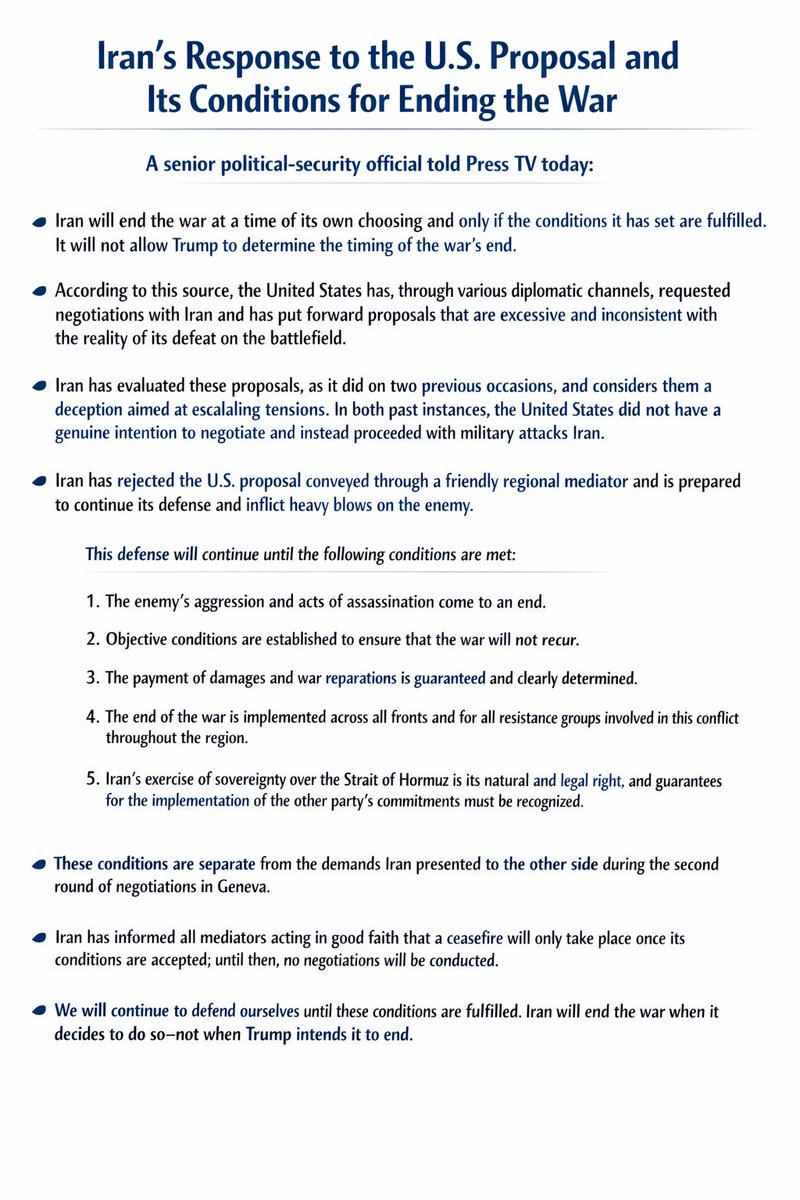
Here is Iran’s counteroffer:
These demands are not ships passing in the night; they are ships passing in different universes. There is literally no common ground in these gambits which suggests that any resolution to the war is very far away.
The US, however, is making incredible threats against Iran. According to CNBC:
“U.S. President Donald Trump said Monday that the U.S. will ‘completely’ obliterate Iran’s electric generating plants, oil wells and Kharg Island if the strategically vital Strait of Hormuz is not ‘immediately’ reopened and a peace deal is not reached ‘shortly.’
“’The United States of America is in serious discussions with A NEW, AND MORE REASONABLE, REGIME to end our Military Operations in Iran,’ Trump said in a post on Truth Social.
“’Great progress has been made but, if for any reason a deal is not shortly reached, which it probably will be, and if the Hormuz Strait is not immediately ‘Open for Business,’ we will conclude our lovely ‘stay’ in Iran by blowing up and completely obliterating all of their Electric Generating Plants, Oil Wells and Kharg Island (and possibly all desalinization plants!), which we have purposefully not yet ‘touched.’”
These threats violate the laws of war. The purpose of war is to disarm one’s enemy, not to destroy it. Total destruction of an enemy is not a legitimate objective, although many states have gone that route. We have witnessed two contemporary wars which have violated this maxim: the Russian assault on Ukraine and the Israeli assault on the Gaza Strip. It seems as if states have become intoxicated with the destructiveness of their weaponry. Wars against the civilian populations is easy, but abhorrent–non-combatants have no defenses and pose no threat to a state’s military.
The reason why international law forbids wars against civilians is because such brutal actions often lead to conflicts that cannot be resolved by diplomacy. When the civilian populations feel aggrieved, restraints on war are difficult to achieve. War is not slaughter–we can slaughter people in all sorts of ways, and nature does a pretty good job of attacking civilians through hurricanes, wildfires, and earthquakes. But slaughter is not a political objective. It is the objective only for those who feel hatred and a need to shed blood vindictively. These attitudes do not lend themselves to an honest resolution of disputes.
“When it was over, Scipio began to weep and publicly lament the misfortune of the enemy. Polybius asked him why he was weeping and he compared the fate of Carthage to that of Troy. He spoke the words of Homer:
“The day shall come in which our sacred Troy and Priam and the people whom spear-bearing Priam rules, shall perish all.”
“Polybius asked him what he meant by this and he said ‘When I consider the mutability of human affairs, I fear that someday this may also be the fate of Rome.’”
Scipio understood well the dynamics of hate and how it should have no place in the conduct of war. All wars should be fought with an eye toward attaining the conditions that will re-establish peace.
The Trump Administration is asking for an extra $200 billion for its operations in Iran. That number is in addition to the $1 trillion defense department budget already authorized. The request also comes as the evidence seems to indicate that the Administration is seriously thinking about sending ground troops into the battle.
Regardless of how one defines the threats to US national security, it seems clear that the US already spends an incredible amount of money on the ability to wage war. It is hard to assess how realistic this sum is given that the US and its allies already spend significantly more than their primary opponents.
More importantly, Trump is asking for 20% more to prosecute a war that has not been approved by Congress, despite the Constitution’s clear delegation of the power to declare war to the Congress.
The Congress should refuse to authorize the money.
Trump claims that he the power to wage war because his authority as Commander in Chief gives him the right to do so in the face of an “imminent” threat, which assumes that the Congress might not have the necessary time to declare war.
That claim is nonsense. Israel and the US had been panning this war for months before the first bomb was dropped. The plans to attack Iran were not created suddenly in 2026. They were built on years of contingency planning, sharpened by the June 2025 war, and finalized in the months leading up to February 2026 as diplomacy collapsed. Moreover, the “imminence” the asserted Iranian attack was based upon Trump’s assertion that Iran was “weeks” away from developing a bomb. According to FactCheck:
“A week before the recent military operation, on Feb. 21, Trump’s special envoy to the Middle East, Steve Witkoff, was more definitive in describing a time frame for Iran’s nuclear ambitions. Witkoff said in a Fox News interview that while Iran says that its nuclear capability is “about their civil program … they’ve been enriching well beyond the number that you need for civil nuclear. It’s up to 60%. They are probably a week away from having industrial-grade bomb-making material, and that’s really dangerous.” But experts told us it would likely take months for Iran to enrich uranium to that level and then much longer before the “bomb-making material” could be made into a weapon.
“Daryl G. Kimball, executive director of the Arms Control Association, a nonpartisan organization that provides analysis on arms control and national security issues, told us that “it is clear that it would take Iran years to fully rebuild its enrichment plants” that were bombed in June 2025. ‘It is possible that Iran may have a very small number of operational centrifuges somewhere undisclosed,’ Kimball said. ‘But it would still take months for a smaller number of centrifuges to accomplish what thousands of centrifuges at these major facilities could’ve done,’ which would be to enrich small amounts of uranium to weapons-grade level and then turn it into metal to be used for a weapon. ‘It would take longer to fashion a nuclear explosive device.’”
Trump has no authority to wage war under these circumstances, and Congress should assert its Constitutional role. It runs the risk of implicitly declaring war by passing this supplemental budget which is targeted toward military operations against Iran. In the same way, President Lyndon Johnson used the Gulf of Tonkin Resolution to justify the war in Vietnam, even in the absence of a Declaration of War.
If the supplemental budget is not approved, the Republicans will argue that the action will jeopardize the safety of American troops. That argument is ridiculous. We can put the budget request in context with other states:
First, the Department of Defense has a budget of over a trillion dollars.
Current forecasts put the US Defence Spending for 2024-25 somewhere between $895 billion and $1.04 trillion.
The likely range dwarfs anything else by a margin most people still find surprising. Take the figures below, which come from the same set of Congressional projections.
China: $224 billion.
Russia: $109 billion.
India: $73 billion.
United Kingdom: $71 billion.
When one averages these numbers, US outlays alone account for roughly 40 per cent of all defence money spent around the planet.
It is hard to believe that the Defense Department is bankrupt, particularly since it is notorious for never passing an audit of its expenditures in its entire history. If one wants to see how the DoD spends money foolishly, one should check out this information provided by the Center for Arms Control and Non-Proliferation.
Second, the Congress should demand greater clarity on the purposes of the invasion and the conditions for ending the war. We have been treated to a variety of explanations for the war. Additionally, the Congress should outline what cuts it is willing to make in the current budget so that the American people will know how their money is being spent. Specifically, the supplemental request should be framed in the context of domestic programs that have been cut. For example, the recent cuts to the Affordable Care Act (Obamacare) totaled approximately $92 billion in ACA subsidies–half of the supplemental budget request. Plenty of money to kill people; limited money to heal them.
Third, opponents of the war should advance a simple peace plan: revive the Joint Comprehensive Plan of Action (JCPOA) which all analysts regarded as an effective check to Iranian nuclear ambitions. If Iran agrees to rejoin the plan, then the US should lift all sanctions on Iran. Plenty of problems remain in the US-Iran relationship, but at least the “imminent” threat will be defanged.
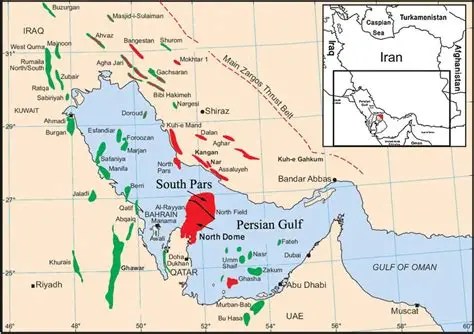
There is news coming in about the war against Iran which I think is of great magnitude. Israel has attacked the South Pars Natural gas fields that are jointly managed by Qatar and Iran. That field is the largest natural gas field in the world and many states, particularly in Europe, are depending on natural gas as they make the transition to green energy since it is more environmentally friendly than coal and oil. Additionally, Europe used to buy a lot of natural gas from Russia, but that has deteriorated as the Ukrainian conflict rages on.
South Pars Natural Gas Field
The Israeli attack crossed a profound redline. When Trump decided to bomb Kharg Island, which is where most Iranian oil is offloaded into tankers for sale abroad, he was careful to state that the US had not attacked any of the oil facilities on the island. That tactic is a critical factor. One can bomb the infrastructure of a state, its military installations, and even (unfortunately) civilian sites. But oil and natural gas are the only commodities that most of the Gulf States can export for profit. There has always been an implicit rule of war in the Middle East to not damage the oil and gas fields because such attacks pose the threat of economic catastrophe. In other words, attacking oil and gas fields is the economic equivalent of nuclear war to the oil producing states in the Gulf Region.
“After the strike on the South Pars gas field, Iran said energy infrastructure in Qatar, the United Arab Emirates and Saudi Arabia would now be considered legitimate targets.The strike on South Pars was “dangerous & irresponsible,” Qatar’s Foreign Ministry spokesman, Majed al-Ansari, said in a post on X.
“Iran’s state-run Press TV reported later on Wednesday that the country’s armed forces had struck ‘US-linked oil facilities in the region in retaliation for attacks on Iran’s oil facilities.’ Qatar’s state oil company said in a social media post that Ras Laffan Industrial City, a hub for exports of liquefied natural gas, was hit by rocket attacks. ‘Fires resulting from the attack … caused significant damage,’ QatarEnergy said.”
The Arab Gulf states are enraged, but now they are posing a very important new consideration for the world. An all-out assault on oil and gas fields would destroy the global economy for a considerable period of time. Although the world has made great progress in eliminating fossil fuels, the unfortunate fact is that those fuels since account for the bulk of economic activity in the world. This war has become one of much higher stakes than other important, but not global, issues in the current war such as the building of missiles, the funding of terror, or the enrichment of uranium.
For the Arab producing Gulf States there are unquestionably pressures to retaliate. But that course of action is not consistent with their long-term economic interests–it would lead to even more destruction of the reservoirs of oil and natural gas. And the destruction of those irreplaceable reservoirs is clearly not compatible with the interests of most people in the world. It remains to be seen whether cooler heads can prevail in this game of “chicken”. I also believe that Iran knows how counterproductive such escalation would be to its future.
The only country that has a more urgent priority than maintaining the integrity of the oil and natural gas markets is Israel. It has a more existential perspective on the war with Iran. Israel sees Iran not only as a threat to its existence, but also a threat to its military freedom in the Middle East. A nuclear armed Iran would place Israeli military actions in the region (Lebanon, Jordan, Syria, the Gaza Strip, and the West Bank) in a completely different strategic context. There are two possibilities that concern Netanyahu.
First, the real threat that Iran would blow up the state of Israel. This is not a threat that any Israeli Prime Minister could ignore, although military power is not necessarily the only way to dissuade Iran from building a bomb. But Netanyahu has chosen a military path to address the concern.
Second, and less obviously, is the possibility that an Iranian nuclear weapon would create the pressure of self-deterrence. Israel has considerable freedom of military action now because it does not face the possibility of nuclear annihilation. But would a real nuclear threat act as a deterrent even to conventional warfare? It apparently did in Ukraine, as the Biden Administration refused to allow Ukraine to procure long-range missiles because Putin had identified such transfers as a possible trigger for nuclear action. But the possibility of self-deterrence seeps down to the general population. Would Israelis have been more restrained in the Gaza Strip if Iran had had a nuclear weapon? Perhaps the citizens of Israel would have considered a different approach to responding to the horrific attacks of 7 October. If those fears are real, then those Israelis who wish to take over the lands they have occupied in the Gaza, the West Bank, Syria, and Lebanon might reconsider the costs and benefits of military action on such a broad scale.
The war against Iran, led by the US and Israel, has exposed the total vacuity in Trump’s understanding of diplomacy. The typical insult to someone who plays a benighted foreign policy is to suggest that someone is playing checkers against someone playing chess. The essence of the insult is that some do not think beyond the first step in a dispute while others think about a second, third, or even fourth move. The Israelis do not need to think about future moves since their objective is to destroy Iran in much the same way that they destroyed the Gaza Strip.
But the US has a tangle of objectives, and it seems clear that no one in his Administration did much thinking beyond dropping the first bomb. Incomprehensibly, the US does not appear to have prepared for the Iranian blockage of the Strait of Hormoz, even though that possibility aways loomed large in previous US interventions in the Middle East. According to CNN:
“The Pentagon and National Security Council significantly underestimated Iran’s willingness to close the Strait of Hormuz in response to US military strikes while planning the ongoing operation, according to multiple sources familiar with the matter.
“President Donald Trump’s national security team failed to fully account for the potential consequences of what some officials have described as a worst-case scenario now facing the administration, the sources said….
“‘Planning around preventing this exact scenario — impossible as it has long seemed — has been a bedrock principle of US national security policy for decades,’ a former US official who served in Republican and Democratic administrations said. ‘I’m dumbfounded.’”
“Trump’s plea to the UK contrasts with comments made on the same social media site last week, when he accused prime minister Keir Starmer of attempting to join the conflict after he had already claimed victory.
“’The United Kingdom, our once Great Ally, maybe the Greatest of them all, is finally giving serious thought to sending two aircraft carriers to the Middle East,’ Trump wrote. ‘That’s OK, Prime Minister Starmer, we don’t need them any longer – But we will remember. We don’t need people that join Wars after we’ve already won!’”
Today, however, Trump has changed his tune. He has called for a coalition of states to open the Strait of Hormuz: “Hopefully China, France, Japan, South Korea, the UK, and others, that are affected by this artificial constraint, will send Ships to the area so that the Hormuz Strait will no longer be a threat by a Nation that has been totally decapitated.”
The decision to first ignore its allies, but then to ask them to join the fight mirrors the decision that the US made when it invaded Afghanistan in 2001. NATO offered to join the US because of its commitment to Article 5 of the NATO Treaty: “Collective defence is NATO’s most fundamental principle. Article 5 of the North Atlantic Treaty states that an armed attack against one NATO member shall be considered an attack against them all. Since 1949, this unwavering pledge has bound together a group of like-minded countries from Europe and North America, which have committed themselves to protecting each other in a spirit of solidarity.” However, President George W. Bush believed that the US did not need assistance: “The United States began Operation Enduring Freedom in October 2001 without taking up NATO’s offer of collective defense involvement.” Bush’s reasons were as follows:
Skepticism about NATO’s military effectiveness: The U.S. believed NATO’s command structures were too slow and politically cumbersome for the rapid, flexible operations planned in Afghanistan.
Preference for a U.S.-led coalition: Washington preferred to assemble a “coalition of the willing” tailored to its operational needs rather than operate under NATO’s consensus-based command.
Desire for operational freedom: The Pentagon wanted maximum autonomy in planning and executing the invasion.
Yet as the US effort faltered in its campaign, it reversed course and NATO joined the effort in 2003 under the aegis of the UN Security Council. And NATO remained a steadfast ally throughout the conflict until NATO and US forces withdrew in 2021.
In both cases, the hubris of the US betrayed a stunning lack of foresight, and, in both cases, it had to admit that it was not able to secure the victory on its own. It would have been better if the US had coordinated its effort with its allies before the fighting began.
Similarly, the US did not anticipate the Iranian closure of the Strait and what it would do to the global energy system. After it became clear that oil and natural gas prices were rising rapidly, Trump has made the decision that keeping energy prices low was in the interests of the Republican Party and the mid-term elections. So, he lifted the sanctions against the sale of Russian oil which will replenish the almost empty cash reserves of Russia, allowing it to continue its war against Ukraine. Because he does not know how to play chess, Trump failed to anticipate that his actions in Iran would vitiate the efforts to allow Ukraine to defend its territory. To abandon an ally and to favor an adversary is a high crime in diplomacy.
During the Vietnam War, Senator Fulbright (D-Ark) wrote a book entitled The Arrogance of Powerwhich raised a perennial problem in diplomacy–the reckless assumption that military power is decisive and that diplomacy can take a back seat as long as the bombs are falling. It appears as if the US is going to double down on its failed strategy. The New York Times has reported that US troops are being sent to the region as a potential ground invasion of Iran is being contemplated:
“About 2,500 Marines aboard as many as three warships are heading to the Middle East, as Iran blocks the world’s most important choke point for oil. The deployment, after two weeks of war, comes as Iran’s response has proved more resilient than U.S. officials had anticipated. The Marines will join more than 50,000 American troops in the region.”
Iran has about 100,000 soldiers in the Revolutionary Guard and even more troops in the regular army. I’m not sure how Trump thinks that a ground invasion could be successful. But it is difficult to account for his ignorance and delusions.
R.I.P Country Joe McDonald. Thanks for showing us how hubris manifests itself on the battlefield. The US never thought it would (or could) lose the war in Vietnam.
The number of justifications offered by the Trump Administration for its attack on Iran is a hodgepodge of assertions that are not really supported by available evidence. So far, I have detected 9 reasons:
The Trump Administration’s Stated Justifications for the War on Iran
Secretary of State Marco Rubio repeatedly framed the strikes as a response to an “imminent threat” to U.S. forces or interests. This language appears designed to fit the War Powers Resolution, which allows unilateral presidential action only under extraordinary imminent danger.
There is no evidence provided except for Trump’s gut feeling. Karoline Leavitt argued that Trump “had a good feeling that the Iranian regime was going to strike”.
Officials have claimed the war aims to prevent Iran from acquiring nuclear weapons or to destroy its nuclear infrastructure. However, reporting notes that this justification has shifted, especially since the administration also claimed early on that Iran’s nuclear program had already been “obliterated.”
There is no evidence that Iran was close to building a nuclear bomb. It is also impossible to destroy the knowledge and expertise that Iranian nuclear scientists possess. Perhaps an attack would delay them, but Trump argued that he had destroyed the nuclear program a few months ago.
Another stated objective has been to destroy Iranian missile stockpiles and missile‑production facilities. This justification has appeared and disappeared in official statements, contributing to the sense of a moving target. One should remember that missiles are also a component of a space program, including launching satellites. Telling the difference between a peaceful missile and an aggressive missile is impossible.
Trump and senior officials have invoked the idea of helping Iranians overthrow their government, describing the war as a campaign for “freedom” or “liberation.”
Trump’s initial announcement video framed the operation as both a defensive strike and a call for Iranians to “take back your country.” This rationale conflicts with other statements denying that regime change is the goal.
Trump has cited “47 years of Iranian aggression”, referencing the 1979 hostage crisis, Hezbollah, Hamas, and Iranian‑backed militias. This frames the war as a long‑overdue reckoning rather than a response to a specific event. It ignores the fact that the US overthrew a legitimately elected Iranian government in 1953. A good reason for hostility.
Secretary of State Rubio suggested that Israel was preparing to strike Iran, and the U.S. intervened preemptively to avoid higher American casualties. This justification has been controversial even among Trump’s supporters, who see it as contradicting “America First.” Rubio offered no evidence for his claim, but it is believable. But why would Iran attack the US if only Israel was conducting the air strikes?
At times, officials have claimed Iran was preparing an attack on U.S. forces or assets. But other statements have conceded that Iran was not planning such an attack, further muddying the rationale.
Trump has described the mission as an effort to “destroy their missiles and raze their missile industry to the ground.” This overlaps with the nuclear and missile justifications but is framed more broadly as degrading Iran’s military capacity.
Some messaging from within the administration has invoked a religious justification, suggesting the war aligns with “God’s divine plan.” Mikey Weinstein, founder and president of the Military Religious Freedom Foundation, is quoted as following:
“This morning our commander opened up the combat readiness status briefing by urging us to not be ‘afraid’ as to what is happening with our combat operations in Iran right now,” one complaint reads. “He urged us to tell our troops that this was ‘all part of God’s divine plan’ and he specifically referenced numerous citations out of the Book of Revelation referring to Armageddon and the imminent return of Jesus Christ. He said that ‘President Trump has been anointed by Jesus to light the signal fire in Iran to cause Armageddon and mark his return to Earth.'”
Forget the fact that these justifications lack substantive evidence. The incoherence of the justifications is also a serious problem because it indicates that no one in the Trump Administration has forged a consensus on what the war is supposed to accomplish. That lack of clarity means that there is no condition which will qualify as “victory” for the US. The Iranians have identified their objective: the regime must survive. As long as the US fights this war from the air, there is essentially no way to overthrow the regime. Even the protesters are unlikely to demand the overthrow of the regime since that is tantamount to being an ally of the US and Israel. Thus, Iran wins the war simply by surviving with no change to the regime.
Israel has one clear objective: the regime must be overthrown. And Israel will follow the same playbook as it did in the Gaza Strip. The strategy is to make the Gaza and Iran unlivable. Whether Israel has enough bombs to reduce Iran to rubble is questionable. Trump likely will not support a “Sherman at Atlanta” policy (at least before the midterms). At some point Trump will have to stop Netanyahu from the scorched earth strategy. Better soon, rather than later.
It has been difficult to figure out what is happening with the war against Iran. We have been treated to a variety of possible objectives which might lead to an end to the war, but none is coalescing into a coherent policy. Trump outlined his objectives in his speech to the nation. The White House has compiled a slew of statements from all over the world to justify the war, but most of those statements do not really address the fundamental disagreements between the US, Israel, and Iran. At this point, the war is a military mismatch: Iran really has little capability to protect itself against the aerial bombardment. But one could easily have said the same thing about the North Vietnamese and the Afghans who also had few capabilities to defend themselves against the US and the Soviet Union. Nonetheless, both states succeeded in defeating more powerful states.
Trump’s speech justifying the war on 28 February takes no notice of this fact. Indeed, Trump touted the power of the US military (which is undeniable) but failed to account for the political factors that lead to victory or defeat in war. Trump also failed to offer Iran any alternative to war which might satisfy US interests. His opening remarks in the speech were hyperbolic:
“A short time ago, the United States military began major combat operations in Iran. Our objective is to defend the American people by eliminating imminent threats from the Iranian regime. A vicious group of very hard, terrible people. Its menacing activities directly endanger the United States, our troops, our bases overseas, and our allies throughout the world.”
We should be clear: there was no “imminent” threat. Iran did not possess a nuclear weapon, nor did it have missile capabilities that could directly threaten the US homeland. The war is being fought to prevent a threat in the future, a reality that belies any sense of “imminence”. The more prudent course of action would have been to engage in diplomacy to prevent these outcomes. Indeed, the Obama Administration had succeeded in forging a comprehensive policy to achieve both outcomes, the Joint Comprehensive Plan of Action (JCPOA). By all accounts, that agreement was successful in preventing Iran from developing a nuclear bomb. It was also a plan supported by Great Britain, France, China, Russia, and Germany giving it tremendous leverage and weight.
The JCPOA accomplished much: The deal imposed strict limits on Iran’s nuclear fuel cycle that directly blocked the pathways to a bomb:
Centrifuges reduced and older models required, sharply limiting enrichment capacity.
Enrichment capped at 3.67%, far below weapons‑grade levels.
Uranium stockpile cut to a fraction of what would be needed for a weapon.
Reactor redesigns at Arak and restrictions at Fordow and Natanz ensured no plutonium pathway.
These measures increased Iran’s “breakout time”—the time needed to produce enough fissile material for one bomb—to about one year, compared to just a few months before the deal.
Iran implemented the IAEA Additional Protocol, allowing access to declared and suspect sites.
Continuous monitoring and real‑time surveillance made covert diversion extremely difficult.
Experts widely regarded the inspection system as the strongest in nonproliferation history. Bottom line: During this period, Iran was not able to develop a nuclear weapon without being detected, and its technical capacity to do so was sharply constrained.
Despite its success, Trump withdrew from the JCPOA in 2018 breaking the agreement. Note: Iran did not break the agreement, a conclusion verified by on-site inspectors from the International Atomic Energy Agency (IAEA). Trump himself jettisoned the agreement that would have prevented Iran from building a nuclear bomb. The current war is therefore a consequence of Trump’s failure in 2018.
Trump’s other justifications for the war are ridiculous. He dredges up acts committed by Iran that are clearly heinous but ignores the context of the Iranian opposition to Israel and the US, most notably the fact that the US helped overthrow the Iranian government in 1953. And there are many states committing heinous crimes in the international system (the Israeli destruction of the Gaza Strip will undoubtedly go down in history as a mass atrocity).
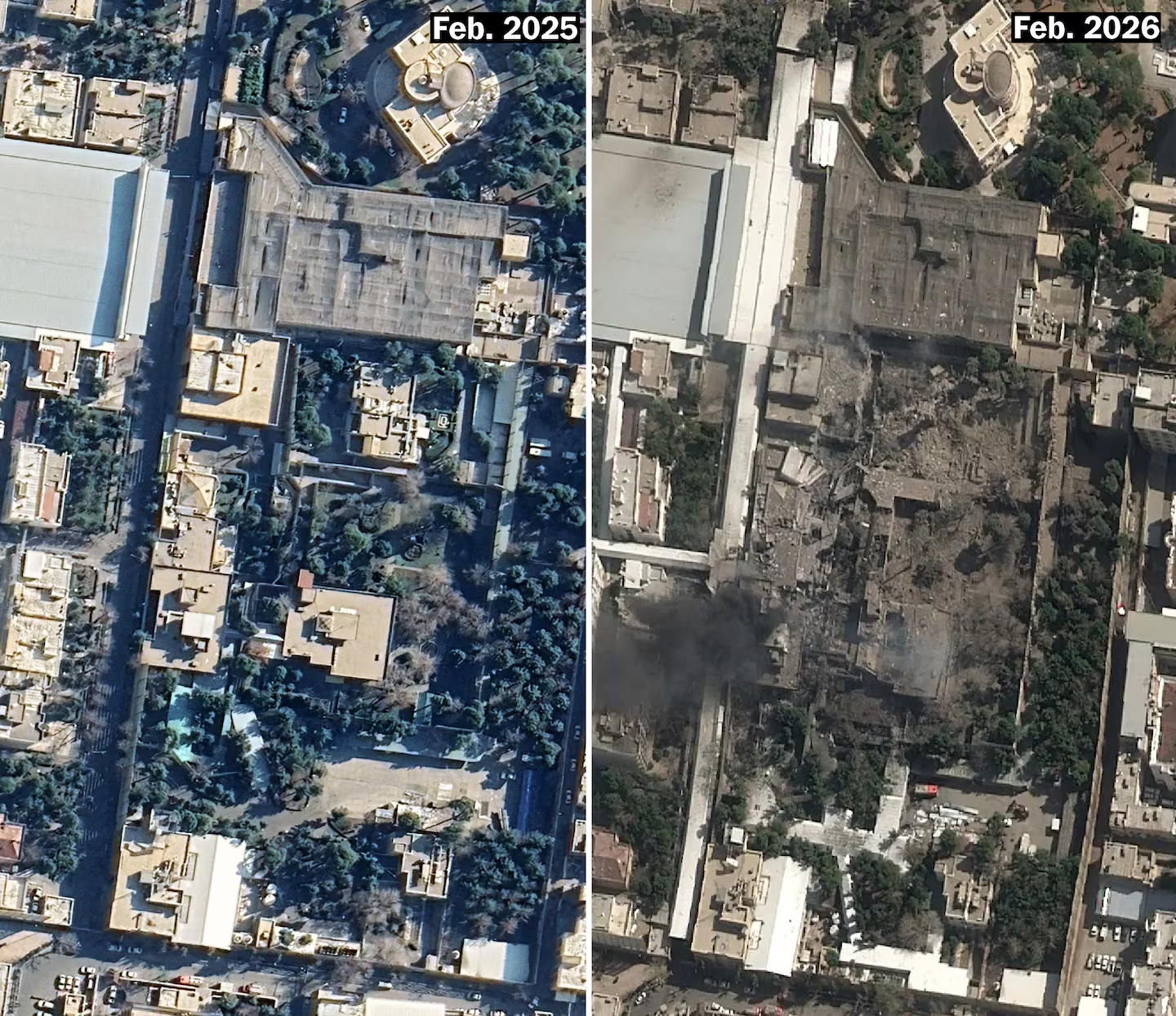
The evidence suggests that Trump was most interested in overthrowing the regime. The photographic evidence of the compound of the Ayatollah which was destroyed on the first day of the attack indicates that regime change was the highest priority. No doubt, Trump was emboldened by his “success” in Venezuela. He succeeded in removing President Maduro, but Maduro’s political infrastructure is still in power except for decisions regarding the sale of Venezuelan oil. The New York Times reports:
“’What we did in Venezuela, I think, is the perfect, the perfect scenario,’ Mr. Trump said.
“Then he offered a very different model of what the transition of power in Iran might look like, referring repeatedly to his experience in Venezuela after he ordered a Delta Force team to seize Mr. Maduro.
“His answer implied that what worked in Venezuela would work in Iran, a nation with about three times the population and a military and clerical leadership that has ruled with increasing repression since the 1979 revolution. Over the past several weeks, Mr. Trump has repeatedly brought up Venezuela as the model of a successful operation and hoped to replicate aspects of it in Iran, identifying leadership that would be more cooperative and friendly to the United States.
“But he has been told by his advisers that the vast differences in cultures and history made it virtually impossible to apply the strategy used in Venezuela — in which the existing government was kept in place, after it agreed to take instructions from Washington — and try to replicate it in Tehran.
“Nonetheless, Mr. Trump appears enamored of using a Venezuela-like model in Iran.”
Trump made two huge mistakes. First, the situation in Venezuela is nothing comparable to Iran. The Ayatollah did not rule in a vacuum. The Islamic Revolutionary Guard is a formidable political and military organization and will persist as the ruling force in Iran. It is nothing like the motley crew of sycophants that supported Maduro. Second, he ignored all the lessons about regime change. It did not work in Iran in 1953; it did not work in Guatemala in 1954; it did not work in Cuba in 1962 at the Bay of Pigs; it did not work in Vietnam in 1963; it did not work in Iraq in 2003; it did not work in Afghanistan in 2014. Outsiders can never produce legitimate new regimes and only a fool would entertain such a preposterous thought.
This fixation on regime change is perhaps the most insidious aspect of the Iranian intervention. Trump loudly asserted that he was working on behalf of those Iranians who opposed theocratic rule:
“Finally, to the great proud people of Iran, I say tonight that the hour of your freedom is at hand. Stay sheltered. Don’t leave your home. It’s very dangerous outside. Bombs will be dropping everywhere. When we are finished, take over your government. It will be yours to take. This will be probably your only chance for generations.
“For many years, you have asked for America’s help. But you never got it. No president was willing to do what I am willing to do tonight. Now you have a president who is giving you what you want. So let’s see how you respond. America is backing you with overwhelming strength and devastating force. Now is the time to seize control of your destiny, and to unleash the prosperous and glorious future that is close within your reach. This is the moment for action. Do not let it pass.”
With this pronouncement, Trump effectively de-legitimatized the protest movement in Iran. He has undermined the authenticity of the internal dissent because anyone who opposed the theocracy will now be associated with the US intervention. And the Islamic Revolutionary Guard has more than enough military, political, and economic power to continue the violent suppression of dissent in Iran. In a very real sense, Trump has created the conditions for a bloody civil war, one which the protesters cannot win. This mistake was made by President Eisenhower when Hungarian protesters challenged communist rule in 1956:
“The United States considers the development in Hungary as being a renewed expression of the intense desire for freedom long held by the Hungarian people. The demands reportedly made by the students and the working people clearly fall within the framework of those human rights to which all are entitled, which are affirmed in the charter of the United Nations, and which are specifically guaranteed to the Hungarian people by the treaty of peace to which the Governments of Hungary and of the Allied and Associated Powers, including the Soviet Union and the United States, are parties.
“The United States deplores the intervention of Soviet military forces which, under the treaty of peace, should have been withdrawn and the presence of which in Hungary, as is now demonstrated, is not to protect Hungary against armed aggression from without but rather to continue an occupation of Hungary by the forces of an alien government for its own purposes.
“The heart of America goes out to the people of Hungary.”
It was a nice sentiment, but it gave false hope to the protesters. The US did not take any action to support them, and they felt betrayed by the empty promises. Which will leave Trump with a difficult decision. If the IRG does violently suppress the protest movement, will Trump send in ground troops to prevent the bloodshed? No matter how this question is answered, it ends in tragedy.
The US and Israel have attacked Iran. I will wait for more information before I make any comments on the conduct of the war. But there are some initial points that need to be made.
First, the attack was unprovoked. I am well aware of the fact that President Trump listed a number of times Iran has attacked either US facilities, troops, or those of its allies. But at the time of the attack, Iran had not launched any strikes on either the US or Israel. There are a lot of grievances that states have against each other, but war demands a violent threshold to justify self-defense. Otherwise, states would always be at war. Trump started his list of grievances with the takeover of the US Embassy in Tehran in 1979. The Iranians would start with the CIA supporting a coup that overthrew the Iranian government in 1953. Similarly, Trump did not mention the bombing of Tehran that killed General Sulemani in 2020 or the attack on Iran’s nuclear facilities in 2025.
Second, the objectives of the attack are not at all clear. It appears from the photographic evidence that there was a concerted attempt by Israel and the US to assassinate the Supreme Leader of Iran, Ayatollah Ali Khamenei. At this point, both Israel and the US are claiming that Khamenei is dead. The photographs show that this was a definite objective:
Third, there was little or no attempt to justify the attack to the American people or the US Congress, which has the exclusive authority to declare war. Julian Borger, writing for the Guardian is explicit:
“The first war of Donald Trump’s Board of Peace era has begun – an unprovoked attempt at regime change in collaboration with Israel, with no legal foundation, launched in the midst of diplomatic efforts to avert conflict, and with minimal consultation with Congress or the American public.
“Trump’s recorded eight-minute address after the first bombs had fallen made clear that this would be no limited strike aimed at cajoling Tehran into concessions at the negotiating table.
“He warned that if Iran’s Islamic Revolutionary Guard Corps (IRGC) did not surrender, they would be killed, and the country’s armed forces, its missiles and navy would be smashed.
“The way would then be open for the Iranian opposition and the country’s ethnic minorities to rise up and bring the regime down.
“’It’s time for all the people of Iran – Persians, Kurds, Azeris, Balochis and Akhvakhs – to shed from themselves the burden of tyranny and bring forth a free and peace-seeking Iran,’ Trump said. There are no Akhvakhs in Iran. They are a small minority in Dagestan, and it is unclear how they were included in Trump’s list.”
I will wait for more substantive information before I offer further thoughts. In the meantime, Randy Newman anticipated this attack way back in 1972. Such prescience!
We should keep our eyes on Jerusalem for the next month. Since 1967, there have been a number of accommodations made around the site of the al-Aqsa mosque. That mosque is considered by many Muslims to be the third holiest site in Islam and is visited by Muslims for prayers during the month of Ramadan. The mosque was also used as a church by the Christian crusaders after they captured Jerusalem in 1099, but after Saladin retook Jerusalem in 1149 it has remained a mosque. After Israel captured Jerusalem during the Six-Day War in 1967, the control of the mosque was given to Jordan and regulated by a series of agreements between Israel and Jordan. The difficulty is that the mosque rests on the Temple Mount, which is the site of the Jewish First Temple (built by King Solomon and destroyed by King Nebuchadnezzar) and the Second Temple which was destroyed by the Roman Empire. Many Jews (but not all) believe that the area of the Temple Mount should be completely under Israeli control. The site is the scene of unresolved conflict.
“The administrative body responsible for the whole Al-Aqsa Mosque compound is known as “the Jerusalem Waqf“, an organ of the Jordanian government.
“The waqf employed architects, technicians and craftsmen in a committee that carry out regular maintenance operations. The Islamic Movement in Israel and the waqf have attempted to increase Muslim control of the Temple Mount as a way of countering Israeli policies and the escalating presence of Israeli security forces around the site since the Second Intifada. Some activities included refurbishing abandoned structures and renovating.
Those agreements have periodically been tested, and the current situation is highly volatile. After the Hamas attacks on Israel in October 2023, there has been a systematic campaign to increase Israeli control over the Gaza Strip and the West Bank, and a concerted effort to bring the Temple Mount under complete Israeli control. The Guardian outlines the collapse of the previous agreements:
“A six-decade agreement governing Muslim and Jewish prayer at Jerusalem’s most sensitive holy site has ‘collapsed’ under pressure from Jewish extremists backed by the Israeli government, experts have warned.
“A series of arrests of Muslim caretaker staff, bans on access for hundreds of Muslims, and escalating incursions by radical Jewish groups culminated this week in the arrest of an imam of al-Aqsa mosque and an Israeli police raid during evening prayers on the first night of Ramadan.
“The actions by the Jerusalem police and the Shin Bet internal security force, both now under far-right leadership, represent a rupture in the status quo agreement dating back to the aftermath of the 1967 war, which stipulates that only Muslims are permitted to pray in the sacred compound around the mosque, known as the al-Haram al-Sharif to Muslims, which also encompasses the seventh-century Dome of the Rock shrine. To Jews it is the Temple Mount, the site of the 10th-century BC first temple and second temple, which was destroyed by the Romans in AD70.”
“Police extended visiting hours for Jewish worshipers on the Temple Mount in Jerusalem by an hour more than is customary during Ramadan on Wednesday, the first day of the Islamic holy month.
“The change comes as Israel has repeatedly shifted norms on the flashpoint holy site where the Biblical Jewish temples stood and that today houses the Al-Aqsa Mosque and the Dome of the Rock Shrine under far-right National Security Minister Itamar Ben Gvir.
“Jewish visitors were able to ascend the flashpoint holy site in the morning from 6:30 to 11:30 a.m., following pressure from activists. In previous years, visiting hours during Ramadan were from 7 to 11 a.m, with the Al-Aqsa compound completely closed to Jewish visitors throughout the afternoon.”
The issue is not necessarily the limitation of prayers, but rather the unilateral moves by Israel which stimulates fear among Muslims that Israel is moving toward complete control of the site. The Guardian outlines some of the moves that have inspired this fear:
“Tensions have escalated steadily around al-Aqsa mosque as far-right Israelis have taken up key security positions. The national security minister, Itamar Ben-Gvir – who had eight criminal convictions before taking office, for supporting a terrorist organisation and incitement to racism, among other charges – has said he wanted to raise the Israeli flag at the compound and build a synagogue there.
“Ben-Gvir has made inflammatory visits to al-Aqsa over the past year, and backed a series of unilateral changes to the status quo, allowing Jews to pray and sing in the compound. In January, he installed an ideological ally, Maj Gen Avshalom Peled, as the Jerusalem police chief, and with the reported backing of the prime minister, Benjamin Netanyahu, allowed Jews to take printed prayer sheets on to the site, in ever-more clearcut violations.
“’The status quo has collapsed because there are prayers on a daily basis,’ Seidemann (Daniel Seidemann, a Jerusalem lawyer) said. ‘In the past, the police were very strict about preventing any kind of provocation … but these measures are displays of ‘we’re in control here, get used to it or get out of the way’.”
“In the run-up to Ramadan this year, the Jerusalem Waqf, the Jordanian-appointed foundation charged with managing al-Aqsa’s site as part of the status quo agreement, has come under increasing pressure. Waqf sources said five of its staff had been put in administrative detention (detention without charge) this week by the Shin Bet, while 38 staff members had been banned from entering the site. Six imams from the mosque had also been denied entrance, they said.
“They said six Waqf offices had been ransacked in recent weeks and the staff prevented from rehanging doors or doing other repairs. The Waqf has been prevented from installing sun and rain shelters or temporary clinics for worshippers. Officials allege they have even been prevented from bringing toilet paper on to the site.
“The cumulative effect, the officials said, had been to strain the Waqf’s ability to cater to the 10,000 Muslims expected to come to pray at al-Aqsa mosque over the month of Ramadan.”
The Palestinians have lost control over the land in the Gaza Strip and are witnessing the steady encroachment of Israeli settlers in the West Bank. Losing access to the al Aqsa mosque would amplify these fears to an incredible extent. At this writing, however, there does not seem to be any US to restrain the Israelis. Many states in the rest of the world are objecting to the creeping annexation of the West Bank and the UN Security Council has condemned many of the moves. The Washington Post reports:
“This month, Prime Minister Benjamin Netanyahu’s security cabinet, in a closed-door meeting, adopted measures to make it easier for settlers to purchase land and circumvent the Palestinian Authority in areas it has controlled since a 1995 agreement under the Oslo accords. The move was widely condemned in the Arab world and globally as a violation of international law and an undoing of decades-old regional security agreements….
“In the meantime, Palestinians continue to face an ever-quickening transformation of the West Bank, which, in the shadow of war on Gaza, has seen new Jewish settlements approved at record rates — and more than 1,300 Palestinians killed by settlers or Israeli forces — since Netanyahu took office in 2022, according to U.N. statistics.
“Now, many say they fear not only being displaced, but losing all legal claim to their land. Many international lawyers and even some Israeli cabinet ministers who supported the measures say they are a clear reach toward seizing territory.
“’We are continuing the revolution of settlement and our hold on all regions of our land,’ Finance Minister Bezalel Smotrich said, adding: ‘The State of Israel is taking responsibility for its land and acting according to the law with transparency and determination.’”
We should pay attention to how this situation evolves over the next month.
The Trump Administration is currently engaged in diplomatic talks with Iran, ostensibly over Iran’s nuclear program. If the issue is simply halting the Uranium enrichment program in Iran, there are some reasons to be optimistic. Iran seems willing to return to the agreement forged by the US, Germany, Russia, China, France and Great Britain during the Obama Administration. That agreement limited the level of enrichment to those levels necessary to build a nuclear bomb in return for the lifting of economic sanctions on Iran. But the US and Israel are demanding other limitations, including restrictions on Iran’s missile program (which was never part of the original deal).
In order to buttress his demands, Trump has ordered a significant expansion of the US military presence near Iran, including the dispatch of another aircraft carrier to the region. Axios describes the scale of the buildup:
“Trump’s armada has grown to include two aircraft carriers, a dozen warships, hundreds of fighter jets and multiple air defense systems. Some of that firepower is still on its way.
More than 150 U.S. military cargo flights have moved weapons systems and ammunition to the Middle East.
In the past 24 hours, another 50 fighter jets — F-35s, F-22s and F-16s — headed to the region.
“Between the lines: Trump’s military and rhetorical buildups make it hard for him to back down without major concessions from Iran on its nuclear program.
It’s not in Trump’s nature, and his advisers don’t view the deployment of all that hardware as a bluff.
:With Trump, anything can happen. But all signs point to him pulling the trigger if talks fail.”
It is doubtful that Iran will agree to those additional demands. Robert Reich believes that Trump wants “regime change” in Iran which essentially means the removal of the Supreme leader, Ayatollah Ali Khamenei:
“The United States is being represented in the talks by “Special Envoy” Steve Witkoff (whose son is the chief executive of World Liberty Financial, the Trump family’s cryptocurrency company, nearly half of which was purchased last year for $500 million by an investment firm tied to the United Arab Emirates). And by Trump son-in-law Jared Kushner (who’s been making private deals with the Saudis and who raised several billion dollars before Trump’s second term from overseas investors including sovereign wealth funds of Saudi Arabia, Qatar, and the United Arab Emirates).
“No one from the State Department. Nobody from the National Security Council. No one who knows much of anything about Iran.
“So what’s the real goal?
“On Friday, in a little-noticed remark, Trump said “the best thing that could happen” in Iran would be regime change, noting “there are people” who could take over from Iran’s Islamic ruler Ayatollah Ali Khamenei.”
That objective is significantly more complicated than the removal of Venezuelan leader, Maduro. I have given up on trying to predict what Trump will actually do (largely because I believe that often he has no real plan for the consequences of his actions). But it seems to be clear that Israel is pushing hard for a more sustained attack: According to the New York Times:
“In Israel, the two defense officials said that significant preparations were underway for the possibility of a joint strike with the United States, even though no decision has been made about whether to carry out such an attack. They said the planning envisions delivering a severe blow over a number of days with the goal of forcing Iran into concessions at the negotiating table that it has so far been unwilling to make.
“The U.S. buildup suggests an array of possible Iranian targets, including short and medium range missiles, missile storage depots, nuclear sites and other military targets, such as headquarters of Iran’s Islamic Revolutionary Guard Corps.”
There are currently negotiations between the US and Iran in Geneva on the nuclear issue. But it does not appear that any progress has been made on the ballistic missile issue. Moreover, the Trump Administration may think that the recent protests in Iran make the possibility of a regime collapse more likely, and that a sustained attack on Iran would usher in regime change. There does not seem to be much discussion on the implications of an overthrow of the regime. Iran is different from the intervention in Venezuela which does not seem to have changed the character of the Venezuelan government much. There are many more fragmenting concerns in Iran: ethnic issues, distributional issues, and the threat of a sustained drought.
“Prime Minister Donald Tusk called on Thursday for all Polish citizens to leave Iran, after US President Donald Trump again hinted at military action against the Islamic Republic.
“’Everyone who is still in Iran must leave immediately, and under no circumstances should anyone plan to travel to that country,’ he said at a press conference.
He added that ‘the possibility of heated conflict is very real, and in a few, a dozen or several dozen hours, evacuation may no longer be an option.'”
If the attack occurs, it will mark the seventh time Trump has bombed a foreign power since January. I have not checked, but it seems to me that this is probably a record number of bombed states for any President in the first year of a presidential term.
The Munich Security Conference is an annual event held in Germany every year. It is an assemblage of experts in security matters, and generally it focuses on military matters. It issues a security report after each meeting and this year’s report is quite stunning in its bluntness. This is an excerpt from its Executive Summary:
“The world has entered a period of wrecking-ball politics. Sweeping destruction – rather than careful reforms and policy corrections – is the order of the day. The most prominent of those who promise to free their country from the existing order’s constraints and rebuild a stronger, more prosperous nation is the current US administration. As a result, more than 80 years after construction began, the US-led post-1945 international order is now under destruction.
“In many Western societies, political forces favoring destruction over reform are gaining momentum. Driven by resentment and regret over the liberal trajectory their societies have embarked on, they seek to tear down structures that they believe will prevent the emergence of stronger, more prosperous nations. Their disruptive agendas build on widespread disenchantment with the performance of democratic institutions and a pervasive loss of trust in meaningful reforms and political course corrections. In all G7 countries surveyed for the Munich Security Index 2026, only a tiny proportion of respondents say that their current government’s policies will make future generations better off. And both domestically and internationally, political structures are now perceived as overly bureaucratized and judicialized, impossible to reform and adapt to better serve the people’s needs. The result is a new climate in which those who employ bulldozers, wrecking balls, and chainsaws are often cautiously admired if not openly celebrated.
“The most powerful of those who take the axe to existing rules and institutions is US President Donald Trump.”
The report is, no doubt, a response to the National Security Strategy white paper issued by the Trump Administration in November 2025. But the perspective of the US paper is radically different:
“Over the past nine months, we have brought our nation–and the world–back from the brink of catastrophe and disaster. After four years of weakness, my administration has moved with urgency and historic speed to restore American strength at home and abroad, and bring peace and security to our world.
“No administration in history has achieved so dramatic a turnaround in so short a time.”
This juxtaposition of perspectives defies an easy explanation–both cannot be true at the same time. One is clearly wrong. There is no doubt in my mind that the Munich group is much closer to the mark. That raises a serious question: Who is writing this delusional nonsense for Trump? And why are Americans and the world not doing more to stop this ignorant fool?
 World Politics News