The US has asserted that it will blockade all oil tankers from Venezuela on a sanction list. This action follows the seizure of the oil tanker Skipper that was carrying 2 million barrels of crude oil destined for Cuba. Generally speaking, a blockade is considered an act of war but the Trump Administration has not asked the Congress for a declaration of war, nor has it met the requirements of the War Powers Act. Nonetheless, Trump has deployed a massive military buildup off the coast of Venezuela acting on his asserted authority as Commander-in-Chief. The Washington Post listed all the military assets deployed as of today.
AC-130J Ghostrider
Heavily armed gunship
Special Operations Forces
U.S. Air Force (Special Ops Command)
AV-8B Harrier II
Fighter and attack aircraft
Air
U.S. Marine Corps
B-1B Lancer
Supersonic bomber
Air
U.S. Air Force
B-52 Stratofortress
Strategic bomber
Air
U.S. Air Force
EA-18G Growler
Electronic attack jet
Air
U.S. Navy
F-35 Lightning II
Supersonic fighter jet
Air
U.S. Marine Corps
MH-6 Little Bird
Light observation helicopter
Special Operations Forces
U.S. Army (160th SOAR)
MH-60M Black Hawk
Medium-lift military utility helicopter
Special Operations Forces
U.S. Army (160th SOAR)
MH-60T Jayhawk
Medium-range recovery helicopter
Air
U.S. Coast Guard
MQ-9 Reaper
Unmanned combat aerial vehicle (drone)
Air
U.S. Air Force
MV Ocean Trader
Floating special operations base
Special Operations Forces
Operated for U.S. Special Operations Command (SOCOM)
MV-22 Osprey
Transport and cargo aircraft
Air
U.S. Marine Corps
P-8 Poseidon
Maritime patrol aircraft
Air
U.S. Navy
Sikorsky UH-60L Black Hawk
Medium-lift military utility helicopter
Air
U.S. Army
USS Bainbridge
Guided missile destroyer
Naval
U.S. Navy
USS Fort Lauderdale
Amphibious transport dock
Naval
U.S. Navy
USS Gerald R. Ford
Aircraft carrier
Naval
U.S. Navy
USS Gettysburg (CG-64)
Guided missile cruiser
Naval
U.S. Navy
USS Iwo Jima (LHD-7)
Amphibious assault ship
Naval
U.S. Navy
USS Jason Dunham
Guided missile destroyer
Naval
U.S. Navy
USS Lake Erie
Guided missile cruiser
Naval
U.S. Navy
USS Mahan
Guided missile destroyer
Naval
U.S. Navy
USS San Antonio
Amphibious transport dock
Naval
U.S. Navy
USS Stockdale
Guided missile destroyer
Naval
U.S. Navy
USS Thomas Hudner
Guided missile destroyer
Naval
U.S. Navy
USS Wichita
Littoral combat ship
Naval
U.S. Navy
USS Winston S. Churchill
Guided missile destroyer
Naval
U.S. Navy
I doubt that the US is contemplating an invasion of Venezuela (but I also doubt that Trump has thought that far). His intention is to create economic chaos in Venezuela that will lead to the overthrow of President Maduro. This particular playbook was actually used by the Anglo-Iranian Oil Company (now known as BP) in 1951 against Iran after Iran nationalized its holdings. The company effectively blockaded Iran from selling its oil to others by following oil tankers leaving Iran and using the courts to prevent the sale of what it called “stolen” oil. Eventually, the Iranian economy collapsed and with a shove from the US CIA led to the overthrow of the president of the country and leading to the rule of the Shah of Iran.
The Iranian example is instructive since the Iranian regime that toppled the Shah in 1979 led to the creation of the Islamic Republic of Iran and the longstanding bitterness between Iran and the US today. The US has a poor track record of regime change. It did not work in Vietnam in 1963 when South Vietnamese President Diem was assassinated or when the US overthrew Iraqi President Hussein in 2003. Other examples include the overthrow of Guatemalan President in 1954 and the toppling President Allende of Chile in 1973. Regime change is a policy adopted by states that pay little attention to the long-term consequences of meddling in the internal affair of other states.
But there is another thread in the Venezuela situation that has not received sufficient attention. Venezuela has the largest oil deposits in the world although its oil is heavy with sulfur and thus requires significant refining in order to be useful. The main seller of Venezuelan oil in the US is a company called Citgo, and it has three refineries in the US. But the US took control of Citgo properties in 2018 using the Foreign Sovereign Immunities Act (FISA). In December 2025 Citgo shares were sold to a US company called Amber Energy with a $5.9 billion bid.
What’s interesting about Amber Energy is that one of its primary backers is Elliott Investment Management, a hedge fund based in West Palm Beach, Florida and whose primary sponsor is Paul Singer. Singer is often termed a venture capitalist (some call him a “vulture” capitalist) and an example of his activities was in profiting from Argentina’s debt problem in the early 2000s:
“Perhaps the most infamous chapter of Singer’s career is his prolonged battle with the government of Argentina over defaulted sovereign bonds. In the early 2000s, Argentina experienced a financial crisis that led to the country defaulting on its debt. While many creditors agreed to restructure their bonds at a fraction of their original value, Elliott Management refused, demanding full repayment. What followed was a 15-year legal and financial battle that saw Singer’s firm seize Argentine naval vessels and block international payments. In 2016, the dispute culminated in a $2.4 billion payout to Elliott Management, a victory that underscored Singer’s tenacity and strategic prowess.”
Regime change might result in a US company controlling all of Venezuela’s oil (if Maduro does leave, his most likely successor would be María Corina Machado who would likely have Trump’s blessing, although her political power will be sorely tested if she does not protest the US actions). In short, a US company would have control over Venezuela’s massive reserves.
Trump’s actions against Venezuela are reprehensible and short-sighted. The long-term consequences of Trump’s “gunboat” diplomacy will weaken US credibility and prestige, all in the name of preserving the viability of fossil fuel hegemony in the US. It is a fool’s errand and completely out of touch with the world as it currently operates.
The assassination of Charlie Kirk was a tragedy, and the act should be condemned in the strongest possible terms. Such condemnation is appropriate, but it should also be directed against the exceptionally large of people who die every year from gun violence.
Guns kill 128 people a day in the US, or about one death every 11 minutes, and is the leading cause of death for children aged 1-19.
It is disturbing that the discussion about Kirk’s assassination has not included consideration of these facts. Instead, the discussion has focused on the political polarization in the US. For example, US President Trump made these comments about the assassination:
“It’s long past time for all Americans and the media to confront the fact that violence and murder are the tragic consequence of demonizing those with whom you disagree. For years, those on the radical left have compared wonderful Americans like Charlie to Nazis and the world’s worst mass murderers and criminals. This kind of rhetoric is directly responsible for the terrorism that we’re seeing in our country today, and it must stop right now.”
It may be the case that the alleged shooter was indeed a radical leftist. He has been apprehended and we will know more about his motives soon. But to attribute the atrocity to leftists ignores the acts of violence against individuals who were allied with the political left. The list is long, as cataloged by The Huffington Post:
I will not attempt to explain why Trump did not mention these other acts of violence against political figures, but neglecting to mention these facts is in itself reflective of political polarization. Refusing to acknowledge that gun violence seems to be explainable for reasons other than, or in addition to, political ideology leads to a sterile and vapid conversation.
“The Second Amendment is not about hunting. I love hunting. The Second Amendment is not even about personal defense. That is important. The Second Amendment is there, God forbid, so that you can defend yourself against a tyrannical government. And if that talk scares you — “wow, that’s radical, Charlie, I don’t know about that” — well then, you have not really read any of the literature of our Founding Fathers. Number two, you’ve not read any 20th-century history. You’re just living in Narnia. By the way, if you’re actually living in Narnia, you would be wiser than wherever you’re living, because C.S. Lewis was really smart. So I don’t know what alternative universe you’re living in. You just don’t want to face reality that governments tend to get tyrannical and that if people need an ability to protect themselves and their communities and their families.”
I have posted about the 2nd Amendment previously, and Kirk’s defense of the 2nd Amendment is fundamentally flawed. I argued on 27 March 2023 that the Militia Act of 1792 required all young men to join the various militias, and that they were required to provide their own weapons:
“That every citizen so enrolled and notified, shall, within six months thereafter, provide himself with a good musket or firelock, a sufficient bayonet and belt, two spare flints, and a knapsack, a pouch with a box therein to contain not less than twenty four cartridges, suited to the bore of his musket or firelock, each cartridge to contain a proper quantity of powder and ball: or with a good rifle, knapsack, shot-pouch and powder-horn, twenty balls suited to the bore of his rifle, and a quarter of a pound of powder…”
The intent of the 2nd Amendment was to ensure that the militias were armed, not to make sure that citizens could overthrow the central government. For those who support an “originalist” interpretation of the Constitution, the correct strategy would be to get rid of the newly named “Department of War” and to require universal military service to all National Guard units in the fifty states and the US territories. We should also remember that there was an armed insurrection against the Federal Government in 1861 and that it was suppressed in a very bloody war. The lethality of the Federal Government’s arsenal today far exceeds the alleged strength of armed civilians.
“You will never live in a society when you have an armed citizenry and you won’t have a single gun death. That is nonsense. It’s drivel. But I am, I, I — I think it’s worth it. I think it’s worth to have a cost of, unfortunately, some gun deaths every single year so that we can have the Second Amendment to protect our other God-given rights. That is a prudent deal. It is rational. Nobody talks like this. They live in a complete alternate universe.”
I suspect that Kirk’s wife and children might have some questions about his assessment of the risks. We all must acknowledge that the individual right to bear arms, as codified in the Supreme Court decision, District of Columbia v. Heller (2008) was wrongly decided and completely inconsistent with an originalist interpretation of the Constitution.
This morning’s headline for the online version of the New York Timeswas “U.S. enters War Against Iran”. The headline is misleading. The more accurate headline would have been “US President Trump Declares War on Iran”. The actual headline ignores the fact that the US has been engaged in coercive diplomacy against Iran since 2018 when President Trump withdrew the US from the Joint Comprehensive Plan of Action (JCPOA) which was considered by most analysts as an effective check on any nuclear ambitions that Iran might have held, although there was no evidence at the time (nor two days ago) that Iran had made a decision to build a nuclear weapon:
“More than three years of Iran’s compliance with the JCPOA from January 2016-May 2019 demonstrated its nonproliferation benefits. Taken together, the array of restrictions on uranium enrichment ensures that Iran’s capability to produce enough weapons-grade uranium sufficient for one warhead would be approximately 12 months for a decade or more. The JCPOA also effectively eliminated Iran’s ability to produce and separate plutonium for at least 15 years. Just as importantly, the JCPOA mandates unprecedented international monitoring and transparency measures that make it very likely that any possible future effort by Iran to pursue nuclear weapons, even a clandestine program, would be detected promptly.”
Israeli Prime Minister Netanyahu had held for a long time that Iran’s nuclear program represented an “existential threat” to Israel. Indeed, he warned about the Iranian nuclear program when he was just a member of the Knesset in 1992:
“Since 1992, when Netanyahu addressed Israel’s Knesset as an MP, he has consistently claimed that Tehran is only years away from acquiring a nuclear bomb. ‘Within three to five years, we can assume that Iran will become autonomous in its ability to develop and produce a nuclear bomb,’ he declared at the time. The prediction was later repeated in his 1995 book, Fighting Terrorism.
“The sense of imminent threat has repeatedly shaped Netanyahu’s engagement with United States officials. In 2002, he appeared before a US congressional committee, advocating for the invasion of Iraq and suggesting that both Iraq and Iran were racing to obtain nuclear weapons. The US-led invasion of Iraq followed soon after, but no weapons of mass destruction were found.”
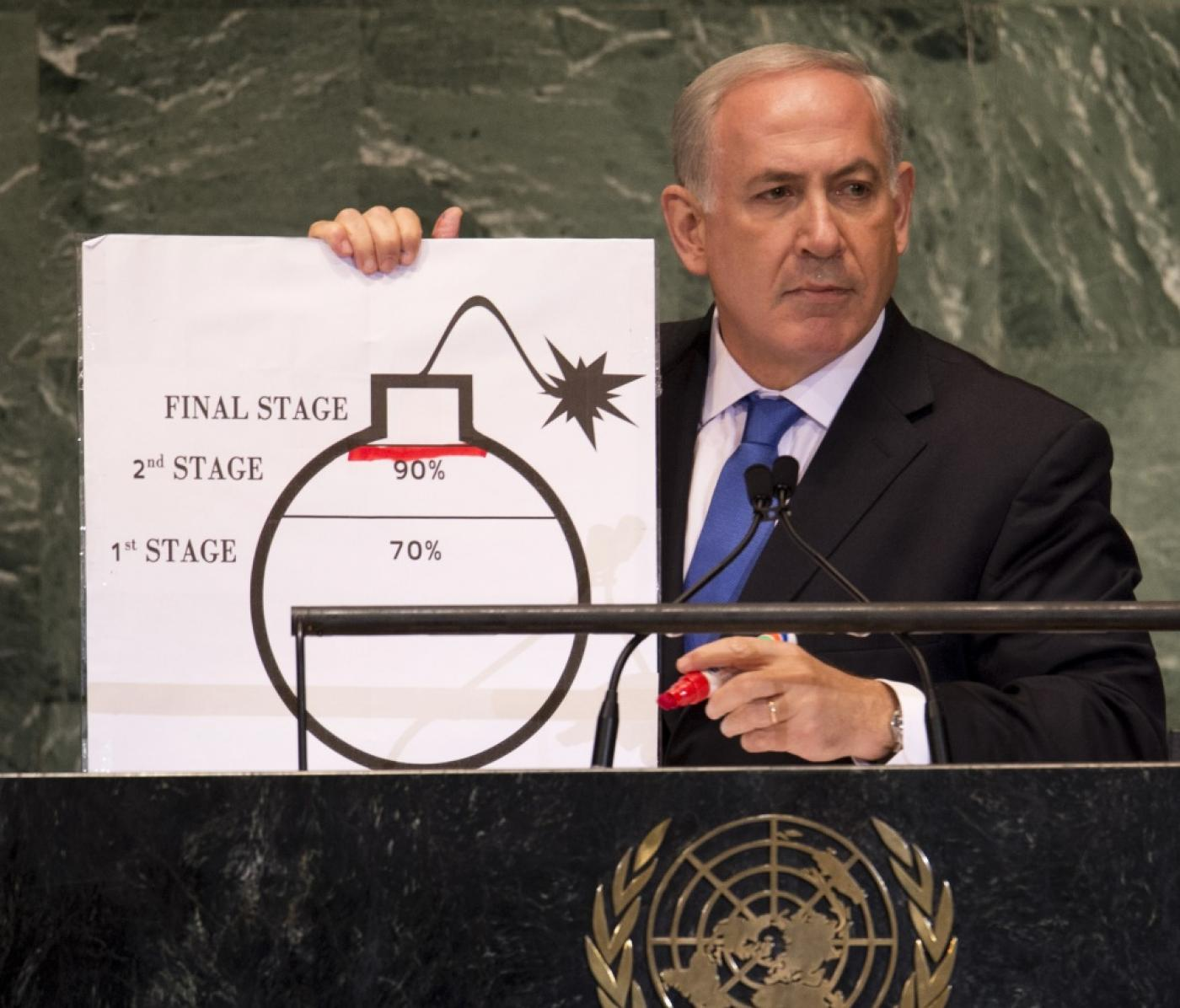
Netanyahu has worried about Iran for 33 years and yet the Iranians never developed a nuclear bomb, even though it clearly had the expertise and means to do so. Instead, Iran adhered to its commitment to the Non-Proliferation Treaty and refused to take that path, despite being surrounded by nuclear powers: Russia to the north, China to the east, India and Pakistan to its southeast, Israel to its west, and US air and sea forces parked in the Mediterranean, the Persian Gulf, and in bases in Oman and Bahrain. Netanyahu went so far as to bring a visual aid to the UN General Assembly to communicate his fears about Iran.
We should be clear about what Netanyahu regards as an “existential threat”. Does Netanyahu actually believe that Iran would drop a nuclear bomb on Israel, killing millions of Palestinians in the process? One cannot dismiss the possibility that at some point there will be an Iranian regime that would commit such a heinous crime. But one would have to offer more evidence of Iranian indifference to human life to persuade me that such an outcome was likely. There are currently nine nuclear powers in the world and some of them engaged in reckless propaganda (“godless communists” and “capitalist running dogs” are two of my favorites) that is roughly comparable to Iranian propaganda (“America is Satan”). But none of these states, except for the US, has ever dropped a nuclear bomb
The existential threat that Netanyahu fears is the possibility of Israeli self-deterrence in the face of a nuclear Iran. Nuclear threats are taken seriously by civilian populations and are effective even when palpably implausible. The US threatened nuclear war against China in 1956 over two insigificant islands (Quemoy and Matsu) which were controlled by the Republic of China, now known as Taiwan. Similarly, the US refrained from arming Ukraine with advanced weaponry after Russian President Putin started referring to Russian nuclear capabilities. Israel currently has a free military hand in Lebanon, Syria, the Gaza Strip and the West Bank, and it has used that advantage to its benefit after the attacks of 7 October. A nuclear-armed Iran, however, might restrain Israeli military power just by posing the possibility of a nuclear attack, forcing the Israeli people to ask the question “Is dropping more bombs on the Gaza Strip worth risking nuclear annihilation?” States are reluctant to gamble on their existence, even when the odds are in their favor. An Israeli government may not want to be constrained by an Israeli population afraid of a nuclear attack. And that fear is the real existential threat to Israel.
The last few weeks have been confusing. There were statements that the US wanted to restart the negotiations to revive the JCPOA, but refused to entertain the possibility that Iran would be allowed to enrich Uranium, a right guaranteed by the Non-Proliferation Treaty and the JCPOA. The precipitating event for the Israeli attack on Iran was the Iranian decision on 13 April to enrich its Uranium far beyond the traditional limit of 20% which is considered essential for civilian nuclear power purposes (Iran believes that it makes more money selling its petroleum rather than burning it for energy purposes). But the Stockholm International Peace Research Institute interpeted this decision quite differently than one designed to build a nuclear bomb:
‘On 13 April, Iran announced its intention to enrich uranium to 60 per cent U-235. This was characterized by Iran as a response to a sabotage of its vast underground enrichment cascades at Natanz two days before. The move comes against the backdrop of sensitive negotiations happening in Vienna aimed at rescuing the 2015 Iran nuclear deal, the Joint Comprehensive Plan of Action (JCPOA), and bringing the United States back into compliance with the deal…
“Uranium enriched to 60 per cent cannot be used to make a useful nuclear explosive device, and Iran has no other realistic use for this material.
“Nevertheless, 60 per cent was not an arbitrary choice. Cascades of centrifuges are designed to enrich uranium in steps; Iran’s centrifuges are likely set up to enrich up to 20 per cent, from 20 to 60 per cent, and from 60 to 90 per cent. Assuming the 60 per cent-enriched uranium is stored in the form of uranium hexafluoride (UF6) gas—and there would be no point in Iran converting it to any other chemical form—the enrichment step from 60 per cent-enriched to weapons-grade uranium is very short.
“This strongly suggests that Iran’s decision was intended to send a political message: ‘We have gone as far as we can go in response to provocations without producing weapons-grade uranium.’”
One needs to appreciate the position of Iran after Trump pulled the US out of the JCPOA: it was placed under punishing sanctions which have severely damaged the Iranian economy and was not offered any way to remove those sanctions without giving up its right to enrich Uranium. The question we need to answer is whether the decision to enrich Uranium to 60% actually signaled an intent to build a nuclear bomb. Trump’s Director of National Intelligence, Tulsi Gabbard, was explicit on this question: “In March, Gabbard testified on Capitol Hill that the U.S. ‘continues to assess that Iran is not building a nuclear weapon and Supreme Leader Khamenei has not authorized the nuclear weapons program he suspended in 2003.'” Trump insisted that Gabbard was wrong, but that is not the first time he has disagreed with his own intelligence services.
We should also think about Trump’s decision to declare war on Iran in the context of the US Constitution. Only Congress has the right to declare war: “Article I, Section 8, Clause 11 states that Congress has the power to declare war. Initially, the draft of the Constitution granted Congress the power to make war. There were suggestions to give this power solely to the President, solely to the Senate, or to both the President and the Senate. However, the Framers decided that involving both the President and Congress addressed their concerns. They didn’t want just one person to decide something so significant, nor did they trust a single branch alone.” The wisdom of the writers of the Constitution has been lost. Iran did not attack the US, so the US claim of self-defense is hollow. Nor does Iran have any ability to hit the US mainland with a nuclear bomb or any conventional bomb. Iran does pose a threat of terror attacks on US citizens, but such threats are better dealt with by local officials and not the US military.
Now the US and Iran are in a state of war. Iran does not need to declare war on the US for a state of war to exist–the US attack on Iranian territory constituted a state of war. For example, the US declared war on Japan after the Pearl Harbor attack, but Roosevelt wanted to focus on fighting Germany immediately (he didn’t have much choice since the US fleet was at the bottom of the Pacific and therefore didn’t have the ability to fight Japan immediately). Foolishly, Hitler declared war on the US first, relieving the US of the need to make a decision about declaring war against Germany. Now that the US has created a state of war, it is imperative to ask the question: What are the US war objectives?
The US is still committed to preventing the Iranians from developing a nuclear bomb. We have yet to see whether the US attack effectively destroyed Iranian capabilities. Trump declared that the facilities had been “completely and totally obliterated” but we have no way to confirm that assessment (it’s not clear on what evidence he based this assertion). More importantly, there is no way for the US to destroy the knowledge that Iran has about building a bomb. That knowledge will endure if the Iranians want it to endure. At best, the US and Israel have gained some time derailing Iran nuclear intentions, but to maintain that respite, Israel and the US will have to keep bombing Iran anytime there is a suspicion that Iran is engaged in nuclear-related activities.
Unless, of course, that the Israeli and US intention is to force regime change in Iran in order to prevent any government that would attempt to build a bomb. The US has often forced regime change (Iran 1953; Guatemala, 1954; the Dominican Republic in 1965; Grenada, 1983; Panama, 1989; and Iraq in 2003). One would be hard pressed to assert that these efforts genuinely served the US national interest. And it is more likely that the Iranian people will want a more aggressive regime given the humiliation inflicted on them by the Israeli and US attacks. They may welcome a new regime that is less stringent in terms of personal conduct. But given the obvious failures of the current regime to prevent the wholesale leakage of Iranian secrets, it is more likely that Iranians would support greater scrutiny (how else does one explain the precision Israeli attacks against specific military and scientific individuals in early June? Someone was telling the Israelis names, addresses, and times, and it is likely that the Iranians will direct most of their efforts to uproot those spies).
I suspect that the Iranians will do two things. First, they will announce their withdrawal from the Non-Proliferation Treaty which allows states to abrogate the treaty after 90 days of warning. Since Israel and the US did not believe that Iran was adhering to the treaty, the repercussions of such a move would be small diplomatically. There will, however, a great deal of negative press for the Iranians, but both the US and Israel have muzzled the press on this matter already. Leaving the NPT would end the pretense that a nuclear weapon is not necessary for national defense against nuclear powers. Iraq proved that nuclear weapons are the only way to prevent an invasion, and North Korea proved that breaking the NPT does not preclude engagement with nuclear powers. Furthermore, the Iranians do not have a choice unless they wish to submit to the dictates of Israel–their previous strategy of relying on proxies and air defenses was an abject failure. Israel has forced the Iranian hand on this matter.
Second, Iran will likely make noises about shutting down the Strait of Hormuz, a narrow channel through which 40% of the world’s exported petroleum passes. Noises could go from verbal threats to actually blocking the channel with sunken vessels. The threats are probably sufficient to force insurance rates for oil-carrying cargo shops to skyrocket. That alone would focus the attention of India, Europe, and China on finding a better solution to this state of war. Moreover, it would force Saudi Arabia and the Gulf States to gauge their interests less in alignment with the interests of the US. Finally, a spike in oil prices would doom Republican chances in the mid-term elections in 2026.
For me, the most unfortunate aspect of this remarkable event is that allowing this war to be declared unilaterally by the President has insulated US foreign policy from democratic processes. Foreign policy has almost always been determined by small groups of people (did you notice that as Trump delivered his speech at the White House announcing the bombing, he was flanked by Hegseth, Rubio, and Vance?), and moving foreign policy in the democratic process was an arduous and difficult process which began with the Vietnam War. That process was never completed and today it seems to be unattainable.
The video below is chilling, and I honestly could not believe it when I first saw it. According to The Guardian:
“Rumeysa Ozturk, a doctoral student in Boston detained on Tuesday by federal immigration agents in response to her pro-Palestinian activism, was on Wednesday evening being detained at the South Louisiana Ice processing center, according to the government’s Immigration and Customs Enforcement (Ice) detainee locator page.
“The transfer of Ozturk, a PhD student at Tufts University, appeared to violate a federal court order from Tuesday, which directed the Department of Homeland Security (DHS) and Ice to give the court 48 hours’ notice before attempting to take her out of Massachusetts.
“After Ozturk’s transfer to Louisiana emerged from the online locator, the federal judge ordered DHS and Ice to respond to an emergency request in court on Wednesday to produce Ozturk, by 9am ET on Thursday.”
The article cites an ICE official who claimed that Ozturk’s student visa (she is a Fulbright scholar at Tufts) was revoked because of her purported support of Hamas and not because she had committed any crime.
The thuggish nature of this action was clearly calculated to intimidate. The message is clear: if a student shows any sympathy for Palestinians, she cannot assume that she will be afforded the right of free speech. This action is not isolated and it is consistent with the Trump Administration’s conflation of anti-semitism with support for the right of self-determination for the Palestinian people.
The video should provoke outrage among those who believe in the First Amendment. So far, it has been overshadowed by the firestorm over the critical security failure of the Trump foreign policy team. But we should all imagine ourselves in Ozturk’s shoes and how dangerous the deportation policy is to the freedoms of citizens and non-citizens.
We are witnessing a very strange event in political history. Under the pretext of eliminating “waste, fraud, and abuse”, the Trump Administration is attempting to deconstruct most parts of the government, leaving the Executive Branch the sole repository of power in the US. The strategy is to completely erase any institutional support for the process of checks and balances that the Constitution requires to work properly.
The maneuver clearly intends to reduce the power of the Congress and the Courts. I suspect that the courts will try to preserve their power, but courts lack enforcement powers. Trump’s behavior in courts during 2020-24 suggests that he is more than willing to exploit that weakness through delay and manipulation of the legal process. If push comes to shove in the courts, it is only the Congress that can levy penalties to induce changed behavior.
Which raises an interesting question: why are Republican Congresspeople and Senators willing to give away their principal authority which is to allocate money to keep the government going? It is rare to witness the voluntary forfeiture of power. The immediate answer to this question is that these Republicans fear the power of Trump to oust them through primaries. But this begs the question. If the Federal government is eviscerated, then many of the constituents of these Congresspeople will suffer badly and are likely to take out their anger in an election. This outcome is highly probably if the cuts to the Federal government diminish the benefits of Medicare, Medicaid, Social Security, and other social programs. Why is the fear of Trump greater than the fear of angry voters?
I will put my money on the people if the cuts happen quickly, before Trump can defang Federal enforcement of the Constitution. There is a reason Trump went after USAID first–most Americans have little idea of what USAID does. But going after USAID will not fund the tax cuts that the President wants–it is a small amount of money relative to the overall budget.. The budget deal being contemplated by the Republican caucus must go through a process called reconciliation which has strict rules permitting a budget to pass with only 51 votes and not the 60 votes in a Senate with a filibuster rule. Once the American people feel the pain of what it means to lose the Federal government, they may have second thoughts about supporting Trump and those in the Congress who support him.
We will have to see. The budget must be submitted by 14 March and there are still large divisions within the Republican Party about how the budget should be structured. The deficit hawks in the House of Representatives will demand spending cuts that would require cuts in the most important programs affecting the well-being of Americans, such as Social Security and Medicaid. A month is not enough time to work out these fundamental disagreements since the main members of the Freedom Caucus live in gerrymandered districts and have little to fear from Trump’s threats of being primaried. We will see how this works out.
The Trump Administration refuses to accept climate change as real. Its ignorance of the facts is breathtaking as is its determination to make sure that no agency of the Federal Government even hints that climate change is occurring. The Guardian reports:
“Donald Trump’s administration has started to remove or downgrade mentions of the climate crisis across the US government, with the websites of several major departments pulling down references to anything related to the climate crisis. Climate scientists said they were braced ‘for the worst’.
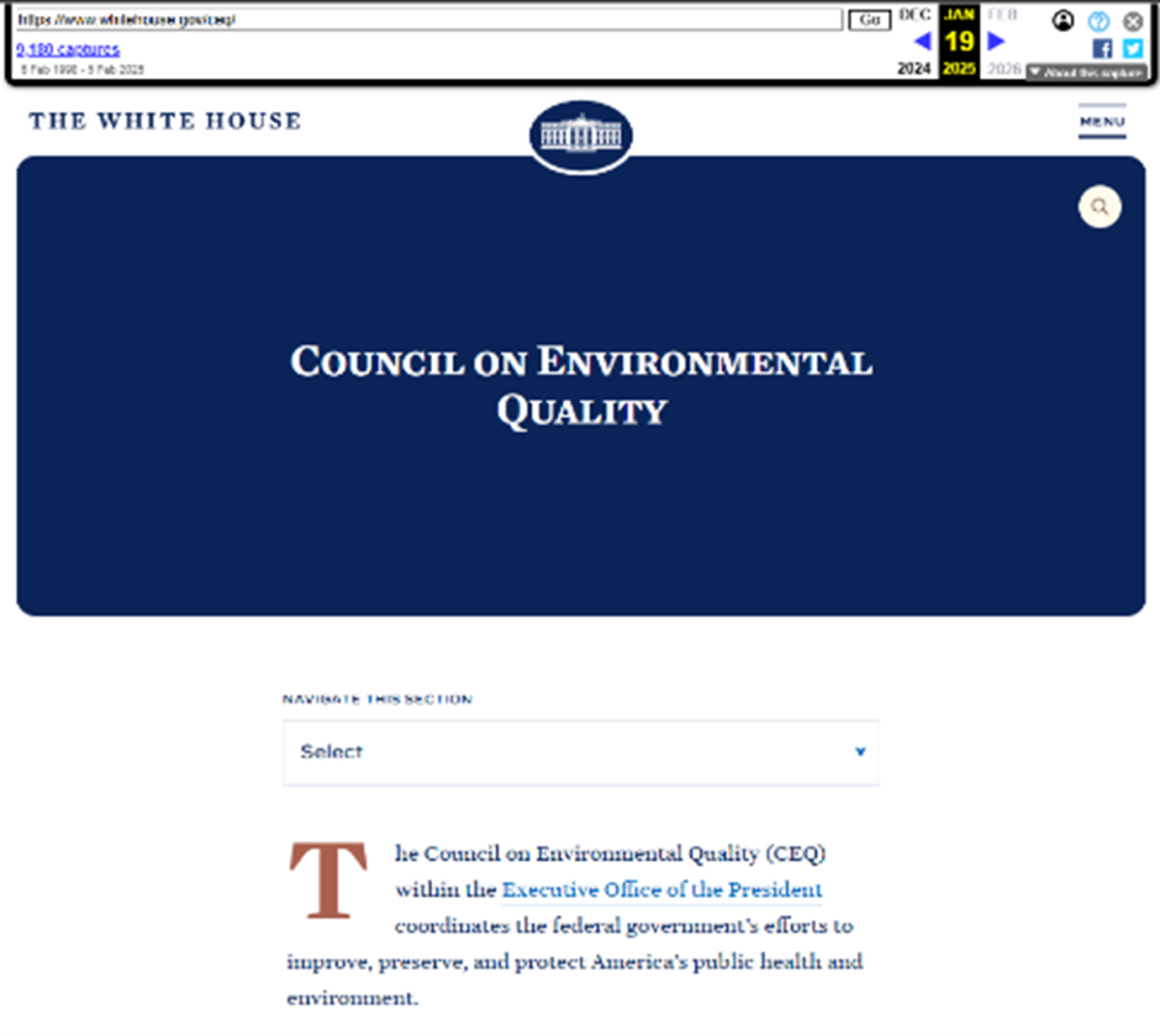
“A major climate portal on the Department of Defense’s website has been scrapped, as has the main climate change section on the site of the Department of State. A climate change page on the White House’s website no longer exists, nor does climate content provided by the US agriculture department, including information that provides vulnerability assessments for wildfires.”
“An entire section on ‘climate and sustainability’ hosted by the Department of Transportation has now vanished, with the department’s new leadership also ordering the elimination of any policy positions, directives or funding ‘which reference or relate in any way to climate change, ‘greenhouse gas’ [sic] emissions, racial equity, gender identity, ‘diversity, equity and inclusion’ goals, environmental justice or the Justice40 initiative’.”
The purging of information is truly extraordinary. The White House pages on the Environment were changed in a matter of days. Trump is practicing an ancient practice of the Roman Empire known as damnatio memoriae in which the names of hated enemies were erased all over the Empire.
White House Page on the Environment after Trump’s Election
19 January 2025 and 5 February 2025
The facts, however, are hard to deny. Last January was the hottest month ever recorded, inexplicably far hotter than predicted by climate models (although 2025 is likely to be cooler than 2024 due to the influence of the La Nina emerging in the Pacific). The data about warming temperatures are compelling.
As much as the Trump Administration would like people to forget about climate change, it is doubtful that degree of amnesia is possible given the dramatic changes in weather over the last few years. Perhaps the most conccrete example of how formidable that reality is can be found in the insurance industry’s reaction to climate change. First Street, a climate risk financial modeling company, estimates that “human-driven climate change could result in $1.47 trillion in net property value losses from rising insurance costs and shifting consumer demand”. Additionally, the US now joins Iran, Libya. and Yemen as the only countries that are not part of the Paris Accords.
It is important that we understand completely the abject failure of the Republican Party. The people who wrote the Constitution knew that a person like Trump was a real possibility–their experience with King George made them acutely aware of the danger of consolidating power in the hands of one person. To prevent this from happening they employed the idea of checks and balances to prevent such concentrations. Their logic was straightforward: since the lust for power could not be eliminated, they decided to distribute power in three branches of government and assumed that the lust for power in these three branches would be counterbalanced.
The system is not infallible, but it worked for most of the country’s history, the most recent example being the proceedings against President Nixon in 1973. Members of Congress protected the prerogatives of Congress and the Courts held that the President’s power was not unlimited. We are now witnessing the complete collapse of the willingness of the Congress to curtail Trump’s actions, such as the attacks against USAID which is an office created through Congressional action. Rather than telling Trump that he should seeks a law to reorganize USAID, the Republicans in Congress are simply abdicating their sworn duty. The sad fact is that the Republican Party now loves power more than it loves the Constitution or the Republic.
This reality is profoundly unsettling and augurs ill for the future of the country. I am convinced that there will be a backlash against Trump’s actions eventually, but much damage has already been done to our faith in the integrity of our political institutions. The decline in respect for the Supreme Court is just one example of something that will be difficult to restore.
Moreover, the previous Congress, the 118th, was the least productive in recent history: “The 118th Congress is on track to being one of the least functional sessions ever, with only 34 bills passed since January of last year, the lowest number of bills passed in the first year of a congressional session since the Great Depression, according to congressional records.” In place of legislation, the Republicans in Congress are content with a flurry of Executive Orders that clearly infringe upon the duties of Congress.
The Republican Party should be well advised to pay attention to a revised aphorism: Hell hath no fury greater than a people betrayed by their Savior.
President Trump and his Press Secretary, Karoline Leavitt, both claimed that President Trump had “identified and stopped $50 million being sent to Gaza to buy condoms for Hamas”. I was struck by this curious claim since the US has not been sending money to Hamas and decided to explore whether the claim was true.
It turns out that the US had sent $102 million to the International Medical Corps which had received $68 million to set up two field hospitals in the Gaza Strip. When queried, the organization responded that “No US government funding was used to procure or distribute condoms”. The organization described its role in Gaza as follows:
“Since January 2024, the statement said, the organization “has provided healthcare to more than 383,000 civilians who had no other access to services or treatment, including performing about 11,000 surgeries, with one-third of those categorized as major or moderate procedures. We have assisted in the delivery of some 5,000 babies, about 20% of them via cesarean section. In addition, International Medical Corps has screened 111,000 people for malnutrition, treated 2,767 for acute malnutrition, distributed micronutrient supplements to 36,000 people, and more.” Needless to say, all such activities in Gaza will no longer be funded by the US.”
“As the Guardian reported on Tuesday, a comprehensive report issued in September by the US Agency for International Development (USAid), not a penny of the $60.8m in contraceptive and condom shipments funded by the US in the past year went to Gaza. In fact, the accounting shows, there were no condoms sent to any part of the Middle East, and just one small shipment, $45,680 in oral and injectable contraceptives, was sent to the region, all of it distributed to the government of Jordan.”
Subsequent posts on X indicated that the money was in fact sent to Gaza to prevent sexually transmitted diseases. But the Gaza referenced in that $83 million grant was not the Gaza Strip, but rather a province in Mozambique named Gaza which was developed by the Elizabeth Glaser Pediatric Aids Foundation. The province has a high incidence of AIDS, so it makes sense to send concoms there. There is also a town called Gaza in Iowa–perhaps they received the condoms (one should check out Gaza, Iowa on Google maps–it looks like a lonely place).
Trump and Leavitt told a falsehood. I spent two hours trying to track down whether the assertion was true and used the reports from others who did the same. It was wasted time because there are now millions of Americans who believe that the US sent $50 million of condoms to a terrorist organization. But it was not really wasted because I wrote this post and some Americans now know that Trump lied.
Today honors Dr. Martin Luther King for his role in protecting the civil rights of every American. His genius was in understanding his audience. When he delivered his “I Have a Dream” speech in Washington, DC in August 1963, he knew that his primary audience was white Americans and his objective in the speech was to make civil rights palatable to those who refused to grant equal rights to black Americans.
The speech came in two parts. The first was written out and he followed the script, laying out how the idea of equal rights was the bedrock of the Constitution even though the actual text of the Constitution institutionalized slavery. It is a careful and patient outline of how the black population has been denied civil rights by segregation and Jim Crow laws. This part of the speech was to make universal civil rights consistent with the values and ideals of the United States. Because it was written out, the first part of the speech relied upon logic and evidence and suffered from the typical flaws of a speech that was read and not delivered.
The second part was not written out but was a speech that he had often given to black Americans and it begins about 10 minutes in the video below. This part of the speech demonstrated the power of the spoken word and the full meaning of rhetoric. Mahalia Jackson, a gospel singer and close associate of King, encouraged him to leave off the logic and to rely upon the emotions that flow from a sense of liberation. She gave King the license to treat white America to the true feelings of black Americans:
“The story that has been told since that day has Mahalia Jackson intervening at a critical junction when she decided King’s speech needed a course-correction. Recalling a theme she had heard him use in earlier speeches, Jackson said out loud to Martin Luther King Jr., from behind the podium on the steps of the Lincoln Memorial, “Tell them about the dream, Martin.” And at that moment, as can be seen in films of the speech, Dr. King leaves his prepared notes behind to improvise the entire next section of his speech—the historic section that famously begins “And so even though we face the difficulties of today and tomorrow, I still have a dream. It is a dream deeply rooted in the American dream….”
The result was one of the most powerful speeches in American history and a genuine turning point in the fight for civil rights. And the speech led to the Civil Rights Act of 1965 which laid the foundation for a more substantive understanding of what rights are. Those rights have since been extended to the rights of women and the gay community. More work needs to be done enhancing the rights of transgender individuals, disabled people, immigrants, and refugees. But King made these developments possible, and Americans should be grateful to King, and all those who supported him, for leading the way.
President Biden, in his final address to the nation as President, warned citizens against the danger of living in an oligarchy: “Today, an oligarchy is taking shape in America of extreme wealth, power and influence that literally threatens our entire democracy, our basic rights and freedoms, and a fair shot for everyone to get ahead.” He was not the first President to warn of this danger. John Adams, in a letter to Thomas Jefferson, wrote the following:
“9 July 1813
“Your “” [aristocrats] are the most difficult Animals to manage, of anything in the whole Theory and practice of Government. They will not suffer themselves to be governed. They not only exert all their own Subtilty Industry and courage, but they employ the Commonalty, to knock to pieces every Plan and Model that the most honest Architects in Legislation can invent to keep them within bounds. Both Patricians and Plebeians are as furious as the Workmen in England to demolish labour-saving Machinery.
“But who are these ““? Who shall judge? Who shall select these choice Spirits from the rest of the Congregation? Themselves? We must first find out and determine who themselves are. Shall the congregation choose? Ask Xenophon. Perhaps hereafter I may quote you Greek. Too much in a hurry at present, english must suffice. Xenophon says that the ecclesia, always chooses the worst Men they can find, because none others will do their dirty work. This wicked Motive is worse than Birth or Wealth. Here I want to quote Greek again. But the day before I received your Letter of June 27. I gave the Book to George Washington Adams going to the Accadamy at Hingham. The Title is a Collection of Moral Sentences from all the most Ancien[t] Greek Poets. In one of the oldest of them I read in greek that I cannot repeat, a couplet the Sense of which was
“‘Nobility in Men is worth as much as it is in Horses Asses or Rams: but the meanest blooded Puppy, in the World, if he gets a little money, is as good a man as the best of them.’ Yet Birth and Wealth together have prevailed over Virtue and Talents in all ages. The Many, will acknowledge no other ““. Your Experience of This Truth, will not much differ from that of your old Friend.”
Most Americans are unfamiliar with the word “oligarchy” since the Republic has tried very hard since its inception to convey the sense of equality best expressed in Jefferson’s Declaration of Independence. It would be years before any American President emphasized the idea of equality over that of freedom. Lincoln did so in his second Inaugural Address. For the first time, an American President declared that slavery was incompatible with the values of the American people, notwithstanding the inclusion of slavery in the Constitution.
An oligarchy is a political system in which the wealthy direct the machinery of government to protect and enhance their interests as opposed to the interests of the citizenry. Brooke Harrington, a Sociology Professor at Dartmouth College wrote this for the Washington Post at the beginning of Trump’s first term:
“There are no laws against a president and his super-wealthy Cabinet using their power to benefit their own class. There is nothing that compels them to look beyond their privilege to address the needs of the citizenry.
“The problem with these prospective leaders is not their money. It’s that they — like Trump — seem more interested in what their country can do for them than in what they can do for their country.”
The concentration of wealth in the second Trump administration is staggering. The following table gives an idea of how concentrated wealth has become in recent years. Many of the people listed, like Musk, Bezos, and Zuckerberg, have actively solicited Trump on various matters and represent business interests that clearly constitute conflicts of interest with a number of important policy issues like freedom of speech in a digital world.
Source: Bloomberg, “Bloomberg Billionaires Index”, 18 January 2025, accessed at: Bloomberg Billionaires Index, on 19 January 2025
Many of these people have contributed a great deal of money to Trump’s inauguration and several of them have been quite visible in the upcoming Trump Administration. We also have a hard time realizing exactly what these numbers represent: a billion of anything is far removed from anything we come into daily contact. One way to comprehend these numbers is to translate them into more accessible terms:
If someone made one million dollars a year, they would make about $480.77 per hour and $3,846.15 per day.
On the other hand, making a billion dollars per year would mean about $480,769 per hour and $3,846,153.85 per day.
These 20 individuals possess more wealth than most countries in the world. Indeed, there are only 7 countries with GDPs larger than $3 trillion:
There are 186 countries in the world with GDPs less than $3 trillion. The combined population of these countries comprises 56% of the global population. But 20 people have more wealth than each of the 186 countries.
Concentrations of wealth lead inevitably to a distorted political system. Adam Smith was well aware of the dangers of concentrated wealth to the public interest:
“Not only the prejudices of the publick, but what is much more unconquerable, the private interests of many individuals, irresistibly oppose it. Were the officers of the army to oppose with the same zeal and unanimity any reduction in the number of forces, with which master manufacturers set themselves against every law that is likely to increase the number of their rivals in the home market; were the former to animate their soldiers, in the same manner as the latter enflame their workmen, to attack with violence and outrage the proposers of any such regulation; to attempt to reduce the army would be as dangerous as it has now become to attempt to diminish in any respect the monopoly which our manufacturers have obtained against us. This monopoly has so much increased the number of some particular tribes of them, that, like an overgrown standing army, they have become formidable to the government, and upon many occasions intimidate the legislature. The member of parliament who supports every proposal for strengthening this monopoly, is sure to acquire not only the reputation of understanding trade, but great popularity and influence with an order of men whose numbers and wealth render them of great importance. If he opposes them, on the contrary, and still more if he has authority enough to be able to thwart them, neither the most acknowledged probity, nor the highest rank, nor the greatest publick services can protect him from the most infamous abuse and detraction, from personal insults, nor sometimes from real danger, arising from the insolent outrage of furious and disappointed monopolists.”
This pattern was present as the Roman Republic began its descent into dictatorship. It was also evident in 13th Century Venice and in late-19th Century America. It is happening again, not only in the US, but in India, Russia, China, the low-population oil producers such as Kuwait, and Brazil. It is difficult to see how democracy can persist under these conditions. Active steps must be taken to create a more just distribution of wealth globally.


 ” [aristocrats] are the most difficult Animals to manage, of anything in the whole Theory and practice of Government. They will not suffer themselves to be governed. They not only exert all their own Subtilty Industry and courage, but they employ the Commonalty, to knock to pieces every Plan and Model that the most honest Architects in Legislation can invent to keep them within bounds. Both Patricians and Plebeians are as furious as the Workmen in England to demolish labour-saving Machinery.
 a Collection of Moral Sentences from all the most Ancien[t] Greek Poets. In one of the oldest of them I read in greek that I cannot repeat, a couplet the Sense of which was


 World Politics News