Commit permanently to never pursue nuclear weapons.
Stop all uranium enrichment on Iranian territory.
Transfer all enriched uranium to the International Atomic Energy Agency (IAEA) under a defined timeline.
Decommission three major nuclear facilities: Natanz, Isfahan, and Fordow.
Allow extensive international monitoring and inspections. (Reported as part of “international monitoring” and “civilian nuclear cooperation.”)
Restrict Iran’s ballistic missile program to narrow “self‑defense” purposes.
Impose limits on missile development and testing. (Implied in multiple reports.)
End support, financing, and arming of regional proxy groups (e.g., Hezbollah, Houthis, Iraqi militias).
Dismantle Iran’s proxy network and halt all cross‑border operations.
11. Reopen the Strait of Hormuz immediately and guarantee freedom of navigation.
Commit to keeping the Strait open permanently under international norms. (Implied in multiple reports.)13.
Agree to a one‑month ceasefire between the U.S. and Iran to negotiate a longer‑term deal.
Suspend Iranian missile and drone attacks across the region during the ceasefire. (Implied by the ceasefire framework.)
Sanctions relief in exchange for compliance, including economic normalization and possible civilian nuclear cooperation
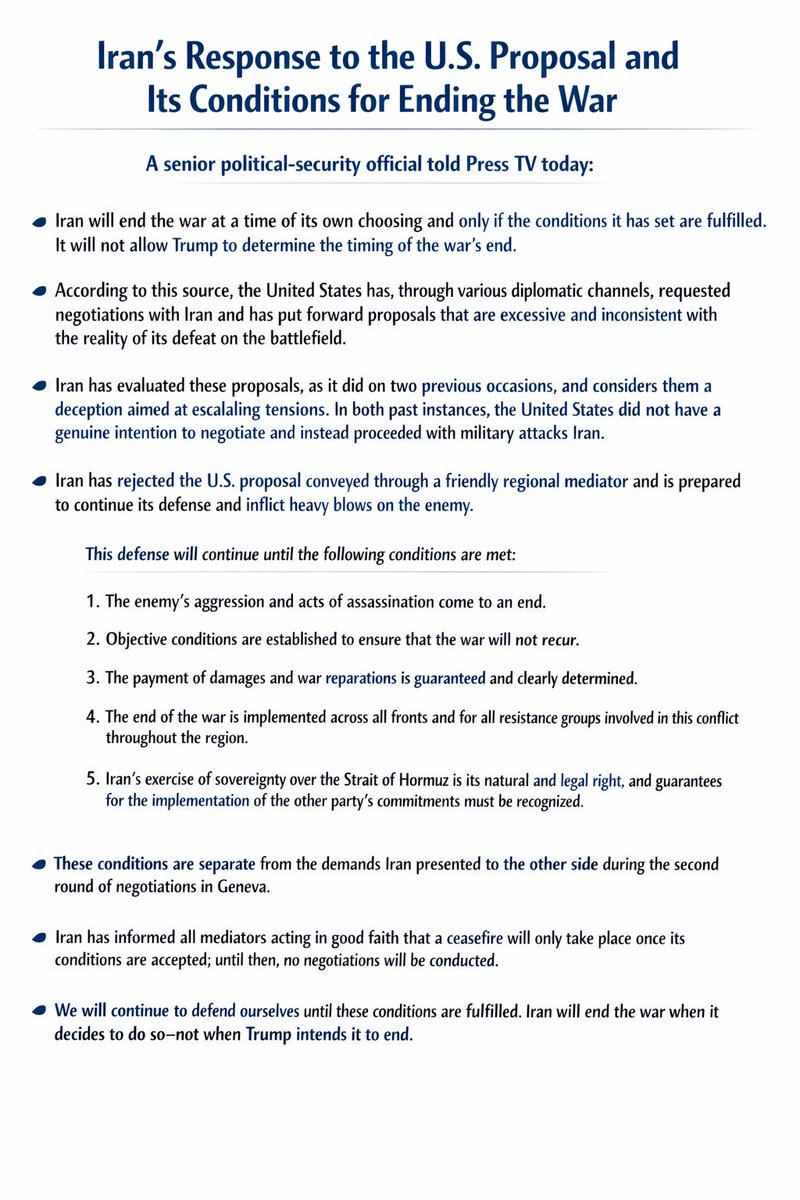
Here is Iran’s counteroffer:
These demands are not ships passing in the night; they are ships passing in different universes. There is literally no common ground in these gambits which suggests that any resolution to the war is very far away.
The US, however, is making incredible threats against Iran. According to CNBC:
“U.S. President Donald Trump said Monday that the U.S. will ‘completely’ obliterate Iran’s electric generating plants, oil wells and Kharg Island if the strategically vital Strait of Hormuz is not ‘immediately’ reopened and a peace deal is not reached ‘shortly.’
“’The United States of America is in serious discussions with A NEW, AND MORE REASONABLE, REGIME to end our Military Operations in Iran,’ Trump said in a post on Truth Social.
“’Great progress has been made but, if for any reason a deal is not shortly reached, which it probably will be, and if the Hormuz Strait is not immediately ‘Open for Business,’ we will conclude our lovely ‘stay’ in Iran by blowing up and completely obliterating all of their Electric Generating Plants, Oil Wells and Kharg Island (and possibly all desalinization plants!), which we have purposefully not yet ‘touched.’”
These threats violate the laws of war. The purpose of war is to disarm one’s enemy, not to destroy it. Total destruction of an enemy is not a legitimate objective, although many states have gone that route. We have witnessed two contemporary wars which have violated this maxim: the Russian assault on Ukraine and the Israeli assault on the Gaza Strip. It seems as if states have become intoxicated with the destructiveness of their weaponry. Wars against the civilian populations is easy, but abhorrent–non-combatants have no defenses and pose no threat to a state’s military.
The reason why international law forbids wars against civilians is because such brutal actions often lead to conflicts that cannot be resolved by diplomacy. When the civilian populations feel aggrieved, restraints on war are difficult to achieve. War is not slaughter–we can slaughter people in all sorts of ways, and nature does a pretty good job of attacking civilians through hurricanes, wildfires, and earthquakes. But slaughter is not a political objective. It is the objective only for those who feel hatred and a need to shed blood vindictively. These attitudes do not lend themselves to an honest resolution of disputes.
“When it was over, Scipio began to weep and publicly lament the misfortune of the enemy. Polybius asked him why he was weeping and he compared the fate of Carthage to that of Troy. He spoke the words of Homer:
“The day shall come in which our sacred Troy and Priam and the people whom spear-bearing Priam rules, shall perish all.”
“Polybius asked him what he meant by this and he said ‘When I consider the mutability of human affairs, I fear that someday this may also be the fate of Rome.’”
Scipio understood well the dynamics of hate and how it should have no place in the conduct of war. All wars should be fought with an eye toward attaining the conditions that will re-establish peace.
The Trump Administration is asking for an extra $200 billion for its operations in Iran. That number is in addition to the $1 trillion defense department budget already authorized. The request also comes as the evidence seems to indicate that the Administration is seriously thinking about sending ground troops into the battle.
Regardless of how one defines the threats to US national security, it seems clear that the US already spends an incredible amount of money on the ability to wage war. It is hard to assess how realistic this sum is given that the US and its allies already spend significantly more than their primary opponents.
More importantly, Trump is asking for 20% more to prosecute a war that has not been approved by Congress, despite the Constitution’s clear delegation of the power to declare war to the Congress.
The Congress should refuse to authorize the money.
Trump claims that he the power to wage war because his authority as Commander in Chief gives him the right to do so in the face of an “imminent” threat, which assumes that the Congress might not have the necessary time to declare war.
That claim is nonsense. Israel and the US had been panning this war for months before the first bomb was dropped. The plans to attack Iran were not created suddenly in 2026. They were built on years of contingency planning, sharpened by the June 2025 war, and finalized in the months leading up to February 2026 as diplomacy collapsed. Moreover, the “imminence” the asserted Iranian attack was based upon Trump’s assertion that Iran was “weeks” away from developing a bomb. According to FactCheck:
“A week before the recent military operation, on Feb. 21, Trump’s special envoy to the Middle East, Steve Witkoff, was more definitive in describing a time frame for Iran’s nuclear ambitions. Witkoff said in a Fox News interview that while Iran says that its nuclear capability is “about their civil program … they’ve been enriching well beyond the number that you need for civil nuclear. It’s up to 60%. They are probably a week away from having industrial-grade bomb-making material, and that’s really dangerous.” But experts told us it would likely take months for Iran to enrich uranium to that level and then much longer before the “bomb-making material” could be made into a weapon.
“Daryl G. Kimball, executive director of the Arms Control Association, a nonpartisan organization that provides analysis on arms control and national security issues, told us that “it is clear that it would take Iran years to fully rebuild its enrichment plants” that were bombed in June 2025. ‘It is possible that Iran may have a very small number of operational centrifuges somewhere undisclosed,’ Kimball said. ‘But it would still take months for a smaller number of centrifuges to accomplish what thousands of centrifuges at these major facilities could’ve done,’ which would be to enrich small amounts of uranium to weapons-grade level and then turn it into metal to be used for a weapon. ‘It would take longer to fashion a nuclear explosive device.’”
Trump has no authority to wage war under these circumstances, and Congress should assert its Constitutional role. It runs the risk of implicitly declaring war by passing this supplemental budget which is targeted toward military operations against Iran. In the same way, President Lyndon Johnson used the Gulf of Tonkin Resolution to justify the war in Vietnam, even in the absence of a Declaration of War.
If the supplemental budget is not approved, the Republicans will argue that the action will jeopardize the safety of American troops. That argument is ridiculous. We can put the budget request in context with other states:
First, the Department of Defense has a budget of over a trillion dollars.
Current forecasts put the US Defence Spending for 2024-25 somewhere between $895 billion and $1.04 trillion.
The likely range dwarfs anything else by a margin most people still find surprising. Take the figures below, which come from the same set of Congressional projections.
China: $224 billion.
Russia: $109 billion.
India: $73 billion.
United Kingdom: $71 billion.
When one averages these numbers, US outlays alone account for roughly 40 per cent of all defence money spent around the planet.
It is hard to believe that the Defense Department is bankrupt, particularly since it is notorious for never passing an audit of its expenditures in its entire history. If one wants to see how the DoD spends money foolishly, one should check out this information provided by the Center for Arms Control and Non-Proliferation.
Second, the Congress should demand greater clarity on the purposes of the invasion and the conditions for ending the war. We have been treated to a variety of explanations for the war. Additionally, the Congress should outline what cuts it is willing to make in the current budget so that the American people will know how their money is being spent. Specifically, the supplemental request should be framed in the context of domestic programs that have been cut. For example, the recent cuts to the Affordable Care Act (Obamacare) totaled approximately $92 billion in ACA subsidies–half of the supplemental budget request. Plenty of money to kill people; limited money to heal them.
Third, opponents of the war should advance a simple peace plan: revive the Joint Comprehensive Plan of Action (JCPOA) which all analysts regarded as an effective check to Iranian nuclear ambitions. If Iran agrees to rejoin the plan, then the US should lift all sanctions on Iran. Plenty of problems remain in the US-Iran relationship, but at least the “imminent” threat will be defanged.
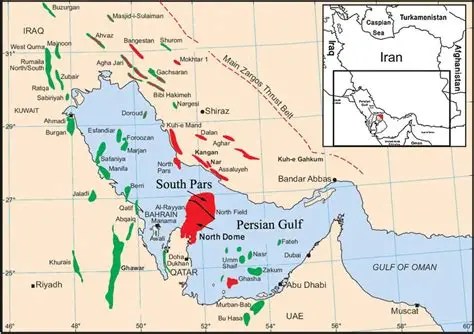
There is news coming in about the war against Iran which I think is of great magnitude. Israel has attacked the South Pars Natural gas fields that are jointly managed by Qatar and Iran. That field is the largest natural gas field in the world and many states, particularly in Europe, are depending on natural gas as they make the transition to green energy since it is more environmentally friendly than coal and oil. Additionally, Europe used to buy a lot of natural gas from Russia, but that has deteriorated as the Ukrainian conflict rages on.
South Pars Natural Gas Field
The Israeli attack crossed a profound redline. When Trump decided to bomb Kharg Island, which is where most Iranian oil is offloaded into tankers for sale abroad, he was careful to state that the US had not attacked any of the oil facilities on the island. That tactic is a critical factor. One can bomb the infrastructure of a state, its military installations, and even (unfortunately) civilian sites. But oil and natural gas are the only commodities that most of the Gulf States can export for profit. There has always been an implicit rule of war in the Middle East to not damage the oil and gas fields because such attacks pose the threat of economic catastrophe. In other words, attacking oil and gas fields is the economic equivalent of nuclear war to the oil producing states in the Gulf Region.
“After the strike on the South Pars gas field, Iran said energy infrastructure in Qatar, the United Arab Emirates and Saudi Arabia would now be considered legitimate targets.The strike on South Pars was “dangerous & irresponsible,” Qatar’s Foreign Ministry spokesman, Majed al-Ansari, said in a post on X.
“Iran’s state-run Press TV reported later on Wednesday that the country’s armed forces had struck ‘US-linked oil facilities in the region in retaliation for attacks on Iran’s oil facilities.’ Qatar’s state oil company said in a social media post that Ras Laffan Industrial City, a hub for exports of liquefied natural gas, was hit by rocket attacks. ‘Fires resulting from the attack … caused significant damage,’ QatarEnergy said.”
The Arab Gulf states are enraged, but now they are posing a very important new consideration for the world. An all-out assault on oil and gas fields would destroy the global economy for a considerable period of time. Although the world has made great progress in eliminating fossil fuels, the unfortunate fact is that those fuels since account for the bulk of economic activity in the world. This war has become one of much higher stakes than other important, but not global, issues in the current war such as the building of missiles, the funding of terror, or the enrichment of uranium.
For the Arab producing Gulf States there are unquestionably pressures to retaliate. But that course of action is not consistent with their long-term economic interests–it would lead to even more destruction of the reservoirs of oil and natural gas. And the destruction of those irreplaceable reservoirs is clearly not compatible with the interests of most people in the world. It remains to be seen whether cooler heads can prevail in this game of “chicken”. I also believe that Iran knows how counterproductive such escalation would be to its future.
The only country that has a more urgent priority than maintaining the integrity of the oil and natural gas markets is Israel. It has a more existential perspective on the war with Iran. Israel sees Iran not only as a threat to its existence, but also a threat to its military freedom in the Middle East. A nuclear armed Iran would place Israeli military actions in the region (Lebanon, Jordan, Syria, the Gaza Strip, and the West Bank) in a completely different strategic context. There are two possibilities that concern Netanyahu.
First, the real threat that Iran would blow up the state of Israel. This is not a threat that any Israeli Prime Minister could ignore, although military power is not necessarily the only way to dissuade Iran from building a bomb. But Netanyahu has chosen a military path to address the concern.
Second, and less obviously, is the possibility that an Iranian nuclear weapon would create the pressure of self-deterrence. Israel has considerable freedom of military action now because it does not face the possibility of nuclear annihilation. But would a real nuclear threat act as a deterrent even to conventional warfare? It apparently did in Ukraine, as the Biden Administration refused to allow Ukraine to procure long-range missiles because Putin had identified such transfers as a possible trigger for nuclear action. But the possibility of self-deterrence seeps down to the general population. Would Israelis have been more restrained in the Gaza Strip if Iran had had a nuclear weapon? Perhaps the citizens of Israel would have considered a different approach to responding to the horrific attacks of 7 October. If those fears are real, then those Israelis who wish to take over the lands they have occupied in the Gaza, the West Bank, Syria, and Lebanon might reconsider the costs and benefits of military action on such a broad scale.
The number of justifications offered by the Trump Administration for its attack on Iran is a hodgepodge of assertions that are not really supported by available evidence. So far, I have detected 9 reasons:
The Trump Administration’s Stated Justifications for the War on Iran
Secretary of State Marco Rubio repeatedly framed the strikes as a response to an “imminent threat” to U.S. forces or interests. This language appears designed to fit the War Powers Resolution, which allows unilateral presidential action only under extraordinary imminent danger.
There is no evidence provided except for Trump’s gut feeling. Karoline Leavitt argued that Trump “had a good feeling that the Iranian regime was going to strike”.
Officials have claimed the war aims to prevent Iran from acquiring nuclear weapons or to destroy its nuclear infrastructure. However, reporting notes that this justification has shifted, especially since the administration also claimed early on that Iran’s nuclear program had already been “obliterated.”
There is no evidence that Iran was close to building a nuclear bomb. It is also impossible to destroy the knowledge and expertise that Iranian nuclear scientists possess. Perhaps an attack would delay them, but Trump argued that he had destroyed the nuclear program a few months ago.
Another stated objective has been to destroy Iranian missile stockpiles and missile‑production facilities. This justification has appeared and disappeared in official statements, contributing to the sense of a moving target. One should remember that missiles are also a component of a space program, including launching satellites. Telling the difference between a peaceful missile and an aggressive missile is impossible.
Trump and senior officials have invoked the idea of helping Iranians overthrow their government, describing the war as a campaign for “freedom” or “liberation.”
Trump’s initial announcement video framed the operation as both a defensive strike and a call for Iranians to “take back your country.” This rationale conflicts with other statements denying that regime change is the goal.
Trump has cited “47 years of Iranian aggression”, referencing the 1979 hostage crisis, Hezbollah, Hamas, and Iranian‑backed militias. This frames the war as a long‑overdue reckoning rather than a response to a specific event. It ignores the fact that the US overthrew a legitimately elected Iranian government in 1953. A good reason for hostility.
Secretary of State Rubio suggested that Israel was preparing to strike Iran, and the U.S. intervened preemptively to avoid higher American casualties. This justification has been controversial even among Trump’s supporters, who see it as contradicting “America First.” Rubio offered no evidence for his claim, but it is believable. But why would Iran attack the US if only Israel was conducting the air strikes?
At times, officials have claimed Iran was preparing an attack on U.S. forces or assets. But other statements have conceded that Iran was not planning such an attack, further muddying the rationale.
Trump has described the mission as an effort to “destroy their missiles and raze their missile industry to the ground.” This overlaps with the nuclear and missile justifications but is framed more broadly as degrading Iran’s military capacity.
Some messaging from within the administration has invoked a religious justification, suggesting the war aligns with “God’s divine plan.” Mikey Weinstein, founder and president of the Military Religious Freedom Foundation, is quoted as following:
“This morning our commander opened up the combat readiness status briefing by urging us to not be ‘afraid’ as to what is happening with our combat operations in Iran right now,” one complaint reads. “He urged us to tell our troops that this was ‘all part of God’s divine plan’ and he specifically referenced numerous citations out of the Book of Revelation referring to Armageddon and the imminent return of Jesus Christ. He said that ‘President Trump has been anointed by Jesus to light the signal fire in Iran to cause Armageddon and mark his return to Earth.'”
Forget the fact that these justifications lack substantive evidence. The incoherence of the justifications is also a serious problem because it indicates that no one in the Trump Administration has forged a consensus on what the war is supposed to accomplish. That lack of clarity means that there is no condition which will qualify as “victory” for the US. The Iranians have identified their objective: the regime must survive. As long as the US fights this war from the air, there is essentially no way to overthrow the regime. Even the protesters are unlikely to demand the overthrow of the regime since that is tantamount to being an ally of the US and Israel. Thus, Iran wins the war simply by surviving with no change to the regime.
Israel has one clear objective: the regime must be overthrown. And Israel will follow the same playbook as it did in the Gaza Strip. The strategy is to make the Gaza and Iran unlivable. Whether Israel has enough bombs to reduce Iran to rubble is questionable. Trump likely will not support a “Sherman at Atlanta” policy (at least before the midterms). At some point Trump will have to stop Netanyahu from the scorched earth strategy. Better soon, rather than later.
It has been difficult to figure out what is happening with the war against Iran. We have been treated to a variety of possible objectives which might lead to an end to the war, but none is coalescing into a coherent policy. Trump outlined his objectives in his speech to the nation. The White House has compiled a slew of statements from all over the world to justify the war, but most of those statements do not really address the fundamental disagreements between the US, Israel, and Iran. At this point, the war is a military mismatch: Iran really has little capability to protect itself against the aerial bombardment. But one could easily have said the same thing about the North Vietnamese and the Afghans who also had few capabilities to defend themselves against the US and the Soviet Union. Nonetheless, both states succeeded in defeating more powerful states.
Trump’s speech justifying the war on 28 February takes no notice of this fact. Indeed, Trump touted the power of the US military (which is undeniable) but failed to account for the political factors that lead to victory or defeat in war. Trump also failed to offer Iran any alternative to war which might satisfy US interests. His opening remarks in the speech were hyperbolic:
“A short time ago, the United States military began major combat operations in Iran. Our objective is to defend the American people by eliminating imminent threats from the Iranian regime. A vicious group of very hard, terrible people. Its menacing activities directly endanger the United States, our troops, our bases overseas, and our allies throughout the world.”
We should be clear: there was no “imminent” threat. Iran did not possess a nuclear weapon, nor did it have missile capabilities that could directly threaten the US homeland. The war is being fought to prevent a threat in the future, a reality that belies any sense of “imminence”. The more prudent course of action would have been to engage in diplomacy to prevent these outcomes. Indeed, the Obama Administration had succeeded in forging a comprehensive policy to achieve both outcomes, the Joint Comprehensive Plan of Action (JCPOA). By all accounts, that agreement was successful in preventing Iran from developing a nuclear bomb. It was also a plan supported by Great Britain, France, China, Russia, and Germany giving it tremendous leverage and weight.
The JCPOA accomplished much: The deal imposed strict limits on Iran’s nuclear fuel cycle that directly blocked the pathways to a bomb:
Centrifuges reduced and older models required, sharply limiting enrichment capacity.
Enrichment capped at 3.67%, far below weapons‑grade levels.
Uranium stockpile cut to a fraction of what would be needed for a weapon.
Reactor redesigns at Arak and restrictions at Fordow and Natanz ensured no plutonium pathway.
These measures increased Iran’s “breakout time”—the time needed to produce enough fissile material for one bomb—to about one year, compared to just a few months before the deal.
Iran implemented the IAEA Additional Protocol, allowing access to declared and suspect sites.
Continuous monitoring and real‑time surveillance made covert diversion extremely difficult.
Experts widely regarded the inspection system as the strongest in nonproliferation history. Bottom line: During this period, Iran was not able to develop a nuclear weapon without being detected, and its technical capacity to do so was sharply constrained.
Despite its success, Trump withdrew from the JCPOA in 2018 breaking the agreement. Note: Iran did not break the agreement, a conclusion verified by on-site inspectors from the International Atomic Energy Agency (IAEA). Trump himself jettisoned the agreement that would have prevented Iran from building a nuclear bomb. The current war is therefore a consequence of Trump’s failure in 2018.
Trump’s other justifications for the war are ridiculous. He dredges up acts committed by Iran that are clearly heinous but ignores the context of the Iranian opposition to Israel and the US, most notably the fact that the US helped overthrow the Iranian government in 1953. And there are many states committing heinous crimes in the international system (the Israeli destruction of the Gaza Strip will undoubtedly go down in history as a mass atrocity).
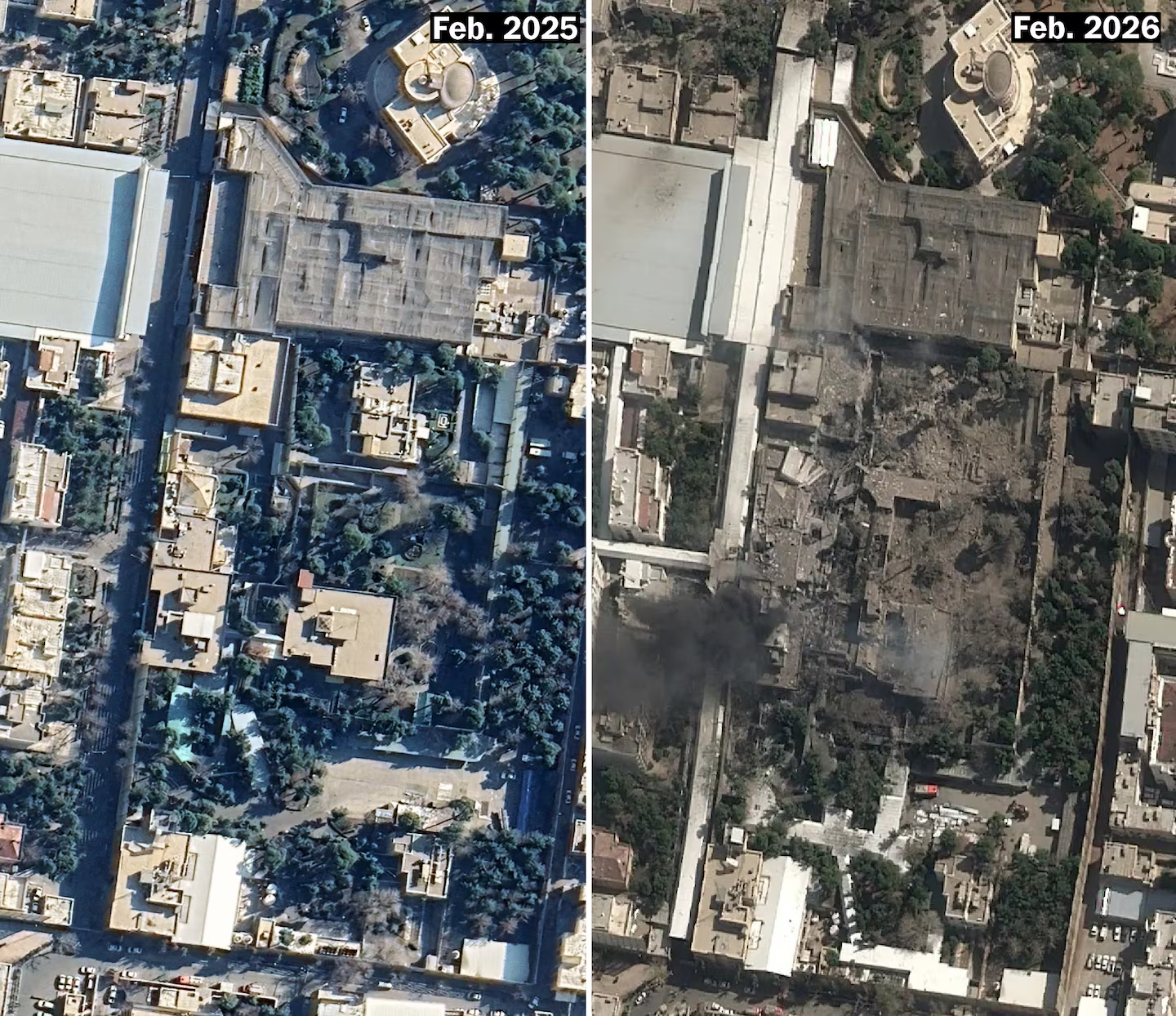
The evidence suggests that Trump was most interested in overthrowing the regime. The photographic evidence of the compound of the Ayatollah which was destroyed on the first day of the attack indicates that regime change was the highest priority. No doubt, Trump was emboldened by his “success” in Venezuela. He succeeded in removing President Maduro, but Maduro’s political infrastructure is still in power except for decisions regarding the sale of Venezuelan oil. The New York Times reports:
“’What we did in Venezuela, I think, is the perfect, the perfect scenario,’ Mr. Trump said.
“Then he offered a very different model of what the transition of power in Iran might look like, referring repeatedly to his experience in Venezuela after he ordered a Delta Force team to seize Mr. Maduro.
“His answer implied that what worked in Venezuela would work in Iran, a nation with about three times the population and a military and clerical leadership that has ruled with increasing repression since the 1979 revolution. Over the past several weeks, Mr. Trump has repeatedly brought up Venezuela as the model of a successful operation and hoped to replicate aspects of it in Iran, identifying leadership that would be more cooperative and friendly to the United States.
“But he has been told by his advisers that the vast differences in cultures and history made it virtually impossible to apply the strategy used in Venezuela — in which the existing government was kept in place, after it agreed to take instructions from Washington — and try to replicate it in Tehran.
“Nonetheless, Mr. Trump appears enamored of using a Venezuela-like model in Iran.”
Trump made two huge mistakes. First, the situation in Venezuela is nothing comparable to Iran. The Ayatollah did not rule in a vacuum. The Islamic Revolutionary Guard is a formidable political and military organization and will persist as the ruling force in Iran. It is nothing like the motley crew of sycophants that supported Maduro. Second, he ignored all the lessons about regime change. It did not work in Iran in 1953; it did not work in Guatemala in 1954; it did not work in Cuba in 1962 at the Bay of Pigs; it did not work in Vietnam in 1963; it did not work in Iraq in 2003; it did not work in Afghanistan in 2014. Outsiders can never produce legitimate new regimes and only a fool would entertain such a preposterous thought.
This fixation on regime change is perhaps the most insidious aspect of the Iranian intervention. Trump loudly asserted that he was working on behalf of those Iranians who opposed theocratic rule:
“Finally, to the great proud people of Iran, I say tonight that the hour of your freedom is at hand. Stay sheltered. Don’t leave your home. It’s very dangerous outside. Bombs will be dropping everywhere. When we are finished, take over your government. It will be yours to take. This will be probably your only chance for generations.
“For many years, you have asked for America’s help. But you never got it. No president was willing to do what I am willing to do tonight. Now you have a president who is giving you what you want. So let’s see how you respond. America is backing you with overwhelming strength and devastating force. Now is the time to seize control of your destiny, and to unleash the prosperous and glorious future that is close within your reach. This is the moment for action. Do not let it pass.”
With this pronouncement, Trump effectively de-legitimatized the protest movement in Iran. He has undermined the authenticity of the internal dissent because anyone who opposed the theocracy will now be associated with the US intervention. And the Islamic Revolutionary Guard has more than enough military, political, and economic power to continue the violent suppression of dissent in Iran. In a very real sense, Trump has created the conditions for a bloody civil war, one which the protesters cannot win. This mistake was made by President Eisenhower when Hungarian protesters challenged communist rule in 1956:
“The United States considers the development in Hungary as being a renewed expression of the intense desire for freedom long held by the Hungarian people. The demands reportedly made by the students and the working people clearly fall within the framework of those human rights to which all are entitled, which are affirmed in the charter of the United Nations, and which are specifically guaranteed to the Hungarian people by the treaty of peace to which the Governments of Hungary and of the Allied and Associated Powers, including the Soviet Union and the United States, are parties.
“The United States deplores the intervention of Soviet military forces which, under the treaty of peace, should have been withdrawn and the presence of which in Hungary, as is now demonstrated, is not to protect Hungary against armed aggression from without but rather to continue an occupation of Hungary by the forces of an alien government for its own purposes.
“The heart of America goes out to the people of Hungary.”
It was a nice sentiment, but it gave false hope to the protesters. The US did not take any action to support them, and they felt betrayed by the empty promises. Which will leave Trump with a difficult decision. If the IRG does violently suppress the protest movement, will Trump send in ground troops to prevent the bloodshed? No matter how this question is answered, it ends in tragedy.
The US and Israel have attacked Iran. I will wait for more information before I make any comments on the conduct of the war. But there are some initial points that need to be made.
First, the attack was unprovoked. I am well aware of the fact that President Trump listed a number of times Iran has attacked either US facilities, troops, or those of its allies. But at the time of the attack, Iran had not launched any strikes on either the US or Israel. There are a lot of grievances that states have against each other, but war demands a violent threshold to justify self-defense. Otherwise, states would always be at war. Trump started his list of grievances with the takeover of the US Embassy in Tehran in 1979. The Iranians would start with the CIA supporting a coup that overthrew the Iranian government in 1953. Similarly, Trump did not mention the bombing of Tehran that killed General Sulemani in 2020 or the attack on Iran’s nuclear facilities in 2025.
Second, the objectives of the attack are not at all clear. It appears from the photographic evidence that there was a concerted attempt by Israel and the US to assassinate the Supreme Leader of Iran, Ayatollah Ali Khamenei. At this point, both Israel and the US are claiming that Khamenei is dead. The photographs show that this was a definite objective:
Third, there was little or no attempt to justify the attack to the American people or the US Congress, which has the exclusive authority to declare war. Julian Borger, writing for the Guardian is explicit:
“The first war of Donald Trump’s Board of Peace era has begun – an unprovoked attempt at regime change in collaboration with Israel, with no legal foundation, launched in the midst of diplomatic efforts to avert conflict, and with minimal consultation with Congress or the American public.
“Trump’s recorded eight-minute address after the first bombs had fallen made clear that this would be no limited strike aimed at cajoling Tehran into concessions at the negotiating table.
“He warned that if Iran’s Islamic Revolutionary Guard Corps (IRGC) did not surrender, they would be killed, and the country’s armed forces, its missiles and navy would be smashed.
“The way would then be open for the Iranian opposition and the country’s ethnic minorities to rise up and bring the regime down.
“’It’s time for all the people of Iran – Persians, Kurds, Azeris, Balochis and Akhvakhs – to shed from themselves the burden of tyranny and bring forth a free and peace-seeking Iran,’ Trump said. There are no Akhvakhs in Iran. They are a small minority in Dagestan, and it is unclear how they were included in Trump’s list.”
I will wait for more substantive information before I offer further thoughts. In the meantime, Randy Newman anticipated this attack way back in 1972. Such prescience!
The Trump Administration is currently engaged in diplomatic talks with Iran, ostensibly over Iran’s nuclear program. If the issue is simply halting the Uranium enrichment program in Iran, there are some reasons to be optimistic. Iran seems willing to return to the agreement forged by the US, Germany, Russia, China, France and Great Britain during the Obama Administration. That agreement limited the level of enrichment to those levels necessary to build a nuclear bomb in return for the lifting of economic sanctions on Iran. But the US and Israel are demanding other limitations, including restrictions on Iran’s missile program (which was never part of the original deal).
In order to buttress his demands, Trump has ordered a significant expansion of the US military presence near Iran, including the dispatch of another aircraft carrier to the region. Axios describes the scale of the buildup:
“Trump’s armada has grown to include two aircraft carriers, a dozen warships, hundreds of fighter jets and multiple air defense systems. Some of that firepower is still on its way.
More than 150 U.S. military cargo flights have moved weapons systems and ammunition to the Middle East.
In the past 24 hours, another 50 fighter jets — F-35s, F-22s and F-16s — headed to the region.
“Between the lines: Trump’s military and rhetorical buildups make it hard for him to back down without major concessions from Iran on its nuclear program.
It’s not in Trump’s nature, and his advisers don’t view the deployment of all that hardware as a bluff.
:With Trump, anything can happen. But all signs point to him pulling the trigger if talks fail.”
It is doubtful that Iran will agree to those additional demands. Robert Reich believes that Trump wants “regime change” in Iran which essentially means the removal of the Supreme leader, Ayatollah Ali Khamenei:
“The United States is being represented in the talks by “Special Envoy” Steve Witkoff (whose son is the chief executive of World Liberty Financial, the Trump family’s cryptocurrency company, nearly half of which was purchased last year for $500 million by an investment firm tied to the United Arab Emirates). And by Trump son-in-law Jared Kushner (who’s been making private deals with the Saudis and who raised several billion dollars before Trump’s second term from overseas investors including sovereign wealth funds of Saudi Arabia, Qatar, and the United Arab Emirates).
“No one from the State Department. Nobody from the National Security Council. No one who knows much of anything about Iran.
“So what’s the real goal?
“On Friday, in a little-noticed remark, Trump said “the best thing that could happen” in Iran would be regime change, noting “there are people” who could take over from Iran’s Islamic ruler Ayatollah Ali Khamenei.”
That objective is significantly more complicated than the removal of Venezuelan leader, Maduro. I have given up on trying to predict what Trump will actually do (largely because I believe that often he has no real plan for the consequences of his actions). But it seems to be clear that Israel is pushing hard for a more sustained attack: According to the New York Times:
“In Israel, the two defense officials said that significant preparations were underway for the possibility of a joint strike with the United States, even though no decision has been made about whether to carry out such an attack. They said the planning envisions delivering a severe blow over a number of days with the goal of forcing Iran into concessions at the negotiating table that it has so far been unwilling to make.
“The U.S. buildup suggests an array of possible Iranian targets, including short and medium range missiles, missile storage depots, nuclear sites and other military targets, such as headquarters of Iran’s Islamic Revolutionary Guard Corps.”
There are currently negotiations between the US and Iran in Geneva on the nuclear issue. But it does not appear that any progress has been made on the ballistic missile issue. Moreover, the Trump Administration may think that the recent protests in Iran make the possibility of a regime collapse more likely, and that a sustained attack on Iran would usher in regime change. There does not seem to be much discussion on the implications of an overthrow of the regime. Iran is different from the intervention in Venezuela which does not seem to have changed the character of the Venezuelan government much. There are many more fragmenting concerns in Iran: ethnic issues, distributional issues, and the threat of a sustained drought.
“Prime Minister Donald Tusk called on Thursday for all Polish citizens to leave Iran, after US President Donald Trump again hinted at military action against the Islamic Republic.
“’Everyone who is still in Iran must leave immediately, and under no circumstances should anyone plan to travel to that country,’ he said at a press conference.
He added that ‘the possibility of heated conflict is very real, and in a few, a dozen or several dozen hours, evacuation may no longer be an option.'”
If the attack occurs, it will mark the seventh time Trump has bombed a foreign power since January. I have not checked, but it seems to me that this is probably a record number of bombed states for any President in the first year of a presidential term.
The US has asserted that it will blockade all oil tankers from Venezuela on a sanction list. This action follows the seizure of the oil tanker Skipper that was carrying 2 million barrels of crude oil destined for Cuba. Generally speaking, a blockade is considered an act of war but the Trump Administration has not asked the Congress for a declaration of war, nor has it met the requirements of the War Powers Act. Nonetheless, Trump has deployed a massive military buildup off the coast of Venezuela acting on his asserted authority as Commander-in-Chief. The Washington Post listed all the military assets deployed as of today.
AC-130J Ghostrider
Heavily armed gunship
Special Operations Forces
U.S. Air Force (Special Ops Command)
AV-8B Harrier II
Fighter and attack aircraft
Air
U.S. Marine Corps
B-1B Lancer
Supersonic bomber
Air
U.S. Air Force
B-52 Stratofortress
Strategic bomber
Air
U.S. Air Force
EA-18G Growler
Electronic attack jet
Air
U.S. Navy
F-35 Lightning II
Supersonic fighter jet
Air
U.S. Marine Corps
MH-6 Little Bird
Light observation helicopter
Special Operations Forces
U.S. Army (160th SOAR)
MH-60M Black Hawk
Medium-lift military utility helicopter
Special Operations Forces
U.S. Army (160th SOAR)
MH-60T Jayhawk
Medium-range recovery helicopter
Air
U.S. Coast Guard
MQ-9 Reaper
Unmanned combat aerial vehicle (drone)
Air
U.S. Air Force
MV Ocean Trader
Floating special operations base
Special Operations Forces
Operated for U.S. Special Operations Command (SOCOM)
MV-22 Osprey
Transport and cargo aircraft
Air
U.S. Marine Corps
P-8 Poseidon
Maritime patrol aircraft
Air
U.S. Navy
Sikorsky UH-60L Black Hawk
Medium-lift military utility helicopter
Air
U.S. Army
USS Bainbridge
Guided missile destroyer
Naval
U.S. Navy
USS Fort Lauderdale
Amphibious transport dock
Naval
U.S. Navy
USS Gerald R. Ford
Aircraft carrier
Naval
U.S. Navy
USS Gettysburg (CG-64)
Guided missile cruiser
Naval
U.S. Navy
USS Iwo Jima (LHD-7)
Amphibious assault ship
Naval
U.S. Navy
USS Jason Dunham
Guided missile destroyer
Naval
U.S. Navy
USS Lake Erie
Guided missile cruiser
Naval
U.S. Navy
USS Mahan
Guided missile destroyer
Naval
U.S. Navy
USS San Antonio
Amphibious transport dock
Naval
U.S. Navy
USS Stockdale
Guided missile destroyer
Naval
U.S. Navy
USS Thomas Hudner
Guided missile destroyer
Naval
U.S. Navy
USS Wichita
Littoral combat ship
Naval
U.S. Navy
USS Winston S. Churchill
Guided missile destroyer
Naval
U.S. Navy
I doubt that the US is contemplating an invasion of Venezuela (but I also doubt that Trump has thought that far). His intention is to create economic chaos in Venezuela that will lead to the overthrow of President Maduro. This particular playbook was actually used by the Anglo-Iranian Oil Company (now known as BP) in 1951 against Iran after Iran nationalized its holdings. The company effectively blockaded Iran from selling its oil to others by following oil tankers leaving Iran and using the courts to prevent the sale of what it called “stolen” oil. Eventually, the Iranian economy collapsed and with a shove from the US CIA led to the overthrow of the president of the country and leading to the rule of the Shah of Iran.
The Iranian example is instructive since the Iranian regime that toppled the Shah in 1979 led to the creation of the Islamic Republic of Iran and the longstanding bitterness between Iran and the US today. The US has a poor track record of regime change. It did not work in Vietnam in 1963 when South Vietnamese President Diem was assassinated or when the US overthrew Iraqi President Hussein in 2003. Other examples include the overthrow of Guatemalan President in 1954 and the toppling President Allende of Chile in 1973. Regime change is a policy adopted by states that pay little attention to the long-term consequences of meddling in the internal affair of other states.
But there is another thread in the Venezuela situation that has not received sufficient attention. Venezuela has the largest oil deposits in the world although its oil is heavy with sulfur and thus requires significant refining in order to be useful. The main seller of Venezuelan oil in the US is a company called Citgo, and it has three refineries in the US. But the US took control of Citgo properties in 2018 using the Foreign Sovereign Immunities Act (FISA). In December 2025 Citgo shares were sold to a US company called Amber Energy with a $5.9 billion bid.
What’s interesting about Amber Energy is that one of its primary backers is Elliott Investment Management, a hedge fund based in West Palm Beach, Florida and whose primary sponsor is Paul Singer. Singer is often termed a venture capitalist (some call him a “vulture” capitalist) and an example of his activities was in profiting from Argentina’s debt problem in the early 2000s:
“Perhaps the most infamous chapter of Singer’s career is his prolonged battle with the government of Argentina over defaulted sovereign bonds. In the early 2000s, Argentina experienced a financial crisis that led to the country defaulting on its debt. While many creditors agreed to restructure their bonds at a fraction of their original value, Elliott Management refused, demanding full repayment. What followed was a 15-year legal and financial battle that saw Singer’s firm seize Argentine naval vessels and block international payments. In 2016, the dispute culminated in a $2.4 billion payout to Elliott Management, a victory that underscored Singer’s tenacity and strategic prowess.”
Regime change might result in a US company controlling all of Venezuela’s oil (if Maduro does leave, his most likely successor would be María Corina Machado who would likely have Trump’s blessing, although her political power will be sorely tested if she does not protest the US actions). In short, a US company would have control over Venezuela’s massive reserves.
Trump’s actions against Venezuela are reprehensible and short-sighted. The long-term consequences of Trump’s “gunboat” diplomacy will weaken US credibility and prestige, all in the name of preserving the viability of fossil fuel hegemony in the US. It is a fool’s errand and completely out of touch with the world as it currently operates.
This morning’s headline for the online version of the New York Timeswas “U.S. enters War Against Iran”. The headline is misleading. The more accurate headline would have been “US President Trump Declares War on Iran”. The actual headline ignores the fact that the US has been engaged in coercive diplomacy against Iran since 2018 when President Trump withdrew the US from the Joint Comprehensive Plan of Action (JCPOA) which was considered by most analysts as an effective check on any nuclear ambitions that Iran might have held, although there was no evidence at the time (nor two days ago) that Iran had made a decision to build a nuclear weapon:
“More than three years of Iran’s compliance with the JCPOA from January 2016-May 2019 demonstrated its nonproliferation benefits. Taken together, the array of restrictions on uranium enrichment ensures that Iran’s capability to produce enough weapons-grade uranium sufficient for one warhead would be approximately 12 months for a decade or more. The JCPOA also effectively eliminated Iran’s ability to produce and separate plutonium for at least 15 years. Just as importantly, the JCPOA mandates unprecedented international monitoring and transparency measures that make it very likely that any possible future effort by Iran to pursue nuclear weapons, even a clandestine program, would be detected promptly.”
Israeli Prime Minister Netanyahu had held for a long time that Iran’s nuclear program represented an “existential threat” to Israel. Indeed, he warned about the Iranian nuclear program when he was just a member of the Knesset in 1992:
“Since 1992, when Netanyahu addressed Israel’s Knesset as an MP, he has consistently claimed that Tehran is only years away from acquiring a nuclear bomb. ‘Within three to five years, we can assume that Iran will become autonomous in its ability to develop and produce a nuclear bomb,’ he declared at the time. The prediction was later repeated in his 1995 book, Fighting Terrorism.
“The sense of imminent threat has repeatedly shaped Netanyahu’s engagement with United States officials. In 2002, he appeared before a US congressional committee, advocating for the invasion of Iraq and suggesting that both Iraq and Iran were racing to obtain nuclear weapons. The US-led invasion of Iraq followed soon after, but no weapons of mass destruction were found.”
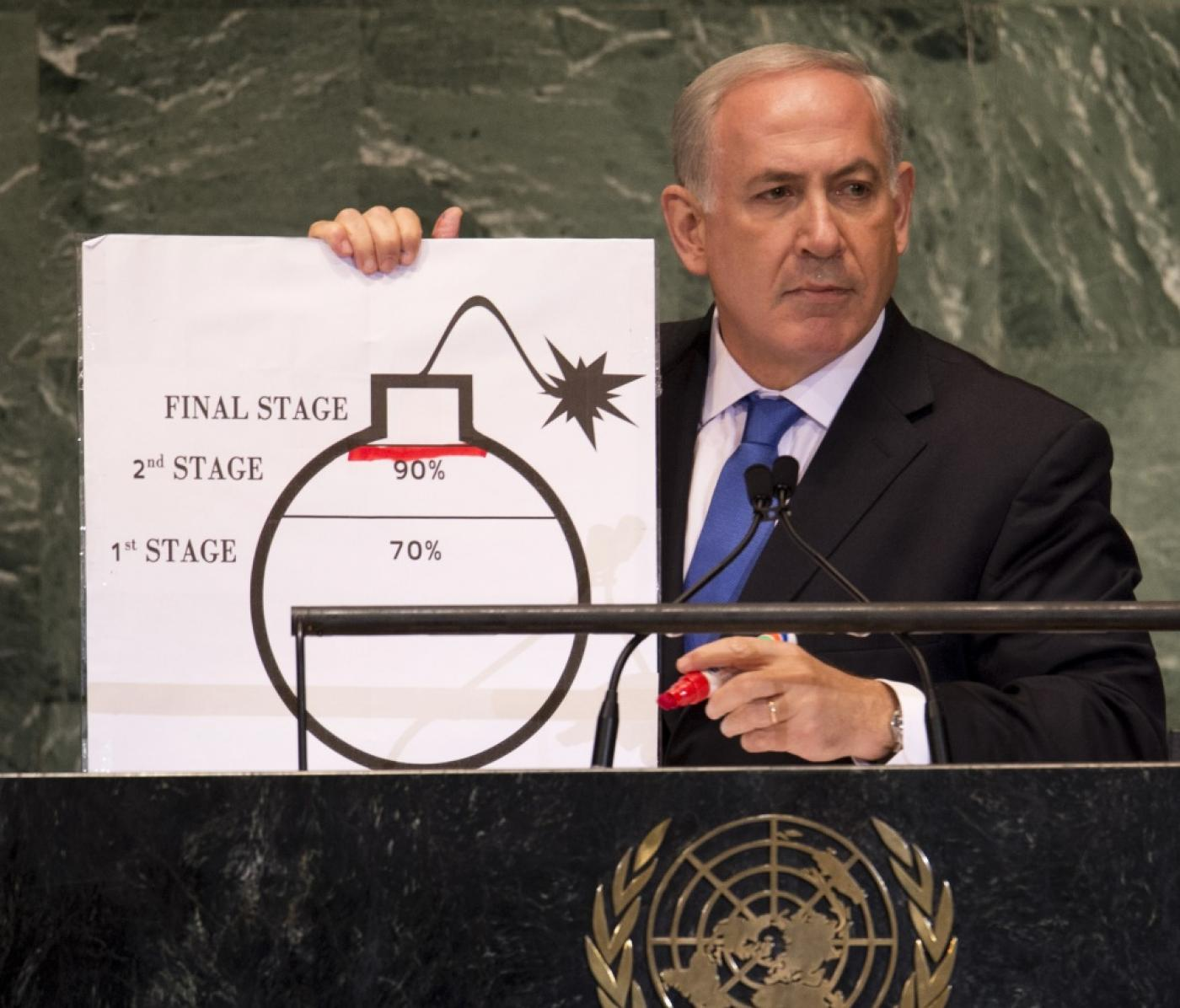
Netanyahu has worried about Iran for 33 years and yet the Iranians never developed a nuclear bomb, even though it clearly had the expertise and means to do so. Instead, Iran adhered to its commitment to the Non-Proliferation Treaty and refused to take that path, despite being surrounded by nuclear powers: Russia to the north, China to the east, India and Pakistan to its southeast, Israel to its west, and US air and sea forces parked in the Mediterranean, the Persian Gulf, and in bases in Oman and Bahrain. Netanyahu went so far as to bring a visual aid to the UN General Assembly to communicate his fears about Iran.
We should be clear about what Netanyahu regards as an “existential threat”. Does Netanyahu actually believe that Iran would drop a nuclear bomb on Israel, killing millions of Palestinians in the process? One cannot dismiss the possibility that at some point there will be an Iranian regime that would commit such a heinous crime. But one would have to offer more evidence of Iranian indifference to human life to persuade me that such an outcome was likely. There are currently nine nuclear powers in the world and some of them engaged in reckless propaganda (“godless communists” and “capitalist running dogs” are two of my favorites) that is roughly comparable to Iranian propaganda (“America is Satan”). But none of these states, except for the US, has ever dropped a nuclear bomb
The existential threat that Netanyahu fears is the possibility of Israeli self-deterrence in the face of a nuclear Iran. Nuclear threats are taken seriously by civilian populations and are effective even when palpably implausible. The US threatened nuclear war against China in 1956 over two insigificant islands (Quemoy and Matsu) which were controlled by the Republic of China, now known as Taiwan. Similarly, the US refrained from arming Ukraine with advanced weaponry after Russian President Putin started referring to Russian nuclear capabilities. Israel currently has a free military hand in Lebanon, Syria, the Gaza Strip and the West Bank, and it has used that advantage to its benefit after the attacks of 7 October. A nuclear-armed Iran, however, might restrain Israeli military power just by posing the possibility of a nuclear attack, forcing the Israeli people to ask the question “Is dropping more bombs on the Gaza Strip worth risking nuclear annihilation?” States are reluctant to gamble on their existence, even when the odds are in their favor. An Israeli government may not want to be constrained by an Israeli population afraid of a nuclear attack. And that fear is the real existential threat to Israel.
The last few weeks have been confusing. There were statements that the US wanted to restart the negotiations to revive the JCPOA, but refused to entertain the possibility that Iran would be allowed to enrich Uranium, a right guaranteed by the Non-Proliferation Treaty and the JCPOA. The precipitating event for the Israeli attack on Iran was the Iranian decision on 13 April to enrich its Uranium far beyond the traditional limit of 20% which is considered essential for civilian nuclear power purposes (Iran believes that it makes more money selling its petroleum rather than burning it for energy purposes). But the Stockholm International Peace Research Institute interpeted this decision quite differently than one designed to build a nuclear bomb:
‘On 13 April, Iran announced its intention to enrich uranium to 60 per cent U-235. This was characterized by Iran as a response to a sabotage of its vast underground enrichment cascades at Natanz two days before. The move comes against the backdrop of sensitive negotiations happening in Vienna aimed at rescuing the 2015 Iran nuclear deal, the Joint Comprehensive Plan of Action (JCPOA), and bringing the United States back into compliance with the deal…
“Uranium enriched to 60 per cent cannot be used to make a useful nuclear explosive device, and Iran has no other realistic use for this material.
“Nevertheless, 60 per cent was not an arbitrary choice. Cascades of centrifuges are designed to enrich uranium in steps; Iran’s centrifuges are likely set up to enrich up to 20 per cent, from 20 to 60 per cent, and from 60 to 90 per cent. Assuming the 60 per cent-enriched uranium is stored in the form of uranium hexafluoride (UF6) gas—and there would be no point in Iran converting it to any other chemical form—the enrichment step from 60 per cent-enriched to weapons-grade uranium is very short.
“This strongly suggests that Iran’s decision was intended to send a political message: ‘We have gone as far as we can go in response to provocations without producing weapons-grade uranium.’”
One needs to appreciate the position of Iran after Trump pulled the US out of the JCPOA: it was placed under punishing sanctions which have severely damaged the Iranian economy and was not offered any way to remove those sanctions without giving up its right to enrich Uranium. The question we need to answer is whether the decision to enrich Uranium to 60% actually signaled an intent to build a nuclear bomb. Trump’s Director of National Intelligence, Tulsi Gabbard, was explicit on this question: “In March, Gabbard testified on Capitol Hill that the U.S. ‘continues to assess that Iran is not building a nuclear weapon and Supreme Leader Khamenei has not authorized the nuclear weapons program he suspended in 2003.'” Trump insisted that Gabbard was wrong, but that is not the first time he has disagreed with his own intelligence services.
We should also think about Trump’s decision to declare war on Iran in the context of the US Constitution. Only Congress has the right to declare war: “Article I, Section 8, Clause 11 states that Congress has the power to declare war. Initially, the draft of the Constitution granted Congress the power to make war. There were suggestions to give this power solely to the President, solely to the Senate, or to both the President and the Senate. However, the Framers decided that involving both the President and Congress addressed their concerns. They didn’t want just one person to decide something so significant, nor did they trust a single branch alone.” The wisdom of the writers of the Constitution has been lost. Iran did not attack the US, so the US claim of self-defense is hollow. Nor does Iran have any ability to hit the US mainland with a nuclear bomb or any conventional bomb. Iran does pose a threat of terror attacks on US citizens, but such threats are better dealt with by local officials and not the US military.
Now the US and Iran are in a state of war. Iran does not need to declare war on the US for a state of war to exist–the US attack on Iranian territory constituted a state of war. For example, the US declared war on Japan after the Pearl Harbor attack, but Roosevelt wanted to focus on fighting Germany immediately (he didn’t have much choice since the US fleet was at the bottom of the Pacific and therefore didn’t have the ability to fight Japan immediately). Foolishly, Hitler declared war on the US first, relieving the US of the need to make a decision about declaring war against Germany. Now that the US has created a state of war, it is imperative to ask the question: What are the US war objectives?
The US is still committed to preventing the Iranians from developing a nuclear bomb. We have yet to see whether the US attack effectively destroyed Iranian capabilities. Trump declared that the facilities had been “completely and totally obliterated” but we have no way to confirm that assessment (it’s not clear on what evidence he based this assertion). More importantly, there is no way for the US to destroy the knowledge that Iran has about building a bomb. That knowledge will endure if the Iranians want it to endure. At best, the US and Israel have gained some time derailing Iran nuclear intentions, but to maintain that respite, Israel and the US will have to keep bombing Iran anytime there is a suspicion that Iran is engaged in nuclear-related activities.
Unless, of course, that the Israeli and US intention is to force regime change in Iran in order to prevent any government that would attempt to build a bomb. The US has often forced regime change (Iran 1953; Guatemala, 1954; the Dominican Republic in 1965; Grenada, 1983; Panama, 1989; and Iraq in 2003). One would be hard pressed to assert that these efforts genuinely served the US national interest. And it is more likely that the Iranian people will want a more aggressive regime given the humiliation inflicted on them by the Israeli and US attacks. They may welcome a new regime that is less stringent in terms of personal conduct. But given the obvious failures of the current regime to prevent the wholesale leakage of Iranian secrets, it is more likely that Iranians would support greater scrutiny (how else does one explain the precision Israeli attacks against specific military and scientific individuals in early June? Someone was telling the Israelis names, addresses, and times, and it is likely that the Iranians will direct most of their efforts to uproot those spies).
I suspect that the Iranians will do two things. First, they will announce their withdrawal from the Non-Proliferation Treaty which allows states to abrogate the treaty after 90 days of warning. Since Israel and the US did not believe that Iran was adhering to the treaty, the repercussions of such a move would be small diplomatically. There will, however, a great deal of negative press for the Iranians, but both the US and Israel have muzzled the press on this matter already. Leaving the NPT would end the pretense that a nuclear weapon is not necessary for national defense against nuclear powers. Iraq proved that nuclear weapons are the only way to prevent an invasion, and North Korea proved that breaking the NPT does not preclude engagement with nuclear powers. Furthermore, the Iranians do not have a choice unless they wish to submit to the dictates of Israel–their previous strategy of relying on proxies and air defenses was an abject failure. Israel has forced the Iranian hand on this matter.
Second, Iran will likely make noises about shutting down the Strait of Hormuz, a narrow channel through which 40% of the world’s exported petroleum passes. Noises could go from verbal threats to actually blocking the channel with sunken vessels. The threats are probably sufficient to force insurance rates for oil-carrying cargo shops to skyrocket. That alone would focus the attention of India, Europe, and China on finding a better solution to this state of war. Moreover, it would force Saudi Arabia and the Gulf States to gauge their interests less in alignment with the interests of the US. Finally, a spike in oil prices would doom Republican chances in the mid-term elections in 2026.
For me, the most unfortunate aspect of this remarkable event is that allowing this war to be declared unilaterally by the President has insulated US foreign policy from democratic processes. Foreign policy has almost always been determined by small groups of people (did you notice that as Trump delivered his speech at the White House announcing the bombing, he was flanked by Hegseth, Rubio, and Vance?), and moving foreign policy in the democratic process was an arduous and difficult process which began with the Vietnam War. That process was never completed and today it seems to be unattainable.
“Over the decades since the Six Day war in 1967, when Israeli forces first captured the Gaza Strip, which had been under Egyptian military rule, Israeli officials and commentators have periodically pushed the notion that Palestinians in Gaza could be resettled in Egypt.
“Most recently that notion was floated in a leaked paper by Israel’s intelligence ministry – which prepares studies and policy papers rather than representing the intelligence agencies – a few weeks into the war in Gaza.
“That ‘concept’ paper recommended that Israel ‘evacuate the civilian population to Sinai’ then create ‘a sterile zone of several kilometres … within Egypt’ that would prevent return.”
The idea is profoundly offensive and clearly violates the Geneva Convention prohibition against ethnic cleansing. It is also something that the Palesstinians would reject, even though mush of the Strip has been completely decimated. It is extraordinary to view the numbers of people who have taken advantage of the cease-fire to move back into northern Gaza–even though living there will be dangerous, difficult, and uncomfortable. The photograph of the Palestinians moving back is a powerful statement on the Palestinian determination to not repeat the tragedy of the nakbaof 1948.
Both Egypt and Jordan have flatly refused to accept refugees from Gaza. Jordan already has several million Palestinian refugees and Egypt fears that its territory will be compromised by the refugees, who would likely continue to attempt moving back to Gaza. The Washington Post reports:
“Reaction from the Middle East was quick — and sharply negative. Jordan’s foreign minister, Ayman Safadi, said that Jordan’s opposition to displacement of Palestinians was ‘firm and will not change.’ The Egyptian Embassy on Sunday reposted a 2023 comment by its ambassador, Motaz Zahran, saying that ‘Egypt cannot be part of any solution involving the transfer of Palestinians into Sinai.’”
“Germany on Monday rejected US President Donald Trump’s proposal to move Palestinians from Gaza to nearby countries – Egypt and Jordan.
“Speaking at a press briefing in Berlin, Foreign Ministry spokesman Christian Wagner said that Germany maintains its commitment to the international consensus regarding Gaza’s status.
“’There is a common position shared by the EU, our Arab partners and the United Nations, which is very clear: The Palestinian population cannot be expelled from Gaza, and Gaza must not be permanently occupied or resettled by Israel,’ he said.
“Wagner added that the G7 group of the world’s leading economies, which includes the US, has so far consistently supported this position in multiple joint statements.
“’Expulsions from Gaza, and establishing new settlements here is not possible. This is also something that we made very clear during the G7 Foreign Ministers’ Meeting in Tokyo in 2023. In this respect, I think our position is more than clear,’ he said.”
If Trump and Netanyahu succeed in “cleaning out” Gaza, the possibilities for a two-state solution are completely eliminated. John Lyons of the Australian Broadcasting Corporation makes that argument:
“Trump’s move has been seen here in Israel as essentially saying that these and other armed and violent settlers can commit any atrocities against Palestinians with impunity and without interference from the US. Rarely are Jewish settlers brought to justice by Israel for acts of violence against Palestinians.
“Trump’s early appointments are also a strong indication that a Palestinian state is very much an endangered species.
“He has chosen former Arkansas governor and Fox News host Mike Huckabee as new US Ambassador to Israel. According to The Times of Israel, Huckabee has said that Israel’s claim to the West Bank is “stronger than American ties to Manhattan” and he even laid bricks in 2018 as ground was broken on a new housing complex in the settlement of Efrat.
“The website reported that Huckabee had said that “of course” annexation of the West Bank was a possibility during Trump’s second term.”
Israel is the only country today that occupies territory with such a large population. There is no justification for its war of conquest.

 World Politics News