“Mussolini did not have any philosophy: he had only rhetoric” — Umberto Eco, 1955
Today has been very difficult for many. This post was written in a state of confusion, fear, and rage. So you should tread carefully here, because there are dragons.
We had hoped that Mr. Trump had effectively diminished his allure to voters, but that was not the case. Instead, we now face the prospect of a mob boss political system, bent on enriching only those who submit and disenfranchising those who do not submit.
This terrain will be difficult to navigate, and it creates a problem for those of us who opposed Mr. Trump. Knowing that he will punish anyone who disagrees with him and knowing that the Congress and the Supreme Court will not restrain his basest instincts leaves us in uncharted territory. The Supreme Court has completely abdicated its responsibility to maintain checks and balances in Trump v. The United States and has decided that it does not have the power to check executive power as long as there is some mention in the Constitution of the powers of the President, no matter how indirect or peripheral the reference. With the Republicans in control of the Senate and possibly of the House as well, there is no posssibility that that party will restrain Mr. Trump given his ruthless purge of malcontents in the party.
We should place the blame for this situation squarely on the Republican Party which has completely abandoned its responsibility to defend the Constitution. The Democrats ran a very effective campaign which was not sufficient. What does the failure of opposition to Mr. Trump mean?
The election of 2024 was essentially a rerun of the early 20th Century. The end of the 19th Century brought about a wave of globalization powered by advances in refrigeration, telecommunications, shipping, and transportation. The result was a phenomenal explosion of wealth at the expense of those with limited access to capital and whose only link to the global economy was the sale of their labor. The growing inequality between rich and poor ultimately led to widespread dissatisfaction which resulted in the abandonment of traditional political norms and the adoption of new ideologies, fascism and communism, which channeled that dissatisfaction into acceptance of authoritarian rule. That inequality also led to the Great Depression.
Similarly, the technological revolutions of the 1980s and 1990s led to the creation of fabulous wealth–think Gates, Musk, Jobs, and Zuckerberg. But that wealth was accumulated by tapping into the labor markets of poor states such as China and Vietnam, leading to a massive loss of manufacturing jobs in the developed world. Those unemployed by the 2nd wave of globalization are the ones who abandoned traditional political norms, not only in the US, but in India, Hungary, Italy, France, Sweden, Denmark, and the Cech Republic. They have reasons to be angry.
The pattern of the early 20th century is repeating because the conditions are roughly similar. And, I suspect, the outcome will be the same: economic collapse and war.
The question for me is how do I respond to this situation? My gut instinct is to resist as Trump attempts to create a White, Male, and Christian Republic. I should resist any attempts to cut Obamacare, Social Security, health and safety regulations, and the proposed deportations. These are the issues that Trump used to secure the support to win the election. My suspicion is that those who supported Mr. Trump did not believe that he would truly implement those policies. But they knew exactly who Mr. Trump was: a person who cheated on his taxes, who assaulted women and bragged about his conquests, who punished anyone who did not support him, and who showed little regard for the rule of law. He will, I am certain, insure that everyone appointed to his government will share the same contempt for integrity and lawfulness. Those who voted for Mr. Trump cannot plead ignorance of who he was and how he defined his interests as the single guide for public policy. They knew what they were buying when they voted.
I fear, however, that, for the next two years, resistance will be futile. So I think there should be a second course of action, a course of action which deeply offends my sensibilities as a civic person. The Democrats should simply withdraw from the process of governing. It will be a huge waste of time and, ultimately, counterproductive. The Democrats should simply sit in Congress and refuse to vote or participate in any hearings. Those who supported Mr. Trump should live in the world they voted for. And with tariffs, deportations, and the lack of income security and health insurance, they can figure out how to survive. That economic collapse is inevitable given the obscene inequalities of power and wealth that Trump’s Administration will foster.
Then the Republican Party will have to decide whether it cares more about the Constitution than raw power. And the American people might learn to appreciate the idea of Justice and Equality and to temper their infatuation with unaccountable freedom.
In 1935, Sinclair Lewis published a book entitled It Can’t Happen Here about the election of a Fascist President in the United States. It is a creepy read (and not a particularly good book, but I do not think that Lewis really wanted to write great book–just a book with an important warning to Americans. Americans very rarely think about Fascism in the US, but that is due to willful amnesia. Former President Trump’s rally in Madison Square Garden reminded some of the Nazi rally that was held there in February 1939.
Nazi Rally at Madison Square Garden, 20 February 1939
The Nazi movement grew out of the virulently racist period after the Civil War that spawned the Jim Crow laws that institutionally segregated African-Americans. We are familiar with the images of the Ku Klux Klan, but there was a more explicit movement marrying fascism with institutionalized racism which was known as the Black Legion:
“The Black Legion was a spinoff of the so-called Second Ku Klux Klan, which flourished in the 1920s, fusing anti-Catholicism and antisemitism with anti-Black racism. Strongest in the North — with 500,000 members in Ohio alone — it fell apart by the decade’s end in the face of internal scandals and public denunciations. A doctor in Bellaire, Ohio, named William Shepard founded the Black Legion in 1924. He painted KKK robes black and added pirate imagery and an even greater obsession with militarism and secrecy. By 1935 the Black Legion had grown to hundreds of thousands of members nationwide, largely in the Upper Midwest but spreading to at least 21 states. No one really knows how big it was.”
The Regalia of the Black Legion
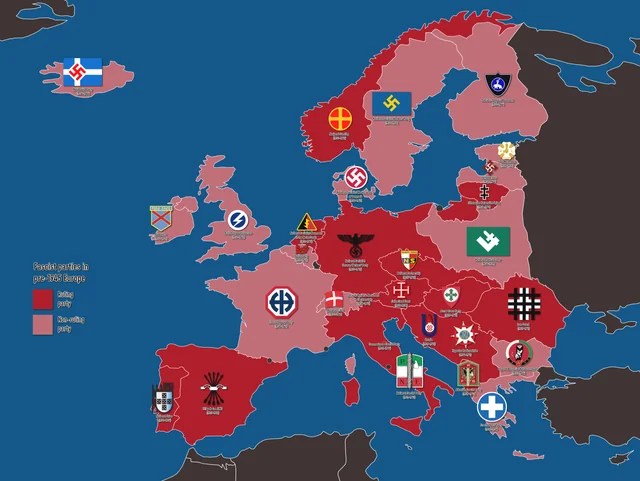
The Black Legion grew as Fascism became prevalent in Europe in the early 20th Century. It was a dynamic movement, starting with the first Fascist state in Italy in 1920 (although one could argue that Hungary was actually the first after the collapse of the Soviet Republic of Hungary founded by Béla Kun). By 1940, the only European states not ruled by a fascist party were Great Britain and Switzerland (one could argue that the Swiss worked closely with the Nazis). It was an amazing transformation in the space of only 20 years, counterbalanced by the emergence of the communist brand of totalitarianism in the Soviet Union.
Map of Fascist regimes in Europe in 1940
As Americans vote today, we should all be reminded of the Fascist history in the US. It is not necessarily a fluke in American culture, but rather a persistent presence. It can happen here.
The decision of the Supreme Court on the matter of Trump vs. United States today was a profound disappointment. It offered little on the critical question of whether Mr. Trump’s actions within the Justice Department were official or unofficial acts. Those actions involved replacing certain members of the Justice Department with a new Attorney General (Jeffrey Clark) who wanted to write a letter to various state legislatures suggesting that there were irregularities in the votes cast in the 2020 election which would justify the naming of alternate Electors. The Washington, DC Bar Association moved to disbar Mr. Clark because of these actions, noting that
“‘We must do what we can to ensure that this conduct is never repeated. The way to accomplish that goal is to remove from the profession lawyers who betrayed their constitutional obligations and their country. It is important that other lawyers who might be tempted to engage in similar misconduct be aware that doing so will cost them their privilege to practice law. It is also important for the courts and the legal profession to state clearly that the ends do not justify the means; that process matters; and that this is a society of laws, not men,’ wrote disciplinary counsel Hamilton Fox III. ‘Jeffrey Clark betrayed his oath to support the Constitution of the United States of America. He is not fit to be a member of the District of Columbia Bar.’”
Apparently, the US Supreme Court thinks that Mr. Clark’s behavior fell within the scope of Presidential authority. The majority decision held that
“The indictment’s allegations that the requested investigations were shams or proposed for an improper purpose do not divest the President of exclusive authority over the investigative and prosecutorial func- tions of the Justice Department and its officials. Because the President cannot be prosecuted for conduct within his exclusive constitutional authority, Trump is absolutely immune from prosecution for the alleged conduct involving his discussions with Justice Department officials.”
Additionally, the Special Prosecutor, Mr. Smith, charged that Mr. Trump tried to improperly influence the actions of the Vice-President, Mr. Pence, to delay the certification of Electoral votes. The Supreme Court held that “The indictment’s allegations that Trump attempted to pressure the Vice President to take particular acts in connection with his role at the certification proceeding thus involve official conduct, and Trump is at least presumptively immune from prosecution for such conduct.”
Critical to both of these findings is the curious statement by the Supreme Court that
“In dividing official from unofficial conduct, courts may not inquire into the President’s motives. Such a ‘highly intrusive’ inquiry would risk exposing even the most obvious instances of official conduct to judicial examination on the mere allegation of improper purpose. Fitzgerald, 457 U. S., at 756. Nor may courts deem an action unofficial merely because it allegedly violates a generally applicable law. Otherwise, Presidents would be subject to trial on ‘every allegation that an action was unlawful,’ depriving immunity of its intended effect.”
These presumptions are bullshit. Essentially the Court is holding that subverting a valid electoral outcome is not unconstitutional as long as the subversion is done by the President and anyone who serves under the authority of the Executive Branch. By refusing to examine the motivations for the action, the Court is saying that replacing the appointed Attorney General with someone who would subvert the Electoral College was normal activity within the Justice Department. No one questions whether the President had the authority to name a new Attorney General; the only relevant question is whether that action contitutes a crime against the Constitution.
On this question, the Court punts:
“On Trump’s view, the alleged conduct qualifies as official because it was undertaken to ensure the integrity and proper administration of the federal election. As the Government sees it, however, Trump can point to no plausible source of authority enabling the President to take such actions. Determining whose characterization may be correct, and with respect to which conduct, requires a fact-specific analysis of the indictment’s extensive and interrelated allegations. The Court accordingly remands to the District Court to determine in the first instance whether Trump’s conduct in this area qualifies as official or unofficial.”
In this paragraph, the Court contradicts itself. Having said that an inquiry into the motives of the President are not permissable, the Court ends up holding that whether Mr. Trump was taking action to “ensure the integrity and proper administration of the federal election” is something that needs to be determined. The Court apparently believe that the motive of ensuring the integrity and proper administration of the federal election is both legitimate and appropriate.
Now the lower courts have to make such a determination. But is there any reason to think that the Supreme Court lacked the ability to make such a determination? Did this decision require more evidence as to whether Mr. Trump’s actions were motivated by his strong desire for a legitimate election outcome? The Court wanted to assure that future Presidents are not paralyzed by the fear of prosecution for official acts. But it now appears that the Court wants lower courts to make such decisions on a case-by-case basis. Future Presidents may not be “paralyzed” by threats to prosecute. However, they will undoubtedly be hamstrung by the Supreme Court’s invitation to anyone who differs on the meaning of an “official act” to sue in the lower courts. It has released the Kraken.


 World Politics News