The Munich Security Conference is an annual event held in Germany every year. It is an assemblage of experts in security matters, and generally it focuses on military matters. It issues a security report after each meeting and this year’s report is quite stunning in its bluntness. This is an excerpt from its Executive Summary:
“The world has entered a period of wrecking-ball politics. Sweeping destruction – rather than careful reforms and policy corrections – is the order of the day. The most prominent of those who promise to free their country from the existing order’s constraints and rebuild a stronger, more prosperous nation is the current US administration. As a result, more than 80 years after construction began, the US-led post-1945 international order is now under destruction.
“In many Western societies, political forces favoring destruction over reform are gaining momentum. Driven by resentment and regret over the liberal trajectory their societies have embarked on, they seek to tear down structures that they believe will prevent the emergence of stronger, more prosperous nations. Their disruptive agendas build on widespread disenchantment with the performance of democratic institutions and a pervasive loss of trust in meaningful reforms and political course corrections. In all G7 countries surveyed for the Munich Security Index 2026, only a tiny proportion of respondents say that their current government’s policies will make future generations better off. And both domestically and internationally, political structures are now perceived as overly bureaucratized and judicialized, impossible to reform and adapt to better serve the people’s needs. The result is a new climate in which those who employ bulldozers, wrecking balls, and chainsaws are often cautiously admired if not openly celebrated.
“The most powerful of those who take the axe to existing rules and institutions is US President Donald Trump.”
The report is, no doubt, a response to the National Security Strategy white paper issued by the Trump Administration in November 2025. But the perspective of the US paper is radically different:
“Over the past nine months, we have brought our nation–and the world–back from the brink of catastrophe and disaster. After four years of weakness, my administration has moved with urgency and historic speed to restore American strength at home and abroad, and bring peace and security to our world.
“No administration in history has achieved so dramatic a turnaround in so short a time.”
This juxtaposition of perspectives defies an easy explanation–both cannot be true at the same time. One is clearly wrong. There is no doubt in my mind that the Munich group is much closer to the mark. That raises a serious question: Who is writing this delusional nonsense for Trump? And why are Americans and the world not doing more to stop this ignorant fool?
As I have argued before, Trump is reviving the balance of power (or, at least, being explicit about his intentions) which also suggests that he is a practitioner of Realpolitik. There was little question in my mind that his adviser, Stephen Miller, is a hardline realist (sovereignty seems to be his favorite word which is the holy mantra of all realists). The New York Times has published a good overview of the lineage of realism, and all its varied meanings. The rubric, realist, gives too much credit to Trump since I doubt he is aware of any of the possible implications or significance of what it means to be a realist: a realist wants to enhance the power of the state while Trump seems to be interested in enhancing personal benefit. The Times article points out the crucial difference:
“For Walt and other realist thinkers, Trump’s aggressive and chaotic actions on the world stage — his antagonism of U.S. allies, threats of territorial conquest and assertions that the U.S. is not afraid of putting ‘boots on the ground’ — undermine any claim he could make to practicing a realist foreign policy. Realists largely opposed the U.S. wars in Vietnam, Iraq and Afghanistan, preferring policies of restraint. The failures of those episodes vindicated the realist worldview.”
I was reminded of this difference by a conversation with a colleague about the Venezuelan attack who reminded me of earlier episodes of US balance of power moves. One earlier intervention in hemispheric affairs was the US intervention of Haiti which lasted from 1915 to 1934. It was a brutal occupation:
“In 1910 an American investor acquired Haiti’s National Railroad with rights to establish banana plantations on either side of the track between Port-au-Prince and Cap Haitien. This land had sustained rural farmers and their families for generations. The Haitian Constitution did not even permit foreigners to own land – a safeguard against restoring slavery. The abrupt eviction of peasants from their land to make way for banana plantations prompted fierce resistance. Four years of insurrection followed, involving peasant armies – the Cacos – along with urban elites and members of Parliament who were opposed to foreign domination.
“This period of government instability became the pretext for the US occupation. By August 1915, there were 3000 US Marines in Haiti. They seized the customs houses, imposed martial law, instituted press censorship, and outlawed dissent. The US installed a compliant president, imposed a “treaty” that was ratified only by the US Senate, disbanded the legislature, and rewrote the Constitution eliminating the ban against foreign land ownership.
“Haiti’s indigenous religion, Vodou – so central to the war for independence – was banned. US Marines – all white, many Southern, replaced local heads of every town and rural district throughout the country. By 1922, the US completely controlled Haitian finances – including the treasury, collected taxes and forced Haiti to repay American loans.”
Butler was a highly decorated Marine: “Butler had received 16 medals, five for heroism. He is one of 19 men to receive the Medal of Honor twice, one of three to be awarded both the Marine Corps Brevet Medal and the Medal of Honor, and the only Marine to be awarded the Brevet Medal and two Medals of Honor, all for separate actions.” Butler wrote a pamphlet entitled “War is a Racket” in which he argued that there was no national interest involved in the occupation of Haiti, but that it served corporate interests (Parenthetically, it is interesting to note that this pamphlet does not rest with the other writings by Butler: “at the Library of the Marine Corps at Quantico, Butler’s anti-war writings are isolated from his memoirs and other texts about him—in a separate bookshelf for radical thought that includes the works of Marx.”)
When he retired from the Marine Corps, Butler assessed his role in the military:
“I spent 33 years and 4 months in active service as a member of our country’s most agile military force—the Marine Corps.… And during that period I spent most of my time being a high-class muscle man for Big Business, for Wall Street and for the bankers. In short, I was a racketeer for capitalism.”
It is always dangerous to compare events in different historical periods, but the US attack on Venezuela resonates with Butler’s final analysis. The Trump Administration offered a number of explanations for its acts of war against Venezuela. First it was to interdict Fentanyl (very little of which comes from Venezuela). The intervention was also justified as a means of countering Chinese influence in Venezuela. The US has also claimed that its attack on Venezuela was not an intervention but rather a “law enforcement operation” since the US had indicted Venezuelan President Maduro on drug trafficking charges. This last explanation ignores the fact that attacking the capital city of a state and kidnapping its President are both acts of war, even if the US claims it does not intend war (just think what the US response would be if a country attacked Washington, DC and kidnapped President Trump).
The real explanation is somewhat tortured, but it revolves around oil. The claim is that Venezuela has the largest reserves of oil in the world. Technically, this assertion may be true, but it is highly misleading. Venezuelan oil reserves are considered “heavy” which means that it has a high sulfur content and high viscosity. These characteristics make the refining of the oil a very expensive process, one that would not be profitable with today’s oil prices of around $59 a barrel. According to World Energy News:
“…estimates that breakeven costs for the Orinoco belt’s key grades are already above $80 per barrel. This puts Venezuelan oil on the high end of the “global cost scale” for new production. The average cost to break even for heavy oil produced in Canada is around $55 per barrel. Exxon has set a breakeven price of $30 per barrel for its global oil production in 2030, largely due to low-cost fields located in Guyana and U.S. Permian Shale Basin. Chevron also has a similar goal, and Conoco is working on a plan that will generate cash flow for the company even if oil drops to $35 per barrel.”
Nonetheless, Trump invited oil company executives to a meeting at the White House to persuade them to make the necessary investments to produce Venezuelan oil. The executives seemed unenthusiastic and an Exxon executive all Venezuela “uninvestable” (which I do not believe is a real word). I also find it hard to believe that Trump would prefer oil to be priced at $80 a barrel.
As far as I can tell, the real reason for attacking Venezuela was to gain control of its oil reserves but no oil company really wants to drill in Venezuela. Ordinarily, I would be flummoxed by this contradiction, but rationality does not seem to be an important consideration for Trump’s foreign policy. Smedley Butler would probably not be surprised at all.
The New York Times conducted an extensive interview with President Trump which is definitely worth reading with a very critical eye. Much of the interview was simple gibberish, but the Times highlighted an astonishing excerpt:
“President Trump declared on Wednesday evening that his power as commander in chief is constrained only by his ‘own morality,’ brushing aside international law and other checks on his ability to use military might to strike, invade or coerce nations around the world.
“Asked in a wide-ranging interview with The New York Times if there were any limits on his global powers, Mr. Trump said: ‘Yeah, there is one thing. My own morality. My own mind. It’s the only thing that can stop me.’
“’I don’t need international law,’ he added. ‘I’m not looking to hurt people.’
When pressed further about whether his administration needed to abide by international law, Mr. Trump said, ‘I do.’ But he made clear he would be the arbiter when such constraints applied to the United States.
“’It depends what your definition of international law is,’ he said.
“Mr. Trump’s assessment of his own freedom to use any instrument of military, economic or political power to cement American supremacy was the most blunt acknowledgment yet of his worldview. At its core is the concept that national strength, rather than laws, treaties and conventions, should be the deciding factor as powers collide.”
The quotes reveal a mentality toward governance that harks back to Louis XIV: “L’État, c’est moi“. It is a perspective that generated abject misery among the poorer classes during Louis’s reign and ultimately led to the French Revolution. It is a perspective that has no place in a democratic republic. And it epitomizes an arrogance that is truly sinister and frightening.
We all woke up to the news that the US had attacked Venezuela and kidnapped its President and his wife. This outcome was not on my bingo card. I fully expected Trump to overthrow Maduro, but I honestly did not think that Trump would be so blatant in violating US obligations under the United Nations Charter (which outlaws wars of aggression). I am still digesting the few scraps of real information that we have and will probably write more as additional information becomes available. Right now, however, I can make some general observations.
First, the act is the literal end of the world order under which we have lived since 1945. This world order was based upon a repudiation of balance of power politics which was the norm since 1648. Under the balance of power system, states are free to use any and all means available to increase their power and an important part of the system was an implicit recognition that powerful states can take actions to preserve their spheres of influence. Thus, for example, Russia simply asserted that Ukraine was an integral part of the Russian sphere of influence and justified its aggression in those terms. China makes similar claims to the South China Sea and to Taiwan. The US now is firmly entrenched in that 19th century doctrine and we now live in a world where, as the Athenians said to the Melians in the Peloponnesian War: “The strong do as they will, and the weak suffer what they must”.
Second, Trump apparently made the decision to attack Venezuela without consulting any members of Congress and without informing its allies of what was going to happen. In other words, he made a unilateral decision: it was neither democratic nor multilateral. It was an imperial order and that apparently means that Trump is prepared to do whatever he thinks necessary to secure what he believes are US interests. Unless the decision is restrained in some way by Congress, the Supreme Court, or by widespread protests, we now effectively live in a dictatorship.
Third, I suspect that the US will relearn the same lessons it ignored in its earlier attempts at regime change: Guatemala, Iran, Libya, Iraq, the Dominican Republic, Grenada, and Vietnam. It’s easy to overthrow a government, but very difficult to establish a viable, legitimate government to replace it. That task will be even more difficult in the case of Venezuela since Maduro was the only authority removed. All his henchmen are still there, and it is very likely that there will be political instability as the different groups compete for power. In this press conference Trump said that the US would “run” Venezuela for the immediate future. The profound irony of that assertion is that Trump has yet to learn who to “run” the US. And with Pete Hegseth and Marco Rubio in charge, I expect that the Keystone Kops will meet their match in incompetence.
Fourth, Trump asserts that Venezuela “stole” US oil when it nationalized some US companies holdings. TO be clear, Venezuela never gave up its sovereign rights to its own oil. It simply gave the US oil companies the right to lift a certain number of barrels of oil and set a price for that sale. The companies never “owned” the oil; they simply agreed to pay Venezuela for its oil. So nothing was “stolen”. It is true that Venezuela refused to renew those contracts, but for Trump to argue that contracts are sacrosanct is absurd after he’s fired so many Federal employees who had their contracts simply annulled.
I suspect that I will have more to say about this matter as more information is available. But I can assert confidently that this decision to invade Venezuela will go down as one of the most egregious diplomatic failures in American diplomatic history.
The video below is chilling, and I honestly could not believe it when I first saw it. According to The Guardian:
“Rumeysa Ozturk, a doctoral student in Boston detained on Tuesday by federal immigration agents in response to her pro-Palestinian activism, was on Wednesday evening being detained at the South Louisiana Ice processing center, according to the government’s Immigration and Customs Enforcement (Ice) detainee locator page.
“The transfer of Ozturk, a PhD student at Tufts University, appeared to violate a federal court order from Tuesday, which directed the Department of Homeland Security (DHS) and Ice to give the court 48 hours’ notice before attempting to take her out of Massachusetts.
“After Ozturk’s transfer to Louisiana emerged from the online locator, the federal judge ordered DHS and Ice to respond to an emergency request in court on Wednesday to produce Ozturk, by 9am ET on Thursday.”
The article cites an ICE official who claimed that Ozturk’s student visa (she is a Fulbright scholar at Tufts) was revoked because of her purported support of Hamas and not because she had committed any crime.
The thuggish nature of this action was clearly calculated to intimidate. The message is clear: if a student shows any sympathy for Palestinians, she cannot assume that she will be afforded the right of free speech. This action is not isolated and it is consistent with the Trump Administration’s conflation of anti-semitism with support for the right of self-determination for the Palestinian people.
The video should provoke outrage among those who believe in the First Amendment. So far, it has been overshadowed by the firestorm over the critical security failure of the Trump foreign policy team. But we should all imagine ourselves in Ozturk’s shoes and how dangerous the deportation policy is to the freedoms of citizens and non-citizens.
We are witnessing a very strange event in political history. Under the pretext of eliminating “waste, fraud, and abuse”, the Trump Administration is attempting to deconstruct most parts of the government, leaving the Executive Branch the sole repository of power in the US. The strategy is to completely erase any institutional support for the process of checks and balances that the Constitution requires to work properly.
The maneuver clearly intends to reduce the power of the Congress and the Courts. I suspect that the courts will try to preserve their power, but courts lack enforcement powers. Trump’s behavior in courts during 2020-24 suggests that he is more than willing to exploit that weakness through delay and manipulation of the legal process. If push comes to shove in the courts, it is only the Congress that can levy penalties to induce changed behavior.
Which raises an interesting question: why are Republican Congresspeople and Senators willing to give away their principal authority which is to allocate money to keep the government going? It is rare to witness the voluntary forfeiture of power. The immediate answer to this question is that these Republicans fear the power of Trump to oust them through primaries. But this begs the question. If the Federal government is eviscerated, then many of the constituents of these Congresspeople will suffer badly and are likely to take out their anger in an election. This outcome is highly probably if the cuts to the Federal government diminish the benefits of Medicare, Medicaid, Social Security, and other social programs. Why is the fear of Trump greater than the fear of angry voters?
I will put my money on the people if the cuts happen quickly, before Trump can defang Federal enforcement of the Constitution. There is a reason Trump went after USAID first–most Americans have little idea of what USAID does. But going after USAID will not fund the tax cuts that the President wants–it is a small amount of money relative to the overall budget.. The budget deal being contemplated by the Republican caucus must go through a process called reconciliation which has strict rules permitting a budget to pass with only 51 votes and not the 60 votes in a Senate with a filibuster rule. Once the American people feel the pain of what it means to lose the Federal government, they may have second thoughts about supporting Trump and those in the Congress who support him.
We will have to see. The budget must be submitted by 14 March and there are still large divisions within the Republican Party about how the budget should be structured. The deficit hawks in the House of Representatives will demand spending cuts that would require cuts in the most important programs affecting the well-being of Americans, such as Social Security and Medicaid. A month is not enough time to work out these fundamental disagreements since the main members of the Freedom Caucus live in gerrymandered districts and have little to fear from Trump’s threats of being primaried. We will see how this works out.
It is important that we understand completely the abject failure of the Republican Party. The people who wrote the Constitution knew that a person like Trump was a real possibility–their experience with King George made them acutely aware of the danger of consolidating power in the hands of one person. To prevent this from happening they employed the idea of checks and balances to prevent such concentrations. Their logic was straightforward: since the lust for power could not be eliminated, they decided to distribute power in three branches of government and assumed that the lust for power in these three branches would be counterbalanced.
The system is not infallible, but it worked for most of the country’s history, the most recent example being the proceedings against President Nixon in 1973. Members of Congress protected the prerogatives of Congress and the Courts held that the President’s power was not unlimited. We are now witnessing the complete collapse of the willingness of the Congress to curtail Trump’s actions, such as the attacks against USAID which is an office created through Congressional action. Rather than telling Trump that he should seeks a law to reorganize USAID, the Republicans in Congress are simply abdicating their sworn duty. The sad fact is that the Republican Party now loves power more than it loves the Constitution or the Republic.
This reality is profoundly unsettling and augurs ill for the future of the country. I am convinced that there will be a backlash against Trump’s actions eventually, but much damage has already been done to our faith in the integrity of our political institutions. The decline in respect for the Supreme Court is just one example of something that will be difficult to restore.
Moreover, the previous Congress, the 118th, was the least productive in recent history: “The 118th Congress is on track to being one of the least functional sessions ever, with only 34 bills passed since January of last year, the lowest number of bills passed in the first year of a congressional session since the Great Depression, according to congressional records.” In place of legislation, the Republicans in Congress are content with a flurry of Executive Orders that clearly infringe upon the duties of Congress.
The Republican Party should be well advised to pay attention to a revised aphorism: Hell hath no fury greater than a people betrayed by their Savior.
President Biden, in his final address to the nation as President, warned citizens against the danger of living in an oligarchy: “Today, an oligarchy is taking shape in America of extreme wealth, power and influence that literally threatens our entire democracy, our basic rights and freedoms, and a fair shot for everyone to get ahead.” He was not the first President to warn of this danger. John Adams, in a letter to Thomas Jefferson, wrote the following:
“9 July 1813
“Your “” [aristocrats] are the most difficult Animals to manage, of anything in the whole Theory and practice of Government. They will not suffer themselves to be governed. They not only exert all their own Subtilty Industry and courage, but they employ the Commonalty, to knock to pieces every Plan and Model that the most honest Architects in Legislation can invent to keep them within bounds. Both Patricians and Plebeians are as furious as the Workmen in England to demolish labour-saving Machinery.
“But who are these ““? Who shall judge? Who shall select these choice Spirits from the rest of the Congregation? Themselves? We must first find out and determine who themselves are. Shall the congregation choose? Ask Xenophon. Perhaps hereafter I may quote you Greek. Too much in a hurry at present, english must suffice. Xenophon says that the ecclesia, always chooses the worst Men they can find, because none others will do their dirty work. This wicked Motive is worse than Birth or Wealth. Here I want to quote Greek again. But the day before I received your Letter of June 27. I gave the Book to George Washington Adams going to the Accadamy at Hingham. The Title is a Collection of Moral Sentences from all the most Ancien[t] Greek Poets. In one of the oldest of them I read in greek that I cannot repeat, a couplet the Sense of which was
“‘Nobility in Men is worth as much as it is in Horses Asses or Rams: but the meanest blooded Puppy, in the World, if he gets a little money, is as good a man as the best of them.’ Yet Birth and Wealth together have prevailed over Virtue and Talents in all ages. The Many, will acknowledge no other ““. Your Experience of This Truth, will not much differ from that of your old Friend.”
Most Americans are unfamiliar with the word “oligarchy” since the Republic has tried very hard since its inception to convey the sense of equality best expressed in Jefferson’s Declaration of Independence. It would be years before any American President emphasized the idea of equality over that of freedom. Lincoln did so in his second Inaugural Address. For the first time, an American President declared that slavery was incompatible with the values of the American people, notwithstanding the inclusion of slavery in the Constitution.
An oligarchy is a political system in which the wealthy direct the machinery of government to protect and enhance their interests as opposed to the interests of the citizenry. Brooke Harrington, a Sociology Professor at Dartmouth College wrote this for the Washington Post at the beginning of Trump’s first term:
“There are no laws against a president and his super-wealthy Cabinet using their power to benefit their own class. There is nothing that compels them to look beyond their privilege to address the needs of the citizenry.
“The problem with these prospective leaders is not their money. It’s that they — like Trump — seem more interested in what their country can do for them than in what they can do for their country.”
The concentration of wealth in the second Trump administration is staggering. The following table gives an idea of how concentrated wealth has become in recent years. Many of the people listed, like Musk, Bezos, and Zuckerberg, have actively solicited Trump on various matters and represent business interests that clearly constitute conflicts of interest with a number of important policy issues like freedom of speech in a digital world.
Source: Bloomberg, “Bloomberg Billionaires Index”, 18 January 2025, accessed at: Bloomberg Billionaires Index, on 19 January 2025
Many of these people have contributed a great deal of money to Trump’s inauguration and several of them have been quite visible in the upcoming Trump Administration. We also have a hard time realizing exactly what these numbers represent: a billion of anything is far removed from anything we come into daily contact. One way to comprehend these numbers is to translate them into more accessible terms:
If someone made one million dollars a year, they would make about $480.77 per hour and $3,846.15 per day.
On the other hand, making a billion dollars per year would mean about $480,769 per hour and $3,846,153.85 per day.
These 20 individuals possess more wealth than most countries in the world. Indeed, there are only 7 countries with GDPs larger than $3 trillion:
There are 186 countries in the world with GDPs less than $3 trillion. The combined population of these countries comprises 56% of the global population. But 20 people have more wealth than each of the 186 countries.
Concentrations of wealth lead inevitably to a distorted political system. Adam Smith was well aware of the dangers of concentrated wealth to the public interest:
“Not only the prejudices of the publick, but what is much more unconquerable, the private interests of many individuals, irresistibly oppose it. Were the officers of the army to oppose with the same zeal and unanimity any reduction in the number of forces, with which master manufacturers set themselves against every law that is likely to increase the number of their rivals in the home market; were the former to animate their soldiers, in the same manner as the latter enflame their workmen, to attack with violence and outrage the proposers of any such regulation; to attempt to reduce the army would be as dangerous as it has now become to attempt to diminish in any respect the monopoly which our manufacturers have obtained against us. This monopoly has so much increased the number of some particular tribes of them, that, like an overgrown standing army, they have become formidable to the government, and upon many occasions intimidate the legislature. The member of parliament who supports every proposal for strengthening this monopoly, is sure to acquire not only the reputation of understanding trade, but great popularity and influence with an order of men whose numbers and wealth render them of great importance. If he opposes them, on the contrary, and still more if he has authority enough to be able to thwart them, neither the most acknowledged probity, nor the highest rank, nor the greatest publick services can protect him from the most infamous abuse and detraction, from personal insults, nor sometimes from real danger, arising from the insolent outrage of furious and disappointed monopolists.”
This pattern was present as the Roman Republic began its descent into dictatorship. It was also evident in 13th Century Venice and in late-19th Century America. It is happening again, not only in the US, but in India, Russia, China, the low-population oil producers such as Kuwait, and Brazil. It is difficult to see how democracy can persist under these conditions. Active steps must be taken to create a more just distribution of wealth globally.
President-Elect Trump’s press conference yesterday was an excursion into the mind of a seriously deranged individual. National Public Radio reports in an interview with Laura Barron-Lopez of NPR:
“And in it, the president-elect talked about using force to gain control over countries and territories. He raised the possibility of using military force to secure Greenland and the Panama Canal. He also talked about using economic control to pressure Canada to acquire it.
“And he said that — as you played there, Geoff, renaming the Gulf of Mexico as the Gulf of America. And he also said that — quote — “all hell will break out” if Hamas doesn’t release hostages by the time he takes office.
“In addition to that, he said that he wants to use tariffs at a high level against Denmark to try to pressure it to cede control of Greenland to the United States. And on that idea of the annexation of Canada, Geoff, outgoing Prime Minister Justin Trudeau said that — just outright rejected it on X, saying that there wasn’t a snowball’s chance in hell that it would happen.”
One never knows whether Trump is actually serious–he has a long history of making outrageous statements and never following through on them. But the mind-set revealed in the press conference is straight out of Nineteenth Century Europe when the balance of power was the operating system of global politics and manifested most dramatically in the carving up of Africa by the colonial powers. The period from 1870 to 1914 is commonly known as “The Scramble for Africa“.
After World War II, the US tried to create a different system, based upon multilateral organizations such as the United Nations, the World Bank, NATO, and various other organizations. The aspirations for this system were quite simple. Instead of the system of power politics characterized by Thucydides as one in which “The strong do as they will, and the weak suffer what they must“, the hope was that international politics could be governed by rules and norms agreed upon by the major powers. That aspiration was never realized, and it seems clear that Trump intends to govern US foreign policy by the maxims of power politics and to return the world to the 1800s.
Trump should read some history. He would find that the US did in fact invade Canada in 1812 and gained nothing from that war (forget the Battle of New Orleans and focus instead on the British burning down the White House). He should also learn that the Gulf of Mexico was named the Gulf of Mexico long before the US was even a state. He also needs a refresher course on what it means to be an ally–if Russia or China would dare to invade Greenland, the NATO treaty would obliged the US to defend the island because Denmark is a member of NATO. THe US does not need to “own” Greenland in order to defend it.
What is deeply troubling is that Trump uses the phrase “national security” to justify his fantasies in such a sloppy manner. He seems to be worried that Chinese companies on each end of the Panama Canal gives China a strategic advantage (conveniently ignoring that China is 6000 miles away from the Panama Canal while the US has easy access to the canal). China would have the same problems defending its troops that Russia had when it tried to place nuclear missiles on Cuba in 1962. When confronted with American military power in the Gulf of Mexico, the Russians had no choice but to capitulate.
Unfortunately, Trump seems to be following the policies of Putin and Netanyahu: grabbing land when it appears to be a task with few immediate downsides. Both Putin and Netanyahu seem oblivious to the long-term costs of being an imperial power: the immense cost and the serious damage to the reputation of their states. Randy Newman wrote a song about the phenomenon which is macabrely funny:
And while we are at changing names, Trump should now start thinking about purging foreign names from American geography. We should call Los Angeles the City of the Angels, Baton Rouge should be called Red Stick, and by all means we should get rid of Native American names like Massachusetts (“Large Hill Place”) and Connecticut (“Long Tidal River”). I am not sure I can survive this stupidity for four years.
The Economic Innovation Group has published a new study entitled “The Great Transfer-mation” which is a report decrying the dependence of US citizens on income transfers from the government. There are many points in the report with which I strongly disagree and I found it personally useful to go through the mental exercise of critiquing flawed arguments and evidence. But the report does provide some information which I found quite interesting, the most important of which was the correlation between getting transfers from the Federal Government and votes in the recent presidential election in the US.
According to the report, in 2000 about 10% of counties in the US received significant income from the government; by 2022, that percentage increased to 53%. Those counties tended to be rural with a significant population of elderly people and considerably poorer than many other counties in the US. The transfer programs idenitified in the study include:
● Old age supports such as Social Security and Medicare
● Medical supports to low-income households such as Medicaid
● Veterans benefits
● Poverty alleviation and income maintenance supports such as the Earned Income Tax Credit (EITC), Supplemental Nutrition Assistance Program (SNAP), and Supplemental Security Income (SSI)
● Unemployment insurance (UI) compensation
● Education and training supports, such as Pell grants
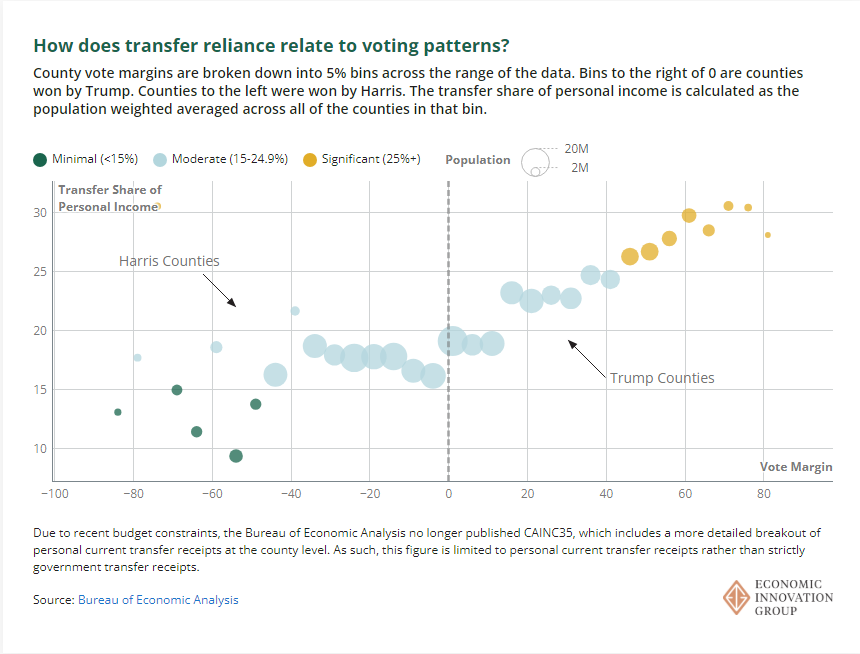
The report is trying to make the case that the only way to address the growing dependence of Americans on income transfers is to stimulate economic growth through lower taxes and reduced regulation–in other words, a stronger commitment to the “trickle-down” myth of modern capitalism (despite all the evidence suggesting that that ideology is fundamentally flawed). But I found the link between income transfers and voting to be highly intriguing as reflected in the following graph:
The graph shows that those most dependent on income transfers were more likely to vote for Mr. Trump and that those who are less dependent on income transfers were more likely to vote for Vice-President Harris. That conclusion is not surprising and comports to my own understanding of why Trump was able to secure a popular majority.
The question is why were people who relied so heavily on aid from the Federal Government were so willing to back a candidate who made such an issue of government deficits and the need to control the Federal budget. The answer is that Mr. Trump was able to make the case that Federal aid was going to the “undeserving” poor (“illegal” immigrants and people who benefit from discriminatory DEI programs) and that he would protect the income transfers to those that truly “deserved” the support. Presumably, those Americans who voted for Trump obviously believed that they deserved those transfers.
The Harris campaign tried to refute those assertions, but many people were not persuaded even though the idea that undocumented individuals without social security numbers could ever receive aid from the Federal Government was clearly ludicrous. The question that nettles me is why it was so difficult for so many Americans to clearly assess their own self-interest.
The question is important to me because I dedicated much of my life to a process that demanded close attention to evidence and logic and I am now confronted with the possibility that many people no longer believe those standards are valid. Give me a few more days to think this over, and I will post those thoughts in a few days.

 ” [aristocrats] are the most difficult Animals to manage, of anything in the whole Theory and practice of Government. They will not suffer themselves to be governed. They not only exert all their own Subtilty Industry and courage, but they employ the Commonalty, to knock to pieces every Plan and Model that the most honest Architects in Legislation can invent to keep them within bounds. Both Patricians and Plebeians are as furious as the Workmen in England to demolish labour-saving Machinery.
 a Collection of Moral Sentences from all the most Ancien[t] Greek Poets. In one of the oldest of them I read in greek that I cannot repeat, a couplet the Sense of which was


 World Politics News