The Economic Policy Institute has released its annual report on how much compensation Chief Executive Officers (CEOs) receive. As in previous years, CEO compensation continues to rise dramatically: “By this measure, in 2017 the average CEO of the 350 largest firms in the U.S. received $18.9 million in compensation, a 17.6 percent increase over 2016. The typical worker’s compensation remained flat, rising a mere 0.3 percent. ” The ratio of CEO earnings to the average worker’s earnings is astonishing:
“Average CEO compensation attained its peak in 2000, at the height of the late 1990s stock bubble, at $21.0 million (in 2017 dollars)—344 times the pay of the typical worker. The CEO-to-worker pay ratio dropped to 188-to-1 in 2009, in the wake of the financial crisis but rose to 312-to-1 in 2017, as worker compensation has stagnated in the recovery.
“CEO pay continues to be dramatically higher than it was in the decades before the turn of the millennium. The CEO-to-average-worker pay ratio was 112-to-1 in 1995, 58-to-1 in 1989, 30-to-1 in 1978, and 20-to-1 in 1965.”
“The richest 5 percent of Americans have captured 74 percent of the wealth created in the country from 1983 to 2010, according to a report by the Economic Policy Institute. Another report from the Institute for Policy Studies, a left-leaning think-tank, found that the richest 400 Americans control more wealth than the poorest 80 million U.S. households, and similar research has found the top 1 percent now holding 40 percent of the nation’s wealth.”
Remarkably, none of this data reflects the impact of the tax cuts passed by the US Congress recently. Those changes will undoubtedly aggravate the disparities in wealth and income.
One of the greatest singers of all time has died today. Aretha Franklin sang for me my entire life and she never failed to lift my spirits. She epitomized what Martin Luther King, Jr. called “soul” and she made me acutely aware of how important music is to a meaningful life. Fortunately, her voice will always live on.
Micah Zenko has written an essay for Foreign Policy which is the most honest analysis of the US role in the Saudi Arabian war against Yemen I have yet read. Most Americans are unaware of the war and even less aware of the US role in supporting Saudi Arabia. Zenko starts out the essay by pointing out that US support for Saudi Arabia goes back to the Obama Administration:
“Washington’s participation began on March 26, 2015, when a White House spokesperson announced, ‘President Obama has authorized the provision of logistical and intelligence support to [Gulf Cooperation Council]-led military operations.’ On March 26, toward the end of a Senate Armed Services Committee hearing, Sen. Kirsten Gillibrand (D-N.Y.) asked U.S. Central Command commander Gen. Lloyd Austin what the ultimate goal of the GCC air campaign in Yemen was, and for the general to estimate its likelihood of success.
“Gen. Austin answered with refreshing honesty: ‘I don’t currently know the specific goals and objectives of the Saudi campaign, and I would have to know that to be able to assess the likelihood of success.’ Gillibrand replied, ‘Well, I do hope you get the information sooner than later.’ In other words, the military commander responsible for overseeing the provision of support for a new air war in the Middle East did not know what the goals of the intervention were, or how he could evaluate whether it was successful. The United States had become a willing co-combatant in a war without any direction or clear end state.
Zenko’s concluding paragraph says it all:
“The United States has been directly engaged in the civil war since March 25, 2015, and its support has not prevented the killing of innocents. It is time to phase out and terminate America’s support for the Saudi-led component of this civil war, and, more importantly, never again go to war, or support other’s wars, without purpose or objectives.”
The dispute between Turkey and the US over the fate of an American pastor, Andrew Brunson, has quickly escalated and the turmoil has brought the Turkish economy to the brink of disaster. That the Trump Administration has focused so intently on one US citizen is somewhat inexplicable given that there are 50,000 Turks who have been imprisoned and a large number of foreign nationals, including 12 Americans. It is clear that the Administration has been willing to compromise its relations with Turkey over the fate of a Christian pastor without mentioning the other prisoners is testimony to the power of the evangelical lobby. At the White House press briefing today, Sarah Sanders said:
“We feel that Turkey and specifically President Erdogan have treated Pastor Brunson, who we know to be a very good person and a strong Christian, who has done nothing wrong, very unfairly. And it’s something that we won’t forget in the administration.”
QUESTION: Why is it important, this one American, to put global financial stability at risk, put U.S. base presence in Turkey at risk, put a NATO ally – an alliance with a NATO partner at risk, for one American who’s being put through the Turkish justice system?
MS NAUERT: So you’re saying this is our fault?
QUESTION: No, I’m saying why —
MS NAUERT: This situation is our fault?
QUESTION: Why escalate it to that level for a single American who has —
MS NAUERT: I think —
QUESTION: — not been tortured or treated – he’s being put through the Turkish justice system.
MS NAUERT: I think that I would take issue with the premise of your question. In terms of the financial situation in Turkey, we addressed this yesterday, and Turkey’s financial situation has been in the works for quite some time and it dates prior to the imposition of sanctions on August – I believe it was August the 1st. So this has been in train for quite some time and you cannot blame the U.S. Government for that.
We have a very broad relationship with the Government of Turkey. Of course, with all nations, as a general matter, we will often have areas where we don’t always agree, where we don’t always see eye to eye, but we also have areas where we do work together and cooperate, and Turkey would be one of those governments where we sometimes have areas where we disagree and we certainly sometimes have areas where we cooperate as well. Okay.
QUESTION: But this isn’t one thing that you simply disagree one area. This has been put to the forefront of everything.
MS NAUERT: And your question is?
QUESTION: So why is this one more important than all the others, it seems?
MS NAUERT: You’re trying to single out one individual, and I have stood here repeatedly, as have many of my colleagues, to speak about other people who have been detained in that country. Our chief mission is the protection of American citizens. That would obviously include Pastor Brunson. We also have three locally employed staff. I spoke about them just yesterday and was very clear with all of you that that is a major concern of ours. There is also a NASA scientist who has been detained by the Turkish Government; that is important to us as well, and you’ve heard that come out of the State Department, you’ve heard that come out of the White House, and from our other colleagues as well.
The US is sending a three-star general to investigate the horrific bombing of a school bus in Yemen which led to the deaths of 40 children and 11 adults. The UN is also launching an investigation. The investigations come because the Saudi Arabian defenses for the attack seem hardly compelling in light of what was clearly a war crime. The Saudis claim that they were targeting leaders of the Houthi rebels and that the attack was “legitimate.” The US has taken a “Pontius Pilate” position on the tragedy, insisting that it was not responsible, despite providing the armaments, intelligence, and refueling of the jets that conducted the attacks. ABC News quotes US Defense Secretary Mattis on the strike:
“On Sunday, Mattis told reporters that the U.S. is ‘not engaged in the civil war,’ emphasizing that the U.S. military does not do any dynamic targeting for the coalition.
“‘We will help to prevent the killing of innocent people, we’re very concerned about the humanitarian situation,’ Mattis said, adding, ‘Wars are always tragic, but we’ve got to find a way to protect innocent in the midst of this one.’
“Col. Turki al-Malki, a spokesman for the coalition in Yemen, said last week that the coalition had launched an operation in Saada in response to Houthi fighters firing a missile on the Saudi city of Jizan on Wednesday evening.
The US position of denying its responsibility in this horror is indefensible and morally reprehensible.
The Taliban have launched a major attack on the Afghan city of Ghazni, leading to significant losses of life in the Afghan military and constabulary as well as within the insurgent ranks. The war in Afghanistan does not figure prominently in the American consciousness despite its distinction of being the longest war in US history. US troops have been sent in to reinforce the Afghan troops and the city appears to still be under government control. The fighting occurred despite the truce that was declared at the end of June. The battle suggests that the Taliban are far from defeated.
“In three public addresses, Erdogan lashed out at the United States, threatening to find new alliances and new markets. He also took higher interest rates off the table and said Turkey wouldn’t accept an international bailout. His message was essentially the opposite of what investors have called for to stem the plunge in the markets.”
“At a time when evil continues to lurk around the world, unilateral actions against Turkey by the United States, our ally of decades, will only serve to undermine American interests and security. Before it is too late, Washington must give up the misguided notion that our relationship can be asymmetrical and come to terms with the fact that Turkey has alternatives. Failure to reverse this trend of unilateralism and disrespect will require us to start looking for new friends and allies.”
The threat to the unity of NATO is unmistakable and there are countries in the region–notably Russia and Iran–who will seek to exploit this fissure. Erdogan also indicated that Turkey would be willing to trade with its other major trading partners in local currencies and not use the dollar, echoing rising sentiments in many other countries to stop using the dollar as a reserve currency. If a sufficient number of other countries stop using the dollar for international transactions, the US will find that the dollar will be subjected to pressures that will constrain US control over its interest rates, its budgets, and its bonds. The financial markets will be watching closely to see if the instability in Turkey spreads to major banks and, from the, to other emerging markets.
“EIA estimates that there were 48 billion barrels of oil and 292 trillion cubic feet (Tcf) of natural gas in proved and probable reserves within the basins that make up the Caspian Sea and surrounding area in 2012. Offshore fields account for 41% of total Caspian crude oil and lease condensate (19.6 billion barrels) and 36% of natural gas (106 Tcf). In general, most of the offshore oil reserves are in the northern part of the Caspian Sea, while most of the offshore natural gas reserves are in the southern part of the Caspian Sea.
“In addition, the U.S. Geological Survey (USGS) estimates another 20 billion barrels of oil and 243 Tcf of natural gas in as yet undiscovered, technically recoverable resources. Much of this is located in the South Caspian Basin, where territorial disputes over offshore waters hinder exploration.”
Negotiations over the resources have been going on for almost three decades, and this agreement represents a turning point in the relations of the countries abutting the Sea. Iran has also reached agreement with China to develop the South Pars Gas field, the world’s largest natural gas reservoir. China will take over the role of the French oil company Total, which had the rights to develop the field but stopped working on the gas field because of the sanctions on Iran. Bloomberg describes the new deal:
“China National Petroleum Corp. is expected to take the lead on a $5 billion project to develop Iran’s share of the world’s biggest gas deposit, taking over from France’s Total SA, which halted operations after U.S. President Donald Trump reimposed sanctions on the Islamic Republic.
“State-owned CNPC, which joined a consortium with Total and Iran’s Petropars Ltd. in 2016 to develop Phase 11 of the South Pars Gas field, is set to increase its stake in the project from the current 30 percent. Total had originally agreed to take a 50.1 percent interest.”
There are two relevant points to make about these agreements. First, it seems clear that many countries are willing to work with Iran despite the US insistence that all economic ties with Iran be terminated. We will have to see how the Trump Administration responds to these acts of defiance. Second, all of the countries are highly dependent on oil and gas revenues and one can expect them to develop these fossil fuels as quickly as possible. In a world faced with climate change brought about by greenhouse gas emissions, the last thing it needed was for more oil and natural gas become available for consumption. Agreements to limit greenhouse gas emissions will likely become more difficult.
“Venezuela, the country with the largest known oil reserves in the world, is bankrupt. It once was one of the richest nations on the continent, but now the people are starving, especially in the interior of the country. The economy collapsed in 2014, and now there are regular protests and riots because stores lack food and everyday items like toilet paper and detergent. Armed guards stand at the entryways of supermarkets, and the annual inflation rate of 42,000 percent is eating up people’s incomes. The poor are starving, the weak and the sick are dying, youths are joining criminal gangs. Anyone who can afford to is leaving the country.”
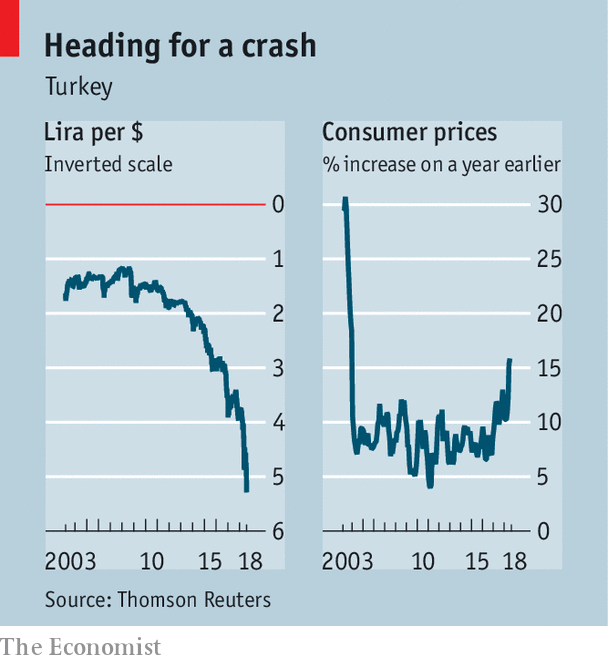
Global financial markets were roiled today as the Turkish lira fell by almost 17% in value. The Turkish economy has been sputtering lately as confidence in the Erdogan government has declined, but the diplomatic spat between the US and Turkey over the imprisonment of an American evangelical, Andrew Brunson two years ago on charges that he had participated in a failed coup attempt against Erdogan. The US slapped sanctions on Turkish officials to coerce Brunson’s release, but the Turks have adamantly refused. In retaliation, US President Trump doubled the tariffs on Turkish aluminum and steel and the global markets took this as a sign that the Turkish economy would stop growing. In turn, markets feared that banks which have lent money to Turkey–primarily Spanish, Italian, and French banks–would lose substantial amounts of money. Global stock markets slumped on the fears of contagion.
The Russian ruble also fell as Russia angrily denounced the additional sanctions the US has imposed on it for the chemical weapons attack in Great Britain. Those sanctions are required by US law and will become even more severe–including the right to deny the Russian airline, Aeroflot, from landing on US soil–if the Russians deny the UN the right to inspect its chemical weapons facilities (also required by US law). According to Politico: “Russian Prime Minister Dmitry Medvedev warned Friday that his nation could retaliate against the United States’ newly issued economic sanctions, saying it would consider any action against its banks an act of economic war.” The ruble fell by about 5% as investors feared that foreign investors will stay away from Russia because of likely economic weakness in the year ahead.
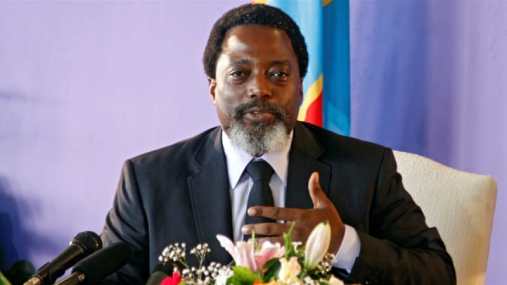
Democratic Republic of Congo’s President Joseph Kabila announced that he will not seek a third term. Kabila came to power in 2001 after his father was assassinated and his second term–his last according to Congo’s constitution–ended in 2016. He has refused to step down, citing unrest in the country, but there was tremendous domestic and international pressure for him to obey the constitution. Congo has a tremendous resource base and could potentially be a very rich country, but years of colonial and strongman rule have made effective governance impossible. Perhaps, Kabila’s decision will turn that page.
There was a horrific aerial attack near the Yemeni province of Saada which killed 29 children returning from a summer camp. The raid was conducted by Saudi Arabian-led coalition in retaliation for a Houthi missile attack. The civil war is a proxy war between Saudi Arabia and other Sunni-based Arab states and Iran and its Shia allies, the Houthi. The United States actively supports the Saudi-led coalition, providing ammunition, refueling for the jets, and target intelligence. The action was unquestionably a war crime, but the US has no idea whether it was involved in the strike in any way. Alex Ward, writing in Vox, quotes US military personnel:
“‘We may never know if the munition [used] was one that the US sold to them,’ Army Maj. Josh Jacques, a spokesperson for US Central Command, told me. ‘We don’t have a lot of people on the ground.’
“It’s also unclear if the US was involved in refueling planes for the attack, Jacques said, because the military doesn’t track where the coalition planes go. Another Pentagon spokesperson said that ‘US Central Command was not involved in the airstrike in Sa’ada.’
“The US military is also not in the room when the Saudi-led coalition decides to conduct a strike, per Maj. Jacques. ‘At the end of the day, the Saudi-led coalition is responsible for their strikes,’ he continued. A top spokesperson for the Saudi-led coalition defended the strike on Thursdayby calling it a ‘legitimate military action.’”
Zaid Jilani, writing for The Intercept, quotes an exchange between Senator Elizabeth Warren (D-MA) and US CENTCOM Commander Gen. Joseph Votel:
“IN A SURPRISING admission on Tuesday, the head of U.S. Central Command — which oversees U.S. forces in the Middle East and Central Asia — admitted that the Pentagon doesn’t know a whole lot about the Saudi airstrikes in Yemen that the United States is supporting through intelligence, munitions, and refueling.
“U.S. CENTCOM Cmdr. Gen. Joseph Votel made the admission in response to questions from Sen. Elizabeth Warren, D-Mass., during a hearing of the Senate Armed Services Committee.
“’General Votel, does CENTCOM track the purpose of the missions it is refueling? In other words, where a U.S.-refueled aircraft is going, what targets it strikes, and the result of the mission?’ Warren asked.
“’Senator, we do not,’ Votel replied.”
Today’s State Department Press Conference involved exchanges between Heather Nauert and members of the press which is a profoundly embarrassing example of US irresponsibility in the commission of these war crimes.
QUESTION: All right. Let me ask you about this airstrike in Yemen, which appears to have killed dozens of children. The Saudis obviously are the ones who conducted this, but they do that with weapons supplied by the U.S., with training supplied by the U.S., and with targeting information, targeting data, supplied by the U.S. How can something like this happen?
MS NAUERT: How can something like that report happen?
QUESTION: Yeah.
MS NAUERT: Well, I think we would start by saying –
QUESTION: It’s more than a report. I mean, it’s – they admitted that it happened.
MS NAUERT: Yeah. How can situations like this happen? We don’t have the full details about what happened on the ground. We’ve certainly seen the news reports of what has been reported happened, okay? I can’t confirm all the details because we are not there on the ground.
We can say that we’re certainly concerned about these reports that resulted – that there was an attack that resulted in the deaths of civilians. We call on the Saudi-led coalition to conduct a thorough and transparent investigation into the incident. We take all credible accounts of civilian casualties very seriously. We call on the parties to take appropriate measures to protect civilians in accordance with international law and urge all parties to investigate all reported incidents of civilian casualties.
QUESTION: Okay. Well, they say – already the coalition says that they acted in accordance with international law. But if you look at the photographs, the video that come from the scene, it doesn’t look like that’s a really – that that’s a credible answer. So are you okay with the coalition on its own doing an investigation, or would you like to see some kind of an international component to it or an international investigation?
MS NAUERT: Well, I think I just answered that and we said that we would call upon the Saudi Government –
QUESTION: So you’re –
MS NAUERT: — to do a full and thorough investigation, as we always do. And we call upon all parties in any kind of situation like this to take appropriate measures to try to mitigate the risk of civilian casualties.
QUESTION: So you don’t think –
MS NAUERT: DOD and other entities put out reports on this after the fact as they all start to investigate, and so we will look forward to any information on that.
QUESTION: Right. But my question is you don’t see a need for there to be something other than a coalition investigation, you don’t see a need for an independent –
MS NAUERT: Matt, I’m not going to get – this is something that is fresh, that just happened, so I’m not going to get ahead of any kind of investigation that may take place. Okay?
QUESTION: It’s only the latest in a huge number of civilians killed during these operations though.
MS NAUERT: I would encourage you to take a look – and that is we regret any loss of civilian life. That is something that the United States Government – in particular, any time you talk to the Department of Defense about civilian casualties, they will say the same thing –
QUESTION: Well –
MS NAUERT: — that – I’m not finished, okay? And they will say the exact same thing, that all parties take very strong responsibility and measures to try to protect against the loss of civilian life. As we have seen – and you all very rarely ask about the issue that has been unfolding and the devastation that has taken place in Yemen – let’s look at some of the things that have been happening in Yemen.
You have the Houthi rebels who continue to attack Saudi Arabia. They continue to do that with Iranian weapons, missiles, and rockets. They continue to try to attack civilian infrastructure in Saudi Arabia, for example, and that is part of the reason why these actions are being taken.
Let me go back and remind you what I just said a moment ago, and that is we call for an investigation and we anticipate that a thorough investigation will be done. I don’t have anything more for you on that.
QUESTION: The Secretary isn’t planning on having a conversation with –
MS NAUERT: I don’t have any information for you on that. Okay.
Hi, Nick.
QUESTION: Is this – hey, Heather. Is this latest incident or the previous incidents causing the U.S. to re-evaluate in any way the role that it’s playing in the situation, in terms of its relationship with Saudi Arabia?
MS NAUERT: Look, we provide a tremendous amount of humanitarian assistance in Yemen to try to support civilians in Yemen and try to mitigate against the devastation that’s taken place there in that country. I don’t have anything more for you on that.
QUESTION: But you also supply a tremendous amount of weaponry and the data for targeting to the Saudis.
MS NAUERT: Well, then – sorry.
QUESTION: Right? No?
QUESTION: No.
QUESTION: Am I wrong? Is that wrong?
QUESTION: That’s not wrong.
MS NAUERT: Sorry, these ladies over here are laughing. On that I would refer you to the Department of Defense that is involved with that, but as you know, Saudi Arabia is an important strategic partner in the region to the United States.
Okay. Hi, Gardiner.
QUESTION: Just a follow-up on that. Hey. So obviously, there’s growing concerns in Congress about the toll this war is taking within Yemen. It’s the worst humanitarian disaster on the planet. Aren’t you concerned that incidents like this will further erode congressional support and lead to further support for legislation that could cut off Saudi Arabia from arms sales and the rest?
MS NAUERT: I mean, I think that is an entirely hypothetical question and we don’t comment on congressional proposals in any event, but I would ask – all of you have been very silent on the issue of Yemen, and times —
QUESTION: Well –
MS NAUERT: Although Said has asked. You’ve been the one reporter who’s asked a lot about Yemen and the situation there.
QUESTION: Well I would suggest that if you had more than two briefings a week and they lasted for longer than a half an hour or 40 minutes that you might get questions about something other than the actual main topic of the day.
MS NAUERT: Matt, I think you and I talk every single day.
QUESTION: Yes, we do.
MS NAUERT: You have my phone number. You have all my numbers, and anytime you want to talk about Yemen, I’d be more than happy to answer your questions and provide you additional expert briefings –
QUESTION: Okay.
MS NAUERT: — on Yemen anytime anyone is interested, but I have not seen a major level of interest on the part of our press corps, with the exception of Said, on the issue of Yemen.
Yeah.
QUESTION: Why does that matter, though? There’s news today, so –
MS NAUERT: Yeah.
QUESTION: Can you request an expert on Yemen?
MS NAUERT: Yeah, certainly, I’d be happy to. Yeah.
QUESTION: Wait, so first of all, I think that when there have been attacks against Saudi installations or missiles and stuff, I think you’ve seen that there have been just as vigorous of reporting.
MS NAUERT: I don’t – I disagree, but –
QUESTION: Well, I mean, that’s – it’s not our job to, like, sit here and go back and forth on that. We’re asking today. The U.S. has tried to increase its target training with – to try and improve the targeting of the Saudi coalition. Is that still continuing?
MS NAUERT: Elise, I think that would be a DOD issue, so I’d encourage you to talk with my –
QUESTION: But these are foreign – okay, but these are foreign military financing.
MS NAUERT: Yeah, yeah.
QUESTION: Which is out of the State Department.
MS NAUERT: And I would encourage you to talk to DOD about that. So some –
QUESTION: Well, maybe –
MS NAUERT: Some of this – some of this is a State Department equity, but much of this is Department of Defense, so I’d encourage you to talk with them about it.
It is extraordinary that the US can actively support Saudi Arabia and divest itself so thoroughly of the responsibilities for its actions.
The US has placed additional sanctions on Russia for its role in the poisoning of four individuals, one of whom was a former Russian spy, in Great Britain. The sanctions are not an example of President Trump’s toughness on Russia–the sanctions are required by the Chemical and Biological Weapons and Warfare Elimination Act of 1991 (PUBLIC LAW 102-182—DEC. 4, 1991 105 STAT. 1245) which requires that:
“SEC. lie . (a) IMPOSITION OF SANCTIONS.
“(1) DETERMINATION BY THE PRESIDENT.—Except as provided in subsection (b)(2), the President shall impose both of the sanctions described in subsection (c) if the President determines that a foreign person, on or after the date of the enactment of this section, has knowingly and materially contributed—
“(A) through the export from the United States of any goods or technology that are subject to the jurisdiction of the United States under this Act, or
“(B) through the export from any other country of any goods or technology that would be, if they were United States goods or technology, subject to the jurisdiction of the United States under this Act, to the efforts by any foreign country, project, or entity described in paragraph (2) to use, develop, produce, stockpile, or otherwise acquire chemical or biological weapons.
“(2) COUNTRIES, PROJECTS, OR ENTITIES RECEIVING ASSISTANCE. Paragraph (1) applies in the case of—
“(A) any foreign country that the President determines has, at any time after January 1, 1980—
“(i) used chemical or biological weapons in violation of international law;
“(ii) used lethal chemical or biological weapons against its own nationals; or
“(iii) made substantial preparations to engage in the activities described in clause (i) or (ii);
“(B) any foreign country whose government is determined for purposes of section 6(j) of this Act to be a government that has repeatedly provided support for acts of international terrorism; or
“(C) any other foreign country, project, or entity designated by the President for purposes of this section.
The US action comes only after significant prodding. First. on Congressman Ed Royce, who has been quite sympathetic to President Trump. Royce, who has announced that he will not seek-election this year, finally wrote a letter to President Trump, reminding him of his legal obligations. The sanctions have finally been imposed, but significantly later than the law required. The sanctions will seriously affect the Russian economy. According to the Washington Post:
“Unless Russia agrees within 90 days to stop all use of chemical weapons and permit inspections to confirm their elimination, the law requires selection from a broad range of additional measures, including withdrawal of U.S. support for international loans and U.S. bank loans, prohibition of landing rights for Russian airlines, and suspension of diplomatic relations.
“The export bans will apply to all state-owned or state-funded enterprises in Russia, a category the State Department official said could encompass 70 percent of the Russian economy and 40 percent of the workforce.
“Once fully implemented, the sanctions could cut off hundreds of millions of dollars in exports, the official said. Two-way trade between Russia and the United States totaled $38 billion in 2013, the last year for which figures are posted, according to the Office of the U.S. Trade Representative. Since then, the amount is believed to have decreased, with Russia continuing to hold a surplus. U.S. exports are primarily machinery and technical goods, while leading U.S. imports from Russia are petroleum products.
It is highly unlikely that Russia will allow the UN to inspect their weapons sites, so these draconian measures should come into force. We shall see if President Trump follows the law.
The Trump Administration has used economic sanctions (including tariffs) more frequently than most other US administrations. According to Carol Morello, writing for the Washington Post, notes that just in the single month of February 2018:
“Before the month was over, sanctions had also been slapped on Colombian drug traffickers, smugglers of Libyan oil and individuals accused of sex abuse and recruiting child soldiers in Congo.
“More sanctions rained down on abettors of various terrorist groups in Pakistan, Somalia and the Philippines, plus Hezbollah in Lebanon. And the State Department added to its list of designated terrorist groups organizations in the Philippines, West Africa, Bangladesh and Burkina Faso.”
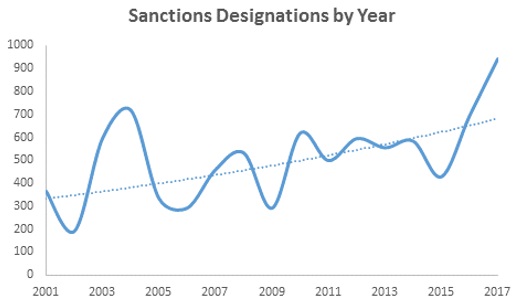
The law firm, Gibson Dunn did an analysis of US sanctions: “The Trump administration continued a nearly two-decade bipartisan trend of increasing reliance on sanctions. Across the full range of sanctions programs, nearly 1,000 entities and individuals were added to the Specially Designated Nationals and Blocked Persons (the “SDN” or “black”) list. (see below). This represented a nearly 30 percent increase over the number added during President Obama’s last year in office, and a nearly three-fold increase over the number added during President Obama’s first year in office.”
US Sanctions over Time
Researchers are suggesting that greenhouse gas emissions are coming very close to creating a “hothouse” earth. Some researchers have identified the current age in which we live as the “Anthropocene”, i.e., an age when human activities dominate the development of the earth as a system. These researchers believe that human activity is more important than the geologic processes that have shaped the earth since its beginnings:
“The knowledge that human activity now rivals geological forces in influencing the trajectory of the Earth System has important implications for both Earth System science and societal decision making. While recognizing that different societies around the world have contributed differently and unequally to pressures on the Earth System and will have varied capabilities to alter future trajectories, the sum total of human impacts on the system needs to be taken into account for analyzing future trajectories of the Earth System.”
The researchers do not believe that a “hothouse” earth is inevitable, but that if it is to be averted, significantly greater actions need to be taken immediately.
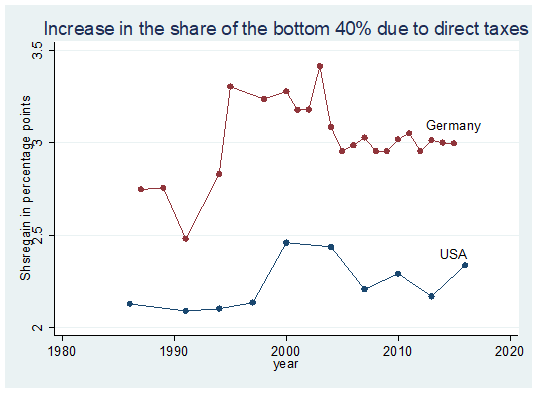
Branko Milanovic is one of my favorite economists and has done pioneering work on the question of income inequality. There is little question that in nominal terms, the US has more extreme income inequality than other developed countries. But some question whether the raw data really reveals the state of the poor in the US and they argue that welfare programs and the tax mechanism actually favor the poor, and that income alone does not accurately capture the quality of life o the poor in the US. Milanovic and others have released a paper which suggests that these transfers do not raise the standard of living for the US poor to the level consistent with the status of the poor in other rich countries. Milanovic summarizes the conclusions of the paper for Global Policy by comparing the impact of the transfers in the US and Germany:
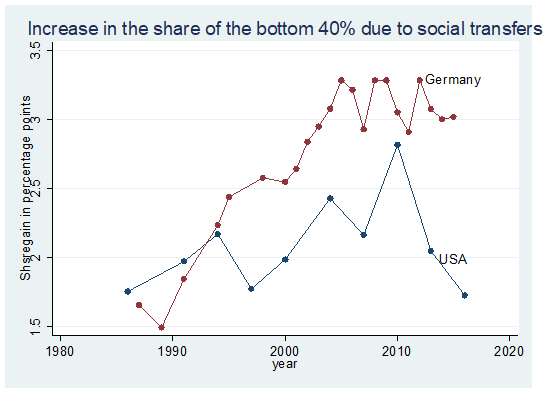
“The ‘poor’ always gain from redistribution but US gains are always smaller than German gains. What is noticeable is that the gains from social transfers were about the same in the US and Germany until 1995, then increased in both countries. In the US they were at their peak in 2010 when unemployment benefits were extended by Obama and afterwards, since US welfare is very modest, they rapidly went down.
“Even more interesting is the evolution of the gains from direct taxes. Here we see that the American “poor” gain throughout less than the “poor” in Germany and that the level of gains does not seem to change much in the US.”
The difference between Germany and the US can be demonstrated graphically:
The results again suggest that addressing the problem of income inequality in the US requires a more focused and determined effort.
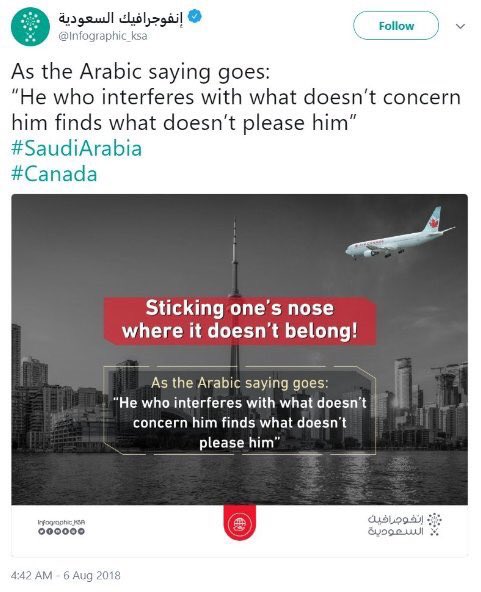
Canada and Saudi Arabia are engaged in a serious dispute. To its credit, Canada criticized the arrests of two human rights activists, Samar Badawi and Nassima al-Sadah, by the Saudi Government. Since May about a dozen women have been arrested because of their activism. According to the Irish Times, they were arrested for campaigning “for the right to drive and an end to the country’s male guardianship system, which requires women to obtain the consent of a male relative for major decisions.” The Canadian statement was simply that it was gravely concerned and that “We urge the Saudi authorities to immediately release them and all other peaceful human rights activists.” In response, the Saudi government told the Canadians that this matter was an internal affair.
“But that was just the beginning. Saudi Arabia proceeded to order the expulsion of Canada’s ambassador, suspend flights to Toronto, and cut off “all new businesses transactions and investments linked with Canada.” On Monday, the country announced that it would relocate about 16,000 Saudi scholarship recipients studying in Canada.
Finally, a Saudi group tweeted the graphic below in what can only be described as a callow and brutal threat to Canada (the Tweet was subsequently removed). Apparently reprehensible rhetoric is not confined to the US.
There is a petition circulating in Israel to change or repeal the new “nation-state” law which declares Israel as the nation-state of the Jewish people alone and elevates the status of Hebrew over Arabic. The petition is supported by minority communities within Israel, notably the Druze and Bedouin peoples, who believe that the law institutionalizes them as second-class citizens. The law is also opposed by Jews in Israel and abroad as well.
“The United States has lived up to the Singapore declaration….It’s just North Korea that has not taken the steps we feel are necessary to denuclearize.”
“The idea that we’re going to relax the sanctions just on North Korea’s say-so, I think, is something that just isn’t under consideration. We’re going to continue to apply maximum pressure to North Korea until they denuclearize, just as we are to Iran. The president feels very strongly about it.”
At midnight tonight the US will reimpose sanctions on Iran. US President Trump abrogated the Joint Comprehensive Plan of Action (JCPOA), otherwise known as the Iran nuclear deal, last May. In so doing, the US violated the agreement since it did not claim that Iran had violated the agreement. Rather, the US claimed that the agreement was flawed because it did not cover Iranian relations with Hamas and Hezbollah, which it regards as terrorist organizations, it did not limit Iranian ballistic missile development, and it did not permanently prevent Iran from developing nuclear weapons. None of these three conditions was ever part of the agreement, and the UN has certified that Iran had complied fully with the specified terms of the agreement.
President Trump’s Executive Order is extensive, covering all the legal aspects of imposing sanctions on a state that has not attacked the US. The Fact Sheet produced by the White House is explicit about the scope of the sanctions which will be imposed in two steps–today and 4 November:
“On August 7, sanctions will be reimposed on:
The purchase or acquisition of United States bank notes by the Government of Iran.
Iran’s trade in gold and other precious metals.
Graphite, aluminum, steel, coal, and software used in industrial processes.
Transactions related to the Iranian rial.
Activities relating to Iran’s issuance of sovereign debt
Iran’s automotive sector.
“The remaining sanctions will be reimposed on November 5, including sanctions on:
Iran’s port operators and energy, shipping, and shipbuilding sectors.
Iran’s petroleum-related transactions.
Transactions by foreign financial institutions with the Central Bank of Iran.
“The Administration will also relist hundreds of individuals, entities, vessels, and aircraft that were previously included on sanctions lists.
ENSURING FULL ENFORCEMENT: President Trump will continue to stand up to the Iranian regime’s aggression, and the United States will fully enforce the reimposed sanctions.
“The Iranian regime has exploited the global financial system to fund its malign activities.
The regime has used this funding to support terrorism, promote ruthless regimes, destabilize the region, and abuse the human rights of its own people.
“The Trump Administration intends to fully enforce the sanctions reimposed against Iran, and those who fail to wind down activities with Iran risk severe consequences.”
It is not clear that these sanctions will be effective. The European Commission has passed a “blocking statute” which exempts European firms from the effects of “extra-territorial legislation” which harms their interests. It published its own Fact Sheet on the new legislation which reads:
How does the Blocking Statute work?
The Blocking Statute applies with regard to the extra-territorial legislation mentioned in its Annex (“listed extra-territorial legislation”).
It forbids EU residents and companies (“operators”) from complying with the listed extra-territorial legislation unless they are exceptionally authorised to do so by the Commission; allows EU operators to recover damages arising from such legislation from the persons or entities causing them; and nullifies the effect in the EU of any foreign court rulings based on it.
EU operators should inform the European Commission – within 30 days since they obtain the information – of any events arising from listed extra-territorial legislation that would affect their economic or financial interests.
Why was the Blocking Statute updated?
The update was triggered by the US’ unilateral decision on 8 May 2018 to re-impose sanctions against Iran (after wind-down periods of 90 and 180 days, i.e. after 6 August 2018 and 4 November 2018) simultaneously with its withdrawal from the Joint Comprehensive Plan of Action (JCPOA) agreed in 2015 between Iran on the one hand, and China, France, Germany, the European Union, Russia, the United Kingdom, and the US, on the other. Some of the re-imposed sanctions have extra-territorial effects and could potentially affect EU operators doing legitimate business with Iran.
How is the Blocking Statute amended?
The EU has amended the annex to the Blocking Statute by adding within its scope the list of extra-territorial US sanctions on Iran that the United States is re-imposing.
The amendment is made through a Commission Delegated Regulation, which was adopted by the Commission on 6 June 2018 and to which neither the Council, nor the European Parliament have objected in the 2 months’ scrutiny period that was foreseen for this purpose. The Delegated Regulation will be published and enter into force on 7 August.
What kind of damages can EU operators ask compensation for?
According to the Blocking Statute, EU operators can recover “any damages, including legal costs, caused by the application of the laws specified in its Annex or by actions based thereon or resulting therefrom”.
From whom can EU operators claim compensation for those damages?
According to the Blocking Statute, EU operators can recover damages, namely from “the natural or legal person or any other entity causing the damages or from any person acting on its behalf or intermediary”.
How can EU operators claim compensation?
The action can be brought before the courts of the Member States and the recovery can take the form of seizure and sale of the assets of the person causing the damage, its representatives or intermediaries. As in any litigation for damages, it will be for the judge to assess the merits of the case, or the causal link.
Additionally, it is not at all clear that European states are sympathetic to US interests, given the trade disputes that have emerged over the last few months. Moreover, it is not at all clear what the Europeans would be cooperating with. The sanctions can be reimposed and they were partially responsible for the JCPOA itself. But what is the objective of new sanctions? What would be the criteria of success? What outcome would bring about the end of sanctions?
It is also highly likely that Russia and China, the other partners to the JCPOA, will go along with reimposed sanctions. Russia is already being sanctioned by the US, and I am not sure that President Trump would be willing to add more sanctions on Russia given his reluctance to impose sanctions for Russian interference with the 2016 elections. Moreover, the US needs Russian cooperation in order to come to a settlement in Syria. China has also indicated that it is not willing to stop buying Iranian oil. According to Bloomberg:
“China — the world’s top crude buyer and Iran’s No. 1 customer — has said previously that it opposed unilateral sanctions and lifted monthly oil imports from the country by 26 percent in July. It accounted for 35 percent the Iranian exports last month, according to ship-tracking data compiled by Bloomberg.”
Turkey and India will also continue to trade with Iran–both are adept at disguising trade deals in order to evade penalties from the US sanctions.
Finally, it is not at all clear that the US has any national interest in stopping the purchases of Iranian oil. Iran currently contributes about 2 million barrels a day to the world energy system. Shutting that flow down, particularly just before the November elections is not in Mr. Trump’s interest, since successful sanctions will undoubtedly raise oil prices in the US.




 World Politics News


