Joshua Kurlantzick has written an essay on populism in Southeast Asia and how it is different from populism in the US and Europe. One difference is clear–Southeast Asia sends many migrants to the world and, aside from local ethnic issues, does not experience an influx of refugees or asylum seekers. Kurlantzick summarizes the key differences in this way: “Southeast Asian populists focus on spurring religious and ethnic divides, countering drug trafficking, particularly of methamphetamines, and appealing to the working and lower-middle classes. The lower-middle classes, in particular, have become frustrated with democracy because they believe democratic politicians have not tackled inequality, addressed crime, or delivered effective state services.” He then goes through many of the Southeast Asian countries and assesses the strengths and sources of populism in each. Unfortunately, populism in Southeast Asia also supports authoritarian politics, as it does in Europe and the US.
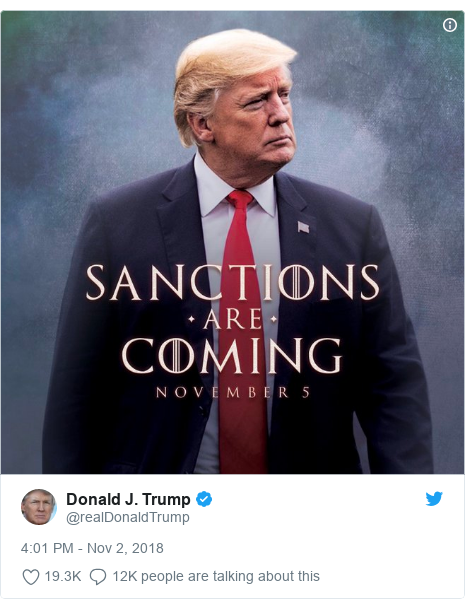
US President Trump has dramatically announced the expected sanctions on Iran in a Tweet that mimics the “Game of Thrones” (HBO, the creator of Game of Thrones, issued this statement: “We were not aware of this messaging and would prefer our trademark not be misappropriated for political purposes.”) Interestingly, however, the US has also issued waivers to 8 countries so that they can continue to import Iranian oil without penalty. It is not clear whether the US issued the waivers because of diplomatic pressure or out of fear that the universal application of the sanctions would raise oil prices precipitously.
A new study of how much heat is being retained in the world’s oceans was published in the journal, Nature. The results indicate that, because the instruments traditionally used to measure the ocean’s heat were flawed, we have underestimated how much the oceans have warmed. New techniques (which I confess are beyond my ability to assess, but Nature is one of the most reputable science journals in the world) have given scientists a more accurate way to measure, suggest that:
“The world’s oceans have been soaking up far more excess heat in recent decades than scientists realized, suggesting that Earth could be set to warm even faster than predicted in the years ahead, according to new research published Wednesday.
“Over the past quarter-century, Earth’s oceans have retained 60 percent more heat each year than scientists previously had thought, said Laure Resplandy, a geoscientist at Princeton University who led the startling study published Wednesday in the journal Nature. The difference represents an enormous amount of additional energy, originating from the sun and trapped by Earth’s atmosphere — the yearly amount representing more than eight times the world’s annual energy consumption.”
The new data show that the oceans have warmed 60% more than assumed by the most recent study by the Intergovernmental Panel on Climate Change (IPCC) which was alarming enough without the new information.
US President Trump said that her might send between 10,000 and 15,000 more troops to the US-Mexican border. If he does, that number would equal the number of US troops in both Afghanistan and Syria. It is not clear what the additional troops would accomplish–they are prohibited by law from enforcing US domestic law. They can supply logistical support to Border Patrol officials, but there is no real evidence that such support is currently lacking. It also not clear what the threat is.
“And despite the heightened rhetoric, the number of immigrants apprehended at the border is dramatically lower than past years. Border Patrol agents this year made only a quarter of the arrests they made in 2000 at the height of illegal immigration, when the agency had half of the staffing it does today. The demographics have also drastically changed, from mostly Mexican men traveling alone, to Central American families with children.”
I have yet to find any cost estimates for these operations, but it is likely that supporting such a large contingent will be very expensive if it stays for any period of time. Most estimates suggest that the “caravan” of asylum seekers is at least a month away from the border.
The Chief Prosecutor for the city of Istanbul officially reported today that the Saudi journalist, Jamal Khashoggi, was strangled and dismembered in the Saudi Consulate. The Saudis have admitted that Khashoggi was murdered, but they have been forthcoming at all about the circumstances. There appears to be a challenge to the Crown Prince because of the uproar over Khashoggi’s death. The only surviving brother of the King, Prince Ahmad bin Abdulaziz , flew to Saudi Arabia from London and he could be perceived as a potential competitor to the Crown Prince, the son of the King. If there is a challenge to the Crown Prince, Saudi Arabia may confront a serious economic challenge.
The Pew Research Center has conducted a poll in 14 countries on political engagement and the results suggest that “in many nations around the world, much of the public is disengaged from politics.” However, there are some issues in the countries–health care, poverty and education–that tend to stimulate higher levels of engagement. In most of the countries, older voters are more engaged than younger voters, but that finding is mediated by the degree to which engagement can take place online. It will be interesting to see whether avenues for engagement can begin to become more institutionalized through social media–a dramatic change from traditional forms of engagement but perhaps not at all inconsistent with the idea of direct democracy.

The World Wildlife Federation has issued its annual Living Planet report and it carries a grim assessment of the health of wildlife on the planet:
“The Living Planet Index also tracks the state of global biodiversity by measuring the population abundance of thousands of vertebrate species around the world. The latest index shows an overall decline of 60% in population sizes between 1970 and 2014. Species population declines are especially pronounced in the tropics, with South and Central America suffering the most dramatic decline, an 89% loss compared to 1970. Freshwater species numbers have also declined dramatically, with the Freshwater Index showing an 83% decline since 1970. But measuring biodiversity – all the varieties of life that can be found on Earth and their relationships to each other – is complex, so this report also explores three other indicators measuring changes in species distribution, extinction risk and changes in community composition. All these paint the same picture – showing severe declines or changes.”
The issue, however, does not seem to be high on the list for many politicians since only humans vote. It is hard to see the necessary action to avert further extinctions. Reutersstate of the world’s oceans has a similarly distressing article on the .
Jair Bolsonaro won the Presidential election in Brazil with 55% of the vote on a platform of “Brazil before everything, and God above all.” Simon Jenkins, writing an opinion piece for The Guardian, assesses the significance of his election:
“Brazil has been one of the world’s most exciting emergent nations, yet its evolution over 30 years from dictatorship to hesitant democracy seems to have stalled. Bolsonaro has exploited the oldest politics, that of self-interest, and also the newest, that of anger, polarisation and fear. Voters have stomached his distaste for gay people, feminism, rainforests and the rule of law, to rid themselves of a corrupt leftwing regime unable to contain street violence. A famously tolerant nation has opted for military and economic discipline.
“In any country, the apparent breakdown of social order will drive voters to extremism. This message has proved popular around the world, from Rodrigo Duterte of the Philippines, Andrés Manuel López Obrador of Mexico, Viktor Orbán of Hungary, Recep Tayyip Erdoğan of Turkey, even America’s Donald Trump. Liberal values, however defined, will not survive when their defenders cannot transmit their virtues to voters.”
The South China Morning Post ran an article reviewing the likely policy changes under Bolsonaro. We will have to see how Brazil changes under his leadership.
Jair Bolsonaro

German Chancellor Angela Merkel has announced that she will step down as the leader of the Christian Democratic Union (CDU) but not as Chancellor of Germany until 2021. She will thus serve essentially as a lame duck for the immediate future. The decision comes after two successive regional election setbacks for the party, indicating that German citizens, as well as members of her party, have reservations about her immigration policies. Merkel has led Germany for the last 13 years and her role in European politics has been as a strong defender of liberal values. With populist/right-wing parties gaining strength in a number of European states, it is probably safe to say that Europe is facing a very serious challenge to the vision of cooperation it has been pursuing for many years. With Great Britain contemplating Brexit and Italy’s government dominated by euro skeptic parties, France’s leader, Emmanuel Macron, is the last leader of a dominant economy still supporting the EU.
The Jerusalem Post is reporting that Israel and Saudi Arabia have concluded a $250 million deal involving some of Israel’s most sophisticated intelligence systems.
The deal is remarkable since Israel and Saudi Arabia do not have diplomatic relations and the report indicates that it was brokered by a European state with inputs from the US and Great Britain. Neither state wishes the information to be public which will make the training of Saudis by Israeli technicians very difficult. But it is clear that “the enemy of my enemy is my friend” since both states regard Iran as their central enemy.
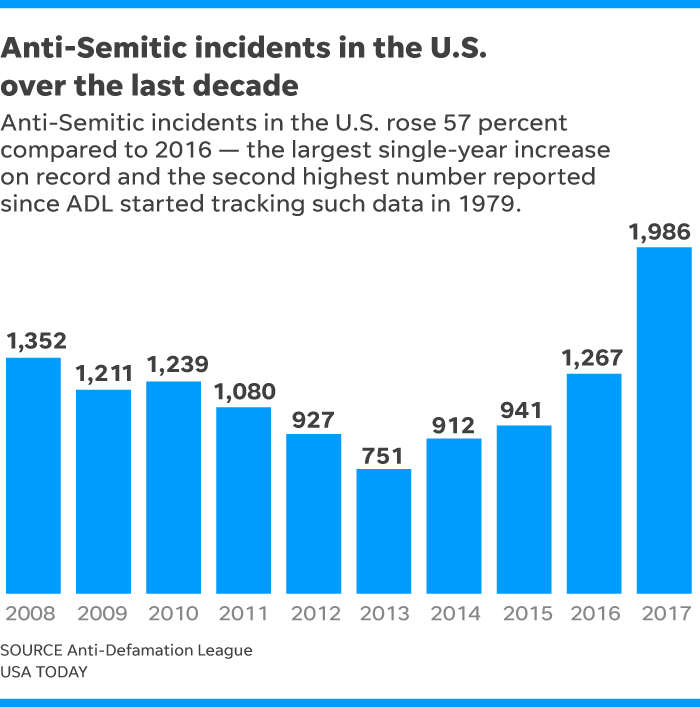
The US endured three acts of domestic terrorism last week. First, a white man killed two African-Americans in a grocery store in Kentucky. He had first tried to enter the predominantly African-American First Baptist church but it was locked. When confronted by bystanders after he had killed the two African-Americans, the killer was reported to have said: “Whites don’t kill whites.” Then as many as thirteen home-made bombs were sent to various critics of the Trump Administration, including former Presidents Obama and Clinton. The person arrested for these crimes drove a van embellished with a variety of stickers suggesting a stark view of good and evil in the American political system. Finally, there was a mass shooting in a synagogue in Pittsburgh in which 11 Jews were killed by a perpetrator who allegedly said “All Jews must die.”
It is impossible not to conclude that American society is in deep distress. I believe firmly that the majority of Americans are committed to the finest aspiration of the Declaration of Independence that “All men are created equal”. But the frequency of hate crimes in the US indicates that there is also a willingness to ignore those who refuse to believe in the fundamental equality of all. As I have read and listened to accounts of these acts in the media, I have been struck by the speciousness of the debate on who is responsible for irresponsible political rhetoric. Anyone who considers their political opponents to be evil or not deserving of respect fails to meet the most basic requirements of what it means to be an American. I fear for the future of the Republic.
German Chancellor Angela Merkel’s governing coalition suffered election losses in Hesse, an important regional state. Merkel’s center-right Christian Democratic Union (CDU) party and the center-left Social Democratic Party (SPD) each lost about 10% of their votes in previous elections. The results in Hesse were similar to the recent elections in Bavaria where the left-wing Greens and the right wing Alternative for Germany (AfD) both increased their representation. The center in Europe continues to lose ground. The election suggests that Merkel will not be able to hold her position much longer, with significant implications for both Germany and the European Union. Reuters frames the European issue in this way: “Merkel’s weakness at home may limit her capacity to lead in the European Union at a time when the bloc is dealing with Brexit, a budget crisis in Italy and the prospect of populist parties making gains at European parliament elections next May.”
|
2018 Result |
2013 Result |
Change |
| CDU |
27.9% |
38.3% |
-10.4% |
| SPD |
19.9% |
30.7% |
-10.8% |
| Greens |
19.5% |
11.1% |
+8.4% |
| AfD |
12.1% |
4.1% |
+8.0% |
| FDP |
7.5% |
5.0% |
+2.5% |
| Left |
6.6% |
5.2% |
+1.4% |
Hilary Hurd and Elena Chachko have written a very informative article for Lawfare on the Intermediate-Range Nuclear Forces (INF) Treaty and the significance of a possible US withdrawal from the treaty. The Treaty prohibits “the United States and Russia from possessing, producing or test-flying ground-launched ballistic and cruise missiles with a range of 500 to 5,500 kilometers and their launchers.” Earlier US President Trump had indicated that he wanted to withdraw from the Treaty because he believes that Russia has violated it and also because it does not include China. The INF was signed in 1987 and stopped a dangerous arms race in Europe. Moreover, the INF called for the elimination of a whole class of nuclear weapons: “the Soviet Union destroyed 1,846 missiles and the United States destroyed 846 missiles by May 28, 1991″ The article assesses the consequences of a US withdrawal:
“On the one hand, continued U.S. compliance in the face of Russian non-compliance undercuts the U.S. strategic position, especially considering the INF-class missile systems that other actors have acquired. Furthermore, NATO appears to support a tougher stance against Russia on INF compliance. Nevertheless, a U.S. withdrawal from the INF would constitute yet another retreat from international instruments and institutions. When coupled with the Trump administration’s intent to replenish the U.S. nuclear arsenal, withdrawal might undermine other longstanding international arms control regimes, including the Nuclear Non-Proliferation Treaty (NPT), and encourage other actors to opt out and fend for themselves.”
My own view is that it makes little sense to withdraw from an arms control treaty without proposing a viable alternative as well. Otherwise, one simply opens the flood gates for another arms race by creating a nasty Security Dilemma.

Brazil will hold its run-off national election tomorrow and the polls suggest that Jair Bolsonaro is the leading candidate. Bolsonaro is a right-wing candidate, running hard on an anti-crime platform, an issue that seems to be of great importance in this election. Bloomberg characterizes Bolsonaro in this way:
“Again and again, he’s flaunted his contempt for the civility and temperance that cement democratic sensibility. The internet rings with his insults to women and gays, and contempt for left-wing activists. His latest pearl: ‘These marginal reds will be banned from the country.’”
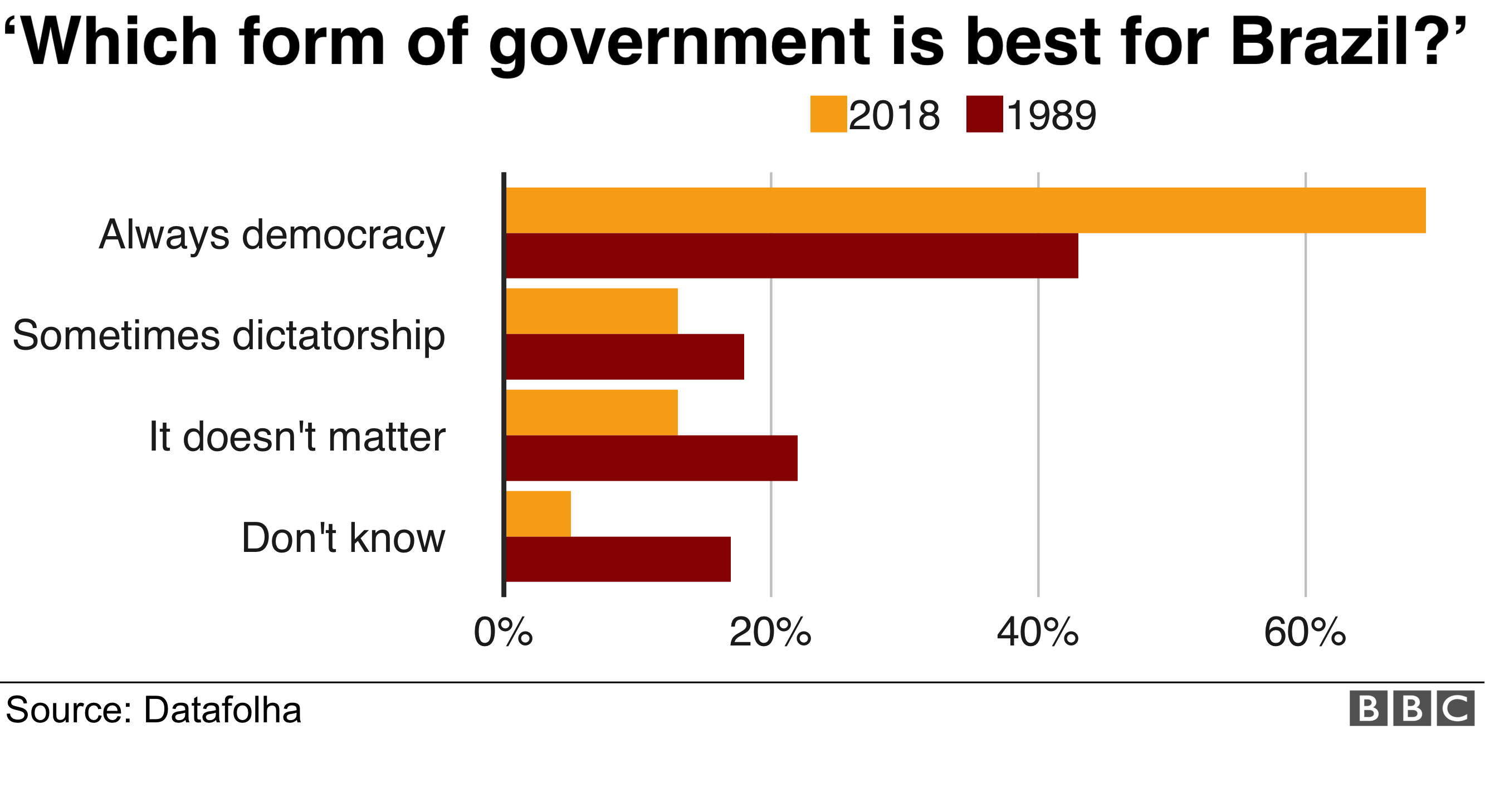
Brazil is Latin America’s largest democracy and, paradoxically, Brazilians seem to be very committed to democracy even though Bolsonaro’s commitment to democracy seems to be tepid. It is tempting to consider Bolsonaro as part of the wave of support for strong leaders that seems to be quite deep in the world today. But that parallel is too simplistic–Brazil is a very diverse and complicated country.
Sri Lanka is entering a very serious political crisis after President Maithripala Sirisena replaced Prime Minister Ranil Wickremesinghe, ending a national unity coalition that has governed the country uneasily for the last three years. Sirisena named Mahinda Rajapaksa as the Prime Minister and the national Parliament was prorogued–not dissolved but suspended for a period of time. Typically, the majority party or parties in a Parliament choose the Prime Minister and it is unlikely that Rajapaksa would have received majority support in Parliament. Rajapaksa served as Sri Lanka’s President from 2005 to 2015 and was in charge of a brutal repression of Tamil unrest on the island in which an estimated 40,000 Tamil civilians were killed. In many respects this political turmoil is reflective of a larger struggle between India and China over influence in Sri Lanka.

The rich continue to get richer. The Swiss bank UBS and the accounting firm of PWC have issued a report, Billionaires report 2018, that analyzes the 2,158 billionaires in the world today. According to The Guardian:
“Billionaires made more money in 2017 than in any year in recorded history. The richest people on Earth increased their wealth by a fifth to $8.9tn (£6.9tn), according to a report by Swiss bank UBS.
“The fortunes of today’s super-wealthy have risen at a far greater rate than at the turn of the 20th century, when families such as the Rothschilds, Rockefellers and Vanderbilts controlled vast wealth. The report by UBS and accountants PwC said there was so much money in the hands of the ultra-rich that a new wave of rich and powerful multi-generational families was being created.”
The report notes that China is producing two new billionaires every week and that billionaires are dominating technological innovation in the world today: ” Just a handful of entrepreneurs, most of them from the US, have changed the world over the past few decades. Billionaires have driven almost 80% of the 40 main breakthrough innovations over the last 40 years. Approximately 70% are technology-related and 80% of the companies behind them are based in the Americas,
with 20% in APAC.” It appears as if the concentration of wealth is becoming self-perpetuating.
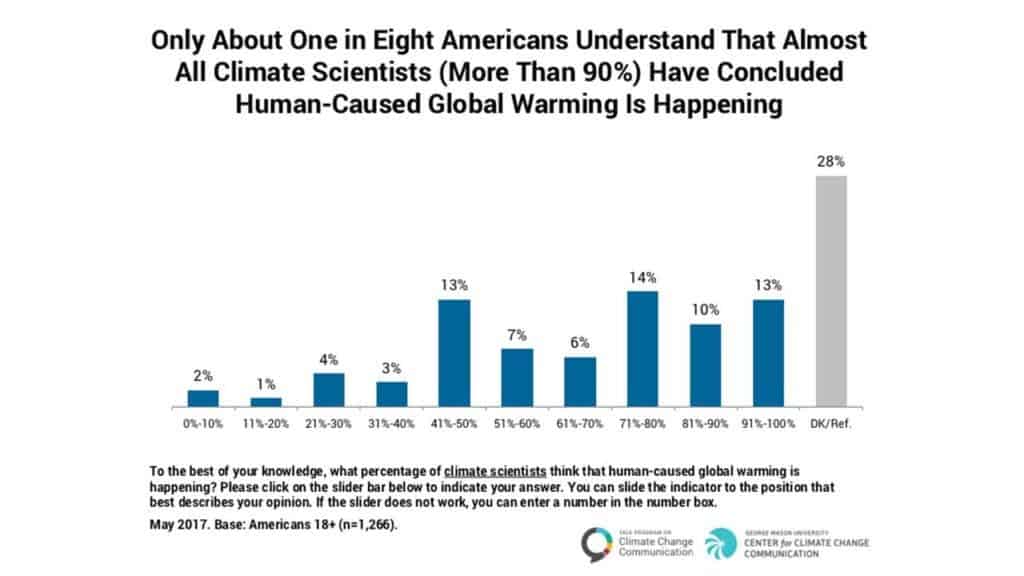
About 97% of climate scientists agree that global warming is happening and that human activity since the Industrial Revolution is responsible for the warming. But most Americans seem to be unaware of that consensus. Yale University and George Mason University have conducted polls on American views and their findings suggest that most Americans do not really know much about the scientific evidence on the issue of global warming. Among some of their findings:
- Only about one in seven Americans (15%) understand that nearly all climate scientists (more than 90%) have concluded that human-caused global warming is happening.
- About six in ten Americans (62%) say they are at least “somewhat worried” about global warming. About one in five (21%) are “very worried” about it – nearly twice the proportion that were “very worried” in March 2015.
- Six in ten Americans are “interested” in global warming (62%). Fewer feel “disgusted” (47%) or “helpless” (45%). Only about four in ten are “hopeful” (41%).
- About six in ten Americans (61%) think global warming is affecting weather in the United States, and three in ten think weather is being affected “a lot” (29%).
It seems clear that more work needs to done educating many about the issue.
The US Gross Domestic Product (GDP) grew at an annualized rate of 3.5% in the third quarter of 2018–perhaps the highest growth rate of any of the developed economies in the world. Interestingly, however, the rate would have been higher if the US had not imposed tariffs during the year. According to Business Insider:
“GDP rose at an annualized rate of 3.5% in the third quarter. But the contribution of net exports of goods and services — the measure of how much trade added or subtracted to GDP growth — was a dismal -1.78 percentage points.
- It was the largest negative contribution to GDP growth for trade in 33 years; in the second quarter of 1985, trade subtracted 1.91 points.
- In other words, if trade were a net neutral, neither adding to nor subtracting from GDP growth, third-quarter GDP growth would have been a dynamite 5.3%.
- If trade had matched its average contribution since 2015, a 0.33-point drag, GDP growth would have come in at 5%.”
Reuters also notes that some producers increased their inventories with imports priced before the tariffs took effect which will affect growth in the future: “Excluding the effects of trade and inventories, GDP grew at a 3.1 percent rate in the third quarter compared to a 4.0 percent pace in April-June.”
The role of money in US politics is difficult to assess, but there is little question that it plays an important role. The Washington Post has a fascinating article on 11 donors who collectively gave $1 billion to Political Action Committees (PAC) over the last few years. Individuals are limited in how much they can contribute to specific candidates, but PACs are not allowed to endorse candidates even though they can endorse specific policies espoused by candidates. According to the Post the donors are:
“The largest super-PAC contributors are casino mogul Sheldon Adelson and physician Miriam Adelson, the married couple who have given $287 million to conservative super PACs, records show.
“In second place behind the Adelsons is Steyer, who has given $213.8 million. He is followed by Bloomberg ($123.4 million), Democratic media executive Fred Eychaner ($68 million), Democratic hedge-fund executive Donald Sussman ($62.9 million), Republican shipping-supplies magnate Richard Uihlein ($59.9 million), Democratic hedge-fund founder James Simons and his wife, Marilyn ($57.9 million), Republican hedge-fund executive Paul Singer ($41.9 million), Republican hedge-fund executive Robert Mercer ($40.9 million), Soros ($39.4 million) and Republican backer and TD Ameritrade founder J. Joe Ricketts ($38.4 million).”
The total amounts are huge, but correlating the money to specific candidates or policies is a difficult task, although, in the case of the Adelsons, there is little question that US policy toward Israel in the Trump Administration has moved closer to the Adelson preferred position.

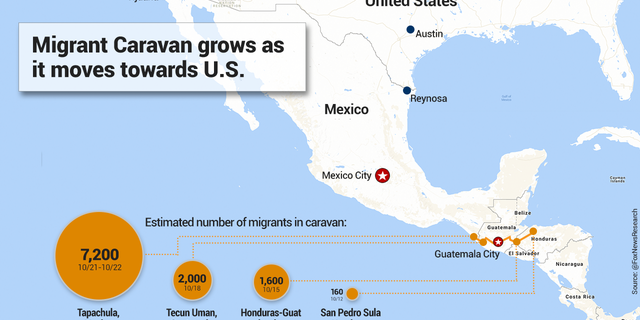
The Trump Administration is sending 800 military troops to the US southern border in anticipation of the “caravan” of refugees and asylum seekers from Honduras, Guatemala, and Mexico. There is a great deal of misinformation about the caravan designed primarily to stoke fear of the people walking across Mexico. The Economist describes the situation quite well:
“Much of what Mr Trump says is untrue, or at least unsubstantiated. As our correspondent in Tapachula reports (see article), the migrants in the caravan are mostly ordinary Hondurans who would rather live somewhere peaceful and rich than poor and violent. There is no evidence of Middle Easterners among them, or an unusual number of criminals. Nor is there a shred of evidence that Democrats had anything to do with organising the exodus. Why would they? The idea of a caravan was first popularised by a Honduran activist, and snowballed. It is easy to see why. Life is much better in the United States than in Honduras. And the journey, overland through Guatemala and Mexico, is dangerous. Migrants have often been robbed or beaten up along the way. Travelling in a large group makes that less likely. Small wonder that so many Hondurans, on hearing that the caravan was passing, decided to join it.”
It will be a long time before the caravan comes close to the US border. In the meantime the US troops being deployed will only provide logistical support to the Customs and Border Patrol forces already there. The US military is prohibited from enforcing US domestic law by the doctrine of posse comitatus.
It seems as if the trade war between the US and China will not end anytime soon. There are reports that the US has told China that it will not negotiate until China agrees to stop demanding on technology transfers from US companies if they wish to invest in the Chinese economy. Alex Ward writes in Vox that the Chinese are becoming convinced that President Trump is less concerned with resolving trade disputes than he is in damaging the Chinese economy. The IMF estimates that the trade measures imposed by the US so far on Chinese imports “could curb China’s economic growth by about 2 percent over the next two years. If true, it would be a major blow to China’s economy, which prioritizes continued growth above all else.” But the tariffs have also hurt US companies who rely on imports from China. Business Insider ran an article that outlines a number of companies that are very concerned about the rising costs imposed by the tariffs:
“Auto manufacturers, retailers, and home-goods makers have weighed in on the downsides of the tariffs. Here are a few examples:
- 3M (consumer-goods manufacturer): “If I fast-forward a little into 2019, we think tariffs will be having a negative impact on our total sourcing cost,” Nick Gangestad, 3M’s chief financial officer, said on Tuesday, adding, “I’ll talk more about this in on November 15, but our view is we have an approximately $100 million headwind from tariffs.”
- Tesla (automaker): The company said on Wednesday in its earnings release that the tariffs on Chinese parts could cost $50 million in its fourth quarter alone.
- Harley-Davidson (motorcycle manufacturer): “In total, we now expect to incur approximately $43 million to $48 million of increased costs related to tariffs during 2018,” CFO John Olin said on Tuesday.
- Ford (automaker): “From Ford’s perspective, the metals tariffs took about $1 billion in profit from us, the irony of which is that we source most of that in the US anyway,” CEO Jim Hackett said earlier this month. “If it goes on any longer, it will do more damage.”
- Sleep Number (mattress and bed manufacturer): “The latest tariff rate hikes affect about 5% to 6% of our overall” cost of goods sold, CFO David Callen said on Wednesday. “We are working with our global sourcing providers to mitigate the potential for 40 basis points to 60 basis points of margin rate pressures arising from this fast-changing tariff landscape.”
- Polaris (motorcycle, ATV, and vehicle manufacturer): “As I mentioned earlier, these efforts have largely been effective so far, allowing us to hold our 2018 gross tariff impact to the previous communicated $40 million,” CEO Scott Wine said on Monday, adding, “Through recent discussion and analysis, we now believe it is unlikely there will be a short- or medium-term agreement with China on trade issues, and with substantial impact of the 301 list looming, we are considering and taking more aggressive action.”
Our attention on Saudi Arabia recently has been focused on the complicity of the Saudi government in the murder of Jamal Khashoggi. As horrific as that murder is, it should not divert our attention from the tragedy in Yemen for which Saudi Arabia is largely responsible. Saudi Arabia considers the civil war in Yemen to be a strategic challenge from Iran, and the Saudi coalition–including the logistic and intelligence support from the US–fighting the rebels in Yemen has been relentless in its bombing campaign. Experts estimate that about 10,000 civilians have died in the war, and many of those deaths have come about because of the inability of Yemen to import necessary food and medical supplies because of the Saudi embargo. The situation continues to deteriorate and the United Nations believes that about 14 million in Yemen are now on the brink of famine.
John B. Judis gave an interview to the Carnegie Council for Ethics in International Affairs entitled “The Nationalist Revival: Trade, Immigration, and the Revolt Against Globalization”. The podcast runs about 17 minutes and is informative and insightful.
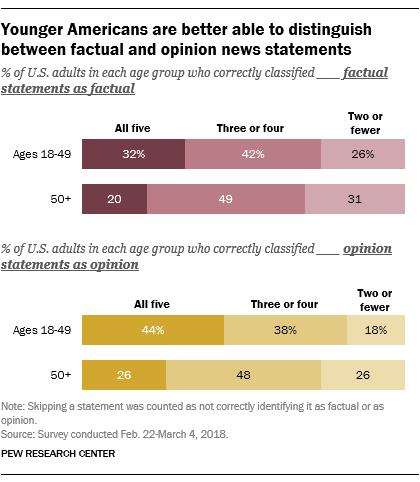
The Pew Research Center has published a report on the differences between younger and older readers on the ability to distinguish between factual and opinion statements in the media. The polling found that younger (ages 18-49) readers are better at making the distinction than older (ages 50+) readers. The difference is significant and likely reflects the deeper experience younger readers have with different media sources of information. The report suggests that
“[t]his stronger ability to classify statements regardless of their ideological appeal may well be tied to the fact that younger adults – especially Millennials – are less likely to strongly identify with either political party. Younger Americans also are more “digitally savvy” than their elders, a characteristic that is also tied to greater success at classifying news statements. But even when accounting for levels of digital savviness and party affiliation, the differences by age persist: Younger adults are still better than their elders at deciphering factual from opinion news statements.”
I would venture that many on the older age group would find this finding counterintuitive. The questions asked were highly politicized which reflect a political bias that younger readers tend to shun.
Turkish President Recep Tayyip Erdogan gave a speech today in which he accused Saudi Arabia of “political murder”. Interestingly, Erdogan raised a number of questions about the murder of Jamal Khashoggi, but he gave no hard evidence of his charge of murder. Many had hoped that the purported audio and video tapes would provide solid answers to many questions, but Erdogan continues his cat-and-mouse game with Saudi Arabia. Bloomberg described the speech as a “damp squib” and made this conjecture:
“In Istanbul, there has been fervid conjecture that Erdogan wants to use the Khashoggi affair to weaken the prince, but that he may yet make a deal with the Saudis that would allow the royal family to save face. It’s easy to see what Turkey could want from Saudi Arabia: A cash injection to revive its flagging economy; a withdrawal of Saudi support for Kurdish militias in Syria (Turkey regards them as terrorists); and an easing of pressure on Qatar, Turkey’s ally. Erdogan’s speech did nothing to end the speculation that he’d be holding out for one or more of these things.
US President Trump called the Saudi explanation “the worst cover-up ever” but only took action to revoke the visas of 21 Saudi suspects. The Atlantic has an interesting article teasing out the broader implications of the Khashoggi murder which raises some provocative questions.
The Italian government and the European Commission remain at loggerheads over the Italian budget. Populism seems to be driving the government to increase its budget deficit far beyond what the rules of the European Union allow. The Council on Foreign Relations points out the dangers of this game of chicken:
“At more than $2.6 trillion, Italy has the world’s fourth-largest total debt load. At roughly 131 percent of gross domestic product (GDP), it’s more than twice what EU rules allow. If investors get spooked and bond yields spike, as happened to crisis-ridden European economies in 2010–2012, Italy’s debt payments could spiral out of control. That could mean an Italian default, which would hit banks across Europe that hold Italian sovereign bonds. Italian banks, still weak from the last crisis, hold a lot of these bonds. If they continue to lose value, banks could fail, lending could dry up, and economic growth could plummet again—the so-called banking doom loop. And if Italy takes the unprecedented step of leaving the euro currency and returning to the lira, it would cause massive losses to investors across the continent, potentially triggering another financial crisis.
“If the eurozone is threatened, Italy would be too big to rescue. In 2012, the European Central Bank (ECB) stepped in with a dramatic promise to do “whatever it takes” to prevent contagion. The EU and the International Monetary Fund bailed out Greece, Ireland, Portugal, and Cyprus. The largest bailout package, to Greece, topped $300 billion. But with a GDP of nearly $2 trillion, Italy is the bloc’s third-largest economy—there simply aren’t enough funds to bail it out. There are also concerns that the ECB used up all its firepower fighting the last crisis and has few tools left to make cheap credit available or buy up troubled bonds.”
We will have to wait to see which side blinks first.
 World Politics News