Poland is worrying many in Europe. Under the leadership of President Jaroslaw Kaczynski and his Law and Justice Party, Poland has systematically abandoned some important democratic principles. Most recently, there is a bill, which has passed the lower house of the Parliament, which will give the President and the party the power to appoint justices which few restrictions, including justices on the Supreme Court. The departure from traditional liberal checks on the concentration of political power threatens Poland’s commitment to the European Union. The European Commission is investigating Poland’s vote in the Union, but all its decisions require unanimous votes and Hungary, led by Viktor Orban, himself no friend to liberal values, has indicated that it would veto any sanction against Poland.
Humanity has developed through three phases of material production: hunting/gathering; agriculture; and industrialization. There is increasing evidence that the human role in industrialization is becoming more and more circumscribed as manufacturing has automated, and is seems as if humanity is entering a fourth phase which is as of yet unnamed but which will rely on digitization and robotization. As this process unfolds, the role of labor in human society will dramatically change. Right now, everyone has to produce something (a good or a service) to sell in order to secure an income. What will happen when every good and service is produced by a machine or a robot? How will people earn an income? That future has always seemed remote, but the future is now in the most important human activity: food production, historically the most labor intensive of all activities.
Jobs and Automation

Violence broke out in Jerusalem and the West Bank as tensions rose over Israel’s decision to place metal detectors at the entrance to the al-Aqsa Mosque. The violence was predictable, but what is not clear is whether the impasse can be resolved. Israel responded to the violence by banning all men under the age of 50 from entering the Mosque, but that policy is not sustainable over the long run. Al Jazeera published a video of the violence and raised questions about the long-term security arrangements at the Mosque.
Protests outside the al Aqsa Mosque

In the discussions about the role of Russian interference in the 2016 US elections, there have been many references about the Magnitsky Act. The Magnitsky Act has a very complicated history and Foreign Policy has a very good article describing how it came about and its effects on US-Russian relations. The critical part of the Act is that it identifies specific Russian individuals who are barred from using certain financial institutions for international transactions and that feature limits the ability of those individuals to launder money out of Russia. The new head of White House communications, Anthony Scaramucci, is on record as believing that US sanctions against Russia are bad policy (Scaramucci was the managing director of the hedge fund, SkyBridge Capital). The policy on Russian sanctions are an incredible lens into the Trump Administration. Just on Tuesday, the Treasury Department levied a $2 million fine on ExxonMobil for violating sanctions by investing in the Russian oil company, Rosneft. The investments were made when the current Secretary of State, Rex Tillerson was the CEO of ExxonMobil. ExxonMobil is suing the Treasury Department for imposing the fine and has named the current Treasury Secretary, Stephen Mnuchin, as the lead defendant. You know that something is wrong when a country has two Cabinet Secretaries suing each other.
US Sanctions Against Russia

The conflict in Syria has exposed certain contradictions in US foreign policy. On the one hand, the US shares the same objective of defeating Daesh (the Islamic State) in Iraq and Syria as its sworn enemy Iran. Despite having a common objective, the US imposed new sanctions on Iran despite certifying that Iran is in compliance with the nuclear agreement forged with Great Britain, France, Germany, China, and Russia. The evidence suggests that President Trump was adamantly opposed to this certification, but was overridden by his National Security Adviser, his Secretary of Defense, and his Secretary of State. The new sanctions are in response to Iranian support for Hezbollah and for the Iranian missile program, issues which are clearly unrelated to the nuclear agreement. It seems clear that the US seems intent on provoking Iran to break the nuclear agreement since none of the other signatories would join the US in breaking the agreement.
The US has also indicated that it changed its policy on Syrian President Assad. Former President Obama wanted Assad to leave, but President Trump seems inclined to allow him to stay, a policy that strengthens the Russian position in Syria. But the US is also building bases in southern Syria which directly challenge Russian and Iranian moves in that region. The US, Russia, and Iran are all rushing to fill the vacuum caused by the slow disintegration of Islamic State control in Syria.

It appears as if millions of Venezuelans are heeding the call for a general strike against the government of President Nicolas Maduro. Maduro still seems intent on calling a constituent assembly to rewrite the Venezuelan constitution in ways that would expand the powers of government. The number of people opposed to the government seems to have grown substantially in recent months although there is strong support for Maduro in some of the poorer parts of various cities. Many of the poor were lifted up by the economic policies of former President Chavez and now-President Maduro, but the overall state of the Venezuelan economy is clearly desperate.

German-Turkish relations require a great deal of attention. There are a large number of Turks who live in Germany and they have maintained close relations with Turkey. After the erection of the Berlin Wall in 1961 which restricted the flow of people from East to West Germany, Germany actively solicited the immigration of Turkish workers to ease a labor shortage and formalized the relationship in terms of a “Gastarbeiter” (“guest worker”) arrangement. But the strains in the relationship have been building since President Erdogan has consolidated greater power, and many Germans have been caught up in the tightening grip of Erdogan’s hold on police power. German Foreign Minister Sigmar Gabriel has announced a complete review of Germany’s ties with Turkey and it is clear that the relationship will change dramatically.
Earlier this week, Israel set up metal detectors at the entrance to the al-Aqsa Mosque compound in Jerusalem. The move was clearly a security gesture, but it was viewed by many Muslims as a symbolic representation of Israeli sovereignty over the Mosque. The Mosque is the third holiest site to Sunni Muslims (after Mecca and Medina) and is part of a larger compound known as al-Haram ash-Sharif (“the Noble Sanctuary”). The Waqf Ministry of Jordan controlled the site until the Six-Day War in 1967; thereafter, the site is controlled by the Islamic waqf trust (a waqf is an inalienable charitable trust). There have been calls by Muslim leaders in Jerusalem to protest the move on Friday and a confrontation might occur.
al-Aqsa Mosque

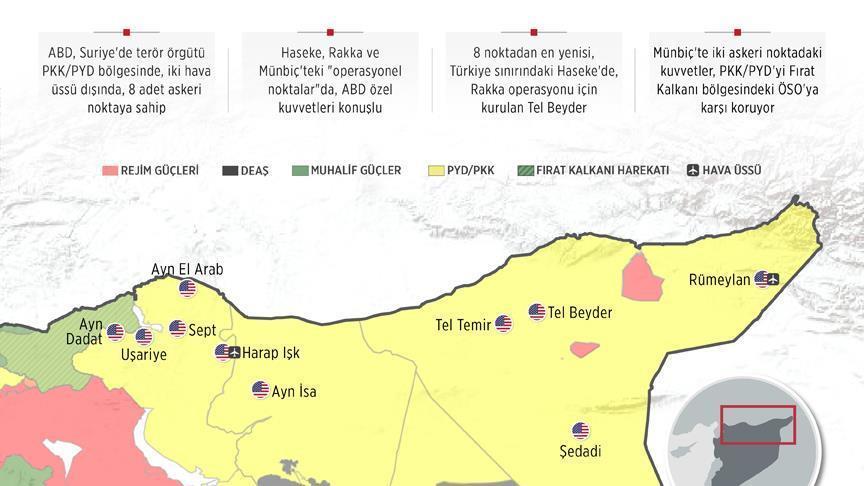
The official Turkish news agency has published the location of secret American bases in northern Syria. We have known that US soldiers have been operating in the area, largely to serve as a buffer between Kurdish and Turkish forces which are also fighting against Daesh (the Islamic State). But the publication of the exact location of these bases is a serious security risk to those soldiers and represents a breach of trust between the US and its NATO ally, Turkey. Curiously, at the same time, the US announced that it is ending the CIA program arming the Syrian rebels who are fighting against Syrian President Assad. The decision is a tremendous victory for Russian President Putin who has been working to assure Assad’s tenure throughout the civil war.
US Bases in Northern Syria
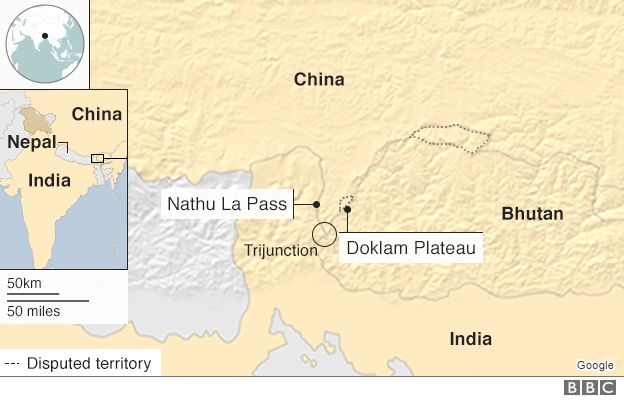
Even though the border dispute between China and India is decades old, for some reason the dispute has slowly been heating up over the last month and there are voices in both India and China that think that a war is imminent. Chinese-Indian relations are not issues I personally study closely, so my impressions of the rhetoric in the media and in official channels may be off base. But there is little question that the area in dispute is strategically important to India since it is the only land connection between the seven northeastern Indian states to the Indian mainland. Both countries are experiencing a surge in nationalist feelings and this type of dispute–which led to war in 1962–stokes nationalist emotions to a fever pitch.
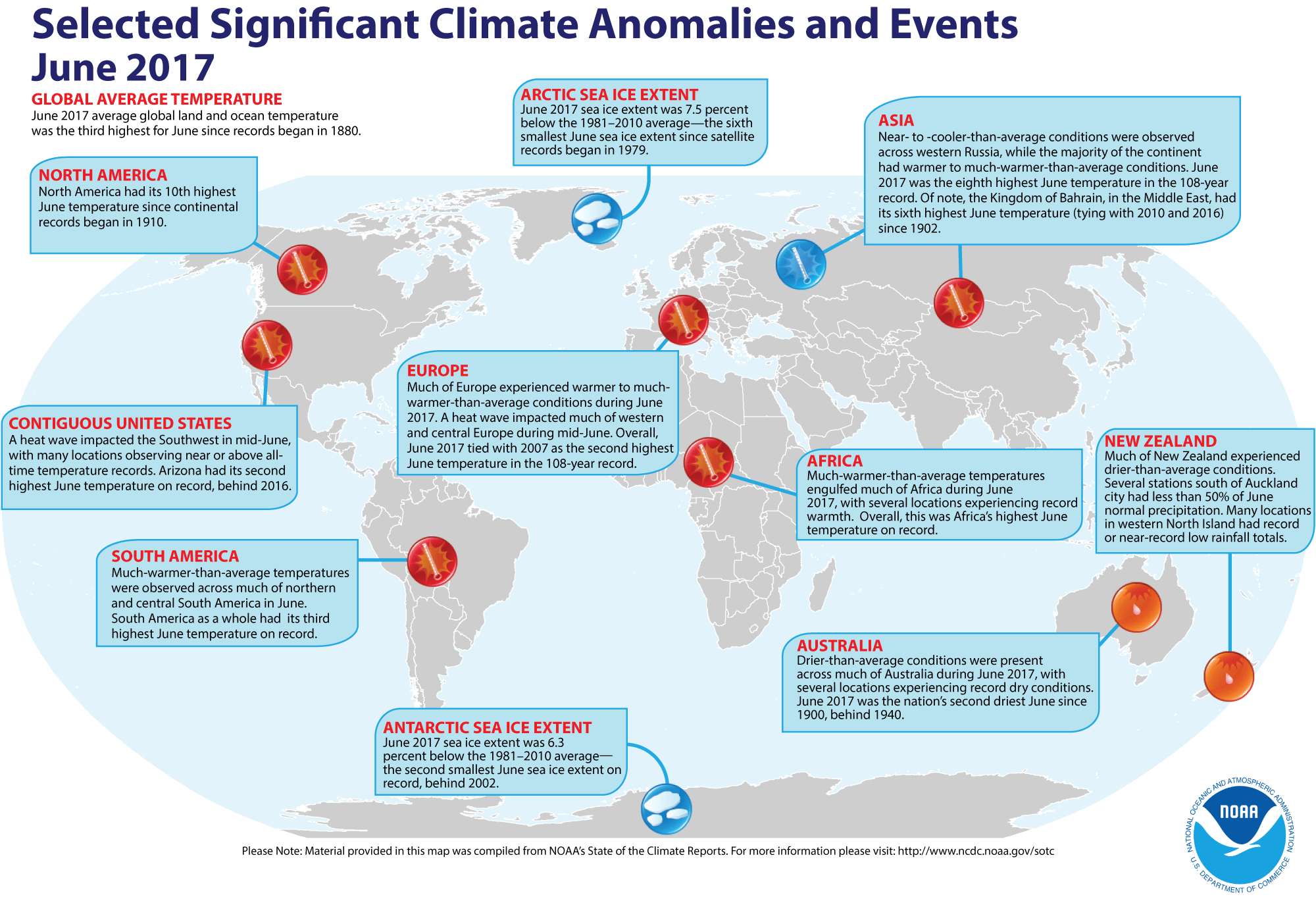
The US National Oceanic and Atmospheric Administration has released its monthly report on global temperatures for June 2017. Its findings are troubling, particularly since there was no el Niño effect to boost temperatures:
“Overall, the combined global land and ocean surface temperature for June 2017 was 0.82°C (1.48°F) above the 20th century average of 15.5°C (59.9°F) and the third highest June temperature in the 138-year record, behind 2016 (+0.92°C / +1.66°F) and 2015 (+0.89°C / +1.60). June 2017 marks the 41st consecutive June and the 390th consecutive month with temperatures at least nominally above the 20th century average.”
The climatologist Michael Mann puts the findings in context in an email to Think Progress:
“As if it wasn’t shocking enough to see three consecutive record-breaking years, in 2014, 2015, and 2016, for the first time on record, we’re now seeing near-record temperatures even in the absence of the El Nino ‘assist’ that the previous record year benefited from.”
The findings are troubling and suggest that the last three years do not appear to be anomalous. As of now, those years still remain “weather” and not “climate”. But when does the abnormal become normal?
There is a spirited debate over the question of whether human rights are universal or culturally determined. Committed liberals believe, in the words of the Declaration of Independence, that all persons “are endowed by their Creator with certain unalienable rights”. This position holds that human rights exist naturally and are not created by governments. Many in the world, however, believe that the question of rights can only be defined in terms of specific contexts. There is an interesting case in Saudi Arabia right now which demonstrated the latter position. A woman was videotaped wearing a miniskirt and a tank top. Saudi culture insists that women “women…wear headscarves and abayas (full-length robes) in public”. We will see whether this particular woman will be prosecuted for exercising what many liberal societies regard as a personal right to choose one’s attire. On the other hand, in the US, the Ladies Professional Golf Association has just issued rules forbidding women golfers from wearing leggings or plunging necklines at golf tournaments.
The Turkish government has just arrested the Director of Amnesty International’s Turkey office and five other human rights activists. The arrests follow a massive crackdown by the government on possible dissidents on the anniversary of the attempted coup against President Erdogan in 2016. Erdogan came to power in 2003 and he has steadily increased the powers of his office since that time. He now has virtual control over all the governmental institutions in Turkey.
The Pew Research Center has released the results of a multi-country poll on opinions about the US role in the world. Generally speaking, public confidence in US leadership has declined rather dramatically since the election of President Trump. According to the report:
“Across 37 countries we surveyed in spring 2017, a median of just 22% said they have confidence in Trump to do the right thing in world affairs. In contrast, 64% expressed confidence in President Barack Obama in these same 37 nations during the final years of his presidency.
“And this shift in American leadership has clearly had an impact on how the world sees the U.S.: A median of 49% now give the U.S. a favorable rating, down from 64% in the Obama era.”
Interestingly, in many European countries, confidence in President Trump mirrors historical confidence in President George W. Bush. President Trump has the highest favorability rating in the Philippines.

Last Sunday more than 7 million Venezuelans participated in a symbolic plebiscite that clearly indicated that they do not support the government’s plan to hold a referendum on a proposal to rewrite the Venezuelan constitution. The government immediately labeled the plebiscite as irrelevant and that it intends to hold its referendum anyway. The opposition parties to the government are now calling for a nation-wide general strike which would cripple the already devastated Venezuelan economy. US President Trump issued the following statement:
“Yesterday, the Venezuelan people again made clear that they stand for democracy, freedom, and rule of law. Yet their strong and courageous actions continue to be ignored by a bad leader who dreams of becoming a dictator.
“The United States will not stand by as Venezuela crumbles. If the Maduro regime imposes its Constituent Assembly on July 30, the United States will take strong and swift economic actions.
“The United States once again calls for free and fair elections and stands with the people of Venezuela in their quest to restore their country to a full and prosperous democracy.”
These are important words to say in defense of the Venezuelan people. We should hope that whatever steps the US decides to take, it does so in coordination with other countries in the world and that it does not act unilaterally. Unilateral action by the US would probably trigger off a nationalist response among the Venezuelan people against American imperialism.
Venezuelan Plebiscite

South Korea has indicated that it wishes to hold direct talks with North Korea, a dramatic change from previous policy. The South Korean President, President Moon Jae-in, came to office after the previous President was forced to resign because of corruption and he has long called for a less confrontational approach to North Korea. China is quite receptive to the possibility, but the US has made it clear that it does believe that direct negotiations should be undertaken at this time. We will see if North Korea accepts South Korea’s offer.
Last May, Saudi Arabia, Bahrain, and the United Arab Emirates blockaded all air and sea access to Qatar in retaliation for statements allegedly made by the leader of Qatar in support of radical terrorists. Today, the US military intelligence released a report that indicated that those statements were concocted by leaders in the United Arab Emirates. US President Trump was also quite enthusiastic about the blockade. It remains to be seen whether the three Arab states and the US will change their positions in light of this new information.
In a classic balance of power move, Vietnam has asked India for its assistance in the struggle with China over control of the South China Sea. Both countries have concerns about the growing power of China in Southeast Asia, and India is a well-established naval power. But the formal request indicates a ratcheting up of the alliances designed to counter Chinese power. The move also reflects a growing concerns among states in Southeast Asia that the US is not willing to provide sufficient counterweight to the Chinese sovereign claims in the South China Sea.

Pressure is growing to remove Brazilian President Michel Temer on charges of corruption and general dissatisfaction with the overall state of the Brazilian economy. Temer’s popularity is in the single digits as his austerity measures designed to restore economic growth have had a depressing effect on the economic lives of many citizens. The movement comes on top of the recent conviction of former President Luiz Inacio Lula da Silva who was sentenced to 10 years imprisonment on corruption charges. Brazil is a critical component of the global economy, and the political uncertainty in the country is seriously compromising its ability to restore economic dynamism.
The Syrian civil war has been ongoing since 2011 and there really is no sign of the violence tapering off any time soon. Indeed, there does not appear to be any framework for a resolution that would satisfy the disparate groups in the country. Increasingly, analysts have begun to think about redrawing the territorial boundaries of the state since the boundaries drawn in the early 20th century carry no meaning for the different groups in the state. The borders were drawn by the British and the French in accordance with their national interests. If only the borders had been drawn in accordance with the interests of the people who lived there, the history of the region might have been quite different. Imperialism never dies.

Iraq is close to pushing Daesh (Islamic State) forces out of Mosul and that event would constitute a significant victory for the government. But regaining control over the city is going to be very difficult as there are a number of groups who were involved in the fighting who believe that they are entitled to some of the spoils of war. In many respects, the Iranian Revolutionary Guard forces involved in the fighting represent the sectarian nature of the government in Baghdad. But if those Shia groups use the success to further exclude the Sunni populations, the victory will be short-lived. The Shia government in Baghdad and Iran need to work hard to make the Sunni Muslims believe that they have a stake in the future of a united Iraq.

Today is the 2nd anniversary of the nuclear deal signed with Iran. The agreement, brokered by Germany, the US, France, Great Britain, China, and Russia, was designed to provide assurances that, at least for ten years, Iran would not be able to build a nuclear weapon. It is a very complicated agreement with a number of very specific and technical details, but it also an agreement that narrowly focuses on weapons. Many in the US, including now-President Trump, were very opposed to the agreement because it did not address Iran’s support for groups, such as Hezbollah, which are opposed to Israel and also because it did not address other aspects of the weapons program, such as building missiles. To date, the Trump Administration has not tried to revise the agreement, a process that would be extremely difficult because the other signatories to the agreement would be very unlikely to support the US. All evidence indicates that the agreement has worked as expected and we should hope that it continues to be supported.
British researchers have found that Saudi Arabia is a key sponsor of radical interpretations of Islam and funds many groups that endorse the use of violence and terrorism to advance those interpretations of Islam. The findings are not that surprising to many who have studied extremist groups, but it is the first time that a research study has nailed down the extent of Saudi support for violence. The findings stand in stark contrast to the rhetoric of states, like the US, who condemn terrorist violence but embrace (and support militarily) Saudi Arabia. The contradiction in rhetoric and practice can only be explained in terms of Saudi economic power in the global petroleum market.
US President Trump in Saudi Arabia


Chinese Nobel Laureate, Liu Xiaobo, has died of liver cancer while still in the custody of Chinese prison authorities. Liu was jailed in 2009 for helping to draft what is known as the Charter 08 manifesto, which called for, among other demands, an end to one-party rule in China. Liu was awarded the Nobel Peace Prize in 2010 but was not allowed to receive the award in Norway. The Nobel Committee gave him the award for “for his long and non-violent struggle for fundamental human rights in China“. Liu advanced the idea of human rights based upon liberal ideas, ones which are not consistent with the conception of human rights held by the Chinese Communist Party.
Liu Xiaobo

The Pew Research Center has issued a new report on how the world views China and the US in economic terms. Overall, more people in the world regard the US as the world’s leading economic power rather than China (42% vs. 32%). But views differ among nations. Several European states who trade extensively with China regard China as the world’s leading economic power. However, countries in east and southeast Asia, which also trade extensively with China, still regard the US as the economic power. Over time, Asian countries appear to have lost confidence in Chinese economic power.
The Countries Polled in the Pew Research Center Study

One of the greatest pleasures of being a teacher is witnessing the success of one’s students. I have been blessed to see many of them succeed in their endeavors, and today Foreign Affairs, one of the premier journals in the field of international relations, published an essay co-authored by a former student, Bassima Alghussein. The essay is entitled “How Saudi Arabia Botched Its Campaign Against Qatar: The Costs of the Pressure on Doha”. I never had any doubts about Bassima’s abilities as a gifted analyst in world affairs when she was a student and she has worked long and hard in the field. Foreign Affairs has a paywall so I recommend that anyone who wishes to read the essay find a library with a subscription to the journal. The essay has a clear argument and it is developed with precision and substance (and it is an argument that I find persuasive–I hope that people in DC and Riyadh read it carefully.
China has set up its first overseas military base in its modern history. The base is in Djibouti, and the Chinese join the US, which maintains Camp Lemonnier in the African country along with France’s military base, a legacy of its former colonial rule. The Chinese, however, have a long way to go before they catch up with the Americans–although no one knows the exact count, there are probably around 800 US military bases around the world. The Chinese move, nonetheless, is a significant step and indicates China’s interest not only in Africa, but also in the Middle East.

The Larsen C Ice shelf has finally broken off. Scientists have been watching a growing crack in the ice shelf for several months and it appears as if the shelf has finally completely broken off. It thus creates an iceberg that “is more than 2,200 square miles in area and weighs a trillion tons.” The iceberg contains enough water to fill Lake Erie in the US twice and scientists will watch to see if it breaks into smaller pieces or remains whole for a period of time. They will also be watching carefully to see whether the entire ice shelf is destabilized by the loss of so much ice, a process that could lead to a more rapid movement of the glaciers sitting on the land.


