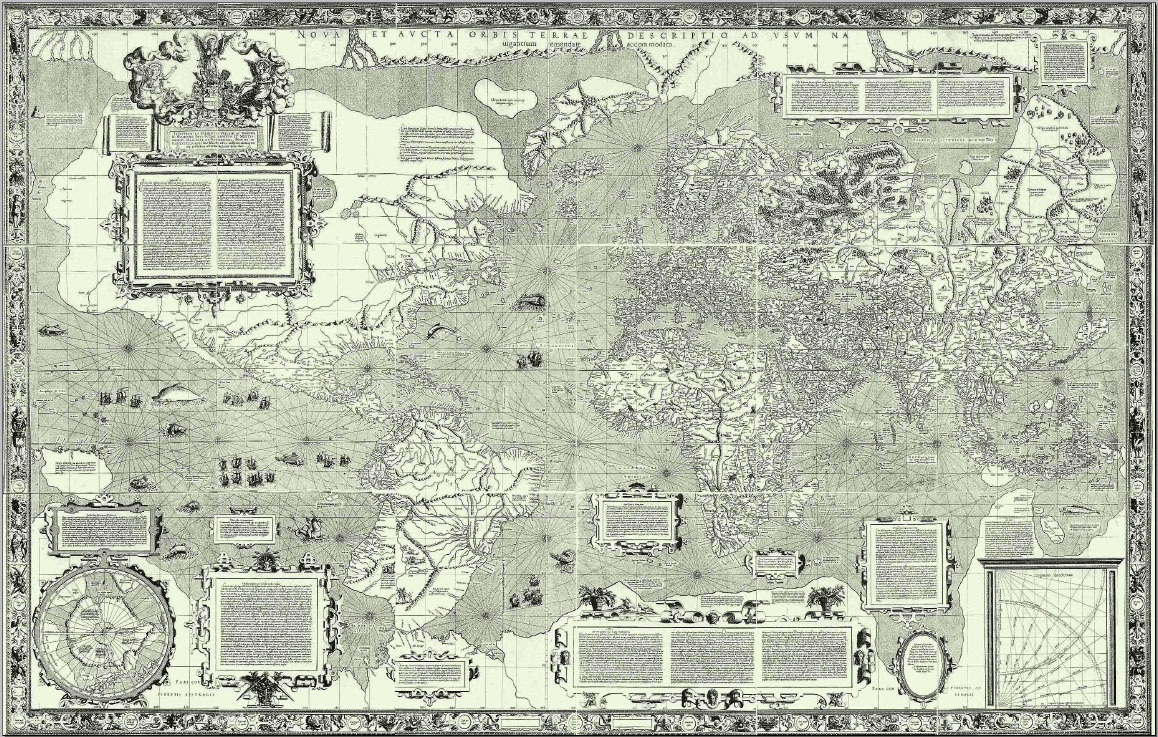
We are all familiar with the Mercator map of the world, designed by Gerardus Mercator in 1569. At the time, it was a significant cartographic breakthrough: a representation of the spherical earth on a plane. But we are all equally familiar with the fact that the Mercator map seriously distorts the actual size of various land masses (notably Greenland). Visual Capitalist offers an interesting graphic which shows how significant this distortion actually is and diminishes the land masses in the north and more accurately shows the size of the continent of Africa.
The Original Mercator Map
The Visual Capitalist Correction
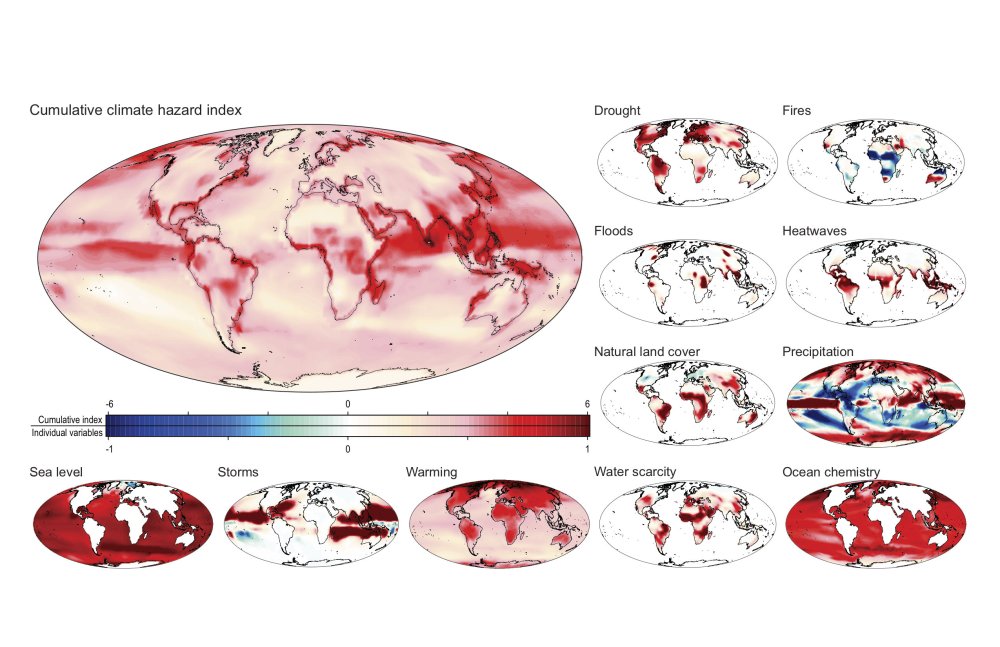
A new study from the University of Hawaii has reviewed thousands of peer-reviewed climate studies and analyzed the different ways climate change poses threats to humanity. The study came up with “467 ways in which human health, food, water, economy, infrastructure, and security have been impacted by multiple climatic changes including: warming, drought, heatwaves, wildfires, precipitation, floods, storms, sea level rise and changes in land cover and ocean chemistry.” Different regions of the world will experience different threats, but the study is the first to examine all possible impacts. The map below shows some of the impacts and how they will have differential effects.
“Xi received applause Saturday when he told the Asia-Pacific Economic Cooperation summit in Papua New Guinea that implementing tariffs and breaking up supply chains was ‘short-sighted’ and ‘doomed to failure.’ He called for a stronger World Trade Organization and defended his signature Belt-and-Road Initiative, saying it’s ‘not a trap as some people have labeled it.’”
“Speaking moments later, Pence told delegates the U.S. offers countries in the region ‘a better option’ for economic and diplomatic relations than Beijing’s heavy-handed approach. He warned against taking Chinese loans, saying the U.S. ‘doesn’t drown our partners in a sea of debt’ nor offer ‘a constricting belt or a one-way road.’”
Pence also was quite explicit about the US position on the South China Sea: “The South China Sea doesn’t belong to any one nation, and you can be sure: The United States will continue to sail and fly wherever international law allows and our national interests demand.”
US Presidents have attended these meetings since they began in 2013, but President Trump chose not to go. His absence was conspicuous given that all other heads of state were at the meeting.
There were large protests at over 2,000 locations in France over the hike in diesel fuel prices caused by higher taxes designed to reduce the consumption of fossil fuels. People wearing yellow vests blocked roundabouts and on-and-off ramps to motorways and hundreds were injured, including one person killed. The popularity of French President Macron has taken a real hit because of the taxes: “Anger over the high fuel prices has resulted in Macron’s popularity taking a hit over the recent months – from 39 percent in July to 21 percent in October.” But the anger toward Macron runs deeper than simply the hike in taxes. According to France24:
“But analysts say the movement now represents more widespread frustration over stagnant spending power under Macron, a former investment banker who promised economic revival and to restore people’s trust in government.
“The protests also reflect longstanding anger among many in rural and small-town France who say the government in Paris doesn’t understand the challenges facing the vast majority of the French.
“‘Macron is the president of the rich and not the poor. He needs to think about the poor as well,’ said Andre, a 38-year-old with no driver’s license who nonetheless joined a blockade in Dole, eastern France.”
The European Union has now three wounded leaders: Macron, May, and Merkel.
Yellow Vest Protest
A new research study has analyzed how adherence to the voluntary commitments made by various countries to reduce greenhouse gas emissions (known as Nationally Determined Contributions) would affect the climate. Unfortunately, it found that the voluntary commitments would fall far short of the goal of limiting temperature increases to 2°C: “When taken as benchmark by other countries, the NDCs of India, the EU, the USA and China lead to 2.6 °C, 3.2 °C, 4 °C and over 5.1 °C warmings, respectively.” There is a very revealing map which shows how far each country in the world has gone toward meeting the goal. The study could be a sharp impetus for countries to ratchet up their contributions, but that outcome remains to be seen.
Supporters of disputed Sri Lankan Prime Minister Mahinda Rajapaksa tried to block a second vote of no confidence in the Sri Lankan Parliament. They threw furniture, chili paste, and books in order to prevent the Speaker of the House, Speaker Karu Jayasuriya, from taking his chair to propose the motion of no confidence. The first vote of no confidence was passed by a voice vote which Rajapaksa’s supporters said was illegitimate. But the roll call vote was not possible due to the actions of Rajapaksa’s supporters. Parliamentary brawls are actually not that unusual. Quartz has a compendium of videos of brawls all around the world. The Financial Times has an article suggesting that the turmoil in Sri Lanka illustrates contention over China’s role in the island’s politics.
The Brawl in the Sri Lankan Parliament
The Washington Post has published an article which asserts–with good evidence–that the US CIA has concluded that “Saudi Crown Prince Mohammed bin Salman ordered the assassination of journalist Jamal Khashoggi in Istanbul last month.” The conclusion is not really a surprise given the information that Turkey has made available, despite the assertions by Saudi Arabia that the Crown Prince was unaware of the operation to kill Khashoggi. Indeed, Saudi Arabia has indicted 11 members of the team that went to Istanbul on the day that Khashoggi was murdered but exonerated the Crown Prince. The surprise in the article is that the CIA is flatly contradicting the narrative that the President has maintained that the Crown Prince was not involved. The CIA finding puts the President in a very awkward situation who had earlier indicated that he did not think the Crown Prince ordered the killing. According to The Daily Beast in October:
“President Donald Trump said Friday night he finds the Saudi Arabian government’s claim that journalist Jamal Khashoggi was killed in a “fist fight” credible. When asked by reporters if he found Saudi claim to be believable, Trump told reporters, ‘I do. I do.’ When further asked if Saudi leaders may have “lied” about what really happened to Khashoggi, a U.S. resident, Trump said, ‘No I don’t think so at all.’ Trump said he wants to speak to the man accused of orchestrating Khashoggi’s alleged murder, Saudi Crown Prince Mohammed bin Salman, before deciding on punishment. However, Trump said he would “rather find another solution” than canceling U.S. arms sales to Saudi Arabia because it ‘would mean a lot of jobs.’”
President Trump has invested a great deal in Saudi Arabia, making it the linchpin of his presumed Middle East peace program. But supporting the Crown Prince after the CIA finding is politically untenable, both for the President and his son-in-law, Jared Kushner.
There are some disquieting rumors in the press about a possible deal with Turkey to get the Turks to ease up on pressure on Saudi Arabia about the murder of Jamal Khashoggi. Several media outlets are reporting that the Trump Administration is thinking about expelling Turkish cleric Fethullah Gulen who has been living in the US for many years. Turkish President Erdogan regards Gulen as the leader of a failed coup against him two years ago. NBC News makes the argument:
“The secret effort to resolve one of the leading tensions in U.S.-Turkey relations — Gulen’s residency in the U.S. — provides a window into how President Donald Trump is trying to navigate hostility between two key allies after Saudi officials murdered Khashoggi on Oct. 2 at the kingdom’s consulate in Istanbul.
“It suggests the White House could be looking for ways to contain Erdogan’s ire over the murder while preserving Trump’s close alliance with Saudi Arabia’s controversial de facto leader, Crown Prince Mohammed bin Salman.”
Eric Levitz, writing for New York Magazine, is much less diplomatic in his understanding of the situation: “To review: In order to help an Islamist theocracy get away with executing one American immigrant, Trump is (reportedly) trying to find a legal rationale for letting another (much less totalitarian) Islamist theocracy execute a different American immigrant.” If the reports turn out to be accurate, one can safely assert that Realpolitik is alive and well at least in some areas of American foreign policy.
We are getting a better idea of how Brazil’s new President, Jair Bolsonaro, intends to rule. He has announced his selection for Foreign Minister and the choice reflects the deep-seated populism of the new government.
“Ernesto Araújo – until recently a mid-ranking official who blogs about the “criminalisation” of red meat, oil and heterosexual sex – will become the top diplomat of South America’s biggest nation, representing 200 million people and the greatest and most biodiverse forest on Earth, the Amazon.”
Since 1992, Brazil has been a true leader in the international actions to protect the global environment. Its defection from the movement will make it more difficult to take the necessary steps to avert climate change.
Separation issues, enabling a smooth winding down of current arrangements (e.g., protect existing intellectual property rights, conclude police and judicial cooperation on criminal matters, enable goods placed on the market to reach their destination)
Financial settlement, ensuring both sides meet all financial obligations undertaken while the U.K. was an EU member
Citizens’ rights, protecting the rights of over 3 million EU citizens in the U.K. and over 1 million U.K. nationals in EU countries
Northern Ireland backstop, ensuring no hard border between Ireland and Northern Ireland and protecting the rights enshrined in the Good Friday Agreement
Protocols for Cyprus and Gibraltar, respectively protecting the interests of Cypriots who live and work in the Sovereign Base Areas and enabling close cooperation with Spain on the rights of citizens living in Gibraltar
The evidence that the US is getting ready to make an arrangement with the Taliban in Afghanistan continues to mount. What is interesting, however, is that the increasing ability of the Taliban to control areas within Afghanistan is occurring even as the US steps up its bombing. The discrepancy between military power and political power has never been more apparent, and that discrepancy should be noted by all who believe that military power can be decisive in what is essentially only a political matter.
British Prime Minister Teresa May has secured the support of her Cabinet for the Brexit agreement with the European Union. The draft runs 585 pages and it deals with a very large number of issues, the most important of which are:
Britain’s financial settlement with the EU to meet agreed commitments.
The post-Brexit rights of EU citizens in the UK and British citizens on the continent.
A mechanism to prevent a hard border on the island of Ireland.
The agreement works largely because both sides have agreed that Great Britain and the EU will forge a free trade agreement after the British leave the Union. Such an agreement would allow Great Britain to not be bound by many of the regulations of the EU but would allow the passage of goods and services without any trade barriers. It is an intriguing resolution, but one which will not satisfy some members of May’s Conservative Party members. Presumably, she will be able to get the votes to pass the agreement through Parliament. The agreement has to be approved by all the other members of the Union and may be subjected to a second national referendum in Great Britain. So there is much left to be done, and it is premature to think that the crisis has passed.
The Los Angeles Times has a well-documented article on the disengagement of the Trump Administration from foreign policy. It is a disturbing article because there is increasing evidence that there will significant personnel changes in the Administration and one gets the sense that no one is minding the store at a time when the inventory of the store is changing rapidly as well. It may be the case that American commitments abroad need to be pulled back. But dropping those commitments is not the same thing as carefully ending them,
The New York Times has published a story indicating that satellite images show that North Korea is building 16 new ballistic missile testing areas even as it engages in talks on denuclearization. The evidence undermines US President Trump’s assertions that progress is being made:
“The satellite images suggest that the North has been engaged in a great deception: It has offered to dismantle a major launching site — a step it began, then halted — while continuing to make improvements at more than a dozen others that would bolster launches of conventional and nuclear warheads.
“The existence of the ballistic missile bases, which North Korea has never acknowledged, contradicts Mr. Trump’s assertion that his landmark diplomacy is leading to the elimination of a nuclear and missile program that the North had warned could devastate the United States.”
The world is remembering the end of World War I, a seminal event in modern history. As always, we try to glean meaning from such remembrances, some of which make sense and others which are misleading. Katrin Bennhold has written a short essay fro The New York TImes entitled “Can Europe’s Liberal Order Survive as the Memory of War Fades?” Her observations about the similarities between 1914 and 2018 are chilling:
“Politicians are apt to use history selectively when it suits them. But the history in this case is ominous.
“Now as then, Europe’s political center is weak and the fringes are radicalizing. Nationalism, laced with ethnic hatred, has been gaining momentum. Populists sit in several European governments.”
9 November was also the 80th anniversary of Kristallnacht, a night when Nazi-inspired thugs broke the windows of Jewish stores, signalling the ultimate intent of Aryan nationalism in Europe. The world, to its everlasting shame, ignored that warning, as it seems to be ignoring the signs of anti-semitism today.
We are finally getting some more information about the US sanctions on Iran which were imposed on Monday. First, the US has apparently granted waivers to 8 countries to continue to import Iranian oil. Those countries are China, India, South Korea, Japan, Italy, Greece, Taiwan and Turkey and they collectively account for 80% of Iranian exports. The waivers are good for 180 days and can be extended. Thus, the sanctions will probably have little effect after December (imports were reduced by these countries in anticipation of the sanctions, but will go up now that the waivers have been granted). Second, there is good evidence that many countries do not intend to honor the sanctions or will seek to evade them. Third, Iranian oil tankers have turned off their maritime transponders so that they cannot be tracked. Turning off the transponders vitiates the insurance on the tankers so there are increased risks to Iran by this tactic, but it will make it more difficult for the US to identify who is buying Iranian oil.
As the economic and political situation in Venezuela continues to deteriorate, almost 3 million Venezuelans have left the country. Most of the refugees have gone to neighboring countries, putting a genuine strain on the resources available to shelter refugees properly. According to The Guardian:
“’The main increases continue to be reported in Colombia and Peru,’ Spindler [UN high commissioner for refugees (UNHCR)] said.
“Colombia is sheltering 1 million Venezuelans. About 3,000 more arrive each day, and the Bogotá government says 4 million could be living there by 2021, costing it nearly $9bn.”
For perspective, one should compare the anxiety in the US over a group of refugees numbering around 3,000 coming through Mexico. What if there were 3,000 coming every day?
The scheduled meeting between US Secretary of State Pompeo and his North Korean counterpart has been postponed, with no explanation given for the decision. The postponement follows the North Korean declaration that it would resume nuclear testing if the US did not lift the sanctions against it. Robert Carlin, in 38North, quotes Kwon Jong Gun, director of North Korea’s Foreign Ministry’s Institute for American Studies (IFAS), to interpret the recent situation:
“In the commentary, Kwon put forth what may actually be a high-level perception in Pyongyang—that the US did not get serious about talks until the North demonstrated in 2017 that it could strike the US mainland with an intercontinental ballistic missile (ICBM) and made clear that the DPRK nuclear threat to the US mainland was ‘only a matter of time.’ A worst-case interpretation of that position, unstated by Kwon, is that the North might at some point in the future decide the only way to get the US into productive talks would be to demonstrate even more starkly its ICBM capability.”
Clearly, the negotiations are not bringing North Korea and the US closer together. It is difficult to predict the US reaction if North Korea resumes nuclear testing.
“The conflict in Yemen began with the 2014 takeover of the capital, Sanaa, by the Houthis, who toppled the internationally recognised government of President Abd-Rabbu Mansour Hadi.
“The coalition forces – which include Saudi Arabia and the United Arab Emirates and are backed by the United States – intervened in 2015 to reinstall Hadi’s government.
Even as the conflict goes on, the humanitarian crisis in Yemen has deepened to the point where the regional director for UNICEF said that Yemen is a “living hell”. According to NBC News: “UNICEF’s operation in Yemen estimates there are 1.8 million children currently facing malnutrition, including 400,000 who are severely malnourished and at risk of death if not urgently treated. More than 8 million children are cut off from regular access to basic water, sanitation and hygiene services.”
The Pew Research Center has some interesting results from a poll it conducted in several European countries. The questions related to the degree of openness to Muslims and Jews and the extent to which citizens regarded their societies as superior to other societies. The poll found a rather sharp divide between western and eastern European societies:
“The continental divide in attitudes and values can be extreme in some cases. For example, in nearly every Central and Eastern European country polled, fewer than half of adults say they would be willing to accept Muslims into their family; in nearly every Western European country surveyed, more than half say they would accept a Muslim into their family. A similar divide emerges between Central/Eastern Europe and Western Europe with regard to accepting Jews into one’s family.”
The poll found similar splits on the issues of gay rights, abortion, and the role of religion. The study is fascinating.
French President Macron is on a tour of World War I battle sites, honoring the centenary of the Armistice agreement that ended the war. While on tour, he called for the creation of a “real European army” saying that “We have to protect ourselves with respect to China, Russia and even the United States of America.” European states have toyed with the idea of creating a unified European army for a number of years, but those plans have always floundered over the question of how to integrate such an army into the overall NATO framework. The US has usually been opposed to the force, but it is not clear how the current US Administration views the possibility. Macron no longer believes that the US is a reliable security partner: “When I see President Trump announcing that he’s quitting a major disarmament treaty which was formed after the 1980s euro-missile crisis that hit Europe, who is the main victim? Europe and its security.”
Photograph revealing the trenches from the battle of the Somme, 100 years after the battle
According to the World Health Organisation (WHO), India has 14 of the top 15 most polluted cities in the world. Fall is always bad in Indian cities: farmers burn the stubble from their fields and the Diwali festival is always accompanied by fireworks that contribute to polluted air. The pollution is a serious health hazard, but it also has serious economic consequences. According to NDTV: “By the World Bank’s calculations, health-care fees and productivity losses from pollution cost India as much as 8.5 percent of GDP. At its current size of $2.6 trillion that works out to about $221 billion every year.” India has made significant progress in developing alternative sources of energy, but its progress in that area lags far behind the efforts to curtail pollution.





 World Politics News