Susan Rice was President Obama’s second term National Security Adviser and she has written an op-ed for the New York Times about the summit meeting between North Korean leader Kim and US President Trump. The summit comes at a very awkward time for President Trump: there are indications that the US Congress might disallow President Trump’s national emergency declaration and Trump’s former lawyer is scheduled to testify about possible criminal behavior in the Trump Administration. These vulnerabilities might make President Trump think about scoring a diplomatic victory in Hanoi (unfortunately, no matter what happens, Mr. Trump will claim victory–after the first summit in Singapore Mr Trump prematurely claimed that there was no longer an nuclear threat from North Korea). Rice argues that Mr. Trump may make “further concessions to the North Korean dictator, like a peace declaration, partial sanctions relief, or continued limitations on United States military exercises or troop presence without receiving tangible, irreversible concessions in return….[h]istory suggests that Mr. Trump will be content with another colorful photo opportunity and more diplomatic shadow boxing that perpetuates the illusion of success, while running down the clock on a nearly intractable challenge.”
It is always dangerous for a politician experiencing weakness at home to look to international diplomacy as a way of shoring up a political base. In this particular case, Mr. Trump may make decisions that will not serve the US national interest.
58 former national security officials, who have served in both Republican and Democratic Administrations, issued a statement protesting President Trump’s national emergency declaration about the southern border. The statement was judicious and read, in part:
” On February 15, 2019, the President declared a “national emergency” for the purpose of diverting appropriated funds from previously designated uses to build a wall along the southern border. We are aware of no emergency that remotely justifies such a step. The President’s actions are at odds with the overwhelming evidence in the public record, including the administration’s own data and estimates. We have lived and worked through national emergencies, and we support the President’s power to mobilize the Executive Branch to respond quickly in genuine national emergencies. But under no plausible assessment of the evidence is there a national emergency today that entitles the President to tap into funds appropriated for other purposes to build a wall at the southern border. To our knowledge, the President’s assertion of a national emergency here is unprecedented, in that he seeks to address a situation: (1) that has been enduring, rather than one that has arisen suddenly; (2) that in fact has improved over time rather than deteriorated; (3) by reprogramming billions of dollars in funds in the face of clear congressional intent to the contrary; and (4) with assertions that are rebutted not just by the public record, but by his agencies’ own official data, documents, and statements.
In addition, 26 former Republican lawmakers issued their own statement indicating deep reservations about the constitutionality of the declaration.
“We offer two arguments against allowing a president—any president, regardless of party—to circumvent congressional authority. One is the constitutional placing of all lawmaking power in the hands of the people’s representatives. Article 1 of the Constitution, which vests the legislative branch with specific powers, states in section 9: “No money shall be drawn from the Treasury, but in Consequence of Appropriations made by Law.” The power of the purse rests with Congress because it is comprised of 535 representatives of the taxpayer and is the most direct connection between those being governed and those governing. If you allow a president to ignore Congress, it will be not your authority but that of your constituents that is deprived of the protections of true representative government.
“The second argument goes directly to the question each of you must face: how much are you willing to undermine both the Constitution and the Congress in order to advance a policy outcome that by all other legitimate means is not achievable? The current issue—a wall on our southern border—has gone through the process put in place by the Constitution. It has been proposed by the President, it has been debated by Congress, and the representatives of the people allocated funding at a level deemed appropriate by Congress. We understand that there are many Members of Congress who disagree with the final funding compromise reached by a bipartisan group of legislators. To you, we ask this question: what will you do when a president of another party uses the precedent you are establishing to impose policies to which you are unalterably opposed? There is no way around this difficulty: what powers are ceded to a president whose policies you support may also be used by presidents whose policies you abhor.”
It is not clear whether the US Congress will heed these warnings. A resolution disapproving the declaration will likely pass the House of Representatives but may not pass the Senate. Even if there are enough Republican Senators to pass the resolution, President Trump will likely veto the resolution. The declaration is incredibly dangerous and unnecessary and it should be defeated.
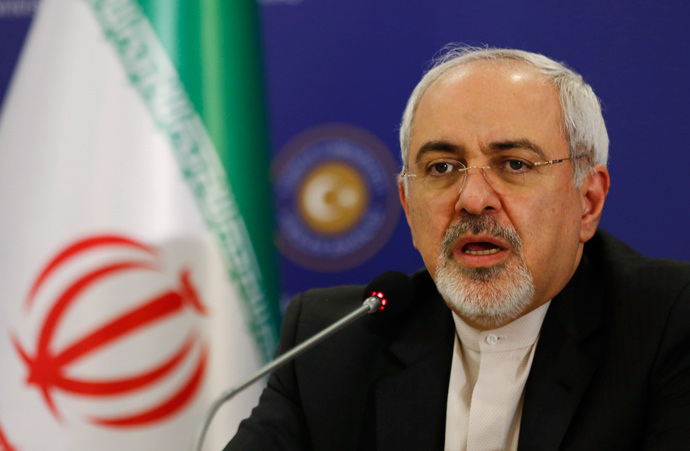
Iran’s Foreign Minister Mohammad Javad Zarif has unexpectedly announced his resignation. Zarif was a central figure in working out the details of the Iranian nuclear agreement which, despite the US pullout, still remains in force. The resignation was likely in response to pressures from hardliners in Iran who oppose the agreement and it may signal growing power of that group in Iranian politics. If true, then we should pay careful attention to Iranian actions in Syria. The hardliners are also determined to maintain a more forceful position vis-a-vis Israel. The resignation must be accepted by President Rouhani to become effective, so it may be the case that Zarif simply wants Rouhani to repudiate the hardliners.
Foreign Minister Mohammad Javad Zarif
Nigerian President Muhammadu Buhari has taken an early lead in the election polls. The election, which was held yesterday after a week’s delay, was accompanied by a degree of violent protests by those who believe that the results are being manipulated. The election is very important as Nigeria is the most populated country in Africa and has the largest economy. It is also, however, a country plagued by corruption and riven by ethnic and religious conflicts. We do not expect the final results of the election to be announced until later this week.
British Prime Minister Teresa May has set 12 March as the day the British Parliament will vote on her deal with the European Union for Brexit. That is only 17 days before the deadline of 29 March for the British departure from the Union. The situation remains quite murky because negotiations between May and the Union are still ongoing, with the status of the British relationship with Northern Ireland and the Republic of Ireland still the unresolved matter. Some in Britain believe that the delay is a tactic to give the Members of Parliament little freedom in avoiding a no-deal Brexit, an outcome that all sides believe to be catastrophic for the British economy. The EU is considering a three-month extension on the deal, as well as a longer 21-month delay. It does appear, however, that May is interested in thinking about a delay at this point, believing that threatening a catastrophe is her best bargaining chip. We will see if Parliament calls her bluff.
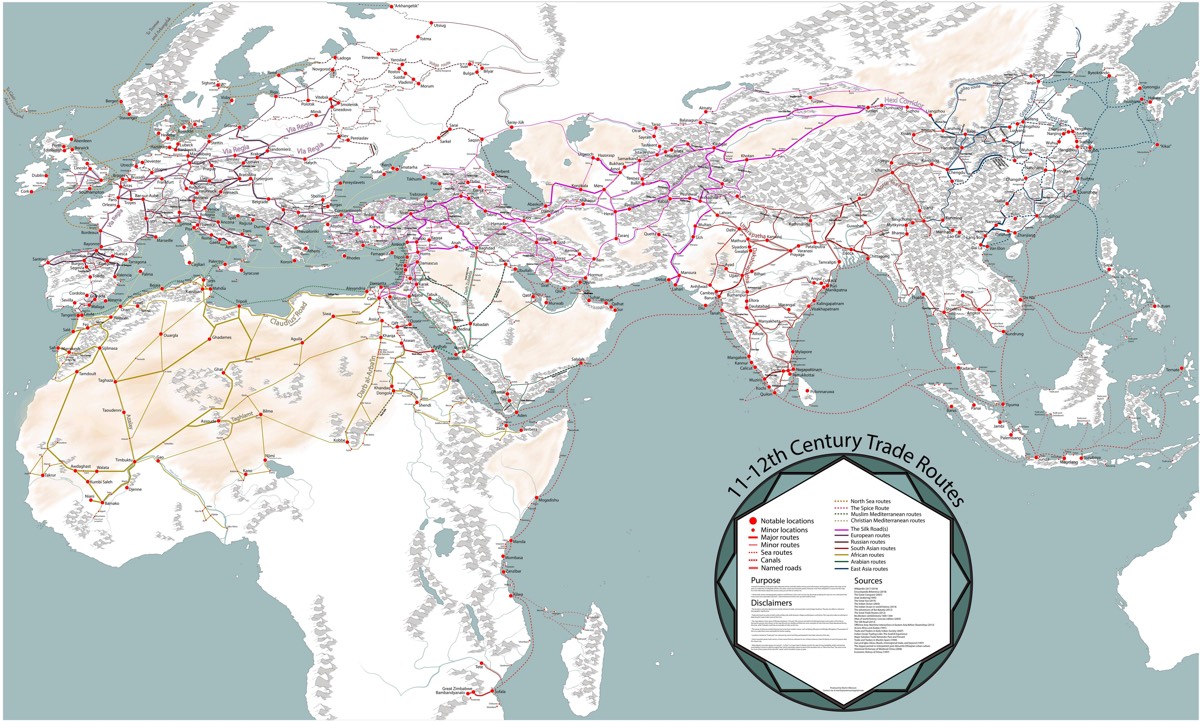
Grad student Martin Jan Månsson has created an extraordinary map of trade routes throughout Eurasia in the 11th and 12th centuries. I cannot even imagine how much work was involved in the creation of the map but it is also hard to calculate how much information the map conveys. The map is reproduced below, but there is an interactive map which is much more useful which can be accessed here. The map is testimony to how important trade was to all these various regions and how dedicated and committed those involved were to making trade possible. Jason Kottke describes the meaning of the map:
“The saying is that “all roads lead to Rome” but as this map shows, that assertion belongs to an earlier era. In the 12th century, it was more accurate to say that all roads lead to Constantinople or Cairo or Baghdad or Hanzhong…or perhaps even “all roads lead to everywhere”. It’s not quite globalization, but many of the world’s peoples were well on their way to connecting with everyone else.”
Eight months after their summit meeting in Singapore, North Korean leader Kim and US President Trump are scheduled to meet again next week in Vietnam. It is not clear what to expect from this second meeting. Both sides achieved certain goals from the first meeting: North Korea got a promise from the US not to hold military exercises with South Korea and leader Kim got the symbolic prestige of being acknowledged as a nuclear power; the US got a suspension of testing from North Korea, the return of military remains from the Korean War, and three hostages were returned to the US. But the ultimate goal remains denuclearization for the US and reunification of the Korean peninsula for North Korea. Neither of those two goals seems achievable next week. Many analysts believe that President Trump is interested in receiving a Nobel Peace Prize for his efforts and it is perhaps conceivable that a final peace treaty for the Korean War could be signed, although that would require the signatures of South Korea and China as well. But the armistice has held between North and South Korea since 1953 and it is not clear what a final peace treaty would signify. And it seems likely that a peace treaty would also imply that the US would pull its troops out of South Korea, a move that would require more than a simple North Korean signature on a piece of paper.
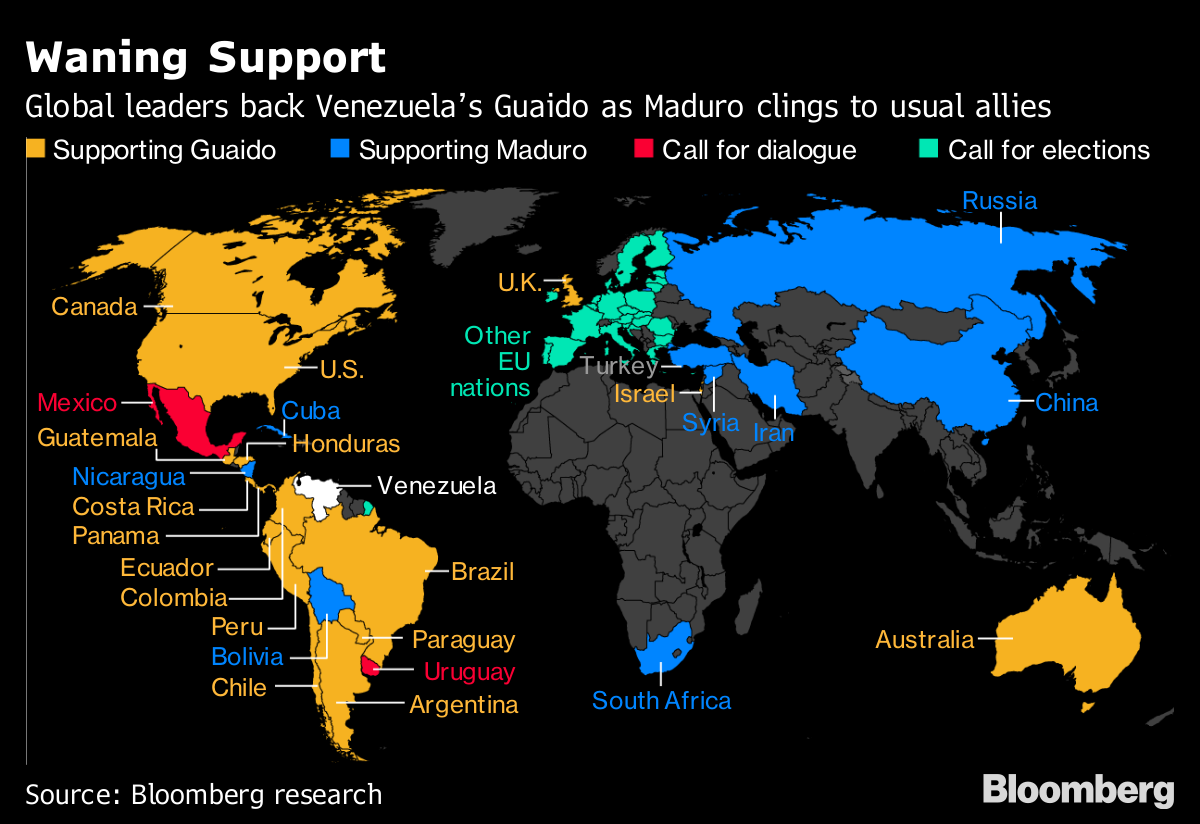
There have been deaths reported along the Venezuela-Colombia border as protesters clashed with the Venezuela national guard preventing humanitarian aid from entering the country. There are also reports of some of the soldiers abandoning their posts and joining the protests. The clashes are primarily symbolic as the amount of aid available at the border is far too small to have any effect on the desperate situation in Venezuela. The aid is a wedge designed to weaken President Maduro’s control over the military. The tactic may in fact lead to defections in the military, but the risks associated with the gamble are huge: the military officers loyal to Maduro have far too much invested in Maduro to overthrow him. The tactic is more likely to fragment the military, leading to a civil war within the military. And China and Russia have also cast their lot with Maduro, meaning that Maduro has every reason to believe that he can hold on. The US is playing a very dangerous game: creating a power vacuum in Venezuela is not going to stabilize the situation for the better.
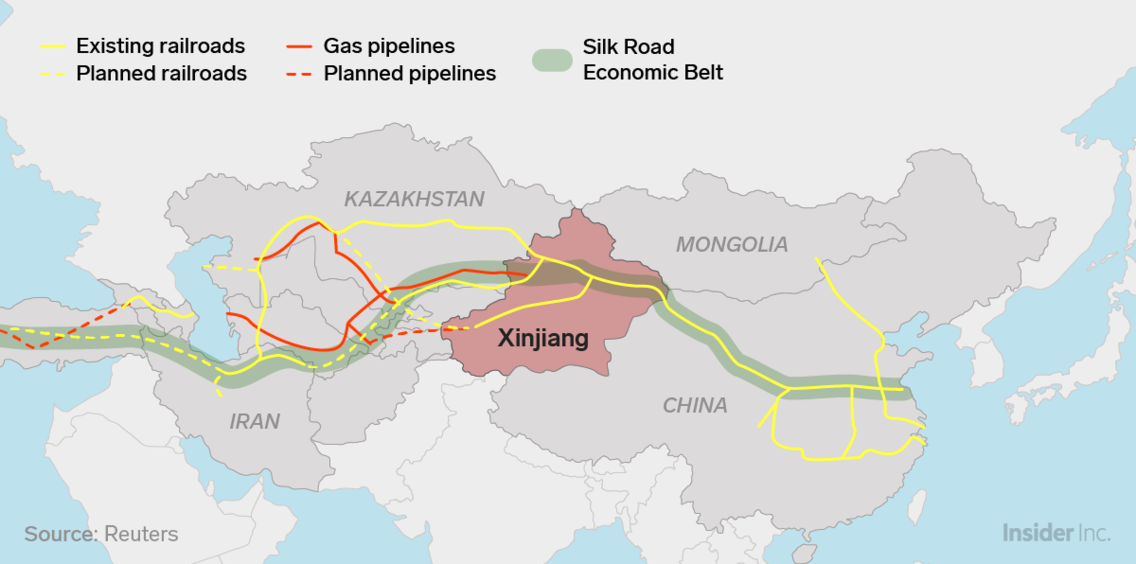
Saudi Crown Prince Mohammed bin Salman has been on a tour of Asian countries and has signed very large economic agreements with Pakistan, India, and China (Pakistan gifted Salman a gold-plated assault rifle). The trip is designed to improve the image of Saudi Arabia in the world after the death of Jamal Khashoggi. Salman’s last visit to China was especially interesting as the two countries signed a $10 billion deal for a refining and petrochemical complex in China. Prince Salman was apparently willing to overlook the detention of over 2 million Uighur Muslims in the northwestern province of China, Xinjiang, who China suspects are not loyal to the central government in Beijing. There is no better proof for the realist adage that interests, not values, rule in world politics.
The Centrality of Xinjiang to China’s Belt and Road Initative
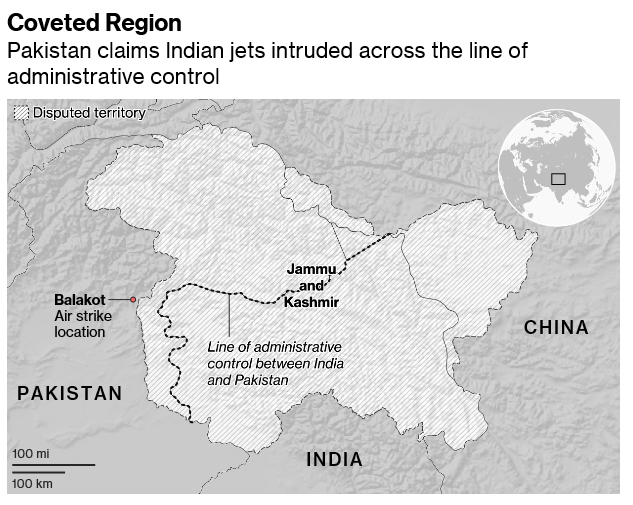
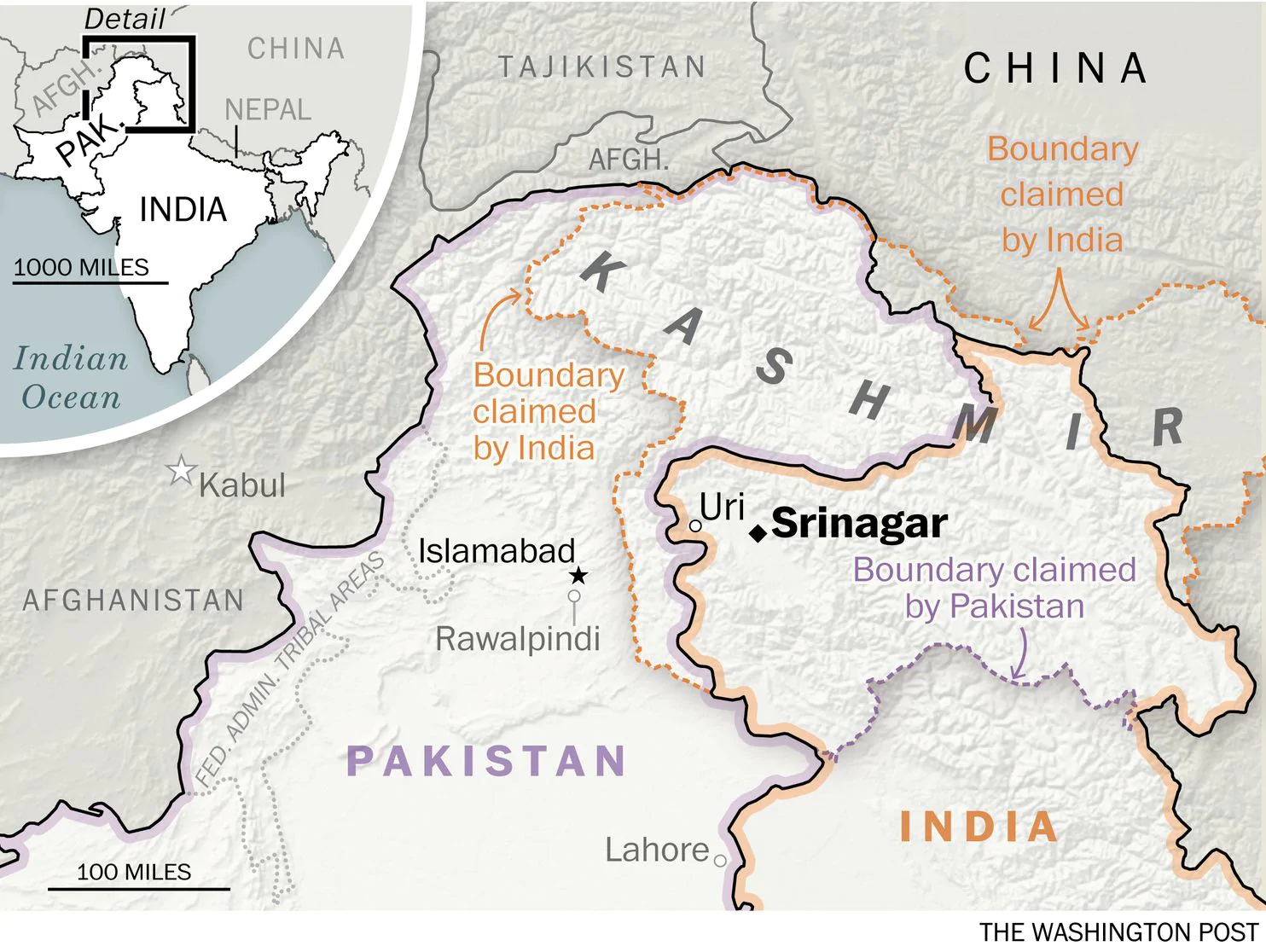
Pakistani military spokesperson, Major General Asif Ghafoor, had some direct words for India as tensions over Kashmir continue to build: “We have no intention to initiate war, but we will respond with full force to full spectrum threat that would surprise you. Don’t mess with Pakistan.” The United Nations Security Council passed a resolution condemning the terrorist attack on Indian forces in Pulwama, but only after a seven day delay as Pakistan and China worked furiously to omit the word “terrorist” from the resolution. India is currently working to ban Pakistan from the upcoming cricket World Cup. India is also threatening to divert water from rivers promised to Pakistan under the Indus Water Treaty. There still seems to be little action designed to defuse the tension.
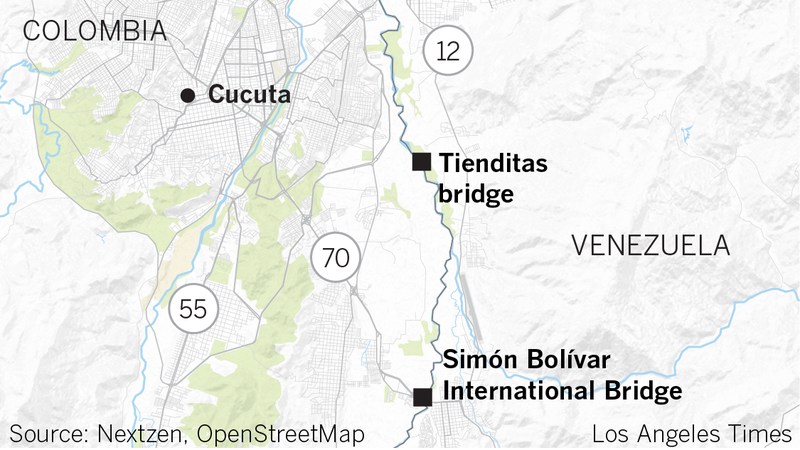
Venezuelan troops fired on people near the Brazilian border as humanitarian aid continues to pile up there and on the Colombian border. The troops have been ordered to prevent that aid from entering the country and both China and Russia have supported the Maduro government’s efforts to stop the flow of aid. There are competing music concerts at the borders. The Venezuelan government is supporting a concert titled “Hands Off Venezuela”and Richard Branson is holding a “Live Aid” concert for Venezuela. The dueling concerts are being held simultaneously as both sides try to appeal for international support. As humanitarian aid flows into the border areas, there are growing fears that force may be used to allow it in or to prevent it from coming in. The aid near the Colombian border city, Cucuta, is substantial but the Venezuelan military has blocked the bridge connecting Colombia with Venezuela with large containers.
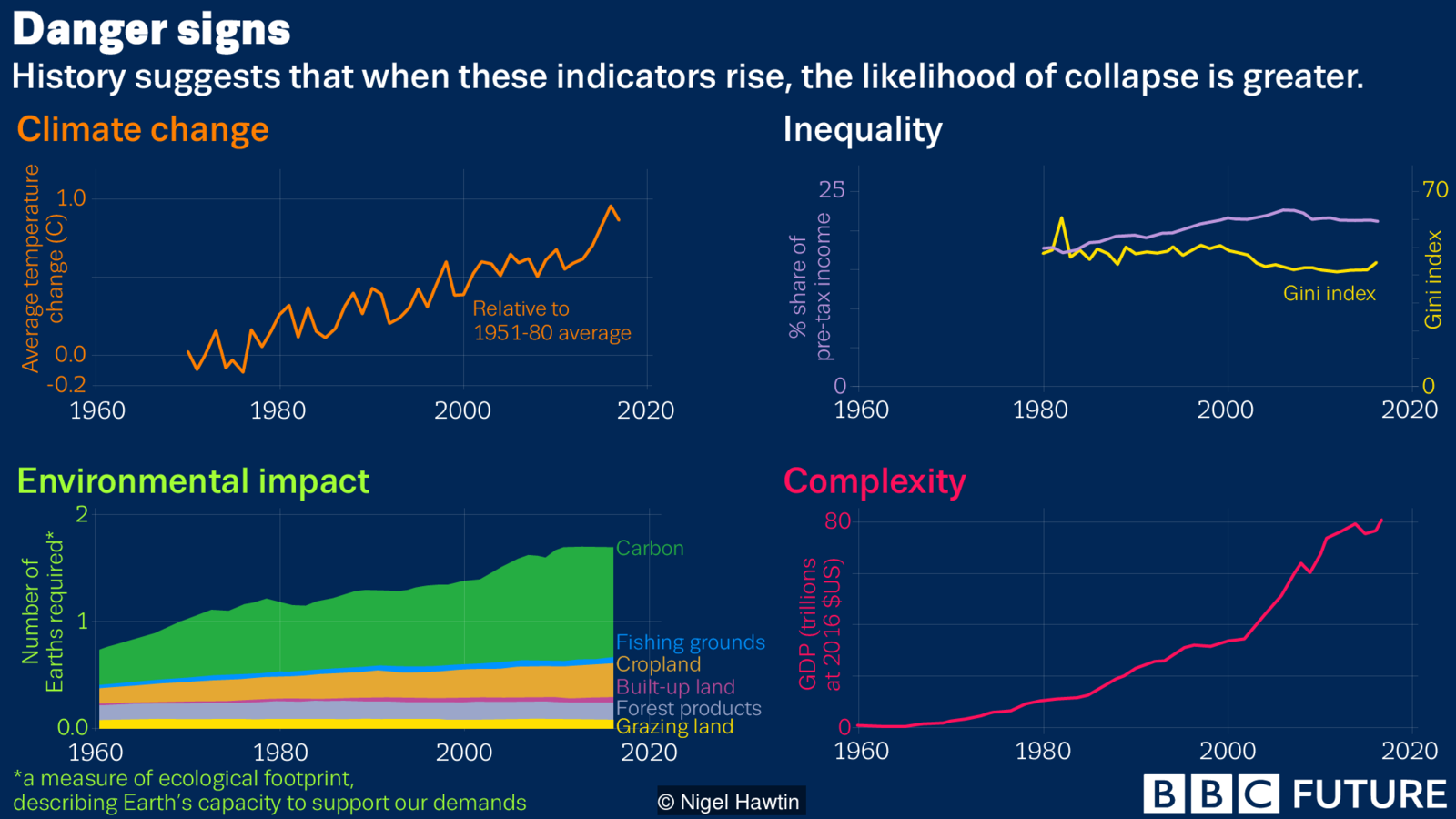
The BBC has been publishing articles on what it calls “Deep Civilisation” raising issues for the future of humanity. The most recent article is on the collapse of civilizations. The article identifies the conditions that have often been associated with the decline of civilizations:
“While there is no single accepted theory for why collapses happen, historians, anthropologists and others have proposed various explanations, including: “CLIMATIC CHANGE: When climatic stability changes, the results can be disastrous, resulting in crop failure, starvation and desertification. The collapse of the Anasazi, the Tiwanaku civilisation, the Akkadians, the Mayan, the Roman Empire, and many others have all coincided with abrupt climatic changes, usually droughts. “ENVIRONMENTAL DEGRADATION: Collapse can occur when societies overshoot the carrying capacity of their environment. This ecological collapse theory, which has been the subject of bestselling books, points to excessive deforestation, water pollution, soil degradation and the loss of biodiversity as precipitating causes. “INEQUALITY AND OLIGARCHY: Wealth and political inequality can be central drivers of social disintegration, as can oligarchy and centralisation of power among leaders. This not only causes social distress, but handicaps a society’s ability to respond to ecological, social and economic problems…. “COMPLEXITY: Collapse expert and historian Joseph Tainter has proposed that societies eventually collapse under the weight of their own accumulated complexity and bureaucracy. Societies are problem-solving collectives that grow in complexity in order to overcome new issues. However, the returns from complexity eventually reach a point of diminishing returns. After this point, collapse will eventually ensue…. “EXTERNAL SHOCKS: In other words, the “four horsemen”: war, natural disasters, famine and plagues. The Aztec Empire, for example, was brought to an end by Spanish invaders. Most early agrarian states were fleeting due to deadly epidemics. The concentration of humans and cattle in walled settlements with poor hygiene made disease outbreaks unavoidable and catastrophic. Sometimes disasters combined, as was the case with the Spanish introducing salmonella to the Americas. “RANDOMNESS/BAD LUCK: Statistical analysis on empiressuggests that collapse is random and independent of age. Evolutionary biologist and data scientist Indre Zliobaite and her colleagues have observed a similar pattern in the evolutionary record of species. A common explanation of this apparent randomness is the “Red Queen Effect”: if species are constantly fighting for survival in a changing environment with numerous competitors, extinction is a consistent possibility.”
All civilizations implode. They generally become too complex to manage given the resources available to them. Now that the world has become incredibly interdependent, it is difficult to imagine any collapse that would not be global in scope.
The Trump Administration is planning to create a Presidential Committee on Climate Security in order to determine the national security implications of climate change. It is a 12-person committee and one of the panelists is William Happer, a noted climate change denier. Happer is a physicist who is not trained as a climate scientist; his role in the government is in the realm of laser technologies and missile defense. The Washington Post quotes Happer from a conference in 2016:
“During a December 2016 energy and climate policy summit sponsored by the conservative Heritage Foundation, Happer explained that the CO2 Coalition aimed to counter the idea that carbon dioxide is a pollutant because it is the primary driver of recent climate change.
“’I like to call this the CO2 anti-defamation league,’ he said, gesturing to a slide, ‘because there is the CO2 molecule, and it has undergone decade after decade of abuse, for no reason.
“’We’re doing our best to try and counter this myth that CO2 is a dangerous pollutant,’ he said. ‘It’s not a pollutant at all. . . . We should be telling the scientific truth, that more CO2 is actually a benefit to the earth.’”
The right amount of CO2 is a good thing, but most climate scientists agree the the levels of CO2 emitted since the beginning of the industrial revolution will raise serious problems for human habitation in many regions of the globe.
“The White House memo notes that multiple scientific and defense reports have recently concluded that climate change poses a significant threat to national security, but it casts doubt on those reports, saying, ‘these scientific and national security judgments have not undergone a rigorous independent and adversarial peer review to examine the certainties and uncertainties of climate science, as well as implications for national security.’”
The assessment is hard to square with the facts. Last November, 13 Federal agencies issued a National Climate Assessment, a document required by law, that totaled 1,656 pages that left no doubt about the inevitability of irreversible climate change absent some very dramatic policy changes. At the time, the Trump Administration ignored the report.
Russian President Vladimir Putin gave his annual address to the nation as his popularity begins to decline as his government intends to make some economic changes, such as raising the age of retirement for a pension, that the Russian people do not favor. He also made clear that Russia views the end of the Intermediate-range Nuclear Forces (INF) Treaty as deeply troubling. Putin said that if the US places intermediate-range missiles in Europe, then Russia would respond vigorously. Reuters quotes Putin:
“‘Russia will be forced to create and deploy types of weapons which can be used not only in respect of those territories from which the direct threat to us originates, but also in respect of those territories where the centers of decision-making are located,’ he said.
“’These weapons, by their tactical and technical specifications, including their flight time to the command centers I’m talking about, will fully correspond to the threats that will be directed against Russia.’”
The reference to command centers is a direct reference to Washington, DC and the threat of faster weapons is manifested in the hypersonic missiles Russia claims to have developed which theoretically can stymie anti-missile defense systems. Reuters explains how Russia views the deployment of intermediate range missiles in Europe:
“Any U.S. move to place new missiles in Europe would cut the time it took some U.S. missiles to reach Moscow to 10-12 minutes, Putin said, something he called a serious threat.
“Such a scenario, if left unmatched, would open up the possibility of Russia being hit by a nuclear strike before its own missiles fired in response could reach U.S. territory.
“The Russian land-based missiles that currently target the United States are based on Russian territory and therefore the flight time to major U.S. population centers would be longer than for U.S. missiles deployed in Europe. “
The Kremlin released a video of its Poseidon nuclear-power underwater drone, a device designed to create devastating tsunamis in port cities. It is impossible for me to think about the circumstances in which the use of such a weapon could be seriously considered.
Michael Axworthy has written a very informative essay on the Islamic Republic of Iran fpr the New Statesman. It is a good place to begin if one wishes to find out how Iran went from one of the most important allies of the US in the 1970s to a harsh enemy after the revolution of 1979. Axworthy explains the longevity of the Islamic Republic despite the overt hostility of the US for almost 40 years:
“The other – which non-Iranians often miss or misunderstand entirely – is the success of the Islamic Republic in finally achieving national independence and self–determination after decades and centuries of humiliation and subordination by foreigners. Iranians are proud people and for many of them this achievement, which they connect directly to the revolution and the country’s endurance of the long war with Iraq is beyond price. It means many ordinary Iranians remain loyal to the Islamic Republic, at least in some way, when they might otherwise not be; and makes them determined to support it in resisting external pressure – notably, now, the exaggerated hostility of the Trump administration and renewed sanctions. It underpins and validates the determination of Supreme Leader Ali Khamenei, along with the Revolutionary Guards and other parts of the state apparatus, to defend and maintain the Islamic Republic.”
One should never underestimate the importance of national autonomy in world politics. The ability of regimes such as Iran and Cuba to stand up to the major powers is an important part of the legitimacy of those regimes–their failures notwithstanding–to their citizens. This dynamic may play out once again if the US pushes the Maduro regime in Venezuela too hard.
The US House Oversight and Reform Committee has issued a report that indicates that the Trump Administration has endeavored to sell nuclear technology to Saudi Arabia. The effort came despite serious reservations in the National Security Council about the possibility that the technology could be diverted to the production of nuclear weapons. The report identifies Derek Harvey, the former Senior Director for Middle East and North African Affairs at the National Security Council, as the person most directly involved with the plans. According to Business Insider:
“The whistleblowers went on to say that the career staff for Derek Harvey, the former Senior Director for Middle East and North African Affairs at the National Security Council, warned him that any nuclear technology transferred to Saudi Arabia would need to reach a “123 Agreement,” or a requirement in the US’s Atomic Energy Act that would demand the Saudis agree to nine nuclear nonproliferation clauses.
“Basically, the US could legally transfer nuclear technology to Saudi Arabia if the Saudis agreed to keep the material safe, let inspectors check on it, and never use it to make a nuclear weapon.
“Harvey’s staff reportedly warned him he couldn’t get around this law, but ‘Mr. Harvey reportedly ignored these warnings and insisted that the decision to transfer nuclear technology to Saudi Arabia had already been made.’
“‘Both career and political staff inside the White House reportedly agreed that Mr. Harvey’s directive could violate the law. One senior political official stated that the proposal was ‘not a business plan,’ but rather ‘a scheme for these generals to make some money,” the report continued.”
We should keep in mind that the Trump Administration has made the issue of Iranian nuclear weapons a central feature of its Middle East policies. There is probably nothing that would stimulate Iran to build nuclear weapons more assiduously than the specter of Saudi Arabian nuclear capabilities. Additionally, we should remember that Saudi Arabian citizens were behind the terror attacks on the US on 11 September 2001. And that Saudi Arabia is ruled by a Prince that ordered the murder of a journalist in cold blood. Finally, the idea that US solicitude toward Saudi Arabia may be fueled by the personal business interests of members of the Trump Administration.
President Trump delivered a speech today at Florida International University in which he made statements directly to the Venezuelan military. Reuters quotes the President as saying: “if the Venezuelan military continues supporting Maduro, ‘you will find no safe harbor, no easy exit and no way out. You’ll lose everything.’” The threat comes as the US continues to send humanitarian aid to points just beyond the Venezuelan border. The apparent hope is that the promise of aid could lead younger members of the Venezuelan military to defect from the military officers who continue to support Maduro. Alex Ward, writing for Vox, describes the horrific economic conditions in the country:
“Inflation in the country now hovers above a million percent, and could reach 10 million percent this year, according to the International Monetary Fund. Food and medicine are too expensive for many to purchase. And since 2015, more than 3 million Venezuelans have left the country in search of better opportunities elsewhere, primarily in Colombia. (It’s expected that another 2 million will become refugees in 2019 alone.)”
There does not appear to be a coordinated response among the US and its allies about what the next step should be. It does seem clear that while many states would like to see a more forceful response, many fear that stronger US action will only reinforce Maduro’s position.
Suresh Naidu, Dani Rodrik, and Gabriel Zucman are economists who have studied economic inequality for many years and they have written a fascinating essay for the Boston Review. The essay attacks the current infatuation with neoliberalism and argues for an alternative focus in economics for “inclusive prosperity.” They define this new perspective in this way:
“While prosperity is the traditional concern of economists, the “inclusive” modifier demands both that we consider the whole distribution of outcomes, not simply the average (the “middle class”), and that we consider human prosperity broadly, including non-pecuniary sources of well-being, from health to climate change to political rights. To improve the quality of public discussion around inclusive prosperity, we have organized a group of economists—the Economics for Inclusive Prosperity (EfIP) network—to make policy recommendations across a wide range of topics, including labor markets, public finance, international trade, and finance. The purpose of this nascent collective effort is not simply to offer a list of prescriptions for different domains of policy, but to provide an overall vision for economic policy that stands as a genuine alternative to the market fundamentalism that is often—and wrongly—identified with economics. “
In rejecting neoliberalism, the authors argue that its embrace has been fundamentally flawed and has damaged the economics profession:
“Many of the dominant policy ideas of the last few decades are supported neither by sound economics nor by good evidence. Neoliberalism—or market fundamentalism, market fetishism, etc.—is not the consistent application of modern economics, but its primitive, simplistic perversion. And contemporary economics is rife with new ideas for creating a more inclusive society. But it is up to us economists to convince our audience about the merits of these claims, which is why we have embarked on this project.”
The authors then go through research that is being conducted by a number of economists that do not share the same assumptions about the nature of the market economy. By and large, this new research looks carefully at the way market assumptions dictate the final conclusions of any analysis. Challenging these assumptions is a long overdue task for liberal economists.
“Our generation will no longer accept catastrophic changes that are negatively impacting our future. Years of limited action against climate change, years of covered up information on the climate crisis, and now we are finally saying enough is enough.
“However, our anger is not inarticulate and misdirected. It’s organised, coordinated and passionate, and we’re using it to ask for change. We deserve better from the people we’re supposed to place our trust in. We can’t even vote yet, but we will be faced with the consequences of politicians’ inaction for decades, despite the fact that we have no say in parliament….
“We demand the government declares a climate emergency, taking active steps towards climate justice; we demand reform of our education system so it teaches all young people about the extent of the climate emergency; we demand the government warns the public about the peril that we face and the urgency that is required to act; and finally, we demand the government recognises that we have the biggest stake in our future, and so lowers the voting age to sixteen.”


 World Politics News