There have been intensifying exchanges of rockets and air strikes between militants in Gaza and Israel. The situation has been worsening over the last few weeks and it appears as if both sides are hunkering down for an extended period. The Palestinians in the Gaza Strip have been living under a strict Israeli blockade for many years and the escalation of violence suggests that there is a sense among some in the Gaza that there is nothing more left to lose. The timing of the strikes is awkward for both sides, as explained by the Public Broadcasting system:
“Israel has vowed to hit back hard against both Hamas and Islamic Jihad, whom it suspects of triggering the current conflagration. But, as in previous rounds where it stopped short of a full-fledged war, the timing for a prolonged round of fighting is tricky for Israel.
“The country marks Memorial Day and Independence Day this week. The following week it is set to host the Eurovision song contest, in which large groups of tourists are expected.
“For Gazans, the violence comes ahead of the Muslim holy month of Ramadan, in which the faithful fast from dawn to dusk, which begins Monday.”
The fighting has erupted as the White House is preparing to roll out its proposed peace plan between the Israelis and Palestinians. We still do not know what the plan will involve, but most analysts believe that the few bits of information we have about the plan suggests that it will not be successful.
We are getting more information about the tests North Korea recently conducted. They are being described a “projectiles” and not necessarily missiles. Since the projectiles did not travel more than 120 miles it appears as if the tests were calibrated not to break any understandings between the US, South Korea, and North Korea. But they were clearly designed to demonstrate North Korea’s displeasure with the slow pace of negotiations. In Slate, Molly Olmstead relates the significance of the test:
“According to the Post, South Korea’s president said the North’s actions violated a September military cooperation agreement between the two countries aimed at reducing tensions. A spokeswoman for the president said the South would work with the U.S. to ‘ramp up vigilance and closely communicate with neighboring countries as needed.’ According to the Times, the South Korean foreign minister said Secretary of State Mike Pompeo had said in a conversation with her that the U.S. would respond ‘with caution.’ In a tweet on Saturday, Trump said he still believes he can reach a nuclear deal with Kim.”
US President Trump had an hour-long telephone conversation with Russian President Putin. Trump reported that Putin told him that Russia did not want to get “involved” in Venezuela and that he and Putin had the same views on events in Venezuela.
“‘He is not looking at all to get involved in Venezuela other than he’d like to see something positive happen for Venezuela,’ Trump told reporters at the White House on Friday, following a call with the Russian leader earlier in the day. ‘And I feel the same way. We want to get some humanitarian aid — right now people are starving, they have no water, they have no food.’”
Trump’s assessment differs profoundly from the views expressed yesterday by his Secretary of State, Mike Pompeo, and his National Security Adviser, John Bolton. Both those officials had strong views that both Russia and Cuba are actively propping up the regime of Nicolas Maduro. Additionally, Mr. Trump said that he had spoken “briefly” about the “hoax” that there was collusion with Russia during the 2016 US election. When asked by a reporter about the issue, Mr. Trump said that he found the question “very rude”. David Graham recounts the exchange with reporters today in the Oval Office:
“In brief remarks during a visit with the Slovakian prime minister, reporters asked Trump about the call. Had he discussed Russian meddling with Putin?
Trump: He sort of smiled when he said something to the effect that it started off as a mountain and it ended up being a mouse. But he knew that, because you knew there was no collusion whatsoever. So that is pretty much what it was—
Reporter: Did you tell him not to meddle in the next election?
Trump: Excuse me. I’m talking. I’m answering this question. You are very rude. So we had a good conversation about many different things. Okay.
Reporter: Did you tell him not to meddle in the next election?
Trump: We didn’t discuss that. Really, we didn’t discuss it. We discussed five or six things.
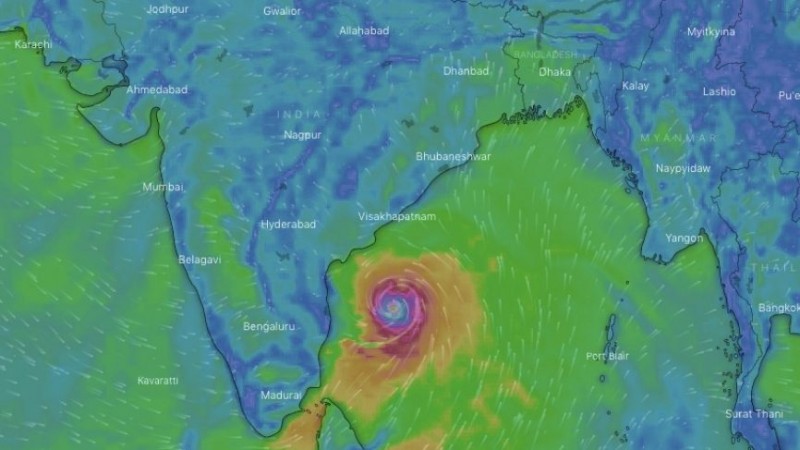
Cyclone Fani hit eastern India today and more than a million people had to be evacuated. Fani is the strongest storm to affect India in the last 20 years and early reports suggest widespread damage. The storm is tracking toward Bangladesh. It will likely take several days for the damage from the storm to be fully assessed.
Kiron Skinner, the Director of Policy Planning for the US State Department, gave an interview with Anne-Marie Slaughter (who once held Skinner’s position) at a conference in Washington DC. Her comments raised some eyebrows. Masha Gessen desxcribed parts of the talk in this way:
“A large part of Skinner’s job is listening to what the President says and trying to make sense of it. She said as much. ‘The President provides the hunches and instincts,’ she said, ‘and it’s my job, and that of Secretary Pompeo, to turn those hunches and instincts into hypotheses.’ She called the hypotheses the ‘Trump Doctrine’ and the ‘Pompeo Corollary.’
“Slaughter, logically, asked what the Trump Doctrine was. ‘That’s a tough one,’ Skinner responded, without a hint of irony. ‘It is, in a kind of broad way, a set of pillars that address twenty-first-century realities.’
“The pillars were: the ‘return to national sovereignty’; national interest; reciprocity in international relations and trade; ‘burden sharing,’ particularly in defense; and ‘new regional partnerships’ for what she described as ‘particular crises.’
“’If I can summarize,’ Slaughter suggested, ‘the Trump Doctrine is ‘The United States is a sovereign nation guided by its national interest—we’ll do for you if you’ll do for us.’
“Skinner confirmed that Slaughter’s understanding was correct.”
“When we think about the Soviet Union and that competition, in a way, it was a fight within the Western family. Karl Marx was a German Jew who developed a philosophy that was really within the larger body of political thought … that has some tenets even within classical liberalism …
“You could look at the Soviet Union, part West, part East, but it had some openings there that got us the Helsinki Final Act in 1975. It was a really important Western concept that opened the door really to undermine the Soviet Union, a totalitarian state, on human rights principles. That’s not really possible with China. This is a fight with a really different civilization and a different ideology. And the United States hasn’t had that before …”
“It’s also striking that it’s the first time we will have a great power competitor that is not Caucasian.”
I am not certain why Skinner thinks that China is so radically different from other great powers, but the injection of race into the equation is distinctly not consistent with realism. Perhaps Skinner can provide us with an explanation for how race changes the dynamics of power and interest.
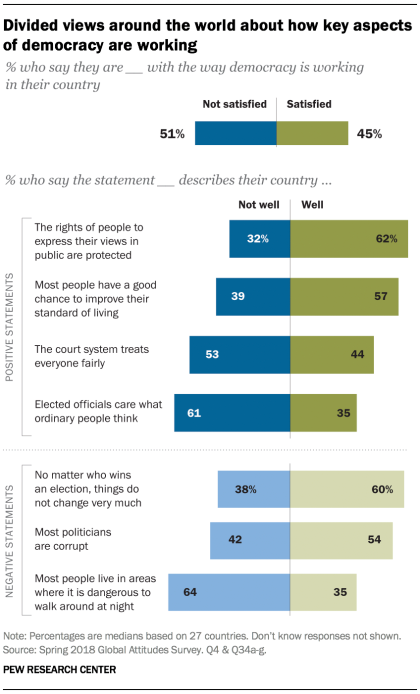
The rise of authoritarian governments in the world since the Great Recession of 2008-09 has been startling and difficult to explain. But the erosion of faith in democratic institutions globally has been dramatic. The Pew Research Center has conducted a poll on the issue and the results are dispiriting.
“Anger at political elites, economic dissatisfaction and anxiety about rapid social changes have fueled political upheaval in regions around the world in recent years. Anti-establishment leaders, parties and movements have emerged on both the right and left of the political spectrum, in some cases challenging fundamental norms and institutions of liberal democracy. Organizations from Freedom House to the Economist Intelligence Unit to V-Demhave documented global declines in the health of democracy.”
What is most striking is the extent to which people tend to associate bad economic times with failures in democracy. The number of people who believe that their national economy is in bad shape is very high.
It is difficult to imagine that these economies will improve dramatically at any time in the near future. The demographics for economic activity are not favorable and the current policies of protectionism in many states will make export-oriented growth very difficult.
One of the pre-eminent analysts of international relations, John Mearsheimer, has written an essay for International Security entitled “Bound to Fail: The Rise and Fall of the Liberal International Order”. It is a theoretical piece that is deeply entrenched in some of the more arcane issues in international relations. But the essay is well-written and intelligent, and deserves close attention. Mearsheimer investigates the significance of the declining support globally for what we call the international liberal order, constructed after the end of World War II.
“Creating a liberal international order involved three main tasks. First, it was essential to expand the membership in the institutions that made up the Western order, as well as erect new institutions where necessary. In other words, it was important to build a web of international institutions with universal membership that wielded great influence over the behavior of the member states. Second, it was imperative to create an open and inclusive international economy that maximized free trade and fostered unfettered capital markets. This hyperglobalized world economy was intended to be much more ambitious in scope than the economic order that prevailed in the West during the Cold War. Third, it was crucial to vigorously spread liberal democracy around the world, a mission that was frequently shortchanged when the United States was competing for power with the Soviet Union. This goal was not the United States’ alone; its European allies generally embraced this undertaking as well.
“These three tasks, of course, are directly tied to the principal liberal theories of peace: liberal institutionalism, economic interdependence theory, and democratic peace theory. Thus, in the minds of its architects, constructing a robust, sustainable liberal international order was synonymous with creating a peaceful world. This deep-seated belief gave the United States and its allies a powerful incentive to work assiduously to create that new order. Integrating China and Russia into it was especially important for its success, because they were the most powerful states in the system after the United States. The goal was to embed them in as many institutions as possible, fully integrate them into the open international economy, and help turn them into liberal democracies.”
Mearsheimer argues that the liberal order created tensions in states that lead to the demise of the order: intense nationalism spawned by the economic inequalities created by globalization. It is a powerful observation, but one that sells short the resiliency of liberal institutions. The world faced the same pressures in the wake of World War I and it is true that liberal institutions failed to contain economic nationalism and the rise of fascism. But liberal institutions were revived in 1945 and proved to be quite effective. Perhaps we should focus on the cycles of international orders and not hold them to a static analysis.
“Bartiromo: Is the US support going to include troops? Are the military troops in the US going to head there and support Guaidó?
“Pompeo: The president has been crystal clear and incredibly consistent. Military action is possible. If that’s what’s required, that’s what the United States will do. We’re trying to do everything we can to avoid violence. We’ve asked all the parties involved not to engage in that kind of activity. We’d prefer a peaceful transition of government there where Maduro leaves and a new election is held, but the President has made clear in the event that there comes a moment — and we’ll all have to make decisions about when that moment is and the -resident will ultimately have to make that decision — he is prepared to do that if that’s what’s required.”
Protests continued in Venezuela and the situation remains fluid and uncertain. The Russians also made threats to the US on the issue of intervention. According to The Independent:
“The comments were quickly seized on by Russia, which warned the US not to become more directly involved in events in Venezuela, a situation that has rapidly turned into a proxy contest between Washington and Moscow.
“Russian foreign minister Sergei Lavrov told Mr Pompeo by phone on Wednesday that further ‘aggressive steps in Venezuela would be fraught with the gravest consequences’. Mr Lavrov also condemned US ‘interference’ in Venezuela’s internal affairs as a breach of international law.”
“For 10 days in April, Extinction Rebellion occupied major junctions across London. It blocked traffic on Oxford Street, Marble Arch, and Waterloo Bridge. Some protestors painted graffiti on the headquarters of oil giant Shell, calling the company “climate criminals.” Others glued themselves to trains, delaying commuters’ journeys. Still others blocked the entrance to the London Stock Exchange, calling on the financial industry to act on climate change. Their tactics to disturb public order led to more than 1,000 arrests.”
The movement has made it clear that its actions have only just begun. It is unclear, however, whether those tactics will spread to other countries or whether there is a natural limit on how far the protests will go to disrupt daily life in various countries.
Institutional Investor publishes an annual list of the world’s richest hedge fund managers. The amount of money these men (and they are all men) made in 2018 is staggering. We only have a rough idea of how rich the rich actually are (and the rich have no clue about how poor the poor actually are). But one also has to remember that these people did not produce anything nor did they employ a large work force. They all made money by manipulating money. It is also important to note that last year was a nad year for hedge funds.
Name
Annual Compensation
Ray Dalio
2019: $2 billion
James Simons
2019: $1.5 billion
Kenneth Griffin
2019: $870 million
John Overdeck, David Siegel (tie)
2019: $820 million
Israel (Izzy) Englander
2019: $750 million
Crispin Odey
2019: $530 million
David Shaw
2019: $500 million
Chase Coleman
2019: $465 million
Alan Howard
2019: $390 million
There were widespread clashes between protesters and law enforcement in Venezuela as the Interim President, Juan Guaido, urged the Venezuelan military to stop supporting Nicolas Maduro. Guaido stood by Leopoldo López, an opposition leader who has been under arrest since 2014 for staging protests against the government. López claims that he was released by members of the military, lending credence to the idea that the military’s support for Maduro may be weakening. The Guardian published a graphic and disturbing video of military vehicles being driven into crowds of protesters. The US is apparently heavily involved in supporting Guaido, but the details of that support are not fully known. But Newsweek assesses the US position:
“White House national security adviser John Bolton has said that the U.S. was actively backing opposition forces seeking to overthrow Venezuelan President Nicolás Maduro.
Amid clashes Tuesday between Venezuelan security forces and defectors supporting U.S.-endorsed National Assembly leader Juan Guaidó, Bolton told reporters that the administration’s ‘principal objective’ was ‘the peaceful transfer of power,’ but reiterated President Donald Trump’s stance that ‘all options are on the table’ in ensuring Maduro was unseated.
“The U.S. has recognized Guaidó as acting president since January, cutting all ties with Maduro and targeting him with increasingly restrictive sanctions.
“‘We’re providing support in a variety of respects, certainly we have done everything we can to get humanitarian assistance into the country, we’re doing a lot of other things, some of which I’m not going to talk about,’ Bolton told said.”
The US involvement comes as both Cuba and Russia are increasing their involvement as well. The situation is becoming more intense and fraught as the violence escalates. The US should not become more involved in this power struggle–it has very little legitimacy in intervening in the internal affairs of states in Central and South America.
Alex Ward has written a very informative article for Vox on Japan’s recent defense build-up. With the encouragement of the US, Japan has been drifting away from the pacifist constraints imposed on it by the constitution written by the US at the end of World War II. States in East and Southeast Asia have not forgotten the behavior of the Japanese state during that war, and they are apprehensive about the change. In particular, the Chinese believe that the build-up is specifically intended to constrain Chinese power. Ward gives excellent background on Japan in world affairs to provide context for the recent decisions. It remains to be seen how far Japan can move in this direction; public opinion polls indicate that the Japanese population is still committed to a pacifist tradition.
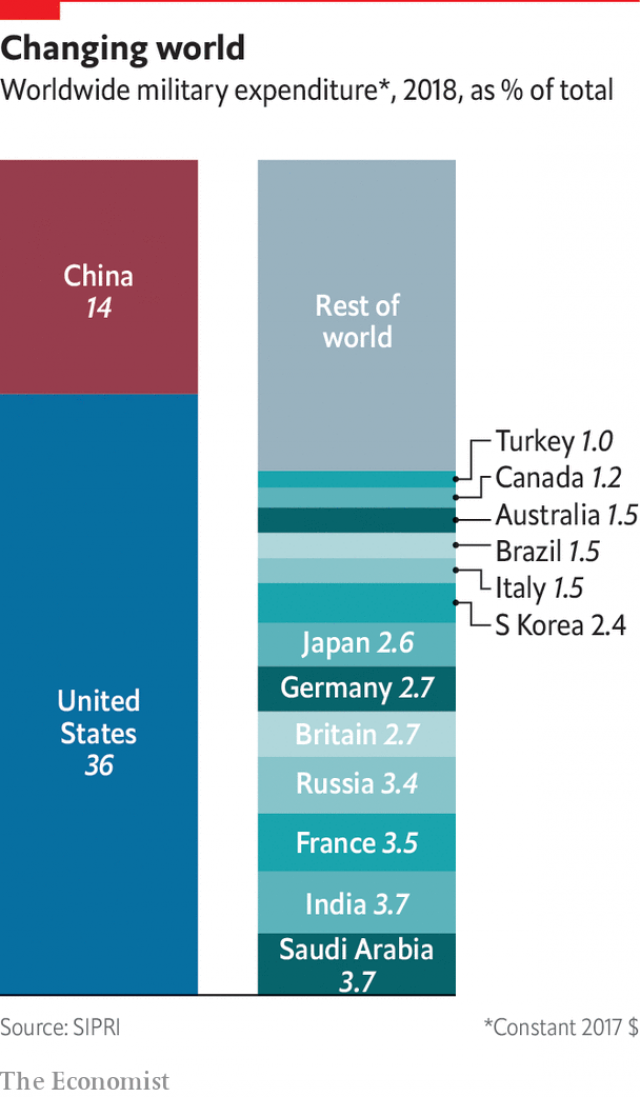
The Stockholm International Peace Research Institute (SIPRI) has released its annual report on military spending in 2018. Global military spending reached $1.8 trillion in 2018. The two largest spenders were the US and China and the two states accounted for half of the total for the world.
“Total global military spending rose for the second consecutive year in 2018, to the highest level since 1988—the first year for which consistent global data is available. World spending is now 76 per cent higher than the post-cold war low in 1998.* World military spending in 2018 represented 2.1 per cent of global gross domestic product (GDP) or $239 per person. ‘In 2018 the USA and China accounted for half of the world’s military spending,’ says Dr Nan Tian, a researcher with the SIPRI Arms and Military Expenditure (AMEX) programme. ‘The higher level of world military expenditure in 2018 is mainly the result of significant increases in spending by these two countries.’”
Interestingly, despite Russian President Putin’s rhetoric about Russian military capabilities, Russian military spending has declined. According to the Economist:
“The most interesting contraction is, however, in Russia. “Can they count?” President Vladimir Putin asked of his Western rivals in February. “I’m sure they can. Let them count the speed and the range of the weapons systems we are developing”. But despite the theatrical flaunting of new missiles, and NATO’s impressive rearmament to the west, SIPRI calculates that Russia’s defence budget actually shrank by 3.5% in 2018—putting it outside the top five for the first time in over a decade. This may be the result of a weakening rouble. But Russia’s long military spending spree seems to be drawing to a close. That is a sobering thought for Mr Putin.
” In 2018, Congress gave the military an additional $61 billion in appropriations — giving the U.S. what then-Defense Secretary Jim Mattis called ‘the largest military budget in history.’
“Trump this year has proposed increasing military spending by $33 billion — a 5% increase. At the same time, Trump is proposing cutting spending on diplomacy and development by $13 billion, or 23%. Trump has also criticized American allies in NATO for not spending enough on defense.”
It is difficult to imagine that pace of spending can persist for a long period of time, particularly since the US budget deficit has increased substantially in the last year. Forbes details the deficit: “The official estimated deficit for the year is supposed to be just under $1.09 trillion. If the current pace keeps up, the total could run to almost $1.4 trillion.”
“Vox shares the same fundamental precepts as the other comparable formations in surrounding European countries. It is a nativist and ultranationalist force, deeply opposed to immigration and promoting a strongly Islamophobic message. In economic terms, it is much closer to the ultra-neoliberal doctrines of Jair Bolsonaro and US libertarians than to the protectionist measures promised by Marine Le Pen’s Rassemblement National (ex-Front National).”
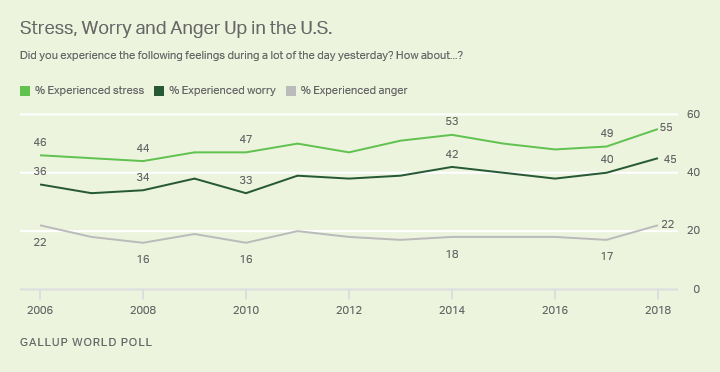
“More than half of United States respondents—around 55 percent—reported feelings of high stress the day prior to being polled, according to a Gallup press release, while 45 percent said they felt worried “a lot of the day,” and 22 percent said the same of anger.
“Americans’ stress levels were significantly higher than the global average of 35 percent, leaving the U.S. tied for fourth (alongside Albania, Iran and Sri Lanka) in Gallup’s ranking of the world’s most stressed populations. Greece topped the list at 59 percent, while the Philippines and Tanzania finished in second and third with 58 and 57 percent, respectively.
“In terms of worry, the U.S.’ 45 percent was ahead of the global average of 39 percent. Comparatively, 63 percent of the world’s most worried population, Mozambique, reported strong feelings of worry the day prior.
“Although Americans experienced anger at levels on par with the global average of 22 percent, this figure was still higher than in years past. On average, U.S. respondents were about half as likely to report strong feelings of anger as individuals from the countries topping Gallup’s list of the most angry global populations. Forty-five percent of respondents from Armenia reported feeling anger, while Iraq and Iran followed closely behind at 44 and 43 percent, respectively.
Some areas of the world are not in the dumps: “At the other end of the spectrum, Paraguay and Panama tied for most positive countries surveyed. Aside from Indonesia, the rest of the nations rounding out the top 10 also hailed from Latin America, reflecting what the report terms ‘the cultural tendency in the region to focus on life’s positives.’ As Gallup’s global managing partner Jon Clifton summarizes, Latin Americans may not always rate their lives highly, but in the end, they ‘laugh, smile and experience enjoyment’ better than anyone else in the world.”
The South China Morning Post has an excellent article on China’s Belt and Road Initiative (BRI). The initiative is an ambitious attempt to revive the old Silk Road that dominated the global economy before the rise of European power. The article is very balanced, looking at the benefits and disadvantages of the effort for countries in southeast, south, and central Asia. It is also an attempt by China to reshape the global economy in ways that serve its interests better than the current liberal world order.
“The growth in investment in places like Cambodia comes despite mounting criticism and resistance, and underlines Beijing’s accelerated push for the world’s most ambitious project amid China’s economic wrangling with the United States and European powers and their unfolding geopolitical rivalry.
“Those ambitions will be in the spotlight this week when 37 heads of state, including Hun Sen and Russian President Vladimir Putin, head to Beijing for the Belt and Road Forum, the second of its kind in less than two years. But neither India nor the US will send senior representatives.”
As the week unfolds there will be more articles on the meeting in Beijing goes on. Keep an eye on how the BRI is received by the less wealthy states.
Climate change has been occurring since the beginning of the industrial revolution and the current situation is the result of the cumulative level of greenhouse gas emissions since the 18th century. There is no question which country is most responsible for the largest contribution to this cumulative problem. Carbon Brief has put together the video below which dramatically illustrates the US role. But pay attention to how rapidly China and India rise in the rankings.
Animation: The countries with the largest cumulative CO2 emissions since 1750
Ranking as of the start of 2019:
1) US – 397GtCO2 2) CN – 214Gt 3) fmr USSR – 180 4) DE – 90 5) UK – 77 6) JP – 58 7) IN – 51 8) FR – 37 9) CA – 32 10) PL – 27 pic.twitter.com/cKRNKO4O0b
The Economist has a fascinating article entitled “Where growth is concerned, is population destiny?” It rightly points out that for much of the past, the more populous nations, such as CHina, were the center of the global economy. The period where European, and subsequently US dominance since the 1500s is an anomaly because these nations were much smaller. The question is straightforward:
“For centuries prior to the Industrial Revolution, Asia’s massively populous societies made the continent the world’s centre of economic gravity. Industrialisation in Europe and North America in the 19th century briefly knocked it from its perch. But now their collective economic might, measured in real output on a purchasing-power-parity basis, is forecast to account for more than half of global production by 2020. Was the West’s period of dominance an anomaly, which could only ever have been short-lived? Is population destiny?”
As economic activity shifts to Asia, it seems as if China is destined to return to its former place. But technological innovation propelled Europe to dominance and that dynamic seems to be independent of overall population density.
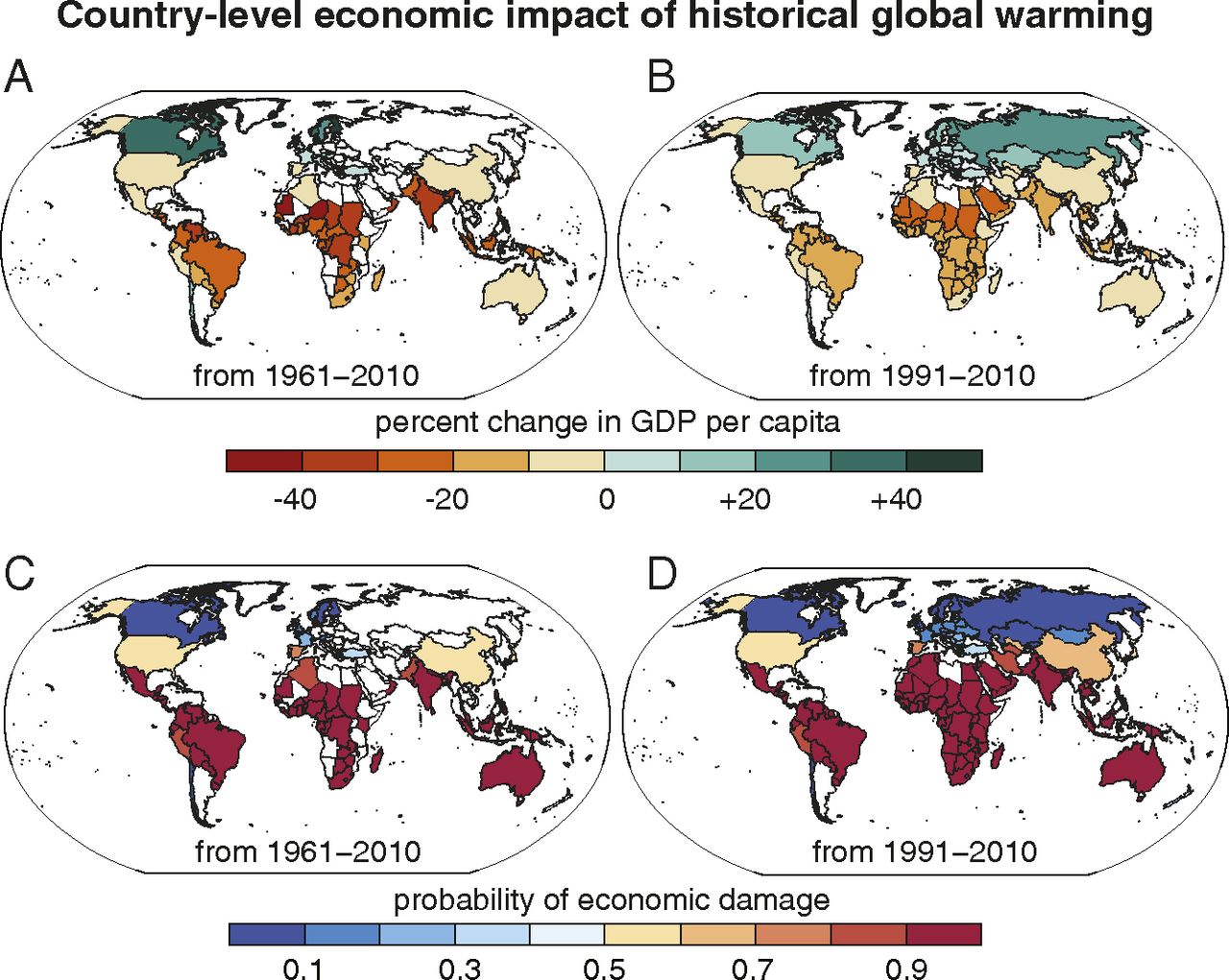
The National Academy of Sciences has published new research which indicates that climate change has exacerbated economic inequality in the world. It is a very technical article, but the authors detail the significance of their findings:
“We find that global warming has very likely exacerbated global economic inequality, including ∼25% increase in population-weighted between-country inequality over the past half century. This increase results from the impact of warming on annual economic growth, which over the course of decades has accumulated robust and substantial declines in economic output in hotter, poorer countries—and increases in many cooler, wealthier countries—relative to a world without anthropogenic warming. Thus, the global warming caused by fossil fuel use has likely exacerbated the economic inequality associated with historical disparities in energy consumption.”
I cannot say that I understood all the equations, but the findings are consistent with my own understanding of the dynamics of climate change. Climate change will definitely affect the poor and vulnerable far more than the people in rich countries who can probably afford to accommodate some of the worst effects of climate change. Jason Daley, writing for the Smithsonian magazine, provides clear examples:
“Warming for many economically powerful nations in the temperate region, including the United States, China and Japan, has pushed them into the perfect temperature ranges for economic output. Norway’s GDP, on the other hand, has grown an extra 34 percent due to warming and Iceland’s economic output is double what it would otherwise have been. That won’t last, the author’s warn, as temperatures increase over the next few decades.
“On the down side, India’s GDP is about 30 percent lower today than it would have been without rising global temperatures. Diffenbaugh tells McKenna that’s on the same order of magnitude as the impacts of the Great Depression in the United States. Lydia DePillis at CNN reports that Costa Rica, which according to the study has experienced a 21% lower GDP, has seen lower yields of coffee and more disease among the crop all due to increasing temperatures.”


 World Politics News