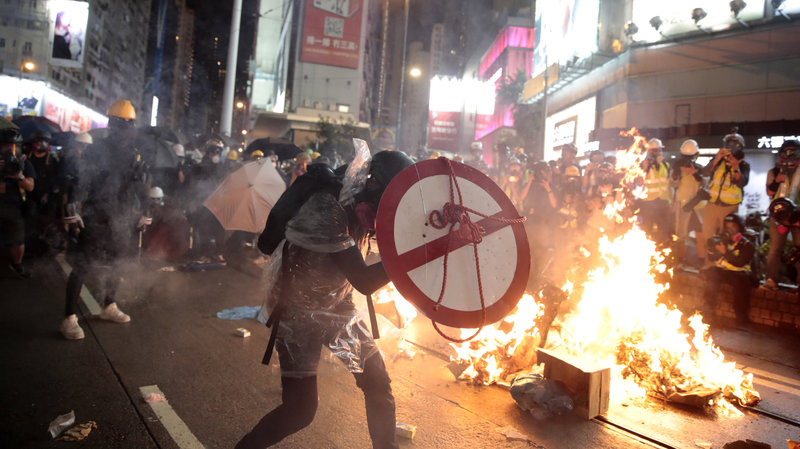
“‘The remarks made by some US politicians disrespect the strict law enforcement by the Hong Kong police,’ the Office of the Commissioner of the Ministry of Foreign Affairs in Hong Kong said.
“‘The real purpose is to let criminals continue to plague Hong Kong and completely destroy the rule of law in Hong Kong.’
“In a separate statement, the office opposed remarks by Ms Federica Mogherini, the High Representative of the European Union for Foreign Affairs and Security Policy. “
Pakistani Prime Minister, Imran Khan, has written an op-ed for The New York Times, entitled “The World Can’t Ignore Kashmir. We Are All in Danger.” It is an essay in response to India’s decision to eliminate the special status of Kashmir and Jammu and to place the people within those territories under the normal constitutional protections of India proper. The Pakistanis regard the move as an attempt to integrate the territories into Indian sovereignty, jeopardizing the rights of the Muslims who will now be under the control of the Hindu-nationalist government of Narendra Modi. Khan writes:
“On Aug. 5, in its most brazen and egregious move, Mr. Modi’s government altered the status of Indian-occupied Kashmir through the revocation of Article 370 and 35A of the Indian Constitution. The move is illegal under the Constitution of India, but more important, it is a violation of the United Nations Security Council resolutions on Kashmir and the Shimla Agreement between India and Pakistan.
“And Mr. Modi’s ‘New India’ chose to do this by imposing a military curfew in Kashmir, imprisoning its population in their homes and cutting off their phone, internet and television connections, rendering them without news of the world or their loved ones. The siege was followed by a purge: Thousands of Kashmiris have been arrested and thrown into prisons across India. A blood bath is feared in Kashmir when the curfew is lifted. Already, Kashmiris coming out in defiance of the curfew are being shot and killed.
“If the world does nothing to stop the Indian assault on Kashmir and its people, there will be consequences for the whole world as two nuclear-armed states get ever closer to a direct military confrontation. India’s defense minister has issued a not-so-veiled nuclear threat to Pakistan by saying that the future of India’s ‘no first use‘ policy on nuclear weapons will ‘depend on circumstances.’ Similar statements have been made by Indian leaders periodically. Pakistan has long viewed India’s ‘no first use’ claims with skepticism.”
For an hour today, Pakistanis recognized the precarious status of Muslims in Kashmir, indicating strong support to reverse the Indian decision. The Pakistani newspaper, Dawn, has run an op-ed supporting Khan’s position on the matter. The Pakistani Senate has unanimously passed a resolution condemning the Indian action. Despite US President Trump’s offer to mediate the crisis, which was rebuffed by India, the US has not issued any hard statements on the crisis. Apparently, the US seems willing to let events in South Asia take their course without any proposals to avoid a deepening of the crisis.
This post will be the last one for about a week. I am off to Yellowstone National Park and I hope that I can avoid newspapers and television. A break from news is long overdue. Perhaps when I return home the world will be more peaceful (I doubt it, but my aspiration is to be less frantically disgusted).
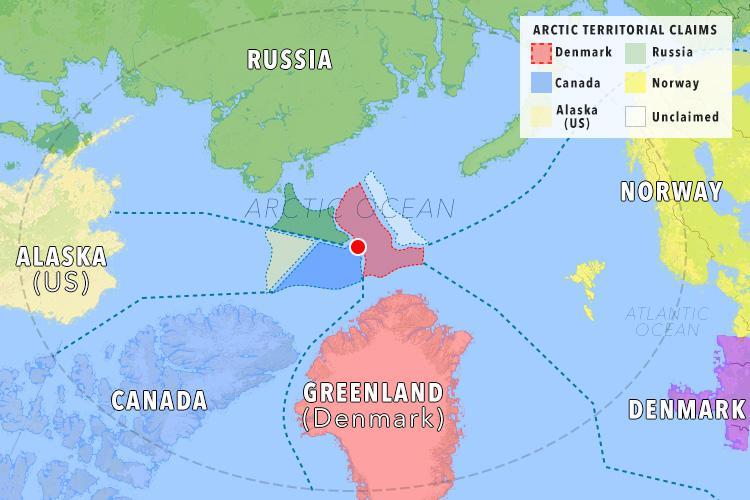
US President Trump has cancelled his scheduled trip to Denmark ostensibly because the state would not discuss the sale of Greenland to the US. The US has purchased land from Denmark in the past: the Danish West Indies became the US Virgin Islands in 1917 as the US feared German control of the islands during World War I. The price was $25 million. US interest in Greenland is twofold. First, the US has only a very small territory abutting the Arctic (Alaska) in comparison to Russian territory (west of Murmansk to the North Pole and from the eastern Chukchi Peninsula). As ice in the Arctic melts because of climate change, many states are interested in the region for maritime routes and resources. Second, Greenland has mineral resources that are quite valuable.
But what was once ordinary state behavior in the early 20th century is now regarded as preposterous. It does not appear as if the US overture to Denmark (which controls the foreign policy of Greenland, but not its domestic policy) was well-considered or even more than a brain fart (I really do need a vacation). When the government of Denmark indicated that Greenland was not up for sale, President Trump cancelled his scheduled meeting with the Danish government–a government that historically has been a steadfast ally to the US. Prime Minister Mette Frederiksen made a very diplomatic statement about the cancellation, but did say that the idea of buying Greenland was “absurd”. She went on: “Thankfully, the time where you buy and sell other countries and populations is over…..Let’s leave it there. Jokes aside, we will, of course, love to have an even closer strategic relationship with the United States.” President Trump characterized the response as “nasty”.
A more likely explanation for President Trump’s cancellation is that he is afraid that former President Obama will upstage his visit when Obama visits Denmark at the end of September.
Zachary Karabell has written a fascinating essay for Foreign Affairs which addresses the demographic decline affecting many of the states in the world. Global population is still predicted to increase to about 10 billion by the middle of the century, but several countries, like Germany and Japan, but also countries like China and India, are experiencing fertility rates less than replacement. A slowdown of population growth would undoubtedly be better for the global environment, but only if people stopped consuming so much. The demographic decline may make that possible:
“No capitalist economic system operates on the presumption that there will be zero or negative growth. No one deploys investment capital or loans expecting less tomorrow than today. But in a world of graying and shrinking populations, that is the most likely scenario, as Japan’s aging, graying, and shrinking absolute population now demonstrates. A world of zero to negative population growth is likely to be a world of zero to negative economic growth, because fewer and older people consume less. There is nothing inherently problematic about that, except for the fact that it will completely upend existing financial and economic systems. The future world may be one of enough food and abundant material goods relative to the population; it may also be one in which capitalism at best frays and at worst breaks down completely.”
The shift should not be surprising. Capitalism developed when there were about 700 million people on the planet and in a region of the world (Europe) where scarcity was the main feature of human existence. Its emphasis on production led to the pillaging of the environment; its neglect of consumption will perhaps be its final undoing.
For the last few weeks, an Iranian oil tanker, the Grace I, has been held in Gibraltar, accused of violating sanctions against Syria. The seizure was part of the US policy of “maximum pressure” against Iran and was designed to deprive Iran of necessary oil revenues. Gibraltar is a British colony and it has decided to release the oil tanker. The US issued a warrant to seize the tanker on the grounds that it was associated with the Iranian Revolutionary Guard and therefore associated with terrorism. The government of Gibraltar rejected the warrant. Al Jazeera explains the decision:
“Gibraltar’s government said on Sunday it could not comply with the US request because of European law.
“‘The Central Authority’s inability to seek the Orders requested is a result of the operation of European Union law and the differences in the sanctions regimes applicable to Iran in the EU and the US,’ the government said in a statement.
“‘The EU sanctions regime against Iran – which is applicable in Gibraltar – is much narrower than that applicable in the US.’
“Iran has denied the tanker was ever headed to Syria.
“Al Jazeera’s Andrew Simmons, reporting from Gibraltar, said the authorities in the overseas British territory had determined that US sanctions on Iran were not applicable in the EU.
“‘The US action is based on US sanctions, while the action taken by Gibraltar and the UK was enforced under EU sanctions, and as far as that issue goes there is compliance now. There was an assurance [from Iran] that this cargo on board, 2.1 million barrels of light crude oil, is not destined for Syria,’ he said. “
The British decision to repudiate the US position is a serious setback for the US government. The ship changed its name to the Adrian Darya-1 and set sail flying an Iranian flag, not the Panamanian flag of the Grace I.
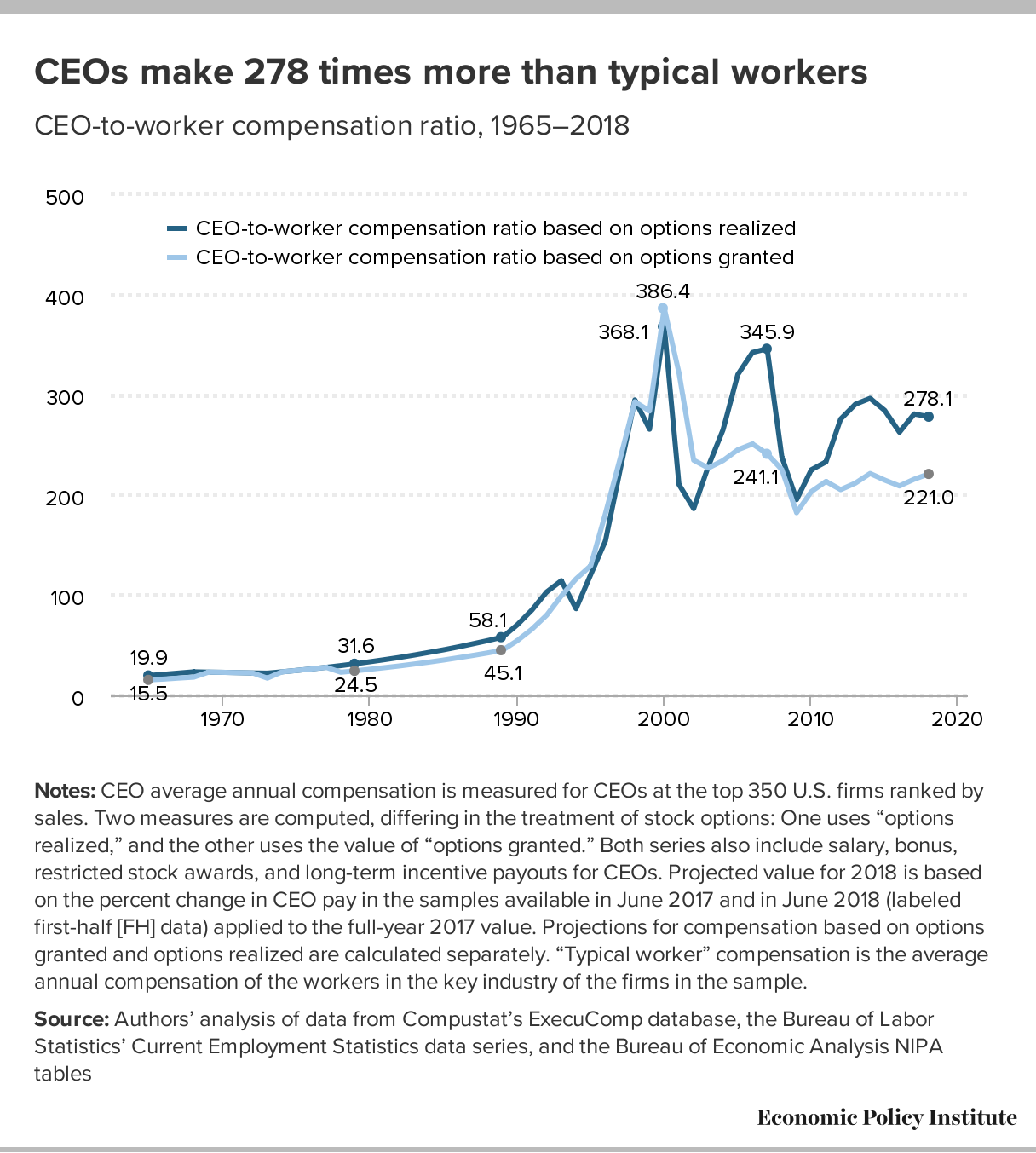
“Average pay of CEOs at the top 350 firms in 2018 was $17.2 million—or $14.0 million using a more conservative measure. (Stock options make up a big part of CEO pay packages, and the conservative measure values the options when granted, versus when cashed in, or “realized.”) CEO compensation is very high relative to typical worker compensation (by a ratio of 278-to-1 or 221-to-1). In contrast, the CEO-to-typical-worker compensation ratio (options realized) was 20-to-1 in 1965 and 58-to-1 in 1989. CEOs are even making a lot more—about five times as much—as other earners in the top 0.1%. From 1978 to 2018, CEO compensation grew by 1,007.5% (940.3% under the options-realized measure), far outstripping S&P stock market growth (706.7%) and the wage growth of very high earners (339.2%). In contrast, wages for the typical worker grew by just 11.9%.”
The report notes that the stock options often granted in compensation packages have increased dramatically in value as the stock market has gone up, often because of the buy-backs that were stimulated by the tax changes made by the US Congress in 2017.
The Trump Administration has announced its intention to sell $8 billion of weaponry, including F16 fighter jets, to Taiwan. The sale has to be approved by Congress, but China has make it clear that it strongly opposes the sale. The South China Morning Post reports:
“Beijing quickly registered its strong displeasure to the proposed contract involving the 66 Lockheed Martin F-16 Viper aircraft, which follows a US$2 billion agreement for 108 Abrams tanks and support equipment approved in July.
“’China urges the US to fully recognise the highly sensitive and harmful nature of the relevant issue, abide by the one-China principle and the three China-US joint communiqués, refrain from selling F-16 fighter jets to Taiwan and stop arms sales to and military contact with Taiwan,’ foreign ministry spokeswoman Hua Chunying said in a press briefing.
“’Otherwise, the Chinese side will surely make strong reactions, and the US will have to bear all the consequences,’ she said, without being specific.”
Reuters is reporting that China is evading the US sanctions against Iran by disabling the transponders on ships that carry crude oil. It is a complicated process which includes off-loading the oil on the high seas, but it apparently is workable (it is also the process by which North Korea evades the sanctions). The process is described by Reuters:
“While in the Indian Ocean heading toward the Strait of Malacca, the very large crude carrier (VLCC) Pacific Bravo went dark on June 5, shutting off the transponder that signals its position and direction to other ships, ship-tracking data showed.
“A U.S. government official had warned ports in Asia not to allow the ship to dock, saying it was carrying Iranian crude in violation of U.S. economic sanctions. A VLCC typically transports about 2 million barrels of oil, worth about $120 million at current prices.
“On July 18, the transponder of the VLCC Latin Venture was activated offshore Port Dickson, Malaysia, in the Strait of Malacca, about 1,500 km (940 miles) from where the Pacific Bravo had last been signaling its position.
“But both the Latin Venture and the Pacific Bravo transmitted the same unique identification number, IMO9206035, issued by the International Maritime Organization (IMO), according to data from information provider Refinitiv and VesselsValue, a company that tracks ships and vessel transactions.
“Since IMO numbers remain with a ship for life, this indicated the Latin Venture and the Pacific Bravo were the same vessel and suggested the owner was trying to evade Iranian oil sanctions.”
China is violating international maritime law but it is difficult to see how the US can respond. US sanctions on Iran do not have the force of international law and seizing an oil tanker would be an act of war. We shall see how the US decides to react.
Israel has barred two US Congresspeople, Representatives Ilhan Omar and Rashida Tlaib, from visiting East Jerusalem and the West Bank because of the support for the Boycott, Divest, and Sanction (BDS) Movement. The decision comes even though the Israeli Ambassador to the US had agreed that they should be allowed to visit. The change of heart came after US President Trump tweeted that Israel should bar the visit:
“It would show great weakness if Israel allowed Rep. Omar and Rep.Tlaib to visit. They hate Israel & all Jewish people, & there is nothing that can be said or done to change their minds. Minnesota and Michigan will have a hard time putting them back in office. They are a disgrace!”
The decision is hard to justify. Israel has passed a law barring the entry of people who support the BDS Movement, but the fact that the US Congress annually allocates a great deal of money to Israel. According to the Congressional Research Service:
” Israel is the largest cumulative recipient of U.S. foreign assistance since World War II. To date, the United States has provided Israel $142.3 billion (current, or noninflation-adjusted, dollars) in bilateral assistance and missile defense funding. Almost all U.S. bilateral aid to Israel is in the form of military assistance, although from 1971 to 2007 Israel also received significant economic assistance.
“In 2016, the U.S. and Israeli governments signed a new 10-year Memorandum of Understanding (MOU) on military aid, covering FY2019 to FY2028. Under the terms of the MOU, the United States pledges to provide $38 billion in military aid ($33 billion in Foreign Military Financing grants plus $5 billion in missile defense appropriations) to Israel. This MOU replaced a previous $30 billion 10-year agreement, which ran through FY2018.”
Additionally, the US Congress has a number of responsibilities to monitor the protection of human rights in the world as well as to address the concerns of other countries, notably in Europe and the Middle East, that have relations with Israel.
“Heads of major Jewish organizations had been on the phone with the U.S. ambassador to Israel imploring Israel not to take this step. According to the leader of one such group, the leader’s group had been urging the Israeli government to stick by the original decision to let the congresswomen in, while being under no illusion about the congresswomen’s views. The potential political and reputational costs of not letting them in might be even higher than of letting them in, the leader acknowledged.”
Finally, we need to think clearly what it means for an American President to advise a foreign power to insult Congresspeople who have been legitimately elected by their constituents.
Stock markets around the world fell today as evidence mounts that global economic growth seems to be slowing. In China, industrial production fell 4.8 percent in July, the lowest level since 2002, and Germany experienced negative growth for the second time in the last three quarters. In the US, the bond market became “inverted” with short term rates higher than long term rates–a sign that bond investors believe that economic growth in the future will decline. An inverted bond market often signals the onset of an economic recession.
The stock market in the US was higher yesterday as US President Trump decided not to impose new tariffs on Chinese products on 1 September as he had threatened. Instead, a decision will be made at the end of the year. The tactical change revealed a number of important issues. First, the delay was justified by President Trump because he did not want prices of such goods as toys and electronics to rise before the Christmas buying season:
Q. Would you consider moving the tariffs, even? Delaying them even further, past December 15?
THE PRESIDENT: No, we’re doing this for Christmas season, just in case some of the tariffs would have an impact on U.S. customers, which, so far, they’ve had virtually none.
Note that the statement contradicts President Trump’s earlier position that the Chinese are paying for the higher tariffs, as noted by Tory Newmyer in The Washington Post: ” The president’s claim that the impact of existing tariffs on American shoppers has been ‘virtually none’ is provably false. Yet the acknowledgment that consumers would be on the hook for tariffs broke new ground for Trump, who has insisted for months, against a consensus among economists and a raft of data, that the Chinese are footing the bill for his trade war.”
Second, the US received nothing in return from China from the delay. Last week, China announced that it would stop buying US agricultural products because of the threat of the new tariffs. But after Trump announced that he was delaying the tariffs, the Chinese did not say that they would return to buying US agricultural products. Backing down without any reciprocation is capitulation, which is not necessarily a bad tactic unless one is engaged in extended negotiations. Capitulation in an early stage of a negotiation weakens a bargaining position since it indicates a reluctance to endure the economic or political position to force concessions.
Third, there are two keys to winning a negotiation. First, one needs to figure out a way for both sides to benefit from the outcome of the negotiation. There is precious little evidence that either Trump or Xi are pursuing a win-win strategy at this point. Second, each side needs to persuade the other that it is willing to endure the pain of loss in order to achieve a victory. President Trump has always said that China will suffer more than the US from a trade war. But his statement today suggests that he is worried about the effects of a trade war on his re-election chances. If that is true, and China is certainly aware of that concern, then there is a real time limit on how much pain Trump is willing to suffer. The Chinese may simply decide that they should wait until election pressures force Trump to capitulate again.

 World Politics News