The British government has been forced to release a study done in August that details the likely consequences of a “no-deal” Brexit. The projections are a worst-case scenario and are suitably grim. According to The Guardian:
“The document, which says it outlines ‘reasonable worst case planning assumptions’ for no deal Brexit, highlights the risk of border delays, given an estimate that up to 85% of lorries crossing the Channel might not be ready for a new French customs regime.
“‘The lack of trader readiness combined with limited space in French ports to hold ‘unready’ HGVs could reduce the flow rate to 40%-60% of current levels within one day as unready HGVs will fill the ports and block flow,’ it warns.
“This situation could last for up to three months, and disruption might last ‘significantly longer’, it adds, with lorries facing waits of between 1.5 days and 2.5 days to cross the border.
“The reliance of medical supplies on cross-Channel routes ‘make them particularly vulnerable to severe extended delays’, the report says, with some medicines having such short shelf lives they cannot be stockpiled.
“A lack of veterinary medicines could increase the risk of disease outbreaks, it adds.
“On food supplies, supplies of ‘certain types of fresh food’ would be reduced, the document warns, as well as other items such as packaging.
“It says: ‘In combination, these two factors will not cause an overall shortage of food in the UK but will reduce availability and choice of products and will increase price, which could impact vulnerable groups.’
“Later, it adds: ‘Low income groups will be disproportionately affected by any price rises in food and fuel.’
“On law and order it warns: ‘Protests and counter-protests will take place across the UK and may absorb significant amounts of police resource. There may also be a rise in public disorder and community tensions.’
National Security Adviser John Bolton has left the Trump Administration. You can choose to think that he was fired or simply resigned because there are competing stories. Dexter Filkins of The New Yorker wrote a very interesting piece on Bolton last April if you want to read a fairly long backgrounder on his policies. I have no doubt that we will be learning more about the dismissal over the next few days–Bolton is not someone who will go quietly into the night. But his departure is not at all surprising (and I am am absolutely delighted that he is gone). The New York Times describes his legacy:
“Instead, Mr. Bolton decided to break the interagency system that had served as the heart of American foreign policy for over seven decades. Driven by confidence in his own ideas about what government should do and how it should run, he had in mind something closer to Roosevelt’s juggling: The president in a room with the national security adviser and a few aides making decisions about most important issues in the world. To realize that plan, Mr. Bolton included fewer people in meetings, made council sessions far less regular, and raced to always be by Mr. Trump’s side. There was no longer a National Security Council, in effect, just a national security adviser.
“Mr. Bolton broke government and then it broke him. As the national security adviser, he pushed for a hard line on North Korea, Iran, Venezuela and Afghanistan. But without a structure behind him, Mr. Bolton was increasingly alone trying sell positions that were a hard sell to Mr. Trump, who is much less an ideologue and much harder to pin down. Eventually, Mr. Trump split with Mr. Bolton and began consulting with outsiders like the Fox News personality Tucker Carlson. When Mr. Bolton fell out with the president, the ad hoc system collapsed right along with him, as reports over the messy decision-making on the proposed Afghanistan peace deal and talks demonstrate.”
President Trump will now have to pick his fourth National Security Adviser in 3 years. US allies no longer know who to talk to or who is in charge, other than President Trump himself. Nor does the US have anyone who’s only job is to coordinate the huge intelligence apparatus of the state.
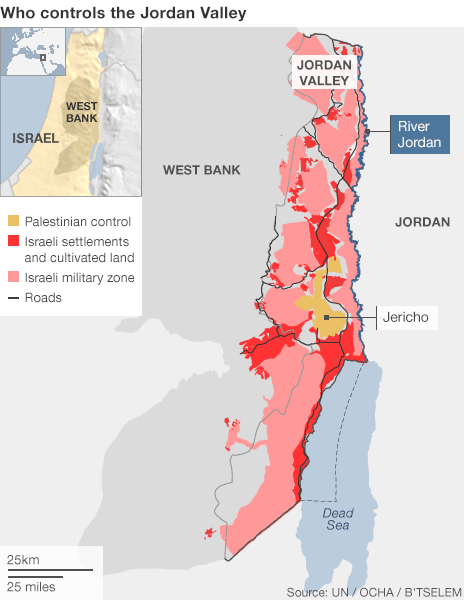
Israeli Prime Minister made an election promise to annex the Jordan Valley if elected. The election is scheduled for 17 September and the polls indicate that the election is very much up in the air. The annexation would divide the West Bank in ways that would render a two-state solution impossible, however improbable it seems at this point.
“Annexing the Jordan Valley at this particular moment is not a response to an urgent security threat. Rather, it a dagger blow to the idea of a two-state solution, amounting to a declaration that Israel is not interested in creating a Palestinian state but rather simply taking the land that it wants for itself.
“’Annexation — taking land while continuing to subjugate the Palestinians on that land — is apartheid and should face the same consequences,’ says Diana Buttu, a Ramallah-based political analyst and former adviser to Palestinian President Mahmoud Abbas.
“This unilateral land grab of a huge chunk of the West Bank would shrink the remaining Palestinian territory to such an extent that most observers believe it would render the very idea of a two-state solution impossible.”
Over the last few months there have been protests in Moscow over elections to the City Council. The election was only symbolically important, since members of parties opposed to the Putin regime were not allowed to run. But the results were quite revealing. Putin’s party, United Russia, lost 13 seats to a potpourri of parties not opposed to Putin, but not supportive of him either. Vox outlines the results:
“The ruling United Russia party, which supports Russian President Vladimir Putin, barely clung to its majority, losing about 13 seats in the city council (from the current 38 down to just 25).
“Opposition parties, on the other hand, did quite well, winning 20 seats. They included the Communist Party (13 seats), the A Just Russia party (3 seats), and the liberal Yabloko party (4 seats).
“There’s a catch, though: These aren’t the ‘real’ opposition parties in Russia.
“With the exception of the Yabloko party members, the opposition candidates who won are part of Russia’s ‘systemic opposition.’ These are parties that are more or less loyal to the Kremlin and are sanctioned by the government to operate as ‘opposition’ parties and stand for elections. In other words, they’re mostly a sham meant to provide a veneer of democracy on an undemocratic system.”
CNN is reporting that a US spy at the highest level of Russian decision-making was extracted after the US intelligence community decided that President Trump’s casual treatment of classified intelligence threatened the spy with exposure. The extraction decision came after President Trump revealed classified material to the Russian foreign minister, Sergei Lavrov, and the then ambassador to the US, Sergey Kislyak, in a meeting in May 2017. That intelligence had come from Israel and the disclosure threatened future intelligence sharing because the Israelis were afraid that their sources were exposed by Trump’s leak. President Trump also released a classified photo of an Iranian missile launch failure that many believed compromised the integrity of future satellite images. It is hard to believe that other states will be willing to share information with the US given their fears that the US President will compromise their sources and methods. It is impossible to determine how significant this loss of intelligence may be, but it is a completely gratuitous loss.
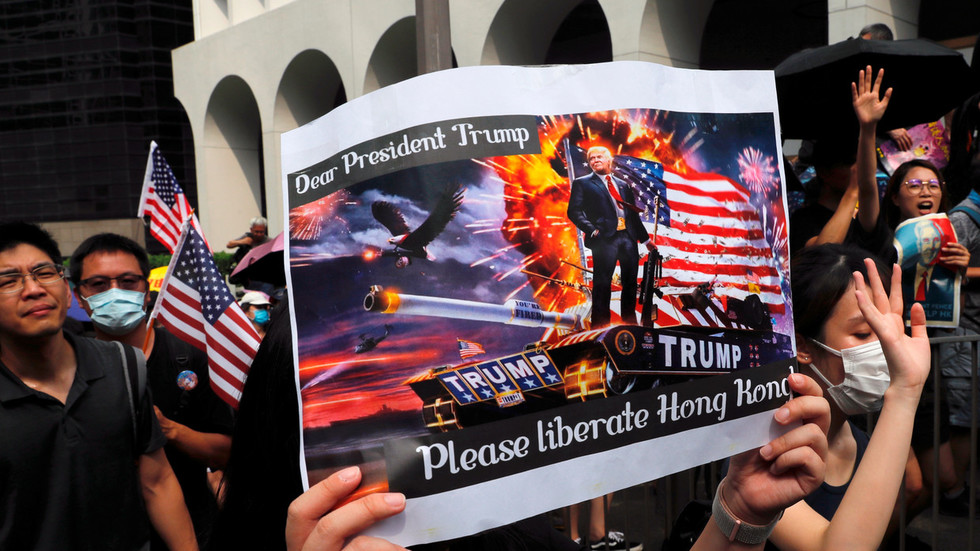
Once again, protesters in Hong Kong demonstrated over the weekend. There were sporadic acts of violence and the riot police used tear gas and water guns. This time, however, protesters massed near the US consulate and handed a petition to US authorities calling on the US to support the protests and to “liberate” Hong Kong–clearly seditious language from the perspective of the authorities in Beijing. The protester also waved American flags and sang the “Star Spangled Banner”. The sentiment of the Beijing government was expressed in rather chilling terms by Global Times a media outlet often expressing the official government position: “As US politicians continue to fan the flames in Hong Kong, Sunday’s mass rally, aimed at pushing the US into passing the Hong Kong Human Rights and Democracy Act, showed how protesters broke the bottom line.” The article continues:
“But US politicians have continuously fanned the flames. Both Republican and Democratic members of the US Congress are pushing for the passage of the Hong Kong Human Rights and Democracy Act as soon as possible. Republican Senator Marco Rubio and Democratic Senator Ben Cardin are among those sponsoring passage of the bill.
“The Hong Kong Human Rights and Democracy Act is an amendment to the Hong Kong Policy Act of 1992 which allows the US government to afford Hong Kong trade and business privileges.
“One of the most important provisions of the proposed bill is that officials of the Hong Kong Special Administrative Region government who are found suppressing Hong Kong’s democracy, human rights or citizen freedoms can have their assets in the US frozen and be denied entry to the US.
“On Twitter, House Speaker Nancy Pelosi posted ‘If we don’t speak out for human rights in China because of commercial interests, we lose all moral authority to speak out elsewhere,’ referring to the introduction of the act and bipartisan consensus around it.
“Regarding the statement, Chinese Foreign Ministry Spokesperson Geng Shuang said at Friday’s media briefing that China deplores and firmly opposes US senators’ attempted move to push the Hong Kong Human Rights and Democracy Act as interfering in China’s internal affairs.”
The French Foreign Minister has threatened to block any further extensions to Great Britain’s decision to leave the European Union, citing a lack of progress in the negotiations. The Guardian highlights the frustrations:
“EU sources have said there is no evidence the British government is even working on ‘concrete proposals’ to strike a Brexit deal, and the latest resignations from the government, recent reports of ‘sham negotiations’ and constant election talk have all contributed to the impression that the government is not serious about finding an agreement.
“The comments appear to confirm the fears of the former work and pensions secretary Amber Rudd, who resigned on Saturday, citing the lack of effort being put into negotiating a deal.”
“Speaking to journalists while flanked by advanced centrifuges, Kamalvandi said Iran has begun using an array of 20 IR-6 centrifuges and another 20 of IR-4 centrifuges. An IR-6 can produce enriched uranium 10 times as fast as an IR-1, Iranian officials say, while an IR-4 produces five times as fast.
“The nuclear deal limited Iran to using only 5,060 first-generation IR-1 centrifuges to enrich uranium by rapidly spinning uranium hexafluoride gas. By starting up these advanced centrifuges, Iran further cuts into the one year that experts estimate Tehran would need to have enough material for building a nuclear weapon if it chose to pursue one.
“’Under current circumstances, the Islamic Republic of Iran is capable of increasing its enriched uranium stockpile as well as its enrichment levels and that is not just limited to 20 percent,’ Kamalvandi said. ‘We are capable inside the country to increase the enrichment much more beyond that.'”
This decision marks the third deviation from the JCPOA since the US withdrew from the agreement. It had previously announced that it would increase uranium “enrichment up to 4.5%, above the 3.67% allowed under the deal, as well as gone beyond its 300-kilogram limit for low-enriched uranium.” The deviations are intended to put pressure on the other signatories to the JCPOA–France, Great Britain, Germany, China, and Russia–to continue to trade with Iran despite the US sanctions on the state. According to The Guardian:
“Analysts said the announcement was carefully calibrated to highlight the urgency on France and others to help relieve Iran’s ailing economy, while avoiding triggering an armed response from the US or forcing Europe to formally abandon the deal.
The Iranian strategy is a high stakes gamble. Iran’s only chance to escape the US sanctions is to persuade the other partners that compliance with US sanctions means the nuclear deal is dead. But the deviations from the agreement provide the US and Israel with an excuse to attack Iran.
We should not, however, lose sight of the fact that if the US had not left the JCPOA, these problems would not exist. The sad truth is that Iran is now closer to developing a nuclear weapon that it was on the day that President Trump was inaugurated.
US President Trump is claiming that he has called off secret negotiations between the US, Taliban leaders, and the government of Afghanistan that were scheduled to take place at Camp David. Mr. Trump said that he cancelled the meeting because of a Taliban car bomb that killed a US soldier in Kabul. The Independent outlined the draft agreement that was supposed to be the basis for the Camp David discussions:
“Mr Trump’s decision to pull out of talks came just days after the US’s top negotiator for peace in Afghanistan, Zalmay Khalilzad, said the two sides were close to a deal to end America’s longest war..
“A draft framework agreement had been drawn up under which US troops would leave five military bases in Afghanistan within 135 days of the signing of the pact.
“In return, the Taliban would be expected to guarantee the country will not be used as a launchpad for global terrorist operations.”
I must confess that this story does not ring true to me. The Taliban have been using car bombs ever since the US invaded Afghanistan in 2001 and it is not clear to me why this attack was considered different, particularly since the agreement said absolutely nothing about a cessation of hostilities. I also find it hard to believe that high ranking leaders of the Taliban would come into the US–I am not sure that any US promise of safe conduct would be believed by any guerrilla fighter. I suspect that the cancellation is more likely the product of bureaucratic infighting among Trump national security advisers. But we shall see as more information becomes available.
Alan Weisman has written a book review for the New York Review of Books on the climate crisis which makes some very important points which are difficult to both accept and deny:
“Just before the 2016 elections, a respected biologist at an environmental NGO told me she actually considered voting for Trump. ‘The way I see it,’ she said, ‘it’s either four more years on life support with Hillary, or letting this maniac tear the house down. Maybe then we can pick up the pieces and finally start rebuilding.’ Like many other scientists Wallace-Wells cites, she has known for decades how bad things are, and seen how little the Clinton-Gore and Obama-Biden administrations did about it—even in consultation with Obama’s prescient science adviser, physicist John Holdren, who first wrote about rising atmospheric CO2 in 1969. For the politicians, it was always, foremost, about the economy.
“Unfortunately, as Wallace-Wells notes:
The entire history of swift economic growth, which began somewhat suddenly in the eighteenth century, is not the result of innovation or trade or the dynamics of free trade, but simply our discovery of fossil fuels and all their raw power.
“This is our daily denial, which now flies in our faces on hurricane winds, or drops as hot ashes from our immolated forests and homes: growth is how we measure economic health, and growth must be literally fueled. Other than nuclear energy, which has its own problems, no form of energy is so concentrated, and none so cheap or portable, as carbon. By exhuming hundreds of millions of years’ worth of buried organic matter and burning it in a couple of centuries, we built our dazzling modern civilization, not noticing that its wastes were amassing overhead. Now we’re finally paying attention, because hell is starting to rain down.”
Weisman goes on to review Bill McKibben’s new book which offers a devastating critique of the role of the fossil fuel industry in fostering doubts about the process of climate change:
“Even McKibben struggles for an adequate vocabulary to describe the duplicity of oil companies: ‘There should be a word for when you commit treason against an entire planet.’ As early as 1977, one of Exxon’s own scientists explained to the company’s executives that their products were causing a greenhouse effect, and that there would be only ‘five to ten years before the need for hard decisions regarding changes in energy strategies might become critical.’ By 1982, McKibben writes, ‘the company’s scientists concluded that heading off global warming would ‘require major reductions in fossil fuel combustion’ or risk ‘potentially catastrophic events.’ Exxon used predictions of ice retreat to lengthen their drilling season in the Arctic, and raised drilling platforms to accommodate sea-level rise. He recounts the deliberate strategy of oil executives and their pet politicians to, as one Exxon official put it, ’emphasize the uncertainty’ of climate science. ‘I’ve lived the last thirty years inside that lie,’ McKibben realizes, ‘engaged in an endless debate over whether global warming was ‘real’—a debate in which both sides knew the answer from the beginning.‘”
I am not sure how the future will judge the greed, duplicity, and pure evil of those who chose to enrich themselves at the cost of a livable planet. The time for polite debate has long passed.
Bruce Gilley and David Kinsella have written a provocative essay for the International Institute for Strategic Studies which argues that international law offers justification for the use of coercive measures (including force) to force states that refuse to reduce their greenhouse gas emissions. Right now I find that proposition difficult to accept as a practical matter (the UN Security Council, which has absolute authority to take steps to preserve international peace and stability, gives three vetoes to the three largest polluters on the planet). At some point, however, it is not difficult for me to believe that some states will take action if the evidence of a looming catastrophe is clear. In either case–action or inaction–the prognosis is poor.
If you are confused about the state of Brexit, then you are just like the vast majority of people on the planet. It is very difficult to figure out what the next steps may be. Labour and defectors from the Conservative Party (who were kicked out of the party because of their defections) managed to pass a resolution blocking early elections and introduced legislation to prevent a “no-deal” Brexit. They also managed to defeat a proposal by Prime Minister Boris Johnson to call early snap elections (although that option is not foreclosed by the vote). Amanda Sloat of the Brookings Institution has written a very nice synopsis of the various alternatives available now to the Leavers and the Remainers. But Brexit is a moving target and the parties making these decisions are not interested in cooperating or pursuing a compromise. And it is not clear that the European Union is willing to cut Great Britain any more slack. But the deadline of 31 October remains fixed (for now) which gives very little time.
Jason Greenblatt, one of the main negotiators fro the Trump Administration’s Middle East peace plan, has quit his post. His departure raises further doubts about the already fragile proposals. Neither Greenblatt, who was a real estate developer before he took on the role of negotiating one of the difficult conflicts in human history, and his colleague, Jared Kushner, were notably ill-qualified to deal with the issue:
“And many experts point to Trump’s decision to appoint uninformed dilettantes like Kushner and Greenblatt to the high-level negotiating roles as one of the core failings of the administration’s efforts.
“’Trump’s Mideast peace team was set up for failure because it lacked experienced diplomats with knowledge about the Israeli-Palestinian conflict,’ Guy Ziv, an Israel expert at American University in Washington, DC, told me.
“’Instead, Trump picked loyalists who knew little about the conflict to help resolve one of the most intractable conflicts in the world,’ Ziv said, adding that the team’s makeup ‘undermined America’s traditional role as an honest broker, losing all credibility with the Palestinians.’
“Although Trump says Greenblatt is merely ‘leaving to pursue work in the private sector,’ Ziv notes that ‘[t]he timing of Greenblatt’s resignation, just weeks before the ‘deal of the century’ was to be unveiled, certainly makes it clear that Greenblatt had no faith that the administration’s peace plan would get anywhere.’”
Greenblatt will be replaced by Avi Berkowitz, who graduated law school in 2016 and who was described by Business Insider in this way: ” Officially a special assistant to the president and assistant to the senior adviser, Berkowitz is Kushner’s right-hand man in the White House. Hope Hicks,a White House spokeswoman, told Business Insider that Berkowitz’s role was primarily administrative and involved assisting Kushner with daily logistics like getting coffee or coordinating meetings.” The appointment does not inspire a great deal of confidence. One could easily infer that the Trump Administration is not the least bit interested in Middle East peace.
US Vice-President Pence visited Ireland and it is safe to say that the Irish were not pleased by the event. Mr. Pence stayed at the Trump property in Doonbeg which was about 180 miles from his meeting with Irish officials in Dublin. He also made it very clear that he and the Trump Administration support British Prime Minister Boris Johnson and a no-deal Brexit, a stance that jeopardizes the relationship of the Republic of Ireland to Northern Ireland. Irish Times columnist Miriam Lord had some harsh words for the Vice-President:
“She described the impact of the Pence visit on Ireland as ‘like pulling out all the stops for a much-anticipated visitor to your home and thinking it has been a great success until somebody discovers he shat on the new carpet in the spare room, the one you bought specially for him’.
“’As Pence read from the autocue and Irish eyes definitely stopped smiling,’ she added, ‘it was clear he was channeling His Master’s Voice. Trump is a fan of Brexit and of Boris.’
“’Pence,’ Lord continued, ‘is Irish American and wastes no opportunity to go misty-eyed about his love for the ‘Old Country’ as he lards on his Mother Machree schtick on both sides of the Atlantic.’
Lord wasn’t alone in her criticism. The Cork Examiner’s political editor, Daniel McConnell, wrote: ‘The cheek of him coming here, eating our food, clogging up our roads and then having the nerve to humiliate his hosts.’”
Senator Elizabeth Warren (D-MA) has demanded information about the decision for Pence to stay at a Trump-owned property that was so far away from the diplomatic venue and insulting to their Irish hosts who had prepared for Pence to stay in Dublin.
Ronen Bergmanand Mark Mazzetti have written a very detailed and well-informed article for The New York Times entitled “The Secret History of the Push to Strike Iran”. The article does an excellent job of interpreting the objectives of the three major actors in this elaborate diplomatic dance: the US, Israel, and Iran. The essay highlights the different bureaucratic factions within each and how those differences affected day-to-day decisions. Given that Iran figures prominently among global concerns that could lead to war, I would recommend that citizens read the essay carefully. The most interesting part of this conflict is the extent to which it seems to be clear that neither the US or Iran are really interested in war; it seems to be Israeli Prime Minister Netanyahu that is the main driver behind the path toward conflict.
“Although Mrs Lam had previously suspended the Bill – saying it was ‘dead’ – her move did little to appease demonstrators, who continued protesting and expanded their demands to include calls for greater democratic freedom. Without the Bill’s formal withdrawal, it could be reintroduced in a matter of days.
“Mrs Lam’s announcement essentially responds to one of five demands protesters have asked for. The others are: the retraction of the word ‘riot’ to describe rallies; the release of all arrested demonstrators; an independent inquiry into the police; and the right for Hong Kongers to democratically choose their own leaders.
But the government’s response to the demonstrations has eroded public trust to an extraordinary degree. Vox quotes several protesters who have vowed to continue the protests in an effort to forestall a future clampdown by the Beijing government. The central government will determine its future course of actions depending on how other movements, such as in Taiwan, interpret the outcome of the protests.
“We call on you to stop what you are doing, to stop the destruction, to stop your attack on the spirits of the Earth. When you cut down the trees you assault the spirits of our ancestors. When you dig for minerals you impale the heart of the Earth. And when you pour poisons on the land and into the rivers – chemicals from agriculture and mercury from gold mines – you weaken the spirits, the plants, the animals and the land itself. When you weaken the land like that, it starts to die. If the land dies, if our Earth dies, then none of us will be able to live, and we too will all die.
“Why do you do this? You say it is for development – but what kind of development takes away the richness of the forest and replaces it with just one kind of plant or one kind of animal? Where the spirits once gave us everything we needed for a happy life – all of our food, our houses, our medicines – now there is only soya or cattle. Who is this development for? Only a few people live on the farm lands; they cannot support many people and they are barren.”
Conservative MP Phillip Lee has defected to the Liberal Democrats, erasing the one-vote majority held by the Tories in the British Parliament. The defectors from the Conservative Party are joining with the Labour Party to pass legislation barring a “no-deal” Brexit, an option that Prime Minister Boris Johnson regards as an essential lever to force concessions from the European Union. But the defectors believe that a “no-deal” Brexit would destroy the British economy. Johnson will likely call for a new election to secure a more supportive House of Commons, but that strategy is a real roll of the dice. We shall see if the Labour Party and the defectors from the Conservative Party can pass legislation to demand an extension from the European Union, a possibility that is probably unlikely. It is very difficult to see the outcome of this very convoluted political strategy.
The International Monetary Fund publishes a journal called Finance and Development. The most recent edition of the journal is focused on how the international financial system allows corporations and individuals to avoid paying taxes through offshore banks. The scale of tax avoidance is truly amazing. According to the report:
“Global GDP last year was $87 trillion, up from just $11 trillion in 1980. While GDP is just one among many measures of well-being, the improvement is remarkable. But before we start celebrating, consider these numbers, which point to the dark side of the global economy:
$7 trillion
“That figure, equal to 8 percent of global GDP, represents the amount of private wealth estimated to be hidden in offshore financial centers, much of which likely comes from illicit activities.
$1 trillion
“That’s the gain in government revenue, by one calculation, that could be achieved by reducing corruption around the world by one-third.
The chances that these loopholes will be closed by the current governments of the rich world is essentially zero. The poor will continue to subsidize the rich.
Great Britain needs to make a deal with the European Union on its departure from the community by 31 October. The new Prime Minister, Boris Johnson, was a strong advocate for Brexit and he just asked the Queen to suspend (prorogue) Parliament until 14 October (a completely legal move). The move will effectively limit the amount of time Parliament can debate the terms of Brexit to two weeks. Many in Britain regard the prorogation as a “coup” against democracy. There are techniques for voiding the prorogation, but none seems to be highly likely given Johnson’s opposition. The suspension makes the possibility of a British exit without an agreement with the European Union (a “no-deal” Brexit) more likely. There are many issues yet to be resolved, but the thorniest seems to be the relationship between Northern Ireland (which is part of Great Britain so it will also leave the European Union) and the Republic of Ireland (which will remain in the Union as an independent state). Since the Good Friday Agreement reached 20 years ago between Great Britain and Ireland, movement between Northern Ireland and the Republic of Ireland has been seamless. If an agreement between Great Britain and the EU is not reached, then a “hard” border between Northern Ireland and the Republic of Ireland–complete with immigration and customs controls–would have to be resurrected, reminding the Irish of their long, tortured history with Great Britain.
There have been negotiations going on for months between the US and the Taliban over a possible peace agreement in Afghanistan. The discussions have been held in the Qatari city of Doha since the US does not recognize the legitimacy of the Taliban regime. These discussions have been set against the backdrop of US President Trump’s desire for a complete US withdrawal from this war which began in October 2001 (a sentiment also held by his predecessor, President Obama, who failed to accomplish that end). The withdrawal is strongly opposed by most in the US military who believe that the situation in Afghanistan is very unstable and that a US withdrawal at this time would allow terrorist forces to once again use Afghanistan as a base for operations. Al Jazeera outlines the essential points of the current round of negotiations:
“Since last year, the two sides have held discussions over a potential agreement that is focused on four key issues: a Taliban guarantee that it will not allow foreign armed groups and fighters to use Afghanistan as a launchpad to conduct attacks outside the country; the complete withdrawal of US and NATO forces; an intra-Afghan dialogue; and a permanent ceasefire.
“A Taliban representative in Doha who is part of the negotiating team told Al Jazeera on Tuesday that a peace agreement was ‘near’, without providing further details.
“‘This round of talks has been very productive and we are near to an agreement that will be finalised and hopefully announced in the next coming weeks,’ he said.
“The Taliban, who was overthrown in 2001 by a US-led military coalition for sheltering al-Qaeda, the group blamed for the September 11, 2001 attacks in the US, has long demanded a complete withdrawal of foreign troops in order to ‘end the occupation’ in Afghanistan.
“About 14,000 US troops and around 17,000 troops from 39 NATO allies and partner countries are in Afghanistan in a non-combative role. “

 World Politics News