There have been fresh attacks in the long-festering conflict in the Democratic Republic of Congo, with more than 60,000 refugees fleeing to neighboring Uganda. The roots of the conflict are complex, but there is little question that they are well-established in the colonial histories of Central Africa, as the European powers set up various ethnic groups to rule over, and at the expense, of other ethnic groups. For a good background to the history of the conflict, one can access the site of World Movement for Democracy. The conflict has cost the lives of almost 6 million people and the systematic rape and torture of many women in the region. Despite several attempts to dampen and control the violence, the world has only responded in pathetic and half-hearted ways.
Duplicity is a common feature of world politics, but rarely is it obvious. Diplomats always figure out ways to disguise their true objectives in acceptable language. One Iraqi diplomat, however, has failed this test. Iraqi Foreign Minister, Hoshyar Zebari, claimed recently that Iraq lacked the capability to stop Iran from using Iraqi airspace to send weapons to the Syrian government of President Assad. He invited Western powers to stop the flights themselves. Does the Iraqi Foreign Ministry really want Western powers back on its soil? A close contender might also be the Pakistani Taliban. The Tehrik-e-Pakistan-e-Taliban (TTP) recently announced its support for the rebels fighting against President Assad in Syria. So it is now the case the the US and the Taliban are allies in Syria.
One of the biggest problems facing the global economy right now is the painfully slow growth of jobs. Many are stumped by the absence of job creation because there is plenty of capital available for investment. One partial explanation for the slow jobs recovery is that machines are performing many of the jobs that used to be done by people. There are clear limits to this substitution process, but it undoubtedly has an effect.
The inter-Arab competition for influence in Egypt is very intense. At the center of this competition is the media outlet, Al Jazeera, which is controlled by Qatar. The Qataris supported President Morsi with almost $8 billion in aid. The Saudi Arabians were uncomfortable with Morsi, and since his overthrow have pledged, along with Kuwait and the United Arab Emirates, roughly the same amount of money to Egypt. The money is crucial to the Egyptian economy, and the grants allow Egypt to avoid going to the IMF for aid which would almost certainly come with debilitating conditions. The competition will complicate efforts to forge a government of reconciliation. To make matters even more difficult, the Turkish press is reporting that Israel has attacked Russian-made anti-aircraft weaponry within Syria. Such reports have not surfaced in the US media.
One of the unspoken tragedies of the war in Afghanistan is that, no matter what the political outcome might be after the US leaves the country, the country will never be the same. The impact of a high-technology country like the US on a relatively low-technology country for such an extended period of time (the US invaded Afghanistan in October 2001). The US withdrawal of troops cannot be viewed also as a withdrawal of responsibility for what it done, both intentionally and inadvertently.
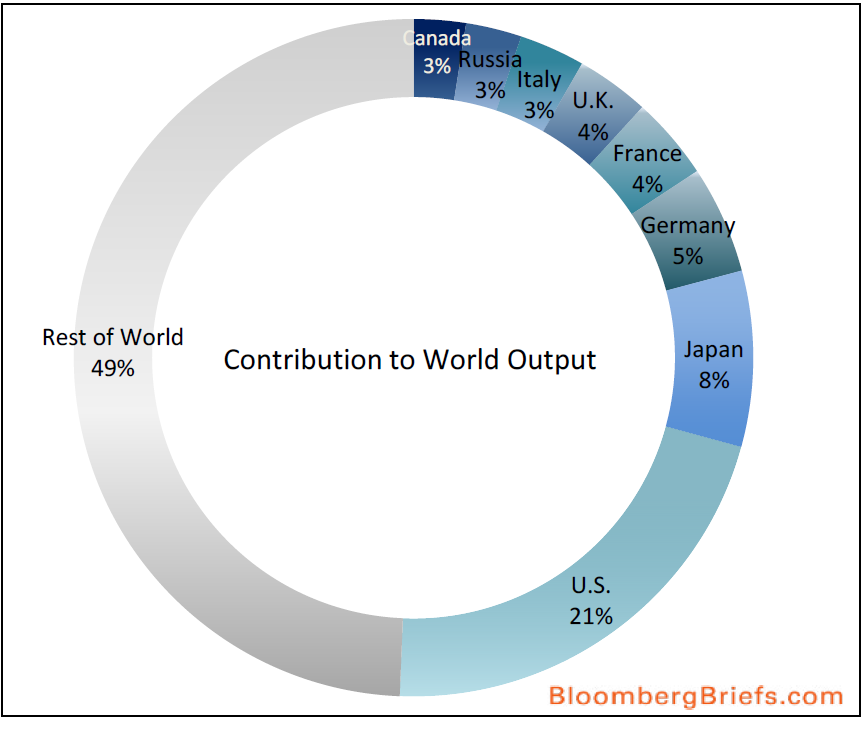
The G-20 meeting begins in Moscow this week. The countries that comprise the G-20 account for 90% of the world’s economic output. The breakdown is as follows:
Kamal Hamami, a commander in the Free Syrian Army has been assassinated by a jihadist group. The killing further fragments the opposition to President Assad and makes it more difficult for liberal states to support the rebel forces. The killing also suggests that, even if Assad were to go, fighting in Syria would likely continue as the rebels would simply turn on each other to take control of the country.
Last fall Malala Yousafza, a young Pakistani girl, was nearly killed by an extremist group because she insisted on being educated. Today, Malala addressed the United Nations General Assembly. She represents a new wave of girls who refuse to back down from asserting their rights as human beings. Malala serves as a powerful example of courage and strength.
July 9th marked the ninth anniversary of the advisory opinion of the International Court of Justice that the separation wall being built by Israel in occupied territories was illegal. The opinion of the Court found that: “The Court concludes that the Israeli settlements in the Occupied Palestinian Territory (including East Jerusalem) have been established in breach of international law.” The advisory opinion has had no effect on the conduct of the Israeli government in the occupied territories.
Brazilian protests have moved into a new stage as the unions in Brazil have joined the protests in a “Day of Struggle.” The demands were for better working conditions and significant economic reforms. THe protests involved stopping transportation in many of the major cities in Brazil. President Rousseff, who is up for re-election did not respond directly to the protests yet.
Slowly but surely, the economies of southern Europe are beginning to look as if they are not going to recover before a crisis occurs. The austerity programs for countries like Greece and Italy have only served to slow down the economies to the point where their sovereign debt cannot be repaid. The crisis has been disguised by the extremely low interest rates that prevail in the world, but the slow unwinding has been unremitting. It also appears as if the banks in Europe have been too slow to recapitalize themselves so they are looking increasingly vulnerable to crises of confidence. There doesn’t appear as if anyone in Europe has a plan to avoid the crisis.
Transparency International has issued its annual report, the “Global Corruption Barometer,” and it suggests that people all over the world are losing confidence in their governments. Corruption has been a principal theme in many of the protests that we have witnessed over the last two years, and the report confirms that it is a major issue for most people. From a political point of view, corruption is perhaps the most important cause for a withdrawal of legitimacy by the people in their governments. Governance under such circumstances is increasingly difficult, and governments are more likely to resort to coercion to get citizens to comply with the laws and directives.
The relationship between fertility rates and economic activity has been difficult to define precisely. But in the recent economic downturn in Europe, the effects have been dramatic: birth rates in all 28 European countries have gone down. The relationship seems to suggest that younger couples defer having children when the economic prospects seem cloudy or difficult. Fertility rates in Europe have been declining for many years, a trend that augurs ill for the future of pensioners in Europe as there will be fewer workers contributing to the pension funds of retired people.
Drone warfare has taken a new turn. The US has landed a drone on an aircraft carrier. The capability is more significant that it initially appears. The US has made agreements with a large number of countries for base rights so that it can use drones in a variety of circumstances. By being able to use aircraft carriers, the US no longer needs to secure these base rights thereby avoiding all the discomfort of those rights such as in Pakistan. Of course, this new capability likely means that the US will rely more heavily on drones in the future.
The World Health Organization (WHO) has called its second emergency meeting ever (it was founded in 1948) to discuss the Middle East Respiratory Syndrome–coronoavirus (MERS-CoV). There have only been 79 documented cases in the world–in 9 countries, but mostly in Saudi Arabia. But of the 79 cases, 42 have proven to be fatal, which makes MERS-CoV one of the most lethal viruses ever. It does not appear to be highly contagious, but WHO is worried that with millions of pilgrims expected to visit Saudi Arabia during the holy month of Ramadan the virus may spread globally in a very short period of time. Unfortunately, it has quite a long incubation period so screening people before they leave Suadi Arabia does not promise to be highly effective.
Many people have been killed in the recent violence in Egypt, and it seems that little progress is being made in creating a government that could effectively rule. The Muslim Brotherhood has called for an “uprising” of the Egyptian people to “restore” democracy to Egypt. The call signals an intent not to cooperate with efforts to forge reconciliation. Without the cooperation of the Brotherhood, such an outcome appears impossible at this time.
A special COmmission in Pakistan has accused the Pakistani government, especially the military and the intelligence services, of gross incompetence in its handling of the whereabouts of Osama bin Laden for about 10 years. The report was leaked to Al Jazeera and can be accessed here. The report also accuses the US of the “murder” of bin Laden and for humiliating the sovereignty of Pakistan. Needless to say, the failure of Pakistan to identify bin Laden for such a long time strained US-Pakistani relations for an extended period of time.
There have been bomb blasts at the Indian Buddhist shrine of Bodhgaya in Bihar. The site is reputed to be the place where Prince Siddhartha attained Enlightenment and Buddhism began in the 6th or 5th century BCE. No group has claimed responsibility and the site was only slightly damaged. But violence against Buddhists is not typical, and could be in retaliation for the Buddhist attacks on Muslims in the northwestern parts of Burma. THe expansion of the framework for violence in the world is quite unsettling.
After thundering condemnations from Europe over US spying of the European Union in Brussels and Washington, it is slowly coming out that Britain, France, and Germany have similar spying programs. The one country about which it was thought free from such criticism was Germany,given the country’s harsh experience of government surveillance during the Nazi and East German Communist regimes. Now, however, we have information that German authorities were working closely with the NSA on electronic surveillance. Hypocrisy and disillusionment are often linked together in world politics.
Zimbabwean Prime Minister Morgan Tsvangirai is making his third attempt to unseat the current president, Robert Mugabe. He most likely won the last election, but voter fraud in 2008 denied him the position. The likelihood of a fair election this time is also virtually nil, but the 89 year old Mugabe, who has ruled Zimbabwe since independence from Britain shows no signs of wanting to step down. THe world will be watchin this election closely, so there is a slight chance that outside observers may have some effect on producing a fairer election.
Many countries in the world are pumping more water from their water aquifers than can be replenished which means that these supplies of fresh water are becoming less adequate over time. The effect of this activity will mean diminishing harvests of food, a trend that has already been observed in several countries already. It is very difficult to find “new” sources of water, so the trend is especially troubling for some heavily populated countries like China and India. But the situation is also acute in many areas of the US which enjoys the role of food supplier of last resort for the entire world. Another point is important: rising food prices are commonly associated with political protest.
The Syrian National Council–the coalition of anti-Assad rebels–has chosen a new leader, one more sympathetic to the views of Saudi Arabia. The move marks a defeat for the Qatari support for other factions within the rebel forces, a significant defeat given the huge financial support the Qataris have provided. It is not clear whether this change of leadership will make it more likely for Western powers to support the rebel forces, but it may represent a significant step forward in making the rebel forces more coherent and effective.
Since 2007, Chinese oceans near the Yellow Sea have been hit by extraordinary algae blooms (Enteromorpha prolifera). This year, off the coast near Qingdao, the blooms cover an area roughly the size of the US state, West Virginia. Nonetheless, some brave swimmers endure the foul-smelling mess and tried to enjoy the water.
Not unexpectedly, violence has broken out in Egypt between pro- and anti-Morsi forces. Unfortunately, the message to the Islamist parties in Egypt (and across the world) is that democratic change is not an option for them. It is difficult to say at this stage how this realization will unfold, but in the short run, violence seems to be most likely–a clearly sad outcome. Al Jazeera has rolling commentary on the situation in Egypt. Here is a strong opinion from the Turkish press, condemning the military coup.
There have been many critiques of globalization, but the recent factory tragedies in Bangladesh have brought home the intimate connections between what we wear, eat, drink, and use and how people live and die in many different places. We can longer afford to pretend that these connections do not exist and we need to make ure that we are comfortable with the connections that have been developed for the benefit of some and the detriment of others.
Stephen Walt has written a wonderful short essay on Edward Snowden and the NSA leaks.I often find that I am in strong agreement with Walt, and that is certainly the case on this issue.
The international reaction to the Egyptian coup is difficult to interpret, and the media is making analysis difficult. Check out this article from Al Jazeera. Then read this article from the New York Times. Note the differences in interpretation, particularly on Turkey and Qatar At least Syrian President Assad is brutally honest and direct. Of course, the only game open to him is the game of Realpolitik. Meanwhile, the military is cracking down hard on the Muslim Brotherhood. The moves are profoundly undemocratic and they will make possible reconciliation highly unlikely.
Portugal is the latest casualty in the austerity mess in Europe. The government is close to collapse as efforts to close the budget deficit seem doomed to fail. Just a few months ago, Portugal was the poster child of the austerity movement (as was Ireland a few years ago). Both countries, however, are having increasingly more difficult choices to make and their growth rates seem to be declining rapidly.
For a chilling read, check out this article on the role of US Special Operations in the world today. The world is a very different place than it was just 12 years ago.