Archive for the ‘World Politics’ Category
A new record has been set. The 400 richest Americans are worth a collective $2.02 trillion. To put that figure in perspective, $2 trillion is roughly the size of the Russian economy. That concentration of wealth is unprecedented in US history. At the same time, the Census Bureau just released data that “In 1989, the median American household made $51,681 in current dollars (the 2012 number, again, was $51,017). That means that 24 years ago, a middle class American family was making more than the a middle class family was making one year ago.”
Brazilian President Dilma Rousseff has cancelled her state visit to the US to protest the allegations that the US National Security Agency spied on her and other Brazilian citizens. The cancellation is an embarrassment to the Obama Administration since Rousseff’s planned visit was one of only a few state visits anticipated by the diplomatic corps, but it is hard to imagine a productive visit under the circumstances. It is highly likely that the protest will enhance Rousseff’s chances for re-election in Brazil.
For the last four years, Nigeria has faced violent attacks from a radical group that calls itself Boko Haram (“Western education is a sin”). The aims of the group are to establish an Islamic state in the northern part of Nigeria (which has a primarily Muslim population, unlike the south, which is primarily Christian). It would be a mistake, however, to interpret the movement as primarily religious–it is fundamentally a protest movement against the political dominance of the southern parts of the country over the north. The group began an active armed struggle in 2009, but it has been agitating for change for over a decade.
Politics often makes very strange bedfellows. In the current civil war in Syria, both the US and Iran have a strong mutual interest in preventing a takeover of Syria by radical Sunni militants. They also have a strong mutual interest in preventing the use of chemical weapons, since Iran was the victim of chemical attacks by Iraq in their war of 1980-88. What is interesting is that neither side seems interested in building on these common objective. The US should be working harder to work with Iran to find a more manageable alternative to President Assad.
Many in Greece have started a week-long series of strikes and protests against the economic policies being forced upon Greece by the EU and the IMF. The austerity programs imposed by the international organizations have shrunk the Greek economy by almost 25% over the years. Previous protests have done little to change these policies, and it is not clear that these activities will be more effective. But it is also clear that Greek society is close to the breaking point given the incredible rise in the suicide rate in the country–an increase of almost 45%
The International Criminal Court has indicted two Kenyan leaders, Deputy President William Ruto and President Uhuru Kenyatta, for fomenting violence after a contested election in 2007. The International Criminal Court has only recently been established, and its mandate is to enforce laws against crimes against humanity if the national courts in which the offenses occur do not take effective action. What makes this case so fascinating is that both leaders were elected in a recent election which was deemed to have been fair, and there is a sense that the election was itself an opportunity for the Kenyan people to take “effective action” against alleged criminality. The controversy over the indictments has called into question the mandate of the ICC.
The Philippines government has been waging a very long war against an insurgent group, the Moro National Liberation Front (MNLF), in the southern part of the Philippines. The discord reflects the tension between the primarily Christian north and the primarily Muslim south. A peace treaty has been signed in 1996 which ended decades of strife, but that agreement, which ceded a great deal of autonomy to the southern provinces of the Philippines has slowly broken down. The violence has heated up recently, and only shows signs of getting worse right now.
The Los Angeles Times has published a story which gives more context to the US position on the use of chemical weapons. According to the story, for which there are no named citations (which indicates that all the information was provided by Obama Administration officials who did not wish to be identified–always a red flag when one is reading a newspaper story), there were as many as 11 previous uses of chemical weapons prior to the event on 21 August that led to the US ultimatum. The information is tantalizing, but one needs to be careful with such stories. Without attribution, there is no way to verify the accuracy of the report. One cannot, however, simply ignore such stories since the LA Times very likely took serious steps to ensure that the story was reliable.
The German elections will occur this coming week, and the odds are that Angela Merkel will be able to retain her position as Chancellor. There are a number of different possible party coalitions that would endorse Merkel, so her own party does not have to win an absolute majority in the Reichstag. There is, however, an interesting development in this year’s election. A new party, formed only last February, is gaining strength, and polls give it a shot at getting the necessary 5% of the vote to secure representation in the parliament. The Party, Alternative for Germany, is a profoundly anti-European Union party which calls for the orderly dismemberment of the EU. If the party does get representation in the Reichstag, it will undoubtedly make Merkel’s life very difficult in the EU.
The US and Russia have hammered out an agreement that may defuse the threat of an American attack on Syria. Here is a link to the signed agreement (I will not ask any quiz questions on the formal agreement–it is too technical). The agreement only relates to chemical weapons, and not at all to the humanitarian crisis in Syria, but it is nonetheless an important breakthrough. There are three conditions that we know about (there are always additional details to every agreement that are not public). First, Syria must declare to the UN all its chemical weapons caches within a week. Second, Syria must allow inspectors free and unlimited access to its territory within thirty days. Finally, by early 2014 all these weapons must be handed over and destroyed by an international team.
The agreement is significant, but fragile. In return for Russian support, the US agreed to have Syrian compliance monitored under Chapter 6 of the UN Charter, not Chapter 7. Only Chapter 7 authorizes the UN Security Council to use force, Chapter 6 only authorizes sanctions. So, theoretically, if Syria fails to comply with the agreement, the US would not have UN authority to renew its threat of an armed attack. The global experience with sanctions as a technique to enforce arms limitations is not encouraging. Such sanctions did not work with Iraq after 1991, nor did they prevent North Korea from developing nuclear weapons. The current negotiations with Iran over nuclear weapons have also been very difficult.
This agreement will be a case study in international relations in the future. The question is whether the US threat of force brought about the agreement, and whether the absence of the use of force may scuttle the agreement. Here are some interesting insights: Foreign Policy; The Atlantic; The Spectator.
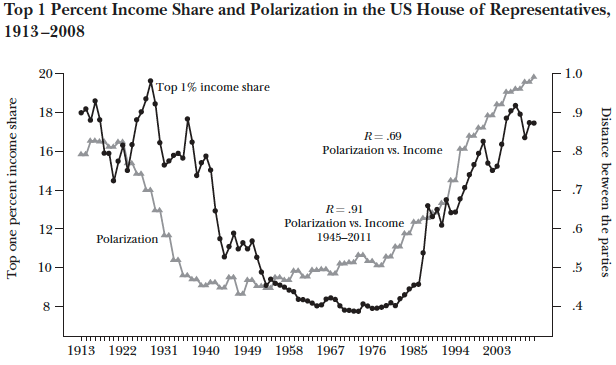
A team of Political Scientists at Stanford have published a fascinating study in the Journal of Economic Perspectives on a very important question: Why Hasn’t Democracy Slowed Rising Income Inequality? I will not ask any questions on the weekly quiz about the study because it is pretty detailed. But Mother Jones, a lefty journal in the US, published a short analysis of the study. The scholars looked at the relationship between income inequality in the US and liberal/conservative polarization in the US House of Representatives. The relationship seems to be fairly clear as suggested by this graph. But the explanation for the relationship remains elusive since it seems intuitive that people would vote to protect their economic interests. But the definition of economic and political interests seems to be quite different from what one might normally expect. The radicalization of politics does, however, seem to be a global process. As economic inequality has deepened in many countries of the world, more radical political parties have emerged such as the National Front in France, the True Finns in Finland, the Party for Freedom in e Netherlands, and the Jobbik Party in Hungary. Perhaps the most notorious of all these radical movements is the Golden Dawn in Greece.
Mexican teachers have been protesting changes in national education policy for the last three weeks, and the protests have turned increasingly violent. The strikes are in response to proposed changes in the governance of Mexican teachers which have one of the most powerful unions in Mexico. Governance in education have led to massive strikes in Chile and Canada in recent years. Indeed, the access to higher education is a prominent issue is most countries of the world.
Stephen Walt is a Professor at Harvard and one of the most prominent realists in the field of international relations. He maintains a regular blog on the Foreign Policy website. His analysis of the situation in Syria is very specific and direct, and in this post he uses the advice the General Colin Powell gave prior to the attack on Iraq in 1991, the war often called “Desert Storm.” The advice is highly pertinent to a strategic analysis of US interests in Syria.
Vladimir Putin in 1998. Vladimir Putin in 2013. Death toll estimates for the First and Second Chechen Wars: 160,000. Hypocrisy in World Politics: Universal, ubiquitous, and eternal. Relevance of this debate to the suffering of the Syrian people: Zero. The Washington Post did a fact-check on Putin’s op-ed. These criticisms notwithstanding, we should all understand that Putin’s op-ed resonated strongly with the sentiments of a very large segment of the global population.
Income inequality in the US continues to worsen. According to a recent study the top 10 percent of income earners in the US took home 50 percent of all income. That disparity is the highest ever recorded in US history (since the records began in 1917). According to the study “…from 2009 to 2012, income for the 1 percent grew by 31.4 percent, while everyone else only saw it grow by 0.4 percent. That means the 1 percent ‘captured 95 percent of the income gains in the first three years of the recovery,'”
The last principle of the Just War Doctrine that we will consider is #5:
- The ultimate goal of a just war is to re-establish peace. More specifically, the peace established after the war must be preferable to the peace that would have prevailed if the war had not been fought.
It is impossible to know exactly what President Obama’s intentions actually are. His stated objective is to punish President Assad with a single attack for the purpose of deterring the future use of chemical weapons. That objective is perfectly consistent with the Just War Doctrine. Note that that objective has nothing to do with stopping the humanitarian tragedy in Syria, but it is not necessary for all possible objectives to be satisfied. After all, one of the stated purposes of the Just War Doctrine is to limit the frequency and intensity of war, not necessarily to end all violence.
There are, however, reasons to doubt that this single objective is the only one. The same objective was stated in the intervention in Libya in March 2011, which was the reason why the Russians and Chinese did not veto the Security Council Resolution justifying the intervention. The purposes of that intervention, however, changed into one of regime change, i.e., the overthrow of Muammar Gaddafi, President Obama has not given any indication that his current plans include regime change, but he is on record as calling for President Assad to step down. Additionally, we know that there are many voices in the US Congress who are calling for the overthrow of President Assad. So, if the strike occurs, the objectives of the attack must remain completely limited to be covered by the Just War Doctrine.
We continue our discussion of the Just War Doctrine and a possible intervention in Syria with Principle #3 of the Doctrine:
- A just war can only be fought to redress a wrong suffered. For example, self-defense against an armed attack is always considered to be a just cause (although the justice of the cause is not sufficient–see point #4). Further, a just war can only be fought with “right” intentions: the only permissible objective of a just war is to redress the injury.
The Syrian case raises many questions about the “wrong” suffered. There is no ambiguity at all that the use of chemical weapons is a criminal act that warrants a response. But there are questions about how best to “redress” that wrong.
First, for reasons that are inexplicable to many, there remain some questions about who was responsible for the attack. The Obama Administration has said that it is certain that the Syrian Government ordered the attack, but aside from references to satellite images that show the missiles coming from Syrian government-controlled areas, there has been no evidence that can be scrutinized. There is some evidence that Assad did not personally order the attacks. That assertion may well be true, but it does not absolve the Syrian “government” of responsibility. Even is some rogue element of the Syrian military used the weapons without authorization, the government of Syria is still responsible for all actions taken by its agents on its territory. The Russians claim that the Syrian rebels are the ones who used the chemical weapons. In short, despite the strong position taken by the Obama Administration, there are still legitimate reasons to raise questions about who inflicted the “injury.”
Second, the Syrian people suffered the injury–they have the right to respond. They are not, however, in any position to protect themselves. The Just War Doctrine does permit weak powers to ask for assistance from stronger allies. The allies then act in concert to redress the injury suffered. There is overwhelming evidence that the Syrian rebels have received assistance from a very large number of countries such as Qatar and Saudi Arabia. The rebels have also received material assistance from the US and some European powers. The problem with receiving outside assistance is that the outsiders rarely have redressing the injury as their sole objective–generally, the allies want something additional which complicates the matter entirely. The US may aid the rebels in order to overthrow the Assad regime. But is US-inspired regime change a legitimate redress? Al Qaeda may wish to establish an Islamic state in Syria. Is such a state consistent with the interests of those who suffered the chemical attacks?
Finally, can the Just War Doctrine tolerate a much larger definition of an injury suffered? There is little question that the Syrian people suffered an injury. Can one make the claim that the destruction of a well-established international norm, such as the prohibition against the use of chemical weapons, is also a injury suffered by the larger international community? Is that an injury that needs to be redressed? Such a definition of injury would be a massive expansion of the traditional concept. But international law is a true casualty of the attack. Does it not also deserve to be defended?
We are continuing our discussion of whether an American attack on Syria conforms to the demands of the Just War Doctrine. The second principle of the Doctrine is as follows:
A war is just only if it is waged by a legitimate authority. Even just causes cannot be served by actions taken by individuals or groups who do not constitute an authority sanctioned by whatever the society and outsiders to the society deem legitimate.
There are several dimensions to this principle. The US government is unquestionably a legitimate authority over its own national security. It has a government that adheres to a regular process of elections, observes constitutional limits to the authority of the government, and enjoys the broad support of the population on the character of its government (representative democracy). It is for this reason that President Obama and Secretary Kerry continue to emphasize the national security dimension of the alleged chemical attack. If the government truly believes, on the basis of clear and convincing evidence, that the chemical weapons will be used against Americans on American soil, then an American attack on Syria would be justified.
The difficulty in this argument, however, is that there is no one who believes, nor is there any evidence to suggest, that Syria intends to attack the US with chemical weapons. Therefore, the US government alone is not a legitimate authority to decide whether to attack Syria because of a chemical attack on Syrian people. The chemical attack is clearly a war crime, and it therefore means that the provisions of the “Responsibility to Protect” (R2P) can be implemented. The legitimate authority for R2P, however, is the UN Security Council:
“In this context, we are prepared to take collective action, in a timely and
decisive manner, through the Security Council, in accordance with the Charter,
including Chapter VII, on a case-by-case basis and in cooperation with relevant
regional organizations as appropriate, should peaceful means be inadequate and
national authorities are manifestly failing to protect their populations from
genocide, war crimes, ethnic cleansing and crimes against humanity”
We know, however, that the Russians (and probably the Chinese) would veto any effort by the Security Council to take decisive action against the Syrian government. So the legitimate authority for humanitarian purposes would not take any action.
There is a third possible source of legitimate authority in this controversy, and it is derived from the very long prohibition against the use of chemical weapons. The list of international treaties is long, beginning with the Strasbourg Agreement (1675), the First Hague Convention, 1899, the Second Hague Convention (1907), the Washington Treaty (1922), and the Geneva Convention (1925). Finally, the Chemical Weapons Convention (1997) has been signed by 189 countries, although it was not signed by Syria which refused to sign because of Israel’s possession of nuclear weapons.
The Obama Administration has argued that there is an international norm against the use of chemical weapons that needs to be enforced. Implicit in this position is that the US as a dominant world power has the authority to enforce clear international norms. In his meeting with Baltic leaders on 30 August in Washington, DC, President Obama said:
“So I have said before and I meant what I said, that the world has an obligation to make sure that we maintain the norm against the use of chemical weapons. Now, I have not made a final decision about various actions that might be taken to help enforce that norm. “
So the authority being claimed is actually one of a hegemonic power enforcing the international rules of conduct. Needless to say, this definition of authority is not codified in any way, nor could it be because it essentially gives great latitude to great powers. But hegemonic power is itself a “norm” of international behavior. The world often looks to the great powers to take action in the face of great tragedy, such as occurred in Rwanda in 1994.
In many respects, this definition of authority is an appeal to the future: “We must take action now in order to prevent a greater problem in the future.” Indeed, there is little question in my mind that the Obama Administration has made such a big issue of international norms because it is also looking to a future problem with Iran and the norm of non-proliferation. If the US does not take action against Syria, is it implicitly sending a message to Iran that it would not be punished for violating the norm of non-proliferation?
Overall, the Just War concern with legitimate authority is a very muddy issue with respect to an American attack on Syria. It is very difficult to argue that the US has sufficient legitimate authority on its own to launch an attack.
Over the next few days, I will examine the status of an American attack on Syria using the framework of the Just War Doctrine. As the US and the world comes closer to making a decision whether to use force in response to the alleged chemical attack by the Syrian government, we all, as citizens, need to make up our own minds as to the morality of such a response. The Just War Doctrine is one such framework. It is not a legal code, but rather a series of questions that force an observer to examine specific points which may often be ignored by statespeople as they work to serve their respective country’s national interest rather than the collective morality of humanity.
As a refresher, here are the principles of the Just War:
- A just war can only be waged as a last resort. All non-violent options must be exhausted before the use of force can be justified.
- A war is just only if it is waged by a legitimate authority. Even just causes cannot be served by actions taken by individuals or groups who do not constitute an authority sanctioned by whatever the society and outsiders to the society deem legitimate.
- A just war can only be fought to redress a wrong suffered. For example, self-defense against an armed attack is always considered to be a just cause (although the justice of the cause is not sufficient–see point #4). Further, a just war can only be fought with “right” intentions: the only permissible objective of a just war is to redress the injury.
- A war can only be just if it is fought with a reasonable chance of success. Deaths and injury incurred in a hopeless cause are not morally justifiable.
- The ultimate goal of a just war is to re-establish peace. More specifically, the peace established after the war must be preferable to the peace that would have prevailed if the war had not been fought.
- The violence used in the war must be proportional to the injury suffered. States are prohibited from using force not necessary to attain the limited objective of addressing the injury suffered.
- The weapons used in war must discriminate between combatants and non-combatants. Civilians are never permissible targets of war, and every effort must be taken to avoid killing civilians. The deaths of civilians are justified only if they are unavoidable victims of a deliberate attack on a military target.
In today’s post, I will examine the first principle. Is a US military attack truly a last resort to a wrong suffered? Has the US exhausted all other non-violent options?
The conflict in Syria began as part of a regional phenomenon dubbed the “Arab Spring.” The movement starts in December of 2010 in Tunisia and spread throughout the Middle East. In January 2011 protests began in Syria against the lack of human rights. The Arab League was the first international organization to initiate a peace process in Syria and in November 2011 the Syrian government agreed to let League observers into the country to monitor how the protests were being handled by the government. The League noted a wide variety of humanitarian abuses and by January 2012 the League withdrew its monitors. The Arab League, however, did introduce a resolution to the UN Security Council on 31 January 2012 calling upon Syrian President Assad to step down. Russia and China both vetoed the resolution.
The UN then launched a peace effort led by former UN Secretary-General, Kofi Annan. Annan specifically tried to enlist Russian support, and a UN peace-keeping mission was sent to Syria. Annan resigns his position because he believes the peacekeeping mission was not viable and in June 2012, the peacekeeping mission is suspended. Throughout the period, violence in Syria only escalated.
Lakhdar Brahimi, a representative of the Arab League, takes over Annan’s position. In May/June 2013, both the US and Russia propose a peace conference to be held in Geneva to resolve the violence. That meeting is postponed by the US, and although still proposed, does not seem to be highly likely.
Finally the G8 Summit held in June 2013 devoted a great deal of its agenda to the situation in Syria. No proposals emerged from those discussions.
The most recent discussions on Syria, the G20 meeting in St. Petersburg, revealed large cleavages in the international community about the prospects for peace in Syria. No proposals emerged from these discussions, and most of the participants prefer to wait for the UN to issue its report on the facts of the chemical weapons assault before making a decision.
There is little question that there have been sustained and serious attempts to resolve the conflict peacefully. These attempts have failed, for a variety of reasons. One could make the argument that Requirement #1 of the Just War Doctrine has been satisfied.
I will take up Requirement #2 tomorrow.