Archive for the ‘World Politics’ Category
There apparently is a move in the Obama Administration to speed up the process of exporting natural gas in an attempt to blunt Russia’s control over European energy. This option is possible because of fracking, a policy that is problematic. Exporting natural gas would also raise prices in the US. Such are the costs of implementing an economic foreign policy.
The Crimean Parliament has voted to hold a referendum on whether Crimea should join Russia. The Parliament does not have the authority to order such a referendum–only the Ukrainian Parliament can make decisions about Ukrainian territory. But it is likely that a Crimea-only referendum would favor merging with Russia. Such a vote would force Ukraine’s hand–it is tantamount to a vote to secede, and, like the Union in the American Civil War, Ukraine would likely move to repress the secession with armed force. The move raises the stakes considerably.
The rise of the right-wing in world politics is one of the more distressing patterns today. The parties in Europe have been notable for their anti-immigrant and anti-Muslim sentiment (sentiments which exist in many places) which makes them somewhat different from right-wing parties in other areas of the world that tend to emphasize economic issues. Germany has seen a rise in anti-Muslim sentiment which is likely to have a big impact on the upcoming European Parliament elections.
Do you have difficulty wrapping your head about the problem of income inequality? There’s nothing wrong with your head:

The EU is offering economic support of about 15 billion euro to Ukraine. The money would be disbursed over several years, but is contingent on Ukraine following conditions laid down by the IMF. Those conditions are generally quite austere and will demand significant changes to the Ukrainian economy that many citizens will find hard to accept–much as is the case in Greece, Spain, Portugal, and Italy. It is, however, a very generous counter proposal to that offered by Russia, so it gives the Ukrainian government a viable alternative to Russian support.
Boko Haram continues to wage violent attacks in northern Nigeria. The government seems to be incapable of responding effectively to these attacks, and the constant pressure of the attacks is steadily eroding the stability of the government. Nigeria is a critically important state and the prospect of a slow deterioration in the politics of the country poses a serious challenge to the overall stability of West Africa.
India announced that it will begin to hold its national elections on 7 April. The contest this year is likely to be a particularly sharp political debate, pitting the likely Bharatiya Janata Party (BJP) candidate, Narendra Modi, against the Congress Party. The BJP is a Hindu nationalist party, and Modi has the legacy of a horrible anti-Muslim incident in his home state of Gujarat in 2002. This election bears close watching as it will be the largest democratic election in human history.
Any attempt to persuade Russia that the costs of invading Ukraine are higher than the benefits depends on the ability of the West to implement economic sanctions that penalize the invasion. There are reasons, however, to believe that Russians have insulated themselves from such measures by disguising their wealth in offshore banks that hide the identity of the owners of the wealth. In this situation, the interests of economic elites in avoiding state scrutiny trumps the national interests of preventing armed aggression. That conclusion suggests a global elite with no national loyalties at all.
The US Ambassador to the UN, Samantha Power, gave a strong speech to the UN Security Council condemning the Russian invasion of Ukraine. Definitely worth a read. Russian President Putin gave a press conference which has dampened the fears of an immediate Russian-Ukrainian conflict. In the press conference, Putin said that Russia had no intention of annexing any Ukrainian territory. The global reaction seems to be one of relief, but one should be careful about Putin’s honesty in such circumstances. He obviously has bought himself some time and dampened the furor, but there has been no change in Russia’s ability to do precisely what he said he would not do. Always watch capabilities, and not rhetoric.
One would think that the US and the European Union would easily forge a united front against the Russian invasion of Ukraine. But the Europeans are quite reluctant to take strong economic action, largely because of European dependence on Russian natural gas exports to the region. Given that the US is now the world’s largest natural gas producer, one would think that the Obama Administration is trying to figure out how to increase its gas exports to Europe.


Reuters is reporting a Russian ultimatum to Ukrainian forces in Crimea. We will see if this report is confirmed. If true, it represents a very dramatic escalation of the crisis.
Protests continue in Venezuela, as evidence mounts that President Maduro is using paramilitary thugs to intimidate the opposition. The protesters are difficult to categorize: some are leftists, and others are supporters of the business community. They only seem to agree that Maduro must go. If Maduro does fall, it is hard to imagine how Venezuela will reconstitute a government–a very dangerous political situation.
We are getting more information about the strength of the Ukrainian military. The basic information we have which is largely an estimate gleaned from public sources is that the Ukrainian military probably lacks the strength to do anything about the Russian invasion of Crimea–the Russians seem to have an overwhelming advantage. But the Ukrainian military could likely hold its own if the conflict expanded outside of Crimea. So much depends on how President Putin chooses to exploit his advantage in Crimea and whether he has the self-discipline to avoid moving his objectives beyond that simple strategic goal.
There has been a violent extremist attack in China that was reputed to have been launched by Uighurs from the Xinjiang Province. There are some in Xinjiang who wish to have independence from the central government in China, although it is difficult to gauge the depth of that feeling. This attack is only the latest of a strong of attacks that have occurred over the last few years. The Chinese regard the movement as a threat to the territorial integrity of China, and have tried to repress the independence movement with little success.
Behind every political crisis is an economic backstory. Speigel has an excellent overview of the economic problems facing Ukraine right now. The political instability in the country makes it especially difficult for Ukraine to address these problems, and as chaos seems to descent on the country, its economic turmoil will only increase. The only hope for the easing of these issues is some sort of aid coming from the EU or the US, and, right now, it does not appear as if they will be stepping up to the plate.
The reports that the Russians have sent 15,000 troops to Crimea (reports which cannot be verified by journalists on the ground) have sharply raised the question of how Ukraine and its allies should respond to an invasion. At this point I really do not have any idea of how strong or reliable the Ukrainian military is, nor do I have any sense of how truly divided the Ukrainian polity is. There are plenty of talking heads, essentially repeating what each other has said, and I cannot vouch for any of the rumors that are currently flying around. My advice is to keep reading as much as you can from as many sources that you can find. There is little question, however, that the next 24-48 hours will be critical in determining the direction of this crisis.
The Economist has published a very perceptive and powerful essay entitled “What’s Gone Wrong with Democracy?” It is a very long essay, so I will not ask any questions about it on the weekly quiz. But I strongly encourage everyone to read it. As we witness the middle class protests all over the world, we cannot ignore the larger question of whether a globalized world is governable along the lines of political and economic authority that have been developed over the last 500 years. The world seems to be moving very fast away from that ideal.
Adam Taylor of the Washington Post has written an informative piece on the history of the Crimea. The essay explains much of the historical tension that pervades the peninsula and why so many residents there have such strong and mixed feelings toward each other and their neighbors. It also suggests that there is no easy resolution to this particular crisis which can almost be thought of as independent of the crisis facing Ukraine as a whole.

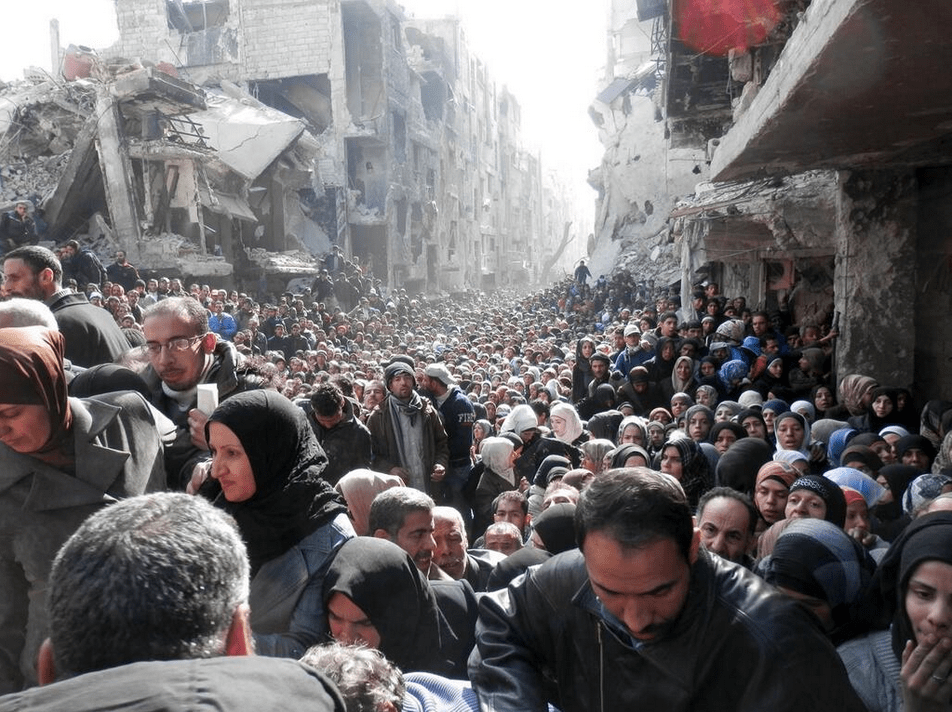
The situation in Venezuela continues to deteriorate as food shortages amplify the high rates of inflation and unemployment. President Maduro apparently refuses to acknowledge the seriousness or the legitimacy of the protests. The photograph below is of a food line in San Cristobal. It is reminiscent of the food lines in Yarmouk, Syria, and symbolic of the critical role food prices play in the protests all over the world right now.

The US NSA and the British Intelligence Service, GCHQ, have been busy intercepting and storing thousands of webcam images lifted from Yahoo! users. There appears to be no criteria involved in capturing those images, and a very high percentage of those webcam images were of a sexually explicit nature. This activity is worse than anything George Orwell ever imagined in 1984. The political power implicit in being able to use such images in political blackmail is simply extraordinary.
George Kennan was one of the most influential foreign policy analysts in American diplomatic history. He was, in many respects, the person who crystallized a strategy for the US in the Cold War even though the final form of that strategy departed from his central propositions. The New York Times ran an insightful op-ed piece suggesting that many of his insights would be highly relevant to a re-formulation of American foreign policy today.
The World Bank postponed a loan scheduled to finance health care in Uganda to signal its opposition to the anti-gay legislation recently passed in the country. The move is highly unusual as the World Bank tries to avoid overt intervention in the domestic politics of its member states. Other countries, such as Norway and Denmark, have suspended aid to Uganda. The moves are designed to show clear opposition to discrimination, but it also represents a clear expression of cultural values that are not necessarily universally shared.
Russian President Vladimir Putin continues to show Russia’s military strength as the crisis in Ukraine unfolds. The Viktor Leonov SSV-175, one of Russia’s intelligence naval vessels (read: spy ship), docked in Havana, Cuba. The message was clear: the Russian military is prepared to take whatever steps are necessary to defend Russian interests.
The Russian press is reporting a massive military exercise by Russian forces in Western and Central Russia. Sergey Shoigu, Russia’s Defense Minister, claimed that: “The drills are not connected with events in Ukraine at all.” Of course, no one believes Shoigu, and the exercise is regarded as sabre-rattling by Russian President Putin. Anti-government protesters in Ukraine are certainly concerned by the Russian moves, but the important constituency to watch are the Russian supporters in Eastern Ukraine. Will they be encouraged by the Russian moves to push to restore Yanukovich to the Ukrainian Presidency?
US Secretary of State Kerry issued some very strong language when he characterized a possible Russian military move in Ukraine as a “grave mistake.” Kerry is walking a very fine line, trying to convey the strongest US opposition to a possible Russian military action without making a formal commitment by the US to respond militarily. Both the US and Russia are engaged in a very dangerous game.
The situation in Syria has not improved at all for the civilians trapped in the violence of the civil war. The photograph below is from a refugee camp in Yarmouk, south of Damascus. These are civilians lining up to receive humanitarian food supplies.