Archive for the ‘World Politics’ Category
The Islamic State asserts that its principles are derived from Islam, although most Muslims would strongly differ. The interpretation of Islam most closely associated with the Islamic State comes from the teachings of an Islamic scholar, Muhammed ibn Abd al-Wahhab, who lived in the Saudi peninsula in the 18th century and whose doctrine has come to be known as Wahhabism. Wahhabism is the dominant interpretation of Islam in Saudi Arabia, and was a source of inspiration to Osama bin Laden, the founder of al Qaeda. The linkage between the terrorist groups and the Saudi Arabian monarchy is a serious problem for the Saudi government which likely explains Saudi participation in the coalition in the air strikes against the Islamic State.
Muhammad ibn Abd al Wahhab

Nigerian authorities are claiming an important victory over forces supporting Boko Haram in the northeast town of Biu. The military has been trying for several years to get control of the northeastern part of the country, and this incident is a solid sign of progress. The death of the leader of this militant group (whether for real, or of the stand-in for the leader) is likely an important psychological blow. We’ll see if the Nigerian government can follow through.
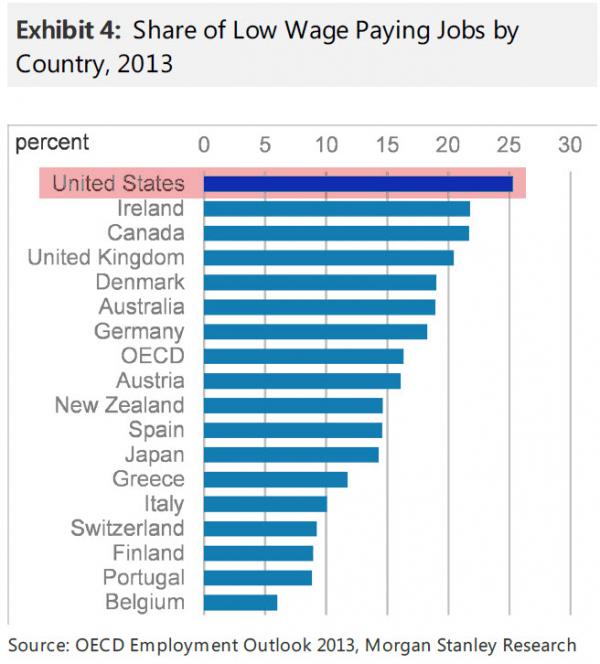
The US has the unenviable position of being the most economically developed country with the highest percentage of low paying jobs as a total of all jobs. This chart from Morgan Stanley does not paint a flattering picture.
The US, Saudi Arabia, Bahrain, Jordan, Qatar, and the United Arab Emirates have conducted bombing missions in Syrian territory. The move is a rather dramatic escalation of the US effort to dislodge and destroy the Islamic State. The coalition is a rather odd assortment of states given the animosity within the group (the Saudis and the Qataris do not see eye to eye on many matters), but the fact that all five allies are Arab states provides the US with some political cover from the charge of unilateral action. What remains to be seen is how Turkey, Iran, and Russia will respond to this escalation.
The US Center for Disease Control (CDC) has issued a warning that the number of Ebola virus cases could reach as many as 1.4 million cases by next January. The high estimate is based on a scenario in which there is not a concerted effort to contain the disease, but also based on the large number of unreported cases that the CDC has detected. But vigorous containment efforts, like those recently and successfully implemented in Nigeria, could significantly slow down the spread of the virus.
A document purportedly from the Islamic State has been posted on the Internet. There is no way for me to verify that the document is in fact from the IS, but a number of reputable news sources have cited it. The post is a call to arms to all Muslims to support the Caliphate and to articulate the IS view of world affairs. It is worth a cursory reading–some of the language is truly inflammatory. I will not ask any questions on the quiz about this article.
There have been a string of bomb explosions in the Xinjiang Province of China. The explosions are likely protests by the Uighur ethnic group in the province against the political power exercised by the ethnic Han Chinese who are the majority group in China. The blasts are also likely related to the upcoming verdict of a prominent Beijing economist who has been accused of inciting violence on behalf of the Uighurs. The Uighurs are primarily Muslim so the threat of separatism is taken very seriously by the Beijing government. The Indonesian government has arrested 4 Chinese nationals who are accused of trying to connect with a local representative of the Islamic State. If that report is accurate, then the Chinese will certainly worry about a spillover from Iraq and Syria into Xinjiang.

Students in Hong Kong have begun a weeklong boycott of classes in order to prove their commitment to democracy in Hong Kong. The concern of the students is that the central government in Beijing will choose the candidates for election in local races. The students would prefer to have more democratic selection processes. The protesters carried banners that said: “The boycott must happen. Disobey and grasp your destiny.” Protests have been going on for several months now, and there does not appear to be any movement toward a reconciliation.
The US was flooded with talking heads on the Sunday News Programs in the media, all of whom were trying to figure out the future course of action by the US in its activities against the Islamic State. I sincerely doubt that any of the commentators had any basis for their observations, but it does seem very clear that no one has a clue about how matters will unfold. One very thoughtful analysis, however, appeared in The Hindu. The article outlines the sequence of problems the US will face as it tries to determine a military response to the IS.
Despite heroic efforts and substantial efforts to reduce greenhouse gas emissions, China now produces more of those gases than the United States and Europe combined. Indeed, the world is now producing 65% more carbon gases than it did in 1990, the year the world began to talk seriously about limiting such emissions. The UN meeting this week will tell us a great deal about whether progress will be made in the future to reduce carbon emissions–unless those emissions are reduced by at least 5% a year, then catastrophic global warming cannot be averted.
There was a very large protest in Moscow against Russian activities in Ukraine. The protesters reject President Putin’s explanation of events in Ukraine, and believe that Russia is the aggressor. The anti-war protest was the first since violence broke out in Ukraine last April, and apparently there were a lot of anti-Kremlin posters. The Russian people remember the loss of soldiers in the Russian military actions in Afghanistan and Chechnya and are worried about an escalation of violence in Ukraine.
The People’s Climate March takes place tomorrow in New York City. The march is sponsored by more than 1,400 organizations and targets a meeting scheduled for later in the week at the United Nations. The UN Climate Summit starts on 23 September against a background of dismal failure by the international community to take effective action against climate change. The American public, in particular, has been generally unaware of the problem of climate change, and the march attempts to change that apathy. It is likely to at least make a lot of noise.

US Secretary of State Kerry has stated that Iran has a “role” in fighting the Islamic State, but that would not be part of any coalition in which the US played a part. Iran has strongly supported the Shia government of Iraq and the Alawite government of Assad in Syria. Thus, the US and Iran agree on supporting the current government of Iraq, but not the current government of Syria. One should suspect that the US and Iran are actually cooperating to a large degree, but that neither government wishes their respective populations to know about the cooperation. It will be interesting to see if this cooperation has any spillover in the current negotiations with Iran over its nuclear program.
We will be reading more and more about the coalition of states that have joined the US to “degrade and destroy” the Islamic State. US President Obama is desperately looking for states that would be willing to send ground forces to Iraq and Syria since he has declared that the US would not do so. We should, however, be quite aware of the fact that some states in this purported coalition often work at cross-purposes to US interests. Most notable among these states are Saudi Arabia and Qatar.
By a 55-45 percentage margin, Scottish voters have voted to remain part of the United Kingdom. It is a decisive margin, and a triumph for democratic procedures (most secessionist movements are distinctly violent). The result, however, does not mean that things will remain the same. In order to avoid a “yes” vote for independence, the British government made significant promises toward greater autonomy for all parts of the United Kingdom. Thus, it is likely that Scotland, Wales, England, and Northern Ireland will all demand great powers over questions of taxation and spending. The only areas likely to be untouched by the autonomy changes will be in the arenas of foreign and defense policy.
German Muslims united to show their disdain for the Islamic State. There are about 4 million German Muslims and authorities estimate that about 400 German Muslims have left to join the Islamic State. The vast majority of German Muslims do not regard the “Islamic State” as Islamic since its behavior contravenes the precepts of Islam. It is unfortunate that demonstrations of this sort are rarely mentioned in the American media, since the protests are a more accurate index of Muslim attitudes in the world.
The recent visit by Chinese President Xi to India was highlighted by extensive economic talks and agreements. On the surface, it appeared as if Prime Minister Modi and President Xi got along very well. There are, however, some deeper rifts between the two countries, not the least of which is a long history of territorial competition. The economic ties are mutually beneficial, but unlikely to override the great power rivalries between the two emerging powers.
For many years now, experts have assumed that global population would stabilize at 9 billion people around the year 2050. That projection was based upon a number of assumptions which, while reasonable, were never really carefully examined. New research, however, has raised questions about the estimates, and the new studies suggest that global population could plausibly increase to about 11 billion by the year 2100. Such an increase would create serious challenges to the global environment and the carrying capacity of the planet.
The US Senate has followed the lead of the House of Representatives and endorsed arming Syrian rebels dedicated to the overthrow of Syrian President Assad as well as opposing the Islamic State in Syria and Iraq. The measure was voted upon as part of a larger bill to fund the government, so many Senators were unable to express their true feelings about supporting the rebels. Nonetheless, it does not seem to be likely that the measure will have any effect on the Syrian civil war any time soon since it will take months to begin training the rebels. But the measure deepens US involvement in this very sticky situation.
Eight health workers were killed in Guinea as a crowd believed that the health care providers were intent on spreading the Ebola virus. The tragedy reflects one of the ongoing problems in containing the outbreak of the Ebola virus: many of the people in the region are afraid of the health care system and some parts of the population believe that Ebola is being deliberately spread. The article quotes a local police officer, Richard Haba, who said that the villagers believed that Ebola “is nothing more than an invention of white people to kill black people.”
The US House of Representatives has passed a bill to allow the US to start arming Syrian rebels. There was no money provided for in the bill, and it is not at all clear who qualifies as a “Syrian rebel.” The votes reflected sharp divisions within both the Republican and Democratic Parties. In short, the bill was high in drama but low in specifics. We will have to see what the Senate does with the bill. But President Obama reiterated his pledge that no American combat troops would be deployed.
Chinese President Xi Jinping is visiting India. Relations between the two state have always been frosty as they compete for dominance in Asia. In addition, there are several border disputes between the two countries that have d\festered for a long time. But the New Indian Prime Minister, Modi, is making a concerted effort in the area of foreign relations and his dynamism is certainly changing the landscape. It seems as if the two countries primarily discussed economic relationships, but Modi’s strident nationalism will undoubtedly get in the way of such closer ties.
General Martin Dempsey, chairman of the U.S. military’s Joint Chiefs of Staff, did not rule out the possibility of sending more American soldiers into the fight against the Islamic State (IS), but ruled out a significant “combat” role for those soldiers. The US is threading a fine needle, trying to maximize the intensity of force it can bring to bear against IS without incurring large casualties in the fight. Dempsey also revealed that the US would be training 5,000 Syrian fighters in Saudi Arabia to fight in the rebellion against Syrian President Assad. Since President Obama’s speech last Wednesday, there has been a flurry of ideas floated about how to confront the Islamic State, but one cannot help but think that the Administration is flailing around trying to develop a strategy designed to assuage American fears of a terrorist attack against the American homeland–a threat that hardly seems credible at this point in time.
US President Obama has ordered 3,000 American troops into Liberia to help contain the Ebola virus outbreak in the region. The decision comes as Doctors Without Borders estimates that the number of infected cases may reach 20,000, a level that would be virtually impossible to contain. The troops would be used to set up hospitals and other medical infrastructures necessary to care for the sick, but not necessarily to enforce quarantines which have turned out to be counterproductive. It is safe to say that even this commitment falls far short of what is necessary to address the crisis in West Africa, and we should pressure other governments to make similar commitments.
Henry Kissinger was one of America’s premier realist thinkers, and he served not only as an academic, but as a public servant for many years. I have never been comfortable with Kissinger’s policies, but I have a tremendous respect for his intellect and his ability to articulate complex matters in intelligent and comprehensible ways. His newest book, World Order, has been critically reviewed by many, and Amitai Etzioni’s (hardly a fan of Kissinger) review is definitely worth a read.
US Secretary of State Kerry has been working overtime to create a coalition of countries that will join in an effort to push the Islamic State (IS) out of Iraq and Syria. The IS has attracted a lot of supporters, but there are no nation-states that would ever publicly state their support for the group. Indeed, the IS is a direct threat to the world system of nation-states since it does not even claim statehood–it is, rather, a caliphate that theoretically has no borders and could be populated by anyone who swore allegiance to the caliphate. Thus, the IS has a lot of enemies, but many nation-states do not wish to be identified as an enemy of the IS for fear of alienating domestic populations that might have sympathies with the radical regime. The US likely has a lot of supporters who would like to join the coalition, but they will not do it openly.
Swedish politics took a slight turn to the left and a sharp turn to the right simultaneously. The center-left Social Democrats will hold a plurality of seats in the new Parliament, but not a majority. The center-right parties came in second, and the far-right Sweden Democrats came in a surprising third, with 13% of the votes. The Sweden Democrats ran on a platform opposing immigration, a position at odds with Sweden’s long history of openness. It is difficult to see how the Social Democrats will be able to rule effectively given the configuration of power in the Parliament. The Social Democrats have stated that they will not work with the Sweden Democrats.