Archive for the ‘World Politics’ Category
Japanese prime minister Shinzo Abe’s coalition won a super-majority of seats in the snap election Abe called a few weeks ago. The outcome assures that Abe will be able to pursue his economic policy of stimulus and his bid to beef up the Japanese military. Interestingly, although Abe’s coalition won a super-majority, his party, the Liberal Democratic Party, actually lost seats. Moreover, turnout for the election was significantly lower than the turnout in 2012 when Abe last won a majority. Those two facts suggest that the outcome of the election is a little more nuanced than the final count suggests.
Shinzo Abe

Haiti’s Prime Minister Laurent Lamothe has resigned after a presidential commission raised serious questions about his effectiveness. He and the government have received serious criticisms after the failure to hold scheduled elections last October. That failure has led to a completely ineffective Senate since it has led to repeated failures to achieve a quorum. Haiti cannot afford to have such a dysfunctional government–its people need much more effective governance.
The US Congress has passed the Ukraine Freedom Support Act of 2014 which authorizes President Obama to provide lethal military aid to Ukraine. Fortunately, the bill does not require President Obama to provide such aid–such a move would have been outrageously provocative, as opposed to the moderately provocative move endorsed by the bill. The last thing that should be done in the current Ukrainian crisis is for another outside power to contribute to the lethality of military action.
One of the more curious arguments against the publication of the Senate’s report on US torture during the “Global War on Terror” was that the information would add fodder to the extremists who wish to bring harm to the US. It is unclear why this argument received any credibility at all: much was already known about the US use of torture. Moreover, groups such as the Islamic State hardly believe in human rights, and have proudly displayed behavior which clearly belong in the same barbaric category of torture. More likely is the argument that those who opposed publication were more afraid of the reaction of the American people. Unfortunately, the American people are actually divided on the legitimacy of torture.

The climate change talks in Lima, Peru, have ended and the conference failed to reach any meaningful agreements on restraining the emissions of greenhouse gases. According to The Guardian:
“By the time the final draft text appeared, it had been stripped of language that would have required the emissions cuts offered by countries to keep warming below the two-degree target. It was even unclear whether those targets would be subjected to a serious review.”
The failure to reach an agreement is a major setback to efforts to prevent a rise in global temperature of less than 2° C.
For the first time China has commemorated the anniversary of the Japanese massacre of over 300,000 Chinese in the city of Nanjing in 1937. The willingness to commemorate the tragedy is an index of the extent to which China is willing to admit its weaknesses in the early 20th Century. Chinese President Xi took the occasion to denounce the rebirth of Japanese militarism, but also suggested that the massacre was caused by a small group of individuals in Japan.

The US Congress barely passed a budget today. The passage of the bill was threatened, in part, by the opposition of economic progressives to a part of the bill that repealed part of previous legislation that exempted Federal Deposit insurance for bank holdings known as “derivatives.” Derivatives are not physical assets such as a bank deposit. They are, rather, bets on the expected future value of certain physical assets. For example, you can make a deal with someone else that the price of oil will go up by $10. If the price does go up by that amount, you get paid. If the price fails to go up by that amount, you must pay. Such bets are fine in a casino, where one has to pay immediately when a game is over. The problem with financial derivatives is that people buy and sell those derivatives even before the outcome of the bet is clear. So, in essence, banks can now use the Federal Deposit Insurance money to get bailed out if their derivative bets fail.
The problem with the legislation is that it takes away the pain of making a bad bet. It therefore encourages riskier behavior. It hardly seems appropriate to use public money to insulate banks from bad bets, particularly since if the bet turns out to be a good one, all the benefits accrue only to the bank. Additionally, however, the size of these bets is huge. Banks currently have about $303 trillion in derivatives; at the same time, the banks have only about $14 trillion in physical assets. The following chart breaks down the distribution of assets vs. derivatives for major banks:

It is not at all clear how the Federal Deposit Insurance Company (FDIC) can handle the magnitude of these risks.
The climate talks in Lima, Peru, are entering the final day of the conference. As of yesterday, the delegates had successfully written one paragraph, and the obstacle to progress is an old one. The idea that rich and poor countries should have different standards for climate change responsibilities (an idea known as “common but differentiated responsibilities”) is entrenched in the 1992 UN Convention on Climate Change. The idea is rooted in the truth that rich countries should shoulder the heaviest burdens for ameliorating climate change, but also rests on a partial truth that rich countries are principal polluters. With the economic emergence of India and China, it is no longer the case that only rich countries are polluters of global dimensions. The UN needs to come to grips with the fact that exemptions for poor countries that also contribute to the global problem no longer make environmental sense even if the exemptions make sense in terms of economic justice.
Poland has expressed deep concern over Russian military activities in the Baltic region. On Monday, there were more than 30 Russian flights in the region. Although none of the flights intruded upon national airspace, the level of activity is unprecedented, signalling a level of preparation that seemingly has no training objective.
The Economist has an interesting analysis of the future of the euro, and how possible elections in Greece, Spain, and Portugal could upset the consensus in favor of the European Union. There is little doubt that the political landscape in Europe has turned against the EU, but there is no coherent vision of how to proceed outside of the union framework. The risk to the global economy of a European meltdown appears to becoming greater as time goes by.
The Irish Parliament and the French upper-house of Parliament have passed non-binding votes to recognize Palestine as a state. The moves follow Sweden’s decision to recognize Palestine, and are an index to the extent to which sentiment in Europe is swinging in favor a a negotiated two-state settlement. Unfortunately, the decision by Israeli Prime Minister to call early elections suggests that he is interested in pursuing a one-state solution to the crisis.
The Hong Kong government has cleared out most of the protesters from the streets of Hong Kong. But it would be a mistake to think that the protests are over. The protesters have apparently made a tactical decision to change the nature of their protests and have not given up on their strategic goal of ensuring citizen participation in the selection of political candidates in the government. It will be interesting to see how the protests morph–it will certainly send a message to protesters all over the world.
The United Nations High Commissioner for Human Rights, Zeid Ra’ad Al-Hussein (a member of the Jordanian royal family and the first Muslim to serve in that role) stated that the US now has an obligation under the UN Convention against Torture to prosecute those individuals identified in the recent Senate report. The US signed the Treaty in 1988 and ratified it in 1994. Under the Treaty, the US is obligated to prosecute individuals accused of committing torture under its national law. Those obligations include:
|
(i) Each State party shall take effective legislative, administrative, judicial or other measures to prevent acts of torture. The prohibition against torture shall be absolute and shall be upheld also in a state of war and in other exceptional circumstances (article 2); |
|
(ii) No State party may expel or extradite a person to a State where there are substantial grounds for believing that he would be in danger of being subjected to torture (article 3); |
|
(iii) Each State party shall ensure that acts of torture are serious criminal offences within its legal system (article 4); |
|
(iv) Each State party shall, on certain conditions, take a person suspected of the offence of torture into custody and make a preliminary inquiry into the facts (article 6); |
|
(v) Each State party shall either extradite a person suspected of the offence of torture or submit the case to its own authorities for prosecution (article 7); |
|
(vi) Each State party shall ensure that its authorities make investigations when there is reasonable ground to believe that an act of torture has been committed (article 12); |
|
(vii) Each State party shall ensure that an individual who alleges that he has been subjected to torture will have his case examined by the competent authorities (article 13); |
|
(viii) Each State party shall ensure to victims of torture an enforceable right to fair and adequate compensation (article 14). |
Under the Convention, torture is defined as:
“For the purposes of this Convention, torture means any act by which severe pain or suffering, whether physical or mental, is intentionally inflicted on a person for such purposes as obtaining from him or a third person information or a confession, punishing him for an act he or a third person has committed or is suspected of having committed, or intimidating or coercing him or a third person, or for any reason based on discrimination of any kind, when such pain or suffering is inflicted by or at the instigation of or with the consent or acquiescence of a public official or other person acting in an official capacity. It does not include pain or suffering arising only from, inherent in or incidental to lawful sanctions.” (Article 1, Section 1)
By the terms of this Treaty, the US Government cannot choose to not prosecute individuals implicated in committing torture.
India has been an important player in world politics since its independence in 1947. Yet its overall power has never been sufficient for it to be an active participant in anything other than a regional balance of power. As Indian power grows, that role will certainly change. In the past, India has relied heavily on moral suasion; in the future it will be expected to rely more heavily on its economic and military power. The shift will pose some problems for India’s domestic population which has never been ask to play the realpolitik game.
Of all the oil-exporting countries. Venezuela has suffered the most from the recent collapse of petroleum prices. Even before the price collapse, the Venezuelan economy was suffering from very high rates of inflation and shortages of goods and services due to the economic mismanagement of President Maduro. Recent data suggests that Venezuela may be close to an outright default on all its foreign obligations, and the political repercussions of such a failure would create chaos.
The Senate Intelligence Committee has released a small part of its 6,000 page report on the torture tactics used by the US during the “Global War on Terror.” I am slowly reading through it, but the little I’ve read is revolting. The CIA and some Senators are making a big issue about how the report damages the US and how it will be used by its enemies to attack American interests. I respectfully submit that the CIA and those Senators should have thought about that matter before the US engaged in such barbaric behavior.
It appears as if the Greek government may fall, and the its likely successor will be a left-wing party, Syriza. Syriza’s platform calls for Greece to refuse to honor its bond commitments in full, largely because Greece lacks the money to repay completely. I personally believe that that policy is long overdue for Greece, but there is little question that the act will rattle financial markets across the planet. But the Greek people should not continue to pay for the sins of the bad deals made between its former governments and international banks that neglected the normal requirements for lending.
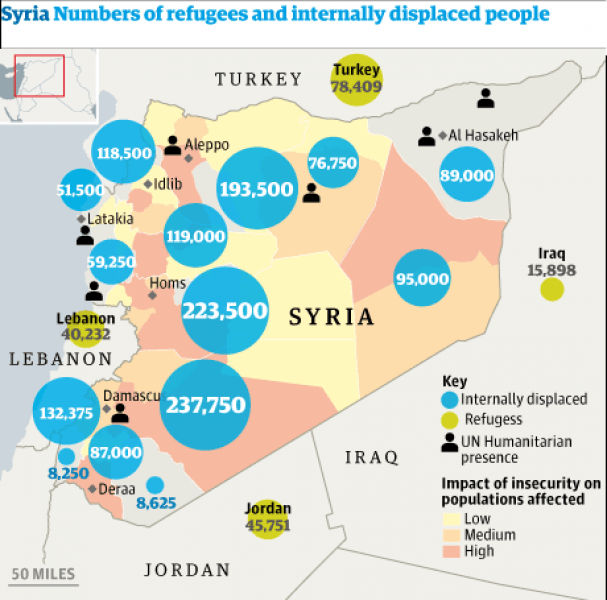
One of the saddest aspects of the tragedy of the Syrian civil war is the status of the Syrians who have sought refuge outside of their country. There are 1.7 million refugees and all but 7,000 have been living in refugee camps in a small number of neighboring countries, none of which has the resources to deal adequately with the needs of the displaced people. There will be a conference in Geneva this week, and an urgent plea is being made for rich countries to take a larger number of refugees. Unfortunately, I suspect that the plea will fall on deaf ears–the rich countries apparently have no shame and no conscience.
The US Senate is close to releasing parts of its 6,000 page report on US torture tactics in the “Global War on Terror.” We actually do not know how much of the report will be released since there are still fierce negotiations going on between the Executive Branch of government (primarily the US CIA) and the Congress over ‘sensitive” parts of the report. The release of the report is long overdue since the American people deserve to know what was done to other human beings in their name. One can only hope that information will shake the American people from their long slumber over the massive violations of human rights.
The Organization for Economic Co-operation and Development (OECD), an organization devoted to the economic interests of the rich countries in the world, has issued a report which argues that economic inequality seriously compromises economic growth. Indeed, the organization found that rising inequality cost the economy almost nine percentage points of GDP growth in Great Britain between 1990 and 2010. The results suggest that addressing income inequality could be an effective way to stimulate economic growth–not a strategy that has received much attention from most governments thus far.
Today marks the 73rd anniversary of the attack by Imperial Japan on US forces stationed at Pearl Harbor in Hawaii. The attack ushered the US into the second World War despite a strong isolationist sentiment in the American population and Congress. The event was attended by the remaining 4 survivors of the attack on the USS Arizona which was completely destroyed in the attack, and remains in the harbor as a memorial to the lost.
USS Arizona on 7 December 1941

Israeli jets bombed two targets in Syria, most likely trying to destroy rocket shipments to Hezbollah operatives in the country. The bombing itself is not unusual–Israel frequently takes actions to prevent arms shipments to extremists in the region. It is, however, interesting that Israel has sent fighter jets over Syrian airspace so soon after Iran sent its fighter jets over Iraq. There are messages being sent by both sides to each other.
The Associated Press has obtained a document from the Obama Administration that lists the concessions made thus far by Iran in the nuclear negotiations. Those concessions include:
1. Iran will further limit its development of new technology for enriching uranium
2. Patch up loopholes on Iran’s research and development of advanced centrifuges
3. For one centrifuge model, Tehran won’t be able to pursue the industrial-scale operation needed for any “breakout” effort toward producing enough material for a nuclear weapon
4. For other centrifuge models, Iran won’t be allowed to feed the centrifuges with uranium gas or begin testing on a cascade level
5. Iran has agreed to turn 35 kg of higher-enriched uranium oxide stocks into fuel, making it unusable for weapons development
6. Iran will grant international inspectors expanded access to its centrifuge production facilities, allowing the U.N. nuclear agency to double the amount of visits it makes to sites and to undertake unannounced or “snap” inspections
7. Iran will refrain from any other forms of enrichment, including through the use of laser technology
This list is impressive, and would undoubtedly prevent the “rapid” development of nuclear weapons. It remains to be seen whether these concessions are sufficient for the US Congress or for the Netanyahu government.
More than 500,000 people in the Philippines have fled for higher ground as Typhoon Hagupit is slamming into the country. The typhoon looks like it will make landfall in roughtly the same area that Typhoon Haiyan hit last year, causing widespread damage and loss of life.

The International Criminal Court has dropped charges against Kenyan President Uhuru Kenyatta for the deaths of at least 1,200 people in political violence associated with the 2007 presidential election. The decision is highly contentious as memories of the violence against the Kikuyu ethnic group in Kenya have festered since the election. The decision was met with both joy and disbelief in Kenya, but there is no further legal route to pursue for those who believe the President is guilty.
The overuse of antibiotics has been a looming problem for the world for many years, and it appears as if the problem may be getting out of control. The rise of bacteria that are resistant to antibiotics is beginning to overwhelm the medical system in India, and strains of bacteria that were once well controlled in other areas of the world are now emerging as drub resistant. Unless new antibiotics are developed, then humanity will become once again to diseases that once ravaged the species.

