Archive for the ‘World Politics’ Category
The US has a commanding share of the world’s “very wealthy people” who are defined as those with net worth of $50 million or more. The concentration of wealth is not only extraordinary domestically, but also internationally. According to the New York Times:
“Propelled by market gains and a skewed economic recovery, the United States’ share of the world’s superrich is rebounding. Since mid-2013, the number of millionaires in the United States has grown by 1.6 million, by far the biggest increase in the world and dwarfing the 90,000 Chinese who crossed the million-dollar mark since then, Credit Suisse estimates.”
The charts in the article are quite revealing of the discrepancy. One of our colleagues, Julia Worcester, forwarded a link to a New York Times article that documents the sale of luxury apartments in New York to wealthy individuals who are represented only by shell corporations. Some of these individuals are criminals who are using the apartments to shelter money. According to the Times:
But The Times also found a growing proportion of wealthy foreigners, at least 16 of whom have been the subject of government inquiries around the world, either personally or as heads of companies. The cases range from housing and environmental violations to financial fraud. Four owners have been arrested, and another four have been the subject of fines or penalties for illegal activities.
The foreign owners have included government officials and close associates of officials from Russia, Colombia, Malaysia, China, Kazakhstan and Mexico.
They have been able to make these multimillion-dollar purchases with few questions asked because of United States laws that foster the movement of largely untraceable money through shell companies.
Vast sums are flowing unchecked around the world as never before — whether motivated by corruption, tax avoidance or investment strategy, and enabled by an ever-more-borderless economy and a proliferation of ways to move and hide assets.
One of the most famous studies of human behavior was conducted by Yale Psychologist, Stanley Milgram, who studied obedience to authority in the 1960s. We have not replicated his studies because of deep ethical concerns, but many continue to probe his conclusions in all sorts of creative ways. Milgram’s conclusions tend to hold up quite well in the face of these sustained critiques.
German Chancellor Angela Merkel spoke at a security conference in Munich on Saturday and her analysis of the military situation in Ukraine was quite straightforward and at odds with the rhetoric of several analysts in the US:
“I cannot imagine any situation in which improved equipment for the Ukrainian army leads to President Putin being so impressed that he believes he will lose militarily,” Merkel said. “I have to put it that bluntly.”
US President Obama has been under increasing pressure from several Republican Senators, including Senators Graham and Corker, to provide lethal military aid to the Ukrainian government. Obama has not signaled yet which way he will go.
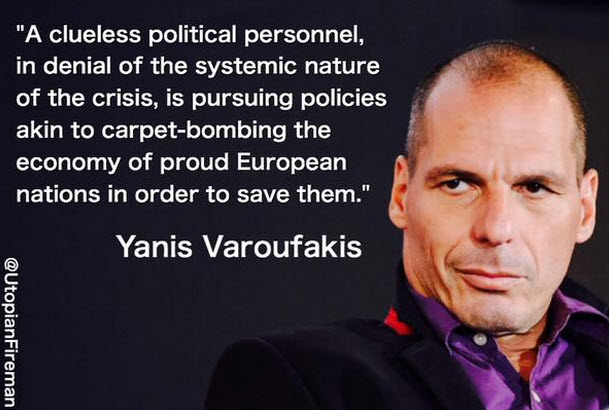
The European Union has decided to play hard-ball with Greece, giving the country until 16 February to accept its terms for additional credit. Without that credit, Greece will likely be forced to default on its debts on 28 February. Greek Finance Minister Varoufakis ended his tour of European capitals seeking additional aid, but he was completely unsuccessful. Push has become shove. The rhetoric surrounding Greek debt is quite intense:

On Thursday, US President Obama gave a speech at the National Prayer Breakfast, an annual event in Washington, DC. In this speech, Obama cautioned against thinking about violence in the world in religious terms. In his remarks, Obama mentioned the atrocities committed by Christians during the Crusades. The comment elicited a storm of criticism from some Christian sources who accused Obama of attacking Christianity. Bloomberg ran an article describing the politics surrounding the word “Crusade.”
The US and Europe are facing a difficult decision: whether to provide lethal weaponry to the Ukrainian government to help it fend off the assaults by the Russian-speaking separatists who are being supported by Russia. The move would escalate the crisis and Russia’s response to the move would likely be quite hostile. Al Jazerra spoke with several foreign policy analysts about the wisdom of such a move. Their responses provide no simple point of view.
The global debt crisis has only gotten worse since the debt crisis of 2008-09. McKinsey Analytics has done a study global debt patterns and has found that most countries have higher levels of debt than was the case previously. In fact, in its study, only two countries, India and Argentina have made progress in reducing their overall debt ratios. Since 2007, global debt has increased by $57 trillion, or about 17% of global GDP.

Some Democrats have indicated that they will not be present when Israeli Prime Minister Netanyahu delivers an address to Congress. These Democrats are angry at what they regard as an attempt by the Prime Minister to manipulate American politics by dividing the Congress from President Obama. Support for Israel has always been a bipartisan policy in American politics, but this breach of protocol has the potential to change that sentiment.
Historically, the use of force among nations has manifested itself in organized military actions. Increasingly, however, organized military action has proven less and less effective, and armed force has begun to take on a variety of different forms. These changes call for sometimes radical adaptations and conceptualizations, a flexibility that is difficult for large militaries. The changes in thinking are nonetheless necessary.
The European Central Bank dropped the hammer on Greece by denying it the ability to use its bonds as collateral to receive money from possible lenders. The move means that Greek banks will no longer be able to raise capital easily because they will no longer be able to use Greek government bonds as collateral to those loans. The banks will still be able to apply for loans from the ECB’s Emergency Liquidity Funds, but at a substantially higher interest rate. Check out the difference in reporting this move from Bloomberg (a business news outlet) to Ekathimerini (a Greek source). It is hard to believe both are reporting on the same event.
Nigerians will vote next week for a new government, but it appears as if the conditions for a legitimate vote are far from optimal. It appears as if it will be virtually impossible to conduct a fair and honest vote, and the major parties are engaged in election ploys that will make it extremely difficult for all voters have equal access to the ballots. The Nigerian political system is already fragile and a broken election will only diminish the authority of the government even more.
The conflict in Ukraine has been in many respects a “stealth” war. The rhetoric about the conflict is heated, but much of the violence remains hidden to outsiders as both the Russian separatists and the Kiev government really do not wish their activities to be closely scrutinized. Alan Taylor has taken some extraordinary photographs of the war which clearly indicate that the conflict is much more savage than many of us believed. I should warn everyone that some of these photographs show the dead and are quite unnerving. So do not go the site if you do not wish to view such photos.
Check out how climate change may alter the way people in the US will live in 2100 in certain cities. Boston will have summer temperatures close to that of Palm Beach in Florida.
http://www.climatecentral.org/wgts/CityFutureTemps/index.html?utm_source=ext&utm_medium=embed&utm_campaign=CityFutureTemps
The Greek government has offered to offer new “growth-linked” bonds to replace the current debt it holds (about 315 billion euros). The purpose of this switch is to allow Greece to pay back the debt on a schedule that more closely links to its actual economic growth (as opposed to a schedule that is not at all linked to its economic growth). This switch means that Greece’s creditors will still get full repayment, but not as quickly as is currently anticipated. Does this switch make sense? It actually does if one assumes that there is no way for Greece to pay back its current debt on schedule. The question is whether Greece’s creditors will still demand what is clearly impossible, both economically and politically. Paul Krugman believes that the offer is perfectly reasonable.
The Islamic State executed a Jordanian fighter pilot who was shot down in an attack against the IS. The IS chose to burn the pilot alive and to broadcast a video of the execution. Needless to say, the response of most of the world has been profoundly hostile, and Jordan has announced that it will execute several jailed militants in retaliation. Jordan has also threatened an “earth-shaking” response. The escalating spiral of violence is incredibly dangerous, and one hopes that cooler heads can determine a more effective response than tit-for-tat executions of jailed individuals.
The suspicions about the integrity of Argentine President, Cristina Fernández de Kirchner, deepened as it was determined that a murdered Argentine prosecutor had written out a warrant for her arrest in connection with a cover-up of the role of Iran in the bombing of a Jewish center in Argentina in 1994. The controversy over the death of the prosecutor, Alberto Nisman, has exposed many irregularities in the administration of Argentinian justice. The news about the warrant will unquestionably destabilize the political situation in Argentina.
A bomb went off in Nigeria near a rally site for President Goodluck Jonathan. There were other bomb blasts nearby, but only the bombers themselves were killed in those blasts. The violence raises fears that the presidential election scheduled for 14 February may be marred by other acts of violence. Nigerians are deeply involved in social media and are masters of the media. Dr. Damages, a New York-based Nigerian satirist, gives an irreverent view of the elections.
The Members of the European Union have long banned capital punishment. The US, however, still maintains the practice. Most Americans are unaware of how Europeans view the American practice as a violation of human rights. Spiegel has run an op-ed piece which outlines the European position powerfully.
Many regard Indian Prime Minister Narendra Modi as a hard-line Hindu nationalist. All of politics, however, is relative. There are some in India who believe that Modi is not hard-line enough. The threat of Hindu extremism in India continues to grow and to threaten the very healthy civic society that generally characterizes the country.
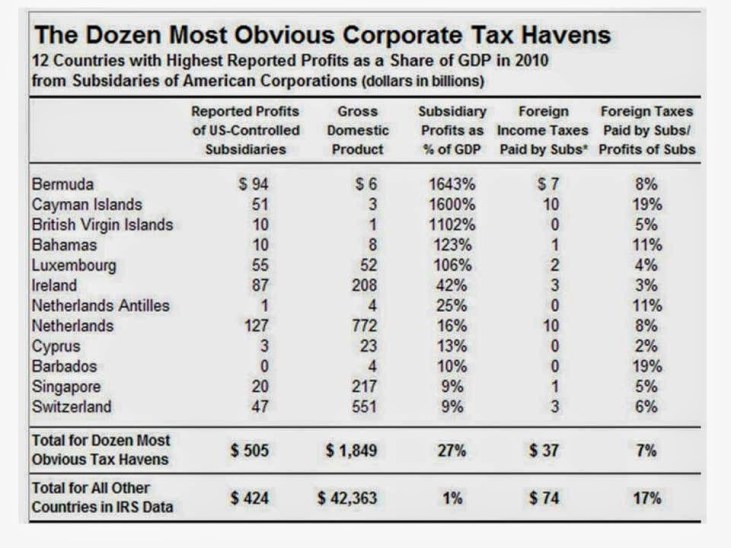
One of the paradoxes of the current world system is that its political structure is dominated by nation-states that have strict territorial limits and its economic structure is almost completely globalized. The paradox means that some entities, such as multinational corporations, operate in both structures. Some corporations avoid the taxes imposed by some nation-states by placing some of their profits in other nation-states with lower tax rates. Many believe that such a system is unfair since most of the profits are made in high-tax states and not in the lower-tax states such as the British Virgin Islands and Bermuda. President Obama is proposing that the US exercise extra-territorial authority to tax corporations even if their money does not reside in the territorial boundaries of the US. As one can see from the chart below, many of these tax havens rely heavily on these tax dodges.
The killing of Japanese citizens by the Islamic State has raised, once again, the issue of whether ransoms should be paid to terrorists to save innocent civilians. The official US position is that such ransoms can never be paid because payment would only encourage further kidnappings. Jordan is currently confronting this issue as the Islamic State holds one of its fighter pilots and has demanded the release of a convicted suicide bomber for his release. The dilemma is a classic example of the realist assertion that interests and values are not interchangeable.
After a short respite, protesters are back in the streets of Hong Kong demanding the right to choose candidates for local elections. The number of protesters was much smaller than those of last year, but their return is evidence of the commitment to a liberal democracy in Hong Kong. The Beijing government insists upon the right of the Communist Party to select candidates, and is reluctant to concede, fearing that other localities within China might demand similar rights.
On 19 January the Communist Party of China Central Committee and State Council issued an “Opinion” on improving the quality of college-level instruction in China. The document is a fascinating outline of a philosophy of higher education that is remarkably different from Western philosophy. In summary, the “Opinion” outlines the following objectives [the following translation from the Chinese is a Google translation]:
First, strengthen and improve college propaganda and ideological work is an important and urgent strategic task; Second, the guiding ideology, basic principles and main tasks; three, effectively promote the theoretical system of socialism with Chinese characteristics into textbooks into the classroom into the mind; four, greatly improve the ideological and political quality of university teachers; five, growing mainstream ideological and public opinion; six, strengthen propaganda and ideological positions university management; seven, strengthen the Party’s leadership college propaganda and ideological work.
Some differences are striking and worthy of close attention. First, the emphasis on the ideological function of higher education is something that would never be uttered in the West: the pretense in the West is that higher education ought to be free from the routinized reasoning implicit in the idea of ideology. Yet there is no doubt that most Western higher education is deeply rooted in liberal ideology. Second, the admission that knowledge is distinctly cultural (“Chinese characteristics”) is at odds with the Western assumption that knowledge is universal and not culturally bound. These differences are truly important and we as scholars should be the first to assess their validity.
The situation in Greece and its upcoming struggle with the European Union should not be viewed as an isolated case. There are many issues facing the EU right now, and it would be a mistake to think that because of its underlying political and economic core the Union will inevitably emerge as the winning side. It may, indeed, force Greece to back down, but the Greek issues highlight similar concerns in many other parts of the European experiment. Indeed, there are many reasons to be concerned about the future of the Union.
One of the more immediate effects of Syriza’s success in Greece has been the increased popularity of a similarly leftist party in Spain called Podemos (“We can”). It held a rally in Spain on Sunday that attracted a huge crowd. Spain holds its national elections in November and some polls have Podemos already in the lead to win. Spain has arrangements with the troika that are similar to those made with Greece.

The new Greek government has announced that it will not negotiate with the “troika” (the European Union, the International Monetary Fund, and the European Central Bank) on an extension of the current loan repayment program. What this means in very concrete terms is that the current owners of Greek debt (which are banks and sovereign governments like France or Germany) will not be repaid on schedule or in the full amount they were expecting. The “troika” was going to lend money to Greece so that these repayments could be made. If this turns out to be what actually happens, then there will be two “victims”. The first victim will be the Greek people who will be unable to borrow any new money so that the Greek economy will become a cash only economy. The second victim will be the owners of Greek debt: the banks and governments who were expecting money. The governments can certainly handle a shortfall–they will simply increase taxes or cut services to manage the loss. The banks, however, may suffer a loss of credibility if their depositors believe that the banks don’t have enough money to both return their (the depositors) full deposits and to cover their losses (from the lost Greek payments) simultaneously. In other words, the banks may collapse. From the view of some analysts, the real issue is whether the banks should receive full payment at the cost of extreme austerity in Greece.

The African Union has selected the leader of Zimbabwe, Robert Mugabe, as its next chairman. Mugabe was a true hero in the African liberation movement and will always be remembered for his role in that important struggle. Nonetheless, he has been the leader of Zimbabwe since 1980 and has hung on to power through ruthlessness and corruption. His selection does not serve the African Union well.
Nigeria has an important presidential election on 14 February, and it seems as if the inability of the current government of Goodluck Jonathan to control the radical group, Boko Haram, is going to be a critical issue in the election. President Jonathan is opposed by Muhammadu Buhari, a Muslim leader from the north of Nigeria where Boko Haram is quite strong. It does not, however, appear as if Buhari has excited much of the Nigerian electorate.

The Russian economy continues to suffer from the Western sanctions and the drop in the price of oil. The critical question is how the economic slowdown will affect President Putin’s political power. Most polls indicate that Russians strongly support President Putin’s strong nationalist stance. But perhaps a critical variable is the extent to which the wealthiest Russians support Putin’s policies which have had such an adverse effect on their incomes.
For four months the Islamic State and the Kurdish peshmerga have fought over the Syrian town of Kobani. The Kurds have finally secured the town, but the photographs of the destruction are truly appalling. The Kurds were successful in preserving their freedom, but the costs of that victory were extraordinarily high.


