US CIA Director Brennan has conceded that the Iraqi government acts as an “interlocuter” between US and Iranian forces in the fight against the Islamic State. This statement marks the first time that the US has admitted that it is coordinating military action in Iraq. Needless to say, the cooperation is merely expedient: the interests of both sides coincide with the defeat of the Islamic State. After that objective is secured, their interests will once again diverge. Nonetheless, temporary alliances can have the effect of building trust over the long run.
Twenty opposition parties in Bangladesh have been coordinating a nationwide blockade of economic activities since 6 January. The blockade was called to protest the arrest of a prominent government critic, Khaleda Zia. Over a hundred people have been killed in violence associated with the blockade and the economic effects on the country have been quite serious and extensive. The Awami League, the party in power, has so far refused to negotiate with the opposition parties.
The US dollar has been appreciating in value since early 2014, but it recent weeks the appreciation has been quite dramatic. The dollar is now at its highest level vis-a-vis the euro since 2003. This news is wonderful if one is thinking about traveling abroad. But if one is an exporter of US goods, then the news is rather grim, and analysts have been slashing their estimates of US economic growth for 2015 as a result. The surging dollar will unquestionably have dramatic effects on all people who hold debts calculated in dollar terms.
Rumors are a staple of world politics, and it is important for analysts to keep a critical eye on all news stories. The current rumor is about Russian President Putin who has not been seen in public since 5 March. He has missed some important meetings and old photos are being used in the Russian press accompanying current events. Putin generally speaking keeps a very high visible image in Russia so his absence is peculiar. Whether it means anything of importance is impossible to tell.
The Syrian civil war is entering its fifth year and it only continues to get worse. There has been no progress whatsoever in achieving a cease-fire or even in providing humanitarian assistance to innocent civilians. Life expectancy in Syria has dropped by 20 years, from 75 to 55 last year. And the international community is completely paralyzed, incapable of even keeping the conflict in the public’s mind.
CO2 continues to concentrate in the atmosphere at levels the planet has not seen for a long time. According to Scientific American:
“Such CO2 concentrations in the atmosphere have likely not been seen since at least the end of the Oligocene 23 million years ago, an 11-million-year-long epoch of gradual climate cooling that most likely saw CO2 concentrations drop from more than 1,000 ppm. Those of us alive today breathe air never tasted by any of our ancestors in the entire Homo genus.”
It is unlikely that the accumulation of carbon dioxide will stop anytime soon. Despite efforts on the part of many countries, the rate of increase continues to grow. We are no longer talking about stopping the increase in order to avert climate change; we now need to figure out a way to reverse the level of accumulation.
Some analysts have coined the phrase “perpetual war” to describe the state of the world since the attacks against the US on 11 September 2001 (see Bacevich, Anderson, and Hoh). It appears as if the terror attacks in France, including the slaughter at Charlie Hebdo, have persuaded the French government to station 7,000 soldiers on the streets of France to supplement the more traditional police and security forces. It is difficult to imagine the effects of daily exposure to armed forces as a normal part of daily life will do to the French conception of normalcy.
Debates in the European Parliament are not widely viewed, but there was an interesting exchange on the floor of the Parliament concerning Juncker’s proposal for a European Army. The exchange was prompted by a speech by Nigel Farage, the leader of the U.K. Independence Party, a party dedicated to removing Great Britain from the European Union. I regard Farage as a fringe politician but the points he makes in the speech are worthy of consideration (as well as his well-deserved reputation for an acid tongue).
The Greek government is being whipsawed between party members who no longer wish to cooperate with the troika on the austerity program and those members who want to maintain some financial relationship with the troika. The division threatens Syriza’s control over Parliament, and Prime Minister Tsipras is desperate to avoid a vote in Parliament for fear that the more left-leaning members of the Party will vote against his delicate arrangement with the troika that bought Greece four more months before the bailout money runs out.
Venezuelan President Maduro condemned the US decision to brand his country as a national security threat. Maduro called the action an attempt by the US to overthrow his government, branding the action as US imperialism. At the same time, Maduro asked for new powers to control the unrest in the country as the economy continues to deteriorate.
Police broke up student demonstrations in Myanmar. The students were protesting new education laws that they felt would cripple the university system which was once regarded as one of the best in the world. But years of military rule, only recently ended, degraded the system, and the new laws seem designed to curb free expression within the academy. Myanmar has had a very bad human rights record which has slowly gotten better as civilians were brought into power. The brutal suppression of the student protest seems like a step backward for the country.
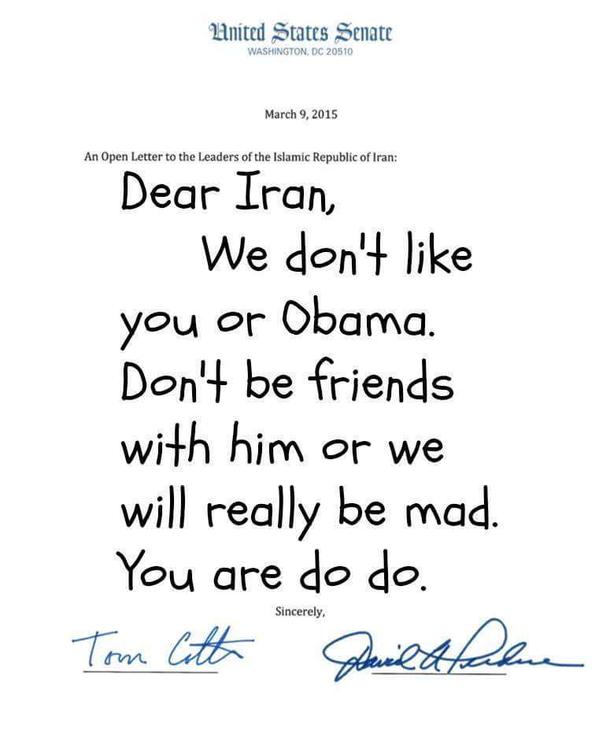
47 Republican US Senators sent a letter to Iran, warning it that it should not trust any Executive Agreement signed by President Obama since it could be reversed at any time by a subsequent US President. The letter was deliberately designed to scuttle the negotiations currently being conducted by the P5+1. Iran’s Foreign Minister responded to the letter by asserting that the US Senators were “ignorant of international law.” He went on to say:
“The letter by the senators show that not only they are alien to international law but even not familiar with the details of the their own constitution about the authority of the president”
Under most circumstances, one would be inclined to characterize a deliberate attempt to sabotage negotiations conducted in good faith by a nation’s chief executive as treason. Congress certainly has authority in foreign affairs, but undermining negotiations is not among the enumerated powers of Congress. President Obama was bemused by the apparent alliance of the Republican Senators with the most radical members of the Iranian governing council: “I think it’s somewhat ironic to see some members of Congress wanting to make common cause with the hardliners in Iran. It’s an unusual coalition.”
I have posted on the issue of censorship in both India and China in recent days. I am sad to report that the US state of Florida is also engaged in censorship. Apparently, Florida Governor Rick Scott (R) has banned the words “global warming” and “climate change” from the mouths and pens of state officials. Governor Scott believes that global warming won’t happen if we don’t talk about it. But the University of Arizona has drawn up a map of the effects of a two meter rise in ocean levels on the state.
US President Obama identified Venezuela as a national security threat to the US. The declaration is a necessary step toward the imposition of sanctions on any country by the United States. Venezuela has been wracked recently by corruption, governmental incompetence, and declining oil prices. There are serious shortages of many household items as government revenues have run dry, and the inflation rate in the country is nearing 60% a year. The US is exerting pressure on the government of President Nicolas Maduro in order to force changes in the political intimidation used by Maduro to silence his critics.
In an audio clip posted online, the Nigerian extremist group Boko Haram has pledged allegiance to the Islamic State caliphate. In so doing, the group joins other extremist groups in Libya, the Philippines, and other countries. The attraction of a restored caliphate seems to be powerful to some Muslims in the world, although the actual number is hard to quantify. The movement clearly qualifies as a supranational movement as the caliphate is a genuine alternative to the nation-state.
There are a number of popular resistance movements throughout the world right now, but very few of them attract much attention. The absence of a sustained and global resistance to much of the inequality in the world is somewhat puzzling. But there are some small signs that groups are becoming organized on the local level and addressing primarily local issues. These issues, however, are not purely local–they are, in many respects, the product of globalization. Whether these groups will begin to organize across national borders remains to be seen.
European Commission President Jean-Claude Juncker has issued a call for a common European army. Such proposals have been made in the past, but the crisis in Ukraine appears to have stimulated quite serious talk of a single European army. Germany has responded favorably to the proposal, but the British and the French have traditionally opposed any move which might erode their own national military power.
Another video has been banned by another government. This time the video is a documentary about air pollution in China which has banned its viewing on You Tube. The video, “Under the Dome,” was produced bu Chai Jing, a former news anchor. The problem of air pollution in some parts of China is hardly a secret and the Chinese government has taken strong steps to try to mitigate the problem. Nonetheless, the documentary is apparently considered to be a threat to the political and social stability of Chinese society. It is a long video (about 1 hour and 43 minutes) and it has English subtitles for those of us who cannot speak Chinese.
Today marked the 50th anniversary of the Civil Rights march in Selma, Alabama. The people who walked across the bridge over the Alabama River were protesting against an injunction against their efforts to promote voter registration in the state. The protesters were met with profound police force, and the brutality against the protesters showed America and the world the ugly violence of racial discrimination. The event ushered in the Civil Rights Act of 1965 and is in my mind one of the most important moments in American (and world) history. President Obama delivered a brilliant speech marking the event (I will not ask any questions about the content of the speech).
Last year Saudi Arabia sentenced Raif Badawi to 1,000 lashes and 10 years in jail for “insulting Islam”. Badawi is a blogger and he received the first 50 lashes of his sentence last January. There was a storm of criticism leveled against the Kingdom for its conduct–criticism which it rejected as an intrusion into its internal affairs.
Social media has transformed politics in ways that are hard to analyze. We all suspect that the changes are dramatic but the changes are difficult to measure because of the decentralized nature of the medium. The Islamic State, however, seems to be quite savvy in using social media, and it has broadcast its message to what think may be a large audience. Some researchers have gone through Twitter accounts and have determined that the Islamic State used perhaps 46,000 Twitter accounts over a period of time.
Even though most of us are oblivious to much of what goes on in financial markets, it would be hard not to notice that many government bonds in Europe are being sold in Europe at negative interest rates–almost $1.9 trillion worth of bonds. Essentially, people are paying governments for sovereign debt, exactly the opposite of what usually happens when governments pay interest to people who purchase bonds. The negative interest rates are the result of a very deliberate strategy of central banks. They are flooding financial markets with bonds to force people to seek positive interest rates by purchasing corporate equities (stocks). The logic is that by forcing people to buy stocks in order to make (and not lose) money, they will be stimulating the corporations to make productive investments. Of course, the strategy also rewards people who have the money to spare to buy stocks–not a very large proportion of the population.
Petrobas, the Brazilian national oil company, is one of the largest oil companies in the world. It is also deeply involved in political corruption that is shaking the Brazilian political system. Many top governmental officials are accused of taking bribes in order to facilitate to company’s operations. The scandal is not only destabilizing Brazilian politics, it is also slowing down the economy by creating tremendous uncertainty among foreign investors. It is hard to see how President Rousseff can avoid being weakened by the crisis.
One cannot view the Israeli-US disagreement over the Iranian nuclear program in isolation. The US is increasingly dependent upon Iranian forces to carry on the fight against the Islamic State in Iraq. The two states do not talk directly to each other, but there is close coordination between the American air forces and the Iranian ground forces. As this alliance deepens, it can only add to the apprehensions of Israel and Saudi Arabia about an Iranian rapprochement.
We have had several discussions in class about freedom of speech and the circumstances in which speech can or should be curtailed. A documentary on the vicious rape and murder of a young Indian woman has been banned in India, and India has asked You Tube to remove the documentary. The video shows one of the convicted rapists claiming innocence of a crime because the victim fought back. The controversy over showing the video revolves around the extent to which speech can gratuitously defame a larger community. The documentary is below.
It seems increasingly likely that Japan’s Prime Minister, Shinzo Abe, will seek to change in some way, Article 9 of the Japanese constitution which prohibits an offensive military capability for the country. That clause was adopted in the wake of strong fears throughout Asia that a rebuilt Japan would also carry on a militarist tradition. Since the end of the war, Japan has notably carried out a strong pacifist policy which has begun to weaken as China has gotten stronger. If Japan is to rearm, it needs to do so in a way that persuades its neighbors that aggressive behavior will no be an adjunct to the change in military policy.