The Trump Administration is currently engaged in diplomatic talks with Iran, ostensibly over Iran’s nuclear program. If the issue is simply halting the Uranium enrichment program in Iran, there are some reasons to be optimistic. Iran seems willing to return to the agreement forged by the US, Germany, Russia, China, France and Great Britain during the Obama Administration. That agreement limited the level of enrichment to those levels necessary to build a nuclear bomb in return for the lifting of economic sanctions on Iran. But the US and Israel are demanding other limitations, including restrictions on Iran’s missile program (which was never part of the original deal).
In order to buttress his demands, Trump has ordered a significant expansion of the US military presence near Iran, including the dispatch of another aircraft carrier to the region. Axios describes the scale of the buildup:
“Trump’s armada has grown to include two aircraft carriers, a dozen warships, hundreds of fighter jets and multiple air defense systems. Some of that firepower is still on its way.
More than 150 U.S. military cargo flights have moved weapons systems and ammunition to the Middle East.
In the past 24 hours, another 50 fighter jets — F-35s, F-22s and F-16s — headed to the region.
“Between the lines: Trump’s military and rhetorical buildups make it hard for him to back down without major concessions from Iran on its nuclear program.
It’s not in Trump’s nature, and his advisers don’t view the deployment of all that hardware as a bluff.
:With Trump, anything can happen. But all signs point to him pulling the trigger if talks fail.”
It is doubtful that Iran will agree to those additional demands. Robert Reich believes that Trump wants “regime change” in Iran which essentially means the removal of the Supreme leader, Ayatollah Ali Khamenei:
“The United States is being represented in the talks by “Special Envoy” Steve Witkoff (whose son is the chief executive of World Liberty Financial, the Trump family’s cryptocurrency company, nearly half of which was purchased last year for $500 million by an investment firm tied to the United Arab Emirates). And by Trump son-in-law Jared Kushner (who’s been making private deals with the Saudis and who raised several billion dollars before Trump’s second term from overseas investors including sovereign wealth funds of Saudi Arabia, Qatar, and the United Arab Emirates).
“No one from the State Department. Nobody from the National Security Council. No one who knows much of anything about Iran.
“So what’s the real goal?
“On Friday, in a little-noticed remark, Trump said “the best thing that could happen” in Iran would be regime change, noting “there are people” who could take over from Iran’s Islamic ruler Ayatollah Ali Khamenei.”
That objective is significantly more complicated than the removal of Venezuelan leader, Maduro. I have given up on trying to predict what Trump will actually do (largely because I believe that often he has no real plan for the consequences of his actions). But it seems to be clear that Israel is pushing hard for a more sustained attack: According to the New York Times:
“In Israel, the two defense officials said that significant preparations were underway for the possibility of a joint strike with the United States, even though no decision has been made about whether to carry out such an attack. They said the planning envisions delivering a severe blow over a number of days with the goal of forcing Iran into concessions at the negotiating table that it has so far been unwilling to make.
“The U.S. buildup suggests an array of possible Iranian targets, including short and medium range missiles, missile storage depots, nuclear sites and other military targets, such as headquarters of Iran’s Islamic Revolutionary Guard Corps.”
There are currently negotiations between the US and Iran in Geneva on the nuclear issue. But it does not appear that any progress has been made on the ballistic missile issue. Moreover, the Trump Administration may think that the recent protests in Iran make the possibility of a regime collapse more likely, and that a sustained attack on Iran would usher in regime change. There does not seem to be much discussion on the implications of an overthrow of the regime. Iran is different from the intervention in Venezuela which does not seem to have changed the character of the Venezuelan government much. There are many more fragmenting concerns in Iran: ethnic issues, distributional issues, and the threat of a sustained drought.
“Prime Minister Donald Tusk called on Thursday for all Polish citizens to leave Iran, after US President Donald Trump again hinted at military action against the Islamic Republic.
“’Everyone who is still in Iran must leave immediately, and under no circumstances should anyone plan to travel to that country,’ he said at a press conference.
He added that ‘the possibility of heated conflict is very real, and in a few, a dozen or several dozen hours, evacuation may no longer be an option.'”
If the attack occurs, it will mark the seventh time Trump has bombed a foreign power since January. I have not checked, but it seems to me that this is probably a record number of bombed states for any President in the first year of a presidential term.
In what is likely the most consequential decision of his administration, Trump has allowed the Environmental Protection Agency (EPA) to repeal its “endangerment” policy. That policy codified a 2009 scientific conclusion that greenhouse gas emissions pose a danger to Americans’ health and welfare, allowing the EPA to regulate those gases. The repeal of the policy means that these gases can no longer be regulated by the Agency. The endangerment finding is pretty straightforward:
“The endangerment finding is a 2009 EPA ruling that determined greenhouse gases were a threat to public health. The finding originated from a 2007 Supreme Court case, Massachusetts v. EPA, in which the Court ruled that greenhouse gases qualify as pollutants under the Clean Air Act. Following the ruling, the Court ordered the EPA to determine whether greenhouse gasses endanger public health and welfare. The EPA concluded in the 2009 endangerment finding that six greenhouse gases—including carbon dioxide, methane, and hydrofluorocarbons—posed a threat to the public. The agency was then able to use those findings to regulate emissions from cars, trucks, and power plants.”
The repeal of the finding will have a direct effect on the health of American citizens but also on people all over the world. According to the New York Times:
“By repealing the endangerment finding, the United States is likely to add up to 18 billion metric tons of emissions to the atmosphere by 2055, according to the Environmental Defense Fund, an advocacy group. That is about three times the amount of climate pollution the country emitted last year.
“The added pollution could lead to as many as 58,000 premature deaths and an increase of 37 million asthma attacks between now and 2055, the group said.”
President Trump has called climate change a hoax, and he has stopped projects designed to promote alternative sources of energy and has ordered the Pentagon to increase its reliance upon coal-fired power plants. Coal is unquestionably the most damaging fuel for the environment. ABC News documents the significance of coal in climate change: “According to the EPA, ‘coal combusting is more carbon-intensive than burning natural gas or petroleum for electric power production.’ The EPA reported that in 2022, coal was responsible for 55% of CO2 emissions but only represented 20% of the electricity generated in the U.S.” Scientific American outlines Trump’s wrecking of the institutional mechanisms for restraining greenhouse gases:
“Trump has long referred to climate change as a ‘hoax’ despite decades of rigorous research and evidence in support of global warming. He began his second presidency by once again removing the U.S. from the Paris climate agreement to limit warming to below 1.5 degrees Celsius. Trump also in 2025 withdrew the U.S. from the U.N. Framework Convention on Climate Change, the treaty under which the Paris agreement was negotiated.
“The current Trump administration has also sought to hobble the buildout of renewable energy in the U.S., particularly offshore wind turbines, which the president has falsely linked to the deaths of whales. The administration has also sought to bolster fossil fuels, opening more federal lands to drilling and ordering coal plants marked for retirement to stay open.”
Despite the overwhelming scientific evidence supporting the dangers of climate change, Trump relied upon a hand-picked panel of 5 researchers to support his contention that climate change is a hoax. That panel released a report entitled “A Critical Review of Impacts of Greenhouse Gas Emissions on the U.S. Climate”. That report has been resounding rejected by most climate scientists, as reported by the Sierra Club:
“The larger climate science community has resoundingly criticized the DOE’s report, which was not peer reviewed. Some scientists say their work was misrepresented by the report authors. A recent Carbon Brief analysis revealed that the report contains over 100 false or misleading statements.
“’This assessment appears to be manufacturing uncertainty and stoking controversy where there is none,’ Carlos Martinez, a senior scientist at the Union of Concerned Scientists, told Sierra….
“Martinez also noted the stark contrast between the DOE report and the congressionally mandated National Climate Assessment reports, the latter of which are peer reviewed and offer multiple opportunities for public comment, involve hundreds of scientists and take several years to produce. ‘In terms of the credibility here, the contrast is clear as day,’ he said.”
The repeal of the endangerment finding will be contested in court, so this is hardly the end of the story. The urgency of the danger posed by climate change is only increasing. The Washington Post ran an article on the possibility that climate change may in fact be accelerating. The article is worth reading since it has a number of graphs that I cannot reproduce on this medium. The article holds that:
“For about 40 years — from 1970 to 2010 — global warming proceeded at a fairly steady rate. As humans continued to pump massive amounts of greenhouse gases into the atmosphere, the world warmed at about 0.19 degrees Celsius per decade, or around 0.34 degrees Fahrenheit.
“Then, that rate began to shift. The warming rate ticked up a notch. Temperatures over the past decade have increased by close to 0.27 degrees C per decade — about a 42 percent increase.
“Those data — combined with the last few years of record heat — have convinced many researchers that the world is seeing a decisive shift in how temperatures are rising. The last 11 years have been the warmest years on record; according to an analysis by Berkeley Earth, if we assume a constant rate of warming since the 1970s, the last three years have a less than 1-in-100 chance of occurring solely due to natural variability.
“’There is greater acceptance now that there is a detectable acceleration of warming,’ said Zeke Hausfather, a climate scientist and the research lead at the payments company Stripe.”
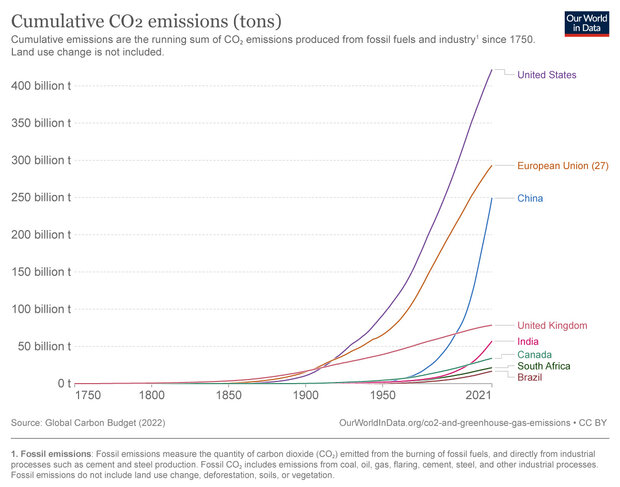
Trump’s decision is fateful for the vast majority of the global population, who have no voice in this decision. The US is by far the country most responsible for greenhouse gases since the beginning of the Industrial Revolution, but it only accounts for about 4% of the global population. The following chart gives an idea of how unfair the US position on climate change is to the rest of the world.
The Munich Security Conference is an annual event held in Germany every year. It is an assemblage of experts in security matters, and generally it focuses on military matters. It issues a security report after each meeting and this year’s report is quite stunning in its bluntness. This is an excerpt from its Executive Summary:
“The world has entered a period of wrecking-ball politics. Sweeping destruction – rather than careful reforms and policy corrections – is the order of the day. The most prominent of those who promise to free their country from the existing order’s constraints and rebuild a stronger, more prosperous nation is the current US administration. As a result, more than 80 years after construction began, the US-led post-1945 international order is now under destruction.
“In many Western societies, political forces favoring destruction over reform are gaining momentum. Driven by resentment and regret over the liberal trajectory their societies have embarked on, they seek to tear down structures that they believe will prevent the emergence of stronger, more prosperous nations. Their disruptive agendas build on widespread disenchantment with the performance of democratic institutions and a pervasive loss of trust in meaningful reforms and political course corrections. In all G7 countries surveyed for the Munich Security Index 2026, only a tiny proportion of respondents say that their current government’s policies will make future generations better off. And both domestically and internationally, political structures are now perceived as overly bureaucratized and judicialized, impossible to reform and adapt to better serve the people’s needs. The result is a new climate in which those who employ bulldozers, wrecking balls, and chainsaws are often cautiously admired if not openly celebrated.
“The most powerful of those who take the axe to existing rules and institutions is US President Donald Trump.”
The report is, no doubt, a response to the National Security Strategy white paper issued by the Trump Administration in November 2025. But the perspective of the US paper is radically different:
“Over the past nine months, we have brought our nation–and the world–back from the brink of catastrophe and disaster. After four years of weakness, my administration has moved with urgency and historic speed to restore American strength at home and abroad, and bring peace and security to our world.
“No administration in history has achieved so dramatic a turnaround in so short a time.”
This juxtaposition of perspectives defies an easy explanation–both cannot be true at the same time. One is clearly wrong. There is no doubt in my mind that the Munich group is much closer to the mark. That raises a serious question: Who is writing this delusional nonsense for Trump? And why are Americans and the world not doing more to stop this ignorant fool?
A former student, Jenna Ruddock, is the advocacy director of Free Press Action and she has been monitoring the press situation in Minnesota. The arrests of independent journalists are not unprecedented in US history, but in every case, such arrests have threatened the freedom of the press which is indispensable to democracy. Jenna was just quoted in The Guardian and her words deserve close attention:
“’While journalists and civilians continue to heroically document conditions on the ground in the face of escalating violence from federal agents, the Trump administration is using every weapon at its disposal to shut down efforts to document, report and dissent,’ she said.
“These latest arrests are just the latest in a long line of first amendment violations by the administration. Too often, corporate media have readily capitulated to the administration’s demands. Independent journalists, on the other hand, are continuing to lead by example with their critical reporting under increasingly unsafe conditions – indeed, with targets on their backs.”
One should not underestimate the importance of independent journalists. Some prominent mainstream media outlets, such as the Washington Post, have compromised their independence by seeking favor with the Trump Administration. Jeff Bezos is more than likely expecting solicitude by the Trump Administration by producing flattery projects such as the documentary, “Melania”. These journalists lack the law departments that most large media firms employ and are therefore highly vulnerable. People like Jenna are to be applauded for their willingness to protect and defend our freedoms.
Watching the debate over Trump’s wish to take over Greenland (how many of us ever thought that there would ever be such a debate?) was profoundly dispiriting. And Trump’s intemperate remarks decisively rejected the world order that has been remarkably stable for the last 80 years. His replacement for that order, the so-called Board of Peace, is designed to solidify the power of wealthy states in world affairs (why else would there be a membership fee of $1 billion?). I am certain that the Board of Peace will be an abject failure (like Trump University, Trump Steaks, and Trump Airlines), but that still leaves us searching for a substitute for the old world order.
One very refreshing aspect of the meeting at Davos was the speech by Mark Carney, the Prime Minister of Canada. I recommend that everyone should listen carefully to someone who truly appreciates how vulnerable we all are to those who wish to depart from a world order based upon principles of international law.
“He also added that he is “a fan” of Denmark but questioned the country’s claim to Greenland.
“I’m big fan, but you know the fact that they had a boat land there 500 years ago doesn’t mean that they own the land,” Trump said. “I’m sure we had lots of boats go there also.”
I am not sure how anyone could be as ignorant as Trump, but I am certain that Native Americans would be happy to school him on this subject.
Unfortunately, he went on to articulate his plans for Greenland:
“President Donald Trump said Friday that the U.S. will do ‘something’ on Greenland, ‘whether they like it or not.’
“He made the comments during a meeting with oil executives at the White House.
“The president said that he would like to make a deal ‘the easy way’ to acquire Greenland, because if the U.S. doesn’t own it, he claimed Russia or China will take over it, and the U.S. does not want them as neighbors.
“‘If we don’t do it the easy way, we’re going to do it the hard way,’ Trump said, without explaining what the ‘hard way’ entailed.”
I sincerely doubt that the Greenlanders, the Danish, and most of Europe wish to see China or Russia in control of Greenland, and they would all be happy to join the US in resisting invasions by either state. But Trump apparently wants to “own” everything. As I have indicated before, “America First” is “America Alone”.
As I have argued before, Trump is reviving the balance of power (or, at least, being explicit about his intentions) which also suggests that he is a practitioner of Realpolitik. There was little question in my mind that his adviser, Stephen Miller, is a hardline realist (sovereignty seems to be his favorite word which is the holy mantra of all realists). The New York Times has published a good overview of the lineage of realism, and all its varied meanings. The rubric, realist, gives too much credit to Trump since I doubt he is aware of any of the possible implications or significance of what it means to be a realist: a realist wants to enhance the power of the state while Trump seems to be interested in enhancing personal benefit. The Times article points out the crucial difference:
“For Walt and other realist thinkers, Trump’s aggressive and chaotic actions on the world stage — his antagonism of U.S. allies, threats of territorial conquest and assertions that the U.S. is not afraid of putting ‘boots on the ground’ — undermine any claim he could make to practicing a realist foreign policy. Realists largely opposed the U.S. wars in Vietnam, Iraq and Afghanistan, preferring policies of restraint. The failures of those episodes vindicated the realist worldview.”
I was reminded of this difference by a conversation with a colleague about the Venezuelan attack who reminded me of earlier episodes of US balance of power moves. One earlier intervention in hemispheric affairs was the US intervention of Haiti which lasted from 1915 to 1934. It was a brutal occupation:
“In 1910 an American investor acquired Haiti’s National Railroad with rights to establish banana plantations on either side of the track between Port-au-Prince and Cap Haitien. This land had sustained rural farmers and their families for generations. The Haitian Constitution did not even permit foreigners to own land – a safeguard against restoring slavery. The abrupt eviction of peasants from their land to make way for banana plantations prompted fierce resistance. Four years of insurrection followed, involving peasant armies – the Cacos – along with urban elites and members of Parliament who were opposed to foreign domination.
“This period of government instability became the pretext for the US occupation. By August 1915, there were 3000 US Marines in Haiti. They seized the customs houses, imposed martial law, instituted press censorship, and outlawed dissent. The US installed a compliant president, imposed a “treaty” that was ratified only by the US Senate, disbanded the legislature, and rewrote the Constitution eliminating the ban against foreign land ownership.
“Haiti’s indigenous religion, Vodou – so central to the war for independence – was banned. US Marines – all white, many Southern, replaced local heads of every town and rural district throughout the country. By 1922, the US completely controlled Haitian finances – including the treasury, collected taxes and forced Haiti to repay American loans.”
Butler was a highly decorated Marine: “Butler had received 16 medals, five for heroism. He is one of 19 men to receive the Medal of Honor twice, one of three to be awarded both the Marine Corps Brevet Medal and the Medal of Honor, and the only Marine to be awarded the Brevet Medal and two Medals of Honor, all for separate actions.” Butler wrote a pamphlet entitled “War is a Racket” in which he argued that there was no national interest involved in the occupation of Haiti, but that it served corporate interests (Parenthetically, it is interesting to note that this pamphlet does not rest with the other writings by Butler: “at the Library of the Marine Corps at Quantico, Butler’s anti-war writings are isolated from his memoirs and other texts about him—in a separate bookshelf for radical thought that includes the works of Marx.”)
When he retired from the Marine Corps, Butler assessed his role in the military:
“I spent 33 years and 4 months in active service as a member of our country’s most agile military force—the Marine Corps.… And during that period I spent most of my time being a high-class muscle man for Big Business, for Wall Street and for the bankers. In short, I was a racketeer for capitalism.”
It is always dangerous to compare events in different historical periods, but the US attack on Venezuela resonates with Butler’s final analysis. The Trump Administration offered a number of explanations for its acts of war against Venezuela. First it was to interdict Fentanyl (very little of which comes from Venezuela). The intervention was also justified as a means of countering Chinese influence in Venezuela. The US has also claimed that its attack on Venezuela was not an intervention but rather a “law enforcement operation” since the US had indicted Venezuelan President Maduro on drug trafficking charges. This last explanation ignores the fact that attacking the capital city of a state and kidnapping its President are both acts of war, even if the US claims it does not intend war (just think what the US response would be if a country attacked Washington, DC and kidnapped President Trump).
The real explanation is somewhat tortured, but it revolves around oil. The claim is that Venezuela has the largest reserves of oil in the world. Technically, this assertion may be true, but it is highly misleading. Venezuelan oil reserves are considered “heavy” which means that it has a high sulfur content and high viscosity. These characteristics make the refining of the oil a very expensive process, one that would not be profitable with today’s oil prices of around $59 a barrel. According to World Energy News:
“…estimates that breakeven costs for the Orinoco belt’s key grades are already above $80 per barrel. This puts Venezuelan oil on the high end of the “global cost scale” for new production. The average cost to break even for heavy oil produced in Canada is around $55 per barrel. Exxon has set a breakeven price of $30 per barrel for its global oil production in 2030, largely due to low-cost fields located in Guyana and U.S. Permian Shale Basin. Chevron also has a similar goal, and Conoco is working on a plan that will generate cash flow for the company even if oil drops to $35 per barrel.”
Nonetheless, Trump invited oil company executives to a meeting at the White House to persuade them to make the necessary investments to produce Venezuelan oil. The executives seemed unenthusiastic and an Exxon executive all Venezuela “uninvestable” (which I do not believe is a real word). I also find it hard to believe that Trump would prefer oil to be priced at $80 a barrel.
As far as I can tell, the real reason for attacking Venezuela was to gain control of its oil reserves but no oil company really wants to drill in Venezuela. Ordinarily, I would be flummoxed by this contradiction, but rationality does not seem to be an important consideration for Trump’s foreign policy. Smedley Butler would probably not be surprised at all.
The New York Times conducted an extensive interview with President Trump which is definitely worth reading with a very critical eye. Much of the interview was simple gibberish, but the Times highlighted an astonishing excerpt:
“President Trump declared on Wednesday evening that his power as commander in chief is constrained only by his ‘own morality,’ brushing aside international law and other checks on his ability to use military might to strike, invade or coerce nations around the world.
“Asked in a wide-ranging interview with The New York Times if there were any limits on his global powers, Mr. Trump said: ‘Yeah, there is one thing. My own morality. My own mind. It’s the only thing that can stop me.’
“’I don’t need international law,’ he added. ‘I’m not looking to hurt people.’
When pressed further about whether his administration needed to abide by international law, Mr. Trump said, ‘I do.’ But he made clear he would be the arbiter when such constraints applied to the United States.
“’It depends what your definition of international law is,’ he said.
“Mr. Trump’s assessment of his own freedom to use any instrument of military, economic or political power to cement American supremacy was the most blunt acknowledgment yet of his worldview. At its core is the concept that national strength, rather than laws, treaties and conventions, should be the deciding factor as powers collide.”
The quotes reveal a mentality toward governance that harks back to Louis XIV: “L’État, c’est moi“. It is a perspective that generated abject misery among the poorer classes during Louis’s reign and ultimately led to the French Revolution. It is a perspective that has no place in a democratic republic. And it epitomizes an arrogance that is truly sinister and frightening.
 World Politics News