The US Congress is apparently rethinking its earlier vote opposing fast-track authority for the Trans-Pacific Partnership (TPP), the trade agreement currently being hammered out by 11 Pacific countries. We actually know very few of the details of the pact as it has been decided thus far since all the discussion have been secret. One of the most troubling details that we do know about concerns protections for investors. These clauses are known as investor state dispute settlement (ISDS) provisions which allow investors to sue governments if policy changes or even court rulings substantially affect the value of their investment. An example of how these tribunals can be used can be found in Argentina and Uruguay where both states passed legislation to reduce smoking and the tobacco companies went to the ISDS and claimed that they should be compensated for the profits lost from these measures. The cases are still pending.
The Global Database of Events, Language, and Tone (GDELT) is an ambitious attempt to map news events all across the globe in real time. The project monitors new events in more than 65 languages and takes in 600,000 to a million news stories every day. It then maps the stories geographically and shows “heat maps” of what is going on in the world. It now has a data base that goes back 30 years and is constantly being refined. I recommend going to the site and looking at the maps–verbal descriptions do not convey the process well.
US Secretary of State John Kerry is going to Beijing to try and head off a military confrontation in the South China Sea. The fact that the Secretary of State himself is going is an index of the seriousness of the matter. As China continues to build up isolated reefs in contested waters, the US is sending naval vessels to ensure freedom of navigation in the sea. The hard-line Chinese newspaper, Global Times, made this statement about US actions:
“But if it ventures to violate the bottom line, the US will make the South China Sea a powder keg. Washington will be too naive to think that China will exercise forbearance and self-restraint in that scenario. It should keep in mind that China is a major power with nuclear weapons, and there is no way that US forces can take reckless actions in the South China Sea. Considering China’s proximity to this area and determination to defend its sovereignty, the US, although equipped with the strongest military forces, will stand no chance of overwhelming China. Besides, the long-term chaos will eventually deprive the US of its patronage to other countries in the region, which will only be victimized by the war.”
China has warned the US to respect its territorial waters in the South China Sea. The statement is in response to an American intention to test the freedom of navigation in the disputed waters. China is not the only country building up reefs in the area–Vietnam, Malaysia, and the Philippines are doing the same thing. The possible confrontation over the issue is worrisome: there is precious little room for compromise on territorial matters.
Iran fired warning shots at a Singaporean tanker ship in the Persian Gulf. The ship sought assistance from the United Arab Emirates and there was no escalation of the violence. The incident follows the Iranian seizure of a cargo ship flying the falg of the Marshall Islands–a ship that was subsequently released after the settlement of a commercial dispute between the owner of the cargo ship and Iran. The incidents raise tensions between Iran and its Arab neighbors, and the Obama Administration is attempting to reassure the Arab states through security assurances and the sale of advanced military equipment. Such efforts will not, however, ease the tension. They will simply raise the stakes for both sides. In the meantime, the Congress has passed a bill that gives it the right to review the Iranian nuclear agreement, and possibly prevent the US from lifting sanctions if the Congress does not believe that the agreement is in the US national interest. President Obama has indicated that he will sign the bill. We will see if the law in simply a Trojan horse for mischief.
Chinese President Xi Jinping is hosting Indian Prime Minister Narendra Modi as the two discuss improving Indian-Chinese relations. It was the first time President Xi had invited a foreign leader to his father’s home province of Shaanxi, and analysts are hoping that the invitation is a sign that the two sides might be seriously considering the resolution of a border dispute along the Himalayas. There is great suspicion between the two powers, and it would be difficult to imagine a quick resolution of the tensions. Two great powers coexisting side-by-side are rarely tension-free.
Australian and Japanese scientists have confirmed that an el Niño event will occur in the Pacific this year, and expect it to be a moderate to strong pattern. The pattern is associated with weather extremes throughout the world. Some of these patterns may be useful–typically in such a year California receives above-average rains. But in other areas of the world, droughts and very high temperatures occur. We have not seen a strong el Niño since 1997.
The Vatican has recognized the state of Palestine. The treaty will solidify the status of Catholic Churches in territory controlled by the Palestinian Authority, and it further legitimizes the legal status of Palestine. Israel indicated that it was disappointed with the move and that it would not further the peace process. There are about 136 states that currently recognize Palestine as a state.
The situation in Burundi continues to be unstable as President Nkurunziza refuses to back down from his threat to run for a third term. The crisis in Burundi, however, is unlikely to remain confined to its borders. Rwandan President Paul Kagame has made noises to run for a prohibited third term, as have the Presidents of Congo-Brazzaville and the Democratic Republic of Congo. In addition, the ethnic rivalries between the Hutu and the Tutsi spill over into all these countries.
US President Obama has been pushing for two free trade agreements: the Trans-Pacific Partnership (TPP) and the Transatlantic Trade and Investment Partnership (TTIP). The trade pacts are incredibly complex and cumbersome and the only way to ensure passage of such bills is to get the US Congress to give up its right to place amendments on each of the trade bills. Such legislation is known as fast-track legislation, or, more formally, Trade Promotion Authority or TPA. Today the Senate refused to grant such authority to the President, largely because Senate Democrats refused to back the President. These Democrats believe that free trade pacts have led to the loss of millions of manufacturing jobs in the last thirty years. This vote, if it stands, could mark the end of globalization as supported by the US.
The Pew Research Center has polled Americans about their religious beliefs. Interestingly, the number of Americans who describe their faith as Christian has declined in recent years: 71% describe themselves as Christian as opposed to 76% in 2007. The number of Americans who do not profess a religious faith has increased. The numbers certainly do not resonate with the mainstream media’s characterization of American religious beliefs.
The US is considering whether to test China’s activities in the South China Sea by sending US naval vessels within 12 miles of the reefs upon which China is building up facilities. The challenge would be to see whether China’s activities have led to a Chinese territorial claim to those islands. The US is committed to the idea that the South China Sea is “high sea” and not territorial–a point of view essential to freedom of navigation for all countries using those sea lanes. The Chinese, however, may decide that the reefs are part of Chinese national territory. It will be an interesting confrontation.
“In Amnesty International’s view, the USA is granting what amounts to a de facto amnesty for crimes under international law and has effectively engaged in an executive encroachment on judicial power. This arrogation of judicial function can be seen as a continuation of the Bush administration’s deliberate and calculated removal of the judiciary from any oversight over the secret detentions in question. During the course of these detentions multiple crimes under international law were committed, crimes which the Obama administration continues to insulate from judicial determination of individual criminal responsibility.”
On Monday the US appeared before the UN High Commission on Human Rights and was asked questions about its commitment to human rights given these allegations. The media brief released by the UN on this review of American policy can be accessed here.
Medical scientists have identified a strain of the typhoid bacteria, called H58, that is resistant to most typical antibiotics. Typhoid fever affects about 30 million people a year and, if not treated, can lead to death (25% of untreated patients). The disease is most common in South Asia and Africa and is usually quite debilitating. The drug-resistant bacteria was first identified many years ago, but it is becoming much more prevalent.
British Prime Minister David Cameron, fresh from his recent electoral victory, has decided to move up his proposed referendum on the terms of British participation in the European Union to next year. The move was made to prevent a conflict with the French and German elections scheduled for 2017. Cameron campaigned on renegotiating these four issues:
Give Britain an opt-out from the historic EU ambition to forge an “ever closer union” of the peoples of Europe.
Create safeguards to ensure that changes in the single market cannot be imposed on non-eurozone members by the eurozone.
Tighten access to in-work and out-of-work benefits for EU migrants.
Hand greater powers to national parliaments to block EU legislation.
He is clearly in a stronger position given the outcome of the election and the EU will need to respond to these concerns without jeopardizing its larger mission of a united Europe.
Jeffrey Rothfeder has written an article for the Washington Post entitled “The great unraveling of globalization”. The article details some of the problems of businesses that decided to globalize their operations, as well as the relatively meager returns on globalized investments. The article does a great job of signalling problems, but does not really address the question of what happened to those businesses that did not decide to globalize. Sometimes one has to dance even if the music sucks.
Much attention has been given to the flood of refugees who are crossing the Mediterranean in hopes of a safer life, but the movement of peoples globally is huge. Thousands of Rohingya, Muslims from Myanmar, are feeling that country in hopes of ultimately getting to Australia. They end up either lost at sea or at the mercy of human smugglers in Thailand or Indonesia. One of the unfortunate legacies of the political opening in Myanmar is the open persecution of the Rohingya by Buddhists who regard the Rohingya as illegal immigrants from Bangladesh.
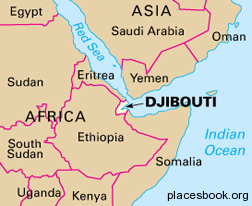
Djibouti is a very small country, but the US, France, Japan, and Germany have military bases there since it is so critically situated in the global petroleum traffic. Now China is building a base there. The move is not the first for China in Africa–it built a military base in Zimbabwe, close to strategic minerals in central Africa, in 2014. The moves signal the quiet rise of China in global affairs. Building and maintaining bases abroad is a profoundly important step and inevitably causes concerns in countries that have similar bases in the world.
NASA has released a composite image of average cloudiness all over the earth. The darker areas average more sunny days and the lighter ones more cloudy days. According to NASA:
…this version of the map shows an average of all of the satellite’s cloud observations between July 2002 and April 2015. Colors range from dark blue (no clouds) to light blue (some clouds) to white (frequent clouds).
North Korea has claimed that it has launched a ballistic missile from a submarine. If true, the test suggests that North Korea has considerably widened its range of delivery to most places in the world. The test does not indicate whether North Korea has developed a miniaturized nuclear warhead to fit on the missile–a very difficult feat. But it does suggest that the current sanctions against North Korea are not discouraging the country from pursuing an active nuclear weapons capability. It is not clear what the next step should be. In many ways, the next steps really depend upon the Chinese reaction to the test.
The US and its allies have been bombing the Islamic State for nine months. The attacks have cost the US about $2 billion and have killed about 8,500 people in the area controlled by the IS. But it is difficult to assess how effective the strikes have been. The military consensus is that the strikes alone cannot really do more than slow down the IS, and the US military is prepared for a long bombing campaign. The Saudi attack on the Houthis in Yemen has diverted some of the bombing capabilities away from the IS so the campaign is at reduced strength.
British voters decided to confound all the pollsters and voted overwhelmingly to keep Prime Minister Cameron and the Conservative Party in power. All talk of a “hung” Parliament disappeared as the Conservatives won an outright majority in Parliament. The big losers were the Labor Party and the UK Independence Party. Curiously, the big winner (aside from the Tories) was the Scottish National Party which only a few months ago lost the referendum to make Scotland independent of the United Kingdom. Now the European Union must brace for the changes in EU policy that Cameron will likely make.
There were four allies in the war against Nazi Germany: the Soviet Union, Great Britain, France, and the US. Yet they do not celebrate the end of World War II on the same day. The Russians observe 8 May; the US, France, and Great Britain observe 7 May. The difference is explained by fastidious attention to diplomatic detail, the errors of translation, and the significance of geography for historical memory.
It’s Friday night. Time to kick back.
Israeli Prime Minister Netanyahu was able to cobble together a 61 vote coalition in the 120 seat Israeli Knesset at essentially the stroke of midnight. The adamant refusal of the Labor Party to join the coalition diminished the significance of Netanyahu’s Likud Party’s commanding victory in the election 6 weeks ago. The coalition is an odd assortment of parties that really do not have much in common, except for the fact that they represent some of the most extreme views in Israel’s polity. Perhaps the most significant alliance was between Netanyahu’s Party and Naftali Bennett’s Jewish Home Party. That alliance resulted in the appointment of Ayelet Shaked as the Justice Minister who is known for her dismissal of a two-state solution between Israel and the Palestinians. In a Facebook Post during the last Gaza War (since taken down), Shaked posted an essay by the late Israeli writer Uri Elitzur which reads in part:
“Behind every terrorist stand dozens of men and women, without whom he could not engage in terrorism. Actors in the war are those who incite in mosques, who write the murderous curricula for schools, who give shelter, who provide vehicles, and all those who honor and give them their moral support. They are all enemy combatants, and their blood shall be on all their heads. Now this also includes the mothers of the martyrs, who send them to hell with flowers and kisses. They should follow their sons, nothing would be more just. They should go, as should the physical homes in which they raised the snakes. Otherwise, more little snakes will be raised there.”
We will see how long this coalition lasts.
A few posts ago, I wrote about the new T-14 Armata Russian tank, reputed to be one of the most cutting edge weapons developed in recent history. Unfortunately, it suffered a very embarrassing moment in the parade in Red Square. I suspect someone will find themselves in Siberia very soon.
Alan Taylor has compiled some large-crowd photographs taken in China. The large-crowd phenomenon is extraordinary, but the Chinese do a brilliant job of orchestrating large crowds in mesmerizing ways. Some of the photos are strikingly beautiful; others are simply awesome.
Tomorrow the British will vote in a general election, but the polls suggest that there will be no clear majority party or coalition in the next Parliament. It doesn’t happen very often, but when it occurs the phenomenon is known as a “hung” Parliament. In the election of 2010 the Conservatives and Liberal Democrats formed a majority coalition fairly quickly even though the coalition was a marriage of very different parties. The speed last time was a function of a clear fear in Great Britain that a hung Parliament would cause great financial distress given the economics of the Great Recession. This time around there a similar sense of urgency doesn’t really exist. So we can watch as the British parties try to come up with a governing majority. Israel has been going through intense bargaining since its general election and the deadline for forming a government there ends at midnight tonight.
For the first time since records have been kept the whole world averaged 400 parts per million Carbon Dioxide, a level long considered to be dangerously high. Parts of the earth’s atmosphere had reached that level in the past, but this time the global average topped 400 ppm. The levels have increased by 120 ppm since the beginning of the industrial revolution, and the rate of increase over 2012-2014 was 2.25 ppm, the highest rate ever recorded. In many respects, the planet has now crossed the point of no return: even if emissions of C)2 were to stop completely, the levels would continue to go up for years and will only decline very slowly.
The parliament of Belarus has just passed a law which requires all unemployed persons to pay an annual tax of about $250. The law is designed to prevent “social dependency” and encourage people to find employment and was passed on a vote of 100-2. The interesting aspect of the law is that it is designed to prevent a huge “shadow” economy in which a large number of people are not “officially” working in an attempt to avoid paying taxes.