Archive for the ‘World Politics’ Category
Amnesty International and Human Rights Watch, two of the most prominent human rights non-governmental organizations in the world, have called upon the UN to suspend Saudi Arabia’s membership on the UN Human Rights Council until Saudi military action in Yemen is stopped. An earlier move in the UN to blacklist the Saudi coalition in Yemen failed after Saudi Arabia applied tremendous pressure on the Secretary-General, Ban Ki-moon. We will have to see if this move is more effective.
The Guardian has a short video of one of the leaders of the Brexit movement, Nigel Farage, giving a speech to the European Parliament. Farage is the leader of the United Kingdom Independence Party but he was also elected as a Member of the European Parliament (MEP). I highly recommend the video because it rather dramatically highlights the extreme depths of incivility that has characterized the Brexit debate. It also makes me feel a little better to know that Donald Trump is not the only asshole in politics.
Among neoconservative analysts of world politics, there is a sense that a war between the US and China is almost inevitable. The argument is that rising powers almost always clash with status quo powers as the balance of power undergoes a re-calibration. The neoconservatives refer to Thucydides and his explanation for the “inevitable” war between Athens and Sparta. Richard Ned Lebow and Daniel P. Tompkins raise some excellent reasons to doubt this line of analysis.
Unicef, The United Nations Fund for Children, has issued its annual report on the state of the world’s children in 2016. The picture painted by the report is truly sobering:
“Despite great progress in school enrollment in many parts of the world, the number of children aged 6 to 11 who are out of school has increased since 2011. About 124 million children and adolescents do not attend school, and 2 out of 5 leave primary school without learning how to read, write or do basic arithmetic, according to 2013 data. This challenge is compounded by the increasingly protracted nature of armed conflict. Nearly 250 million children live in countries and areas affected by armed conflict, and millions more bear the brunt of climate-related disasters and chronic crises.”
The report also noted that by 2030 nearly 750 girls will be married while still children. The report outlines a plan of action to improve the lives of children, but the obstacles to that plan of action are formidable.

We continue to ponder the Brexit and its implications. Financial markets have stabilized somewhat, but the longer term outlook is that British departure from the EU and the uncertainty surrounding it will dampen economic growth. We also have a better sense of who voted for the Brexit and it appears as if the main supporters were people from what we might call the upper middle-class. This group of individuals have seen virtually no income growth over the last few years and their anger and resentment at being cut off of the economic rewards of globalization is fueling what many have labelled a populist movement.

The Ataturk Airport in Istanbul suffered a devastating terrorist attack in which at least 36 people were killed and more than 140 injured. Turkey has endured many such attacks since 2014 and they have been variously ascribed to either Daesh (the Islamic State) or Kurdish elements attached to the Kurdistan Workers Party (PKK). No group has yet claimed responsibility for this most recent attack, but attacks on airports where international visitors are assembled is more a trademark of Daesh than it is of the PKK, which tries to attack Turkish security authorities. The political situation in Turkey becomes less stable every day.
Turkey has apologized to Russia for downing a Russian plane that intruded upon Turkish territory last November. The Russian plane was conducting bombing attacks on rebels in Syrian territory and briefly passed through Turkish airspace. Turkey did not renounce the claims it had made in defense of its territory and indicated that it would prosecute a Turkish national for killing the Russian pilot. The apology by President Erdogan is unusual in that states usually do not apologize for the defense of their territory–that act is one of the most important of all sovereign rights. Erdogan is clearly interested in repairing Turkish relations with Russia.
The EU has signaled to Britain that it wishes a quick British exit from the Union. David Cameron, the British Prime Minister who has indicated that he will step down in November, has already bought Britain several months for possible negotiations before the formal exit negotiations begin. The formal negotiations are triggered by activating Article 50 of the EU Treaty which gives the two sides 2 years to work out an exit. The British are asking for informal negotiations first, but the EU leadership does not want the negotiations to drag out beyond the two years. The belief is that the negotiations will weaken the Union as a whole as the membership watches possible exceptions being offered to the British which may induce other wavering members to consider an exit as well.
The Spanish election yesterday did not produce a government. The conservative Popular Party of Acting Prime Minister Mariano Rajoy won the largest number of seats in Parliament but it fell short of a majority, even in a coalition with the center-right Ciudadanos party. So Rajoy has to figure out a way to work with the left-wing parties or there has to be another election (the third) in another 6 months. The Spanish economy is not strong enough to endure an extended period of time without an effective government.
Magnum Photos has put together an absolutely brilliant web site on global cities entitled “The Places We Live”. It is a dazzling example of the power of the new media, bringing together sound, visuals, and information in a coherent and compelling manner. I highly recommend it to those who seek to use the new technologies to make the world a better place.
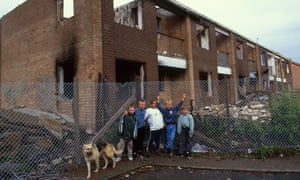
The reliably left-wing newspaper, The Guardian, has an insightful class analysis of the Brexit vote. The argument is captured by a quote from a woman from Collyhurst, a rundown suburb of Manchester: “If you’ve got money, you vote in. If you haven’t got money, you vote out.” The article traces the roots of the Brexit vote to the neoliberal policies enacted by Prime Minister Margaret Thatcher in the 1980s. In many respects, those same policies were initiated by US President Ronald Reagan at the same time.
Collyhurst, Manchester, England
For the second time in 6 months, Spain is holding national elections today. The last election did not produce a clear winner and no government was formed. This election did not elicit great enthusiasm but pollsters expect Podemos (“We Can”), a left wing party to do well. If the Socialist Party does well, there is a chance that the two parties together may be able to form a government. We will have to wait for the results on the election to be announced.
The conflict between the Mexican government and some of the teachers’ unions has been unraveling for some time and it exploded in incredible violence today. The Mexican government is trying to introduce reforms into the Mexican educational system and the unions believe that the reforms are largely directed toward busting the unions. There is little question that the Mexican educational system is failing most of its students. These confrontations hardly ensure that effective changes will be made.
Scene from Oaxaca, Mexico

The Scots rejected independence in 2014 in a referendum in which 55% of Scots voted to remain a part of the United Kingdom. The Brexit vote will likely bring about another such referendum as the majority of voters in Scotland voted to remain in the European Union. The voters in Northern Ireland also voted to remain in the EU and they may consider leaving the United Kingdom and joining the Republic of Ireland (which is a member of the EU and also uses the euro). We may witness the dissolution of “Great” Britain and have only England and Wales remaining.
A new and improved Panama Canal opens tomorrow ushering in what may be new patterns of global trade. For the last nine years, construction at the canal has been ongoing so that the new super-sized cargo vessels can pass through. The improvements will double the amount of cargo that can pass through the canal. After tomorrow cargo vessels from Asia will no longer need to unload on the US West Coast which requires the containers to be shipped by truck or railroad to the US East Coast. They will be able to unload their cargo in ports in the Gulf of Mexico and the East Coast reducing shipping costs for most items. Panama makes an incredible amount of money from the tolls it charges to use the canal. Unfortunately, most of that money never trickles down to the majority of Panamanian citizens.
The media is inundating us with articles that suggest that the Brexit vote signals the “end” of globalization. The Washington Post ran such an article as did The New York Times. There is little question that the Brexit vote was supported by a lot of anti-globalization sentiment. But it is hard to see how “globalization” can be stopped. Companies will still move their factories to low wage areas (or will roboticize their production); rich people will still shuffle their money to offshore banking sites; and people will still figure out ways to cross borders.
I readily admit that I was surprised by the Brexit vote. I did not anticipate it nor did I take it seriously enough. Now I have to figure out what it means and what I missed. There is no way I can properly interpret the event today–it will take months before we can properly sort out the dynamics of the vote. But we have to start somewhere and it is important to put down initial reactions so that when we look back we can better understand the chain of thought.
The first thought is that the vote was a repudiation of the process of globalization and an assertion of national autonomy. The EU is a regional manifestation of the idea that national borders impede economic efficiency and that market integration, whether on a regional or global scale, is a desirable objective. The Brexit vote asserts that British people will be better off without institutional commitments to other economies beyond those that are voluntarily self-imposed through national measures.
Second, the vote suggests that the British people believe that the world is a dangerous place and that it is better for Britain to implement self-protection measures against others. This belief raises the more difficult political issues of race, ethnicity, and religion, usually cloaked in more oblique language, in a rather dramatic manner. I suspect that we should prepare ourselves for more xenophobic and “us-them” slogans. I also suspect that anti-German sentiment will become more widespread.
Third, an anti-EU knock-off effect undoubtedly will resonate among other EU states. That sentiment exists at some level in most of the EU countries and those movements will be emboldened by the Brexit vote. There is a national election in Spain on Sunday and we will get our first read on the Brexit effect. France and Germany have national elections next year, and Italy has one the year after.
Fourth, the economic effects of the Brexit are highly uncertain. We had panic in many stock markets today, but that response was simply knee-jerk to greater uncertainty. The most immediate concern has to do with currency values. The British currency fell by 8% today (which is actually good news for British firms and for tourists who wish to visit Great Britain). But other states will regard that degree of devaluation as threatening to their own exporters and we will have to watch China’s response to the drop. If the Chinese allow the Yuan to drop by an appreciable amount, then we will have to worry about other currencies following suit. The medium-term concern has to do with the flow of investments. If it appears as if the new British government does not have a clear plan to exit within the permitted two-year period, then investment decisions will be deferred and the consequent decline in economic activity will likely lead to a recession.
Finally, the Brexit vote seems to be an expression of frustration more than it was a vote for a specific plan of action. It thus parallels other elections in Europe such as in Austria where the two major parties were completely ignored by the voters. It also parallels the primary elections in the US where the greatest enthusiasm was for two outsiders, Trump and Sanders. Trump’s message resonates with many aspects of the vote in Britain and Sanders certainly represented an anti-globalization stance. There is something going on in the world which suggests that there is no longer anything like “business as usual” in politics. Such moments indicate that political authority has been lost and that the social system has become dangerously fragile.
The world continues to evolve in ways that both flummox and delight me. These are puzzles worthy of our intellects. Do not think about them as something necessarily to fear. Not understanding them is what should make us afraid.
Refugees fleeing violence perpetrated by Boko Haram in Nigeria are slowly dying of starvation in the refugee camps. More than 2 million Nigerians have been displaced by the violence and tens of thousands have been killed. The Nigerian government has proven unable to bring the northeast region of the country under control and Boko Haram, which has pledged allegiance to Daesh (the Islamic State) and is trying to create it own state in Nigeria.
For more than 50 years the Colombian government and the Revolutionary Armed Forces of Colombia (FARC) have waged a bloody war that killed 250,000 people and displaced 6 million people. The FARC was a revolutionary peasant’s army at the beginning of the conflict but it morphed into a drug-dealing, kidnapping, and extortion movement that induced the Colombia government to resort to bloody repression and vigilante action. Today, a peace agreement was signed between the two sides. It needs to be ratified by a referendum and there are many splinter rebel groups that need to be brought into the agreement. But the agreement is a hopeful sign for a country that deserves far better.

Protests against changes to the French labor laws continued as the government continues to press for reform. According to the BBC, the changes to the laws include the following:
French labour reform bill – key points:
- The 35-hour week remains in place, but as an average. Firms can negotiate with local trade unions on more or fewer hours from week to week, up to a maximum of 46 hours
- Firms are given greater freedom to reduce pay
- The law eases conditions for laying off workers, which is strongly regulated in France. It is hoped companies will take on more people if they know they can shed jobs in case of a downturn
- Employers to get more leeway to negotiate holidays and special leave, such as maternity or for getting married. These are currently also heavily regulated
The protesters view the changes as challenges to not just the economic system, but to the French way of life. It seems likely, however, that the government will likely win most of these reforms.
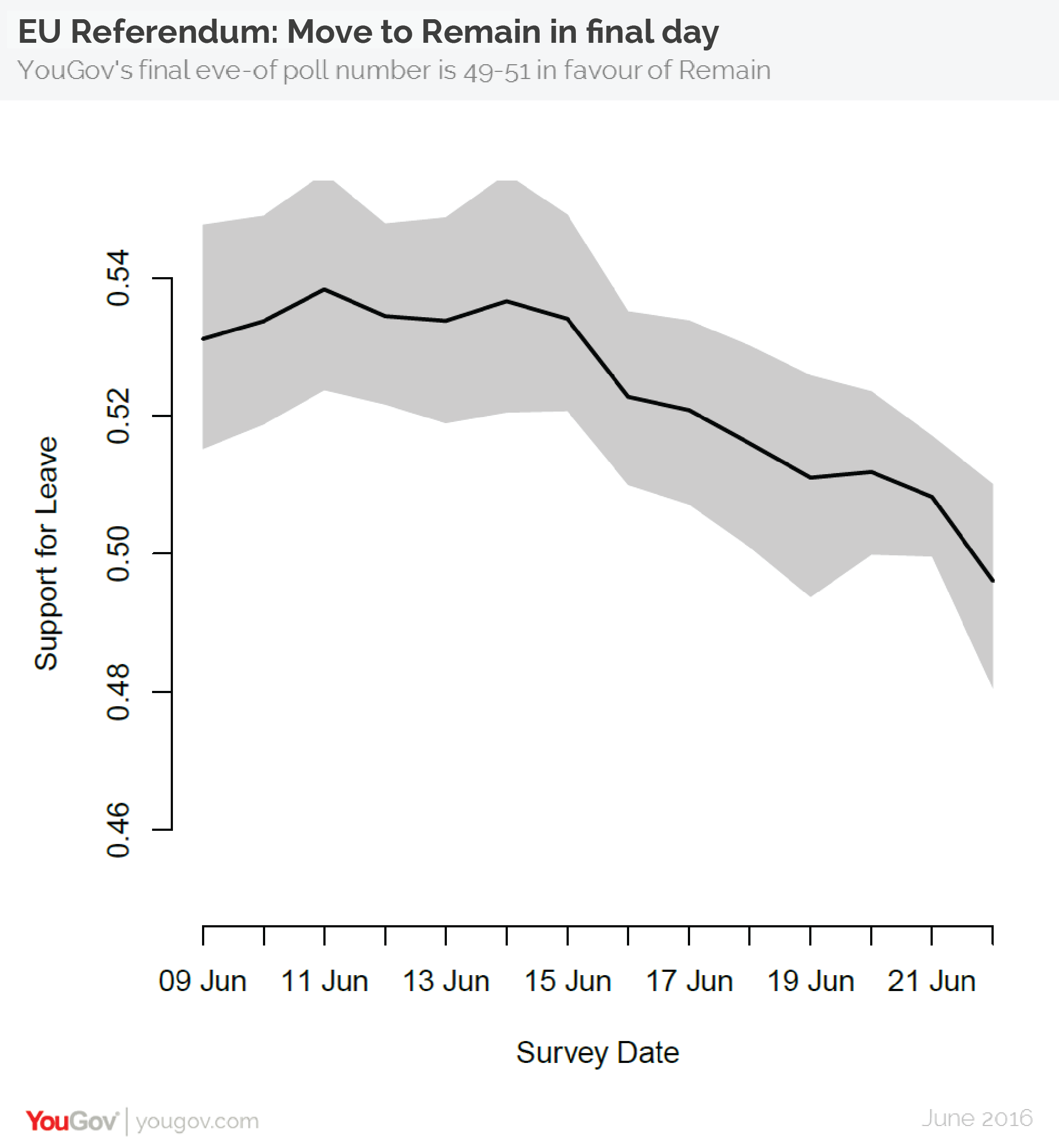
YouGov has released its final poll results on the Brexit referendum and it shows a slight lead for those who favor Great Britain remaining in the EU, 51-49%. It still is a very close margin, but the polling from 9 June to today shows a decline in the number of voters who favored a Brexit. Interestingly, the bookies in Great Britain are also giving better odds to the Remain voters. We will have to wait for Friday morning for the results. It will be an interesting day.
After five unsuccessful attempts, it seems as if North Korea has finally succeeded in launching a medium-range ballistic missile. The missile, named Musudan by Western sources, was launched in the direction of Japan, but it splashed down in the Pacific without doing any damage. The launch violates the UN Security Council prohibition against such capabilities, but it is unclear what additional sanctions the Security Council might impose for this most recent test. The capability now poses a risk to American forces based in the Pacific and is a clear threat to both South Korea and Japan.

Since 2010 an estimated 66 million trees have died in the US’s Sierra Nevada. The trees are victims of a 5-year drought, very high temperatures, and an invasion of bark beetles. The dead trees are fodder for future fires in the six states of the Sierra Nevada and represent a tragic loss. There are already a number of wildfires in the American southwest and temperatures there have been brutally hot over the last few days. Climate change is the backdrop to these events.
Last April, Egypt gave two Red Sea islands, Tiran and Sanafir, to Saudi Arabia. The transfer of the islands was arranged to show Egypt’s appreciation for substantial financial assistance Saudi Arabia had given Egypt after the turmoil of the coup against former President Morsi. The decision led to sustained protests against the Egyptian government for the unprecedented action. The Administrative Court in Egypt today ruled that the transfer was illegal and that the islands should remain under Egyptian control. The Egyptian government is likely to appeal the decision.

Refugees are fleeing the city of Fallujah in Iraq as government forces continue to wrest control of the city away from Daesh (the Islamic State). The conditions the refugees face are desperate. They are living in the desert with few tents, and little food and water. The refugees are also telling horrific stories of life under the control of Daesh. It is not clear whether the Iraqi government or international aid organizations can respond quickly enough to help these people. Most aid organizations have already passed their limits because of the crisis in Syria. The world is clearly not prepared for the dimensions of the catastrophe in Iraq and Syria.
The world is holding its breath on the results of the referendum in Great Britain on Thursday. Bloomberg has a great site that provides a great deal of material on the most recent pools and the substantive issues involved in the vote. Right now, it appears as if the vote will swing in the direction of Britain remaining in the EU. But the voting goes until 10 pm British time on Thursday, so we won’t have many results until late Friday morning.
In the last two weeks, there have been 50 food riots in Venezuela. The riots are a consequence of the almost complete collapse of the Venezuelan economy due to the continuing misrule by President Maduro and the inability of the Venezuelan Congress to pass laws that are enforced by the courts which are controlled by Maduro’s appointments. According to surveys conducted by local universities in Venezuela, almost 87% of Venezuelan families say they do not have enough money to buy food, and food prices command more than 70% of the average family’s monthly wage. The country will likely collapse into total violence very soon.
The UN reported that a record number of people–65 million–have been displaced by war or persecution in 2015. That number is 5 million more than last year. SOme of the information includes:
- Measured against the world’s population of 7.4 billion people, one in every 113 people globally is now either a refugee, an asylum-seeker or internally displaced – putting them at a level of risk for which UNHCR knows no precedent.
- On average, 24 people were forced to flee each minute in 2015, four times more than a decade earlier, when six people fled every 60 seconds.
- Syria, Afghanistan and Somalia produce half the world’s refugees, at 4.9 million, 2.7 million and 1.1 million, respectively.
- Colombia had the largest numbers of internally displaced people (IDPs), at 6.9 million, followed by Syria’s 6.6 million and Iraq’s 4.4 million.
Turkey and Lebanon are the host countries for the largest number of refugees and both are straining to address the needs of those people.
Mexican President Enrique Peña Nieto has struggled to introduce education reforms into the Mexican educational system and his efforts have been strongly resisted by the teachers’ unions. In the state of Oaxaca that resisted erupted in violence with 6 protesters killed in clashes with the police. There is little question that the Mexican educational system needs reform, but the government has been notably ham-fisted in dealing with the reforms. These protests have been going on for years and little progress has been made.

