Archive for the ‘World Politics’ Category
Japanese Prime Minister Shinzo Abe scored a stunning victory in the elections for the Parliament’s upper house. His party and his coalition partners won over two-thirds of the seats in the chamber, holding out the possibility that Abe might be able to amend the Japanese constitution. Currently, Article Nine of the constitution forbids Japan from engaging in militaristic activities, a legacy of the US-written constitution after Japan’s defeat in World War II. Although such a change is one of Abe’s objectives, it is not clear if or when he might pursue the change. There is a formidable anti-war constituency in Japan.
English Translation of Article Nine
ARTICLE 9.
(1) Aspiring sincerely to an international peace based on justice and order, the Japanese people forever renounce war as a sovereign right of the nation and the threat or use of force as means of settling international disputes.
(2) In order to accomplish the aim of the preceding paragraph, land, sea, and air forces, as well as other war potential, will never be maintained. The right of belligerency of the state will not be recognized.
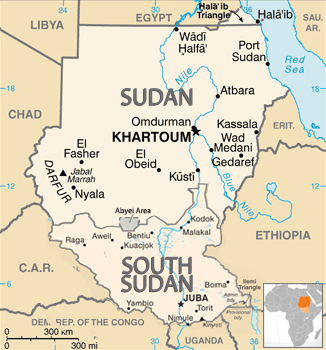
South Sudan became an independent state in 2011. It was created through the efforts of Western powers, principally the US, to protect the residents of the region from the genocidal actions of President Omar Hassan al-Bashir of Sudan. Bashir is currently under indictment by the International Criminal Court, but he has not been arrested and still reigns as Sudanese President. The hopes for South Sudan, however, were ill-fated. Two leaders in the state, Salva Kiir and Riek Machar, have been fighting essentially a personal feud which has inflamed tensions between their respective ethnic groups, the Dinka and the Nuer. The fighting has displaced thousands and the UN has been trying unsuccessfully to broker a cease-fire.
The US is sending 560 additional combat troops to Iraq in order to help the Iraqi government retake the cities of Mosul in Iraq and Raqqa in Syria. The offensive comes as Daesh (the Islamic State) continues to lose ground in its self-declared caliphate. The American ground commitment to Iraq is also a ground commitment to the Iranian forces supporting Iraq. It may also be a sign of a growing military involvement that may prove to be more long-lasting than the initial commitment intended. We should hope that the offensive is successful or else more US troops may be going to Iraq.

Michael Klare is my colleague at Hampshire College and a very good friend. He has written an essay for The Nation entitled “The United States and NATO Are Preparing for a Major War With Russia”. I have posted many articles about the build-up by NATO and the various provocative moves taken by Russia in Ukraine and along its western border. The situation is a classic example of the Security Dilemma: where one side is engaged in defensive moves that are unquestionably interpreted as aggressive by the other side. It is a very dangerous condition.
An international court at the Hague is scheduled to rule on the Philippines case against China on the matter of maritime claims in the South China Sea. China has refused to participate in the proceedings and has stated publicly that it will not abide by the ruling. But a ruling against the Chinese claims will certainly damage the credibility of China and will cast China as a breaker of international law. The ruling will be closely examined by all states and the reactions of all involved will determine the course of future events.

I am always amazed at the creativity of some people on the internet (and hopelessly depressed by the idiots who also populate the web). One person has compiled some before and after photographs of some of the most famous cities in the world. The changes are breathtaking and they should make us aware of how powerful the impact of human activity can be. Below is a before and after photograph of Shanghai, China.

The US has decided to sell an anti-missile system–the Terminal High Altitude Area Defense (THAAD) system–to South Korea. THAAD is a very sophisticated anti-missile system (the link goes to the Lockheed Martin Company so one should read the claims with a degree of skepticism) and it is being deployed ostensibly to protect South Korea from a nuclear attack by North Korea. But it also protects South Korea from a Chinese attack and the Chinese regard the deployment as highly provocative. It also suggests that South Korea is cementing its alliance with the US and is not thinking about taking a more conciliatory stance toward China.

The British government has emphatically said “No” to a petition requesting that a second vote be held on Brexit. A petition circulated which collected more than 4 million signatures requesting a do-over. The government, however, has decided that the first vote should be decisive since over 33 million people voted. The decision was inevitable–at some point votes have to be determinant or no decisions will ever be made.
Another prominent environmental activist, Lesbia Yaneth Urquia, has been killed in Honduras. Urquia was killed four months after the death of Berta Caceres who was also active in environmental protests. Both opposed the building of a new hydroelectric dam, the Agua Zarca dam, in the La Paz region of the country. The current Honduran government seized power in 2009 and has approved 47 new dam projects in the country. Over 100 activists have been killed in the country over the last five years.

The nuclear deal forged between Iran and the P5 + 1 (the five Permanent Members of the Security Council and Germany) in 2015 was a diplomatic triumph, but also one with unresolved questions. One of the most important issues was whether Iran’s development of ballistic missiles violates the accord. Iran has held that missile development is independent of a nuclear weapons program since such missiles can carry conventional weapons and can also be used in its space program. The P5 + 1 had concerns about the missile program since the missiles can also carry nuclear warheads. The Security Council has been given a report which has found that the missile program violates the “constructive spirit” of the agreement and the entire council will vote on the matter. If the Council passes a resolution finding that the missiles do violate the program, the Iranians will likely strongly object and think about leaving the agreement.

Jacobin is a Marxist journal that adheres closely to a class analysis of world events. Its interpretation of the Brexit vote is no different. In a careful analysis of the voting patterns of “Remain” and Leave”, there is widespread support for “Leave” throughout the country, but very concentrated support for “Remain”. The conclusions of the analysis are not surprising, but they are carefully documented. Those conclusions include:
- The “strong” Leave vote was widely and evenly spread across England.
- Large groups of the working class in the North voted strongly for Leave.
- Areas of pronounced poverty across England voted strongly for Leave.
- There were “strong” Leave votes in working-class areas in the South, particularly around London; these are sometimes called “white-flight areas”.
- The “strong” Remain vote was extremely concentrated in London, particularly in the working-class areas that contain large concentrations of second- and third-generation immigrants. Note, though, that several of these areas have also been undergoing a process of gentrification and have substantial concentrations of the middle class.
- The better-off areas of London voted strongly in favor of Remain. Very few other areas of the country voted similarly, including Cambridge, St. Albans, and Oxford.
Interestingly, the Marxist analysis does not differ substantially from the mainstream conclusions.
Labor protests have become increasingly common in Europe as governments and companies try to change the conditions of work. In the US there has been a movement to support low wage workers through an increase in the minimum wage and those movements have scored some successes. Workers at Walmarts in China, however, have started striking, something American Walmart workers have not yet tried. There are no unions in China, but social media has given the Walmart workers a way to organize outside the union framework. We will have to see if these procedures are effective.
The European Commission has voted to sanction both Spain and Portugal for violating the Union’s budget rules. The Union’s rules dictate that no member’s budget deficit can exceed 3% of its total GDP and both countries have exceeded that limit for several years. Both have been given extra time to cut their budget deficits since the Great Recession of 2008-09, but progress has been sporadic and slow. The decision poses a problem for the Union in light of the recent Brexit vote: harsh penalties might increase euroscepticism in the Union members and precipitate additional moves to leave the Union.
In other European news, some of the Italian and German banks are in serious trouble. Italian banks are struggling with a number of bad loans they have made that have little likelihood of being repaid. Deutsche Bank is also in serious trouble as it failed one of the US Treasury’s stress tests last week and has been labeled by the IMF as the bank most likely to bring down the global financial system. All banks are suffering from the very low interest rates that currently are the international norm. The German government will probably not let Deutsche Bank fail, but the Italian government lacks the economic muscle to rescue its own. Everyone should keep an eye on the banks.
The costs of war can be calculated in a number of ways: by the number of soldiers killed, by the amount of money spent, or by the value of the objectives of the war, to name just a few traditional ways. We rarely think about the lives of the soldiers who have served in a war and what they can accomplish after the war is over for them (if wars are ever “over” for a soldier). The US Department of Veterans Affairs has just released a report which points out that 20 veterans a day commit suicide–the leading cause of death for American veterans. The risk of suicide for veterans is much greater than that for civilians.
Great Britain has released a long-awaited analysis of the decision to go to war against Iraq in 2003. The analysis was led by Sir John Chilcot and the final report is 2.6 million words long. One can read his summary of the report here. The report refutes most of the central claims made by the British Government, whose Prime Minister at that time was Tony Blair, and, by association, the claims made by the Administration of President George W. Bush. In the summary, Chilcot argues that:
We have also concluded that:
• The judgements about the severity of the threat posed by Iraq’s weapons of mass destruction – WMD – were presented with a certainty that was not justified.
• Despite explicit warnings, the consequences of the invasion were underestimated. The planning and preparations for Iraq after Saddam Hussein were wholly inadequate.
• The Government failed to achieve its stated objectives.
I seriously doubt that the report will force a thoughtful rethinking of the decision within the US.
Rystad Energy, a Norwegian consulting firm, has issued a new report on the oil reserves held by different countries which is at odds to conventional wisdom. According to these new findings, the US holds the largest reserves in the world, followed by Russia and Saudi Arabia. Significantly, the new estimates hold that Venezuela, which was believed to hold the largest reserves, actually has far limited reserves. Much of the US reserves are available only by fracking which is a controversial practice for environmental reasons.

US President Obama announced today that he would not remove American troops from Afghanistan and would in fact increase their levels to 8,400. He came to office promising to end the war but will now be handing it off to his successor. The decision rests upon the judgment of his advisors that Afghanistan’s central government would not survive without American military support. The war is already the longest war in American military history. Unfortunately, the Afghans have been at war for a far longer period of time.
Australia has had six Prime Ministers in the last nine years, and the most recent election held last Saturday was far from definitive. The Liberal-National Party gained 70 seats in the Parliament and Labour had 67 seats. A majority in the Parliament is 76 seats. It appears as if the incumbent Prime Minister, Malcolm Turnbull, and his conservative coalition might be in a better position to form a government, but the process of coalition building could take a considerable period of time. The outcome is just another index of the current frustration of voters in liberal democracies.
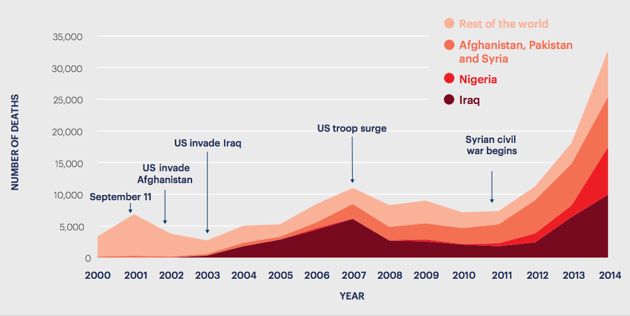
On Sunday, there was a bomb blast in Iraq that killed more than 250 people. Iraq is getting pummeled as the strategic situation of Daesh (the Islamic State) continues to deteriorate due to Russian and American air strikes. Iraq, Nigeria, Afghanistan, Syria, and Pakistan are the places where the vast majority of terrorist attacks have taken place. While the richer countries have had dramatic incidents, the truth is that most of the attacks occur have occurred in those five countries.
Israel has announced new plans to build settlements outside of Jerusalem as well as in Arab sections of East Jerusalem. The US, the UN, and many of the European states have condemned the plans as a significant barrier to any peace settlement. The spokesperson for the UN Secretary-General, Ban Ki-moon stated:
“This raises legitimate questions about Israel’s long-term intentions, which are compounded by continuing statements of some Israeli ministers calling for the annexation of the West Bank.”
It is unlikely that anything more than a verbal condemnation will be forthcoming from any of the outside parties to the conflict
.gif)
Immigration in Europe is a very difficult political issue and the discussion usually centers on the flow of refugees from Syria and other war-torn countries. But Germany also attracts many immigrants from other EU countries, principally Poland, Romania, and Bulgarians. While the numbers are lower than the current flow of refugees from non-European countries, it still is a large number (685,485 in 2015). There is also an outflow from Germany of about half that number. The truth is that the movement of human populations is quite substantial and sustained.
Elie Wiesel has died at age 87. Wiesel was an Auschwitz survivor and a tireless advocate of human rights all over the world. He made a profound difference in the world and his voice will be heard many years from now.
Elie Wiesel

We are slowly getting more information about the attack on the cafe in Dhaka, Bangladesh. The gunmen were clearly singling out foreigners and members of the Bangladeshi elite. They also allowed people who could recite specific verses of the Quran to live. The impact on Bangladesh has been quite dramatic, even though Bangladesh is no stranger to terrorist attacks on non-Muslims. The government is going to have to address these attacks more effectively if the state is to survive.
There is, as of this writing, an armed attack going on in Dhaka, the capital of Bangladesh. According to reports, a “group” of armed gunman have taken as many as 20 hostages in the Holey Artisan Bakery in the Gulshan diplomatic area of the city. The Hindu is live updating the episode as more details become available. Daesh (the Islamic State) is claiming responsibility for the attack, but there is no way to verify the claim right now.

The US has released data on the effectiveness of drone strikes in protecting US security. According to the statistics, the US claims to have “taken off the battlefield” (I assume that means killed) between 2,372 and 2,581 militants in the countries that the US has targeted (which included, but is not limited to, Yemen, Somalia, Pakistan, and Libya (the statistics do not include the countries where IS combat troops are “officially” engaged such as Iraq and Afghanistan. The US estimates that there have been between 64 and 116 noncombatant civilians inadvertently killed in the strikes (“collateral damage”). Those numbers do not correspond well with the numbers compiled by non-governmental agencies. It is impossible to tell which numbers are closest to the truth.

The Austrian high court has ruled that there were irregularities in the vote counting in the Austrian presidential election which was held last May. In that election, which was finally determined by absentee ballots, the Green Party candidate barely eked out a victory over the right-wing candidate, Norbert Hofer of the Freedom Party. The Freedom Party is anti-EU and anti-immigrant and its chances for victory have no doubt been boosted by the recent Brexit vote. A new election will be held sometime in the autumn. The right continues to rise in Europe.
Rolling Stone has an investigative report on the current suit against ExxonMobil for fraud. The case has been brought by the New York Attorney General and it accuses ExxonMobil of claiming a book value for its stocks which includes reserves of oil it knows cannot be burned because of the threat of climate change. It is an innovative case and it is hard to predict how it will turn out. But according to the article:
“To meet the climate goals of last year’s Paris Agreement, more than two-thirds of global fossil-fuel reserves – $100 trillion worth, according to a Citigroup estimate – would have to remain in the ground. If Exxon believes climate change is real, that warming more than two degrees Celsius could be catastrophic, and that the world is finally serious about averting this disaster, it must also accept that it may never sell tens of billions of barrels of oil currently on its balance sheet.”
The suit will likely take many years to resolve, but the pressure is clearly on oil companies now.

The US has ended its ban on transgender people serving in the military. The decision has been a long time coming but the military only ended its “don’t ask, don’t tell” policy on gay and lesbians serving in 2011. The move is a great step forward in the protection of human rights. The change is supposed to take effect on 1 October. Fortunately, the decision is an executive decision and it does not require an act from Congress–human rights are not a legislative decision.
Nigerian President Muhammadu Buhari is facing another challenge to the stability of Nigeria. Boko Haram has unsettled large parts of the northeast part of the country with its attacks on civilians and the Nigerian army has not made much progress in pacifying the region. But conflict has erupted (again) in the delta region of the south. That region is the oil producing area of the country and it was once disrupted by an armed group, the Movement for the Emancipation of the Niger Delta (MEND). That group was ultimately contained, but a new group, the Niger Delta Avengers, has arisen. The groups believe that the oil wealth is not being equally shared with the people in the delta region and they are demanding economic support for them.


