Archive for the ‘World Politics’ Category
Visual Capitalist has a beautiful visual graphic of international trade. The graphic shows trade flows between countries and color codes the content of those flows. If one clicks on a particular country, the graphic will show only the flows in and out of that country. One can also zoom in and out of particular regions of the world. Not surprisingly, the dominant flows are between countries in the northern hemisphere.
The Law and Justice Party in Poland has been slowly increasing the powers of the Polish state. Last year it passed laws restricting the powers of the constitutional court and limiting the ability of protesters to assemble freely. Protesters have surrounded the Parliament building to voice their concerns over the growing authoritarianism of the government. The European Union has voiced its concerns over the loss of freedoms in Poland, but the Law and Justice Party refuses to change the laws.
James Fallows has written a very well-informed short essay on the US-China relationship and how President-elect Trump’s cavalier tweets about China are compromising a very delicate relationship. His conclusion is somewhat encouraging, but the tone of resigned disappointment rings true:
“I do not believe the United States and China are likely to go to war. There are too many buffers on each side; too many many positive linkages; too much awareness on the Chinese side of U.S. relative military advantages—and on both sides of the potential risks.
“But if historians and citizens look back on our era as the transition point, when 40 years of relatively successful management of U.S.-China gave way to a reckless focus on grievances and differences, and a cavalier approach to a showdown, tweets like the one today will be part of their sad record.”
Let’s hope that President-elect Trump becomes a little more disciplined in this crucial relationship.
China seized a US underwater research drone in international waters about 50 miles off the coast of the Philippines. The drone had been launched by the USNS Bowditch, an oceanographic research vessel. When the Chinese took the drone, they were challenged by the Bowditch but the Chinese vessel did not respond to demands that the drone be returned. The US has filed a formal protest, but the incident seems like another chapter in the continuing showdown between the Chinese and the Americans on the status if the South China Sea.
USNS Bowditch

President-elect Trump has indicated that he intends to appoint David Friedman as the next US Ambassador to Israel. Mr. Friedman is a bankruptcy lawyer who has worked with Mr. Trump in his legal affairs in Atlantic City but he has no diplomatic experience. Mr. Friedman is on record as supporting the total Israeli annexation of the West Bank and to move the US Embassy in Israel from Tel Aviv to Jerusalem. Both positions conflict with US policy since 1967 and the appointment is additional evidence that the two-state solution to the Israeli-Palestinian dispute is no longer a viable option.
Russian President Putin and Turkish President Erdogan are calling for negotiations on the future of Syria without the participation of either the US or the United Nations. The two countries are an odd couple: Russia favors Syrian President Assad and Turkey wishes Assad to be removed. But the gambit reflects the growing confidence of both parties to fill perceived vacuums created by American disengagement from the conflict. Whether the two countries can come up with a plan is doubtful. But at this point, anything that could stop the slaughter in Syria would be welcome.
Last September, Chinese President Xi pledged to US President Obama that “China does not intend to pursue militarization” in the reefs it has built up in the South China Sea. Photographs of those “islands” clearly show that that promise has not been kept. The photos clearly indicate that anti-aircraft defense systems have been built up and that runways have been built that can accommodate any plane in the Chinese arsenal. The Obama Administration has quietly challenged the Chinese claims of sovereignty by navigating near the islands in an assertion of the freedom of the seas. These new weapons systems will make similar acts by the US significantly more dangerous. It is unlikely that Obama will try to challenge these moves, instead leaving the issue for President-elect Trump.
Johnson Reef

US President-elect Trump’s cabinet appointments clearly suggest that he is likely not to support the sanctions regime against Russia that have been in place since Russia annexed the Crimea. It also appears as if there is strong sentiment in Europe for dropping the sanctions as well. As the year ends it appears as if Putin’s gambits in Ukraine and Syria will result in, at least, short-term victories. We will have to see how strong Russian support for maintaining such a vigorous foreign policy can persist over the long-term.
The Pew Research Center has done another study on international migration. According to the study:
“If all of the world’s international migrants (people living in a country that is different from their country or territory of birth) lived in a single country, it would be the world’s fifth largest, with around 244 million people. Overall, international migrants make up 3.3% of the world’s population today.”
The countries that send out the most migrants are India, Mexico, Russia, China, and Bangladesh, countries with relatively large national populations. The flows are dynamic: Mexico used to send a lot of migrants to the US, but the flows now are actually negative, with more leaving the US for Mexico.

Scientists have calculated the impact of a one-foot sea level rise on the New York City tri-state region would be very serious. According to Scientific American:
“Without additional protection measures, 1 foot of sea-level rise will inundate nearly 60 square miles of the tri-state region. That’s about 19,000 people in 10,000 homes, in places where about 10,000 people work. It could happen as soon as 2050 if emissions aren’t curtailed, the report found.”
The study indicates that specific areas within the region are most susceptible and that steps have to be taken as soon as possible to protect the 3,700 mile coast line of New York, Connecticut, and New Jersey.
There are new ideas floating around about the affinity between the supporters of Donald Trump and Vladimir Putin. The historical animosity of American conservatives toward Russia is apparently being overcome by an attraction to Putin’s strong views on the character of the Russian nation and state. According to the Washington Post:
“Soon, governments in Washington and Moscow will be both led by figures who embrace a similar brand of right-wing nationalism, one that harps on the primacy of national sovereignty, invokes myths of a greater past, trumpets Christian values and rejects multiculturalism and cosmopolitanism. Their ideological brethren have also found firm footing in parts of Europe and threaten to rewind decades of liberal integration on the continent.”
This ideological realignment will be interesting to watch if it continues.
As Aleppo crumbles, Iran is claiming victory. We tend to think almost exclusively about the alliance between Russia and Syria, but the Iranian militias proved to be the decisive element in the ground attack upon Aleppo. The fear is that the Iranian Shiite forces will take retribution against the Sunnis involved in the fighting around the city. At some point, Iran, Syria, and Russia will have to figure out their real interests in the Middle East, and I suspect that sorting out those interests will be quite difficult.
It seems as if the Syrian government is close to taking control of the city of Aleppo. The news reports of the takeover are horrific. They include the summary execution of civilians and the refusal to allow children safe passage out of the city. According to The Guardian:
“We’re seeing the most cruel form of savagery in Aleppo, and the regime and its supporters are responsible for this,” foreign minister Mevlüt Çavuşoğlu said, adding that his country was negotiating with Russia to implement a ceasefire. “The wounded are not being let out and people are dying of starvation,” he told a news conference in Ankara.
Confronted with what many have described as a “meltdown of humanity”, Russian Foreign Minister, Sergei Lavrov, stated:
“We are tired of hearing this whining from our American colleagues in the current administration that we need to immediately halt military action.“
The complete breakdown of the international community to respond to this tragedy in Syria is comparable only to earlier failures in the Holocaust and in Rwanda in 1994. The shame can never be erased.
In the city of Aleppo, one day ago

The news about the Russian government deliberately releasing hacked emails for the specific purpose of damaging Hillary Clinton’s bid for the White House has finally elicited a sense of outrage (I have no explanation why it took so long). But the question is how to prevent similar attacks in the future, particularly since there are suggestions that the Russians are interfering in the German upcoming elections as well. Fred Kaplan is an astute observer of strategic affairs and he points out the major difficulty of figuring out a suitable response: the fact that the US is probably the most vulnerable state in the system to cyberattacks. Any action taken by the US to punish the Russians would most likely elicit a counterattack that would damage the US more.
Antony J. Blinken is the current US Deputy Secretary of State and he has written an op-ed piece for the New York Times on the importance of the liberal world order to American foreign policy. He poses the possibility of a world order based on the more traditional balance of power rules and points out how disadvantageous that world order would be to US interests. The essay is an elegant statement of the world order the US attempted to create in 1945.
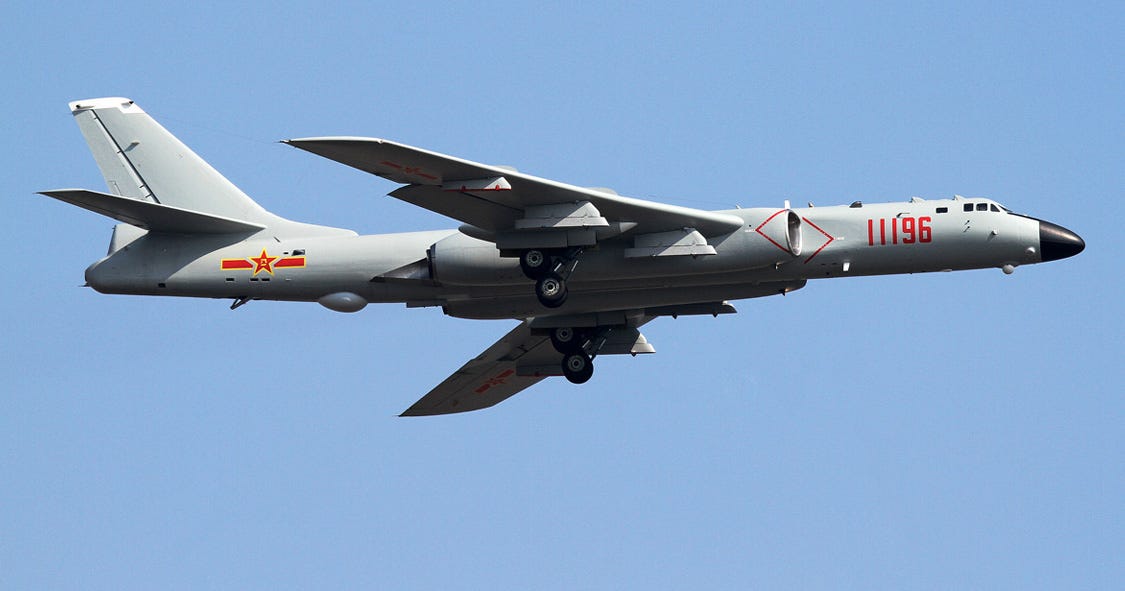
China flew a long-range nuclear-capable bomber along its “nine-dash line” in the South China Sea. It was the first time that China has sent the bomber that far into the contested region and its followed a statement by US President-elect Trump’s televised comment that:
“I don’t know why we have to be bound by a One China policy unless we make a deal with China having to do with other things, including trade. …I mean, look … we’re being hurt very badly by China with devaluation; with taxing us heavy at the borders when we don’t tax them; with building a massive fortress in the middle of the South China Sea, which they shouldn’t be doing; and, frankly, with not helping us at all with North Korea.”
In addition, there is evidence that China is getting ready to deploy its Chinese version of the SA-21 surface-to-air missile system on the artificial islands it has built in the South China Sea. The anti-missile system is its most advanced defensive system against air attacks. An editorial in the China Times, which reflects official Chinese government opinion, asserted that Trump is “as ignorant as a child in terms of foreign policy”. It is hard to believe that Mr. Trump does not appear to understand how seriously China takes the “one China” policy–there are no higher cards in the Chinese card game.
China’s H-6 Bomber
The rumored pick for Secretary of State in the Trump Administration is Rex Tillerson, the CEO of ExxonMobil. ExxonMobil once had shared licenses with the Russian oil company, Rosneft, to explore oil fields in the Arctic. The company was forced to drop those licenses in 2014 as part of the economic sanctions after the Russian intervention in Ukraine. It now looks likely that those sanctions will be lifted even though Russian activities in Ukraine have not changed, and ExxonMobil will probably renew its relationship with Rosneft in Arctic drilling. Just recently, Russia sold parts of Rosneft to Qatar and the Glencore company, a commodities trading company, for $11.3 billion. The money for the sale of 19% of Rosneft will go directly to the Russian government, an infusion of money that the government desperately needs to cover immediate needs. But the sale also diffuses the distinctive “Russian” nature of the Arctic drilling aspirations which may make it easier for ExxonMobil to lessen the political sting of the dropped sanctions.

The second most important greenhouse gas is methane (CH4), a gas that is 28 times more powerful in terms of warming than carbon dioxide but which does not last nearly as long in the atmosphere as CO2. For a variety of reasons, little attention has been paid to methane, but that complacency is changing quite rapidly as levels of methane in the atmosphere have increased quite rapidly in recent years. According to the Washington Post:
“Overall, atmospheric concentrations of methane have grown from about 700 parts per billion in the preindustrial era to more than 1,840 parts per billion today. This suggests that much like with carbon dioxide, industrialization and modernization have had a long-term effect of unlocking large volumes of methane from the Earth.”
Fortunately, methane is short-lived, so effective measures to curtail methane emissions could have dramatic effects on the pace of climate change.

At least 38 people were killed and about 150 wounded in twin bomb blasts around a soccer stadium in Turkey. At this time, no group has claimed responsibility for the bombings but the government is unified in its condemnation for the attacks. The suspicion is that the Kurdish Workers Party (PKK) is the most likely candidate since the bombing seems to be consistent with its decades-long struggle for greater autonomy in Turkey.
South Korea’s President Park Geun-hye was impeached by the Parliament on Friday. After months of protests and growing anger over Park’s relationship with a confidant who peddled her influence with corporations for millions in bribes, there was little support for allowing the scandal to persist any longer. Investigations into the companies that paid the bribes will continue, but these corporations, known as chaebol in South Korea, are incredibly powerful and it is doubtful that they will pay any public price for their crimes. Right now, there are no clear candidates to replace Park and South Korea will undoubtedly go through a difficult transition period. But the global public outrage against governmental corruption continues unabated.
Rumors are swirling that President-elect Trump will nominate Rex Tillerson, the CEO of ExxonMobil, to be the Secretary of State. I have doubts about whether those rumors will come true because I do not think that Trump wishes to run the risk of Tillerson being turned down by the Senate. But Julian Borger of The Guardian has an article about Tillerson which roughly sums up the issues concerning the appointment. He would lead a State Department that would be quite reluctant to adapt to his leadership style.
Tillerson and Putin

Larry Diamond has written a particularly insightful essay on Russian President Putin’s strategy of undermining liberal democracy, not only in the US but also in Europe. The essay is systematic in its analysis of what Putin has done to delegitimize the institutions necessary for citizens to have faith that their interests are being well-represented. The strategy underpins Putin’s desire to resurrect Russia as a great power. The essay follows on a report by the Washington Post on a CIA report that specifically accuses Russia of manipulating the 2016 US presidential elections to favor Donald Trump. The response by the Trump Transition Team was nothing less than extraordinary:

First, the CIA never claimed that Iraq had weapons of mass destruction. Indeed, the CIA cast significant doubt on whether Iraq had weapons of mass destruction. The final National Intelligence Estimate (NIE) of the Bush Administration ignored key qualifiers in the CIA assessment, and according to Jason Leopold, quoting Paul Pillar who was in the CIA at the time:
“But Pillar, now a visiting professor at Georgetown University, added that the Bush administration had already made the decision to go to war in Iraq, so the NIE “didn’t influence [their] decision.” Pillar added that he was told by congressional aides that only a half-dozen senators and a few House members read past the NIE’s five-page summary.”
Moreover, the Defense Department wrote a memo describing how little it knew about the Iraqi weapons program, but the Secretary of Defense Donald Rumsfeld, never circulated it to any decision maker. Michael Morell, the Deputy Director of the CIA at the time, has admitted that the Bush Administration did not accurately reflect the CIA assessments. And the British Government has admitted that the US intelligence estimates were “sexed up” by the Bush Administration, not the intelligence agencies.
Second, blaming the main intelligence agency on which the incoming President has to rely for the most sensitive information is unbelievable. President-elect Trump has just told the most informed analysts in the US government that they are hacks.
Third, the assessment has nothing to do with questioning the electoral outcome. No one suggested that the result should be overturned. But to suggest that we should ignore an attempt by an outside power to install a preferred leader into the highest office in the government shows utter contempt for what democracy is supposed to be. Is Donald Trump comfortable being an agent of Russia?
Fourth, the outcome of the Electoral College ranks Number 46 out of the 58 elections in American history. Is that how Mr. Trump describes “biggest”? No wonder he has small hands.
Europe is beginning to debate the strategic implications of the election of Donald Trump. His campaign remarks about demanding greater financial contributions from NATO allies led to serious questions about his commitment to the NATO alliance. It is likely that some European states will increase their defense spending but there is also the risk that these increases will be made in an uncoordinated manner. If the American commitment to European defense is viewed as problematic, the alliance faces a serious likelihood of significant deterioration.
The European Central Bank (ECB) has refused to give the Italian bank, Monte dei Paschi di Siena (MPS), any more time to recapitalize. The decision means that Italy will have to bail out the bank to keep it from going bankrupt. Under the rules of the European Union, no state money can be used to recapitalize a bank until bondholders take losses first. The Italian government is currently so fragile after the resignation of its Prime Minister, Renzi, that it fears the political repercussions of forcing losses on the depositors of Monte dei Paschi. The insolvency of MPS, however, poses serious risks to the Italian economy and other European banks.
American European allies are warning President-elect Trump not to align with Russia in supporting Syrian President Assad. On several occasions, Mr. Trump has stated that Russia and the US have similar aims in defeating Daesh (the Islamic State) in Syria and Iraq. The allies suspect that if President Assad remains in power, he will not ficus on defeating Daesh, but will rather use his power to put down any opposition to his regime.
The French national elections are far away: 7 May 2017. But the two major contenders are François Fillon, the center-right candidate, and Marine Le Pen, the National Front hard-right candidate. There seems to be an expectation that Fillon is a shoo-in, but after the Brexit vote and the US Presidential election, I doubt that any election can be predicted with great confidence. Timothy Garton Ash is a pre-eminent European analyst and the article in The Guardian gives reasons to believe that Fillon might be vulnerable next spring.
François Fillon

Researchers have concluded that rising income inequality in the US suggests that it is increasingly likely that today’s children will make less money than their parents. The decline is most pronounced for children born to middle-class families. This outcome is the exact opposite of what has always been defined as the “American Dream” and an implicit rejection of the liberal assumption of economic progress. According to the Washington Post:
“The surge in inequality over the past half-century is well documented. New research this week, from economists Thomas Piketty, Emmanuel Saez and Gabriel Zucman, shows the bottom 50 percent of U.S. income earners only gained 1 percent in earnings from 1962 to 2014, after adjusting for inflation. From 1980 to 2014, they found, nearly 70 percent of income gains went to the top 10 percent.”
The current study, however, is the first to link this inequality to declining mobility, a link that suggests that the problem may be even more difficult to address.

The economic malaise is correlated with the evidence that support for democracy is also declining. Matt O’Brien has written an op-ed for The Washington Post that asserts that popular support for representative democracy is reaching levels comparable to the last low point in the the 1930s. The elections in France, Germany, and the Netherlands in 2017 will all be tests of how accurate O’Brien’s forecast might be.

