We are getting more information about the US missile strike on a Syrian airbase and the commentary on the strike is confusing and conflicting. All the commentary misses the central point of military action. Every military action should be guided by one single and overriding concern: does this action bring us closer to bringing a war to an end? The air strike does not meet this objective. But it does meet another objective, which is justifiable but not related to the conflict itself. If this strike had the single intent of sending a clear message to the Syrian regime–and to the world at large–that the use of banned chemical weapons will not increase the chances of victory, then it can be justified on those terms if it turns out that the Syrian government does not use such weapons again. We will see if that outcome is realized.
But in terms of the Syrian civil war, and its attendant international dimensions, the strike itself does not bring us closer to an end to the violence, and all the commentary I have read and heard seems to miss this point. And some of the commentary distorts what actually happened. The New York Times ran an article by Mark Landler entitled “On Syria Attack, Trump’s Heart Came First.” I sincerely doubt that this headline is accurate. If moral imperatives were the driving force, then the current administration would not be restricting refugees from Syria.
Moral considerations have been conspicuously absent in Mr. Trump’s statements about Syria and Iraq until his statement yesterday. The current administration said nothing after 300 civilians were killed in Mosul, Iraq after a US airstrike. I wish to be very clear: I am not equating the chemical attack in Syria with the US strike in Mosul. The Mosul attack appears to have been unintentional and was not conducted with banned weapons of war. These distinctions are critically important to us, but they matter little to the innocents who were killed and their families. We will wait for the US military to conduct its investigation of the Mosul attack, and I am fully confident in the US military’s willingness to issue a truthful report and to punish those involved if the attack occurred because of negligence. But if morality were a primary concern of the current administration then I would have expected a sincere apology and a profound expression of remorse by the US after the Mosul attack. An honest heart is not selective.
The attack also comes as the US is increasing its military commitment to overthrowing Assad (see this blog post of 31 March 2017). That objective is not part of the so-called “war on terror”. The attack in Syria was rather an expression of realpolitik and should be assessed in terms of whether the national interest of the US was advanced in Syria. On this issue, the air strike makes very little sense. The US is in Syria and Iraq to defeat Daesh (the Islamic State). The states who share this same objective and are actively involved in fighting Daesh are the Syrian government, Russia, and Iran. But these states have all condemned the sir strike. In other words, the realpolitik allies of the US have been driven away by the US action. Other states have praised the US action, but these states do not have armed forces on the ground fighting Daesh. If one wishes to play realpolitik, then the enemy of my enemy is my friend.
But realpolitik will not solve the problem of the Syrian civil war. The US is now at war with the Syrian state: an armed attack is a sufficient condition to initiate a state of war. If the objective of US military action in Syria is regime change, then we need to know a lot more about how the US will define “peace” if Assad is removed. Which of the various constituencies in Syria will be involved in this definition? We know that overthrowing a government is possible, and the US has been involved in many of those operations in the past: Mossadegh in Iran in 1953, Arbenz in Guatemala in 1954, Trujillo in the Dominican Republic in 1961, Diem in Vietnam in 1963, and Hussein in Iraq in 2003. In every single one of those cases, the failure of the US to anticipate the turmoil it unleashed led to even greater problems for American national interests.
“That the President is authorized to use all necessary and appropriate force against those nations, organizations, or persons he determines planned, authorized, committed, or aided the terrorist attacks that occurred on September 11, 2001, or harbored such organizations or persons, in order to prevent any future acts of international terrorism against the United States by such nations, organizations or persons.”
There is no evidence that the Syrian government was in any way involved in the 11 September attacks. Congress was not consulted–it was merely informed. The attack on Syria may be covered by the War Powers Act, in which case Mr. Trump can conduct military operations for 60 days before the Constitution requires a Congressional declaration. But the US ground troops in Syria have already been operating in Syria for over 60 days. The clock did not start ticking with yesterday’s air attack.
Ending the suffering of the Syrian people is a legitimate interest of the US. There is as of yet little evidence that the air strikes have moved us closer to that objective. Indeed, I suspect that we may have moved further away.
“On Tuesday, Syria launched a horrific chemical attack on innocent civilians. Using a deadly nerve agent, Assad choked out the lives of hopeless men, women, and children.
It was a slow and brutal death for so many. Even beautiful babies were cruelly murdered in this very barbaric attack. No child of god should ever suffer such horror.”
The second was based on the American national interest:
“It was in the vital national security interest of the US to prevent and deter the use of deadly chemical weapons.
There can be no dispute that Syria used banned chemical weapons, violated its obligations under the chemical weapons convention and ignored the urging of the UN security council.”
Both justifications seem compelling, but we need to withhold judgment until we see how the matter unfolds. But there is a context to these statements that needs to be appreciated.
First, the Sarin attack in Idlib was clearly an atrocity and a global response to that atrocity was imperative. The news is reporting that President Trump informed various allies and the Russians about the strike beforehand, but we do not know to what extent he received replies that indicated support for an attack. The timing of the US response suggests that it was a unilateral act. I suspect it would have been far better if US allies had had a chance to demonstrate solid support for that specific military attack, as opposed to having little alternative but to agree that the chemical attack demanded a response.
Second, the invocation of the position of the UN Security Council would have been far stronger if the Security Council had had a chance to vote to authorize the use of military force. Unquestionably, the Russians and the Chinese would have vetoed such a resolution. But in so doing, both states would have isolated themselves from global public opinion and international law in a way that would have diminished the force of the vetoes and in that sense legitimated a coordinated response by other countries. I would also parenthetically note that invoking the UN after submitting a budget guideline that reduced US funding for the UN is hypocritical.
Third, identifying the Sarin attack as the single reason for a dramatic change in policy (see an earlier post from 5 April) is somewhat difficult to accept given that almost 300,000 people have already died in the conflict. Admittedly, Sarin gas is a singularly vicious way to die. But it is problematic to understand the moral framework that allows the earlier inaction of the US to be justified when the deaths of around 60 civilians is so decisive.
Fourth, everything really depends on how the politics unfold. If it turns out that this is a single strike that does not lead to an escalation of the war, then it is probably justifiable in terms of a message about the impermissible use of chemical weapons. That message should be heeded by all states in the world. But if the strike leads to a wider war, then more innocents will die. The important thing to remember is that all wars are political disputes and that military action is only a way of expressing a calculation of the benefits of holding a particular position. If defending innocents were the highest priority of states, then, in all likelihood, wars would never be fought.
Symptoms likely will appear within a few seconds after exposure to the vapor form of sarin and within a few minutes to hours after exposure to the liquid form.
All nerve agents cause their toxic effects by preventing the proper operation of an enzyme that acts as the body’s “off switch” for glands and muscles. Without an “off switch,” the glands and muscles are constantly being stimulated. Exposed people may become tired and no longer be able to keep breathing.
Sarin is the most volatile of the nerve agents. This means it can easily and quickly evaporate from a liquid into a vapor and spread into the environment. People can be exposed to the vapor even if they do not come in contact with the liquid form of sarin.
Because it evaporates so quickly, sarin presents an immediate but short-lived threat.
Under a deal brokered with Russia, Syria was supposed to have turned over all its chemical weapons for destruction. The revelation puts Russia in a very awkward situation, but only if the international community expresses its outrage not only over Syria’s use of the weapon but also for Russia’s failure to honor its commitment.
In what seems to be a dramatic change from his previous accommodating position, Philippines President Duterte has ordered military vessels to visit a part of the Spratly Islands claimed by China. The international name for the island is Thitu, and it is part of the Spratly Islands complex. An International Tribunal in the Hague has ruled in favor of the Philippines and against China in terms of territorial control, but the Chinese have disregarded that ruling. It is hard to determine Duterte’s objective in sending the military mission, but it will undoubtedly provoke some response from China.
While the world’s population is projected to grow 32% in the coming decades, the number of Muslims is expected to increase by 70% – from 1.8 billion in 2015 to nearly 3 billion in 2060. In 2015, Muslims made up 24.1% of the global population. Forty-five years later, they are expected to make up more than three-in-ten of the world’s people (31.1%).
The explanation for the increase is simple: “In all major regions where there is a sizable Muslim population, Muslim fertility exceeds non-Muslim fertility.”
There are a variety of ways to interpret most diplomatic statements. Generally speaking, diplomatic language strives to leave room for a variety of options, even if concrete policies lie behind them. Such is not the case with the most recent statement by US Secretary of State Tillerson on the ballistic missile test by North Korea yesterday: “North Korea launched yet another intermediate range ballistic missile. The United States has spoken enough about North Korea. We have no further comment.” The statement is also more significant because the day before US President Trump is scheduled to meet Chinese President Xi. What remains unclear is whether the US has a policy right now to back up Tillerson’s statement. It sounds like an outright declaration of war if the North Koreans launch another missile. We shall see.
Parsing the press conference at the White House with King Abdullah is difficult. After yesterday’s blog post, I was of the mind that President Trump was going to stick with Syrian President Assad. But today’s press conference confused me a great deal. Here are the issues that seem strange.
President Trump blamed former President Obama for doing nothing in Syria after the first reports of the use of chemical weapons by the government of Syria in August, 2013. It is true that President Obama made a serious mistake by declaring that the use of such weapons was crossing a red line and then not really responding in any effective way to that war crime. One should also remember, however, that the British Parliament voted not to use military force in Syria after Obama’s declaration, thereby depriving the US of an important ally. The US Congress also refused to pass a resolution authorizing the use of military force in Syria. Finally, President Trump himself was strongly against taking any action in Syria.
How bad has our “leader” made us look on Syria. Stay out of Syria, we don’t have the leadership to win wars or even strategize.
2:28 PM – 30 Aug 2013
President Trump indicated that his view of President Assad had changed because of the chemical attack that was reported yesterday. Indeed, Mr. Trump said: “It crossed a lot of lines for me. When you kill innocent children, innocent babies, little babies with a chemical gas that is so lethal that people were shocked to hear what gas it was, that crosses many lines beyond the red line. Many, many lines.” Presumably, the change in view should have some corresponding change in policy, but Mr. Trump did not indicate how the US position might change. So we are left to speculate about what changes are possible or likely.
First, any change in policy would require a degree of opposition to President Assad, so the language of Secretary of State Tillerson that the “longer-term status of President [Bashar] Assad will be decided by the Syrian people.” Does the US now support the overthrow of the Assad regime? The US has precious little leverage over the regime itself–it has had virtually no relations with Syria since the CIA and Britain’s MI6 tried to overthrow the government of Shukri al-Quwatli in 1957. So if regime change is now the objective, then the US must work through the two main supporters of Assad: Russia and Iran.
Second, President Assad could not survive without the strong support of Russia. But President Trump did not mention Russia once in the press conference. Russian interests in Syria are two-fold. First, it wants a military presence, both ground and naval, in Syria. Second, it wants whatever government exists in Syria to continue to oppose the natural gas pipeline from Qatar and Saudi Arabia that would bring natural gas to Europe, undermining Russian control of the natural gas market there. It is conceivable, within the world of realpolitik, that Russia’s interests could be satisfied in ways that do not require Assad to be in charge. It remains to be seen if President Trump can make a deal with Putin on these issues.
Third, Assad could also not survive without Iranian support. Iran supports Assad because he is amenable to Shia Muslim interests, even though the Syrian population is overwhelmingly Sunni Muslim. In recent years, Iran has seen its influence grow substantially since the overthrow of Saddam Hussein in Iraq. Iraq’s population is 60% Shia Muslim and the new government is sympathetic to Iranian interests. Iran also has strong influence in Lebanon and, now, in Yemen. The US has virtually no leverage over Iran. Indeed, the US and Iran have the same objective of defeating Daesh (the Islamic State) in both Iraq and Syria. The Iranian Revolutionary Guard has been an effective ground force in Iraq and it is unlikely that the military progress against Daesh in Iraq would have been possible without Iranian troops. The US needs Iran in Iraq if it does not wish to send in its own ground troops. It is doubtful that the US could persuade Iran to abandon Assad.
Fourth, overthrowing Assad without the cooperation or at least tacit approval of both Russia and Iran would be the height of stupidity, even though we all want him to leave. Overthrowing Saddam Hussein without having a plan to replace him is the source of most of the issues we currently face in the Middle East. As much as everyone wants Assad to go, one should not forget that the country is in the middle of a savage civil war. Losing the central government in Syria would simply unleash even more atrocities in the areas that the government currently controls.
Finally, everyone seems to have ignored King Abdullah in the press conference. The King emphasized the centrality of the Israeli-Palestinian conflict to the current violence in the Middle East. The Ammon Times of Jordan summarized the King’s comments:
“Turning to the Israeli-Palestinian conflict, His Majesty said it is essentially the core conflict in the region. ‘The President’s early engagement as beginning in bringing the Palestinians and Israelis together has been a very encouraging sign for all of us,’ King Abdullah indicated, adding: ‘It was that initiative that allowed us at the Arab Summit last week to extend through the Arab Peace Initiative the message of peace to Israel, which we all hopefully will work together to make that come about.” He pointed out that all Arab countries launched the Arab Peace Initiative last week, which offers a historic reconciliation between Israel and the Palestinians, as well as all member states of the Arab League. The King stressed that the Arab Peace Initiative remains the most comprehensive framework for lasting peace and it ensures statehood for the Palestinians, but also security, acceptance and normal ties for Israel with all Arab countries and hopefully all Islamic countries.'”
The King’s insights should not be ignored.
Thus, it is not clear what the US can do on its own. However, mobilizing global opinion against Assad and indicting him for crimes against humanity would isolate the Russians and Iranians and that objective is essential if the US wishes to take any sort of military action. At this stage, I suspect that President Trump cannot back up his own words.
“We have been very clear to the Assad regime, but also to other players on the ground, that a red line for us is we start seeing a whole bunch of chemical weapons moving around or being utilized. That would change my calculus. That would change my equation.”
Unfortunately, Mr. Obama never followed through on this statement. It remains to be seen whether the Trump Administration will take a similar line against the use of these weapons. According to the Huffington Post, Trump’s Press Secretary, Sean Spicer, made the following comment:
“Today’s chemical attack in Syria against innocent people, including women and children, is reprehensible and cannot be ignored by the civilized world. These heinous actions by the Bashar al-Assad regime are a consequence of the past administration’s weakness and irresolution.”
“President Obama said in 2012 he would establish a red line against the use of chemical weapons and then did nothing. The United States stands with our allies across the globe to condemn this intolerable act.”
It is not clear how Mr. Spicer’s statement squares with the earlier statement by Mr. Tillerson. Nor is it clear how it squares with Russian support for the Assad regime. Opposition to chemical weapons and unflinching support for the immunity of civilians in warfare is not a Democratic or Republican principle. The people of Syria have suffered horribly because of the unwillingness of the international community to defend these humanitarian norms.
David Wood has written a rather long article entitled “This is How the Next World War Starts.” I thought long and hard about whether I should post my thoughts about the essay. One of the strangest developments in recent years is how emphasizing the threats from Russia has become a gambit for attacking President Trump. That purported link is a dangerous confluence of domestic and foreign politics, in much the same way that attacking Muslims in the US has become a way of addressing the threat of “radical Islamic terrorism.” My concern is that we amplify the genuine issues raised by Russian behavior and by terrorists beyond legitimate concerns. We need to assess those issues without the inflammatory rhetoric of domestic political objectives. Ultimately, I decided to link the article by Wood because it does conatin very useful information.
Russian authorities have identified Akbarzhon Jalilov as the person who launched the bomb attack in the St. Petersburg metro. Jalilov was born in the ex-Soviet republic of Kyrgyzstan and he had an interest in Wahabbism, a fundamentalist interpretation of Islam. But no links have yet turned up to any jihadist groups and there is little known about his motives. The lack of any obvious motives in this case reflects a growing trend in the use of political violence: profound disaffection does not seem to need an organized focus to pose serious threats to civil society. If that analysis is even somewhat accurate, then addressing these acts of violence is incredibly difficult, if not impossible.
One hundred years ago, the US entered World War I. On 2 April 1917, President Woodrow Wilson asked the Congress for a Declaration of War, and on 4 April 1917 the Congress passed the declaration. Wilson had campaigned on a promise to keep the US out of the war in 1916, but the announcement by the Germans that they would be conducting “unrestricted” submarine attacks in January and the interception of the Zimmerman Telegram on 16 January 1917 changed his position. The Zimmerman telegram was an offer by the Germans to help Mexico regain the territories lost to the US in the war of 1845 if Mexico were to open up a front on the southern border of the US. The entry into the war was a dramatic change in US foreign policy, but a change which was reversed after the war was over as the US retreated back into isolationism.
South Africa’s credit rating was cut to junk status as political turmoil deepened in the country. President Jacob Zuma, the leader of the African National Congress, sacked his finance minister Pravin Gordhan, andd many in the country see the dismissal as a sign that the country is becoming increasingly fiscally responsible. The South African economy has slowed significantly and its currency has depreciated sharply in recent days. The African National Congress is quite divided on whether Zuma is becoming a serious liability, and it appears as if the power of the ANC will be diminished as a result of what seems to be growing incompetence and corruption.
An explosion occurred at a metro station in St. Petersburg, Russia, and a second bomb was disarmed at a second stop. Right now, there has been no claim of responsibility and authorities have yet to apprehend a suspect. Russia is no stranger to such attacks: Chechnyan rebels have launched such attacks in the past as they fight for independence from Russia. I suspect that the attack will have the initial effect of bolstering support for President Putin, but the long-term consequences are hard to predict.
President Trump gave an interview with the Financial Times (FT has a very strict paywall–my apologies to readers who do not have access to computers that can sign in) in which he stated: “Well if China is not going to solve North Korea, we will. That is all I am telling you.” The interview was, in some sense, a foreshadowing of the upcoming meeting with Chinese President Xi, scheduled for this weekend. The rhetoric was quite tough and it was designed to put pressure on China before the summit. China would certainly like the North Korean nuclear capabilities addressed, but Trump is profoundly mistaken if he thinks that China has a great deal of slack in its North Korean policy. The Chinese will not do anything that even remotely suggests or regime change in North Korea–they fear a collapse of North Korea more than they fear a nuclear North Korea. After all, Chinese is already threatened by North Korean nuclear weapons; Trump is trying to preempt a North Korean nuclear threat to the US.
There is a potentially inflammatory consequence of Britain’s exit from the European Union (EU): the status of Gibraltar. The peninsula was taken by an Anglo-Dutch force in the War of Spanish Succession in 1704 and ceded completely to Great Britain in the Treaty of Utrecht in 1713. Since that time it has been ruled as part of Great Britain even though the peninsula is completely dependent on trade with Spain. In the guidelines issued by the EU to govern Britain’s exit, there is a clause that says: “no agreement between the EU and the United Kingdom may apply to the territory of Gibraltar without agreement between the Kingdom of Spain and the United Kingdom.” The clause was undoubtedly inserted at the behest of the Spanish Government even though the residents of Gibraltar voted overwhelmingly to remain in the EU. The British have not reacted kindly to the clause, and a former Tory leader, Michael Howard, stated that Britain would “go to war” to preserve Gibraltar’s status.
The two year schedule for the British Exit from the EU. This chart will be useful over the next two years. It shows very nicely the complicated set of European politics that will accomapny the negotiations for Brexit.
The US has openly changed its policy on Syria, acknowledging for the first time that it now accepts the continued rule of President Assad in Syria. Sean Spicer, in his White House Briefing on 31 March 2017 made the following comments:
“Q And then can you clear up where the President stands on whether Bashar Assad is the legitimate President of Syria?
MR. SPICER: Well, I think with respect to Assad, there is a political reality that we have to accept in terms of where we are right now. We lost a lot of opportunity the last administration with respect to Assad. And I think that our statement that both U.N. Ambassador Haley gave yesterday and Secretary of State Tillerson reflects the reality that it’s now up to the Syrian people.
We had an opportunity and we need to focus on now defeating ISIS. But the United States has profound priorities in Syria and Iraq, and we made it clear that counterterrorism, particularly the defeat of ISIS, is foremost among those priorities. And that’s why our forces in the global coalition are partnering with local forces against ISIS in Iraq and Syria.
But I mean — I think there is a bit of political reality with respect to where we are now versus where we were the last administration in terms of there being a potential — there is not the opposition that existed last time and the opportunities that existed last time.”
This position represents a significant change from the position taken by US President Obama on 18 August 2011:
“The United States cannot and will not impose this transition upon Syria. It is up to the Syrian people to choose their own leaders, and we have heard their strong desire that there not be foreign intervention in their movement. What the United States will support is an effort to bring about a Syria that is democratic, just, and inclusive for all Syrians. We will support this outcome by pressuring President Assad to get out of the way of this transition, and standing up for the universal rights of the Syrian people along with others in the international community.”
Venezuela has experienced years of political turmoil, but in recent days it appears as if the situation has deteriorated to a point where one could easily argue that the country lacks a government. The Supreme Court, filled with judges loyal to President Maduro, had recently ruled that all legislative powers of the Congress were suspended and had reverted to the Court itself. Faced with an incredible backlash from its citizens and from governments all over the world, the Court has backed down and restored most of the powers of Congress. Protests have also broken out in Paraguay, as there were efforts to remove constitutional term limits on the President. Those limits had been created in 1992 in order to avoid a repeat of the 35-year dictatorship of Alfredo Stroessner whose rule was destructive of the country’s economy and politics.
Protests in Venezuela
France will be holding national elections in late April and early May and the current top two candidates, Marine Le Pen and Emmanuel Macron, offer stark contrasts toward the European Union (EU). In a rrecent campaign speech, Le Pen, the candidate of the right wing National Front Party, said: ““The European Union will die! The time has come to defeat the globalists.” Macron, on the other hand, is a firm supporter of the EU. It to be seen whether other issues, such as immigration, will be more important to French voters, but after the Brexit vote and the election of Donald Trump, this election will provide some evidence as to how far major liberal powers have swung away from the liberal world order.
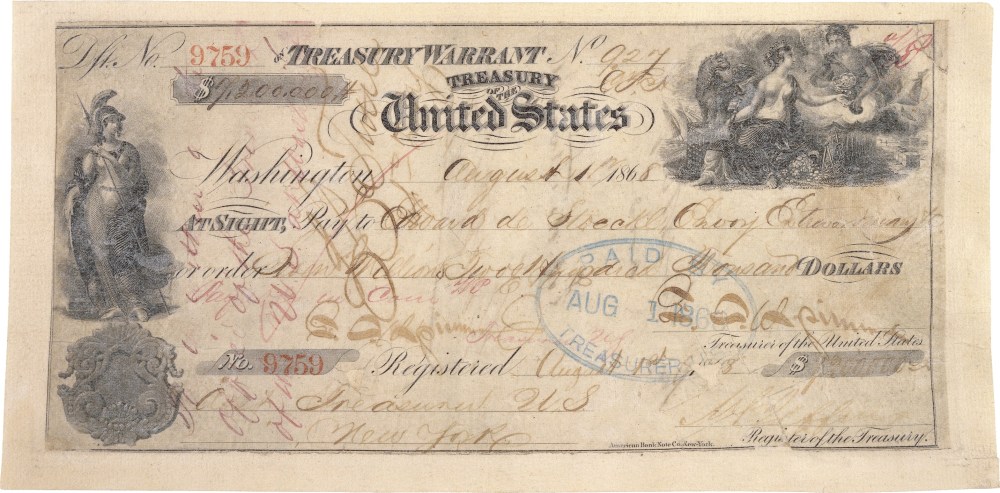
One hundred and fifty years ago, the US purchased Alaska from Russia. The Russians and the British were in competition for the region as a consequence of the Crimean War and the press of Canadians who were pushing north and west into a region with very few Russians. Russia also needed the money. The US purchased the territory in hopes of ultimately securing the entire West Coast from California all the way to Alaska, an aspiration which was never realized.
“Thousands of factories have been stolen from our country. But these voiceless Americans now have a voice in the White House.”
“Under my administration the theft of American prosperity will end.”
“We’re going to defend our industry and create a level playing field for the American worker, finally.”
It is not clear what actions President Trump has in mind, but the orders come just a week before he is scheduled to meet with Chinese President Xi Jinping. These discussions will likely be quite contentious and it would be a mistake to think that the Chinese would not respond to any actions it feels are unfair or uneven.
US Secretary of State Rex Tillerson is in Turkey, one of the members of NATO and an important US ally. Both sides wish to defeat Daesh (the Islamic State), but have serious disagreements about whether the Kurds should be allies in that fight. The dispute is coming to a head, as anti-Daesh forces are mobilizing to retake the city of Raqqa, Syria, which is a Daesh stronghold. Turkey regards the Kurds as a greater threat than Daesh, but the Kurds have proven to be very effective ground troops against them. In the absence of the Kurds, the US might have to substantially increase its own ground troop support.
The election of Donald Trump has raised serious questions among many US allies about the direction of US foreign economic policy. Not surprisingly, these questions have affected the International Monetary Fund (IMF) dramatically since the US is one of the largest supporters of the Fund and traditionally has been one of its most outspoken supporters. But the decision by US Secretary of the Treasury Stephen Mnuchin to excise all mention of free trade from the recent G20 declaration have left the policymakers in the IMF unsure of future US support. Germany has emerged as the strongest economy willing to speak out forcefully on behalf of liberal economic policies, and the IMF is working hard to nurture German economic leadership. We will have to see if Japan and South Korea decide to move closer to Germany in that role.
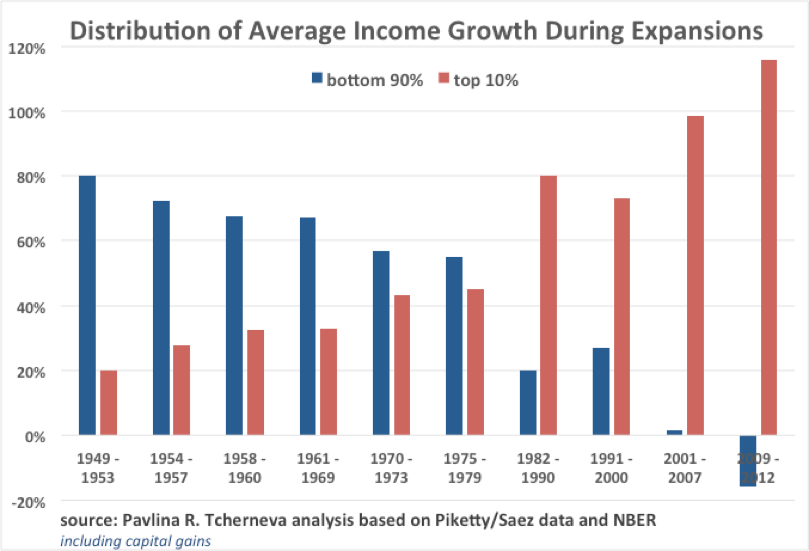
The growth on income inequality in the US (and in the world as a whole) since the 1970s is quite striking, but what is also striking is how different the pattern of the growth of income in the US has differed in that period from previous historical periods in the US. Pavlina R. Tcherneva has written a short essay on this phenomenon, and her conclusions are troubling:
“In sum, the growth pattern that emerged in the 80s and delivered increasing income inequality is alive and well. The rising tide no longer lifts most boats. Instead the majority of gains go to a very small segment of the population.”
This disturbing trend is not an accident but rather the consequence of discrete political decisions.