Archive for the ‘World Politics’ Category
US President Trump has fired Secretary of State, Rex Tillerson. It has long been known that Trump and Tillerson were not a good match (it is reported that Tillerson once referred to the President as a “moron”), but the termination comes rather abruptly. Tillerson was warned that his job was in jeopardy, but fund out officially via Twitter. Tillerson did not protect the personnel of the State Department which has seen a rather remarkable exodus of highly competent persons. Tillerson also supported the Iranian nuclear agreement (Pompeo, like Trump, is a fierce opponent) and has consistently supported diplomacy in the dispute with North Korea.
President Trump has named CIA Director Mike Pompeo as his next Secretary of State and has nominated Gina Haspel as the CIA Director. Haspel is a long-time CIA professional and is apparently highly regarded within the Agency. But she comes with a great deal of baggage. She was responsible for much of the torture (“enhanced interrogation techniques”) used by the CIA during the “war on terror”. That CIA program was soundly condemned by the Senate Select Committee on Intelligence in 2014. Dexter Filkins contextualizes Haspel’s appointment:
“Haspel, a career C.I.A. employee, took part in another of the agency’s darkest moments: the destruction, in 2005, of video tapes of the interrogation of Zubaydah and a second suspect, Abd al-Rahim al-Nashiri, at whose torture she was present, three years before.
“Because Haspel’s new job is exempt from congressional confirmation, it’s doubtful she will ever have to publicly answer questions about her role in what amounts to America’s dirty war.” [editor’s note: I thought that the CIA Director did require confirmation–I will check into this matter. It does, Filkins is wrong]
The appointment of Pompeo likely signals the end of the Iranian nuclear agreement which Pompeo has soundly condemned. It is highly unlikely that the other partners to the agreement will leave, so we will have to see what Iran does when it happens or if the US imposes new sanctions on Iran. But there is little question that the agreement has succeeded in its primary objective to at least delay the development of an Iranian nuclear bomb for at least ten years. Pompeo also favors a very hard line on North Korea. In an interview with CBS News he stated that he agreed with Trump’s objective of “the complete verifiable irreversible denuclearization of North Korea.” The words complete, verifiable, and irreversible are very high bars for any agreement and would require an intrusiveness that North Korea would never allow.
Yet another former Russian has been killed in Great Britain, an emigre named Boris Berezovsky. Last week, Sergei Skripal and his daughter were poisoned with Novichok, a poison developed by the former Soviet Union. British Prime Minister May gave the Russians a deadline of midnight Tuesday night to respond to the charge of attempted assassination. It is not clear what sanctions Great Britain may impose on Russia for the assault, but if they are to be effective, the EU and the US must support them. The Russian Foreign Ministry’s spokeswoman, Maria Zakharova, said in a televised interview: “no one can come to parliament and say: ‘I give Russia 24 hours.'” According to US News and World Reports, she also said that “Britain mustn’t try to scare Russia and pointed to Russian President Vladimir Putin’s recent speech in which he presented a range of new nuclear weapons.” Initially, President Trump did not fully endorse Prime Minister May’s accusation, but more recent reports suggest that he might be willing to blame Russia for the assassination.
On this day in 1947, US President Truman announced what would come to be known as the Truman Doctrine. The Truman Doctrine announced US support for democracies all over the planet. It was triggered by the belief that the Soviet Union was growing stronger and becoming more attractive to polities in Europe and in the newly decolonized states. The US was told by the British that they could no longer guarantee the security of the eastern Mediterranean and there were scattered uprisings in Turkey and Greece that were interpreted as Soviet-inspired. At that point in time, the defense of the emerging liberal international order, set up by President Roosevelt, was confined to the institutions created in 1944–the United Nations and the Bretton Woods institutions (the International Monetary Fund, the World Bank, and what we now call the World Trade Organization). Truman, stimulated by the fear of Soviet power, decided that the US needed to defend those institutions militarily. At that moment, the Cold War crystallized and would endure until the demise of the Soviet Union in 1991.

The Pew Research Center conducted a public opinion survey in 35 countries and found that in countries where people did not have a strong affiliation with a political party support for democracy was low. Competing political parties formed the bedrock of representative democracy and robust competition among parties was a key index of the health of a democracy. The finding is depressingly consistent with elections in liberal democracies since the Great Recession of 2008-09. Many of these elections were determined, not by support for a political party, but rather for those who claimed to be outside the mainstream of political parties. The erosion of these democracies blurs the distinction between liberal and illiberal states and it seems right now that illiberalism is becoming far more common.

One thing to watch carefully as a Trump-Kim summit is being considered is the reaction of China. The Chinese have historically supported North Korea and most certainly do not wish to see it disappear. But relations between China and North Korea have been difficult in recent years as Kim has forged a path for North Korea without consideration for Chinese concerns in East Asia. It would be very difficult to reconcile US and Chinese regional and hegemonic objectives in such a summit and the Chinese do not wish to be excluded from such an important meeting. At this point I doubt that the meeting will even be held, but the Chinese can probably be counted on to throw obstacles in the path of such a planned summit. The South Koreans are making every effort to keep the Chinese in the loop because they are acutely aware of Chinese sensitivities on the matter.
It is now official. China’s National People’s Congress eliminated term limits from its constitution giving current President Xi Jinping the right to rule indefinitely. The change is yet another setback for those of us who hoped that China would slowly establish a robust democracy. China’s censors have been working overtime to suppress any criticism of the change. The Malaysian newspaper, the New Straits Times describes the change as “further evidence of the world’s slide towards more nationalist, authoritarian regimes”. The censorship extends to virtually every space on the internet and includes blocking works by George Orwell and references to Winnie the Pooh who some Chinese believe Mr. Xi resembles.
President Xi Jinping

Enrique Krause has written a long essay on the situation in Venezuela for the New York Review of Books. Krause makes the argument that it is poor governance, not the collapse in global oil prices, that is responsible for the misery in Venezuela. His characterization of the lives of ordinary Venezuelans is stark:
“This is a humanitarian crisis of immense proportions. By May 2017, Venezuela’s minimum monthly wage wasn’t enough to meet even 12 percent of a single person’s basic food needs.2 A survey of 6,500 households by three prestigious universities showed that 74 percent of the population had lost on average nineteen pounds in 2016. Infant mortality in hospitals has risen by 100 percent. Diseases nearly eradicated in many countries, like malaria and diphtheria, have flourished; illnesses largely new to the area, like Chikungunya, Zika, and dengue, have spread. Caracas is now the most dangerous city on the planet. All this is happening in a country that has one of the largest oil reserves in the world.”
The villain in this story is Nicolás Maduro who took power after Hugo Chavez died in 2013. Maduro has crushed the opposition despite heroic and massive protests against his rule. Elections are scheduled for May, but the main opposition parties have vowed to boycott the vote.
A third state plagued by the rise of authoritarianism is Egypt. President Abdel Fatah al-Sissi is running for re-election and there is little evidence that there is an organized opposition willing to contest the election. The Washington Post describes the state of Egyptian politics:
“Over the past year, Sissi has intensified an assault on basic freedoms. Hundreds of websites deemed critical of his regime have been blocked. Extrajudicial killings are rising, human rights groups say. Countless opponents have been jailed, “forcibly disappeared” or sidelined in other ways, targeted often by security forces in the name of combating terrorism, especially a virulent Islamic State affiliate in the northern Sinai Peninsula.”
As in China, Egyptian authorities are trying to suppress the spread of unflattering news. The US appears to be unwilling to apply pressure on Egypt, despite lavishing it with significant foreign aid. Sissi runs few risks for dismantling Egyptian democracy.
There is still a great deal of ambiguity about the tariffs that President Trump has threatened on steel and aluminum. He has, however, claimed that “trade wars are good, and easy to win”. The historical record, however, does not support that characterization. The essential point about trade wars is that tariffs almost invariably invite retaliation and the tit-for-tat responses raise prices and reduce demand. Outside of Europe, most countries have held back in identifying specific retaliatory tariffs, but virtually every country has indicated that they will do so once it is clear how the US will implement its plans. One of the more interesting countries to watch is South Korea which has one of the most open trading arrangements with the US of any country outside of North America. South Korea has already been harmed by the US tariffs on washing machines, and will suffer significantly if the steel tariffs are levied on its steel. But the US also desperately needs South Korean cooperation in the ongoing dispute over North Korea’s nuclear program.
Trade wars are also related to actual military conflict. Trade does not always bring peace, but trade disputes often escalate into actual conflict if there is a power disparity between the trading partners. The Opium Wars between the British and the Chinese is perhaps the most obvious example, but there is also considerable evidence linking the trade wars in the early 1930s to the outbreak of World War II. The US decision to halt petroleum and iron ore exports to Japan in the 1930s likely tipped the political balance to the war factions in Japan.
The British Iron-clad Naval Vessels Outmatched the Wooden Chinese Ships in the Opium Wars

We are still trying to determine the consequences of the decision by the Chinese Communist Party to allow President Xi Jinping to stand for another election. Liberals bemoan the possible emergence of another authoritarian leader in the world who refuses to abide by norms that prevent personal power from determining the terms of governance. But the Chinese seem to think that their model offers a viable alternative to the chaos usually associated with democracy. Given the breakdown of democratic norms in the world at this point in time, there are many who are attracted to the possibility of a “Chinese model” for governance.
Patrick Smyth has written an op-ed piece for the Irish Times on the decline of social democracy in Europe. Smyth has a panoramic view of European politics, including his interpretation of the recent Italian elections, and his argument is sobering:
“Like it or not the consensus politics of the postwar years are coming to an end, surviving perhaps only in the renewed, weakened German coalition of Angela Merkel and the Social Democrats (SPD). The changing times are manifest in the previously taboo willingness of politicians to bring far-right, sometimes openly fascist parties, into governments from Austria to Greece to Finland.”
The collapse of the left and center-left has paralyzed democratic politics, and now most voters view the choices as between right and far-right parties. The problem is not so much that voters are attracted to the right-wing. They do not believe that the left has any vision for the future. Much of that disillusion has to do with the collapse of socialism in the 1990s. But one would think that the legacies of the Great Recession would have energized, not eviscerated, the left.
US President’s Trump’s announcement that he will accept an invitation from North Korean leader, Kim Jong Un, caught everyone by surprise. The invitation came after a South Korean delegation met with the North Korean leader, and those officials came directly to Washington to convey the invitation.
I honestly do not know how to assess this development. On the one hand, any attempt at diplomacy is to be welcomed, particularly after the fiery rhetoric from both sides in recent months. As I have indicated in previous posts, I think that the US recognizing North Korea as a nuclear power is the correct stance. It is a nuclear power and should be treated as such. Moreover, I think that North Korea has developed a nuclear capability not to attack anyone but to deter a US attack. One must deal with the world as it is.
On the other hand, I find it difficult to figure out what is actually going on. North Korea has tested six nuclear bombs and has tested a missile that comes close to intercontinental ranges. It remains unclear whether the North Koreans have miniaturized a warhead to fit on the missile and whether it has a guidance system sufficient to lend targeting capability. Thus, North Korea has come very close to developing a capability that can threaten the US homeland, a crucial attribute necessary for effective deterrence. It has, however, not conducted any tests since last November and, with the prospect of meeting President Trump sometime soon, it is unlikely to conduct any additional tests that might jeopardize the meeting.
It is also probably the case that President Trump’s rhetoric and his success in forging sanctions that have genuinely harmed the North Korean economy. Thus, Trump’s strategy has achieved short-term success in shifting North Korean strategy to a diplomatic track. That diplomatic track also makes it impossible for the US to launch an attack on North Korea but also gives North Korea additional time to further develop its capabilities.
President Trump’s decision to meet Kim also satisfies one of North Korea’s key objectives: to be treated with respect. Meeting the US President was an objective that Kim’s father and grandfather also desired but failed to realize. There is probably no way for Mr. Trump to meet Kim without treating North Korea as a legitimate state.
That is a critical concession by the US and much depends on what it gets in return. We have subsequently learned that Mr. Trump’s announcement was later modified by the White House Press Secretary, Sarah Sanders:
“Let’s be very clear. The United States has made zero concessions but North Korea has made some promises. This meeting won’t take place without concrete actions that match the promises that have been made by North Korea.”
Additionally, US Secretary of State Tillerson said:
“In terms of direct talks with the United States — and you asked negotiations, and we’re a long ways from negotiations….I don’t know yet, until we are able to meet ourselves face to face with representatives of North Korea, whether the conditions are right to even begin thinking about negotiations.”
These details will likely be worked out. President Trump is unlikely to back down from the meeting now, but he may find pressure building to attach preconditions that Kim will not be able to meet. The President is also hampered by the serious lack of Korean experts currently in the Administration.
We should all keep in mind that North Korea has broken promises to previous US administrations (See the 6 March post on this blog). The most recent broken promise was made to US Secretary of State Madeleine Albright in 2000. President Trump should also be aware that if he meets with Kim he must be prepared to offer concessions to North Korea if he expects North Korea to make concessions. Apparently, South Korea and the US have agreed that US aircraft carriers will not participate in the scheduled military exercises (and perhaps nuclear submarines as well), a significant concession that is not widely known. If he goes to the meeting with only the single objective of denuclearization, then the meeting will not succeed. First, the North Koreans define denuclearization in terms of the US-South Korean alliance so the US needs to know what the South Koreans are willing to concede. Second, denuclearization will be nearly impossible to verify without extremely intrusive inspections, something the North Koreans would be unlikely to accept. Inspecting a non-nuclear Iran was difficult; inspecting a country which may already have between 30-60 nuclear bombs would be very difficult.
President Trump should also be aware of the fact that denuclearization is an objective that no other country save Japan believes critically important. South Korean President Moon has already decided that diplomacy is the only route to better relations with the North. China and Russia have already accepted North Korea’s status as a nuclear power. So the US will be negotiating without allies supporting its singular objective. Moreover, there is substantial evidence that substantial portions of President Trump’s administration do not support any concessions to North Korea: the military, the intelligence community, and many Republicans.
With all these caveats in mind, I think the idea of a meeting is a worthwhile risk since I am not deeply troubled by North Korea’s status as a nuclear power. Perhaps Kim should think seriously about having a very dramatic and impressive military parade.
US President Trump has formally announced that the US will impose tariffs on imported steel and aluminum. I am not sure what the President signed today, but presumably it is a finding that the tariffs are being imposed to protect US national security. That authority comes from Section 232 of the Trade Expansion Act of 1962. The Commerce Department has submitted reports to the President that these imports do in fact jeopardize US national Security. The information provided by the White House, however, does not provide specific terms of the President’s order.
First, the information emphasizes the need to protect jobs in both industries. There is a national security aspect to employment in certain industries: trained workers need to be available in case of a national security. But the information briefing emphasizes the economic aspect of protecting jobs:
“The tariffs on steel and aluminum are anticipated to reduce imports to levels needed for these industries to achieve long-term viability.
“As a result, these industries will be able to re-open closed mills, sustain a skilled workforce, and maintain or increase production.
“The strengthening of our domestic steel and aluminum industries will reduce our reliance on foreign producers.”
Second, Canada and Mexico will be exempted from these tariffs, pending a renegotiation of the North American Free Trade Association (NAFTA). These two countries account for 27% of US steel imports and 42% of aluminum imports. It is hard to argue that Mexico and Canada pose a national security threat to the US and the size of the imports from these countries suggest that it would be very difficult to have a sizable impact on the economic viability of the two industries.

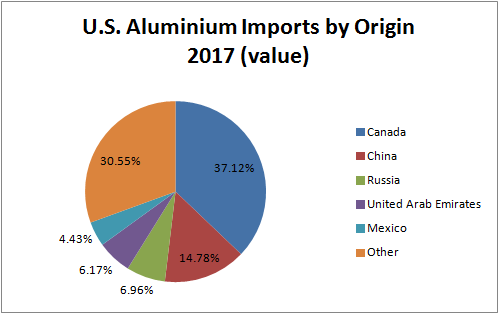
Third, the economic viability of these industries does not depend upon tariffs. The jobs losses in the steel and aluminum industries are more closely associated with automation, not imports. Additionally, aluminum smelters in the US have largely disappeared (there are only two left in the US) because of the environmental damage they cause (the same reason why there are so few oil refineries in the US).

Fourth, it is hard to imagine that US trading partners will not respond to these tariffs. The 11 countries who along with the US forged the Trans-Pacific Partnership until Mr. Trump withdrew US participation have announced that they are going to go forward with the trade pact and will invite China to join. The US will be shut out of the agreement which will certainly have a negative impact on US industries.
Fifth, Mr. Trump singles out China as the biggest offender in the world trading system. Yet Mr. Trump’s actions do not address China’s behavior in any way. As The Economist notes:
“But anti-dumping and countervailing duties have already shut most Chinese steel out of the American market. And the tariffs will alienate WTO members with which America might otherwise make common cause. In December 2017 America, the EU and Japan released a joint statement saying that they would work together to combat “market distorting and protectionist practices”—by which they meant “China”. That looks harder now. To add to the incoherence, America is no longer pursuing a WTO case against Chinese aluminium subsidies started by Barack Obama’s administration in 2017. Instead of helping keep China’s rise within the rules, Mr Trump is providing a distraction from it.”
Finally, the whole trade issue has not been framed in a way that accurately informs good decision-making. Much of Mr. Trump’s rhetoric is based upon selective interpretations of data that is complex and hard to document with hard evidence. The Washington Post has published a very good article on other ways to interpret the debate over the US trade deficit.
One of the most ambiguous developments in world politics is the advent of what we loosely call “cyberwarfare”. Did Russian meddling in the US presidential election of 2016 constitute what we have called in the past as an “armed attack” justifying acts of self-defense? Ryan Goodman has published an interesting essay on the ambiguities of interpreting cyberwarfare in the traditional framework of world politics. The essay is a very thoughtful one raising serious problems if one were to regard cyberwarfare in the same terms as traditional uses of “force”.
There is a US diplomatic mission in Turkey right now as the US tries to repair its relations with what was once regarded as a key NATO ally. Relations have been strained for a variety of reasons, but the major outstanding strategic difference right now is defining the US relationship to the Syrian Kurds who have fought well against ISIS but who the Turks regard as a serious threat. Many Syrian Kurds, along with Arabs who fought together as the Syrian Democratic Force, a US-sponsored alliance, have left the battle against ISIS and have moved into position in the Afrin region of Syria to support the Kurds there. The Kurds have shifted largely because the US is refusing to re-arm them and they feel betrayed by the US. For the Syrian Kurds, the battle for autonomy is far more important than the fight against ISIS. The Syrian government is moving to fill the vacuum created by the US move, and, in a major reversal, is now aiding the Kurds against Turkey.

A group of Indian scholars have been meeting to write a history of India that suggests that India is a Hindu nation. The committee was not publicly appointed but its final report is expected to be embraced by the current government led by Prime Minister Narendra Modi who can be accurately described as a Hindu nationalist. According to Reuters:
“Minutes of the meeting, reviewed by Reuters, and interviews with committee members set out its aims: to use evidence such as archaeological finds and DNA to prove that today’s Hindus are directly descended from the land’s first inhabitants many thousands of years ago, and make the case that ancient Hindu scriptures are fact not myth.
“Interviews with members of the 14-person committee and ministers in Modi’s government suggest the ambitions of Hindu nationalists extend beyond holding political power in this nation of 1.3 billion people – a kaleidoscope of religions. They want ultimately to shape the national identity to match their religious views, that India is a nation of and for Hindus.”
Needless to say, members of other religions are apprehensive about how the final report will affect their status in India. But the report reflects the growing exclusivity of nationalism in the world.
Religions in India

We are beginning to get some of the dynamics arising from the recent Italian elections. One possibility that has emerged is that the leader of the League Party, Matteo Salvini, may be tapped to form a coalition government. Salvini is as close to a clone to Benito Mussolini, the leader of Fascist Italy during World War II, as one could imagine. The Washington Post describes Salvini in these terms: “He says he wants to close mosques, bolster Italy’s borders and take sovereignty back from the European Union. He praises Russian President Vladimir Putin for promoting traditional family values.” Salvini has appropriated a favorite phrase of US President Trump and claims that he wants to put “Italy First”.
Matteo Salvini

South Korean envoys are reporting that North Korea has expressed its willingness to hold negotiations on the possible denuclearization of the Korean peninsula. South and North Korea have held face-to-face negotiations in 2000 and 2007, but this is the first time that the current North Korean leader, Kim Jong Un, has met with South Korean officials (that we know of). This news has been received by the US media as a significant move to reduce the tensions on the peninsula. There may be reasons to be optimistic, but I would urge caution. Such negotiations have been held in the past and the Congressional Research Service has a well-documented survey of the history of those negotiations. But the history is not encouraging:
“The United States has engaged in four major sets of formal nuclear and missile negotiations with North Korea: the bilateral Agreed Framework (1994-2002), the bilateral missile negotiations (1996-2000), the multilateral Six-Party Talks (2003-2009), and the bilateral Leap Day Deal (2012). In general, the formula for these negotiations has been for North Korea to halt, and in some cases disable, its nuclear or missile programs in return for economic and diplomatic incentives. While some of the negotiations have shown progress, North Korea has continued to advance its nuclear and missile programs.”
First, we only have the report of the South Koreans. I am sure those envoys are honest and sincere, but they are representing the current President, Moon Jae-in, who ran for office supporting a policy of engagement, not hostility toward North Korea. President Moon has a clear stake in making progress. We should wait to see what the North Korean report on the meetings say.
Second, North Korea is still working on its nuclear facilities. 38 North, a website maintained by the US-Korea Institute of Johns Hopkins University, is reporting that
“Commercial satellite imagery of North Korea’s Yongbyon Nuclear Scientific Research Center from February 25 indicates that the 5 MWe reactor continue to show signs of operation as indicated by steam vapor plumes emanating from the generator hall and river ice melt near the reactor. Under normal operations, we would also expect to see a cooling water discharge near the river outfall. And while vapor plumes have been noted a few times over the past year, no cooling water discharges have been observed to support this conclusion. However, we cannot rule out that the North Koreans may have suppressed this signature by extending the discharge pipe into the river. If the reactor is operating again, as the evidence suggests, it means North Korea has resumed production of plutonium presumably for its nuclear weapons program. It also means that the North has likely extended its cooling water pipeline into the river (rather than near the river) to better conceal the reactor’s operational status, making monitoring efforts more difficult going forward.”
Third, we do not have a clear idea of how North Korea defines “denuclearization”. In the past, North Korea has insisted that the US and South Korea cease its joint military exercises. The North Korean press, which is state-controlled, quotes the South Korean negotiator on how North Korea defines its interests:
“’The North clarified its will to denuclearize the Korean peninsula, and made it clear that there is no reason to possess nuclear weapons if the security of the North Korean regime is guaranteed,’ South Korea’s chief envoy to the talks Chung Eui-yong said.”
If the North Koreans define “denuclearization” in terms of the guarantee that the North Korean government will not be threatened, then the entire US-South Korean defense alliance comes into question. it may ultimately involve the removal of the 30,000 US troops in South Korea. It may be that his outcome is precisely what US President Trump wants. Many years ago he was quoted as saying:
“‘I keep asking, how long will we go on defending South Korea from North Korea without payment?’ More recently he noted that when ‘the young man from North Korea starts acting up and having one of his fits, we immediately get our ships going. We get our aircraft. We get nothing for this.’”
I am certain, however, that such an action would be viewed with alarm by many analysts, particularly if there was no way to verify totally the North Korean commitment to destroy its nuclear arsenal and its knowledge base that fosters that nuclear program. The Chinese and the Russians would be delighted; the Japanese would be alarmed. The North’s nuclear program has always been characterized by fits and starts.
Fourth, one can easily interpret North Korean behavior in recent months as simply one designed to buy time. We know that North Korea has exploded six nuclear bombs and has tested a missile that puts its missile program at the outer reaches of US territory. There really is no urgency to continued testing at this time and a great risk to continue testing. The North Koreans have agreed not to test while plans are being put into operation for another South-North summit in April. Time is really on the side of the North and not on the side of the US.
Having expressed these doubts, the possibility that there may be an easing of tensions should be pursued vigorously. Buying time instead of waging war (which seems to be the only two possibilities for President Trump: “the U.S. is ready to go hard in either direction!”) is the far better choice.
Kim Jong Un, right, greets Chung Eui-yong in North Korea

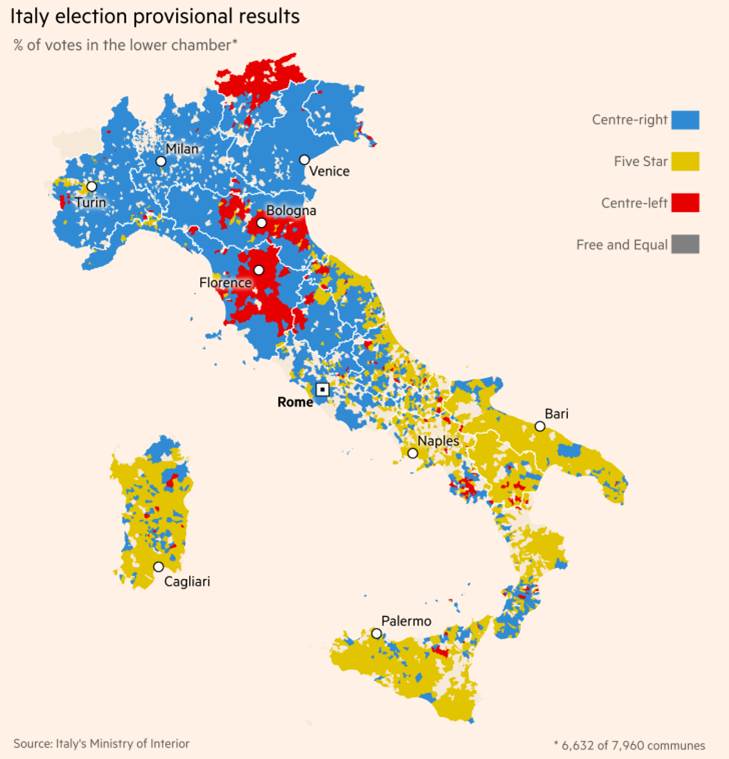
The Italian election produced no clear winner, but demonstrated the strength of anti-establishment sentiment in Italy. The 5-Star Movement and the League garnered the most votes, but not enough to form a coalition government. Nor does it seem as if the two parties are really interested in working with each other. The traditional parties seem to have been completely repudiated by the electorate. The League, formerly known as the Northern League, is an anti-immigrant party led by Matteo Salvini who managed to attract support in the south and is adamantly opposed to the European Union. Italy’s difficulty is that these two parties will not work with each other, so forming a new government will be extremely difficult. The European Union, relieved that Merkel will continue in Germany, will now have to wait for Italy to decide how it will interact with the Union.
North Korean leader, Kim Jong Un, met with South Korean officials in Pyongyang, the North Korean capital. The North-South dialogue continues even as the official US position remains uncertain. There is some ambiguity over whether the US is demanding that North Korean denuclearization is a precondition for further negotiations or whether the US is merely insisting that North Korea show a willingness to discuss denuclearization. The difference may sound minor, but the North Koreans will not accept denuclearization as a precondition for discussions.
U.S. Trade Representative Robert Lighthizer has warned that negotiations to redraft the North American Free Trade Agreement (NAFTA) with Mexico and Canada have slowed down without an agreement in sight. US President Trump’s recent announcement concerning tariffs on steel and aluminum has complicated the negotiations tremendously, and the issue was further clouded by statements that perhaps Canadian and Mexican steel and aluminum could be exempted from the tariffs. I suspect that Canada and Mexico did not appreciate the heavy-handed approach to the negotiations and will be less likely to make concessions under such a threat.
The economic and political situation in Venezuela has reached a breaking point under the rule of President Maduro. The inflation rate is the highest in the world, economic growth is at a virtual standstill, and basic commodities are simply not available. As a result, Venezuelans are feeling the country. According to The Washington Post:
“Nearly 1 million Venezuelans have left their country over the past two years, according to the International Organization for Migration, with experts citing a surge during the second half of 2017, when the economy took a sharp turn for the worse. That figure is in addition to the hundreds of thousands who departed between 1999 and 2015.
“Our migration levels are now comparable to Syria or to [the Rohingya going to] Bangladesh,” said Tomás Páez, an immigration expert at the Central University of Venezuela. More than 1 million Syrians, Afghans, Iraqis and others fleeing war and poverty poured into Europe in 2015, and 650,000 Rohingya Muslims have recently fled persecution in Burma, seeking refuge in Bangladesh.”
The other Latin American states and the international community as a whole have ignored the crisis because of an unwillingness to intervene in what has traditionally been defined as an internal matter. The Trump Administration, however, seems to be interested in fostering a regime change in Venezuela, which, if true, would be a disaster. Having said that, the world should not shirk from what is clearly a humanitarian crisis.

After six months of deliberation and debate, the Social Democratic Party (SPD) of Germany has voted to join Chancellor Angela Merkel’s governing coalition. The vote in the SPD was overwhelming, testimony to the concessions Merkel was obliged to give up in return–six ministerial posts. Nonetheless, the months of wrangling have weakened Chancellor Merkel in the eyes of the public. The decision was also greeted with relief in the European Union although it is still waiting for the results of the Italian election being held today.
One of the more interesting developments in the global balance of power is the growing strategic relationship between Russia and Iran. The two have never coexisted easily–Iran has always felt threatened by the expansive growth of its northern neighbor. The two countries share a common interest in Syria because they both support the continuation of President Assad’s rule. As that goal becomes more likely, many of us had anticipated that Russia and Iran would become more adversarial over how Syria would be ruled. But the hostility of the US to both states seems to have overcome their natural suspicion of each other. It seems that “the enemy of my enemy is my friend” now rules their foreign policy in the region.
 World Politics News