Archive for the ‘World Politics’ Category
Israeli Prime Minister Benjamin Netanyahu made a Powerpoint presentation outlining what he termed were Iranian “lies” about it nuclear program. The Prime Minister claimed that Israeli agents raided a warehouse in Tehran last January which contained “55,000 printed pages and 183 compact discs” dating back to 2003. We do know that Iran had an active nuclear weapons program from 2003-2007 even though it was a signatory to the Non-Proliferation Treaty (NPT). The NPT does not, however, ban research on nuclear weapons, merely the possession of nuclear weapons, and the Iranian weapons program was stimulated by the US invasions of Afghanistan in 2001 and Iraq in 2003. Prime Minister Netanyahu did not produce any evidence that Iran had violated the Joint Comprehensive Plan of Action (JCPOA) which committed Iran to end its enrichment program in 2015. All evidence, including the assessments of the US Departments of State and Defense, as well as the International Atomic Energy Agency, have certified that Iran has been in full compliance with the JCPOA. The presentation was clearly an attempt by the Prime Minister to influence US President Trump’s decision whether to de-certify the JCPOA on 12 May. Netanyahu’s presentation followed an air strike against Syria on Sunday that actually registered as a 2.6 magnitude earthquake. The strike was against a munitions depot and a number of Iranians and Iraqis were killed. No state has claimed responsibility for the strike, but most analysts believe that Israel conducted the attack.
Thirty days ago, US President Trump announced tariffs on imported aluminum and steel but gave affected countries 30 days to negotiate better terms on their trade with the US. That deadline expires at midnight tonight (I hope to be fast asleep at that time). South Korea agreed to renegotiate, but all other countries rejected the US demand, including important US allies in Europe. So tomorrow morning I will wake up to find out whether a trade war has begun. Europe has been quite emphatic that it will retaliate if the tariffs are imposed, and their threatened tariffs are carefully selected to affect politically sensitive products exported from key US states. Late News: The Washington Post has published an article stating that Trump will defer his decision until 1 June. No trade war tomorrow.
Jeff Tollefson has written a remarkable review of current climate change policies for the journal Nature. He examines a variety of different policies with respect to energy alternatives and acknowledges that the world has been making remarkable strides toward the development of renewable energies. But economic growth in many emerging economies is still dependent on fossil fuels and Tollefson notes that
“So it was in 2017, when, after staying relatively flat from 2014 to 2016, carbon emissions grew by about 1.5% (see ‘A brief lull’). All it took to create that spike was a small rise in economic growth across the developing world, according to a final estimate released in March by the Global Carbon Project, an international research consortium that monitors carbon emissions and climate trends.”
The trade-off between economic growth and climate change still seems to be weighted in favor of increased carbon emissions since it is unlikely that states will forego economic growth voluntarily. That relationship has to change if the world is to avoid serious climate change.
/cdn.vox-cdn.com/uploads/chorus_asset/file/10748751/jz_climate_scenarios.png)
The Republican Party of Armenia (RPA) has announced that it will not nominate a candidate for Prime Minister, leaving the post open for Nikol Pashinyan who led the protest movement against a bid to keep the RPA’s candidate, Serzh Sargsyan, in power for an illegal third term. Russia, which is always a factor in Armenian politics (Armenia was once part of the former Soviet Union), was favored by Sargsyan and, even though Pashinyan has tried to remain neutral on relations with Russia, it is highly likely that Russia fears a significant loss of influence in the country. Pashinyan has called for Parliamentary elections on 1 May to form a new government.
Protests in Armenia

North Korean leader Kim Jong-un has invited outside inspectors to visit the Punggye-ri test site to verify that it will be closed down. Kim announced that the testing facility would be closed down prior to a formal agreement with South Korea and the US, a rather astonishing move. The Punggye-ri site was used for all six of North Korea’s nuclear bomb tests, but it is widely believed that the site is seriously damaged and may no longer be usable. But there have been reports of activity at the site which suggests that the government may be trying to rehabilitate the site. It is very difficult to tell what the significance of the North Korean announcement may be.

Peter Beinart has written an interesting article for The Atlantic which argues that even though Iran has not violated the Joint Comprehensive Plan of Action (JCPOA), the US has more than likely violated it. The agreement calls on all parties to facilitate the reintegration of Iran into the global economy as the earlier sanctions against the country are lifted. Beinart gives evidence that the US has not complied with these clauses and that the Trump Administration has in fact made it more difficult for Iran to interact with its trading partners for such commodities as aircraft parts. Iran has always complained about US adherence to the agreement, but few countries have taken it seriously.
Military tensions continue to rise around the island of Taiwan. China has been conducting military exercises around the island in order to send a message to the Taiwan authorities that any move toward independence will spark a crisis. According to Global Times:
“Chinese aircraft including H-6K bombers and fighter jets flew around Taiwan recently after passing over the Bashi Channel and Miyako Strait, according to the People’s Liberation Army [PLA] Air Force. Wu Qian, Chinese defense ministry spokesman, warned if Taiwan independence forces continue to wantonly take rash actions, the PLA will take further steps.
“The live-fire exercises in the Taiwan Straits and the flights around Taiwan conducted by the PLA to specifically target Taiwan independence forces in recent days have shocked the island. Still some separatists attempted to embolden themselves by hyping their US support.”
The US has stepped up its activities as well. It is sending out B-52 bombers to maintain a continuous presence in the South China Sea. According to the US Air Force:
“The B-52Hs conducted training and then transited to the vicinity of Okinawa to conduct training with USAF F-15C Strike Eagles, before returning to Guam……Continuous Bomber Presence (CBP) missions are intended to maintain the readiness of US forces. The US Pacific Command’s CBP missions, which have been routinely employed since March 2004, are in accordance with international law.”
President Trump’s nominee for Commander of the Pacific Command, Admiral Philip Davidson, testified before the US Senate Armed Services Committee on 17 April 2018. His view of Chinese military capabilities in the Pacific was sober:
“The outcome of war is never certain, and I have increasing concerns about the future. China has undergone a rapid military modernization over the last three decades and is approaching parity in a number of critical areas; there is no guarantee that the United States would win a future conflict with China….China will be able to extend its influence thousands of miles to the south and project power deep into Oceania. The PLA will be able to use these bases to challenge U.S. presence in the region, and any forces deployed to the islands would easily overwhelm the military forces of any other South China Sea-claimants. In short, China is now capable of controlling the South China Sea in all scenarios short of war with the United States.”
These rising tensions so far have not been linked by either side to either the North Korean issue or the trade issue. But such compartmentalization could easily erode if Taiwan forces the issue.

Last July, India and China squared off over a piece of disputed territory called Doklam near the borders of Bhutan, India, and China. But Indian Prime Minister Modi met with Chinese President Xi yesterday and they apparently worked out an arrangement that diffused the tension. The Times of India described the meeting:
“Though the Doklam stand-off took place in Bhutanese territory disputed by China, it was an attempt to unilaterally change the status quo in violation of the understanding reached between India and China. India pointed out that the existing ‘tri-junction boundary points’ between India and China and any third party will be ‘finalised’ in consultation with the countries concerned”.
Xinhua also emphasized the cooperative outcome of the meeting, referring to statements by President Xi:
“He said, in developing relations between major countries, China upholds strategic autonomy as well as non-conflict and non-confrontation, and insists on building a new-type of international relations featuring mutual respect, fairness and justice, and win-win cooperation, which are in line with the Five Principles of Peaceful Co-existence jointly advocated by China and India in the 1950s.
“Xi stressed that in the next stage, China and India should jointly plan for all-round cooperation, carry out closer strategic communication, and timely conduct consultation on major issues of common concern, so as to take a firm hold of the general direction of bilateral relations and ensure the effective operation of their dialogue mechanism.”
Relations between India and China have been tense over the last few years, as India has become more apprehensive by China’s growing strength and ambitions in the Belt and Road Initiative. This summit meeting was an important one for both countries, but the dynamics of Great Power rivalry will undoubtedly resurface again.

The US is mounting a drive to encourage its allies to impose sanctions on Iran for its missile program. The Iranian missile program is not covered by the Joint Comprehensive Plan of Action and Iran insists that its program is necessary for its defense. The new US Secretary of State, Mike Pompeo, is in Saudi Arabia making a pitch for additional sanctions, but Saudi Arabia does not trade at all with Iran so it is unclear what measures it could take. The new sanctions campaign suggests that the US does not believe that its allies will stand with it in a bid to renegotiate the JCPOA.
North Korean leader Kim Jong-un and South Korean President Moon Jae-in had face to face meetings in the Demilitarized Zone, marking the first time a North Korean leader has set foot in South Korea. The visual images of the meeting conveyed unmistakably optimistic vibes and the official communiques were laced with promising aspirations. The two signed a document called the Panmunjom Declaration which announced that “South and North Korea confirmed the common goal of realizing, through complete denuclearization, a nuclear-free Korean Peninsula.” Similar documents have been signed in the past, but this is the first time that Kim Jong-un has signed a document that had as its goal the elimination of a nuclear arsenal he has worked so hard to create (and which was largely responsible for all this diplomatic movement). Many of us remain highly skeptical that the US and South Korea share the same definition of denuclearization with North Korea. In his press conference with German Chancellor Angela Merkel,US President Trump made it very clear that he is heavily invested in his upcoming meeting with Kim. According to Jonathan Swan: “He came into office thinking he could be the historic deal maker to bring peace to the Middle East. He’s stopped talking about that. There’s very little point. The peace deal looks dead and cremated. But Trump wants to sign his name even larger into the history books, and he views North Korea as his moment.” If Swan is correct, then Trump is thinking about the upcoming summit in terms that place him a very weak bargaining position.
Kim Jong-un and Moon Jae-in Embrace in Panmunjom


The Jerusalem Post is reporting that Russia is going to provide Syria with its S-300 anti-aircraft missile system, considered by many analysts to be quite formidable. The Israelis are very concerned that the S-300 system will compromise its ability to interdict weapons deliveries from Iran to Hezbollah, the Iranian ally in Lebanon. The conflict between Iran and Israel is unquestionably heating up and the anti-aircraft system is considered a direct threat by many Israeli officials. Iran has threatened to “punish” Israel for its attack on a military base in Syria which killed Iranian military personnel. Reuters is quoting Israeli Defense Minister, Avigdor Lieberman, in a stern warning to Iran not to establish itself in Syria: “Every outpost in which we see Iran positioning militarily in Syria, we will destroy, and we will not allow this no matter what the price”.

Serzh Sargsyan had ruled Armenia for 10 years–two consecutive 5-year terms as President. The constitution did not allow him to run for a third term, but the Armenian Parliament changed the constitution to provide for a Prime Minister in order to allow Sargsyan to continue to rule in a different office. Sargsyan was installed as Prime Minister on 17 April, but the people of Armenia protested massively against what they regarded as a naked grab for power and the protests ultimately led Sargsyan to step down. A new election is scheduled for 1 May and the opposition leader, Nikol Pashinyan, is expected to be named Prime Minister. But allies of Sargsyan in Parliament are waging a move to have Karen Karapetyan named Prime Minister. The political turmoil is of great interest to Armenia’s neighbor, Russia, which has two military bases in the country which might be in jeopardy if Pashinyan is elected. We will have to see if Russia tries to influence the outcome of the election.

While French President Macron was visiting Washington, DC there was some talk of “updating” the Iranian nuclear deal (the Joint Comprehensive Plan of Action (JCPOA)) to address US President Trump’s concerns about Iran’s missile testing and its support for Hezbollah and Hamas. It was unclear whether these concerns would be folded into the original JCPOA or whether a new agreement would be added to the JCPOA. Both Russia and China, however, have firmly rejected both possibilities. The Arab News quotes Russian Foreign Minister Sergei Lavrov: “There are attempts to interfere with the international order upon which the United Nations depends…..We said clearly with China that we will stop attempts to sabotage these agreements that were passed in a UN Security Council resolution”.
We still do not have many details about the proposed meeting between Kim Jong-un and Donald Trump, but there is one thing that we do know: the central point of these negotiations will be over the meaning of the word “denuclearization”. It is a new word (apparently) with no set definition. Fred Kaplan has written an essay on the different possible meanings of the word, highlighting the ways Kim and Trump have variously interpreted the word. Kaplan argues that Kim’s definition is that it is a process that should occur over a long period of time with reciprocal and synchronized steps by both sides toward the ultimate goal of eliminating the presence of nuclear weapons on the Korean peninsula. Trump, however, believes that it is a precondition for further contacts between the US and North Korea.. The two definitions are profoundly divergent. There are possible ways to make them compatible, but those ways are incredibly nuanced and subtle. It remains to be see if both men have the appetite for such delicate diplomacy.
Sharun Mukand and Dani Rodrik wrote a paper in 2015 entitled “The Political Economy of Liberal Democracy” (NBER Working Paper No. 21540, Issued in September 2015) which articulates a very difficult balancing act for all liberal societies that embrace democratic voting systems: “societies are divided by two potential cleavages: an identity split that separates a minority from the ethnic, religious, or ideological majority, and a wealth gap that pits the rich against the rest of society….The depth and alignment of these divisions determine the likelihood of various political regimes. The possibility of liberal democracy is always undercut by illiberal democracy at one end and what we call “liberal autocracy” at the other, depending on whether the majority or the elite retain the upper hand.”
The difficulty in maintaining the balance between the rights of minorities and the preferences of the majority is clear:
“Liberal democracy is inherently fragile because reconciling its terms does not produce a natural political equilibrium. When elites have sufficient power, they have little interest in reflecting the preferences of the public at large. When the masses mobilize and demand power, the resulting compromise with the elites rarely produces sustainable safeguards to protect the rights of those not represented at the bargaining table. Thus, liberal democracy has a tendency to deteriorate into one or the other of its perversions – illiberal democracy or undemocratic liberalism.”
The essay is definitely worth reading and highlights some of the conundrums facing liberalism today in powerful clarity.
Since 2002 the organization, Reporters Without Borders, has published its World Press Freedom Index which measures the degree of press freedom in most countries in the world. In 2018 Norway had the greatest degree of press freedom and North Korea came in last, in 180th place. The overall scores reflect lesser degrees of press freedom overall, as the press has become the object of scorn in a number of countries which traditionally had prized press freedom. The top ranks for 2018 are as follows:
- Norway
- Sweden
- The Netherlands
- Finland
- Switzerland
- Jamaica
- Belgium
- New Zealand
- Denmark
- Costa Rica
- Austria
- Estonia
- Iceland
- Portugal
- Germany
The US came in at #45 in the world. I suspect that most Americans would be surprised at its low rank as well as by many of the countries that have greater press freedom.
It is very difficult to assimilate much of what was said by US President Trump in today’s press conferences. He referred to the nuclear deal with Iran as “insane” and “ridiculous” even as his guest, French President Macron was hailing the agreement as viable and successful. He further threatened Iran if it restarted a nuclear enrichment program if the US pulled out of the agreement: “If Iran threatens us in any way, they will pay a price like few countries have ever paid.” The Iranian Foreign Minister, Mohammad Javad Zarif, responded by saying that “”If the United States were to withdraw from the nuclear deal, the immediate consequence in all likelihood would be that Iran would reciprocate and withdraw…..There won’t be any deal for Iran to stay in.” Zarif also warned North Korea from making any agreements with the US if the US withdraws from the nuclear agreement. Bizarrely, Mr Trump changed his rhetoric about North Korean leader Kim Jong-un who he had earlier referred to as “Rocket Man”. Today he said: ““Kim Jong Un, he really has been very open and I think very honorable from everything we’re seeing.” Finally, Mr Trump flicked some dandruff off Macron’s shoulder in front of the press, saying “We have to make him perfect”.
Did You Get Your Invitation to Tonight’s State Dinner at the White House? (Click to Enlarge)

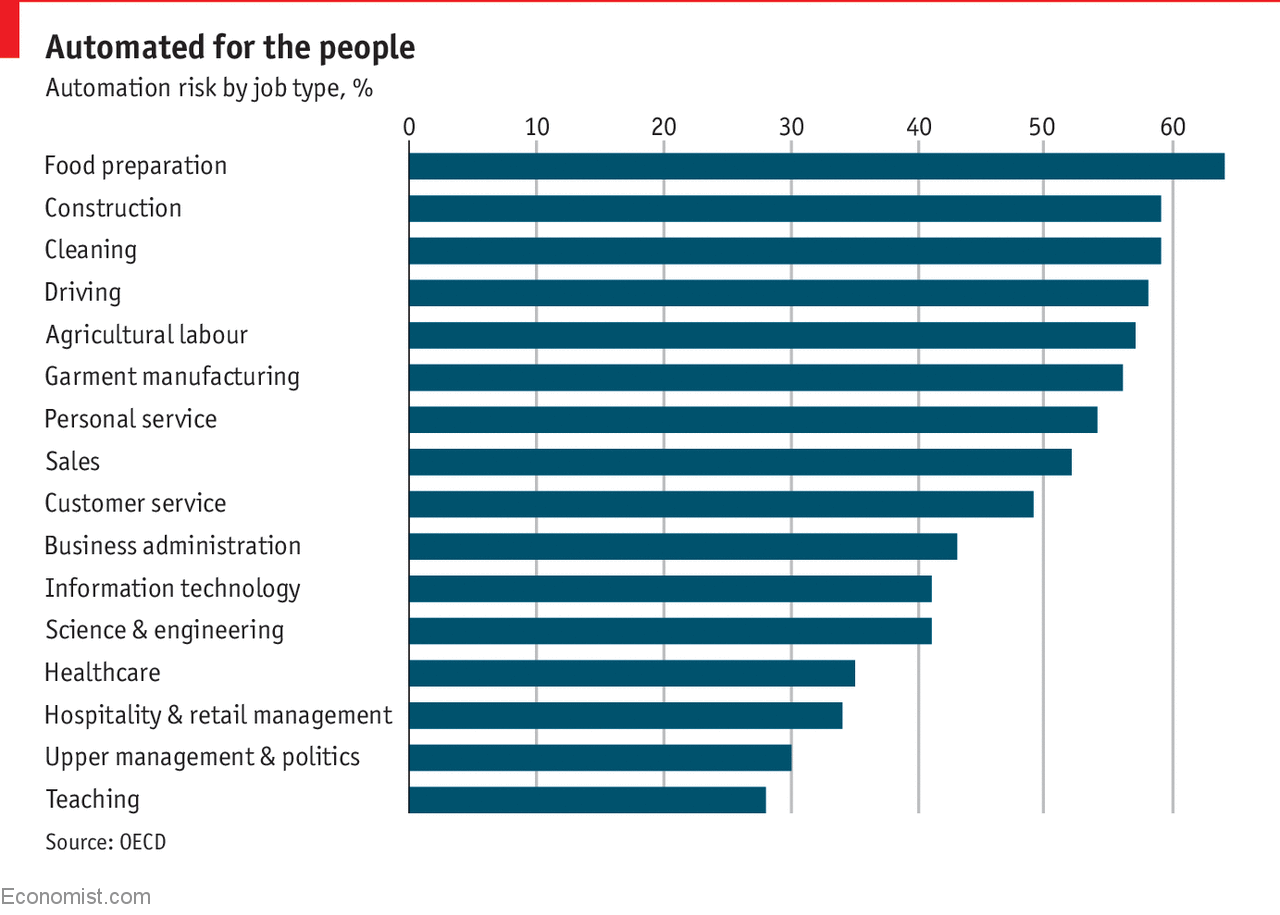
The Organisation for Economic Cooperation and Development (OECD) has published a new paper entitled “Automation, skills use and training“. The paper is based on “the risk of automation…for the 32 OECD countries that have participated in the Survey of Adult Skills (PIAAC) so far.” The findings are unsettling:
“Across the 32 countries, close to one in two jobs are likely to be significantly affected by automation, based on the tasks they involve. But the degree of risk varies. About 14% of jobs in OECD countries participating in PIAAC are highly automatable (i.e., probability of automation of over 70%). Although smaller than the estimates based on occupational titles obtained applying the method of Frey and Osborne (2013) this is equivalent to over 66 million workers in the 32 countries covered by the study. In addition, another 32% of jobs have a risk of between 50 and 70% pointing to the possibility of significant change in the way these jobs are carried out as a result of automation.”
These findings are consistent with earlier studies that came to similar conclusions. But the paper also found one deeply unsettling result which has not been noticed before: “A striking novel finding is that the risk of automation is the highest among teenage jobs. The relationship between automation and age is U-shaped, but the peak in automatability among youth jobs is far more pronounced than the peak among senior workers. In this sense, automation is much more likely to result in youth unemployment, than in early retirements.” This conclusion has profound political implications since youth unemployment is highly correlated with political unrest.
I am supposed to be commenting on events of momentous significance, but there are some news stories that are simply irresistible in their stupidity. Scientists have discovered that the seventh planet in the solar system has clouds that are made of hydrogen sulfide. Or, to use the common tongue, those clouds smell like human flatulence. In other words, according to Time magazine, “Uranus smells terrible”. I sincerely apologize.
Uranus

Patrick Iber has written a fascinating essay for the New Republic on the meanings of the term, “neoliberalism”. He goes through the lineage of the term which he traces to the collapse of the Austro-Hungarian Empire and brings us up to contemporary meanings. The essence of his argument is that that perspective on market capitalism is incompatible with representative democracy. He writes:
“What neoliberalism misses or ignores is that a world of apparently neutral rules is still a world of power inequalities. When capital has more freedom than people, serious democratic deficits are guaranteed. Voters may prefer a strong welfare state, but they may get austerity instead. In many nations, including the United States, the power of money in politics gives concentrated wealth a sword to hold over democracy’s neck. As the wealthy exert ever more influence over the political process, we may be closer to William Hutt’s plan for weighted voting than we would probably admit. In the neoliberal view, this is how it is supposed to work. It is, in Hayek’s language, the “discipline of freedom.” But it makes the goal of achieving relative equality through democracy very difficult.”
Democracy and capitalism started and grew up together as fundamental pillars of liberal society. They may have evolved into incompatible institutions or they each may have been implemented incompletely or poorly. That question is worthy of deep consideration.
French President Emmanuel Macron is in Washington today for US President Trump’s first state dinner. The two leaders apparently have a good relationship (I have been struck by how many media outlets refer to Macron as “The Trump Whisperer”), but Macron came with a message from his European allies and Russia: do not pull out of the Iranian nuclear deal. President Trump has to declare on 12 May whether he will certify that Iran has upheld the terms of the agreement. Mr. Trump does not support the agreement and his nominee for US Secretary of State, Mike Pompeo, who also opposes the agreement, was approved by the Senate Foreign Relations Committee. Mr. Pompeo is likely to be approved by the full Senate very soon.
Microplastics were discovered in 60 per cent of wild flathead grey mullet consumed by Chinese people. The fish bottom-feed and the plastic fragments often sink to the bottom of the ocean where the fragments end up in the digestive systems of the fish. There have been similar findings in a variety of fish species as people continue to be careless in disposing of plastic which does not easily degrade–Hong Kong resident throw away 5.2 million plastic bottles every day. I suspect that we would find similar amounts in fish all around the world.
Wild Flathead Grey Mullet


Scott Ritter was one of the UN inspectors prior to the invasion of Iraq in 2003. At the time he did not believe that Iraq was developing weapons of mass destruction, the argument used by the George W. Bush Administration to justify the overthrow of Saddam Hussein. He has written a very detailed analysis of the evidence used by the US, France, and Great Britain used to justify the recent attack on Syria. Ritter has an extraordinary amount of information that raises serious questions about the way the evidence to support the attack was assembled and interpreted. The article is a great example of investigative reporting which will likely not receive the attention it deserves. Another analyst, Paul Pillar, who worked at the US CIA at the time of the Iraq invasion and who argued that the evidence supporting the invasion was “cherry-picked” has written an essay on the “non-accomplishments” of the Syrian strike. He argues that:
“But a glaring fact in the recent history of the Syrian war is that one year ago the Trump administration fired a salvo of cruise missiles for the same ostensible purpose, and that attack evidently failed to have much, if any, deterrent effect on Assad. The administration is emphasizing that the new attack, which used 105 missiles, is larger than the earlier one, which used 59. So 46 more cruise missiles is supposed to make the difference between deterring or not deterring a regime fighting to defeat rebels and regain control of its country’s territory?”
The two essays together raise serious questions about whether the US has anything close to a policy on the conflict in Syria.
Iran’s Foreign Minister, Mohammad Javad Zarif, said that one of Iran’s options if the US pulls out of the nuclear agreement–the Joint Comprehensive Plan of Action–signed with Russia, China, Great Britain, France, and Germany, would be to restart its nuclear program. US President Trump has threatened to pull out of the agreement unless the parties can fix what he describes as “flaws” in the agreement: 1) that Iran stop its missile development program; and 2) that Iran stop funding Hamas and Hezbollah which the US considers terrorist organizations. Zarif made the statement in an interview with CBS News. A resumption of nuclear enrichment by Iran would likely precipitate a harsh reaction from Israel, an ominous development since the two countries are already at the brink of war. The oil markets are also nervous if the US re-imposes oil sanctions on Iranian oil if the US pulls out of the agreement.
Fadi al-Batsh, a Palestinian engineering lecturer, was assassinated in Malaysia and there is speculation that the Mossad, the Israeli intelligence organization, was involved in the killing. Batsh was reportedly a member of Hamas, the Palestinian group in control of the Gaza Strip and which is currently involved in widespread protests against Israeli control in the Gaza. Israel did not comment on the speculation but The Times of Israel stated that “Israeli reports said the dead man was an expert on attack drone and rocket systems.” Hamas charged that Israel was “internationalizing” the Israeli-Palestinian dispute.
A Poster of Fadi al-Batsh being Hung in the Gaza Strip

Every year the World Bank publishes the World Development Report which summarizes the Bank’s views on the global economy particularly as it affects poorer countries. The Guardian has published an article on a working draft for the bank for this year’s Report which proposes “lower minimum wages and greater hiring and firing powers for employers as part of a wide-ranging deregulation of labour markets deemed necessary to prepare countries for the changing nature of work.” Labor groups have sharply criticized the draft which apparently regards the diminishing power of labor as an inevitable consequence of globalization and automation. Let’s hope that this draft is significantly changed before it is adopted by the Bank as official policy.

Adam Mount and Ankit Panda have written an excellent article raising many questions about North Korea’s declaration that it would stop nuclear bomb and missile testing. The article outlines all the issues that were not covered by the declaration and some of them–like the issue of enriching uranium for additional nuclear bombs–are likely to be highly contentious. If the negotiations with US President Trump are to be effective, these issues have to be very specifically and tightly nailed down.

