In 1935, Sinclair Lewis published a book entitled It Can’t Happen Here about the election of a Fascist President in the United States. It is a creepy read (and not a particularly good book, but I do not think that Lewis really wanted to write great book–just a book with an important warning to Americans. Americans very rarely think about Fascism in the US, but that is due to willful amnesia. Former President Trump’s rally in Madison Square Garden reminded some of the Nazi rally that was held there in February 1939.
Nazi Rally at Madison Square Garden, 20 February 1939
The Nazi movement grew out of the virulently racist period after the Civil War that spawned the Jim Crow laws that institutionally segregated African-Americans. We are familiar with the images of the Ku Klux Klan, but there was a more explicit movement marrying fascism with institutionalized racism which was known as the Black Legion:
“The Black Legion was a spinoff of the so-called Second Ku Klux Klan, which flourished in the 1920s, fusing anti-Catholicism and antisemitism with anti-Black racism. Strongest in the North — with 500,000 members in Ohio alone — it fell apart by the decade’s end in the face of internal scandals and public denunciations. A doctor in Bellaire, Ohio, named William Shepard founded the Black Legion in 1924. He painted KKK robes black and added pirate imagery and an even greater obsession with militarism and secrecy. By 1935 the Black Legion had grown to hundreds of thousands of members nationwide, largely in the Upper Midwest but spreading to at least 21 states. No one really knows how big it was.”
The Regalia of the Black Legion
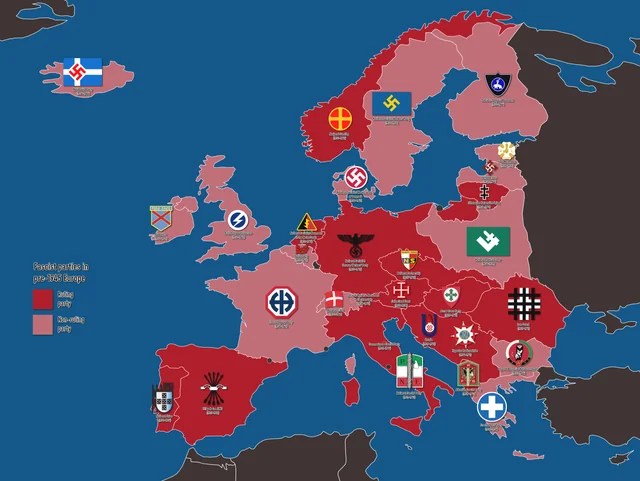
The Black Legion grew as Fascism became prevalent in Europe in the early 20th Century. It was a dynamic movement, starting with the first Fascist state in Italy in 1920 (although one could argue that Hungary was actually the first after the collapse of the Soviet Republic of Hungary founded by Béla Kun). By 1940, the only European states not ruled by a fascist party were Great Britain and Switzerland (one could argue that the Swiss worked closely with the Nazis). It was an amazing transformation in the space of only 20 years, counterbalanced by the emergence of the communist brand of totalitarianism in the Soviet Union.
Map of Fascist regimes in Europe in 1940
As Americans vote today, we should all be reminded of the Fascist history in the US. It is not necessarily a fluke in American culture, but rather a persistent presence. It can happen here.
Israel continues to force Palestinians to leave northern Gaza. Mondoweiss reports:
“Israel’s siege and offensive on northern Gaza have been ongoing for 20 days, as part of what has been described as the implementation of Israel’s ‘Generals’ Plan,’ which aims to forcibly depopulate northern Gaza through deliberate starvation and extermination. Although the Generals’ Plan doesn’t include plans for settler colonization of the area after its ethnic cleansing, far-right Israeli politicians and settler groups have been advocating for settling Gaza since December of last year.
“On Monday, Israelis rallied at Kibbutz Be’eri 3 kilometers away from Gaza’s fence demanding to be allowed to settle in the Strip. The rally was attended by several Israeli ministers, according to Israeli media. Reports indicated that some 700 Israeli families at the event had signed up to move to the prospective Israeli settlements in Gaza.
“Northern Gaza was home to some 700,000 Palestinians before October 7, 2023. According to estimates, some 200,000 Palestinians continue to live in the area, which includes Jabalia, Beit Lahia, Twam, Sheikh Zayed, and Beit Hanoun.”
The “Generals’ Plan refers to a plan devised by Israeli Major General Giora Eiland, although parts of the plan have always been part of Netanyahu’s overall strategy in the Gaza. The plan, however, is most explicit on the forced relocation of Palestinians to southern Gaza. Middle East Eye reports:
“Once Palestinians have been removed from northern Gaza, which the plan anticipates will take a week, the second phase can proceed: the transformation of northern Gaza into a closed military zone.
“The area will, says the plan, be subject to a ‘full and tight blockade, which includes preventing movement to and from it, and preventing the entry of supplies, including food, fuel and water’.
“Anyone remaining will be treated as a combatant. The plan’s YouTube video states that the Hamas operatives who remain can choose to ‘surrender or die of starvation’. After that, ‘it will be possible to enter and cleanse the area of Gaza City with almost no enemy’.”
Middle East Eye interviewed Abdullah al-Muqayid, a resident of Northern Gaza, who eventually left for the south. The report is chilling:
“After an interrogation that lasted until sunset, the Israeli army ordered the residents to evacuate to the southern Gaza Strip. However, reluctant to leave northern Gaza entirely, they moved to the adjacent Gaza City instead.
“‘One of the phrases the soldiers told us was, ‘Go south; you will never return to the north. The north will be ours, and we will build settlements there,'” he said.
‘There were martyrs and wounded people whom no one could help along the way’
“But we came to Gaza City. Along the way, there was a massive number of soldiers and tanks as far as the eye could see, as if they were invading a country, not merely civilians and unarmed individuals. We saw the bodies of martyrs on the ground, with dogs mauling them.”
“Muqayid managed to leave Gaza City, but he had to leave his elderly mother behind.
“She remained in Jabalia; she cannot leave, she cannot walk such a long distance and face the humiliation and insults we faced.”
The “Generals’ Plan” is not official policy of the Israeli government at this point, but The Times of Israel reports that in a recent meeting between US Secretary of State Blinken and Israeli Prime Minister Netanyahu, the Prime Minister refused to rule it out publicly:
Prime Minister Benjamin Netanyahu and his top aides sidestepped US Secretary of State Anthony Blinken’s request during a meeting Tuesday to publicly clarify that Israel is not seeking to lay siege to northern Gaza, a US official tells The Times of Israel.
Netanyahu and Strategic Affairs Minister Ron Dermer insisted during the meeting that Israel is not implementing the so-called General’s Plan aimed at isolating northern Gaza and argued that claims to the contrary have been detrimental to Israel’s public image, the US official says.
Blinken urged Netanyahu to clarify this publicly, but he and his aides demurred, the official adds.”
The Generals’ Plan is a clear violation of the Geneva Accords which forbids the forcible displacement of civilians in any occupied area. It is also completely inconsistent with US foreign policy which still calls for a “two-state” solution to the dispute between Israel and the Palestinians. But Netanyahu likely sees the coming months as a window of opportunity: Americans are transfixed by the upcoming presidential election and the period between election day and the inauguration is a very difficult time to make significant foreign policy changes. Further, Netanyahu probably thinks that, if Israel quickly makes the annexation of northern Gaza a fait accompli, a President Trump would approve and a President Harris would be powerless to dislodge Israel until after inauguration, at which point US opposition would be moot.
The Generals’ Plan is not possible without US continued support. That support has two components: massive military and financial assistance; and the US missile interceptor systems which prevents Hamas, Hezbollah, and Iran from inflicting heavy civilian casualties in Israel. Both are indispensable to the Generals’ Plan, but the US protective shield gives Netanyahu the freedom to do whatever he, or his right- wing cabinet members, Ben-Givr and Smotrich, want.
The US is a clear accomplice in this crime. If Netanyahu had to worry about significant civilian casualties (on the scale of the near 43,000 identified Palestinians bodies, not to mention the bodies buried under the rubble in Gaza), I doubt that he would currently be bombing the Gaza, Lebanon, Syria, Yemen, and Iran with such abandon.
This circumstance places the US in a very delicate moral dilemma. In order to restrain Netanyahu, the US should lift its protective missile shield and allow civilian casualties at a scale necessary to change Netanyahu’s calculations. But that tactic is morally indefensible: innocent civilians cannot be used as a diplomatic tool. The US needs to continue to shield Israeli civilians.
The alternative is to use the military and financial support as a bludgeon. Netanyahu would then have to calculate how long he could continue the military operations without the infusion of weapons and wealth. That course of action lacks the immediacy of the costs of civilian casualties, but Netanyahu has got to start worrying about the long-term capabilities of Israel without US support.
In order to implement this tactic, US President Biden should immediately announce the suspension of US support unless Netanyahu publicly commits to no annexations of land in the Gaza and in the West Bank and the establishment of a viable Palestinian state. It is long past time for the US to indulge Netanyahu’s political survival which is dependent on Ben-Givr and Smotrich. And the US needs to more vigorously pursue its own foreign policy interest which is a peace based on the two-state solution.
It is often good to look at news stories that are supported by journalists who are allowed to report directly from a conflict zone. No US media sources are allowed in the Gaza Strip by order of the Israeli government. Most US citizens are unaware of the desperate circumstances of the people in the Gaza because of this blackout.
As we approach the one-year anniversary of the brutal Hamas attack on Israel, the conflict is also nearing a critical point in the escalation cycle. After the Iranian missile attack last Tuesday, Israeli Prime Minister Netanyahu declared that:
“This evening, Iran again attacked Israel with hundreds of missiles. This attack failed. It was thwarted thanks to Israel’s air defense array, which is the most advanced in the world. I commend the IDF for the impressive achievement. It was also thwarted thanks to your alertness and responsibility, citizens of Israel. I also thank the US for its support in our defensive effort.
“This evening, Iran made a big mistake – and it will pay for it. The regime in Tehran does not understand our determination to defend ourselves and to exact a price from our enemies…
“We will keep to the rule we have determined: Whoever attacks us – we attack them.
“This is true wherever we fight the axis of evil. It is true in Judea and Samaria. It is true in Gaza, Lebanon, Yemen and Syria – and it is also true in Iran. We are fighting the axis of evil everywhere, including in southern Lebanon and Gaza, where our heroic soldiers are active.
“Today, more than ever, the forces of light in the world must unite and work together against the ayatollahs’ dark regime, which is the source of terror and evil in our region. They must stand alongside Israel. The choice has never been more clear, between tyranny and freedom, between the blessing and the curse.”
Both Israel and Iran face a very serious problem–their efforts to deter each other have failed. Iran thought that by arming Hamas and Hezbollah, Israel would not take actions to endanger their citizens. Further, Iran believed that its missile forces would deter Israeli action against Iran. Israel proved these assumptions to be incorrect. Israel believed that its anti-missile systems, buttressed by US forces in the region, would lead Iran to believe that a missile attack on Israel would fail. That assumption is less certain now than it was before 7 October.
Both Hamas and Israel miscalculated. Many observers, including me, were shocked by the intensity of the Israeli response to the 7 October atrocity. And many, including me, believe that the Israeli response in the Gaza (and now in Lebanon) to be wildly disproportionate. After the Iranian missile attack last April, which consisted of about 300 missiles most of which were intercepted by the Israeli and US forces, Israel determined that its civilian population was sufficiently protected to permit extensive Israeli military actions, including the missile attack on Tehran which killed the leader of Hamas, Haniyeh. But that assumption now looks to be problematic.
The Iranian missile attack last Tuesday consisted of 200 missiles, but about 20 of those missiles actually hit Israeli military bases., suggesting that the Israelil missile defense was not as robust as was assumed. The Israeli Defense Force first announced that the Iranian attack had been unsuccessful and that damage was minimal. But National Public Radio quotes Jeffrey Lewis, a professor at the Middlebury Institute of International Studies at Monterey:
“Lewis notes that although over 30 missiles landed inside the base perimeter, the damage caused was still somewhat limited. That’s notable because Iran is believed to have used some of its most advanced Fattah missiles.
“‘Even these missiles, which look substantially more accurate, still struggled to do damage,’ he says.
“Still, he thinks the attack has shown that Iran can strike at targets well inside Israel. ‘They can definitely get missiles through,’ he says.”
If Iranian missiles can penetrate the Israeli missile defense system, then the Israeli civilian population is at risk. The missiles on Tuesday struck Israeli military bases. Iran clearly made a decision not to target civilian population centers. One such missile hitting a city like Tel Aviv or Haifa could be damaging (but not catastrophic), and would change the calculations of acceptable losses for Israel.
There are, however, questions to be raised before the expected Israeli counterattack. The Iranians launched 300 missiles last April, but only around 200 on Tuesday. That difference is significant. It could signal that Iran’s response to the assassination of Nasrallah was not so important and that the Iranians felt they could be restrained. Or it could be that Iran was trying to preserve as much of their missile force as possible for future asttacks. Or it could mean that Iran was only trying to get a better read on the effectiveness of Israeli missile defenses. I personally believe thats Iran’s decision to avoid population centers was a clear signal that Iran did not wish to provoke a major escalation, even though it was bound to retaliate for the assassination of Nasrallah.
Now Israel has to send some messages as well. Interestingly, US President Biden indicated to journalists that he did not think the Israelis should attack the nuclear facilities in Iran, nor should it attack the oil production centers in Iran. An attack on Iranian population centers would be roundly condemned by most in the world. So Israel has to think about what message it wishes to send to both Tehran and Washington.
There are other considerations as well. The Israeli missile defense system is mostly effective, but it is truly expensive. Offensive missiles are reltively cheap; defensive missiles require a great deal of infrastructure,, including extensive radar systems and very sophisticated targeting mechanisms. Offensive missiles can be used for a variety of targets. Defensive interceptor missiles have only one objective, but an objective that has to be perfectly targeted to be considered a “success”. The drain on the Israeli economy will be substantial and Israel’s economy is already suffering from the costs of the war. The Economist reports:
“Stronger economic growth would ease the pain. Although reservists have returned to work and consumption has returned to pre-war levels, Israel’s economy remains smaller than it was on the eve of war. Mr Smotrich has cushioned the least productive parts of society and starved industry of resources. The labour market remains ultra-tight, with the unemployment rate at just 2.7%. Firms are struggling to fill vacancies and Israel’s small high-tech companies are under strain. They are losing out on funding owing to the war, warns Startup Nation, a local think-tank.
“Some 80,000 Palestinian workers were denied permits after October 7th, and have never been replaced. As a consequence, the construction industry is 40% smaller than it was this time last year, greatly impeding housebuilding and repairs. For now, the biggest impact has been on inflation, which hit an annual rate of 3.6% in August, having accelerated over the summer. Should the scale of Hizbullah attacks increase, the lack of construction workers will become an even bigger problem….
“Then there is the nightmare scenario. Few investors are preparing for a war that would engulf all of Israel, including Jerusalem or Tel Aviv—even though Hizbullah may be capable of launching such an attack. In these circumstances economic growth would be hit hard, perhaps even harder than after October 7th. Army outgoings would soar. Fleeing investors would probably topple banks and send the shekel plummeting, forcing the Bank of Israel to intervene and spend its reserves.
“Whatever happens, Israeli economists are resigned to things getting worse. Even Mr Smotrich, generally a bullish type, now emits an air of exhaustion: ‘We are in the longest and most expensive war in Israel’s history.’ Previous conflicts have come at a heavy cost to Israel. Do not be surprised if this one does, too.”
Israel is also free to ignore President Biden’s caution, but the price of that tactic could be substantial. Prime Minister Netanyahu has already ignored several US proposals for a cease-fire, and the cumulative effect of indifference to US preferences could lead many in the US to consider Israel to be an unreliable ally–a problem that could get very difficult for Netanyahu if Kamala Harris wins the Presidential election. In many places in the world, Israel is already becoming a pariah nation.
Finally, a massive Israeli counterattack would send a clear message to Iran that its reliance on conventional weapons is dangerous. A unfortunate paradox of Israeli miltary prowess is that it may lead Iran to the decision that its only effective defense is to build a nuclear weapon–exactly the most troubling scenario nettling the Israeli defense establishment.
Deterrence has failed for both sides. Re-establishing deterrence is a very tricky business, fraught with the possibility of serious misreadings of intentions or inaccurate calculation of risks and costs. Israel’s response to Iran will determine the course of this wretched conflict.
Israeli Prime Minister Netanyahu has established Israel as a rogue state with no red lines. It has attacked the Gaza Strip, Syria, Lebanon, Yemen, and Iran with few repercussions to its own security. And it has launched these attacks with no hints whatsoever as to what would be acceptable terms of peace. Consider: the Gaza Strip has been almost completely destroyed and its inhabitants do not know how the devastation might stop. The US and its allies have all stated that the only possible resolution to the conflict would be the implementation of a two-state solution. Netanyahu has explicitly rejected this approach, according to the New York Times:
“Prime Minister Benjamin Netanyahu of Israel doubled down on his opposition to the creation of a Palestinian state this weekend, again rebuffing pressure from President Biden to agree to that path after the war in Gaza is over.
“My insistence is what has prevented — over the years — the establishment of a Palestinian state that would have constituted an existential danger to Israel,” Mr. Netanyahu said in a statement in Hebrew on Sunday. “As long as I am prime minister, I will continue to strongly insist on this.”
“The statement reiterated comments he made on social media the previous day, when he said in Hebrew that he “will not compromise on full Israeli security control of the entire area west of the Jordan River — and that is irreconcilable with a Palestinian state.”
Because it has offered no alternative, Israel only offers continued occupation, and it demands that the “elimination” of its enemies is the price that the Palestinian people have to pay for those terms if they want peace. And now the same terms are being offered to Lebanon, Syria, and Iran. Moreover, there are apparently no limits on how Netanyahu defines “elimination”. The current war in Gaza was precipated by a heinous Hamas attack that killed 1,200 Israelis but the counterattack on the Gaza has killed almost 42,000 Palestinians, the majority of which are women and children. The disproportionate ratios are also reflected in the losses suffer by the Lebanese in the current escalation, as demonstrated graphically byBloomberg:
The one-sidedness of this conflict means many things, but the one point most relevant to any possible settlement is that the terms of a settlement acceptable to Israel is the complete and utter capitulation of the Palestinian people and that Israel is willing to kill as many people and to attack any state required to achieve that capitulation.
As I have argued before, Israel is only able to follow this strategy because the US continues to arm and financially support Israel with no conditions and that the US is willing to provide the necessary shield to prevent any Israeli civilian losses from attacks from any state in the region. The attack on the Hezbollah headquarters in Beirut was likely done by a 2,000 pound bomb supplied by the US, even though President Biden had earlier banned the export of such bombs to Israel because of their indiscriminate destruction. The Israeli air strike against Yemen yesterday was especially significant because it was a difficult mission that demonstrated the geographic reach of Israeli power as described by The Jerusalem Post:
“Until July, the IDF had outsourced responses to the Houthis to the US, which was fighting the group over various maritime aggression issues. However, after the Houthis killed a civilian in Tel Aviv, the Jewish state struck back directly for the first time.
“During Israel’s July counterstrike, it took two hours and 50 minutes for the IDF’s F-15s, F-35s, and other fighter jets, which carried out around 10 airstrikes against the Houthis, to reach their targets in the Hodeidah Port area. Those aircraft took off around 3 p.m. on July 20 and struck their targets around 6 p.m.
“Although the IDF kept classified the exact number of aircraft it used to refuel its fighter jets to make the 1,800-kilometer flight and return safely during that July attack, it provided a dramatic video showing some of the mid-air refueling in real-time.
“Sunday’s flights and refueling were equally complex, intended to completely destroy the Houthis’ capability (as opposed to a partial cut in July) to receive refined products, including weapons, from Iran.”
The significance of the attack was not in the destruction it caused in Yemen, but rather the message sent by Israel to Iran that it had the capability to attack Iran (also because the Saudis allowed Israel to use its airspace to make the flight). Reuters highlights Netanyahu’s objective:
“Israel warned Iran on Monday that nowhere in the Middle East was beyond its reach and hinted at a land invasion of Lebanon after assassinating the leader of the Tehran-backed Hezbollah group, one of its biggest adversaries, in a Beirut suburb last week.
“‘There is nowhere we will not go to protect our people and protect our country,’ Prime Minister Benjamin Netanyahu said in a three-minute video clip in English that he addressed to the Iranian people.”
The Iranians have taken actions, such as hiding high-ranking officials, in anticipation of such an attack. I doubt, however, that the Iranians want such a war–the country is weak economically and suffering from drought, a weak economy, and questions about the legitimacy of the regime. More importantly, however, Iran does not have a viable military option. As long as the US is committed to the aerial defense of Israel, there is probably nothing that the Iranians could do do change Netanyahu’s determination to eliminate Israel’s enemies. This is particularly true given that Israel has demonstrated that its has pierced Iranian intelligence by its assassination of Ismail Haniyeh right in the heart of Tehran. Israel also compromised the communications network of Hezbollah by its bold tactic of planting explosives in the pagers and walkie-talkies of Hezbollah activists.
There is, however, one course of action open to the Iranians. It could take to heart the lesson of the fate of the “axis of evil” identified by US President George W. Bush after the 11 September attack on the US. The axis consisted of Iraq, North Korea, and Iran. Iraq had no nuclear weapons and was invaded by the US in 2003 and its government was overthrown and the country occupied by the US for a number of years. North Korea, on the other hand, did have nuclear weapons and does not have to worry about an attack by the US or its allies. The lesson seems clear: if one is worried about an attack by a state that is militarily superior and has indicated that it has no constraints on the use of force, then possession of a nuclear weapon is the best defense.
I sincerely doubt that Iran wants a nuclear weapon. The late Ayatollah Khamenei, the Supreme Leader of the Islamic Republic, called nuclear weapons inconsistent with Islam in 2010. But Iran exists in a dangerous neighborhood. Some of its closest neighbors–Russia, China, India, Pakistan, and Israel–already have nuclear weapons and the US is constantly patrolling the Persian Gulf with ships that are nuclear-capable. Iran unquestionably has the capability to develop a nuclear weapon. but would have to develop a nuclear weapon secretly so that Israel would not launch a pre-emptive strike against its nuclear facilities. A nuclear test conducted by Iran would quickly raise the costs of any Israeli action against it. The outcome of a nuclear Iran is decidedly against Israel’s and the world’s interest. But territorial integrity and sovereignty are attributes without which a state cannot exist, and Israel is currently threatening both of those attributes.
The US must immediately announce that it is suspending all military and financial assistance to Israel until Israel puts forth a proposal for the two-state solution that effectively creates the opporunity for the Palestinians to exercise their inherent right of self-determination. That aspiration will never die no matter how many leaders in Hamas, Hezbollah, Yemen, and Iran that the Israelis succeed in assassinating. This has been the official position of the US ever since the war in 1967, and it is second only to the Cuban Embargo as a bootless policy–it is an objective that has been purely rhetorical and meaningless to the countless number of people who have died in the region. Fifty-seven years is a very long time for a power to remain impotent, and Netanyahu has apparently no compunction to disregard American counsel or interests.
The situation is reminiscent of the difficulties the US had in floating peace proposals during the Vietnam war. In 1972, the US had reached agreement with North Vietnam on a cease-fire, but South Vietnamese President Thieu rejected the proposal as a “surrender to the Communists”. Rather than using its formidable levers to change Thieu’s mind, the US instead chose to amplify its military commitment to South Vietnam and the war expanded and dragged on for two more years. President Nixon chose the military path because he did not wish the US to appear as a “pitiful, helpless giant”. The US became a hostage to its weaker ally and many died because of US inaction on the diplomatic front. In the immediate case, choosing a diplomatic path is the only effective course of action. The US must clearly tell Netanyahu that that path is the only one it will support even as it promises to defend Israel against any attack on its territory, but it will not support any further expansion of the war.
Like Thieu, Netanyahu can ignore the US, but the US needs to make clear to its ally that it means what it says. If Israel wants to continue the carnage, then the US should no longer be an accomplice to the war crimes being committed. Israel is a sovereign state and the US should not dictate to Israel what it should do. But Israel also should not tell the US that it has to support actions that do not serve US interests.
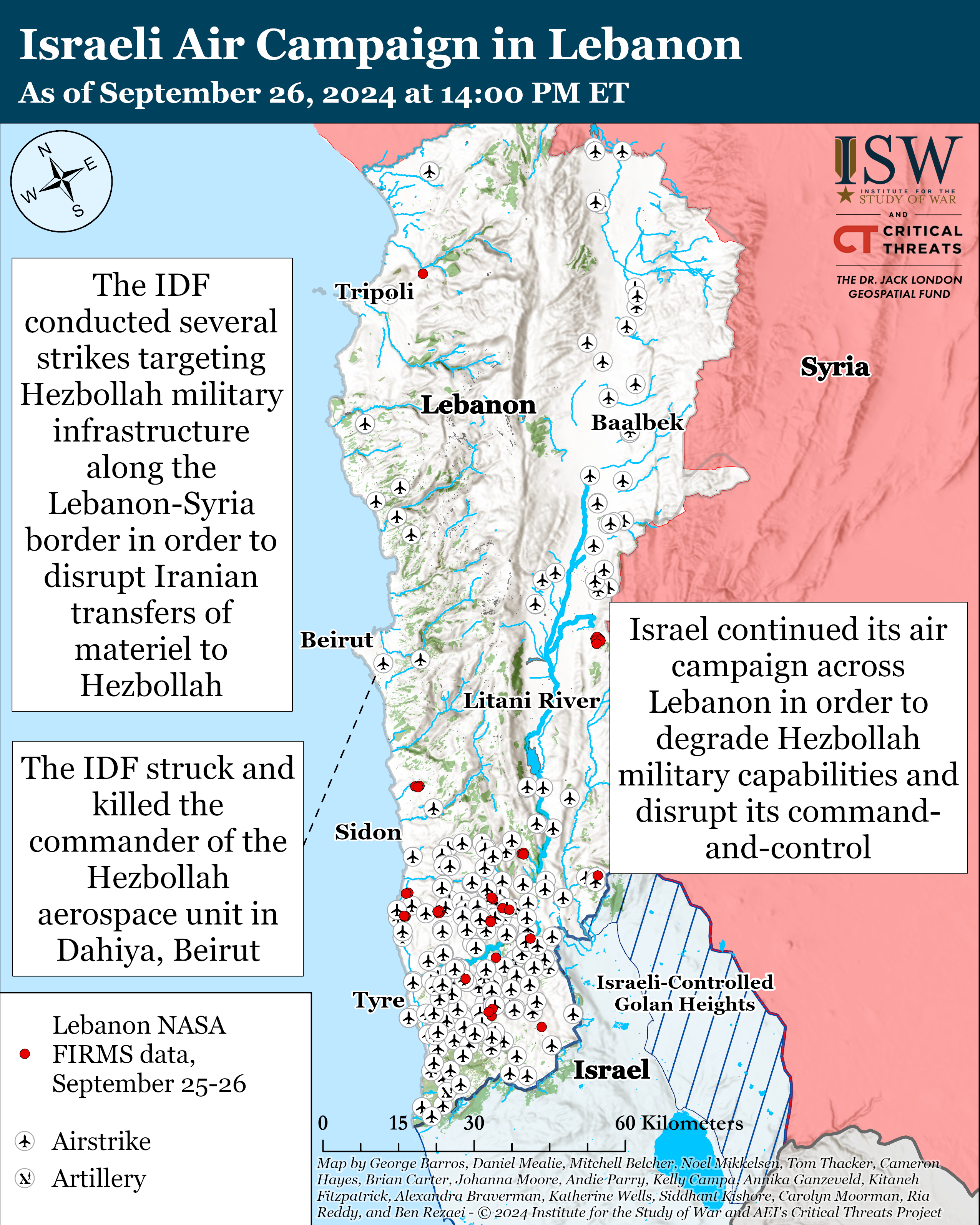
Israel dramatically escalated the conflict in the Middle East by bombing what it called the headquarters of Hezbollah in Beirut, killing the leader of Hezbollah, Hassan Nasrallah, as well as Gen. Abbas Nilforushan, one of the prominent generals in Iran’s Revolutionary Guard. The timing of the attack was impeccable: the Israeli Knesset is in recess until 24 October and the US in nearing its Presidential election which make any dramatic change in US policy unlikely. The US was not forewarned about the attack and it came as Israel rebuffed US efforts to forge a temporary cease-fire between Hezbollah and Israel.
Hezbollah has long been opposed to the state of Israel and there have been many clashes between the two entities which included Israeli occupation of southern Lebanon in 1982, an event that led to the formation of Hezbollah and an occupation that lasted 20 years. That occupation was a disaster for Israel–it was very costly in lives and expense–and it settled nothing: “In 1982, tens of thousands of Israeli soldiers were sent into Lebanon. About 650 Israeli soldiers were killed in the fighting and another 750 during the subsequent occupation. That makes it Israel’s third costliest war, after 1948 and 1973.” [that article was published in 2006 and does not include the expense of the current war].
There is little sympathy for Hezbollah in the world, but in 2018 Lebanese election, Hezbollah and its allies gained a majority in the Parliament (but lost the majority in the 2022 election). So we are not just talking about a terrorist organization but also a major political actor in Lebanon. The US and its European allies will not shed any tears about the killing of Nasrallah, but all Israeli allies are worried about what the next step in the conflict may be.
It seems likely that both Iran and Hezbollah will respond in force, but neither side has any good options given the Israeli defenses and the willingness of the US to provide additional air defense protection. THe failure of an earlier Iranian attack, in which it launched almost 300 missiles which were mostly intercepted, makes anything other than a massed missile attack likely to fail. Such an attack would likely require attacks against population centers which would outrage the world. But Iran and Hezbollah lack the ability to make effective attacks aginst specific military targets in Israel. Neither Iran and Hezbollah can afford to appear impotent if they wish to maintain their ability to organize opposition to Israel.
While there may not be an effective response to the Israeli attack, it is also not clear what Israel has gained through this attack. Both the US and Israel have a fixation on assassinating individuals in hopes of affecting the dynamics of the long-standing conflict. Israel has been remarkably successful in killing people it believed were involved in terrorist activities. Wikipedia has a list of those killed by Israeli forces and it is extensive (too long to reproduce here).
But killing individuals is not the same as addressing the root causes of the violence. Nasrallah is dead, but does anyone doubt that Hezbollah will find a new leader? Indeed, the ranks of Hezbollah have probably increased as a result of the Israeli attacks. And, if Israel invades Lebanon to ssecure its border, how long will the Israeli occupation last?
Israel has seemingly unlimited resources ot fight its wars and the US offers Israel almost airtight protection against counterattacks. Netanyahu obviously believes that more war is the right course of action for Israel. Perhaps Netanyahu should be reminded that there is a real possibility that its allies will withdraw their support unless Netanyahu begins to pursue policies that lead to peaceful resolution.
Israeli Prime Minister is clearly provoking Hezbollah into a broader regional war. Since the 7 October attacks by Hamas on Israel, there has been a persistent low-level conflict at the Israeli-Lebanese border. But the Israelis have escalated the conflict throught the introduction of the booby-trapped pagers and walkie-talkies and the direct aerial attack on Beirut. These actions comes on top of the Israeli attacks against Hezbollah and Hamas leaders in Syria and Iran. In short, Israel has already committed acts of war against three soveriegn states: Lebanon, Syria, and Iran.
These attacks have been quite successful in diminishing the command structure of both Hamas and Hezbollah. But the apparent Israeli assumption that by eradicating the leadership of these organizations, it is reducing the tactical threats of these organizations to Israeli security is profoundly mistaken. Unquestionably, these organizations have been set back and will need to establish new leadership and new communication strategies. But the attacks serve only to amplify the sense of grievance that underlies the conflict. In particular, Hezbollah will have to respond in some effective way or it runs the risk of becoming totally irrelevant. Writing for the Long War Journal, Joe Truzman outlines the dynamic:
“How and when will Hezbollah respond against Israel is the question on the minds of Israeli military leaders, analysts, and many people living in the region. Retaliation will surely come, but it won’t be a knee-jerk reaction. Hezbollah has demonstrated over the past 11 months that despite initiating a conflict with Israel under the guise of assisting Palestinian civilians in Gaza, it prefers to keep the fighting limited to southern Lebanon. However, after months of rocket fire against Israel and the resounding response by the IDF in the last days, the era of limited conflict may be reaching its conclusion in the days ahead.”
Hezbollah and Iran have been remarkably restrained thus far in their responses to the Israeli attacks, most likely because they have yet to figure out an effective response. The both know that the US and its allies in the region have the capability to shoot down many missiles before they hit their targets. The only possible way for Hezbollah and Iran to actually damage the Israeli homeland is through a massive attack that would deplete their arsenals and would only be effective against population centers in Israel. Such an attack, however, would clearly trigger off a massive response by Israel and the US. That outcome would be disastrous, but it might be a better outcome than humiliation and irrelevance.
The real question is why Israel is pushing its adversaries into such a catastrophic position. The question takes on special urgency since we have no idea what the Netanyahu government intends to do with the Gaza Strip. The war there is essentially over: Hamas is probably incapable of launching any attacks on the Israeli homeland any time soon: “As military operations continue in Gaza and the West Bank, the overall posture of the Israeli military appears to have shifted north. Israel has shifted its 98th Division, which contains the Commando and Paratroop Brigade, to the north. This is a key division that played a major role in Gaza fighting between November 2023 and July 2024. It is joining a number of IDF divisions already deployed there.”
But a larger war would take the eyes of the world off of Gaza and that objective may be the purpose of the escalation–to provide cover for the eventual takeover of the Gaza Strip by Israel. The Middle East Eye suggests that this objective is indeed real: “The threat of war, however, will have implications far beyond Lebanon, as it will turn the world’s attention away from Gaza and allow Israel to complete its mass killing and ethnic cleansing of Palestinians.” NBC News reports:
“Warnings from the White House — and the United Nations’ top court — appear to have done little to stop some of Israel’s right-wing ministers from touting a vision that the country’s own prime minister has dismissed: rebuilding Israeli settlements in Gaza after the war.
“Several ministers within Prime Minister Benjamin Netanyahu‘s right-wing government were among thousands of people who flocked to a conference in Jerusalem on Sunday night calling for Israelis’ ‘resettlement’ of Gaza, with far-right National Security Minister Itamar Ben-Gvir and Finance Minister Bezalel Smotrich delivering keynote speeches.
“The conference, dubbed ‘Settlement Brings Security,’ was led in part by the right-wing Nachala organization, a group advocating for the expansion of Jewish settlements, which are considered illegal by international and humanitarian bodies. The event called for Israel to rebuild settlements in both Gaza and northern parts of the occupied West Bank.”
That objective seems fanciful, given the massive destruction in Gaza. But it is precisely because the Israelis have destroyed the infrastructure of the Gaza that resettlement becomes possible. No states, including Israeli allies, will contribute to the reconstruction of the Gaza as long as it remains under Israeli control And the Israelis will not contribute to the reconstruction of Gaza unless it is accompanied by resettlement. The end result is that the default option for the battered Gaza Strip is Israeli control.
The Israelis have decided to start a fire in order to put out another fire. They would be well-advised to read The Possessed by Dostoyevky. In that novel, a revolutionary group starts a fire in a town and the immediate response of the townspeople is to put out the fire. But as a governmental official watches those efforts, he reveals the underlying truth to resistance movements:
‘What is he doing there?’
‘He is putting out the fire, your Excellency.’
‘Not likely. The fire is in the minds of men and not on the roofs of houses.’
Israel bombed a school being used as a shelter for displaced Palestinians in Gaza today, killing as many as 100 civilians according to the Gaza Healthy Ministry. The Israelis claimed that the school was being used by Hamas as a command center and asserted that 20 terrorists were killed in the strike and disputed the number of civilians killed. The Israelis have destroyed most of the schools in Gaza: “The U.N. previously said that as of July 6, 477 out of 564 schools in Gaza had been directly hit or damaged in the war, adding that Israel has a duty under international law to provide safe shelter for the displaced.” Moreover, the Israelis claimed to have used precision weapons which may have included weapons supplied by the US: “Unverified reporting indicated that at least one of the missiles dropped on the al-Tabin school overnight may have been a U.S.-made MK-84 bomb weighing 2,000 pounds.”
“The White House is ‘deeply concerned’ about reports of civilian deaths in Gaza related to Israel striking a school in Gaza City that killed at least 80 people, saying the strike “underscores the urgency of a ceasefire.”
“’We are deeply concerned about reports of civilian casualties in Gaza following a strike by the Israel Defense Forces on a compound that included a school,’ NSC spokesperson Sean Savett wrote in a statement to The Hill. ‘We are in touch with our Israeli counterparts, who have said they targeted senior Hamas officials, and we are asking for further details.’
“’This underscores the urgency of a ceasefire and hostage deal, which we continue to work tirelessly to achieve,’ Savett added.”
The US position is indefensible. On the same day that the attack occurred, the US sent $3.5 billion in military assistance to Israel without any assurances that “precision” bombs would be used with more precision (the idea that a 2000-lb bomb can be “precise” in a densely populated area is malicious doublespeak). Israel’s procedures which permit the killing of civilians as long as there are Hamas militants in the general area is completely at odds with the laws of war. There have been 40,000 deaths in Gaza since the war started last October. The US has a law (the Leahy Law) which prohibits “the U.S. Government from using funds for assistance to units of foreign security forces where there is credible information implicating that unit in the commission of gross violations of human rights.” The US has sent about $310 billion in military aid to Israel since its sounding–by far the most supported country in the world despite the fact that its per capita GDP ranks 14th in the world.
The US-led alliance that thwarted Iran’s mille attack last April undoubtedly contributed to Prime Minister Netanyahu’s sense of immunity to attacks in the future, and the subsequent killing of Hamas leader, Haniyeh in Tehran. Because of the US missile shield, the Prime Minister has pursued policies aptly described as rogue. He appears to ignore international condemnation and any pressures from the US to move toward a cease-fire. Indeed, the Prime Minister appears willing to risk a war with Iran, believing that the US would defend Israel. The US should announce an arms embargo on Israel until a cease-fire is reached and to withold future military assistance to Israel until an agreement between Israel and the Palestinian people is reached on the future of the Occupied Territories.
I need to correct information I posted yesterday. The news reports yesterday were that Hamas leader Haniyeh was killed in Tehran by a guided missile. Apparently, that information was incorrect. The New York Times is reporting that the bomb that killed Haniyeh had been planted in the apartment in which he was staying months before. According to the Times:
“Ismail Haniyeh, a top leader of Hamas, was assassinated on Wednesday by an explosive device covertly smuggled into the Tehran guesthouse where he was staying, according to seven Middle Eastern officials, including two Iranians, and an American official.
“The bomb had been hidden approximately two months ago in the guesthouse, according to five of the Middle Eastern officials. The guesthouse is run and protected by the Islamic Revolutionary Guards Corps and is part of a large compound, known as Neshat, in an upscale neighborhood of northern Tehran.
“Mr. Haniyeh was in Iran’s capital for the presidential inauguration. The bomb was detonated remotely, the five officials said, once it was confirmed that he was inside his room at the guesthouse. The blast also killed a bodyguard.”
The news (if accurate) would be a debilitating blow to the Revolutionary Guard which had been entruted with security for the apartment complex. The news indicates that there are elements within the Guard cooperating with the Israelis. The conclusion is that the Guard is incompetent and untrustworthy. That conclusion may temper the Iranian response to the assassination. We will find out.



 World Politics News