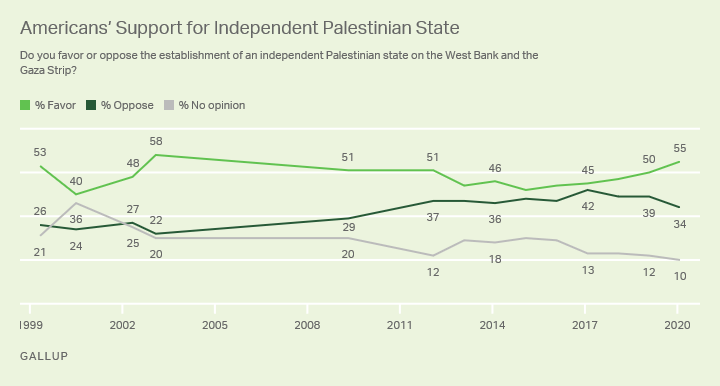
The Gallup polling organization has conducted a poll of Americans every year to see how many citizens favor a Palestinian state as a solution to the conflict between Israel and the Palestinian people. The most recent poll, conducted last February, indicates that 55% of the American people favor a separate Palestinian state in the West Bank and Gaza Strip while 34% are opposed and 10% are unsure. The previous high in favor of a Palestinian state was 58% in 2003. The result surprised me since US policy under the Trump Administration has essentially abandoned the 2-state solution. But when President Trump was elected only 45% of the American people favored a Palestinian state–a shift of 10% is quite dramatic. Even among citizens who identify as Republicans, the number has increased from 25% on 2017 to 44% in 2020. At the same time, however, more Americans have a favorable view of Israel than of the Palestinian Authority. These findings do not coexist easily, and I will have to think deeply about them in order to make sense of the results.
The matter has some urgency. Under the terms of the power-sharing agreement between the current Prime Minister, Benjamin Netanyahu, and his opponent, Benny Gantz, the annexation of the West Bank cannot be broached until 1 July. Netanyahu can bring an annexation proposal to either his Cabinet or to the Knesset; both options have potential obstacles. But Netanyahu will likely make the decision before the US national election in November, in order to create a fait accompli in case President Trump loses the election. US Secretary of State Pompeo is scheduled to visit Israel this week, so we may have a better sense of what might happen soon.
UN Secretary-General António Guterres called for a general ceasefire in all current violent conflicts in the world, arguing that the COIVD-19 pandemic demanded the attention of all nations if it were to be contained. That call was made six weeks ago, and in that time there has been constant wrangling in the UN Security Council about the wording of the cease-fire resolution. His statement last March was clear:
“‘The fury of the virus illustrates the folly of war’, he said. ‘That is why today, I am calling for an immediate global ceasefire in all corners of the world. It is time to put armed conflict on lockdown and focus together on the true fight of our lives.’
“The ceasefire would allow humanitarians to reach populations that are most vulnerable to the spread of COVID-19, which first emerged in Wuhan, China, last December, and has now been reported in more than 180 countries.
“So far, there are nearly 300,000 cases worldwide, and more than 12,700 deaths, according to the World Health Organization (WHO).
“As the UN chief pointed out, COVID-19 does not care about nationality or ethnicity, or other differences between people, and ‘attacks all, relentlessly’, including during wartime.
“It is the most vulnerable – women and children, people with disabilities, the marginalized, displaced and refugees – who pay the highest price during conflict and who are most at risk of suffering ‘devastating losses’ from the disease.”
Unfortunately, consistent with its policies at the G7 and G20 meetings, the Trump Administration has decided to block any progress on other issues to pursue its goal of blaming the Chinese for the pandemic, this time using the World Health Organization as a foil for its tactic. The Security Council resolution initially called for support for WHO, but the US objected to the Chinese sponsored resolution. A compromise resolution mentioning only support for international health organizations was similarly opposed by the US. Reuters reports:
It appeared the 15-member body had reached a compromise late on Thursday, diplomats said and according to the latest version of a French- and Tunisian drafted-resolution.
Instead of naming the WHO, the draft text, which was seen by Reuters, “emphasizes the urgent need to support all countries, as well as all relevant entities of the United Nations system, including specialized health agencies.” The WHO is the only such agency.
The United States rejected that language on Friday, diplomats said, because it was an obvious reference to the Geneva-based WHO.
A UN Security Council Resolution would, under most circumstances, have little effect on ongoing conflicts. But in the midst of a crisis which demands almost complete attention to resolve, most of the participants to these conflicts might welcome a ceasefire. Their overriding self-interest now is in assuring that the pandemic is contained, not in continuing a conflict which drains resources and attention. But the petulance of the US in pursuing an agenda which is driven by the re-election interests of Mr. Trump has squandered this opportunity.
For the last few days, I have been following a bizarre story about an abortive attempt to overthrow the government of Venezuela, replacing the current leader, Nicolás Maduro, with a US-backed candidate, Juan Guaidó. I have been reluctant to comment on it because the information was so sketchy that I could not be sure that any of the information was accurate. If true, it is an important story, but we should be cautious in interpreting what it actually means until more is reliably known. There is a good chance that we will never know what happened, but it will be interesting to see what the press is able to ferret out.
“Jordan Goudreau, a 43-year-old Special Forces veteran who ran a strategic-security firm on the Florida Space Coast, laid out a plan that could double as a screenplay for an episode of ‘Jack Ryan.’ Goudreau claimed to have 800 men ready to penetrate Venezuela and ‘extract’ Maduro and his henchmen, according to J.J. Rendón, the Venezuelan political strategist tapped by Guaidó to help lead the secretive committee.
“Guaidó ‘was saying all options were on the table, and under the table,’ Rendón told The Washington Post. ‘We were fulfilling that purpose.’
“By October, the plan had advanced to the point of a signed agreement, contingent on funding and other conditions. Rendón calls it a trial balloon, a test of what Goudreau could do that was never officially greenlighted. But the language of the agreement left no ambiguity on the objective: ‘An operation to capture/detain/remove Nicolás Maduro . . . remove the current Regime and install the recognized Venezuelan President Juan Guaidó.'”
The plan was apparently implemented last week, but it appears as if it was a colossal failure:
“Venezuelan officials said they had thwarted a predawn ‘invasion’ aimed at killing Maduro. Then Goudreau appeared in a video with a former Venezuelan military officer in battle fatigues. The men proclaimed the start of an operation to ‘liberate’ Venezuela, and Goudreau said participants had entered the country. But by then the mission — apparently infiltrated by Maduro’s agents — had already sustained a devastating blow, with eight men killed and two captured. On Monday, 11 others were detained, two of them Goudreau’s fellow former Green Berets.”
QUESTION: Good thing I have my contacts in today. (Laughter.) Would you be able to tell us, or does the U.S. know who may have initiated or bankrolled this operation in Venezuela from over the weekend? And has the State Department started engaging the Maduro regime about the two Americans who are reportedly in custody there?
SECRETARY POMPEO: So your first question, there – as I think the Secretary of Defense said, or maybe it was the chairman of the Joint Chiefs of Staff, and the President too, there was no U.S. Government direct involvement in this operation. If we had been involved, it would have gone differently. As for who bankrolled it, we’re not prepared to share any more information about what we know took place. We’ll unpack that at an appropriate time. We’ll share that information that makes good sense
“Much of how the plot came together remains murky, but a portrait has emerged of Goudreau, a decorated U.S. commando who has boasted about having protected President Donald Trump and has attended at least one Trump rally wearing an earpiece and scanning the crowd as if he were a security guard.”
Second, there is a very long history of US interference in the domestic politics of Central and South American states. As soon as Mexico declared independence from Spain in 1825, “President John Quincy Adams appointed Joel Roberts Poinsett as the first American minister to the newly independent republic of Mexico”. Poinsett (who introduced the plant to Americans known as the Poinsettia) organized Masonic Temples in Mexico to foster pro-US sentiment. He was so obnoxious that the Mexican government demanded that he be removed in 1829. Further US interference were obvious in Guatemala in 1954, in the Bay of Pigs invasion of Cuba in 1961, and in Chile in 1973, to name just a few.
Goudreau provided a video on Twitter he which he talks about the operation which can be accessed here. I will try to follow this story as more details emerge. But, on the basis of what we know so far, it is clear that there was some truly crazy thinking going on.
I am continuing the argument I started to develop yesterday about how it is a serious mistake to use a war metaphor to think about the efforts to contain and mitigate the COVID-19 pandemic. My concern about this metaphor was only aggravated by the comments made by US President Trump yesterday in Phoenix, Arizona, as he toured a Honeywell facility making protective equipment for healthcare workers:
“Now it is one more time for the men and women of Honeywell who are supplying the weapons, the armor, the sweat, and the scale in a war to defeat the new invisible enemy — a tough enemy, a smart enemy. But nobody is like us, and nobody is tough like us. And I said it before and I’ll say it again: The people of our country are warriors.”
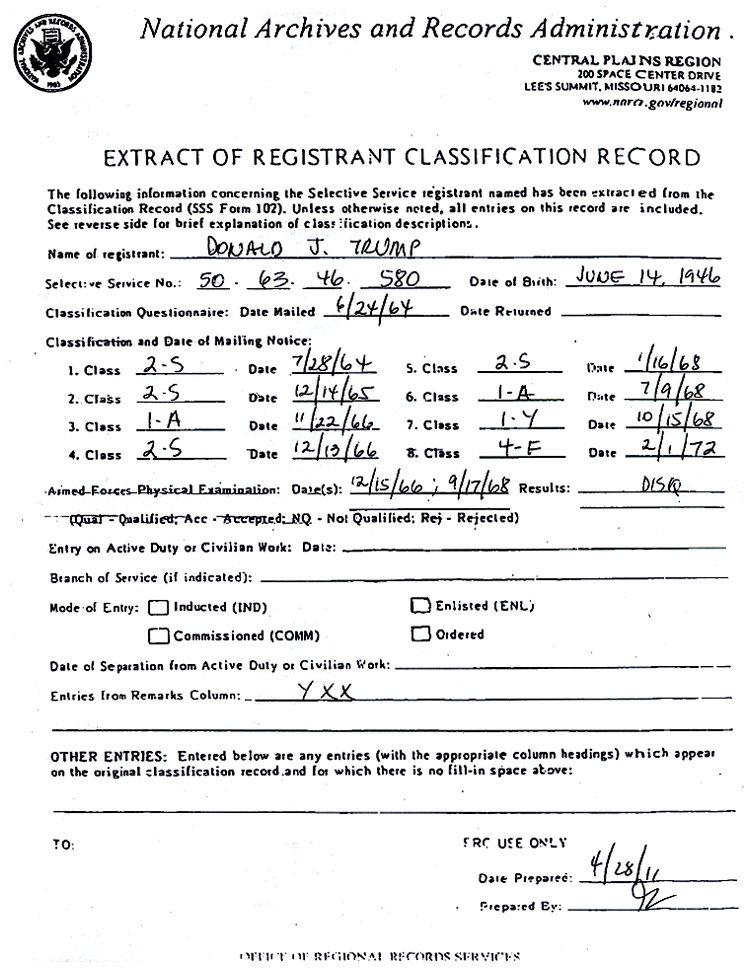
There is considerable irony invoking the warrior cult since Mr. Trump dodged the draft to avoid service in Vietnam from a medical exemption based upon bone spurs. The doctor signing the exemption rented his office from Mr. Trump’s father.
Once President Nixon ended the draft in January 1973, and the US has relied upon a volunteer army since then. It is a serious mistake to emphasize the “voluntary” aspect of the current US military. To be sure, there are some who genuinely volunteer for patriotic reasons, but only “0.4 percent of the U.S. population is on active duty”. Many, however, volunteer because they have no meaningful employment alternatives, or because of the hefty bonuses offered to enlistees, or because they need funding to go to college, or, finally, to avoid a bad home life.
In truth, the war metaphor romanticizes civilian and military life in a wartime. To take Chris Christie’s examples of World Wars I and II, there was little that was “voluntary”. Taxes rose considerably, conscription was rigorously imposed, there was extensive rationing of goods and services, movements of people were monitored and controlled, news was controlled, and propaganda was rife. And, importantly, most were free from the fear of a combat death: young men between the ages of 18 and 35 were the ones who were asked to kill and be killed.
The efforts to contain the COVID-19 pandemic thus far mimic some of the most incompetent generals in human history: General Ambrose Burnside at the Battle of Antietam; General Douglas Haig at the First Battle of the Somme; and Quintus Servilius Caepio at the Battle of Arausio. These generals all shared the contemptible attribute of disregarding the value of the lives of their soldiers. Similarly, Mr. Trump makes sure that he is tested for COVID-19 on a regular basis while failing to assure adequate testing for US citizens. He makes sure that corporations are well-funded while ignoring the plight of ordinary citizens who have been asked to forgo their wages in order to limit the spread of the virus. He wants to open up the economy, admitting that more citizens will die, as pointed out in The Guardian:
“The top US public health expert on the White House coronavirus task force, Anthony Fauci, director of the National Institute of Allergy and Infectious Diseases, warned in a CNN interview the previous evening that there will be a ‘rebound’ of new coronavirus cases in the US if the country rushes towards a ‘premature’ reopening of society and business.
“’How many deaths and how much suffering are you willing to accept to get back to what you want to be some form of normality sooner rather than later?’ he asked.
And on Tuesday morning New York governor Andrew Cuomo warned against what he called a life or death ‘trade-off’ when planning how and when to lift restrictions.
“’The faster we reopen the lower the economic costs, but the higher the human costs because the more lives lost. That, my friends, is the decision we are really making,’ Cuomo said at his daily briefing.
“Critics are now sharply questioning the Trump administration approach to what Fauci called ‘a very difficult choice’ that weighs a death toll against economic catastrophe.
“’They’ve decided in a very utilitarian kind of way that the political damage from a collapsed economy is greater than the political damage from losing as many as 90,000 more Americans just in June,’ said Rick Wilson, a former Republican strategist. ‘We’re witnessing the full-scale application of a kind of grisly realpolitik that is a clear willingness to trade lives for the Dow Jones.’”
The one important way the war metaphor is somewhat apt is that the poor, the people of color, immigrants, incarcerated people, the physically weak, and the elderly will die instead of young men aged 18-35 in order to assure that the rich and well-to-do can continue to live their unruffled lives.
“This struggle may be a moral one, or it may be a physical one, and it may be both moral and physical, but it must be a struggle. Power concedes nothing without a demand. It never did and it never will. Find out just what any people will quietly submit to and you have found out the exact measure of injustice and wrong which will be imposed upon them, and these will continue till they are resisted with either words or blows, or with both. The limits of tyrants are prescribed by the endurance of those whom they oppress.” Frederick Douglass, 1857
“The American people have gone through significant death before. We have gone through it in World War I, we have gone through it in World War II and we survived it. We sacrificed those lives. … We decided to make that sacrifice because what we were standing up for was the American way of life. The very same way now we have to stand up for the American way of life.”
The argument is seductive, but dishonest. We do indeed entertain risks in our daily lives and make choices about the risks that seem to be necessary to maintain a life that we deem worth living. Whenever we drive a car or take a medicine, we understand that there is a chance that the activity may lead to our deaths. Presumably, the choice depends upon a calculation of how great the risk is and how beneficial that activity is to our well-being. We can make even more complex decisions: getting to a particular destination may be worth the risk of getting there in a car, but not the risk of getting there on a motorcycle. We often judge others because we disagree on their calculations of risk, and, depending on our relationship with those others, we may even try to persuade them to change their calculations. Usually, that is a bootless enterprise.
The situation becomes very different when the state imposes risks. A well-functioning state will impose risks if it has made the calculation that the society as a whole will benefit from military action which may kill citizens who serve in the military. The US has historically been very cautious in entrusting such decisions to the state. Theoretically, only the US Congress can make the decision to go to war. That stricture was largely followed until after World War II. Since that time, the requirement has not been followed–a legacy of the Cold War and the possibility of a missile attack on the homeland (with nuclear warheads) which might not have allowed sufficient time for the Congress to meet and make such a declaration. Congress defaulted on its responsibility in the Vietnam War and since that time have passed some essentially vapid laws called “Authorization to Use Military Force” which Presidents use for any conceivable occasion.
Additionally, military service used to be an important criterion for selecting a President. The belief was that such experience was necessary to assure that the decision to go to war was not taken lightly. Of the 45 US Presidents, only 11 did not serve in the military, and most of them were in the 20th and 21st centuries (Wilson, Harding, Coolidge, Hoover, Franklin Roosevelt, Clinton, Obama, and Trump).
Christie’s argument is very misleading. Americans have generally been very reluctant to go to war, even though their governments have not been as inhibited. The US has not, until recently in the Iraq and Afghanistan Wars, been able to create a volunteer army and has, instead, relied upon conscription to fight its wars–the American Revolutionary War, the American Civil War, World War I, World War II, the Korean War, and the Vietnam War). The draft has always created political problems, and riots have often accompanied the use of the draft.
Christie’s argument should be reframed: some have been willing to sacrifice themselves. More often than not, most have been willing to sacrifice others. And those others have typically been those who are most vulnerable. The same seems to be the case in the current discussions about restarting the US economy in the face of COVID-19. I will continue this argument in tomorrow’s post.
Fifty years ago, students at Kent State University in Ohio and Jackson State University in Mississippi were shot and killed as they protested against the Vietnam War. I was a junior in college then and it was a decisive event in my life. The killings followed a string of violent acts–the assassinations of President John Kennedy in 1963, Martin Luther King, Jr in 1968., and Robert Kennedy also in 1968. I also had a number of friends who were killed in the war. I did not serve and, to this day, I do not know what I would have done if I had been drafted into the military. I was, however, active in the anti-war movement and have a deep respect for those who protest against government actions as I am well aware of the scorn protesters usually receive when they oppose the government.
Today I witness some Americans protesting shutdowns ordered by many governors who see the action as necessary to limit the spread of the COVID-19 pandemic. I find myself with little sympathy for many of those protesters, but I certainly understand their frustrations and anger as the shutdowns have caused considerable economic pain. I find myself wondering if I have turned into the curmudgeons who thought that the young Vinnie was unpatriotic, indeed, traitorous.
But the images of some of the protesters make it difficult for me to sympathize. The image below is of a protester in Illinois who held up a sign with the words “Arbeit Macht Frei“, which was the sign hanging over the entrance to Auschwitz (the initials JB refer to the Jewish governor of Illinois, J.B. Pritzker). I find it hard to believe that the protester did not know what she was doing, but she was certainly unaware of the total disgust (and fear) that most people felt at the sign. The irony of her mask, which many veterans of World War II held as a clarion call in the fight against the Nazis, likely escaped her.
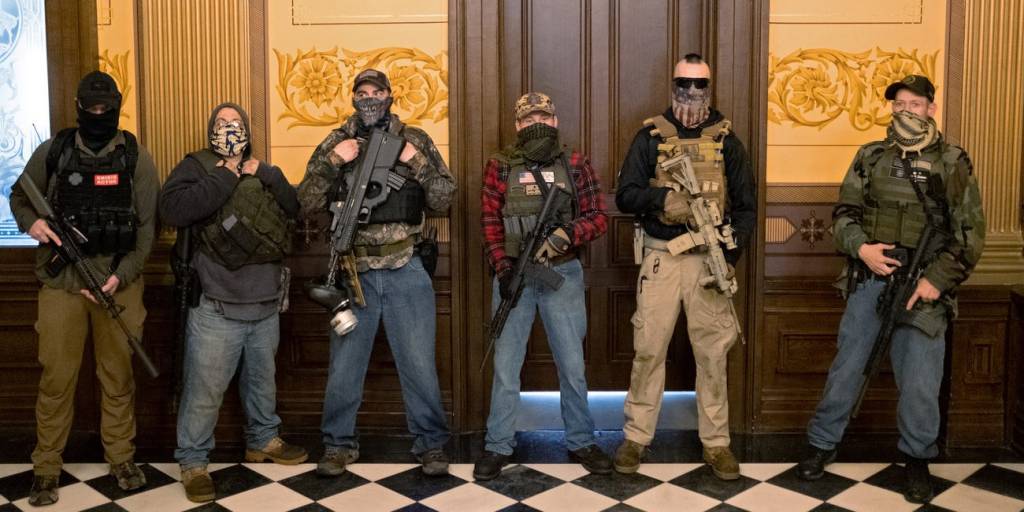
The second image is of protesters in the state capital of Michigan. There were weapons in the civil rights movement (African-American students at Cornell University were armed when they took over the administration building and the Weatherman did employ bombs in their protests against the Vietnam War), but most of the anti-war protesters in the late 1960s were largely inspired by the Age of Aquarius. The Michigan protesters were likely celebrating their understanding of the 2nd Amendment to the US Constitution, but one cannot help but think that the bearing of weapons was also an attempt of intimidation.
Something has dramatically changed since I was 20 years old, and those changes bring me great sadness. I often felt that the government had betrayed the American people during the Vietnam War. Now I fear that the American people are betraying themselves. And I am not sure where this all leads.
US President Trump’s desire to be re-elected has become a driving force behind US policy toward China. The strategy was noted by Politico: “The National Republican Senatorial Committee has sent campaigns a detailed, 57-page memo authored by a top Republican strategist advising GOP candidates to address the coronavirus crisis by aggressively attacking China.” The memo is explicit to the Republican faithful:
● China caused this pandemic by covering it up, lying, and hoarding the world’s supply of medical equipment.
○ China is an adversary that has stolen millions of American jobs, sent fentanyl to the United States, and they send religious minorities to concentration camps.
● My opponent is soft on China, fails to stand up to the Chinese Communist Party, and can’t be trusted to take them on.
● I will stand up to China, bring our manufacturing jobs back home, and push for sanctions on China for its role in spreading this pandemic.
President Trump confirmed the strategy with this tweet: “Concast (@NBCNews) and Fake News @CNN are going out of their way to say GREAT things about China. They are Chinese puppets who want to do business there. They use USA airwaves to help China. The Enemy of the People! One CNN broadcaster, Jake Tapper pointed out the hypocrisy by reproducing many Trump Tweets that had praised China’s response to the coronavirus pandemic.
We should be clear that China did not handle the outbreak of the pandemic well. Sawn Yuan, writing in Wired,outlines the many mistakes, intentional or otherwise, that the Chinese made in late December and early January:
“‘The reality is that we could’ve been better off if China had been more forthcoming,’ Vice President Mike Pence told CNN in early April, when asked why the Trump administration had gotten off to such a late start in taking the virus seriously. The debate has become a strange and strained one, given that whatever China did or did not cover up, the US still squandered its chance to prepare for the inevitable even after Beijing’s warnings had become loud and clear.
“Moreover, it wasn’t the rest of the world that Beijing was most intent on keeping in the dark. Nowhere has China been more aggressive in its war for control of the coronavirus narrative than it has been at home. A vivid and human picture of that information war emerges if you examine all the stories and posts that have been wiped off of the Chinese internet since the outbreak began—which is exactly what I’ve been trying to do for the past few months.”
We should keep in mind that the Chinese failed to alert the world, primarily to keep its domestic population calm while it assessed the threat from the pandemic. That was a serious mistake, and one made by the US as well. The evidence is overwhelming that the government of the US was well aware of the pandemic threat and did little until the middle of March. The intelligence was reported by Scientific American, the New York Times, Vox, The Hill, The Guardian, and Business Insider.
We do not know what Mr. Trump intends to do, but various tactics have been identified in the media. The New York Times summarizes some of the actions planned by the Administration:
“Some top Trump administration officials are moving to take a more aggressive stand against China on economic, diplomatic and scientific issues at the heart of the relationship between the world’s two superpowers, further fraying ties that have reached their lowest point in decades.
“White House aides this week have prodded President Trump to issue an executive order that would block a government pension fund from investing in Chinese companies, officials said — a move that could upend capital flows across the Pacific. Mr. Trump announced on Friday that he was restricting the use of electrical equipment in the domestic grid system with links to “a foreign adversary” — an unspoken reference to China.
“The administration is cutting off grants that would help support virology laboratories in Wuhan, China, the city where the coronavirus outbreak began, and is looking into scientific collaborations undertaken there by the University of Texas…..
“China controls a vast supply of the masks and protective gear needed by American hospitals. And if China develops a vaccine first, it will wield a powerful card, one that will bolster its global standing and give it leverage over the health of hundreds of millions of Americans.”
We should be clear about what is happening. Mr. Trump is deliberately antagonizing a very powerful state and a potential scientific ally in the fight against the pandemic in order to divert attention from the mistakes of his Administration. There is no telling how the confrontation between the US and China may evolve, but there is no national interest of the US or China in this friction at this time. The attention of both states should be focused on marshaling their considerable abilities and wealth to find a vaccine for the virus. Hijacking the foreign policy of the US to seek re-election is reprehensible and contemptible.
The Chinese media outlet, Xinhua, has released a animated video, mocking the US response to the pandemic. It can be viewed here. The relationship between the US and China is quickly beginning a farce.
It appears as if US President Trump will be making China’s role in the COVID-19 pandemic a central theme in his re-election campaign. The BBC reports:
“Mr Trump has recently been escalating his war of words with China over the pandemic after what officials within the US president’s administration had described as a truce with Beijing.
“Mr Trump has often blamed China at briefings, accusing its officials of covering up the virus early on and saying they could have stopped the “disease from spreading.
“He has similarly criticised the WHO and withdrawn US funding for the global body.
“China’s Foreign Ministry, meanwhile, has accused the Trump administration of trying to distract from its own problems tackling the crisis.
“A ministry spokesman has also repeatedly promoted the idea – without evidence – that Covid-19 might have originated in the US.
“According to the Washington Post, the Trump administration is looking into ways to punish China financially. Discussions reportedly include allowing the US government to sue China for damages or cancelling debt obligations.”
There seems to be no question that the virus originated in China but there are questions about how it came about. There have been rumors that the virus was developed in the viral laboratory in Wuhan. But US intelligence has determined that the virus is of natural origin and not made by humans. Nonetheless, President Trump has apparently directed the US intelligence services to “hunt for evidence” linking the laboratory to the virus. If the virus is not made by humans, there is a legitimate question of whether there were accidents that occurred in the laboratory that need to be answered. But that is a question for scientists to answer. There is no reason to treat the virus as a biological weapon. Such an approach diverts us from the urgent task of containing the virus and developing a vaccine against it.
The stalemate in Israeli politics seems to have been broken by an agreement between Benjamin Netanyahu and Benny Gantz to form an emergency unity government. Under the agreement, Netanyahu will remain as Prime Minister for 18 months after which Gantz will serve as Prime Minister for another 18 months. There are obviously terms of the agreement about which we remain ignorant, but there was one part of the agreement which was made public. NBC News points out:
“In a deal to form an emergency unity government last week, Netanyahu and his centrist rival Benny Gantz agreed that Netanyahu will be able to bring forward legislation to annex parts of the West Bank for approval by the government and the Israeli Parliament by July 1.
“Washington would need to agree to the move, according to the power-sharing agreement, under which Netanyahu will serve as prime minister for 18 months before handing power over to Gantz.”
It is highly likely that the Trump Administration will approve the annexation since it has previously recognized Jerusalem as the capital of Israel despite Palestinian hopes for East Jerusalem as its capital in its own state. Additionally, the Trump Administration has also recognized Israeli sovereignty over the Golan Heights, a region Israel took from Syria in the war of 1967. The US State Department made the following statement on Monday:
“‘As we have made consistently clear, we are prepared to recognise Israeli actions to extend Israeli sovereignty and the application of Israeli law to areas of the West Bank that the vision foresees as being part of the State of Israel,’ a US State Department spokesperson said on Monday.
“‘The step would be “in the context of the Government of Israel agreeing to negotiate with the Palestinians along the lines set forth in President Trump’s Vision,’ she said.
“The statement came after Netanyahu said on Monday he was confident the US would give Israel the approval within two months to move ahead with the de facto annexation of parts of the occupied West Bank.”
The plan effectively ends the “two-state” solution which has been the preferred option for most of the countries of the world (including the US, until the Trump Administration, although the current US Administration insists that it is still an option). The annexation of the West Bank would give Israel almost total control over the water resources of the region and it is hard to imagine a viable Palestinian state that would certainly be non-contiguous. Most Arab states, including important US allies such as Jordan and Saudi Arabia, have indicated that they oppose the unilateral Israeli annexation of the West Bank.
If the annexation does occur, then Israel will have to decide what place Palestinians will have in the future. There were 5.79 million Palestinians in 2017: 2.16 million in the West Bank, 1.84 million in Israel, and 1.79 million in the Gaza Strip. There are 6,697,000 Jews in Israel, out of a total population of 9,152,100 in 2020. If the Israelis cannot agree on a Palestinian state that is capable of sustaining itself (which essentially means access to water, agricultural land, and the resources necessary for a viable economy), then it is impossible for me to imagine a stable future for either the Palestinians or the Israelis. The only other alternative is for the Israelis to accept the Palestinians as full-fledged citizens of the Israeli state.
It is a terrible shame that such a dramatic change has occurred when the attention of the world was focused on the COVID-19 pandemic. At some point in the future, the world will be reminded of the price of its inattention.