The assassination of Charlie Kirk was a tragedy, and the act should be condemned in the strongest possible terms. Such condemnation is appropriate, but it should also be directed against the exceptionally large of people who die every year from gun violence.
Guns kill 128 people a day in the US, or about one death every 11 minutes, and is the leading cause of death for children aged 1-19.
It is disturbing that the discussion about Kirk’s assassination has not included consideration of these facts. Instead, the discussion has focused on the political polarization in the US. For example, US President Trump made these comments about the assassination:
“It’s long past time for all Americans and the media to confront the fact that violence and murder are the tragic consequence of demonizing those with whom you disagree. For years, those on the radical left have compared wonderful Americans like Charlie to Nazis and the world’s worst mass murderers and criminals. This kind of rhetoric is directly responsible for the terrorism that we’re seeing in our country today, and it must stop right now.”
It may be the case that the alleged shooter was indeed a radical leftist. He has been apprehended and we will know more about his motives soon. But to attribute the atrocity to leftists ignores the acts of violence against individuals who were allied with the political left. The list is long, as cataloged by The Huffington Post:
I will not attempt to explain why Trump did not mention these other acts of violence against political figures, but neglecting to mention these facts is in itself reflective of political polarization. Refusing to acknowledge that gun violence seems to be explainable for reasons other than, or in addition to, political ideology leads to a sterile and vapid conversation.
“The Second Amendment is not about hunting. I love hunting. The Second Amendment is not even about personal defense. That is important. The Second Amendment is there, God forbid, so that you can defend yourself against a tyrannical government. And if that talk scares you — “wow, that’s radical, Charlie, I don’t know about that” — well then, you have not really read any of the literature of our Founding Fathers. Number two, you’ve not read any 20th-century history. You’re just living in Narnia. By the way, if you’re actually living in Narnia, you would be wiser than wherever you’re living, because C.S. Lewis was really smart. So I don’t know what alternative universe you’re living in. You just don’t want to face reality that governments tend to get tyrannical and that if people need an ability to protect themselves and their communities and their families.”
I have posted about the 2nd Amendment previously, and Kirk’s defense of the 2nd Amendment is fundamentally flawed. I argued on 27 March 2023 that the Militia Act of 1792 required all young men to join the various militias, and that they were required to provide their own weapons:
“That every citizen so enrolled and notified, shall, within six months thereafter, provide himself with a good musket or firelock, a sufficient bayonet and belt, two spare flints, and a knapsack, a pouch with a box therein to contain not less than twenty four cartridges, suited to the bore of his musket or firelock, each cartridge to contain a proper quantity of powder and ball: or with a good rifle, knapsack, shot-pouch and powder-horn, twenty balls suited to the bore of his rifle, and a quarter of a pound of powder…”
The intent of the 2nd Amendment was to ensure that the militias were armed, not to make sure that citizens could overthrow the central government. For those who support an “originalist” interpretation of the Constitution, the correct strategy would be to get rid of the newly named “Department of War” and to require universal military service to all National Guard units in the fifty states and the US territories. We should also remember that there was an armed insurrection against the Federal Government in 1861 and that it was suppressed in a very bloody war. The lethality of the Federal Government’s arsenal today far exceeds the alleged strength of armed civilians.
“You will never live in a society when you have an armed citizenry and you won’t have a single gun death. That is nonsense. It’s drivel. But I am, I, I — I think it’s worth it. I think it’s worth to have a cost of, unfortunately, some gun deaths every single year so that we can have the Second Amendment to protect our other God-given rights. That is a prudent deal. It is rational. Nobody talks like this. They live in a complete alternate universe.”
I suspect that Kirk’s wife and children might have some questions about his assessment of the risks. We all must acknowledge that the individual right to bear arms, as codified in the Supreme Court decision, District of Columbia v. Heller (2008) was wrongly decided and completely inconsistent with an originalist interpretation of the Constitution.
“The world’s several dozen global climate models offer little guidance on how much the climate responds to elevated CO2, with the average surface warming under a doubling of the CO2 concentration ranging from 1.8°C to 5.7°C [Section 4.2]. Data-driven methods yield a lower and narrower range [Section 4.3]. Global climate models generally run “hot” in their description of the climate of the past few decades − too much warming at the surface and too much amplification of warming in the lower- and midtroposphere [Sections 5.2-5.4]. The combination of overly sensitive models and implausible extreme scenarios for future emissions yields exaggerated projections of future warming.
“Most extreme weather events in the U.S. do not show long-term trends. Claims of increased frequency or intensity of hurricanes, tornadoes, floods, and droughts are not supported by U.S. historical data [Sections 6.1-6.7]. Additionally, forest management practices are often overlooked in assessing changes in wildfire activity [Section 6.8]. Global sea level has risen approximately 8 inches since 1900, but there are significant regional variations driven primarily by local land subsidence; U.S. tide gauge measurements in aggregate show no obvious acceleration in sea level rise beyond the historical average rate [Chapter 7].
“Attribution of climate change or extreme weather events to human CO2 emissions is challenged by natural climate variability, data limitations, and inherent model deficiencies [Chapter 8]. Moreover, solar activity’s contribution to the late 20th century warming might be underestimated [Section 8.3.1].
“Both models and experience suggest that CO2-induced warming might be less damaging economically than commonly believed, and excessively aggressive mitigation policies could prove more detrimental than beneficial [Chapters 9, 10, Section 11.1]. Social Cost of Carbon estimates, which attempt to quantify the economic damage of CO2 emissions, are highly sensitive to their underlying assumptions and so provide limited independent information [Section 11.2].
“U.S. policy actions are expected to have undetectably small direct impacts on the global climate and any effects will emerge only with long delays [Chapter 12].”
All of these criticisms are partially true, but they all ignore the fact that the earth has in fact warmed considerably in the last decades. The criticisms suggest that the underlying reality should be ignored and that we should instead nitpick aspects of the concerted efforts of thousands of climatologists working together–this report was actually written by 5 people: John Christy, Ph.D., Judith Curry, Ph.D., Steven Koonin, Ph.D., Ross McKitrick, Ph.D., and Roy Spencer, Ph.D. Further, the study was coordinated by Christopher Wright, who was the CEO of Liberty Energy, North America’s second largest hydraulic fracturing company. Wright’s sentiments are clear in his forward to the study:
“Climate change is real, and it deserves attention. But it is not the greatest threat facing humanity. That distinction belongs to global energy poverty. As someone who values data, I know that improving the human condition depends on expanding access to reliable, affordable energy. Climate change is a challenge—not a catastrophe. But misguided policies based on fear rather than facts could truly endanger human well-being.
“We stand at the threshold of a new era of energy leadership. If we empower innovation rather than restrain it, America can lead the world in providing cleaner, more abundant energy—lifting billions out of poverty, strengthening our economy, and improving our environment along the way.”
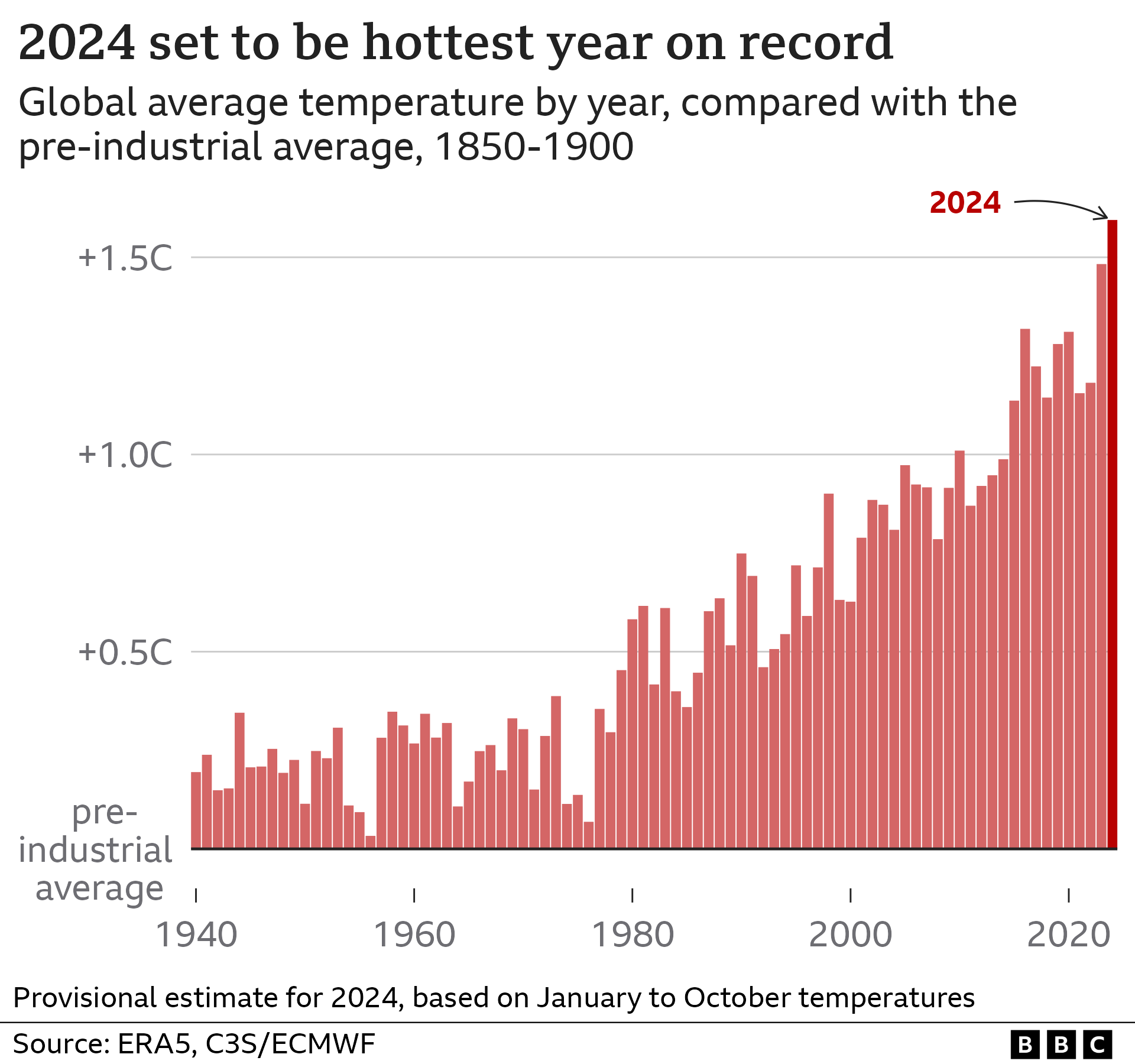
The position taken by the Trump Administration is clearly an outlier. The overwhelming evidence, however, does not support the Trump position. According to Copernicus, the European climate agency, the data are straightforward:
◾ The global average was 1.3 degrees above the 1991-2020 global average and .21 degrees above 2023, the previous warmest year on record.
◾ The temperature was 2.9 degrees above the estimated temperature between 1850-1900, often referred to as the preindustrial era.
◾ Each of the past 10 years has been one of the warmest 10 on record.
◾ A new record-high daily global average temperature was reached on July 22, at 30.8 degrees.
◾ Every month since July 2023, except for July 2024, was above the 2.7 degrees Fahrenheit (1.5 C) threshold.
Recently the International Court of Justice issued a ruling that takes a dramatically different position as explained by Zoë Schlanger in The Atlantic:
“Last month, the world’s highest court issued a long-awaited opinion on how international law should regard climate harm. The International Court of Justice concluded, unanimously, that states have binding legal obligations to act to protect the climate system, and failure to do so—by continuing to produce, consume, and subsidize fossil fuels—may ‘constitute an internationally wrongful act.’ In other words, curbing greenhouse-gas emissions is not merely voluntary in the eyes of the court; failure to do so is illegal.”
The ruling can only be enforced through actions taken by the UN Security Council and it is doubtful that that body would take any effective action to reduce greenhouse gas emissions. But it does stand as a marker for future action.
In the meantime, the Trump Administration has been busy erasing the studies done by the US government that suggested that climate change was real. Jody Freeman writes in the LA Times:
“President Trump has been trying to eliminate climate regulations since his first day back in office when he signed an executive order declaring the primacy of fossil fuels.
“But his administration’s most radical step came last week, when the Environmental Protection Agency unveiled a proposal that would rescind its 2009 “endangerment finding” — the scientific conclusion that greenhouse gases contribute to global warming and harm human health and well-being.
“This isn’t just another regulatory rollback. It’s an assault on the foundation of all federal climate policy.
“The endangerment finding originally applied to vehicle emissions, but it also underpins every major federal climate rule in America: car and truck emissions standards, power plant regulations and limits on oil and gas facilities. By removing this cornerstone, Trump’s EPA is repudiating federal authority to limit greenhouse gases, our most powerful tool for fighting climate change.”
In addition, the Trump Administration has removed the website of the U.S. Global Change Research Program in addition to the five National Climate Assessments that are required by US law. Moreover, according to ABC News “all the authors working on the upcoming Sixth National Climate Assessment, set for release in 2028, were also dismissed.” Finally, according to the Irish Star “NASA has been given orders by the White House to destroy two major satellites in space that are used by farmers, scientists, as well as oil and gas companies.”
The Trump Administration has determined that the US citizenry should not be able to view information that supports the idea thats climate change is occurring. That policy is a fool’s errand. Just as the Catholic Church could not dispel the idea that the earth revolved around the sun, Americans will have access to non-US-governed sources on climate change. More importantly, Americans will not be able to deny the reality of a warming planet because heat waves, intense storms, and migration caused by climate change will continue to unsettle our daily lives. Trump’s policies are a repudiation of the Enlightenment, which raised standards of living all over the world because of its commitment to policies based upon rational analysis based upon empirical evidence. The upcoming Dark Ages will be hot.
US President Trump fired the chief statistician, Erika McEntarfer, from the Bureau of Labor Statistics because he thought that the recent jobs report was distorted by political bias.
There are many examples of “killing the messenger” in history. When a messenger informed King Tigranes of Armenia that Roman general Lucullus was approaching, Tigranes had him executed. Plutarch recounts the result: “The first messenger, that gave notice of Lucullus‘ coming was so far from pleasing Tigranes that, he had his head cut off for his pains; and no man dared to bring further information. Without any intelligence at all, Tigranes sat while war was already blazing around him, giving ear only to those who flattered him”.
Another example is Ivan Adamovich Kraval who was the lead statistician for the 1937 census report in the Soviet Union. That report indicated that the Soviet Union’s population growth had been stunted because of famine induced by Stalin’s agricultural policies:
“The problem was that calculations of natural population growth had projected a population of 186.4 million, an increase of 37.6 million since the 1926 census; the actual increase turned out to be only 7.2 million. The population gap spoke so graphically of unnatural death, and so belied the image of a healthy happy society, that the census was squelched. On September 26, Pravda published a communiqué of the Sovnarkom claiming ‘crude violations of the principles of statistical science.’”
Stalin had Kraval executed for the bad news. as well as others who were involved in the production of the census. But the shortfall in population were the direct result of destructive policies pursued by Stalin;
“Whatever explanations were offered by the statisticians and demographers whose lives were at risk, they were unable to conceal the extent to which population growth had lagged behind the fantastic growth projections of the leadership, to say nothing of the actual decline in population. The child mortality figures were particularly alarming, as was the greater mortality among men, who constituted the greater proportion of the deportees, special settlers and camp inmates, and also the lower birth rate resulting from this catastrophic situation. Over 40 million people were struck down by famine.
“In total, for the year 1933, there were circa 6 million more deaths than usual. As the immense majority of those deaths can be attributed directly to hunger, the death toll for the whole tragedy must therefore be nearly 6 million. The peasants of the Ukraine suffered worst of all, with 4 million lives lost. There were a million deaths in Kazakhstan, most of them among nomadic tribes who had been deprived of their cattle by collectivization and forced to settle in one place. The Northern Caucasus and the Black Earth region accounted for a million more.
“Even if the census of 1937 does not speak of deportations, executions and victims of famine, the data it compiled exposed the true dimensions of the catastrophe. The missing millions correspond fairly precisely to the losses that had arisen through the increased mortality caused by collectivization and the resulting famine.”
The lower employment numbers for the US in 2025 still need to be fully explained, but the most likely explanations involve the uncertainties created by the ever-changing tariff policies of the Trump Administration and the significant cuts to Federal Government employment caused by the efforts of DOGE. President Trump does not care for this explanation, and the statistical manifestations of his moronic economic policies can be fudged by a good statistician. But the human harms created will occur and one hopes that we have a media that is committed enough to publicize these harms. If not, then many millions of people will suffer and die in silence. And the US will cease to be a Republic.
Two prominent Israeli human rights organizations, B’Tselem and Physicians for Human Rights, have made an explosive charge against the Israeli government, accusing it of committing genocide. Needless to say, the accusation affects the world profoundly given the historical experience of Jews. National Public Radio puts the charge in context:
“The rights groups, while prominent and respected internationally, are considered in Israel to be on the political fringe, and their views are not representative of the vast majority of Israelis. But having the allegation of genocide come from Israeli voices shatters a taboo in a society that has been reticent to criticize Israel’s conduct in Gaza.”
The Genocide Convention was adopted in 1948 after the horrors of the Holocaust became undeniable (there was considerable evidence of genocide during World War II, but these reports were not acted upon for a variety of reasons, including prejudice against Jews). Article 2 of the Convention defines genocide as:
“In the present Convention, genocide means any of the following acts committed with intent to destroy, in whole or in part, a national, ethnical, racial or religious group, as such:
(a) Killing members of the group; (b) Causing serious bodily or mental harm to members of the group; (c) Deliberately inflicting on the group conditions of life calculated to bring about its physical destruction in whole or in part; (d) Imposing measures intended to prevent births within the group; (e) Forcibly transferring children of the group to another group.
Physicians for Human Rights–Israel has issued a paper justifying its charge of genocide and it is thorough and comprehensive. Its conclusion is straightforward:
“Each day, dozens die of malnutrition. Ninety-two percent of infants aged six months to two years don’t get enough to eat. At least 85 children have already starved to death. Israel has displaced 9 in 10 Gazans, destroyed or damaged 92% of homes, and left over half a million children without schools or stability. It has wiped out essential health services – including dialysis, maternal care, cancer treatment, and diabetes management.
“This is not a temporary crisis. It is a strategy to eliminate the conditions needed for life. Even if Israel stops the offensive today, the destruction it has inflicted guarantees that preventable deaths – from starvation, infection, and chronic illness – will continue for years. This is not collateral damage. This is not a side effect of war. It is the systematic creation of unlivable conditions. It is the denial of survivability. It is a genocide.”
The charge of genocide is supported by several leading scholars. The Washington Post ran an article citing many of those scholars:
“The governments that have accused Israel at the International Court of Justice of carrying out genocide believe sufficient evidence exists to show that Israel intends to make Palestinian life impossible in Gaza. In this view, they are backed by an emerging number of genocide scholars. As early as December 2023, the institute on genocide prevention that bears Lemkin’s name put out a statement warning about “the clearly genocidal language being used at virtually all levels of Israeli society,” while also condemning Hamas’s actions on Oct. 7.
“Martin Shaw — the leading sociological expert on genocide and author of the 2007 book, “What Is Genocide?” — wrote last week that many Western leaders and journalists have been determined “to avoid, at all costs, the ‘G-word’ in evaluating Israel’s actions,” partially given the sensitivities around the word, but also because they accepted Israel’s argument of self-defense against Hamas and the insistence of Israeli officials that they were trying to alleviate civilian harm.”
The Netanyahu government strongly disagrees with the characterization of genocide, arguing that Israel had the right of self-defense after the vicious attack led by Hamas in October of 2023. No one contests that Israel did have the right of self-defense, but the continued battering of the Gaza Strip and the willful withholding of food, fuel, water, and medicine has gone far beyond acts of self-defense. The death toll of recovered bodies now numbers over 60,000 and there are undoubtedly many more bodies still buried underneath the rubble.
France has announced that it will recognize a Palestinian state in September, and the United Kingdom has threatened to recognize a Palestinian state if Israel does not agree to a cease-fire. Recognition is now being considered by several states. According to The Guardian:
“France and 14 other countries have co-signed a declaration that suggests a wave of future recognitions of an independent Palestinian state, including by Canada, New Zealand and Australia, could take place in the coming months.
“The New York Call, which was published by the French foreign minister, Jean-Noël Barrot, on Wednesday, said that signatories “have already recognised, have expressed or express the willingness or the positive consideration of our countries to recognise the State of Palestine”.
“The signatories include Andorra, Australia, Canada, Finland, Luxembourg, New Zealand, Portugal and San Marino, each of which has not yet recognised an independent Palestinian state. They also include Iceland, Ireland, Malta, Norway, Slovenia and Spain, which have. Emmanuel Macron last week said that France would recognise Palestinian statehood in the near future.”
It is not clear what effect recognition will have since the Palestinians cannot claim to have control over a clearly defined territory nor does it have any of the normal powers over that territory to claim sovereignty. But the act will grant the Palestinians a more credible voice in international organizations such as the International Court of Justice and the International Criminal Court.
The most important actor is the United States, without whose support the Netanyahu government would not be able to continue the slaughter. Despite some signs of movement from the Trump Administration in disagreeing with Netanyahu that mass starvation is occurring in the Gaza, it is extremely unlikely that the Trump Administration will withdraw its financial and diplomatic support for the genocide. But public opinion in the US is decidedly turning against unqualified support for Israel as indicated by the Gallup poll:
Israel has launched a ground assault, including tanks, into the Gaza city of Deir al-Balah, the last remaining city in the Strip that has largely avoided devastation. The Associated Press puts the incursion in context:
“Tens of thousands of people have sought refuge in Deir al-Balah during repeated waves of mass displacement in Gaza.
“The U.N. humanitarian coordinator says 87.8% of Gaza is now under evacuation orders or inside Israeli military zones, “leaving 2.1 million civilians squeezed into a fragmented 12 per cent of the Strip, where essential services have collapsed.”
“Israel has taken over large areas of Gaza and split the territory with corridors stretching from the border to the sea as it seeks to pressure Hamas to release more hostages.”
The move comes after Israeli Prime Minister Netanyahu and Mossad Director, David Barnea, visited Washington for discussions with President Trump. According to Axios, the topic of discussion was the evacuation of the Palestinians in Gaza. The report indicated that the Netanyahu government was talking with Ethiopia, Indonesia and Libya as possible evacuation sites. According to Axios:
Israel has been developing a plan for moving all two million residents of the enclave to a small “humanitarian zone” near the border with Egypt.
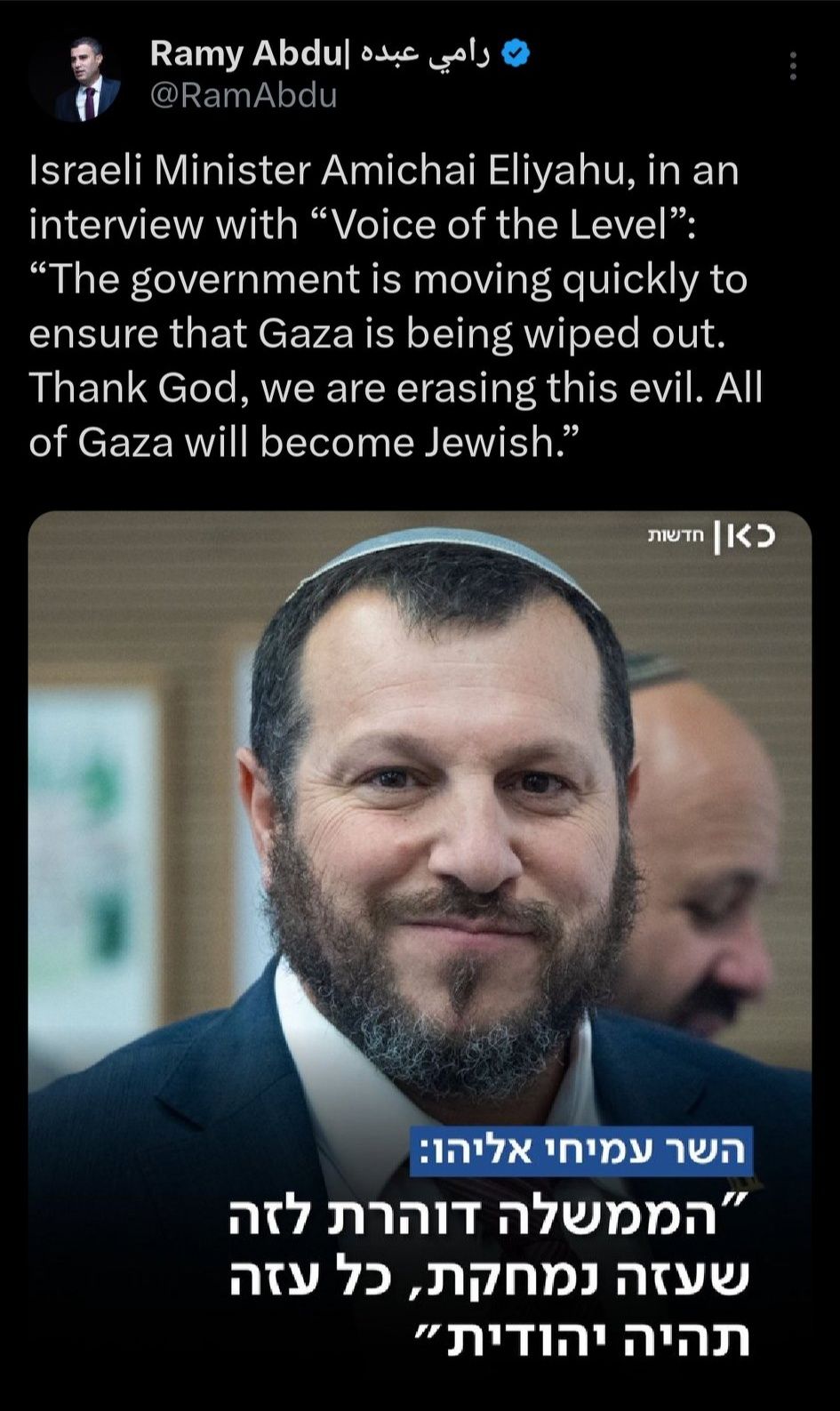
That plan has sparked concerns in Egypt and many Western countries that Israel is preparing for the mass displacement of Palestinians out of Gaza, something Netanyahu’s ultranationalist coalition partners and many inside his own party have been pushing for years.
A senior Israeli official claimed that, as part of the understandings with the three countries, the transfer of Palestinians would be “voluntary and not forced,” and that Israel would commit to allowing any Palestinian who leaves to return to Gaza at any time.
There is no question that the forced removal of civilians from the Gaze Strip is a war crime. But what is more unsettling is that the Netanyahu government either believes that the evacuation could be voluntary or that, after at least 59,000 people dying, that any person could believe that the Palestinians have many choices.
The other part of the Netanyahu strategy to encourage “voluntary” evacuation is to starve the Palestinians to death. Israel refuses to allow humanitarian groups to distribute any food, water, or fuel to the Palestinians. Instead, Israel relies upon a corrupt organization, the Gaza Humanitarian Foundation, to distribute aid in places where the civilian population can be better controlled. There have been a substantial number of Palestinians killed at these distribution centers as Israeli troops have fired upon them because starving people started looting the supplies. I am not sure what the Netanyahu government considers appropriate behavior under the circumstances. Soumaya Ghannoushi describes the situation:
“She died on the floor of a collapsing hospital, her tiny ribs rising and falling like wings too fragile to lift. Her body had no fat left to burn. Her eyes had sunken. Her voice – once a whisper of laughter – had long since vanished.
“She did not die quickly. She died slowly.
“She died watched by her mother, who begged her to hold on. Watched by a doctor who had no more syringes, no more saline, no more words, and by a world that tuned in – then turned away.
“Her death was not a tragedy. It was a sentence, written not in haste, but in policy.
“Razan is not alone. She is one of thousands.
“Between March and June – well into the total blockade – the UN agency for Palestine refugees, UNRWA, screened over 74,000 children in Gaza. More than 5,500 were diagnosed with severe acute malnutrition. Over 800 were already critical.
“That was months after food was declared a threat. After flour became contraband and milk became memory, now children die in their parents’ arms.
This atrocity is not an accident nor is it merely a sad attribute of what often happens in war. Starvation is a deliberate policy to encourage “voluntary” emigration. Peter Beinart explains the policy well:
“Right. This freedom — phrase “freedom to choose” is so Orwellian. First of all, what kind of freedom is it when you have a territory where most of the buildings and the hospitals and the schools and the bakeries and the agriculture have all been destroyed, where you have more child amputees than any other place on Earth? And now you’re talking about people’s freedom to choose?
“The deeper irony is that Palestinians have actually been — in Gaza and beyond, have been asking for the freedom to choose, the real freedom to choose, since 1948, because the vast majority of Palestinians in Gaza are not from Gaza. They were expelled from their homes in what’s now Israel. Many of them can see the lands from which they were — their families were expelled in 1948. So, they do want the freedom to choose. They want the freedom to return to the places from which their families were expelled.”
Israel could not be conducting this slaughter without the active support of the United States. Israelis and Americans both have the blood of innocents on their hands for allowing their governments to commit the slaughter. Netanyahu has consistently prevented the implementation of a ceasefire and the return of the hostages so that he can continue the process of ethnic cleansing. Once the hostages are released, the Israeli people will be able to turn their total attention to the atrocity being committed in the name of self-defense. This war stopped being a war of self defense many months ago. It is now another chapter in the brutal and sordid history of imperialism.
Israel has continued to bomb Gaza and to restrict the flow of vital supplies into the Strip even though there is little evidence to suggest that there is any organized threat to Israel after two years of incessant bombardment. The unwillingness to reach a ceasefire in the Gaza stems from the desire of the Netanyahu government to expel the Palestinian population from Gaza to annex the territory. Arwa Mahdawi, writing for The Guardian explains:
“Omer Bartov is an Israeli-American historian and one of the foremost scholars on genocide in the world. He has spent over 25 years teaching a class on the subject. He deals with atrocities for a living, analyzing some of the very worst things that human beings are capable of. And yet even Bartov has said he can’t bear looking at some of the excruciating images coming out of Gaza any more.
What’s happening, Bartov says, is unprecedented in the 21st century. ‘I don’t know of any comparable situation. Recent estimates show that about 70% of the structures in Gaza are either completely destroyed or severely damaged,’ Bartov says. ‘The argument that the IDF [Israel Defense Forces] is conducting a war in Gaza is simply cynical, there is no war in Gaza. What the IDF is doing in Gaza is demolishing it. Hundreds of buildings are being bulldozed every week. This is not a secret, but mainstream media coverage has been insufficient.'”
“The consequences of the conditions of life created by Israeli state organs in Gaza are so predictable they are almost banal, in Hanna Arendt’s sense of the term. Israel’s blockade restricts access to fuel required to pump and clean water, equipment to restore damaged systems, and even bottled water. Bombing water infrastructure contaminates drinking water with raw sewage. This causes diarrheal disease like dysentery, which leads to malnutrition and increased vulnerability to further illness. Forced crowding into displacement camps and the spread of antimicrobial resistance worsen the cycle. As a result, many Palestinians have resorted to drinking salty water, damaging their kidneys. This past week alone, over 10,000 new cases of acute watery diarrhea (more than half in children under 5) were added to nearly one million cases, along with 90 new cases of Acute Jaundice Syndrome.”
We have virtually no first-hand reports on conditions in the Gaza Strip. Israel does not allow journalists into the Gaza, notwithstanding its reputation as the only “democracy” in the Middle East. There is no reason to deny access to those who would report on the conditions facing the civilian population other than to limit criticism of Israeli policy. Israel claims that it is permitting supplies into Gaza through the Gaza Humanitarian Foundation (GHF), an institution created by Israel and the US (although the funding of the foundation is totally opaque). There are serious criticisms of the GHF, but the most important aspect of the foundation is that it is clearly structured in a way to concentrate the Gaza population in the southern part of the Strip. +972, a website devoted to providing information about Palestine, argues that the GHF is a step toward the ultimate expulsion of the Palestinians from Gaza:
“The location of the four centers is no less important. One is in the central part of the Strip along the Netzarim Corridor, and three in the south, west of Rafah. A quick look at the map is enough to understand: there is no connection between the locations of the “distribution centers” and the needs of the people.
“Instead, the goal is to promote “moving the population” southward, ideally into the “concentration zones.” Since this constitutes a crime against humanity, Israel employed concealment tactics: first expelling established aid groups that could provide aid efficiently, then outsourcing distribution to opaque entities like the U.S.-backed Gaza Humanitarian Foundation (GHF).
“As early as May 11, Benjamin Netanyahu reportedly stated in a secret session of the Foreign Affairs and Defense Committee that ‘receiving aid would be conditional on Gazans not returning to the places from which they came to the aid distribution sites.’ This policy’s underlying logic was confirmed by Dr. Tammy Caner, a lawyer and director of the Law and National Security Program at the Institute for National Security Studies (INSS), a think tank with close ties with the Israeli military.”
I had a hard time accepting the possibility that Israelis would support the expulsion of Palestinians from the Gaza Strip, but a poll conducted by the Israeli Newspaper, Ha’aretz, was shocking:
“The survey, conducted in March and published by Haaretz newspaper on Thursday, found that 82 percent of Israeli Jews support the forced expulsion of Palestinians from the Gaza Strip.
“Meanwhile, 47 percent of Israeli Jews answered yes to the question: ‘Do you support the claim that the [Israeli army] in conquering an enemy city, should act in a manner similar to the way the Israelites did when they conquered Jericho under the leadership of Joshua, ie to kill all its inhabitants?’ The reference is to the biblical account of the conquest of Jericho.”
If Israel does take over the Gaza, then I expect that it will then take further steps to expel Palestinians from the West Bank. Even if that does not happen, Israel will forever bear the shame of committing a crime against humanity. And it will not enhance its security in any meaningful way. The US should stop supporting Israel, militarily and financially. It should also take active steps to organize harsh sanctions against Israel.
This morning’s headline for the online version of the New York Timeswas “U.S. enters War Against Iran”. The headline is misleading. The more accurate headline would have been “US President Trump Declares War on Iran”. The actual headline ignores the fact that the US has been engaged in coercive diplomacy against Iran since 2018 when President Trump withdrew the US from the Joint Comprehensive Plan of Action (JCPOA) which was considered by most analysts as an effective check on any nuclear ambitions that Iran might have held, although there was no evidence at the time (nor two days ago) that Iran had made a decision to build a nuclear weapon:
“More than three years of Iran’s compliance with the JCPOA from January 2016-May 2019 demonstrated its nonproliferation benefits. Taken together, the array of restrictions on uranium enrichment ensures that Iran’s capability to produce enough weapons-grade uranium sufficient for one warhead would be approximately 12 months for a decade or more. The JCPOA also effectively eliminated Iran’s ability to produce and separate plutonium for at least 15 years. Just as importantly, the JCPOA mandates unprecedented international monitoring and transparency measures that make it very likely that any possible future effort by Iran to pursue nuclear weapons, even a clandestine program, would be detected promptly.”
Israeli Prime Minister Netanyahu had held for a long time that Iran’s nuclear program represented an “existential threat” to Israel. Indeed, he warned about the Iranian nuclear program when he was just a member of the Knesset in 1992:
“Since 1992, when Netanyahu addressed Israel’s Knesset as an MP, he has consistently claimed that Tehran is only years away from acquiring a nuclear bomb. ‘Within three to five years, we can assume that Iran will become autonomous in its ability to develop and produce a nuclear bomb,’ he declared at the time. The prediction was later repeated in his 1995 book, Fighting Terrorism.
“The sense of imminent threat has repeatedly shaped Netanyahu’s engagement with United States officials. In 2002, he appeared before a US congressional committee, advocating for the invasion of Iraq and suggesting that both Iraq and Iran were racing to obtain nuclear weapons. The US-led invasion of Iraq followed soon after, but no weapons of mass destruction were found.”
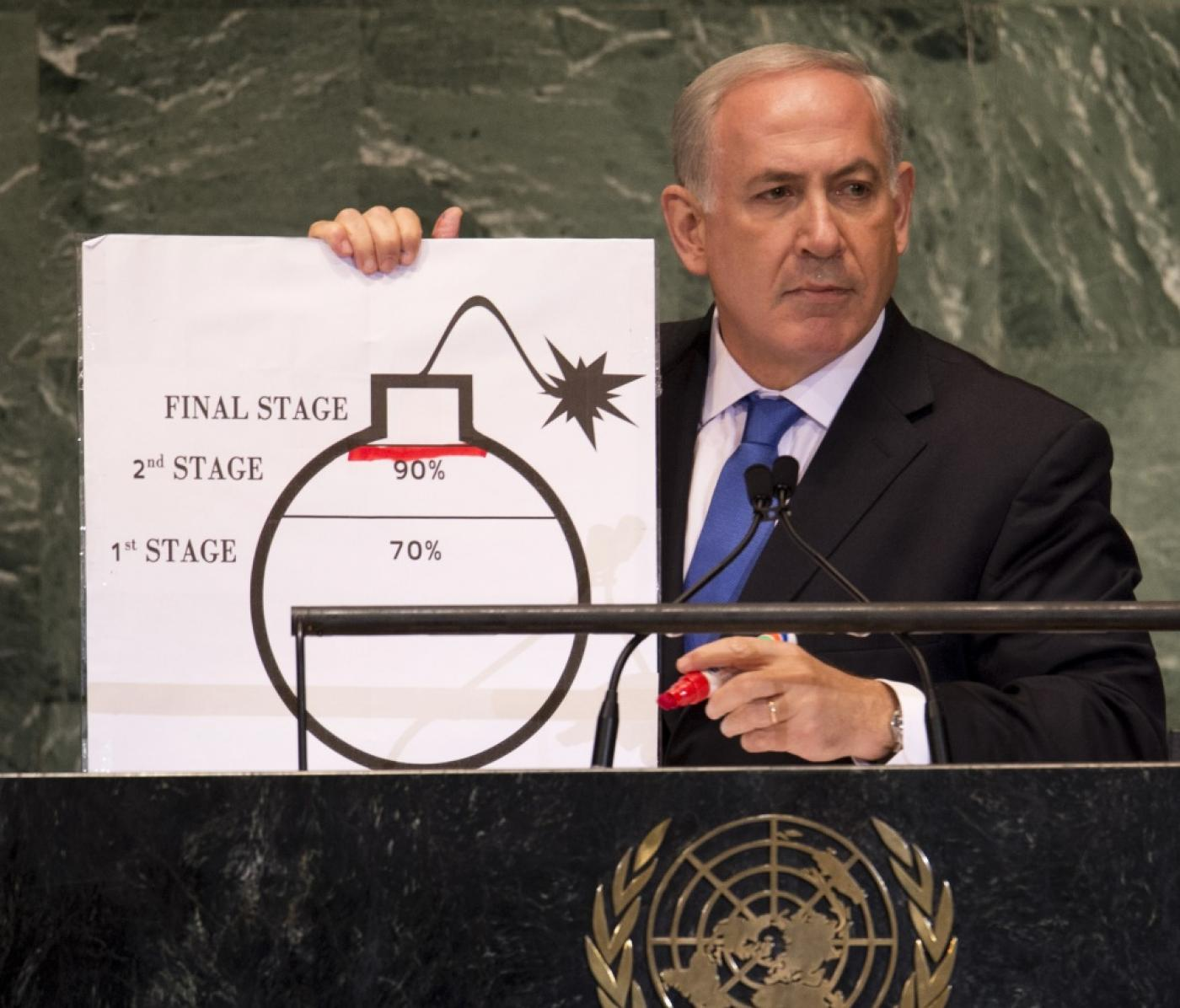
Netanyahu has worried about Iran for 33 years and yet the Iranians never developed a nuclear bomb, even though it clearly had the expertise and means to do so. Instead, Iran adhered to its commitment to the Non-Proliferation Treaty and refused to take that path, despite being surrounded by nuclear powers: Russia to the north, China to the east, India and Pakistan to its southeast, Israel to its west, and US air and sea forces parked in the Mediterranean, the Persian Gulf, and in bases in Oman and Bahrain. Netanyahu went so far as to bring a visual aid to the UN General Assembly to communicate his fears about Iran.
We should be clear about what Netanyahu regards as an “existential threat”. Does Netanyahu actually believe that Iran would drop a nuclear bomb on Israel, killing millions of Palestinians in the process? One cannot dismiss the possibility that at some point there will be an Iranian regime that would commit such a heinous crime. But one would have to offer more evidence of Iranian indifference to human life to persuade me that such an outcome was likely. There are currently nine nuclear powers in the world and some of them engaged in reckless propaganda (“godless communists” and “capitalist running dogs” are two of my favorites) that is roughly comparable to Iranian propaganda (“America is Satan”). But none of these states, except for the US, has ever dropped a nuclear bomb
The existential threat that Netanyahu fears is the possibility of Israeli self-deterrence in the face of a nuclear Iran. Nuclear threats are taken seriously by civilian populations and are effective even when palpably implausible. The US threatened nuclear war against China in 1956 over two insigificant islands (Quemoy and Matsu) which were controlled by the Republic of China, now known as Taiwan. Similarly, the US refrained from arming Ukraine with advanced weaponry after Russian President Putin started referring to Russian nuclear capabilities. Israel currently has a free military hand in Lebanon, Syria, the Gaza Strip and the West Bank, and it has used that advantage to its benefit after the attacks of 7 October. A nuclear-armed Iran, however, might restrain Israeli military power just by posing the possibility of a nuclear attack, forcing the Israeli people to ask the question “Is dropping more bombs on the Gaza Strip worth risking nuclear annihilation?” States are reluctant to gamble on their existence, even when the odds are in their favor. An Israeli government may not want to be constrained by an Israeli population afraid of a nuclear attack. And that fear is the real existential threat to Israel.
The last few weeks have been confusing. There were statements that the US wanted to restart the negotiations to revive the JCPOA, but refused to entertain the possibility that Iran would be allowed to enrich Uranium, a right guaranteed by the Non-Proliferation Treaty and the JCPOA. The precipitating event for the Israeli attack on Iran was the Iranian decision on 13 April to enrich its Uranium far beyond the traditional limit of 20% which is considered essential for civilian nuclear power purposes (Iran believes that it makes more money selling its petroleum rather than burning it for energy purposes). But the Stockholm International Peace Research Institute interpeted this decision quite differently than one designed to build a nuclear bomb:
‘On 13 April, Iran announced its intention to enrich uranium to 60 per cent U-235. This was characterized by Iran as a response to a sabotage of its vast underground enrichment cascades at Natanz two days before. The move comes against the backdrop of sensitive negotiations happening in Vienna aimed at rescuing the 2015 Iran nuclear deal, the Joint Comprehensive Plan of Action (JCPOA), and bringing the United States back into compliance with the deal…
“Uranium enriched to 60 per cent cannot be used to make a useful nuclear explosive device, and Iran has no other realistic use for this material.
“Nevertheless, 60 per cent was not an arbitrary choice. Cascades of centrifuges are designed to enrich uranium in steps; Iran’s centrifuges are likely set up to enrich up to 20 per cent, from 20 to 60 per cent, and from 60 to 90 per cent. Assuming the 60 per cent-enriched uranium is stored in the form of uranium hexafluoride (UF6) gas—and there would be no point in Iran converting it to any other chemical form—the enrichment step from 60 per cent-enriched to weapons-grade uranium is very short.
“This strongly suggests that Iran’s decision was intended to send a political message: ‘We have gone as far as we can go in response to provocations without producing weapons-grade uranium.’”
One needs to appreciate the position of Iran after Trump pulled the US out of the JCPOA: it was placed under punishing sanctions which have severely damaged the Iranian economy and was not offered any way to remove those sanctions without giving up its right to enrich Uranium. The question we need to answer is whether the decision to enrich Uranium to 60% actually signaled an intent to build a nuclear bomb. Trump’s Director of National Intelligence, Tulsi Gabbard, was explicit on this question: “In March, Gabbard testified on Capitol Hill that the U.S. ‘continues to assess that Iran is not building a nuclear weapon and Supreme Leader Khamenei has not authorized the nuclear weapons program he suspended in 2003.'” Trump insisted that Gabbard was wrong, but that is not the first time he has disagreed with his own intelligence services.
We should also think about Trump’s decision to declare war on Iran in the context of the US Constitution. Only Congress has the right to declare war: “Article I, Section 8, Clause 11 states that Congress has the power to declare war. Initially, the draft of the Constitution granted Congress the power to make war. There were suggestions to give this power solely to the President, solely to the Senate, or to both the President and the Senate. However, the Framers decided that involving both the President and Congress addressed their concerns. They didn’t want just one person to decide something so significant, nor did they trust a single branch alone.” The wisdom of the writers of the Constitution has been lost. Iran did not attack the US, so the US claim of self-defense is hollow. Nor does Iran have any ability to hit the US mainland with a nuclear bomb or any conventional bomb. Iran does pose a threat of terror attacks on US citizens, but such threats are better dealt with by local officials and not the US military.
Now the US and Iran are in a state of war. Iran does not need to declare war on the US for a state of war to exist–the US attack on Iranian territory constituted a state of war. For example, the US declared war on Japan after the Pearl Harbor attack, but Roosevelt wanted to focus on fighting Germany immediately (he didn’t have much choice since the US fleet was at the bottom of the Pacific and therefore didn’t have the ability to fight Japan immediately). Foolishly, Hitler declared war on the US first, relieving the US of the need to make a decision about declaring war against Germany. Now that the US has created a state of war, it is imperative to ask the question: What are the US war objectives?
The US is still committed to preventing the Iranians from developing a nuclear bomb. We have yet to see whether the US attack effectively destroyed Iranian capabilities. Trump declared that the facilities had been “completely and totally obliterated” but we have no way to confirm that assessment (it’s not clear on what evidence he based this assertion). More importantly, there is no way for the US to destroy the knowledge that Iran has about building a bomb. That knowledge will endure if the Iranians want it to endure. At best, the US and Israel have gained some time derailing Iran nuclear intentions, but to maintain that respite, Israel and the US will have to keep bombing Iran anytime there is a suspicion that Iran is engaged in nuclear-related activities.
Unless, of course, that the Israeli and US intention is to force regime change in Iran in order to prevent any government that would attempt to build a bomb. The US has often forced regime change (Iran 1953; Guatemala, 1954; the Dominican Republic in 1965; Grenada, 1983; Panama, 1989; and Iraq in 2003). One would be hard pressed to assert that these efforts genuinely served the US national interest. And it is more likely that the Iranian people will want a more aggressive regime given the humiliation inflicted on them by the Israeli and US attacks. They may welcome a new regime that is less stringent in terms of personal conduct. But given the obvious failures of the current regime to prevent the wholesale leakage of Iranian secrets, it is more likely that Iranians would support greater scrutiny (how else does one explain the precision Israeli attacks against specific military and scientific individuals in early June? Someone was telling the Israelis names, addresses, and times, and it is likely that the Iranians will direct most of their efforts to uproot those spies).
I suspect that the Iranians will do two things. First, they will announce their withdrawal from the Non-Proliferation Treaty which allows states to abrogate the treaty after 90 days of warning. Since Israel and the US did not believe that Iran was adhering to the treaty, the repercussions of such a move would be small diplomatically. There will, however, a great deal of negative press for the Iranians, but both the US and Israel have muzzled the press on this matter already. Leaving the NPT would end the pretense that a nuclear weapon is not necessary for national defense against nuclear powers. Iraq proved that nuclear weapons are the only way to prevent an invasion, and North Korea proved that breaking the NPT does not preclude engagement with nuclear powers. Furthermore, the Iranians do not have a choice unless they wish to submit to the dictates of Israel–their previous strategy of relying on proxies and air defenses was an abject failure. Israel has forced the Iranian hand on this matter.
Second, Iran will likely make noises about shutting down the Strait of Hormuz, a narrow channel through which 40% of the world’s exported petroleum passes. Noises could go from verbal threats to actually blocking the channel with sunken vessels. The threats are probably sufficient to force insurance rates for oil-carrying cargo shops to skyrocket. That alone would focus the attention of India, Europe, and China on finding a better solution to this state of war. Moreover, it would force Saudi Arabia and the Gulf States to gauge their interests less in alignment with the interests of the US. Finally, a spike in oil prices would doom Republican chances in the mid-term elections in 2026.
For me, the most unfortunate aspect of this remarkable event is that allowing this war to be declared unilaterally by the President has insulated US foreign policy from democratic processes. Foreign policy has almost always been determined by small groups of people (did you notice that as Trump delivered his speech at the White House announcing the bombing, he was flanked by Hegseth, Rubio, and Vance?), and moving foreign policy in the democratic process was an arduous and difficult process which began with the Vietnam War. That process was never completed and today it seems to be unattainable.
The Homeland Security Director, Kristi Noem, who could not define the right of Habeas Corpus nor where is enshrined as a right in the Constitution, today revoked the right of Harvard University to receive international students. In her message in X, in language reminiscent of the worst days of Senator Joseph McCarthy’s Red Scare:
“This administration is holding Harvard accountable for fostering violence, antisemitism, and coordinating with the Chinese Communist Party on its campus.
“It is a privilege, not a right, for universities to enroll foreign students and benefit from their higher tuition payments to help pad their multibillion-dollar endowments….
“Let this serve as a warning to all universities and academic institutions across the country.”
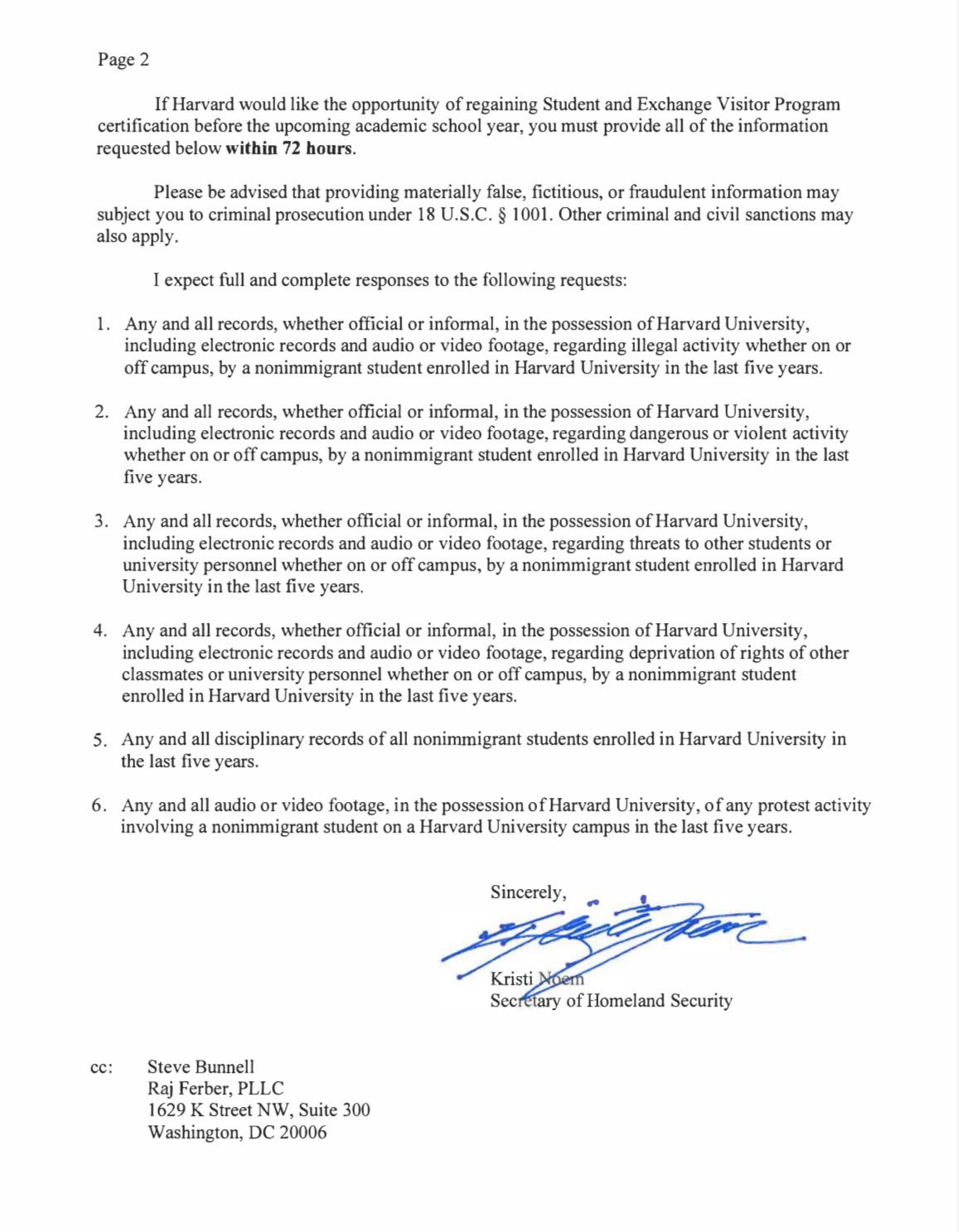
The full letter to Harvard can be read below:
The language in this letter is repulsive and represents an authoritarian impulse which negates the very basic premises of a democratic state. Its objectives are grandiose (“root out the evils of anti-Americanism and antisemitism in society and campuses”) and its tone is imperious (“you must provide all the information requested below in 72 hours“-delivered on a Friday evening).
I do not doubt that Harvard will fight this order in court and win. But the strategy of the Trump Administration is clear: to intimidate and silence any possible critics of its horrific and undemocratic policies. I hope that the courts penalize the Trump Administration in ways that assure the American people that democracy will be protected.




 World Politics News