I posted on 19 August about Turkey’s increasing assertiveness in the Middle East and the Mediterranean. Yaakov Amidror has written on this topic for The National Interest, and his analysis reinforces my views that Turkish President Erdogan is intent on increasing Turkish influence in regional affairs that in many respects mimics the policies of the Ottoman Empire. He writes:
“What motivates Turkey? While the country is recovering relatively well from the coronavirus pandemic, it continues suffering from an ongoing economic crisis. Erdogan appears to feel that his aggressive policies, which are reminiscent of Ottoman behavior, have broad domestic support. He seems to sense the weakness of other powers in the region, especially the EU, and he wants to expand his country’s influence at the expense of others in the Mediterranean—which, without U.S. backing, are left largely defenseless.”
Significantly, Turkish policies seem to be diametrically opposed to Russian interests in Syria, Libya, and in the Eastern Mediterranean. But the Turkish actions have also antagonized two members of NATO, France and Greece, in ways that threaten the alliance itself. Moreover, Erdogan is a supporter of the Muslim Brotherhood, which threatens Egypt which regards the group as a terrorist group. In other words, Turkish policies are disruptive to the interests of many in the region.
The US has strong connections to all these states, but the US has been strangely silent on the possible confrontations. The Brookings Institute has published an article which has taken note of this absence:
“The United States considers this area one of great strategic interest, especially for containing Chinese and Russian interference through regional alignments and allies. The policy objective is to keep the main maritime trade routes — first of all the Suez Canal — safe. In this sense, the goal is to minimize the opportunities for confrontation between the countries of the region, especially with two NATO members involved, Turkey and Greece, and potentially now France.
“The void left by the United States in the political dynamics of the Mediterranean has been filled, to a growing extent, by China and Russia. The two powers are able to maneuver well in the region, taking advantage of the increasing systemic disorder and growing tensions between states. America should act to prevent this.”
The US could easily take the stance on the Eastern Mediterranean that it has taken in the South China Sea: a strict adherence to the international law of the sea. Turkey has been conducting seismic tests for oil in waters that Greece considers within its legal jurisdiction. Other European states have come to Greece’s defense, as noted by CNN:
“‘The Eastern Mediterranean has transformed into a space of tensions,’ French Defense Minister Florence Parly tweeted Wednesday. “The respect of international law should be the rule and not the exception. With our Cypriot, Greek and Italian partners we will start military exercises from today with maritime and air methods.
“The Italian navy said in a statement calling for ‘stronger cooperation and dialogue’ that it would be taking part in an exercise off Cyprus, with the naval units of France, Cyprus and Greece, between August 26-28. The Italian ship involved in that also took part in a four-hour exercise with the Turkish navy on Wednesday.”
The US Geologic Survey has estimated that there are about “1.7 billion barrels of recoverable oil and 122 trillion cubic feet of gas in the Levant Basin section of the Eastern Mediterranean” so there is a lot of interest by many states in those resources. In earlier times, the US would have taken a strong role in trying to mediate these tensions, but there does not appear to be any interest by the US in such a role in this dispute. Without a strong mediating presence, it seems unlikely that these issues can be resolved without conflict.
The Trump Administration has decided not to cooperate with the initiative led by the World Health Organization (WHO) to develop a vaccine against the COVID-19 infection. The Hill reports:
“The United States will not join a global effort led by the World Health Organization (WHO) to develop, manufacture and distribute a vaccine against the coronavirus, the White House said Tuesday.
“The decision represents a gamble by the Trump administration — one that could threaten to leave the country behind if the first viable vaccine candidate is developed by another country.
“Almost every nation in the world is participating in initial talks on the joint COVAX project involving the WHO, the European Union, Germany, Japan and several major nongovernmental organizations.
“The project, announced by the WHO earlier this year, would distribute an eventual vaccine candidate to countries around the world based on the number of high-risk residents in each nation.”
The ostensible reason for the US non-participation is President Trump’s belief that WHO is biased in favor of China. Even if the accusation were true, it really ignores the other 170 countries which will be cooperating with WHO. The real reason for the US decision is the ideology of “America First”. The US wants to be able to charge whatever it wants for the vaccine, a position likely pushed by the private companies who are developing vaccines in the US. Additionally, the US does not want any interference in any decisions about how it will be distributed, likely because the US vaccine will be used as a political tool to reward allies and punish enemies. The crassness of the US position is a disgrace. China’s media outlet, China Times, points out the hypocrisy of the US decision to not cooperate with the rest of the world:
“Li Haidong, a professor at the Institute of International Relations of the China Foreign Affairs University, said the US not participating again reflects its selfishness which is that no other country can gain advantages from it for free, and the country apparently has no intention to share its coronavirus information and vaccine information with others.
“The US’s back-out is in part because the White House does not want to work with the WHO, which President Trump has chastised, for what he characterized as its ‘China-centric’ response to the pandemic, the Washington Post said.
“Judd Deere, a spokesman for the White House, said that “we will not be constrained by multilateral organizations influenced by the corrupt World Health Organization and China.’Li said that such a move is the US’old trick to resist China-linked plans and incite certain other countries to boycott them, which can be described as US-style “political correctness.’
“The current US diplomatic policy is indeed, extreme egocentrism and nationalism. The Trump administration now totally regards vaccine development, which is essentially a key topic close to public health and the safety of human life, as a political weight.
“Who will win the race for a vaccine remains unclear, but the result will influence the US’ health diplomacy policy and its role in the international community, Chinese experts said.
“With the US’ decision to skip over the global vaccine effort, if none of its vaccine candidates are viable, the country would be left behind with no options.”
It is hard to appreciate how quickly the US has lost the capability and will to contribute to a stable world order. The pandemic has revealed that it is apparently willing to let many people die in order to preserve its ability to distance itself from the rest of humanity.
I generally try to avoid direct references to US President Trump and focus instead on specific policies or directives issued by him. But he was interviewed by Laura Ingraham on Fox News and made statements that I regard as quite troubling. Alex Ward writes in Vox:
“On Monday, Trump told Fox News’s Laura Ingraham a wild story he’d heard about a supposed plane full of “thugs” who had traveled together on a commercial flight to an unnamed American city to stage protests during the Republican National Convention. These same thugs, in Trump’s telling, are secretly pulling Biden’s strings from the ‘dark shadows.’
“These are ‘people that you’ve never heard of, people that are in the dark shadows,’ Trump said. ‘They’re people that are on the streets. They’re people that are controlling the streets. We had somebody get on a plane from a certain city this weekend, and in the plane it was almost completely loaded with thugs wearing these dark uniforms, black uniforms with gear and this and that.’
“The president wouldn’t offer any more specifics because he said the whole incident is under investigation — another claim for which there’s no public evidence — but added ‘a lot of people were on the plane to do big damage.’
When a leader starts talking about “dark shadows”, it is probably time to get very worried. Even Ingraham, usually a staunch supporter of Mr. Trump, seemed taken aback by the statement. Snopes provides the context of the statement:
“Trump is picking up on unproven conspiracy theories that began spreading earlier this year during protests for racial justice. One of the first public Facebook posts suggesting a similar conspiracy theory appears to have been made in May when Idaho resident Russell D. Wade wrote on Facebook that a plane was transporting protesters from Seattle to Boise, Idaho.
“’Be ready for attacks downtown and residential areas,’ Wade wrote in a post that has been shared more than 3,500 times. Wade, who lost a bid for local sheriff earlier this year, urged his followers to arm themselves. A social media message sent to Wade on Tuesday was not immediately returned.
“Local police departments from Sioux Falls, South Dakota, to Payette County, Idaho, were forced to knock down similar social media rumors in June that ‘busloads’ of rioters were coming to town. Other social media posts claimed that throngs of ‘antifa,’ a term for leftist militants, were plotting to violently disrupt cities and towns.
“In Michigan, a limousine businessman had to refute online rumors that his buses were purchased by liberal financier George Soros to coordinate protests after Facebook users manipulated images of his white charter buses to show the words ‘Soros Riot Dance Squad’ emblazoned on the sides.
“In Facebook and Twitter posts earlier this summer, Trump also blamed antifa for violence that broke out during racial justice protests. But an Associated Press analysis of court records, employment histories and social media posts for 217 people arrested in Minneapolis and the District of Columbia, cities at the center of the protests earlier this year, found evidence that only a few of those arrested indicated they were involved in left-leaning activities. A few others expressed support for the political right and Trump himself.”
Chris Cillizza for CNN parses the many misleading statements made by the President in the interview. The list of false statements in just 36 minutes is rather stunning. The Times of India expresses the bewilderment that probably represents the views of many people in the world on the upcoming national election. We will see if the Republican Party has any insight into the President’s state of mind.
Several hundred protesters stormed into the German Reichstag building, breaking through a security barrier before they were finally repulsed by police. Many of the protesters were demonstrating against the restrictions imposed upon them to held stem the spread of COVID-19. But many of the protesters were members of the Reichsbürger movement which denies the legitimacy of the modern German state. The movement is difficult to define:
“As matters stand now, Reichsbürger cannot be classified as an organization — not yet. So far, the group is loosely structured with multiple autonomous groups, including “Königreich Deutschland” (The German Kingdom), “Das deutsche Polizeihilfswerk” (The German Police Relieve Agency) or “Reichsbewegung- neue Gemeinschaft von Philosophen” (Reichsmovement – new community of philosophers).
“Because the movement is made up of various splinter groups, it is difficult to assess the actual number of Reichsbürger members. The BfV classified around 18,000 individuals as Reichsbürger in 2018, and recent years have observed increased activity online suggesting that the number of adherents to the Reichsbürger ideology is growing.
“What unites the Reichsbürger is their shared system of belief. A large part of their ideological foundation revolves around the narrative that the Federal Republic of Germany does not exist and is not an actual state. To them, the German Reich did not perish in 1945 and remains the legitimate German authority, while the Federal Republic as an illegitimate creature of foreign occupation and exploitation. They believe that because there has never been an official peace treaty, the occupation continues until this day, with the Federal Republic an instrument of the Allied powers that allows Germans the illusion of independence and democracy. According to the Reichsbürger, Merkel, her cabinet, as well as parliament, the judiciary, and the security agencies are all puppets installed and controlled by foreigners.”
The movement was not taken seriously until 2016 when one of its members killed a German police officer. It represents an extreme version of nationalism, a position which is becoming increasingly common in many countries: Brexit is one such manifestation, as is the BJP in India, and in the Sovereign Citizens Movement in the US. At this time, German authorities estimate that there are about 16,000 members of the Reichsbürger movement, but the numbers seem to be increasing every year.
The retreat into “blood and soil” nationalism in many countries in the world is deeply troubling, although it is in many respects a countermovement to globalization. But these intense nationalist movements usually have a bad end since they tend to be deeply paranoid and exclusive.
One of the many Reichsbürger flags–a chilling image
Congress has been informed by the Office of the Director of National Intelligence that there will no further briefings on foreign election interference in the 2020 national elections. The halt was purportedly due to the fear that there would be unauthorized leaks of classified information by members of Congress. The move comes after William Evanina, the director of the National Counterintelligence and Security Center, briefed Congress that China, Russia, and Iran were taking steps to interfere with the election. According to Evanina, China would like Biden to win because it regards Trump as unreliable, Russia wants Trump to win because he is sympathetic to Russia, and Iran simply wishes to cause chaos in the US.
The idea that Congresspeople are likely to leak information is not far-fetched, but these intelligence reports are mandated by law. The Director of National Intelligence, John Ratcliffe, was a close ally of Mr. Trump when he was in Congress, and he indicated that he would supply written reports that summarize the intelligence findings. But Congressional leaders indicated that they do not wish to lose the opportunity to ask questions in an oral briefing.
One should not take the fear of leaks as a sufficient justification to stop the briefings. Mr. Trump himself has been a prodigious leaker of classified intelligence. Wikipedia has a very nice (and very well sourced) list of those occasions:
“President Donald Trump discussed classified information provided by a U.S. ally regarding a planned Islamic State operation during an Oval Office meeting on May 10, 2017 with the Russian Foreign Minister Sergey Lavrov and the Russian Ambassador Sergey Kislyak, providing sufficient details that could be used by the Russians to deduce the identity of the ally and the manner in which it was collected, according to current and former government officials. The meeting had been closed to the U.S. press, although a photographer from the Russian press contingent was present. The disclosure was first reported in The Washington Post on May 15, 2017. White House staff initially denied the report, but the following day Trump defended the disclosure, stating that he has the “absolute right” to “share” intelligence with Russia….
“In an April 29, 2017, phone call, Trump told Philippines President Rodrigo Duterte that the U.S. had positioned two nuclear submarines off the coast of North Korea. This was during a time when Trump was warning of a possible “major, major conflict” with North Korea. The locations of nuclear submarines are a closely guarded secret, even from the Navy command itself. ‘As a matter of national security, only the captains and crew of the submarines know for sure where they’re located.’
On May 24, 2017, Britain strongly objected to the United States leaking to the press information about the Manchester Arena bombing, including the identity of the attacker and a picture of the bomb, before it had been publicly disclosed, jeopardizing the investigation. British Prime Minister Theresa May issued a public rebuke, and British police said they would stop passing information to U.S. counterparts.
“In July 2017, after a private meeting with Russian president Vladimir Putin at the 2017 G20 Hamburg summit, Trump took the unusual step of confiscating and keeping his interpreter’s notes. This led U.S. intelligence officials to express concern that Trump ‘may have improperly discussed classified intelligence with Russia.’
“On August 30, 2019, Trump tweeted a reportedly classified image of recent damage to Iran‘s Imam Khomeini Spaceport that supposedly occurred as a result of an explosion during testing of a Safir SLV. Multiple concerns were raised regarding the public release of what appeared to be a surveillance photo with exceptionally high resolution, revealing highly classified U.S. surveillance capabilities. Within hours of the tweet, amateur satellite trackers had determined the photograph came from National Reconnaissance Office spy satellite USA-224. Before Trump’s tweet, the only confirmed photographs from a KH-11 satellite was leaked in 1984 by a U.S. Navy analyst who went to prison for espionage. Trump defended the tweet by saying he had ‘the absolute right’ to release the photo.”
The decision to halt the in-person briefings is simply an attempt to prevent the American people from learning about foreign interference in their national elections, largely because Mr. Trump believes that information undermines his legitimacy.
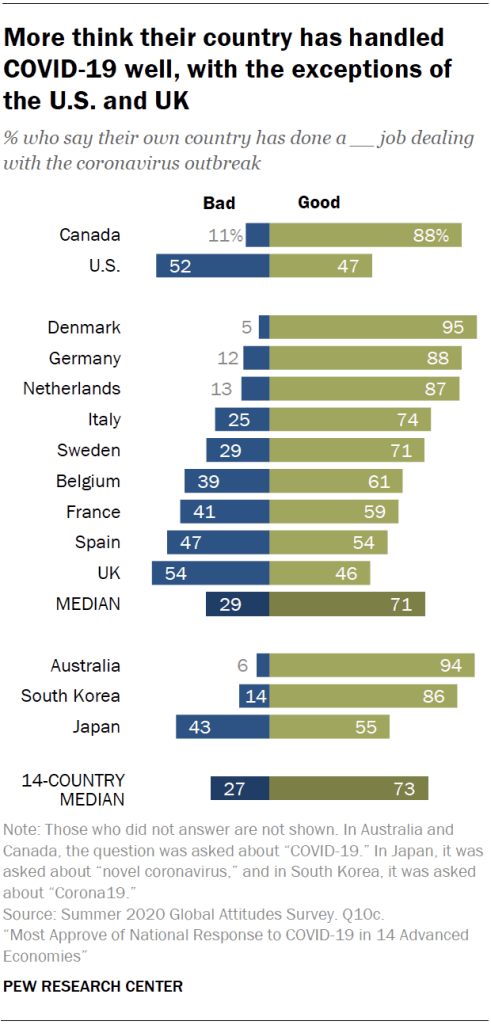
The Pew Research Center has conducted a poll in several countries on how citizens rate their government’s response to the COVID-19 pandemic. The range of results is huge, but not especially surprising. The Center reports:
“Across the 14 countries surveyed, a median of 73% say that their own country has done a good job dealing with the coronavirus outbreak. Just 27% believe their country has handled it poorly. However, there is some variation by country on this assessment.
“About seven-in-ten or more give their nation’s coronavirus response a positive review in Denmark, Australia, Canada, Germany, the Netherlands, South Korea, Italy and Sweden. And more than half in Belgium, France, Japan and Spain share this sentiment.
“In two countries – the United Kingdom and the United States – people are divided in their beliefs when it comes to rating their government’s performance responding to the coronavirus. These two nations also have high levels of political polarization on views of the government’s handling of this crisis. In the U.S., 76% of Republicans and independents who lean to the Republican Party say the government has done a good job, while just a quarter of Democrats and Democratic leaners agree, a 51 percentage point difference. A majority of right-leaning Britons (55%) give a positive rating to their country’s handling of the pandemic, led by Prime Minister Boris Johnson’s Conservative government, but just 26% on the left hold the same opinion.”
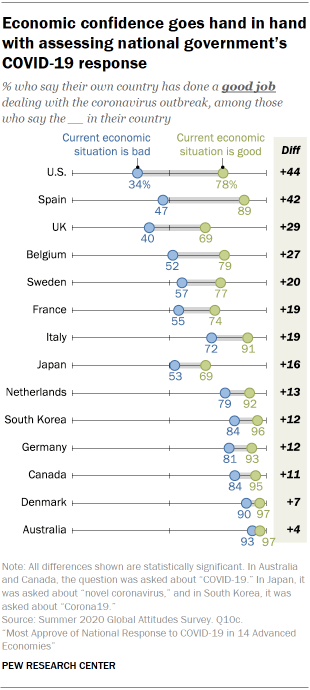
Another finding of the poll is quite striking: there is a strong correlation between those who think their government has done a good job in addressing the pandemic and their assessment of the economy in their country:
“Economies around the world have contracted due to the unprecedented nature of the coronavirus outbreak, and the U.S. Congressional Research Service reports that the global economy could grow between 3% and 6% less in 2020 compared with previous projections. These economic effects also relate to how people assess their own nation’s handling of the pandemic. Across all 14 nations included in the survey, those who think their current national economic situation is good are also more likely than those who believe the economy is bad to say their country has done a good job of dealing with the coronavirus outbreak.
“This divergence is especially pronounced in the United States. Among those with a more optimistic view of the economy, 78% report that they approve of the way the U.S. government has dealt with the virus. But those who think the American economy is currently in poor shape are less than half as likely to give the government response a positive rating.”
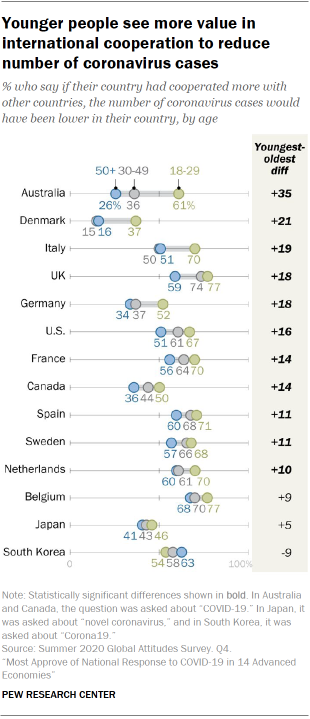
One surprising result of the poll is that younger Americans tend to think that there would have been fewer coronavirus deaths if the US had cooperated with other countries and international organizations such as the World Health Organization (WHO).
“Americans on the whole say that more cooperation could have limited the number of coronavirus cases. A majority (58%) of U.S. adults say that if the U.S. had cooperated with more countries, the number of American coronavirus cases would have been lower.
“Much as younger people globally tend to have more favorable opinions of the UN and younger Americans give higher approval ratings to the WHO for its handling of the coronavirus outbreak, those ages 18 to 29 are more likely than those 50 and older to say that more cooperation would have reduced the number of coronavirus cases in their country.”
The views of people in the European Union (EU) on the coronavirus also reflects the different opinions that many in Europe have of the Union itself. It seems as if it is impossible to view the pandemic from a non-political point of view. That conclusion is dispiriting.
Tensions between the US and China have ratcheted up because the US sent a U-2 surveillance plane into an area China designated as a “no-fly” zone because it was conducting live-fire military exercises in the region. The US insists that its flights were perfectly legal because they were conducted in strict accordance with international law. The surveillance flight might have been legal, but sending an aircraft into a live-fire zone is problematic. In response, the Chinese launched two missiles into an area of the South China Sea. According to The South China Morning Post:
“One of the missiles, a DF-26B, was launched from the northwestern province of Qinghai, while the other, a DF-21D, lifted off from Zhejiang province in the east.
“Both were fired into an area between Hainan province and the Paracel Islands, the source said.
“The landing areas were within a zone that Hainan maritime safety authorities said on Friday would be off limits because of military exercises from Monday to Saturday.
“The DF-26 dual-capable missile is a type of weapon banned by the Intermediate-Range Nuclear Forces Treaty treaty signed by the US and Soviet Union towards the end of the Cold War. When the US withdrew from the treaty last year, it cited China’s deployment of such weapons as justification.
“The DF-26 has a range of 4,000km (2,485 miles) and can be used in nuclear or conventional strikes against ground and naval targets.
“The DF-21 has a range of around 1,800km, with state media describing the most advanced in the series, the DF-21D, as the world’s first anti-ship ballistic missile.”
The missiles were clearly intended to send a message to the US which has routinely sent its naval vessels into the South China Sea to assert freedom of navigation rights. The aircraft carrier is the most dramatic example of what military analysts call “projective power”–the ability to exert military force independently of naval bases and contiguous territory. But there are many questions about the viability of aircraft carriers as missile technology continues to improve.
But the increased tension is also based upon a new policy articulated by US Secretary of State Pompeo on US policy toward the South China Sea. The new policy rejects China’s claims in the sea, a dramatic shift from its previous position that those claims have to be negotiated between China and the other states with maritime claims.
“The PRC has no legal grounds to unilaterally impose its will on the region. Beijing has offered no coherent legal basis for its “Nine-Dashed Line” claim in the South China Sea since formally announcing it in 2009. In a unanimous decision on July 12, 2016, an Arbitral Tribunal constituted under the 1982 Law of the Sea Convention – to which the PRC is a state party – rejected the PRC’s maritime claims as having no basis in international law. The Tribunal sided squarely with the Philippines, which brought the arbitration case, on almost all claims.
“As the United States has previously stated, and as specifically provided in the Convention, the Arbitral Tribunal’s decision is final and legally binding on both parties. Today we are aligning the U.S. position on the PRC’s maritime claims in the SCS with the Tribunal’s decision. Specifically:
“The PRC cannot lawfully assert a maritime claim – including any Exclusive Economic Zone (EEZ) claims derived from Scarborough Reef and the Spratly Islands – vis-a-vis the Philippines in areas that the Tribunal found to be in the Philippines’ EEZ or on its continental shelf. Beijing’s harassment of Philippine fisheries and offshore energy development within those areas is unlawful, as are any unilateral PRC actions to exploit those resources. In line with the Tribunal’s legally binding decision, the PRC has no lawful territorial or maritime claim to Mischief Reef or Second Thomas Shoal, both of which fall fully under the Philippines’ sovereign rights and jurisdiction, nor does Beijing have any territorial or maritime claims generated from these features.
“As Beijing has failed to put forth a lawful, coherent maritime claim in the South China Sea, the United States rejects any PRC claim to waters beyond a 12-nautical mile territorial sea derived from islands it claims in the Spratly Islands (without prejudice to other states’ sovereignty claims over such islands). As such, the United States rejects any PRC maritime claim in the waters surrounding Vanguard Bank (off Vietnam), Luconia Shoals (off Malaysia), waters in Brunei’s EEZ, and Natuna Besar (off Indonesia). Any PRC action to harass other states’ fishing or hydrocarbon development in these waters – or to carry out such activities unilaterally – is unlawful.
“The PRC has no lawful territorial or maritime claim to (or derived from) James Shoal, an entirely submerged feature only 50 nautical miles from Malaysia and some 1,000 nautical miles from China’s coast. James Shoal is often cited in PRC propaganda as the “southernmost territory of China.” International law is clear: An underwater feature like James Shoal cannot be claimed by any state and is incapable of generating maritime zones. James Shoal (roughly 20 meters below the surface) is not and never was PRC territory, nor can Beijing assert any lawful maritime rights from it.
“The world will not allow Beijing to treat the South China Sea as its maritime empire. America stands with our Southeast Asian allies and partners in protecting their sovereign rights to offshore resources, consistent with their rights and obligations under international law. We stand with the international community in defense of freedom of the seas and respect for sovereignty and reject any push to impose “might makes right” in the South China Sea or the wider region.
By branding China’s activities in the South China Sea as “illegal” the US effectively vitiates negotiated settlements, a challenge that China cannot ignore.
The dispute simply adds more tension to an already rattled relationship. The current disputes between the two states includes trade, Taiwan, the status of Hong Kong, the treatment of the Uighurs in Xinjiang Province, and the controversy over the origins of the COVID-19 virus. Given the context, military actions by either side are incredibly dangerous.
US Secretary of State, Mike Pompeo, is slated to give a speech to the Republican National Convention endorsing the re-election of US President Trump. This type of partisan political activity is highly unusual for any State Department official, let alone the most prominent US diplomat. The practice of not participating in political activity is based upon pretty straightforward logic: the State Department is supposed to speak for all Americans when interacting with other states. But the practice is also official policy of the State Department, as evidenced by a memo approved by Pompeo himself in December of 2019:
“This memorandum outlines the current restrictions on political activities that apply to all presidential and political appointees, including Foreign Service and Civil Service career employees serving in such positions. This guidance reflects the provisions of the Hatch Act (the federal statute governing political activities by federal employees), government-wide regulations implementing that Act, and State Department policies. The Department has a long-standing policy of limiting participation in partisan campaigns by its political appointees in recognition of the need for the U.S. Government to speak with one voice on foreign policy matters. The combination of Department policy and Hatch Act requirements effectively bars you from engaging in partisan political activities while on duty, and, in many circumstances, even when you are off duty.”
Pompeo will be using Israel as a campaign prop in order to flatter Christian evangelicals who regard Israel’s presence in the city of Jerusalem as a prerequisite to the second coming of Christ. The Trump Administration has made many concessions to Israel in its dispute with the Palestinians, most notably moving the US Embassy from the city of Tel Aviv to Jerusalem, the eastern part of which the Palestinians have designated as the capital of their hoped-for state. Mimi Kirk explains this position in terms of “Christian Zionism”:
“Trump’s embassy move was controversial—but the two speakers who opened and closed the ceremony were equally controversial. Two evangelical Christian megachurch pastors from Texas who advise Trump, Robert Jeffress and John Hagee, earnestly prayed and thanked God for making the state of Israel possible and Trump for having the courage to acknowledge Jerusalem as the capital of the Jewish people.
“’Father, we are…grateful as we think about [the founding of the state of Israel in 1948], when you fulfilled the prophecies of the prophets from thousands of years ago and regathered your people in this promised land,’ intoned Jeffress, while Hagee identified Jerusalem as the city ‘where Messiah will come and establish a kingdom that will never end.’
“As Christian Zionists—Hagee is the founder of the main US Christian Zionist organization, Christians United for Israel (CUFI) and Jeffress regularly preaches the ideology on Fox news—the two men’s remarks reflect their belief that the modern state of Israel is the result of biblical prophecy. This belief centers around the idea that 4,000 years ago God promised the land to the Jews, who will rule it until Jesus’ return to Jerusalem and the rapture. Not all will benefit from this end of times scenario: While Christians will be saved and ‘live forever with Christ in a new heaven and earth,’ those adhering to other religions who do not convert to Christianity will be sent to hell.”
Pompeo’s speech is an affront to all Americans who do not wish the world to think that the US supports Israel without reservation. It is an affront to all Americans who do not want the world to think that all Americans support Trump or that supporting Trump is a precondition for acceptance in US politics.
“And we moved the capital of Israel to Jerusalem. That’s for the Evangelicals. You know, it’s amazing with that: the Evangelicals are more excited by that than Jewish people.” pic.twitter.com/nO8aIzuZJa
The Guardian is reporting the conclusions of new research which has calculated the loss of ice on the planet over the last 30 years: “A total of 28 trillion tonnes of ice have disappeared from the surface of the Earth since 1994.” The researchers looked at satellite images of the poles and glacier ice to reach that conclusion. The implications of this process, which the researchers attribute to global warming caused by human activity, are potentially devastating to large numbers of people:
“The scientists – based at Leeds and Edinburgh universities and University College London – describe the level of ice loss as “staggering” and warn that their analysis indicates that sea level rises, triggered by melting glaciers and ice sheets, could reach a metre by the end of the century.
“’To put that in context, every centimetre of sea level rise means about a million people will be displaced from their low-lying homelands,’ said Professor Andy Shepherd, director of Leeds University’s Centre for Polar Observation and Modelling.”
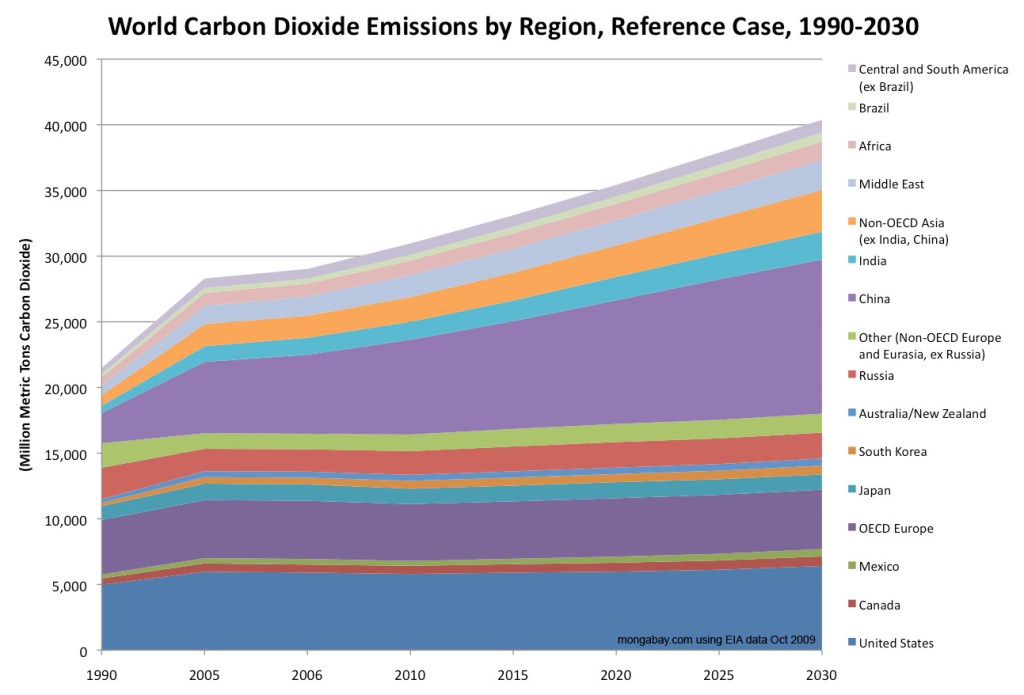
According to the researchers: “The level of ice loss revealed by the group matches the worst-case-scenario predictions outlined by the Intergovernmental Panel on Climate Change (IPCC).” We are long past the time to think that climate change is sometime in the future. The wildfires in California and Colorado are clearly related to warming and dry temperatures. Texas and Louisiana are bracing for potential hurricanes Marco and Laura on Tuesday and Wednesday, hurricanes fueled by water temperatures in the Gulf of Mexico close to 90F. Unfortunately, many of the worst emitters of greenhouse gases, such as the US, are unwilling to take any steps to avoid a desperate situation by mid-century.
The Institute for Policy Studies has published a study on how wealth has become increasingly more concentrated in the US since the advent of the pandemic. The data are actually astonishing:
“For the first time in U.S. history, the top twelve U.S. billionaires surpassed a combined wealth of $1 trillion. On Thursday August 13, these 12 held a combined $1.015 trillion.
“This is a disturbing milestone in the U.S. history of concentrated wealth and power. This is simply too much economic and political power in the hands of twelve people. From the point of view of a democratic self-governing society, this represents an Oligarchic Twelve or a Despotic Dozen….
“The Oligarchic Dozen are Jeff Bezos ($189.4b), Bill Gates ($114b), Mark Zuckerberg ($95.5b), Warren Buffett ($80b), Elon Musk ($73b), Steve Ballmer ($71b), Larry Ellison ($70.9b), Larry Page ($67.4b), Sergey Brin ($65.6b), Alice Walton ($62.5b), Jim Walton ($62.3b), and Rob Walton ($62b).
“Since March 18, the beginning of the pandemic, this Oligarchic Dozen have seen their combined wealth increase $283 billion, an increase of almost 40 percent.”
I will confess that I was an active participant in this trend. I use Facebook (Zuckerberg), Amazon (Bezos), Windows (Ballmer and Gates), Google (Brin and Page), and probably Oracle someplace on my computer (Larry Ellison). I do not, however, own a Tesla (Musk) and will never set foot inside a Walmart (the Waltons). These levels are all calculated primarily in terms of the values of the stocks these individuals hold.
“The Federal Reserve was pumping more than $1 trillion into the markets to stave off a financial meltdown, and besides, with bond yields at record lows, investors didn’t really have any palatable alternatives to stocks as places to put their money. Still, it was jarring, even macabre, to watch the market soar while tens of thousands of Americans were dying of Covid-19 and millions were losing their jobs as a consequence of the nation’s economic shutdown.”
“While there are rational explanations for the normal-level of disconnect between equity returns and economic performance, the current historically wide gap suggests the presence of significant distortions (unparalleled levels of monetary and fiscal stimulus) as well as heightened levels of uncertainty. A few not-so-far-fetched developments may trigger a sudden change in market sentiments: Overly-enthusiastic predictions regarding the future role of technology in our personal and work lives may turn out to be overblown, or the pace of economic recovery may not be in accord with stock market expectations, or a delay in vaccine development may occur. Entry of novice traders, an unstable political climate and upcoming U.S. elections pose additional risks.
“All in all, it would be wise to be prepared for a sudden and sharp course correction in equity markets as the disconnect between the equity market and the real economy reaches historic proportions.”
In many respects, the fact that the stock market bubble will eventually come crashing down is beside the point. The more important issue is whether a society that allows such a wide divide to exist between the rich and poor can ever achieve justice. Ultimately the chasm between rich and poor will corrode and eviscerate the pretense that “all men are created equal”.


 World Politics News