Today marks the 75th anniversary of the beginning of the Nuremberg Trials which prosecuted Nazi officials of crimes against humanity and other war crimes. It is difficult to overestimate the significance of the trials for world politics. They dismissed the pretense that the behavior of states in their internal affairs were not a concern for international politics, a pretense that was established at the end of the Thirty Years War and the Peace of Westphalia that ended the war. As with all wars, the causes were complex, but one of the main issues had to do with how Catholics and Protestants were treated in regions ruled by leaders with opposing faiths. The bloodshed of the war was extraordinary largely because there were no points of compromise. Protestants rulers wanted to protect Protestants who lived in Catholic-ruled regions and vice-versa. In order to end the war, the combatants decided to adopt a rule: “Cuius regio, eius religio”which roughly translates as “whose realm, his religion”. The formulation led to the creation of what we now call nation-states and the doctrine of sovereignty which holds that the internal affairs of a state are not subjects of international scrutiny. That position is still strongly held by many states in the world, most notably China which is concerned about international scrutiny of its conduct in Xinjiang, Tibet, and Taiwan.
That position, however, was not tenable in the aftermath of the conduct of states during World War II, especially in the wake of the Holocaust, the Holodomor in Ukraine, and Japanese atrocities in Nanjing, China. The Nuremberg Trials (and the Tokyo Trials) were the first attempts to alter the doctrine of sovereignty so that future atrocities could be potentially deterred. The effort has not been completely successful, as the atrocities in Cambodia, Rwanda, and Bosnia, have shown. But the efforts to prevent such atrocities continues and those efforts have been bolstered by the emergence of a new doctrine in world politics: the responsibility to protect. The doctrine assets that sovereignty is not simply a right that shields states from criticism; it also implies a powerful obligation by states to protect the human rights of all who live within the territorial borders that define the parameters of sovereignty. The doctrine has yet to be proven effective, as witnessed by the current atrocities in Yemen and Myanmar. But it is an aspiration that deserves to be pursued by all who care about world peace and justice.
One of those individuals fighting to protect the lives of vulnerable people is a Mount Holyoke alumna, Marjory Wentworth. Marjory was a student in the very first class I taught at Mount Holyoke College in the fall of 1976. She went on to found a chapter of Amnesty International at the College and co-authored a book with Juan E. Méndez, the UN Special Rapporteur on Torture and Other Cruel, Inhuman and Degrading Treatment or Punishment, entitled Taking A Stand: The Evolution of Human Rights (New York: Palgrave MacMillan, 2011). Her commitment to human rights is extraordinary and her words have given encouragement to countless numbers of peoples oppressed by states.
In 2016, Marjory wrote a beautiful poem celebrating the 70th anniversary of the Nuremberg Trials. She dedicated the poem to Henry Barbanel, a holocaust survivor: “Polish-born Barbanel was forced to go to a labor camp near Lublin and Wladowa to work for the Germans when he was 14, but quickly escaped and went on to help form a resistance movement based out of the woods of Marjanka, Poland, which was near the concentration camp in Sobibor”. Barbanel was interviewed for the US Holocaust Memorial Museum. Marjory deserves recognition as one of the most powerful voices in the United States for human rights.
Because we are forever weak and wounded, looking for someone to follow or blame, sometimes we become savage and change the rules to ease our minds. Clouded by delusions of power or fame, human beings can justify anything.
Too often things can go wrong in a hurry, and the masses go along as if their hearts were turned inside out, and hatred was something long hidden but there, like a riptide pulling below the glittering smooth surface of the sea.
Abandoning everything we know is right, we become tribal and primitive, tearing the ties that bind us one to another, as if they were made of air. And love dissolves into something lost in the cruel cacophony.
And though it may be far, there is always a storm swirling somewhere. The sea that connects and creates us, holds the seeds of our destruction. Still, God keeps nothing from us. Each new wave is a renewal; every day a gift of our own making.
As we stumble from the shadows of the twentieth century, covered in blood and ash, cradling the bones of those who are lost, we know there can be justice; the pattern has been set. No matter how long it takes, there is no peace without redemption. Without shadows, there is no light.
There are some things that I simply cannot understand, no matter how I try. As a teacher, I have no idea how I would real with this reality in a classroom. That it is apparently the worldview of some people leaves me completely at sea.
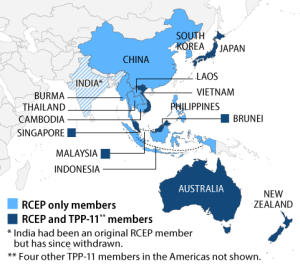
15 Asia-Pacific countries have signed the Regional Comprehensive Economic Partnership (RCEP), a regional free trade bloc that China spearheaded after US President Trump pulled the US out of a similar deal (which excluded China) known as the Trans-Pacific Partnership. Most the states in the TPP remained in that agreement which provided a big boost to international trade. The Brookings Institute describes the significance of the deal:
“Once completed, RCEP will offer a powerful boost to the rules-based global trading system. It will be a free trade area for the record books—huge in population and output (covering 3.6 billion people and a GDP of $25 trillion, exceeding that of the United States) and the most ambitious ever negotiated by developing countries. It will encompass first-ever agreements among China, India, Japan and South Korea, building upon commitments in the World Trade Organization (WTO), and offer new evidence of Asian leadership in world trade….
“RCEP will increase global real incomes by an estimated $286 billion per year (about 0.2 percent of global GDP) once the agreement is fully in place in 2030. Absolute gains will be almost twice as large as those from the CPTPP due to RCEP’s greater scale. These gains represent a permanent upward shift in real income and make RCEP equivalent to a $7.2 trillion investment that returns 4 percent per annum.
“Global trade is expected to increase by 1.9 percent with RCEP. Trade diversion (in which trade shifts from more to less efficient exporters because of trade discrimination) is estimated to be small. Some non-members may in fact benefit due to the multilateral nature of the liberalization that RCEP requires and spillovers from members’ increased productivity.”
The deal will address one of the thorniest issues in international trade: creating rules of origin, which will smooth over many difficulties caused by extensive supply chains. The Center for Strategic and International Studies assesses the significance of the change:
“One of the most significant changes under RCEP is the creation of common rules of origin for the entire bloc. Once implemented, RCEP countries will only require a single certificate of origin. This will allow companies to easily ship products between RCEP countries without needing to worry about specific rule of origin criteria in each country or for each manufacturing step. A common rule of origin for the RCEP bloc will lower costs for companies with supply chains that stretch throughout Asia and may encourage multinationals that export to RCEP countries to establish supply chains across the bloc.”
The RCEP represents the first agreement including China, Japan, and South Korea, a significant achievement. India pulled out of the RCEP last November but held out the possibility of joining at a later date. But it is extraordinary that the US, a champion of free trade since 1945, is not a member of the two largest free trade agreements ever signed. “America First” is actually “America Alone”.
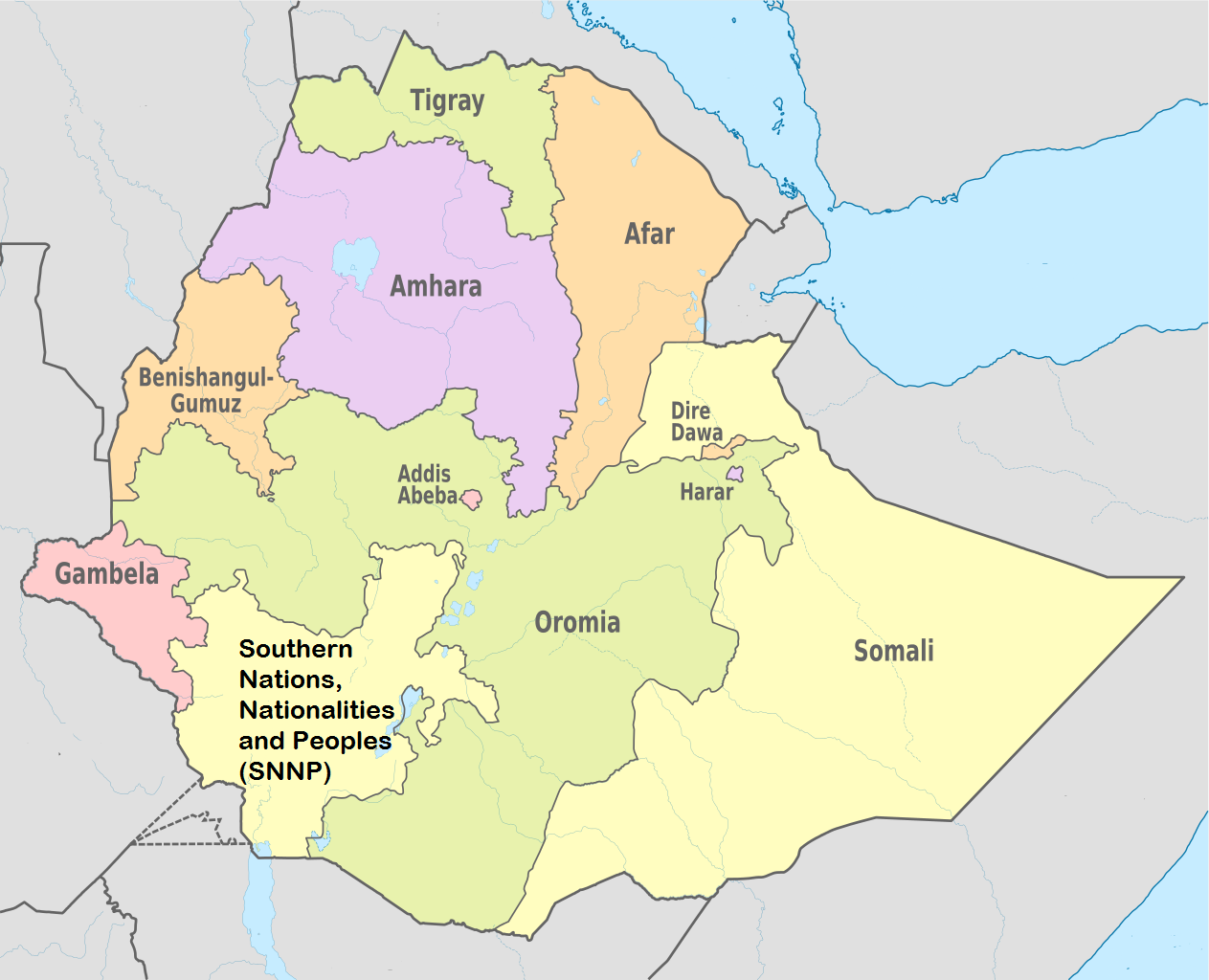
Fighting between the central government of Ethiopia and one of its provincial governments has been going for over a week and it appears as if the fighting might escalate. On 4 November Ethiopian Prime Minister Abiy Ahmed ordered a military strike against a military base in its northern state of Tigray. The dispute reflects long-simmering tensions between the people of Tigray who were the main governing group in Ethiopia for a long period of time. Ethiopia is one of the oldest states in the world and is comprised of about 80 distinct ethnic groups. For much of the 20th Century is was ruled by the Emperor Haile Selassie who was overthrown in 1974. In 1991 the Tigray People’s Liberation Front (TPLF) took control of the government despite the fact that Tigrayans only constitute 6% of the population. The minority rule alienated the much larger Oromo and Amhara ethnic groups. The Ethiopian People’s Revolutionary Democratic Front took control of the government in 2018 after three years of civil conflict, and Abiy, a member of the Oromo ethnic group, was named Prime Minister.
Abiy accomplished much in his initial years, most notably bringing an end to a devastating war with Eritrea, for which he received the Nobel Peace Prize. Additionally, the Ethiopian economy was among the fastest growing economies in the world. The tensions between the Tigrayans and the Ethiopian central government are described in Time:
“In November 2019 he [Abiy] did away with the coalition of regional parties that had ruled the country for 27 years in favor of a single Prosperity Party. The TPLF declined to join, and Abiy removed all remaining TPLF ministers from his cabinet, essentially cutting off Tigray from power. Then, citing the Covid-19 pandemic, he declared that national elections scheduled for August 2020 would be postponed until 2021.
“Tigray wasn’t having it. The state held its own elections in September. Not surprisingly, the TPLF won handily. The federal government declared the elections void and retaliated by withholding funding. Then, on Nov. 2, Ethiopia’s federal parliament designated the TPLF a terrorist group, all but shutting the door to any kind of negotiated resolution. ‘The TPLF crossed a red line,’ says Zadig Abraha, Abiy’s minister in charge of Democratization. ‘The Prime Minister is committed to peace. He brought peace to our country, and he was able to solve the longstanding conflict between Ethiopia and Eritrea, so when you come to his record there is no doubt. The problem is not him, but the TPLF.’”
The Tigrayans resisted the control of the central government and Abiy ordered the military strike to assert the control of the central government. The Tigrayan provincial government, however, is exceptionally well-armed due to its proximity to Eritrea during the war with Eritrea. The fighting has led to the killing of many civilians, and many analysts fear a protracted civil war which could easily spill over into neighboring countries such as Sudan. Communications from the county are limited, but Amnesty International asserts that massacres have occurred:
“Amnesty International can today confirm that scores, and likely hundreds, of people were stabbed or hacked to death in Mai-Kadra (May Cadera) town in the South West Zone of Ethiopia’s Tigray Region on the night of 9 November.
“The organization’s Crisis Evidence Lab has examined and digitally verified gruesome photographs and videos of bodies strewn across the town or being carried away on stretchers. It confirmed the images were recent and using satellite imagery, geolocated them to Mai-Kadra in western Tigray state (14.071008, 36.564681).
“’We have confirmed the massacre of a very large number of civilians, who appear to have been day labourers in no way involved in the ongoing military offensive. This is a horrific tragedy whose true extent only time will tell as communication in Tigray remains shut down,’ said Deprose Muchena, Amnesty International’s Director for East and Southern Africa.”
Foreign policy in a lame duck period usually fades far into the background, as the outgoing administration usually tries to tying the hands of the new administration with new or unexpected commitments. But, as has been true of the Trump Administration, normal behavior is rare. US Secretary of State made a bombshell statement in an interview with the conservative radio commentator Hugh Hewitt yesterday:
“QUESTION: Mr. Secretary, when I interviewed you at Langley and you were the director at the agency, and when I interviewed you at Foggy Bottom and you were the Secretary of State, both occasions you said our commitments to Taiwan are clear and they will be maintained. I know you talk to Democrats all the time. Do you believe that is a bipartisan commitment that the CCP has to realize? Because there is crazy talk among the most radical elements of the CCP that Taiwan ought to be retaken by force if necessary.
“SECRETARY POMPEO: Well, Hugh, remember, when we talk about – it’s always important to get the language right. Taiwan has not been a part of China, and that was recognized with the work that the Reagan administration did to lay out the policies that the United States has adhered to now for three and a half decades, and done so under both administrations. No, I actually think this is in fact bipartisan. I think the central understandings that this is a model for democracy, that the people who live on Taiwan ought to be honored by having the Chinese live up to the commitments that they have made – I think this is something that both parties can agree to.
“And I hope that this will continue for as long as it’s the case that the Chinese and the Taiwanese can’t figure their way through this. We ought to honor the commitments that have been made and we have a set of obligations. You’ve seen our announcements with respect to weapon sales to Taiwan to assist in their defense capabilities. All of these things are designed to live up to the promises that have been made between, frankly, China and the Taiwanese people.”
The statement “Taiwan has not been a part of China” represents a flat contradiction to US policy since President Nixon and Chinese Premier Chou Enlai signed the Shanghai Communique in 1972. That communique stated:
“The United States acknowledges that all Chinese on either side of the Taiwan Strait maintain there is but one China and that Taiwan is a part of China. The United States Government does not challenge that position. It reaffirms its interest in a peaceful settlement of the Taiwan question by the Chinese themselves. With this prospect in mind, it affirms the ultimate objective of the withdrawal of all U.S. forces and military installations from Taiwan. In the meantime, it will progressively reduce its forces and military installations on Taiwan as the tension in the area diminishes.”
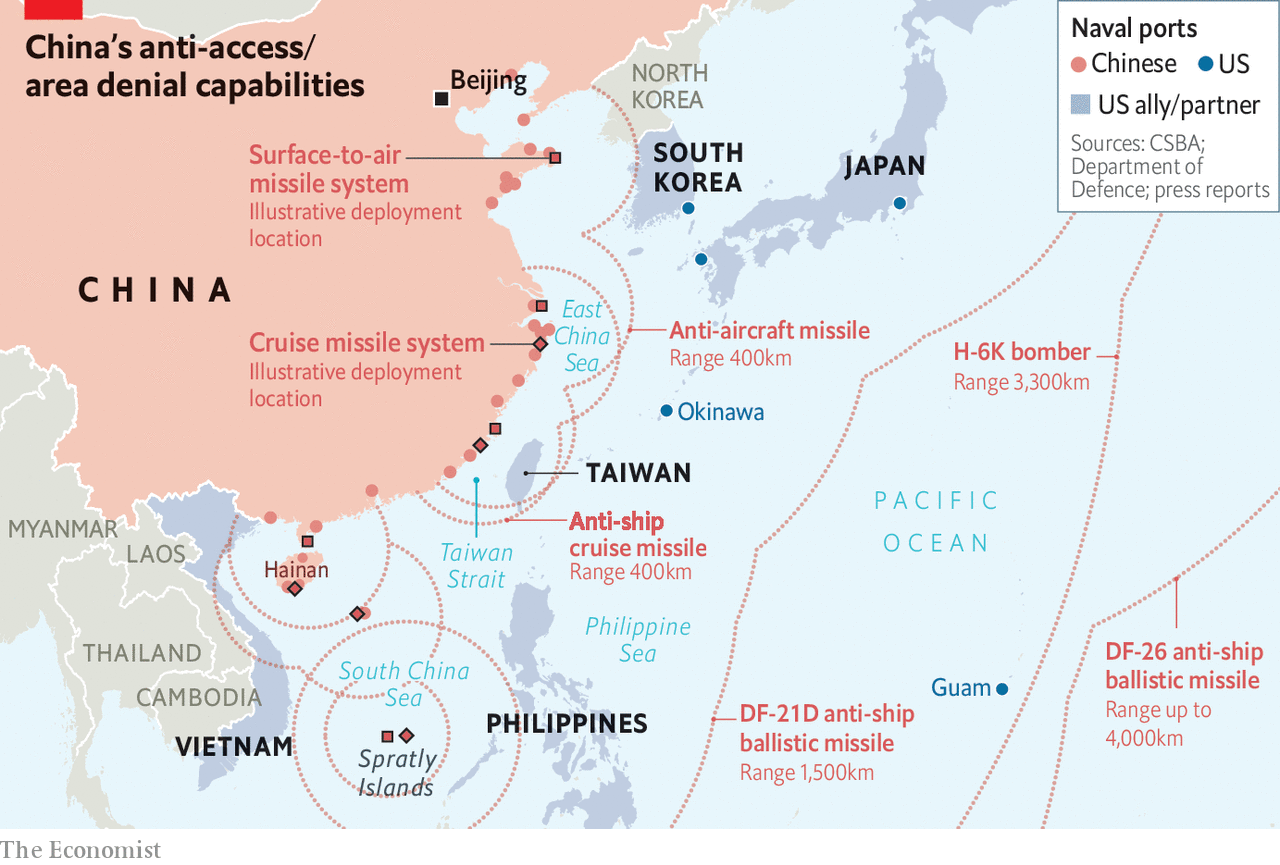
It is very difficult to overestimate the significance of Taiwan to the People’s Republic of China. The Shanghai Communique essentially committed China to a peaceful resolution of the dispute between China and Taiwan as long as the US divested itself of the notion that Taiwan was an independent state. But the US has taken steps that tend to treat Taiwan as separate from China, particularly with respect to arms sales:
“In the latest case, the U.S. State Department approved a $600 million arms package Tuesday that includes four unmanned maritime patrol aircraft, along with maritime radar and other hardware to support the aircraft.
“On October 21 the department greenlighted the potential sale of three weapons systems, including missiles, artillery and sensors. The full price was estimated at $1.8 billion. Five days later it approved a $2.37 billion sale of 100 Boeing-made Harpoon Coastal Defense Systems. Two other arms sale authorizations were announced earlier in the year for a total $800 million.
“’Now what we’re seeing is the transfer of weaponry that can certainly help Taiwan become fortress Taiwan, quote unquote, to make it that impenetrable fortress against Chinese attack,’ said Derek Grossman, a senior analyst with the Rand Corp. research institution.
“Washington cleared sales for Taiwan twice in 2019. They covered three separate arms systems, including F-16 fighter jets and M1A2T battle tanks for a total price of about $10.2 billion. A single $330 million spare parts sale was approved in 2018. President Donald Trump’s administration came out with its first arms package in June 2017 – the only one that year – for a total of $1.42 billion.”
“Beijing’s worst fear is that China hawks in Washington would be tempted to take further steps toward cutting the U.S. clear of its commitment to the so-called One China policy, thus emboldening Taiwan to take actions to solidify its independent status. For example, Taiwan’s legislature has recently formed a committee to amend its constitution, a move Beijing is watching closely to see if Taipei tries to use constitutional amendments to legalize its separation from China.”
All these actions will have the effect of limiting President-elect Biden’s choices with respect to Taiwan. There should be no doubt, however, what the Chinese will do if the Taiwanese decide that the US support for it justifies a move toward independence. Global Times, a reliable mouthpiece for the Chinese government, makes this clear:
“As the US has reached a bipartisan consensus to show toughness toward China, no matter whether Trump gets reelected or his Democratic rival Joe Biden enters the White House, close military ties between the US and the island of Taiwan will only strengthen. But the US and the DPP authorities are clear that if Taiwan crosses the red line of the Anti-Secession Law, the Chinese mainland will definitely resort to force as the means of reunification. Even if the US and Taiwan are military allies at that time, it is uncertain whether the US will send troops to fight for Taiwan. What is certain is the unshakable determination of the Chinese central government to take Taiwan back.”
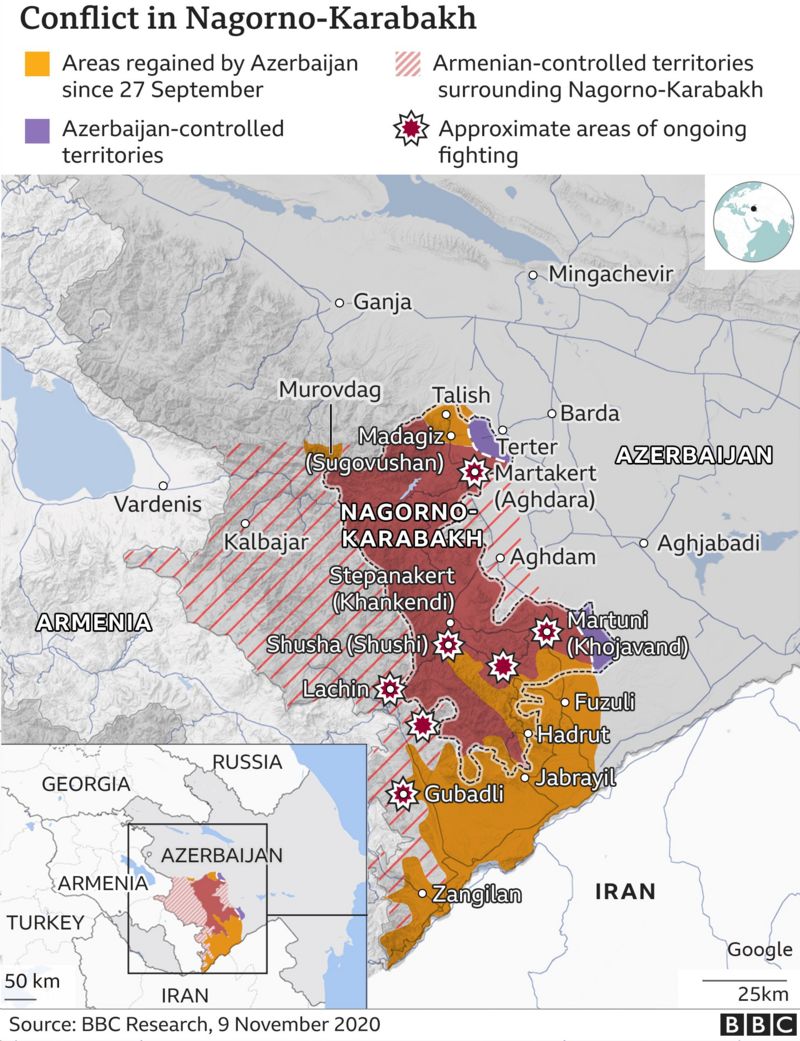
“In the 1920s, the Soviet government established the Nagorno-Karabakh Autonomous Region—where 95 percent of the population is ethnically Armenian—within Azerbaijan. Under Bolshevik rule, fighting between the two countries was kept in check, but, as the Soviet Union began to collapse, so did its grip on Armenia and Azerbaijan. In 1988, the Nagorno-Karabakh legislature passed a resolution to join Armenia despite the region’s legal location within Azerbaijan’s borders. As the Soviet Union was dissolving in 1991, the autonomous region officially declared independence. War erupted between Armenia and Azerbaijan over the region, leaving roughly thirty thousand casualties and hundreds of thousands of refugees. By 1993, Armenia controlled Nagorno-Karabakh and occupied 20 percent of the surrounding Azerbaijani territory. In 1994, Russia brokered a cease-fire which has remained in place since.
The terms of the cease-fire solidifies significant Azerbaijani military successes on the ground and represents a serious defeat for Armenian aspirations. Russian President Putin has asserted that about 5,000 people had died in the most recent outbreak. Both Russia and Turkey gained concessions in the cease-fire, notably the ability to position troops in the territory as well as transit routes through the territory to the Caspian Sea for the Turks.
Significantly, the success of the Azerbaijani forces can be attributed to its advantage in the use of drones, the first time the technology has proven to be decisive in the outcome of a conflict. Both Armenia and Azerbaijan were too poor to invest heavily in modern air forces, but drones are comparatively cheaper than fighter jets and gave significant tactical advantages to Azerbaijan. The Washington Post observes:
“‘Drones offer small countries very cheap access to tactical aviation and precision guided weapons, enabling them to destroy an opponent’s much-costlier equipment such as tanks and air defense systems,’ said Michael Kofman, military analyst and director of Russia studies at CNA, a defense think tank in Arlington, Va.
“’An air force is a very expensive thing,’ he added. ‘And they permit the utility of air power to smaller, much poorer nations.'”
” The OSCE Minsk Group failed miserably and abdicated (or was simply ignored) to Russia and Turkey. While they expanded the rhetoric of “both sides,” Russia and Turkey put Armenia in a corner while everyone else watched. It is no coincidence that the unconditional surrender (my view) was “signed” after Shushi fell. In this way the Azeris can further humiliate the Armenians by losing their cultural capital. This is tragically reminiscent of Stalin giving territorial favors to Attarurk such as Igdir (Mt. Ararat) in an attempt to crush the Armenian psyche. At the end of this chapter, criminal behavior and moral decay prevailed over justice. It is that reality that has numbed our bodies with open wounds and paralyzing emotion. That emotion will eventually fade and our understanding will improve. It is then that our honorable people will adjust and live for another day. This much I am certain of. Imagine how the Armenians must have felt after the battle of Avarayr in 451—an epic defense but we lost the battle. The resistance continued for another 33 years and then our will prevailed. They mourned, analyzed and continued the good fight. Different time, same story. How do you think our people felt in December of 1920 when the First Republic was crushed by the same players—Russians and Turks. Some were relieved the fighting had stopped. Others wished to carry on (February revolt of 1921), but it was one of the darkest moments in our history. Artsakh lost. Nakhichevan lost. Ararat, Kars, Ardahan and Javakhk lost. Yet we endured to live for 1991. This book has not yet been completed.”
There have been protests in Armenia against Prime Minister Nikol Pashinyan for signing the cease-fire which is regarded as a betrayal by many Armenians. It is unlikely, however, that Armenia can do very much without the support of outside allies. We can expect the Armenia constituency in the US to place pressure on American foreign policy to redress the perceived injustice.
I received this comment from one of our readers, worldweber2013, who raised a question that I have been pondering since I received it. It concerns my post of 7 November and I am certain that many are asking the same question. Here it is in its entirety:
“I am grateful to have these insights on the recent , and yet to be concluded election. I hope Joe Biden is listening when you say one of the issues facing the American people is how to deal with Mr. Trump. Addressing this painful and divisive question will require courage, discernment and grace.
“Whatever crimes Trump committed as president should be investigated to the extent that guilt or innocence is established, even if Trump is granted immunity from prosecution.
“And we, as a nation, need to deal with more than Trump as an individual. We must assess the weaknesses in the Constitution that his presidency has exposed. How can we as citizens be assured that disregard for the rule of law is never (again?) permitted to control the White House? Trump skated past the Mueller Investigation, which suggests that the power to investigate but not prosecute is insufficient to deter wrongdoing by the president, especially if said president can claim executive privilege, or security risk, or give other reasons for withholding information. If we accept that a president is entitled to stonewall for reasons of national security, then how does one hold them accountable? Do the checks and balances so essential to the configuration of our democracy, and so brilliantly devised by the authors of our constitution, protect us adequately? I would say, based on the past four years, that they do not. The writers of the constitution may have anticipated the election of a self-serving executive, but they apparently did not foresee the extent to which such an individual would be enabled by other self-serving persons in positions of power.
“Or would you, Vinnie, argue that the constitution has done its job, and we should be relieved and reassured?
“Can a constitutional framework be devised that does not rely on the integrity of the participants? If not, democracy depends on the vigilance, knowledge and integrity of the electorate. In which case, we just witnessed an epic fail of four year duration, and we appear to have narrowly avoided an even more debilitating second term.
The urgency of the comment has increased as we witness a full-throated attempt by Mr. Trump and his colleagues to undermine the election results, perhaps with an eye toward forcing the decision to state legislatures where the Republicans have a majority of states (although I would be hard-pressed to imagine Governor Baker of Massachusetts going along with such a travesty).
The critical question is: “Can a constitutional framework be devised that does not rely on the integrity of the participants?” The enforcement mechanism of the Constitution is loosely called checks and balances. The Constitution was written with the assumption that human beings would always want to accumulate power. The trick, then, was to structure power with three branches (executive, legislative, and judicial) so that the competition for power among the three branches would prevent any single branch from becoming pre-eminent.
In my lifetime, I have witnessed the slow consolidation of power in the Executive Branch of the government. But the deference of the Republican Party in the US Senate and its ability to manipulate the courts to mirror that preference during the Trump Administration (including the ability of Congress to prevent President Obama from placing Merrick Garland on the Supreme Court pre-dates the Trump Administration) has almost completely shredded the powers of the Congress. The Congress, apparently, no longer holds the power of the purse (witness Trump’s ability to secure funds for the border wall with Mexico without Congressional approval). Nor does it hold the power to investigate the actions of Executive Branch officials (witness the disregard of the Trump Administration to legal subpoenas).
There is no inherent reason why the Congress could not assert these powers (although the packing of the court system may render such a move bootless). But the answer to the question seems clear: the Constitution requires faithfulness to the Constitution to work. It apparently is incapable of enforcing itself. If Mr. Trump succeeds in vitiating the results of the 2020 election, then the last enforcement power–voting–will be rendered useless. In 1788 James Madison wrote in the Federalist No. 51: “If men were angels, no government would be necessary. If angels were to govern men, neither external nor internal controls on government would be necessary. In framing a government which is to be administered by men over men, the great difficulty lies in this: you must first enable the government to control the governed; and in the next place, oblige it to control itself.” We seemingly have arrived at that point. The future of the American Republic really hangs in the balance right now.
Needless to say, I am delighted that Mr. Biden is now the President-elect. I suspect that there is little that Mr. Trump can do to change this outcome, but I also suspect that the transition will be ugly and perilous. The most important thing now is for President-elect Biden to outline his policies to address the many issues facing the American people.
One of those issues is how to deal with Mr. Trump. Much depends on how he conducts himself. In my lifetime, George Herbert Walker Bush and Jimmy Carter lost after serving one term in office. Both men conducted themselves with dignity and grace despite the deep emotional scar of failing to be re-elected. I think that Mr. Trump will not follow their footsteps.
It is probably important to divest ourselves as much as possible of the desire to seek revenge for Mr. Trump’s misdeeds. President Lincoln understood this well and was profoundly eloquent in his second inaugural address which is one of the most important speeches ever given. The speech was delivered on 4 March 1865 at the end of the Civil War, still the bloodiest conflict in American history. Lincoln’s task for the previous four years had been to save the Union; he was well aware that a successful end of the war for the Union forces was only the beginning of the final steps of his task: “With malice toward none, with charity for all, with firmness in the right as God gives us to see the right, let us strive on to finish the work we are in, to bind up the nation’s wounds, to care for him who shall have borne the battle and for his widow and his orphan, to do all which may achieve and cherish a just and lasting peace among ourselves and with all nations.”
It is also important to separate Mr. Trump from his supporters. We need to understand and accept the fact that 70 million Americans voted for Mr. Trump. They cannot be dismissed. There are some supporters who deserve no sympathy: those who celebrate white supremacy, hatred for those with different gender identities, and those who believe that their brand of Christianity is the religion that should determine public policy and who show disdain for other religions. These Americans have always been a part of the American society and we should make every effort to teach our children that these patterns of thought are profoundly inconsistent with the better values of the American polity.
But the vast majority of Trump supporters are Americans who believe that they have been betrayed by the American political system. In truth, they are justified in their anger. Both the Democratic and Republican parties pursued policies that have led to the destruction of American jobs and the parties have constructed ways for the rich to concentrate wealth in this country that is probably worse than what the country experienced in the Gilded Age. President Obama was the best President in my lifetime, but I was crushed when he allowed the stimulus money to rectify the financial collapse in 2008 to go to the banks that created the crisis and not to the homeowners that lost their homes. We should keep in mind that corporations, not the government, sent jobs abroad. The fear of being labelled a “socialist” for making this observation is a page from Joe McCarthy’s playbook. We need to make this discussion legitimate and force it to the front of all our political discussions. Ignoring the growing inequality in American society will only aggravate the anger and resentment.
Finally, dealing with Mr. Trump and his enablers is essential, but must be done carefully. Too much of what happened in the last four years is completely unknown and the House of Representatives should be aggressive in uncovering all the details. We need to avoid two desires: first, to punish a person who took delight on inflicting pain on others; and, second, avoid the temptation to simply “move forward”. The US faced a similar problem in 1973 when President Nixon was forced to resign after the Watergate and other associated scandals. When his successor, President Ford (who was never elected to a position that gave him legitimacy to hold the office) pardoned Nixon, the US was in a bad state with the Vietnam War protests and the Oil Embargo. Ford probably did the right thing to pardon Nixon in order to help the country move forward. But this was true only because Nixon had the intelligence to resign from office.
Perhaps Mr. Trump will show similar intelligence in his fall from grace, but I doubt it. His need for public attention is insatiable and he will seize any circumstance and opportunity to force us to look at him and to talk about him. The country needs to be prepared for any attempts by Mr. Trump to rewrite history. Therefore, President Biden and the Congress should be willing to investigate Mr. Trump’s activities as thoroughly as possible and, if warranted, should be prepared to prosecute him as if he were an ordinary citizen because that is precisely what he will become in January 2021. The same is true for all the minions that supported any illegal activities.
The spirit of these investigations should be to re-establish the moral hazard of breaking the law and not to seek vengeance. It is crucially important that from now on we treat Mr. Trump as we would any other citizen. He has not earned and does not deserve any special favors. But we should also not allow ourselves to think that punishing Mr. Trump addresses the problems the nation currently faces. I understand fully the anger that many feel toward Mr. Trump because it burns deeply in my heart. We should heed the words of John Prine in his song, “Bruised Orange (Chain of Sorrow)”:
You can gaze out the window, get mad and get madder Throw your hands in the air, say “What does it matter?” But it don’t do no good to get angry So help me, I know
For a heart stained in anger grows weak and grows bitter You’ll become your own prisoner as you watch yourself sit there Wrapped up in a trap of your very own Chain of sorrow
We should also understand the extraordinary significance of this election. It signals the end of a generation that has dominated American politics for an extended period of time. Let us hope that we do not have another election in which the choices are between a person of 74 years of age and another of 77 years of age. It was also a transformational election. Biden won the election because of the hard work and commitment of people who are not well represented in American politics. Stacie Abrams delivered Georgia. Latinas and Latinos delivered Arizona. African-Americans proved to be the decisive voters in many US cities. Vice-President elect Harris should not be considered the exception; she should be considered the rule.
I did not raise my glass at 10:30 last night. Like many others, I was stunned by what unfolded. My prediction on the outcome of the election was significantly wide of the mark. Right now, it appears as if Biden is within striking distance of receiving 270 electoral votes but it would be premature to declare that he is the victor. I suspect that there will be many obstacles to a smooth transition to a Biden presidency. But everyone should be very suspicious of anything that I predict.
The reasons for my ill-fated predictions seemed obvious to me at the time I wrote them down and I genuinely do not believe that I was merely projecting my own biases. To me, the failure to respond effectively to the COVID-19 pandemic seemed clear and well-substantiated. In comparisons to other countries, such as South Korea, China, and Taiwan, the US situation is abysmal. I thought that the poor performance of the Trump Administration in what should be considered a very important matter would make Americans think seriously about getting new leadership. And I outlined all my other reasons for thinking that the outcome would be a convincing victory for the Democrats.
I am now stuck in the very uncomfortable position of not understanding at all the reasons why so many Americans support Trump and the Republican Party. The 2016 election was difficult for me to accept, but I thought I understood the anger and resentment that many Americans had toward the two parties. Trump represented a sharp divergence from the American political tradition and his election was for me confirmation that the American people wanted a decisive break from the old politics. Trump was the first Third-Party candidate to be elected President in American history. Indeed, elections in other countries, such as in France and in Great Britain, tended to validate the idea that many in the world were looking for something other than the headlong sprint into a fully globalized economy.
But the closeness of the election in 2020 undermines that explanation. Americans had four years to test out the “new” politics under Trump. And all the attributes that I thought were disqualifying–the xenophobia, the racism, the disregard of the environment, and the amplified economic inequality–are apparently not held to be negative to many of my fellow citizens.
So I am adrift. I pretend to be an analyst but I do not understand or comprehend the way the world actually appears to be to many of the people I purport to analyze. I live in a world where deaths from a virus can be considered “alternative” facts. I am, to crib the title of the novel by Robert Heinlein, a Stranger in a Strange Land. It is a disquieting feeling.
 World Politics News