Everyone needs to relax and listen to this beautiful duet. It was recommended by my good friend, the Dr. Cameron Bopp.
Author Archive
3 July 2013 Leave a comment
3 July 2013 Leave a comment
President Morsi has been ousted by the Egyptian military. At this point it is difficult to interpret the action. Obviously, there are many in Egypt who believe that the coup actually re-establishes democracy because they believe that Morsi was becoming too authoritarian. At the same time there are many others who believe that democracy has been subverted. After all, Morsi has only been in office for a year, and ruled in very difficult circumstances. Most presidential systems in the world have fixed terms to prevent premature judgments on whether a president is “successful” (there is always a provision for impeachment in case of high crimes–but no one has accused Morsi of treason). In short, people are most likely to come to pre-determined conclusions on the issue of whether the military coup was justified.
The Obama Administration most likely does not know how to respond. Under the terms of the Foreign Assistance Act of 1961 (USC› Title 22 › Chapter 91 › Subchapter II › § 8422), the US cannot give foreign aid to any country which experiences a military coup. It is unlikely, however, that without the $1.5 billion the US provides to Egypt every year Egypt will be able to stabilize its economy. Additionally, at this time we have no idea how the Muslim Brotherhood will respond to the coup, but it seems probable that the reaction will be highly negative, and possibly violent.
The tectonic plates of the Middle East continue to shift. The protests in Turkey and Egypt have destabilized the politics of two of the most powerful regional actors. The forceful support of Iran and Hezbollah in Syria have propelled the other powerful regional actor into a temporarily dominant position. Israel clearly benefits from the moves in Egypt and Turkey; it suffers by the new-found prominence of Iran. The great powers–the US, Russia, and China–have emerged as irrelevant to the primary dynamics of regional politics.
2 July 2013 Leave a comment
President Morsi has rejected the military’s ultimatum, and Egypt seems to be careening toward a dissolution of the current government. The military apparently intends to suspend the constitution and dissolve parliament and replace it with a governing council that would be more “representative.” Violence is Egypt is accelerating and there does not seem to be a stable equilibrium point at this time. Much depends on how the Muslim Brotherhood responds to the changes–it will be a real test of how close Egypt is to creating a democratic civil society.
As much as I disagree with her policies, I will easily concede that Angela Merkel is a gifted leader. She demonstrates her acumen in an interview with The Guardian in which she surveys the problems currently facing Europe Her assessment of the significance of youth unemployment on the continent (and in the rest of the world as well) is spot on. I wish more politicians were as insightful as she is.
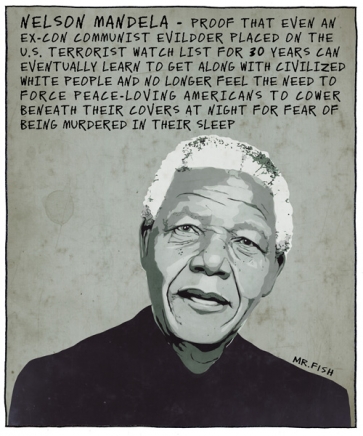
The world is sadly watching the slow deterioration of one of the greatest leaders of the 20th and 21st centuries, Nelson Mandela. President Obama payed him a great tribute when he recently visited South Africa. I have no doubts about President Obama’s sincerity. But I have long and bitter memories of US support for the apartheid regime over many years. And our admiration for Mandela’s accomplishments should not obscure the fact that the US government treated Mandela as a “terrorist” for a long period of time. The cartoonist, Mr. Fish, captured the hypocrisy of US policy quite well:
1 July 2013 Leave a comment
The Egyptian military has issued an ultimatum to the government of President Morsi: “The armed forces repeats the invitation to fulfill the demands of the people and gives everyone 48 hours as a last chance to begin bearing the burdens of this historic circumstance.” It appears as if the military is trying to force Morsi to appoint different ministers to his cabinet as a way of defusing the tensions that have accumulated over the last few weeks. The ultimatum is a stinging rebuke to President Morsi and his allies in the Muslim Brotherhood. Morsi himself was confronted with a number of resignations from his cabinet, and how he fills those vacant slots will determine how the military will enact the ultimatum. It will be a very tense two days.

Francis Fukuyama is an extraordinary scholar–someone who will teach you something even as you disagree strenuously with his analysis. He has written an essay for the Wall Street Journal looking at the global protest movement as one consistent with the emerging middle classes in many countries. The proposition is consistent with many studies of revolutions in the past, but it raises an interesting question: what happens when the middle classes start to decline in power (as in the US and Europe)? Does the Middle Class revolt on the way up as well as on the way down?
19 firefighters died fighting a wildfire in Arizona over the weekend. In a very real sense this tragedy was predicted back in 2004 as 2 scientists at the University of California-Santa Cruz wrote a paper that argued that a reduction in the Arctic ice pack (and 2012 was the most reduced level of ice ever recorded in human history) would lead to drought conditions in the American Southwest. If that link is as strong as the scientists predicted, then the American Southwest will likely get significantly drier in the future.
30 June 2013 Leave a comment
The main source of water for the Gaza Strip is an aquifer that is rapidly becoming depleted and contaminated. In fact, the depletion is so rapid that experts fear that the 1.5 million residents of the occupied territory may run out of water in a matter of years–leading to an unprecedented catastrophe. Finding solutions to the absence of fresh water is extraordinarily difficult and it’s not clear how the issue can be addressed. But what is happening in the Gaza is simply the first example of a looming problem for the world as a whole. A twin feature of the depletion of fresh water is the similarly rapid depletion of fertile soil in various areas of the world.
It’s great to be in the 1%. According to the New York Times, the Chief Executive Officers of the 200 largest corporations in the US had median 2012 pay packages of $15.1 million — an increase of 16 percent from 2011. Lawrence Ellison, the CEO of Oracle, had the highest compensation package of $96.2 million. Aside from the obvious fact (to me, at least, that such compensation is excessive), the real problem is that much of the compensation comes from stock grants and options. This type of compensation creates incentives for CEO to maximize short-term gains without looking at the long-term health of the corporation. Such incentives can lead to disaster, as we saw in the risky behavior of CEOs in the financial markets in 2007-08.
Millions (as many as 14 million out of a total population of 84 million, according to the Egyptian military) protested against the government of Egyptian President Morsi. Even though the temperatures were sweltering, the protests stayed mostly peaceful, although there were scattered acts of violence and four deaths. The size of the protests is a staggering vote of no confidence, but there were no signs whatsoever that Morsi intends to make any changes. Unquestionably, the deteriorating state of the Egyptian economy is a critical determinant of the protests.
29 June 2013 Leave a comment
Egypt is preparing for a day of protests. Opponents and supporters of President Morsi are trying to demonstrate their views of President Morsi a year to the day after his election. The opponents of President Morsi call their movement “Tamarod” which is the Arabic word for rebellion, and they claim to have petitions calling for Morsi’s resignation signed by 22 million Egyptians. There has been a great deal of violence leading up to the protests, and Sunday promises to be a very difficult day for Egypt.
Der Spiegel is reporting that the US National Security Agency bugged the offices of the European Union. There is not much detail in the report, but is goes without saying that the public airing of these activities is highly embarrassing and damaging to the United States. The Germans, in particular, are quite sensitive to the issue of government surveillance given their histories under fascist and communist rule. THe internaitonal backlash against the US policies will certainly complicate any steps that the US may wish to take to prosecute Snowden.
I’ve noted in previous posts the dangerous new virus–called the Middle East Respiratory Syndrome (MERS)–that has emerged with Saudi Arabia as its focal point. The death toll from the virus so far is quite small, although the death rate is exceedingly high. The situation has become quite acute as Saudi Arabia will host more than 6 million visitors for the annual Hajj. In effect, Saudi Arabia will serve as an incubator for one of the more lethal viruses to ever emerge. We can only hope that MERS does not prove to be highly contagious.
28 June 2013 Leave a comment
Moisés Naím, a senior economic analyst at the Carnegie Endowment, offers an interesting interpretation of the protests in Chile, Turkey, and Brazil. He revives an old theory, the theory of rising expectations, to explain the discontent. Essentially, the theory suggests that economic improvements lead to expectations about the capability of the state which it is not capable of satisfying. Naim attributes the theory to Samuel Huntington but the theory goes back much further. Naim’s interpretation is plausible, but it ignores the issue of corruption which seems to loom quite large in the minds of the protesters. Indeed, the “rising expectations” hypothesis seems to be so mechanistic that it divests authorities of the responsibility to remember that their primary job is to serve the public good.
The situation in Egypt seems to be heating up again. There are protests scheduled for this weekend against President Morsi, but violence has broken out already. The sentiment seems to be that Morsi and his supporters in the Muslim Brotherhood are becoming too authoritarian (reminiscent of the charges against Prime Minister Erdogan in Turkey), and, unfortunately, Morsi’s government is responding by cracking down on critical elements of the press and media. It could be a very difficult weekend in Egypt. In other protests in the world, Brazilian truck drivers have called for a 72 hour strike to protest government corruption.
For those who follow the news closely, the sharp rise in the interest rates Chinese banks charge each other (the so-called Shibor, the Chinese counterpart to the Western Libor) was unsettling. The increase meant that the Chinese government had decided, for whatever reason, to stop lending money to banks on very easy terms. Interest rate increases almost inevitably lead to slower economic growth, so the rest of the world took the action seriously, worried that a slower Chinese economy would undoubtedly have negative effects on the rest of the world. But to understand the motives of the Chinese government in restricting money to lending institutions one also has to understand “shadow banking”, a term that refers to financial institutions that offer loans without having the deposits to back them up like traditional banks do. Such institutions often lack the financial discipline (and government regulation) imposed by having deposits to honor and tend to lend in a more speculative and dangerous way. And this is precisely the problem in China right now: there is too much lending of money that is not guaranteed by some sort of collateral. If people begin to default on these risky loans, then the Chinese economy is at great risk. We will have to see how the Chinese government navigates these treacherous waters.
27 June 2013 Leave a comment
There is yet another protest movement going on. This time it is in Chile. Actually, the student strikes in Chile have been going on for years, and they have been very vibrant and well-organized. But like the student stirkes in Canada last year, the protests focus almost exclusively on the quality and cots of higher education. These are important issues, but do not necessarily indicate widespread social unrest. However, the labor movement is now joining in the student protest and the concerns articulate by the unions correlate almost perfectly with the other protest movements going on in the world.
The Russian Times is running a story that the US CIA is stockpiling weapons in Jordan to be used by Syrian rebels in a planned offensive scheduled for August. The suggestion is that the CIA is being used in order to avoid public scrutiny of the move. Although President Obama did signal that the US would step up support for the rebels after the announcement that the Syrian government had used sarin gas, this is the first hint of how the policy was changed. If the report is accurate, the move is not well-considered. Although the CIA claims that it is being very careful as to which rebel groups are getting arms, there is no combination of rebel forces strong enough to govern all of Syria. The only possible way out of the violence in Syria is a negotiated settlement.
The National Weather Service office in Phoenix released this graph today.

It’s getting pretty warm in the US Southwest.
26 June 2013 Leave a comment
Protests in Brazil continue as the government of Dilma Rousseff scrambles to make concessions to defuse the tension. Perhaps the key concession was the withdrawal of a constitutional amendment that limited the power of federal prosecutors to investigate crimes. The amendment seemed to most protesters as a “get out of jail free” card to politicians, and served to convey a sense that corruption in Brazil was intractable. The protests remain leaderless and seemingly without direction which runs the risk of ultimately diffusing the discontent of the people. It further opens up the possibility of some politicians exploiting the protests for their own personal agendas. At some point, the protests need to coalesce around some positive changes to address the issues raised.
Ethnic riots have broken out again in China’s northwest. The Uighurs, who are primarily Muslims of Turkic origin, populate the Xinjiang province and resent the control of the Han Chinese that threatens their identity and limits their opportunities within China. Such unrest flares up periodically, and this particular episode has been similar to previous outbreaks. So far, however, the violence seems to be more limited, although it is difficult to predict how it might unfold. China contains a large number of different ethnic groups, and the central government is quite sensitive to any movements that threaten its control.
The revelations that both the US and Great Britain have been conducting massive data sweeps surreptitiously have soured relations with many countries, and undermined the claims of both countries as representatives of personal rights and freedoms. The German response to these activities is quite interesting, given the misuses of state power in that country’s past. Der Spiegel has collected editorial statements from a number of German media outlets, and the negative response is deep and strong.
25 June 2012 Leave a comment
One of the causes of the rise of income and wealth inequality in the world is the declining share of economic growth that goes to labor. Globalization has certainly rewarded those with capital as there have been extraordinary gains for those who can increase their productivity by tapping into the technological revolution. Bruce Bartlett, a former adviser to Presidents Reagan and George H.W. Bush, has an essay in the New York Times, which outlines the size of the shift from labor to capital. This chart captures the size of the shift internationally:

If you wish to pursue this idea more technically, then check out this post from the blog, Zero Hedge. It outlines how much financial trading is being done by the purely speculative “shadow” banks–financial institutions that trade in money without having deposits to back up their trades.
The global economy seems to be slowing down. Europe is clearly in a recession and the economic situation in China looks increasingly dicey. In order to avoid a slowdown, there has to be a sharp increase in demand somewhere, but it is difficult to see any region in the world that could supply that consumption stimulus.

The Syrian Civil War continues to evolve into the world war in Syria. The great and medium powers are all now involved in some way, and the violence spills over into other countries. The most vulnerable state is Lebanon which persists only because of an acute sensitivity to the fragility of the social bonds within the state. But the Lebanese army has now begun to fight the followers of a Sunni Sheikh, Ahmad al-Assir, who has opposed Hezbollah’s support for Assad in Syria. If the political situation in Lebanon deteriorates, it is fertile crowd for an extension of the schisms in Syria.

