The P5+1 and Iran have announced that they have reached an agreement on the Iranian nuclear program. Remember that this agreement is merely an interim agreement, designed to be in effect for only for 6 months while a longer, more permanent agreement is pursued. The White House has issued a fact sheet on what the agreement entails.
What did the Iranians give up? According to the Financial Times:
“Iran will “neutralise” its stockpile of 20 per cent uranium by diluting below 5 per cent or converting to a form not suitable for further enrichment; halt progress on its enrichment capacity; and leave inoperable about half of installed centrifuges at Natanz and three-quarters of centrifuges at Fordow.
“Iran will also commit to freeze activities at its Arak heavy-water facility which is under construction and, if operable, could produce plutonium for a nuclear weapon. Iran would also not construct a facility capable of reprocessing plutonium from spent fuel.”
Iran has also agreed to what the agreement calls “enhanced monitoring” which translates into daily inspections by the International Atomic Energy Agency. The two enrichment facilities at Natanz and Fordow are already subject to the most intrusive inspections ever maintained by the IAEA: weekly, unannounced inspections.
What did Iran gain? Certain of the sanctions against Iran will be lifted–according to the US about $7 billion out of a total of $100 billion worth of sanctions. The curb on the export of Iranian oil will not be lifted (so do not look for gasoline prices to go down quickly). And Iran will be able to enrich uranium to 5%, although it cannot increase its supplies of 5% enriched uranium during the six months. The latter point is significant. Although the NPT explicitly recognizes the right of every signatory nation to run a peaceful nuclear program, the UN Security Council in its previous three resolutions on Iran has demanded that Iran had to “suspend” its enrichment activities. So even though the US and the other members of the Security Council had argued that Iran had no “right” to enrich uranium (a case presumably based on some sense of the illegitimate intentions of the Iranian state), the agreement implicitly recognizes that Iran has a right to enrich uranium.
What are the reactions from other states to the agreement? One should be careful here: initial comments are almost purely rhetorical since no one has had a chance to really study the agreement. We will follow up on this issue as more careful reactions emerge. Israeli Prime Minister Netanyahu called the agreement a “historic mistake.” Last Friday, Saudi Arabia’s ambassador to the UK, Prince Mohammed bin Nawaf bin Abdulaziz, said “We are not going to sit idly by and receive a threat there and not think seriously how we can best defend our country and our region.” When asked what his country’s options were, he replied: “…all options are available.” Finally, there are many in Congress who opposed any deal that recognized the right of Iran to enrich uranium.
My own view is that this agreement is a very good first step and should be firmly supported. I have no reassurances to offer to those who oppose the deal because it offers no “certainty” that Iran will not develop the capability to develop a nuclear weapon. But the absence of an agreement offers no certainty whatsoever of that outcome. Indeed, without any agreement, Iran has developed a serious capability even in the face of the toughest sanctions the UN has ever applied to any state. The only course of action that holds out any possibility of a permanently disarmed Iran is an armed attack upon Iranian nuclear facilities, and there are considerable doubts about whether that option is at all viable or desirable. President Rouhani has sent many signals that he is serious about reintegrating Iran into the global economy and there are countless reasons to believe that that objective is a compelling one to him and all of the Iranian people. I genuinely hope that the agreement succeeds.
There is an interesting op-ed essay in the New York Times that follows up on the article we read earlier about the Swiss referendum that would limit the highest paid employees to salaries no more than 12 times that of the lowest paid employees. The essay was written by a Swiss resident and it explains some of the cultural background to the issue. The election is to be held on Sunday, and polls indicate that it will likely fail. We shall see.
The People’s Liberation Army (PLA) of China has announced an “Air Defense Zone” that includes the contested Diaoyu/Senkaku Islands (in the lower part of the zone identified in the map).
The Chinese also issued a statement “saying all aircraft must notify Chinese authorities and are subject to emergency military measures if they do not identify themselves or obey orders from Beijing. It said it would ‘identify, monitor, control and react’ to any air threats or unidentified flying objects coming from the sea.” The Japanese have lodged a “serious protest” over the unilateral claim, but it is unclear whether the Japanese will try to test the Chinese claim.
US Secretary of State Kerry has once again gone to Geneva for the P5+1/Iran talks. And, once again, there is a great sense of anticipation of a possible negotiated deal. Whether that feeling is justified will be clear in a few days, but the foreign policy heavy weights of the P5 are deeply involved, suggesting that there is a strong sense that an agreement is possible. We are beginning to get a better idea of the issues that are still under dispute. One of those issues is whether Iran will delay the start-up of its new reactor at Arak. Since that reactor will produce plutonium, the issue is of great significance. But since this negotiation is only on a temporary, not a permanent, agreement, it seems that the Iranians could easily agree to stop working on the reactor for 6 months. The other major issue is a curious one: whether the Iranians should stop enriching uranium. Since the right to enrich uranium is codified in the Non-Proliferation Treaty, to which Iran is a signatory, that dispute seems nonsensical. Article Four of the NPT reads as follows:
“Nothing in this Treaty shall be interpreted as affecting the inalienable right of all the Parties to the Treaty to develop research, production and use of nuclear energy for peaceful purposes without discrimination.”
But the Israelis and the Americans (and apparently the French, although they have said so explicitly) believe that uranium enrichment is not covered by Article Four even though it is impossible to run a peaceful nuclear reactor without enriched uranium. This dispute, however, also seems to be something that can be verbally resolved, at least for 6 months. Whether it can be resolved in a permanent agreement is more difficult to answer.
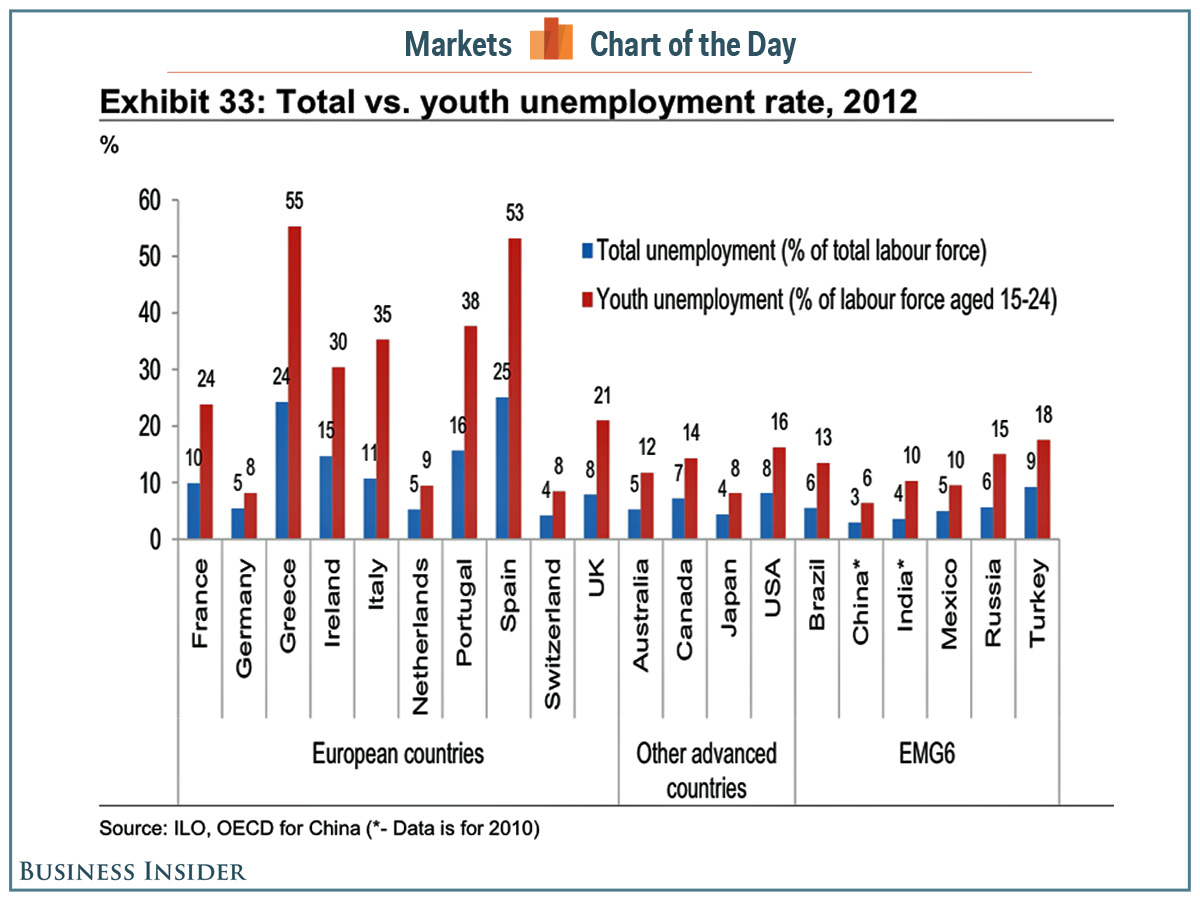
One of the deepest concerns about the very slow economic recovery of the 2007-08 recession (The Great Recession) is the persistence of youth unemployment. Unemployed young people not only contribute to slow economic growth now, but their late start in the job market often reduces possible growth in the future. The global rates on youth unemployment are staggering.
Source: Sam Ro, “Youth Unemployment Rates Are Terrible Everywhere,” Business Insider, 22 November 2013
A study by Richard Heede which was published in the journal Climatic Change argues that 90 corporations are responsible for about 60% of all the carbon dioxide emissions on the planet. The study was presented to the UN Conference on Climate Change in Warsaw and has not yet been vetted by a large number of climate scientists. Moreover, the study suggests that half of all the carbon dioxide emissions from industrial activity has occurred in the last twenty-five years. The latter statistic, if valid, would suggest that the dangers of greenhouse gas emission are accelerating more rapidly than previously thought. The list of companies was described by the Guardian in this manner:
“The list of 90 companies included 50 investor-owned firms – mainly oil companies with widely recognised names such as Chevron, Exxon, BP , and Royal Dutch Shell and coal producers such as British Coal Corp, Peabody Energy and BHP Billiton.
Some 31 of the companies that made the list were state-owned companies such as Saudi Arabia’s Saudi Aramco, Russia’s Gazprom and Norway’s Statoil.
Nine were government run industries, producing mainly coal in countries such as China, the former Soviet Union, North Korea and Poland, the host of this week’s talks.”
If the list is accurate, then it frames an action plan to stop greenhouse gas emissions radically different than the country-by-country model traditionally used.
Ukraine has decided to developed closer economic relations with Russia rather than to embrace the Eastern Partnership program initiated by the European Union in 2009. Both Russia and the EU have been cultivating ties with Ukraine for a number of years, and the decision is a clear victory for Russia and Vladimir Putin. Russia has always regarded Ukraine as a central component of a greater Russia, and a turn to the West would have damaged not only Putin’s economic plans but also the larger sense of nationalism being cultivated in Russia right now. Whether the turn to the East was a wise choice remains to be seen. Ukraine is a heavily indebted country which needs considerable economic assistance to revive its economy.
As we have finished our class discussions on the problems of nuclear proliferation, it seems appropriate to appreciate the significance of nuclear weapons to the conduct of world politics. Between 1945 and 1998 there have been 2053 nuclear explosions on the planet. Japanese artist Isao Hashimoto visually represents these explosions in a stunningly scary video:
Several hundred people walked out of the UN Climate Conference meeting in Warsaw, Poland. It is not clear from the reports I have read whether those that walked out were delegates or observers of the climate conference. There is little question, however, that the level of frustration at this meeting is exceptionally high. Several countries have publicly admitted that they have missed their emission targets for greenhouse gases and the discussion on compensation demanded by the poorer countries has received virtually no official attention. The lack of progress in the round of negotiations is palpable.
In previous posts we have discussed the belief among many states that Germany’s insistence on balanced budgets and a trade surplus is depressing demand in the global economy. Many of those states believe that Germany should take steps to increase domestic spending in order to stimulate purchases of foreign goods and services, thereby stimulating the global economy. The German reluctance to do so rests on its memory of the hyperinflation of 1923–increased government spending always carries with it the risk of greater inflation. The Economist has run an article that describes how this historical experience shapes current German policy.
It appears as if the US and Afghanistan have agreed on the status of American forces that will remain in Afghanistan after all US combat troops leave in 2014. The role of those forces will be merely to “train, equip, and assist” according to US Secretary of State Kerry. According to CBS News: “The Bilateral Security Agreement is a sweeping document that incorporates the usual Status of Forces Protection Agreement, which the U.S. signs with every country where its troops are stationed. The document covers everything from taxation and customs duties to a promise to protect Afghanistan from hostile action.” The Agreement needs to be ratified by the Loya Jirga which is he traditional ruling council of Afghanistan.
The process of globalization accelerated in the last 30 years, but the financial crises of 2007-08 which reverberated across the globe has led some analysts to think that the world is snapping back to a more nationalist orientation toward economic policy. At some level this conclusion seems substantiated. For example, many countries are certainly using currency valuations to protect their export markets. On the other hand, there is plenty of evidence, as described by Time magazine, to believe that globalization is still proceeding at a very fast rate.
Twin bombs were exploded outside the Iranian embassy in Beirut, Lebanon. The Abdullah Azzam Brigades, an Islamist militant group with ties to Al Qaeda, took responsibility for the blasts and it signifies an escalation of the regional war now being waged by Sunni militants against the Shia supporters of Iran in Syria and Lebanon. Lebanon’s political system is very complex, reflecting the incredible variety of peoples and groups in the country, and has managed with great difficulty to navigate tremendous political pressures from within. These explosions threaten the political stability of Lebanon. We will have to see whether other groups respond in kind to these attacks.
Even though the Chinese economy –one of the few bright spots in the global economy–still continues to grow, fears are beginning to surface about the country’s heavy reliance on debt. According to some estimates, Chinese debt has grown from 130% of GDP in 2008 to perhaps 250% this year. Unofficial interest rates (the official interest rate is controlled by the central government) are rising substantially, leading some to fear that borrowers will be unable to repay their debts. In some respects, this situation mirrors the debt problems in the US and Europe in 2007-08, and there are concerns that a similar crisis might occur in this very important country.
The US and Afghanistan are trying to forge an agreement to govern the conduct of American troops which might remain even after the official end of US combat operations in Afghanistan in 2014. A similar agreement was sought in Iraq after the US pullout, but both sides failed to agree on whether Iraqi or American law would govern the conduct of US troops. Consequently, all US soldiers left Iraq. The discussions in Afghanistan are following the same script and may flounder on the same issue. The US will not allow its soldiers to conduct operations if they might be prosecuted in Afghan courts, but Afghanistan does not wish to grant immunity to troops who might commit crimes under Afghan law. A total pullout of US troops will leave Afghanistan in a very difficult situation as it tries to take over security operations for the entire country.
Swiss voters will vote in a referendum on a proposal to limit salaries in large corporations. The ratio of the highest paid employee will be limited to 12 times the salary of the lowest paid employee. The proposal is an attempt to reduce the growing income inequality in virtually every country of the world. There is also, however, a sense that wide pay disparities lead to social dysfunction. The vote will take place on 24 November and the measure is not expected to pass at this time. But a number of other political parties in Europe have seized upon the campaign, and the movement will likely persist for some time.
French President Hollande has been very active on his trip to Israel and the occupied West Bank. When in Israel he strongly argued against any Iranian deal that did not provide certainty that Iran would not develop nuclear weapons. On the other hand, Hollande flatly said that “France demands a full and complete halt to settlement activity.” Both lines in the sand are highly unlikely: there is no way to provide “certainty” that Iran cannot develop nuclear weapons, nor is there any possibility that Israel will completely halt settlement activity. Perhaps Hollande is trying to link the two issues in order to induce a compromise. If so, it will be an incredible diplomatic coup.
Michelle Bachelet won nearly 47% of the popular vote in the Chilean presidential election, 3% short of the majority necessary to avoid a runoff election. Thus, Bachelet will run against her childhood friend, and center-right candidate, Evelyn Matthei next month. Matthei only got 25% of the vote, so it seems likely that Bachelet will win. It remains to be seen if she will have enough support to implement her socialist agenda and it also seems unlikely that she will be able to change the 1980 Pinochet constitution.
The problems of climate change have been strongly suggested by the severity of Typhoon Haiyan and the damage suffered by the people of the Philippines. We have no clear relationship between climate change and specific storms, but there are reasons to believe that a relationship does in fact exist. For many people in the poorer nations of the world, the issue of climate change is also an issue of inequality. Poor countries have contributed little to the historical build-up of greenhouse gases (although they are catching up quickly), but they are the least capable of making the necessary adaptations to the changes that those greenhouse gases may cause. Many of the poor countries are demanding that the rich countries pay for the damages their historical actions are creating in poor countries. Naderev Sano, a Filipino diplomat representing his country at the UN climate talks in Warsaw which were going on as the tragedy unfolded in the Philippines, gave a speech that made that demand quite forcefully.
Another Persian Gulf country, Qatar, has been accused of the extensive abuse of migrant laborers. The charges are similar to those leveled against Saudi Arabia and workers from Ethiopia. Amnesty International has issued a report which catalogs abuses such as forced overtime, harsh working conditions, and delayed wages for migrant workers. The charges are especially troubling since much of the construction work is directed toward Qatar’s role as the host to the 2022 World Cup. It is ironic that one of the richest countries in the world as measured by GDP per capita feels obliged to resort to what is essentially slave labor.
Chile voted for a new president today, and the polls indicate that Center-Left candidate, Michele Bachelet, may well take over 50% of the vote, obviating the need for a run-off election. Bachelet was President from 2006-2010, and in the intervening years there have been many protests against the policies of the more centrist current President Sebastian Pinera. If Bachelet does not get 50% of the vote she will face Evelyn Matthei in a run-off election. Bachelet and her father were torture victims of the dictator Pinochet who brutally led Chile from 1973-90; ironically, Matthei supported the Pinochet regime in a 1998 plebiscite.
Russian Foreign Minister Sergei Lavrov made very positive comments about a possible nuclear deal with Iran. The P5+1 and Iran negotiations are scheduled to resume on 20 November and, according to Lavrov, “now there are no fundamental disagreements on which issues need to be resolved in practice.” The Israelis, however, have a completely different take on the negotiations. Israeli Homeland Defense Minister Gilad Erdan said in a radio interview on Saturday that Israel does not recognize Iran’s right to enrich uranium. Minister Erdan’s position is inconsistent with the Non-Proliferation Treaty which explicitly recognizes the right of signatory nations to enrich uranium for energy and for medical uses. We will have to keep an eye on French President Hollande’s visit to Israel this week, since France was identified as the main opponent within the P5+1 group to the proposed deal with Iran in the previous round of negotiations.
An era has come to an end in India. Sachin Tendulkar, one of the greatest cricket players in the history of the sport, has retired. Few people outside of the countries of the former British Empire comprehend cricket, nor do they appreciate the significance of the sport to the independent nations that emerged from the empire. Cricket is arguably the most popular sport in the world (after soccer/football), and the success of the former colonies in besting Great Britain in the game was an important milestone in the decolonization movement. Tendulkar received India’s highest civilian honor, the Bharat Ratna, for his on- and off-field excellence.
China has announced some major policy changes. It will drop its “one child policy” adopted in 1979 as a means of controlling the country’s large population. In truth, the policy had never been uniformly enforced, but the change was necessary as China goes through a major demographic shift to a much older population. The slow growth in its population means that there will be too few workers to support a large number of retired persons. China also announced that it was going to end its prison labor camps. These camps have held hundreds of thousands of Chinese citizens without trial. All in all, more than 60 reforms were announced by the Chinese government in Xinhua.
The UN Security Council has failed to delay the trial of Kenyan President Uhuru Kenyatta and Deputy President William Ruto. Rwanda, Togo and Morocco sponsored the resolution to delay the trial by one year, and they were joined by Russia, China, Azerbaijan and Pakistan. The resolution, however, required nine affirmative votes and all other members of the Council abstained. Curiously, the US abstained from the vote which effectively reinforces the jurisdiction of the International Criminal Court. The US, however, has never recognized the authority of the ICC in its own affairs. This is part of the statement released by US UN Ambassador Samantha Power explaining the abstention:
The United States and Kenya have been friends and strong partners for half a century. We value the friendship and will continue working with the government and people of Kenya on issues of shared concern, including security against terror, economic development, environmental protection, the promotion of human rights, and justice. We also continue to recognize the important role that the ICC can play in achieving accountability, and are steadfast in our belief that justice for the innocent victims of the post-election violence in Kenya is essential to lasting peace.
I do not know if this article will be accessible to the readers of the blog. It is a blog post from Professor Stephen Walt who teaches at Harvard University who is unquestionably one of the most astute analysts of world politics today. He is also a self-avowed realist and co-author of a very important book that analyzed the power of the Israel lobby on American foreign policy. Unfortunately, it is posted on Foreign Policy which requires registration. I am hoping that the blog sections of the online version do not require registration (since I subscribe to Foreign Policy I automatically have access to the blog and therefore cannot test whether non-subscribers have access). But, given the discussions we have had in class about the current Iranian negotiations, I thought the Walt post would be very helpful. If you have access to a College computer, Foreign Policy can be accessed automatically. Obviously, I will not ask any questions on the quiz about this article.
![£¨Í¼±í£©[¶«º£·À¿Õʶ±ðÇø]¶«º£·À¿Õʶ±ðÇø»®ÉèʾÒâͼ](https://vferraro1971.blog/wp-content/uploads/2013/11/air-defense-zone-november-2013.jpg)