Author Archive
seven months into her second term, Brazilian President Dilma Rousseff is facing possible impeachment charges. The Brazilian economy has slowed considerably due to lower commodity prices, inflation is increasing, and the country’s oil company, Petrobras, is mired in a deep corruption scandal. Only 8% of the Brazilian electorate approve of Rousseff’s policies and there are almost daily protests against her administration. All of the emerging economies (the BRICS–Brazil, Russia, Indonesia, China, and South Africa) all going through an economic slowdown, a development that augurs ill for the global economy.
Violence between Turkish forces and Kurdish rebels has broken out into the open, ending a period of rapprochement begun by Turkish Prime Minister Erdogan. The attacks have occurred as Turkey has joined the fight against the Islamic State but is using that struggle as a cover to contain Kurdish thoughts of independence. The Kurds have been the most effective ground force against the Islamic State, but their successes have led to an expectation of an eventual recognition of their independence as a reward for their effectiveness. Even though Erdogan regards the Islamic State as a potential threat, he apparently believes that moves for Kurdish independence consitute a greater threat to Turkish territorial integrity.

The migrant crisis in Europe has manifested itself in a variety of ways, but the rhetoric surrounding the migrants is hyperbolic. Reading the press in Europe, one would tend to believe that Europe is being engulfed by an overwhelming number of poor people who wish to live off the social safety nets constructed by Europe over the 20th century. The truth is quite different. Nearly 70% of the migrants are not fleeing poverty–they are fleeing violence. Most of the refugees are coming from places like Syria and Afghanistan where personal safety is at great risk. Furthermore, the number of refugees is actually quite small. According to The Guardian:
“In reality, the number of migrants to have arrived so far this year (200,000) is so minuscule that it constitutes just 0.027% of Europe’s total population of 740 million.”
Political rhetoric has distorted our views of what is admittedly a tragic situation but hardly an insoluble one.
Haiti held its first election in four years. The election was marred by violence, but that is not unusual for the country. Haiti, living in the shadow of the United States and its several military interventions, has never developed a stable civic society. It has endured brutal dictatorships, extreme poverty, and natural disasters throughout the 20th century. Since 2011 its legislature has tried to hold two elections which were both cancelled, and it has not met since last January. There are several candidates for President, all of whom are associated with previous governments. One can only hope that these elections can resolve the long-standing dysfunction of the government.

China is the world’s second largest economy and it is showing signs of an economic slowdown. The Chinese government has long tried to manage an economic transition from an export-led economy to a domestic consumption-based economy. That transition is not complete, and Chinese exports fell 8.3% from last year. The fall in exports was caused by an appreciation of the Chinese currency, the yuan, and a fall in demand for Chinese exports from Europe. More troubling was the drop-off in demand for imports by Chinese consumers, indicating that the move to a consumption-based economy is also falling short. A slowdown in Chinese economic growth has led to a steep fall in the price of industrial commodities such as copper and oil, and that decline is hurting the economies of many emerging economies that rely heavily on the revenues from commodity exports. If the Chinese economy slows down considerably it will have a major effect on the global economy.

Four years ago the Fukushima Daiichi nuclear reactors suffered major damage from and earthquake and tsunami resulting in the closure of all 48 nuclear reactors in the country and ther evacuation of 160,000 people from the affected area. Japan is now preparing to restart many of the closed reactors, a move that has triggered off a sharp debate within the country. The Japanese economy has suffered from having to switch to more expensive fossil fuels for energy, but the safety risks associated with reactor restarts are quite substantial. The government, however, seems intent on moving back to nuclear energy.
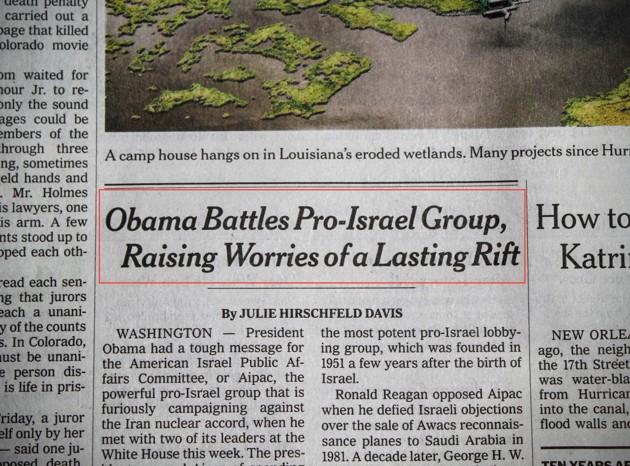
James Fallows has an interesting piece in The Atlantic that raises good questions about how the media frames political issues. In this particular case, Fallows parses out the logic of possible headlines describing the dispute between the Obama Administration and Israel and its allies on the Iranian nuclear deal. He does not charge the New York Times of constructing a headline with a pro-Israel bias, but he does point out how different alternative headlines convey implicit and perhaps subliminal messages.
The US is coming up to its 50th anniversary of the Watts riots, one of the most intense episodes of protests against racism in American history. The riots started from what should have been a routine traffic violation, but the predominately black population of the Watts section of Los Angeles took the occasion as representative of a sustained history of police misconduct against African-Americans. Race-based riots were not new in the United States, but every generation apparently needs to relearn the same lesson. The riots last year in Ferguson, Missouri and subsequent protests in other American cities seem to be following the same pattern of relearning. Perhaps at some point in the future, we won’t need to be reminded that all persons should be given complete and total respect.
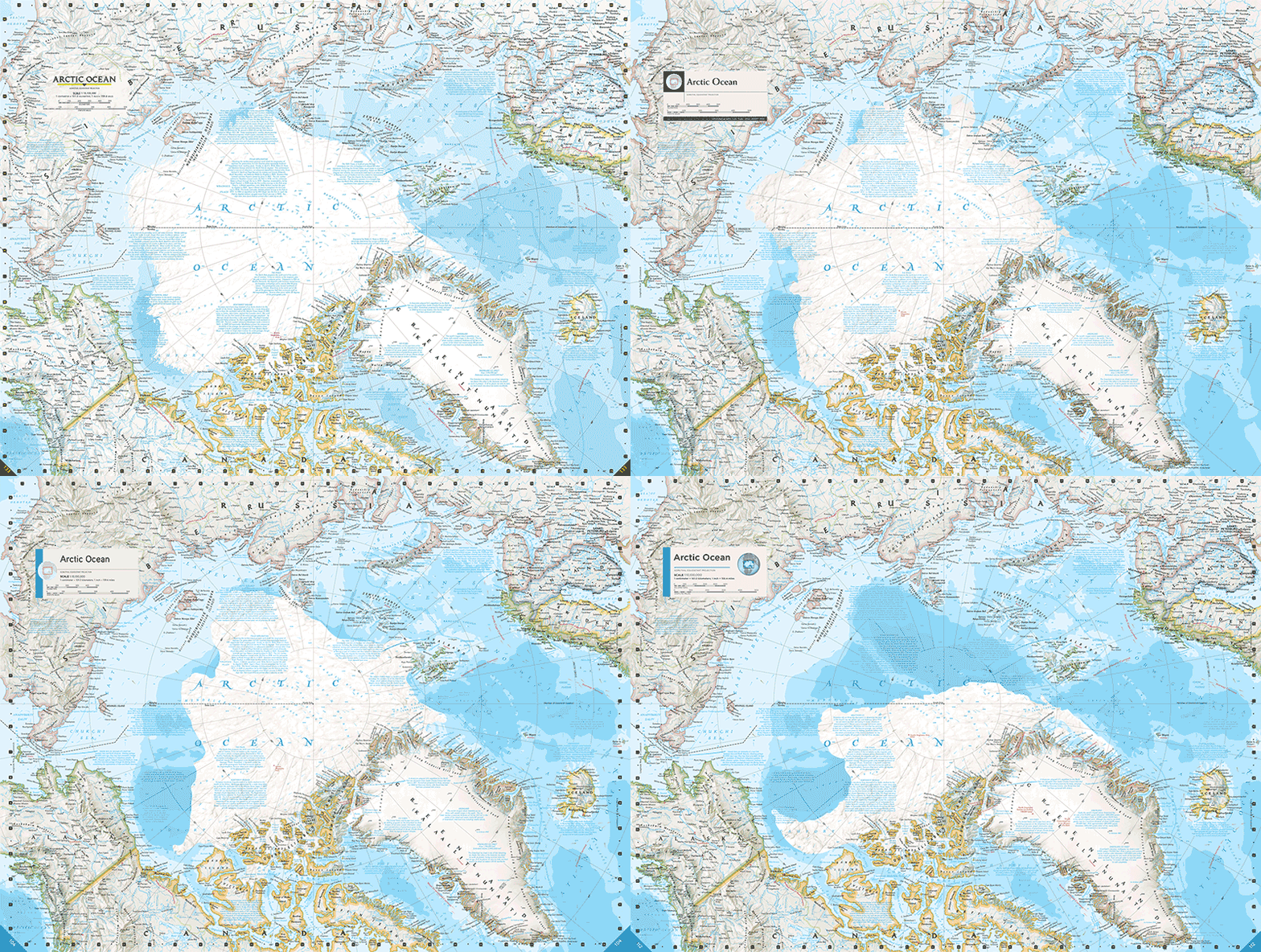
National Geographic has released a new map of Arctic sea ice as it has changed from 1999 to 2014. The map is sobering. As always, it is difficult to tell from a map how consequential the changes are, but it is clear that the changes are already triggering off geopolitical changes as states vie for control of the resources that may become available from the melting or from the navigational changes the ice melt permits.
North Korea has announced a new time zone: “Pyongyang Time”. It moved its clocks by 30 minutes so that it would have its own time zone. The move was coordinated with the anniversary of the end of Japanese occupation and was made with the following announcement by the official news agency: “The wicked Japanese imperialists committed such unpardonable crimes as depriving Korea of even its standard time while mercilessly trampling down its land.” Time zones are not regulated by any international body so every country has the right to manage its time zones according to its own interests.
The fourth blogger in six months was assassinated in Bangladesh. Niloy Chatterjee was hacked to death for his criticism of religious extremism and his defense of secularism in Bangladesh. The bloggers have been demanding justice for those killed in Bangladesh’s war for independence in 1971. The UN, Amnesty International, and the The Committee to Protect Journalists have all demanded that the government investigate these deaths and prosecute those responsible. It is not likely that the government will take these demands very seriously.
The American Psychological Association has voted to prohibit its members from cooperating with the US government in torture practices on foreign soil. The vote was a victory for those psychologists who believe that the Association was morally derelict in colluding with “enhanced interrogation techniques” during the Bush Administration. The Association had been singled out in a report by David Hoffman who published a lengthy critique of the practices of the Association in supporting torture. This step is overdue, as is the prosecution of Bush-era officials who ordered and condoned the practices.
From the Universal Declaration of Human Rights (1948)

Russia has laid claim to a substantial part of the Arctic based upon its interpretation of how its continental shelf extends into the region. Russia has submitted an incredible amount of scientific data which it claims proves that the UN Convention on the Law of the Sea interprets national territory in a manner which supports its claim of ownership. The UN will investigate the evidence which will undoubtedly be contested by other states who dispute the claim such as Canada, Denmark, and the United States.

Andrzej Duda has been sworn in as Poland’s new President. Duda is a member of the right-wing Law and Justice Party which is currently an opposition party in the Parliament, although Parliamentary elections are scheduled for October. Duda’s election signals a shift to the right: Duda favors stronger action against Russia’s activities in Ukraine and supports more robust moves by NATO to counter what he regards as a growing threat form Russia to east and central European countries. Duda is also a strong supporter for the continued use of coal in energy production since Poland has ample supplies of the fuel. Those positions are less consistent with the western members of the EU such as Germany and France.
There is an ongoing crackdown against liberal academics in China. According to some, over 200 academics have been detained or interrogated in recent months. Those academics who support enlarging the realm of choice in politics–suggesting avenues to power other than through the Communist Party–have been harassed by authorities, and many of them have left the country. It seems clear that President Xi is intent on retaining complete authority within the Party and regards liberal democracy as illegitimate.
Tomorrow will mark the 70th anniversary of the dropping of the atomic bomb on Hiroshima by the US. That bombing was followed three days later by an atomic bomb dropped on the city of Nagasaki. Americans believe that these explosions ended the war begun by Japan on 7 December 1941. That conclusion is far from certain as some analysts believe that it was the threat of Soviet intervention that led to the Japanese surrender (see Tsuyoshi Hasegawa, Racing the Enemy: Stalin, Truman, and the Surrender of Japan, Belknap Press, 2006). At the time, the bombings were considered just another phase of a bloody war that completely ignored the prohibitions against killing civilians. We now know that the atomic bombs introduced a completely different level of horror to war.

The analysis of the changing balance of power in Asia has mostly focused on the US-China naval competition. However, that framework ignores the growing cooperation between India, Japan, and Australia–three countries which, for different reasons, have kept a relatively low naval profile. That profile is rapidly changing, and these three rising powers changes the power configurations quite dramatically. The difficulty comes in trying to assess how cooperative these countries will be with each other.
If one is a supporter of liberal thought, here are some things to worry about:
Freedom is taking a real hit in the world.
John Richardson has written an article for Esquire magazine that investigates the mind set of climate scientists. Their task is formidable: modeling the process of climate change is extraordinarily difficult. But these scientists have an additional burden–the organized attempts by some very rich institutions that have dedicated themselves to attacking the scientists and their conclusions. Richardson does an excellent job of plumbing the issues that these scientists have to confront, not the least of which is the idea that they are studying a process that could change human civilization profoundly.
The German prosecutor who sought to bring treason charges against journalists who wrote articles about German government intentions to increase surveillance capabilities on German citizens has been fired. The move is an important step in protecting freedom of the press in Germany. The question of government surveillance is an especially sensitive one to the German people who experienced horrific surveillance under Nazi rule and by the secret police in East Germany under communist rule.
Graham Allison has been writing about US foreign policy as long as I have been alive. He has written a piece for The Atlantic entitled “9 Reasons to Support the Iran Deal.” It is a short and concise list of reasons to support the deal–a good antidote to much of the shoddy analysis that is flying around right now.
Under a new plan announced by the Obama Administration, the US intends to reduce overall carbon emissions by 32% below 2005 levels by 2030. The plan is ambitious and is certain to provoke an angry backlash among the producers of energy in the country. But President Obama declared that “[w}e are the first generation to feel the impact of climate change and the last generation that can do something about it.” The President clearly wishes to set up a high threshold for the UN climate talks scheduled to be held in Paris in December.
Many high-ranking former members of the Israeli military and security forces have signed a petition urging Israeli Prime Minister Netanyahu to accept the nuclear agreement with Iran. According to the Daily Star:
“Signatories include former heads of the Shin Bet security agency, Ami Ayalon and Carmi Gillon; a former deputy director of theMossad intelligence agency, Amiram Levin; the ex-chief of the Atomic Energy Commission Uzi Eilmann; and dozens of former generals and senior officers.”
The petition emphasizes the dangers of possible damage to the US-Israeli alliance by continuing to oppose the deal by pressure on the US Congress.
Turkish Prime Minister Erdogan was responsible for initiating a peace process with the Kurds early on in his Administration. Recently, however, Erdogan has been playing a double game of fighting both the Islamic State and the Kurds, who are also the enemy of the Islamic State. Erdogan’s policies are fraying the domestic politics of the country, and there are reasons to believe that Turkish civil society is not capable of accommodating these internal pressures for much longer. Civil strife in Turkey would only rattle the regional politics of the Middle East even more.
The Changying Precision Technology Company in Dongguan City, China, has set up a factory that is almost fully roboticized. The factory produces parts for cell phones and once employed 650 people. The factory managers believe that the factory could run on perhaps 20 people. According to TechRepublic:
“The robots have produced almost three times as many pieces as were produced before. According to the People’s Daily, production per person has increased from 8,000 pieces to 21,000 pieces. That’s a 162.5% increase.
“The increased production rate hasn’t come at the cost of quality either. In fact, quality has improved. Before the robots, the product defect rate was 25%, now it is below 5%”
Many other Chinese companies, including Foxconn, which makes most Apple product components, have announced similar initiatives. One can only wonder how this movement will affect workers in China.

German prosecutors are considering treason charges against reporters for an online news service call Netzpolitik. The online service published confidential information about attempts in the German government to increase online surveillance. Those activities hardly seem serious enough to threaten the national security of the Republic, so many are interpreting the move as an attempt to stifle freedom of the press in Germany. Protests against the charges are scheduled for today in Germany,

Israeli forces killed a Palestinian teenager who was protesting against the death of a toddler at the hands of Jewish extremists. There have been about 120 attacks by Israeli settlers against Palestinians in 2015 as the issue of settlements is being pushed to the forefront. The Palestinians are not likely to be protected by the Israeli government. According to Yesh Din, an Israeli human rights organization:
“Only 7.4% of SJ (Samaria and Judea) District Police investigations following complaints from Palestinian victims of offenses committed against them or their property by Israeli civilians result in indictments.”
The Palestinian Authority is referring the matter to the International Criminal Court.
It is difficult to appreciate how powerful some private companies are. We tend to overlook the powerful connections between economic and political power. One way to think about economic power is to compare how many economic resources are available to a political agent. For example, how the size of a corporation compares with the stock market of a state:

An experimental vaccine against the Ebola virus has been tested in Guinea and it appears as if the vaccine is 100% effective. If these tests are valid, then the development of the vaccine would be a tremendous breakthrough against one of the most virulent viruses to affect humans. One can only hope that the resources will be made available so that the vaccine can be widely distributed across affected areas: vaccinations are difficult and expensive in many areas of Africa and the local governments lack the money to conduct such protocols.
A Yale University study has found that about 40% of the world’s population is completely unaware of the problem of climate change. The finding should not be surprising, but it does suggest how far the world is away from reaching a consensus on effective measures to address the issue. Interestingly, people in Latin America seem to be the most aware of the problem of all the regions polled. The variations across regions should provide insights into how best to communicate the dangers of climate change based upon cultural differences.


