Sean McElwee and Vijay Das have written an op-ed piece for Al Jazeera on how campaign financing is affecting the healthcare debate in the United States. The evidence is sobering: 0.1% of the American population contributed 30% of all the campaign funds in the 2012 presidential election cycle. The choices available to the American people on healthcare is overwhelmingly influenced by these contributions.
Daesh (Islamic State) adherents staged a terror attack in central Jakarta in Indonesia. The attack mirrors other such attacks–no evidence of centralized direction but rather attacks conducted by individuals inspired by Daesh propaganda. These types of attacks are not necessarily debilitating to a strong polity, but can weaken one that already lacks a degree of legitimacy.
Scientific American has created two interactive visualizations of the refugee crisis in the world today. The effects are quite dramatic and one can choose to isolate specific countries or time periods. It is a very impressive site.
e-waste is a serious problem globally and much of the electronic waste generated in the world comes from the rich countries. Much of this waste is sent to poorer countries where a remarkable percentage of it is effectively recycled. But a lot of the toxic waste ends up being burned in poorer countries and it is a serious health problem.
I have posted many articles about the growing income inequality in the US which I regard as the most serious problem in the country right now. It has been getting worse over the last 40 years, and one of the main causes of inequality is the way the tax system favors capital over labor income. The National Bureau of Economic Research has just published a report on a tax technique of which I was unaware: the growth of “pass-through” entities which allows corporate profits to be taxed at a much lower rate. According to the NBER report:
In 1980, pass-through entities accounted for 20.7 percent of U.S. business income; by 2011, they represented 54.2 percent. Over roughly the same period, the income share of the top 1 percent of income earners doubled. Previous research has shown that the two phenomena are linked: The growth of income from pass-through entities accounted for 41 percent of the rise in the income of the top 1 percent. By linking 2011 partnership and S corporation tax returns with federal individual income tax returns, in particular Form 1065 and Form 1120S K-1 returns, the researchers find that over 66 percent of pass-through business income received by individuals goes to the top 1 percent. The concentration of partnership and S corporation income is much greater than the concentration of dividend income (45 percent to the top 1 percent) which proxies for income from C corporations (traditional corporations). While taxpayers in the top 1 percent are eight times as likely to receive dividends as taxpayers in the bottom 50 percent, the ratio for partnerships is more than 50 to 1.
Such is the sleight of hand used to disguise how the rich get richer.
Ian Buruma is a brilliant analyst/historian of world politics. One of his more recent essays analyzes the rhetoric of the current Republican candidates with respect to US policies toward Daesh (the Islamic State), specifically Senator Cruz’s promise to “carpet bomb” the caliphate and Trump’s promise to “bomb the shit” out of Daesh. Buruma points out the vulgar silliness of such policy prescriptions, advocated by people who know absolutely nothing about the experience of war.
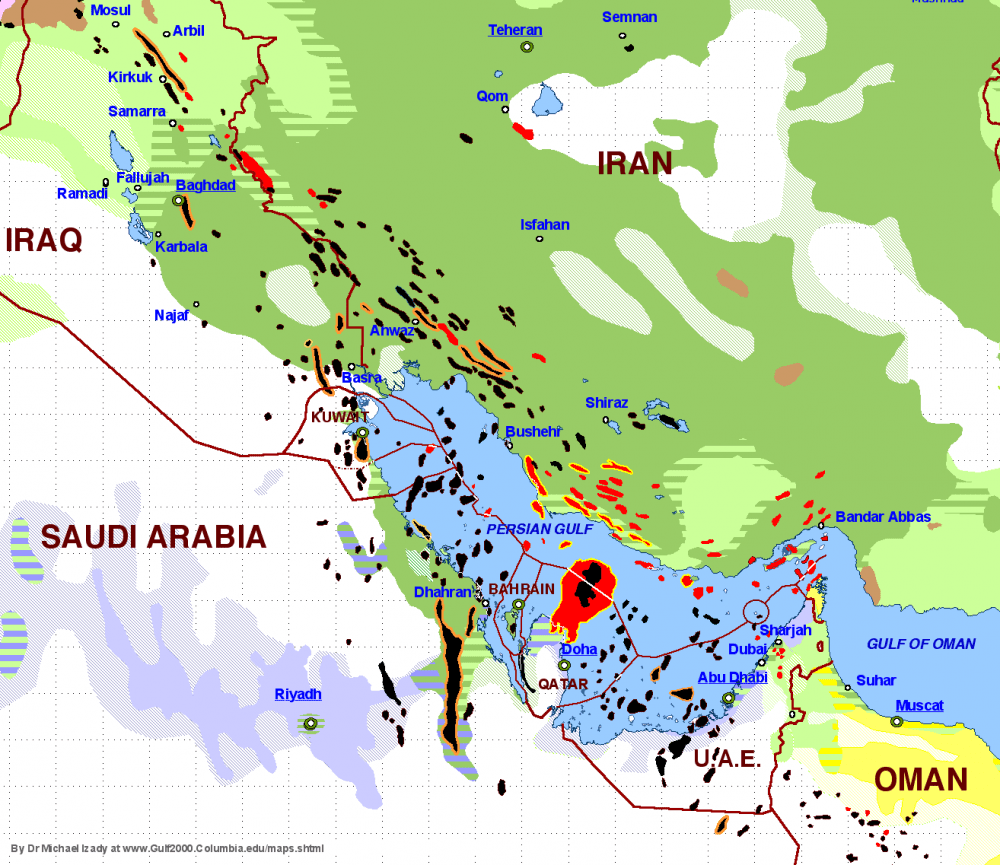
One of the reasons why the Saudi-Iranian conflict is so sharp is because most of Saudi oil and gas reserves are in areas populated by Shia Muslims who have more of an affinity for Iran than the Sunni-dominated Saudi government. A quick glance at a map shows how the Saudis might legitimately fear for control of their most precious resource. The dark green areas are Shia-majority and the light green are Sunni-majority. The black and red are oil and gas reserves.
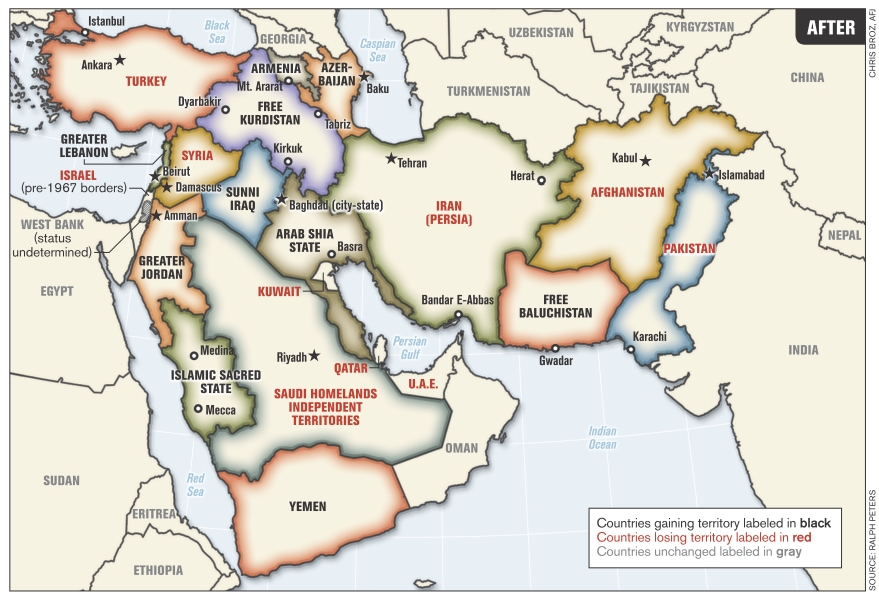
Rami Khouri is a very smart analyst of Middle Eastern affairs. His interpretation of the growing Saudi-Iranian discord is right on target–not alarmist but sufficiently sober. His essay, however, has an insight which I had not though about before. The dynamic of this hostility may lead to the break-up of some well-established states. Such an transformation would be very unstable when it occurred but might be more stable in the long run.
There’s lot going on in the stock markets all around the world, and all of it is bad. The Shanghai stock market was open for only 29 minutes before it was closed to trades because the index had fallen by over 7%. The US stock market is now officially in “correction” because it has fallen over 10% from its previous high. Financial uncertainty always aggravates world politics, but there is usually a lag in time. Incredibly, the Saudis are losing a great deal of money and are thinking the unthinkable: selling ARAMCO, arguably the most valuable company in the world as an initial public offering (IPO)
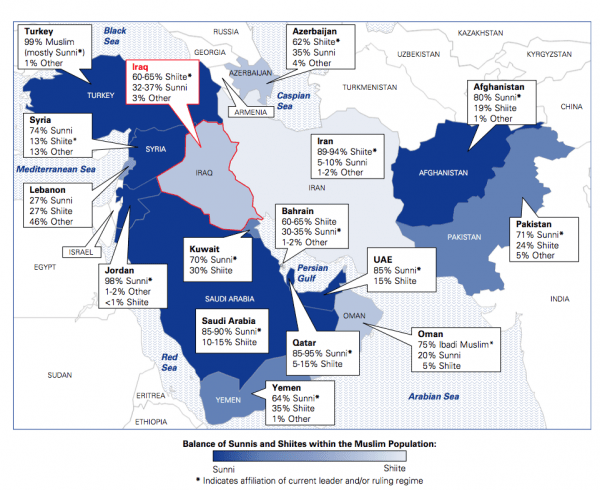
The dispute between Saudi Arabia and Iran continues to deepen, although it is not likely that an open, violent confrontation will take place any time soon. The dispute is long-standing over dominance in the Middle East although many continue to refer to the dispute as a Shia-Sunni split. However, that issue is overblown by Westerners and, to the extent that it is valid, it is also constant. What has changed is the relative distribution of power between the two. Iran has been slowly gaining power largely due to the overthrow of Saddam Hussein in Iraq and the successful nuclear agreement. At the same time Saudi Arabia has been losing influence largely due to the change in the government and Saudi stubbornness on the issue of its support for Wahabist groups abroad.
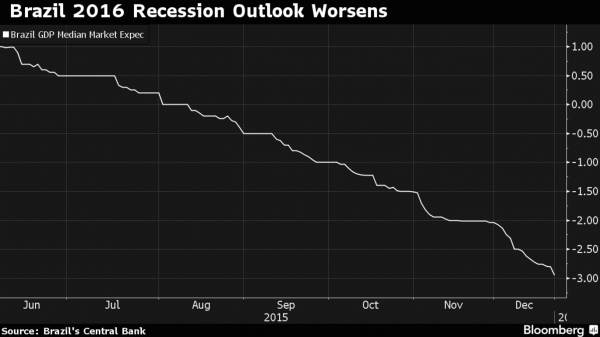
Stock markets all over the world took a major hit today and evidence continues to mount that the Chinese economy is slowing down. Lost in all the panic, however, is the fate of some very important middle-income countries to global growth. The worst case is probably Brazil as it has slid steadily into a crushing recession.
Sweden introduced border controls on refugees entering from Denmark. The change in policy reflects the incredible pressure on what has always been the most welcoming country in the world to refugees. Although press coverage of the refugee crisis has tapered off, the crisis continues almost unabated despite the onset of winter.
A strong theme in the Republican primary debates is that the US should “do more” in the Middle East. But the details of what should be done are few and far between (except for Senator Cruz’s suggestion to carpet bomb Daesh). One of my old college friends, Paul Pillar, has written an essay that shreds these vapid suggestions.
Saudi Arabia and Iran have exchanged serious diplomatic insults after Saudi Arabia executed Shaikh Nimr al Nimr, an outspoken defender of the rights of Shia Muslims. Nimr was one 47 persons executed by Saudi Arabia at the of the year. Those who oppose capital punishment decried the Saudi attitude toward human rights.
It is safe to say that since the Great Recession which began in 2008, there are very people who really understand what is going on in the global economy. With globalization, roboticization, zero and negative interest rates, and incredible rates of indebtedness, the world is in uncharted waters. The Atlantic polled some analysts to tap into their insights. It is a sobering group of statements.
Turkish President Recep Tayyip Erdogan has been pushing for constitutional reforms in order to give the country’s president more powers. When he returned from a trip to Saudi Arabia, Erdogan was asked whether such powers were possible given that the current system gives power to a Prime Minister. According to the New York Times, Erdogan responded:
“There are already examples in the world,” Mr. Erdogan said. “You can see it when you look at Hitler’s Germany.”
The response is not one likely to give comfort to those Turkish citizens who believe in human rights and democracy.
Russia has issued an update of its national security policy which describes NATO expansion as a threat to Russian national security. Several states which were once part of the Soviet Union’s military alliance, the Warsaw Pact, are now members of NATO and Russia fears that the former policy of containment is being revived against it much closer to its national borders. NATO expansion has occurred as several states have indicated that they seek protection against Russian expansionism. The conflict is a classic case of the security dilemma.
The World Health Organization (WHO) has labeled New Delhi as the city with the most polluted air on the planet. The air usually worsens in the city during the winter as inhabitants turn to a variety of fuels to keep warm, but the levels of particulates in the air is higher than even in Beijing. Officials have ordered a crackdown on automobile traffic in the city in an effort to reduce those levels. India needs to take effective action as 13 of the 20 cities on the planet with the highest levels of pollution are in India.
I am going on vacation for two weeks and will only blog sporadically. I will return to daily postings on 17 January.
Many of the current political problems in the Middle East stem from the artificial boundary lines drawn up by the British and French after the collapse of the Ottoman Empire after World War I (the British and French actually agreed on the lines in 1916 before the Ottoman Empire collapsed but kept their agreement secret). The contesting parties–Sunni Mulsims, Shia Muslims, Arabs, Turkmen, Kurds, to name a few–are fighting over boundaries that divide their own groupings. We don’t know how the final boundaries will be drawn, but one can imagine a Middle East with ethnic and religious boundaries quite different from today’s lines.
One of the groups that has been fighting for many years to be able to draw its own boundaries is the Kurds. There are about 30-32 million Kurds in the world, making them one of the largest nations without a state. They also have expanded the area in Syria under their control considerably during the current fighting. Their success has frightened the Turks, who fear losing some of their territory to an independent Kurdistan. That fear has led to a sharp increase in military attacks on the Kurds in southeastern Turkey and a frightening increase in civilian casualties. It is difficult to see how the conflict in Syria and Iraq will be resolved without some major concessions to the Kurds.
It’s New Year’s Eve!! For your listening pleasure, listen to Eric Clapton and J.J. Cale play “After Midnight” Rock On!
Find the Panda in this Image (I found it in one minute)