The Hungarian Prime Minister of Hungary has used inflammatory rhetoric against what he considers to be a Muslim invasion of Christian Europe to justify his treatment of the refugees from Syria. That rhetoric is not new to that region of Europe. In 1389 Serbian forces faced an invasion of the Ottoman Empire on the “field of blackbirds” (kosovo polje). In 1989, on the 600th anniversary of the battle, Slobodan Milosevic, who ultimately became the leader of Serbia and waged a brutal genocidal war against the primarily Muslim Bosnians, referred to that battle in these terms:
“Six centuries ago, Serbia defended itself in the field of Kosovo, but it also defended Europe. Serbia was at that time the bastion that defended the European culture, religion and European society in general.”
The fear of Muslim “invasions” in southeast Europe is long-standing and apparently impossible to erase.

Hundreds of refugees stranded at the Hungary-Serbian border stormed past the border control and entered Hungary. They complained of inadequate facilities at the border and feared being stranded there without any support. Germany stepped up its promises to aid the refugees, as did the French. The British promised to admit 5,000 refugees over the next five years. These promises are important steps but remain inadequate to the problem. The US still refuses to make substantial commitments.
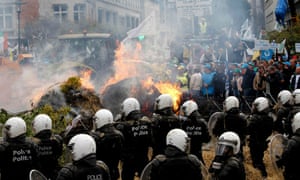
Europe was also troubled by the discontent of its farmers. Thousands of farmers descended on Brussels to protest high taxes and plunging food prices. Tractors blockaded the streets of Brussels and the protesters hurled eggs and sprayed the police with milk and hay.
 World Politics News
Just as “The fear of Muslim ‘invasions’ in southeast Europe is long-standing and apparently impossible to erase,” the fear of Crusaders in the muslim countries is often invoked in the context of unequal relations between the West and the muslim ones, especially among the disadvantaged strata.
LikeLike
Absolutely. A reality that George W. Bush forgot when he used the word “crusage” to describe the so-called “war on terror.”
LikeLike