Professor Lars Osberg of Dalhousie University has written a paper under the auspices of the OECD which takes current trends of income inequality in the US and extrapolates them to the year 2032. The results are quite sobering:
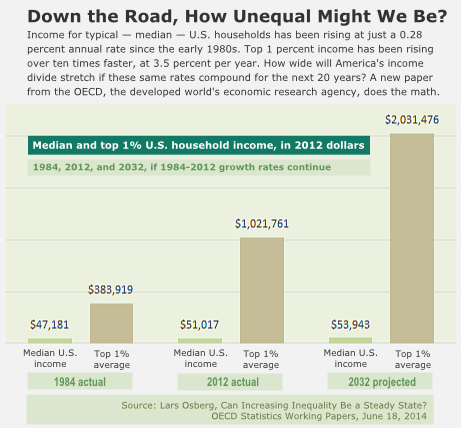
The important message of Professor Osberg’s paper is intuitively obvious:
The ‘new normal’ of the United States, Canada and Australia is ‘unbalanced’ growth – specifically, over the last thirty years the incomes of the top 1% have grown significantly more rapidly than those of everyone else. The paper asks if auto-equilibrating market mechanisms will spontaneously equalise income growth rates and stabilise inequality. It concludes that the more likely scenario is continued unbalanced income growth. This, in turn, implies, on the economic side, consumption and savings flows which accumulate to changed stocks of indebtedness, financial fragility, and periodic macroeconomic crises; and, on the social side, to increasing inequality of opportunity and political influence. Greater economic and socio-political instabilities are therefore the most likely consequence of increasing income inequality over time.
Growing inequality is both economically and politically unstable. And there is no market mechanism to reduce growing inequality–only political intervention can redress the imbalance.
The Lebanese army has moved against the Islamic State which has taken over the town of Arsal. The battle represents yet another spillover from the Syrian civil war. The article from the Tehran Times has some interesting points to note. It makes sure that the Lebanese army commander is a Sunni Muslim (since the Islamic State is a Sunni Muslim organization and Iran is ruled as a Shia Islamic Republic), and the article identifies the Islamic State as ruled by “hardline takfiri militants.” Takfiri is a term to denote those who follow an apostate version of Islam. Iran wants to make sure that the enemy is properly identified. Meanwhile, Kurdish forces are also battling the Islamic State in Iraq. Although they share the same enemy, it is unlikely that Iran and the Kurds will ally–Iran fears the creation of a Kurdish state since it believes that such a state would be used by Israel and the US in their conflicts with Iran.

The Guardian has run an article asking the question of how biased Western media reports have been in their coverage of the Ukrainian crisis. The newspaper asked several analysts to ponder the question, and their answers are quite diverse. There is little question that the Russian side of the story has not been covered by the Western press–the real question is to what extent this omission is deliberate or based upon clear reasons to discount the interpretation.


Leave a Reply