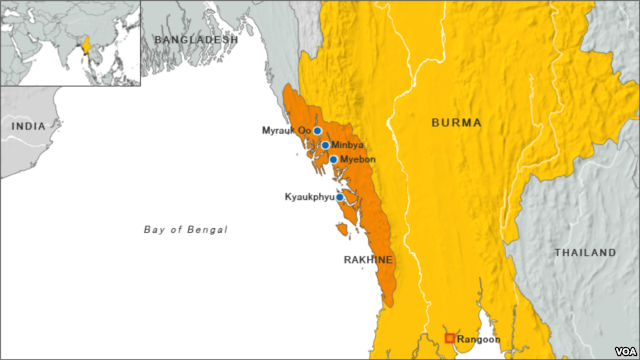
There are many nations in the world that lack a state to protect them. These nations are usually minorities in states with majority populations that control the state (but not exclusively–there are some majority peoples who are ruled by a minority). One of the world’s largest nations is the Royingha, Muslims who live in Myanmar which has a majority Buddhist population. The Buddhists resent the presence of the Muslims who migrated to Burma from Bangladesh and live primarily in the Rakhine Province of Myanmar. Since the military government in Myanmar has loosened its domestic controls, the Buddhists have taken the new freedom as an opporunity to assert what they believe is appropriate control over the region. In recent years, the violence between Buddhists and Muslims has grown steadily worse.
A truce has been declared in the ongoing violence between the Ukrainian government and protesters. The truce comes after intense fighting yesterday, but it only holds in the capital city of Kiev and there are reports that the protests have erupted in other cities as well. Both sides seem to be well aware of the stakes involved, but it is not clear what possible points of reconciliation exist or even what is being discussed during the truce. Initial reports suggest that there were no positive results from the truce.
One of the more unsettling changes over the last two years has been the movement of Japan toward a more aggressive military posture. The change can be justified by the new military power of China as well as the nuclear policy of North Korea. But in many respects, Japan had tried not to be a “normal” country. In article 9 of its constitution, the state declared that “the Japanese people forever renounce war as a sovereign right of the nation and the threat or use of force as a means to settle international disputes”. It is difficult to say how the Japanese people feel about this change in military posture–they definitely feel as if their position is more precarious, but their commitment to a more peaceful policy is also quite deep.


On the topic of various nations uneasily coexisting within a state, I’ve never understood why breaking Iraq up into separate Sunni, Shiite, and Kurdish states after Hussein was removed was so broadly opposed. I understand why neighboring countries might oppose it, but it seems like the only two realistic possibilities in the long run are either to have separate states or to have a military-backed government that doesn’t represent the will of a large fraction of the population (like Hussein’s). If it were put to a vote, wouldn’t the Sunni and Kurdish nations prefer independence? As far as I can tell, the only one who was in favor of the three-state solution was Biden, whose foreign policy ideas are now apparently a subject of ridicule in DC.
LikeLike
There are about 2000 separate “groups” of people in the world who have more than 100,000 people identifying with a specific group. These entities are likely what we consider “nations”–people who express solidarity with each other on the basis of shared characteristics. There are, however, about 193 states in the world right now. Giving each nation its own state would involve dividing up territory in countless objectionable ways. This attempt to correlate nations with states was the underlying cause of the Bosnian tragedy.
President Wilson tried to give each nation in eastern Europe their own state after the collapse of the Austro-Hungarian Empire. His failure is testimony to the tragedy of relying upon this strange entity called the nation-state.
Dividing up Iraq was considered by several people at the height of the conflict. The proposals all floundered when the question of “who gets the oil?” was raised.
LikeLike