One of the deepest concerns about the very slow economic recovery of the 2007-08 recession (The Great Recession) is the persistence of youth unemployment. Unemployed young people not only contribute to slow economic growth now, but their late start in the job market often reduces possible growth in the future. The global rates on youth unemployment are staggering.
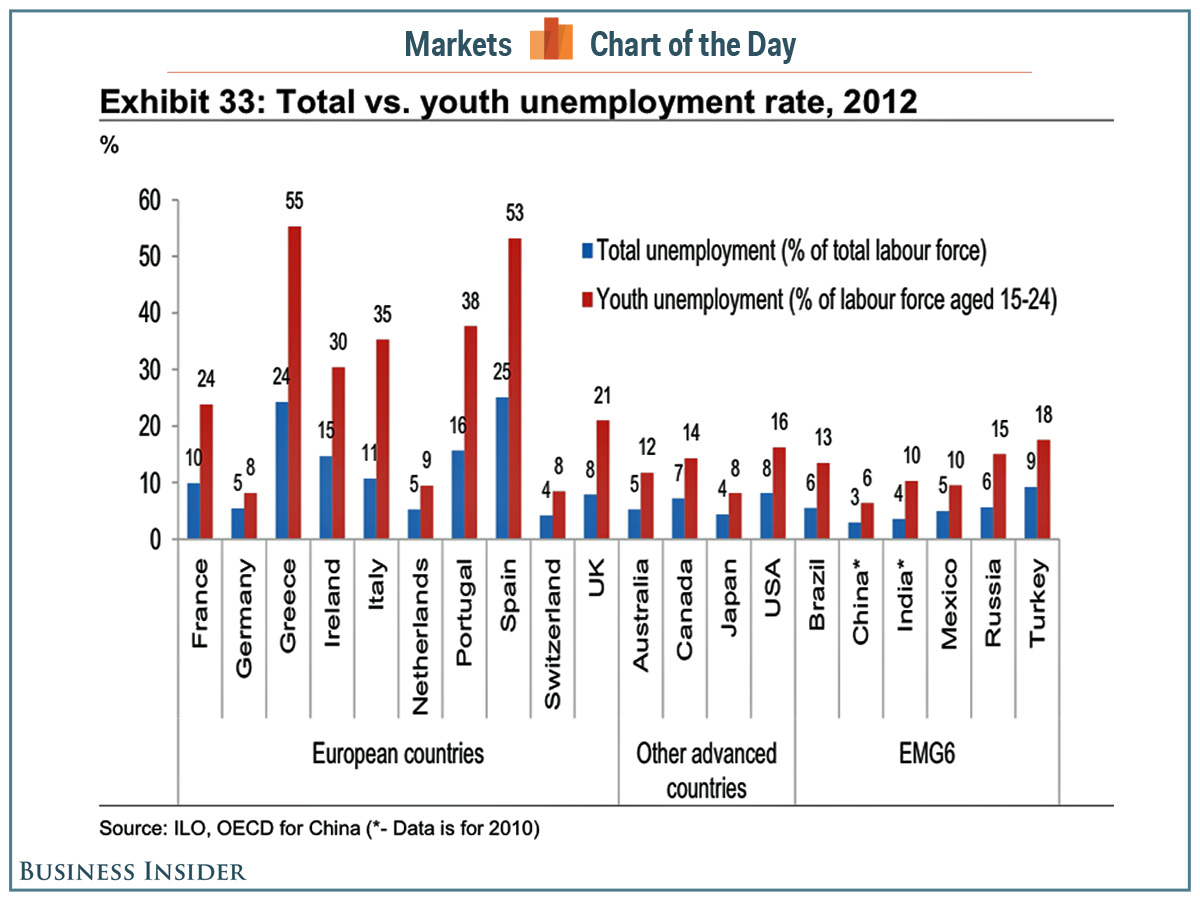
Source: Sam Ro, “Youth Unemployment Rates Are Terrible Everywhere,” Business Insider, 22 November 2013
A study by Richard Heede which was published in the journal Climatic Change argues that 90 corporations are responsible for about 60% of all the carbon dioxide emissions on the planet. The study was presented to the UN Conference on Climate Change in Warsaw and has not yet been vetted by a large number of climate scientists. Moreover, the study suggests that half of all the carbon dioxide emissions from industrial activity has occurred in the last twenty-five years. The latter statistic, if valid, would suggest that the dangers of greenhouse gas emission are accelerating more rapidly than previously thought. The list of companies was described by the Guardian in this manner:
“The list of 90 companies included 50 investor-owned firms – mainly oil companies with widely recognised names such as Chevron, Exxon, BP , and Royal Dutch Shell and coal producers such as British Coal Corp, Peabody Energy and BHP Billiton.
Some 31 of the companies that made the list were state-owned companies such as Saudi Arabia’s Saudi Aramco, Russia’s Gazprom and Norway’s Statoil.
Nine were government run industries, producing mainly coal in countries such as China, the former Soviet Union, North Korea and Poland, the host of this week’s talks.”
If the list is accurate, then it frames an action plan to stop greenhouse gas emissions radically different than the country-by-country model traditionally used.
Ukraine has decided to developed closer economic relations with Russia rather than to embrace the Eastern Partnership program initiated by the European Union in 2009. Both Russia and the EU have been cultivating ties with Ukraine for a number of years, and the decision is a clear victory for Russia and Vladimir Putin. Russia has always regarded Ukraine as a central component of a greater Russia, and a turn to the West would have damaged not only Putin’s economic plans but also the larger sense of nationalism being cultivated in Russia right now. Whether the turn to the East was a wise choice remains to be seen. Ukraine is a heavily indebted country which needs considerable economic assistance to revive its economy.


Leave a comment