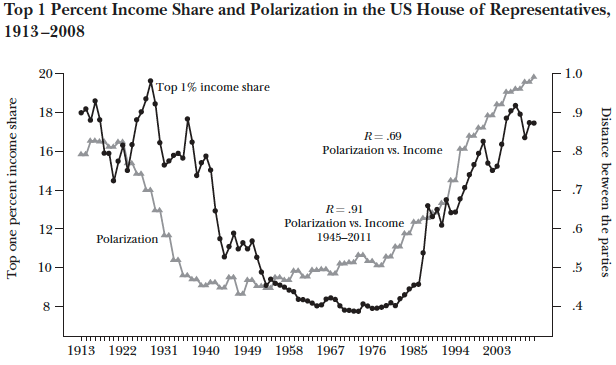
A team of Political Scientists at Stanford have published a fascinating study in the Journal of Economic Perspectives on a very important question: Why Hasn’t Democracy Slowed Rising Income Inequality? I will not ask any questions on the weekly quiz about the study because it is pretty detailed. But Mother Jones, a lefty journal in the US, published a short analysis of the study. The scholars looked at the relationship between income inequality in the US and liberal/conservative polarization in the US House of Representatives. The relationship seems to be fairly clear as suggested by this graph. But the explanation for the relationship remains elusive since it seems intuitive that people would vote to protect their economic interests. But the definition of economic and political interests seems to be quite different from what one might normally expect. The radicalization of politics does, however, seem to be a global process. As economic inequality has deepened in many countries of the world, more radical political parties have emerged such as the National Front in France, the True Finns in Finland, the Party for Freedom in e Netherlands, and the Jobbik Party in Hungary. Perhaps the most notorious of all these radical movements is the Golden Dawn in Greece.
Mexican teachers have been protesting changes in national education policy for the last three weeks, and the protests have turned increasingly violent. The strikes are in response to proposed changes in the governance of Mexican teachers which have one of the most powerful unions in Mexico. Governance in education have led to massive strikes in Chile and Canada in recent years. Indeed, the access to higher education is a prominent issue is most countries of the world.
Stephen Walt is a Professor at Harvard and one of the most prominent realists in the field of international relations. He maintains a regular blog on the Foreign Policy website. His analysis of the situation in Syria is very specific and direct, and in this post he uses the advice the General Colin Powell gave prior to the attack on Iraq in 1991, the war often called “Desert Storm.” The advice is highly pertinent to a strategic analysis of US interests in Syria.


Leave a comment