Last June, the US house of Representatives banned the State Department from using death statistics published by the Gaza Ministry of Health. The amendment was supported by most Republicans and many Democrats but the Senate has yet to pass on the legislation. The rationale for the amendment was best expressed by David Adesnik, Senior Fellow and Director of Research at the conservative think-tank, Fund for Defense of Democracies: “It’s a complete abdication of responsibility for the Biden administration to say it trusts the Gaza Health Ministry’s numbers because the UN considers them trustworthy. We’ve seen that the UN puts blind faith in the ministry’s numbers even when they’re completely implausible. As a result of trusting numbers from a Hamas-controlled entity, the Biden administration has become more focused on the restraints it can put on Israeli forces than how it can help accelerate Hamas’s defeat.” Israel has also criticized the Ministry’s statistics. The Anti-Defamation League published this analysis of the Gaza Minitstry of Health:
“ADL calls on all news organizations to properly caveat data and information cited from the Gaza Health Ministry with clear mention that it is controlled by Hamas and that it has shared false and misleading information in the past. Journalists and news organizations must acknowledge when their sources may be unconfirmed or unreliable.”
It turns out that the Gaza Ministry of Health undercounted the casualties (it only counts bodies that are visible, and does not search through destroyed buildings to find bodies that are covered by rubble). The amendment to legislation was According to the Lancet, one of the world’s premier medical journals, the death toll in the war against Gaza has been significantly undercounted. The study was limited to the period 7 October 2023 to 30 June 2024 so it does not include any reported deaths since July. The Lancet study came to this conclusion: “We estimated 64 260 deaths…due to traumatic injury during the study period, suggesting the Palestinian MoH under-reported mortality by 41%.” The Gaza Ministry of Health currently tallies about 47,000 deaths. If the undercounting of 41% holds from the period of 1 July 2025-11 January 2025, then a straight extrapolation would suggest a death total of about 67,000.
The Lancet study only looked at deaths attributed to military action. The report states that “our findings underestimate the full impact of the military operation in Gaza, as they do not account for non-trauma-related deaths resulting from health service disruption, food insecurity, and inadequate water and sanitation.” It is extraordinarily difficult to make precise estimates of these deaths (called “indirect” deaths in the literature), but the Watson Institute at Brown University has done a solid study. The Center for Strategic and International Studies has also done a report on the long-term effects of such conditions in Gaza.
It is very clear that we lack knowledge of the actual conditions in the Gaza Strip. But we should be extremely wary of attempts to undermine the credibility of sources by parties which have a vested interest in particular conclusions. It appears as if the Gaza Ministry of Health was, and is, the most reliable source in this dispute.
As a follow-up to yesterday’s post about the Amnesty International report on genocide in the Gaza Strip, I call to your attention a website created by Israeli historian, Lee Mordechai, an associate professor at the Hebrew University of Jerusalem. It is entitled “Bearing Witness to the Israel-Gaza War.”
In his preface to the report, Mordechai says:
“The enormous amount of evidence I have seen, much of it referenced later in this document, has been enough for me to believe that Israel is committing genocide against the Palestinian population in Gaza. I explain why I chose to use the term below. Israel’s campaign is ostensibly its reaction to the Hamas massacre of Oct. 7, 2023, in which war crimes and crimes against humanity were committed within the context of the longstanding conflict between Israelis and Palestinians that can be dated back to 1917 or 1948 (or other dates). In all cases, historical grievances and atrocities do not justify additional atrocities in the present. Therefore, I consider Israel’s response to Hamas’ actions on Oct. 7 utterly disproportionate and criminal.”
Further in the Preface, Mordechai directly addresses the critical questions of intent:
“The evidence I have seen and discuss indicates that one of Israel’s very likely objectives is to ethnically cleanse the Gaza Strip, whether in part or in total, by removing as many Palestinians as feasibly possible. Key members in Israel’s government have made statements confirming this intent, and several of Israel’s government ministries have planned or worked to facilitate such an end, sometimes by persuading or pressuring other states. Israel has already cleared significant parts of the Gaza strip by demolition and bulldozing, also attempting to destroy the fabric of Palestinian society by deliberately targeting civilian institutions such as universities, libraries, archives, religious buildings, historical sites, farms, schools, cemeteries, museums and markets. So far more than 60% of the buildings in the Gaza Strip have been destroyed or damaged.”
He goes on:
“All the evidence I have seen indicates that Israel is systematically destroying Gaza to make it unlivable in the future. In the first week of fighting, Israel dropped 6,000 bombs on Gaza – over the annual total used by the US in Afghanistan.48 In the first three months of fighting Israel had destroyed over 10,000 buildings in the Strip – compared to some 4,700 buildings in Aleppo after three years of fighting. A coalition of aid groups stated in December that rebuilding the housing destroyed to that point will take 7 to 10 years if financing is available and will cost some $3.5 billion.49 According to a joint report by the World Bank and the UN, the cost of damage to physical structures alone was around $18.5 billion at the end of January (the cost during the 2014 Protective Edge was $1.4 billion).50 In mid May a UN official stated that rebuilding could cost around $50 billion over two decades.51 The amount of debris created by the destruction of residential areas (estimates ranged between 26 and 37 million tons in April) will take many years to remove.52 A top UN demining official claimed that simply clearing the debris could take as much as 14 years.53 An expert on the warfare-related destruction pointed out that the case of Gaza fits the term ‘domicide’, a massive violation of the right to housing and basic infrastructure in residential areas by making them inhabitable, which is itself a crime against humanity.48
“Israel is said to have dropped over 500 2,000-pound bombs within the densely populated urban area, despite the massive collateral damage these bombs cause (causing death or injury in a radius of up to 365 meters around the target). These bombs are four times heavier than the largest bombs the United States used when fighting ISIS in Mosul; the US dropped a single such 2,000-pound bomb throughout its fight with ISIS.54 After two months of fighting, Israel had already caused more destruction in Gaza than Syria in Aleppo (2012-2016), Russia in Mariupol in 2022, or (proportionally) the Allied bombing of Germany in World War II,55 as well as the fights against ISIS in Mosul (2016-7) and Raqqa (2017).56“
The report is meticulously documented and judicious in its language. It is definitely worth a careful read.
Amnesty International has issued a new report accusing the state of Israel with the crime of genocide in its actions against the Palestinian people in the Gaza Strip. The crime of genocide is the most serious crime in international law and an accusation of genocide needs to meet extremely specific and demanding criteria of both actions and intent. Amnesty International is a well-respected human rights organization with a record of accomplishment that deserves respect.
It is a long, incredibly detailed report with evidence from a variety of credible sources. The report begins with an acknowledgement of what needs to be proven in order to support an accusation of genocide:
“To make a determination on genocide, Amnesty International first examined whether Palestinians in Gaza constitute part of a protected group under the 1948 Convention on the Prevention and Punishment of the Crime of Genocide (Genocide Convention), that is a national, ethnical, racial or religious group. It then focused on three out of the five prohibited acts under the Genocide Convention: ‘killing members of the group’; ‘causing serious bodily or mental harm to members of the group’; and ‘deliberately inflicting on the group conditions of life calculated to bring about its physical destruction in whole or in part’. It finally examined whether Israel committed these acts with the specific ‘intent to destroy, in whole or in part, [the] group, as such’.”
The report then goes through each of these criteria and documents specific cases through eyewitness testimonies. I was unaware of several of these cases, even though I have tried to be as well-informed as I can on this conflict. Much of the evidence, largely from satellite imagery, suggests destruction in Gaza which can hardly be described as precision accuracy. And the degree of forced displacement is staggering. Given the scale of destruction in such a small area, it would be difficult to deny that the degree of “harm” inflicted on the population in the Gaza satisfies the first two criteria of the Convention.
The significantly more difficult question to answer is whether Israel intends to “destroy, in while or in part, [the] group, as such”. People have intentions; governments have intention; it is questionable whether “states” have intentions. In today’s US Department of State Press Briefing, members of the press questioned the matter of intent:
“QUESTION: Because now we have Amnesty International. Before that, we had Human Rights Watch. We have all the UN organizations, all the human rights organizations probably throughout the world, B’Tselem, the Israeli human rights organization, every other organization saying that Israel is committing genocide. And depends – I mean it says – I know that genocide depends a great deal on intent, and it says – it bases its conclusion on statement time and time and time again by Israeli commanders, by Israeli officials, by certainly the president of Israel, by many, many other people that said they are committing genocide. I mean, we see that they have killed 44, 45 thousand people, 17,000 children. It deprives it food from going in, it deprives anesthesia from going on. CNN reported yesterday that Israel disallowed anesthesia from going into Gaza.
What is it going to take for you – for the United States of America that really holds the moral high ground on these issues, on human rights issues – to say what is happening is genocide? Because you are – what we see today, what we witness in northern Gaza is basically starvation by intent.
MR PATEL: Said, that’s an opinion. And you’re certainly welcome and you are entitled to it, as are all the organizations that you listed. They are entitled to make their own analysis of the situation and come to their own conclusions. What I can say as a spokesperson of the U.S. Government and as a spokesperson of this administration is that the findings of – the accusations of genocide, we continue to believe those to be unfounded. That does not change and that does not change the prioritization and the stress and the emphasis that we are placing on ensuring that there is appropriate access to humanitarian assistance, ensuring that every possible measure is taken to protect civilians, ensuring that we’re doing everything possible to bring this war to an end.
QUESTION: So —
MR PATEL: People, organizations, groups are entitled to draw their own conclusions. The U.S. conclusion is that these allegations of genocide are unfounded. There are and there continue to exist a number of avenues within the U.S. Government in which we are looking at what’s happening on the ground, where those assessments continue to be ongoing. But I don’t have any update to provide as it relates to that.
I sincerely doubt that there are many Israelis who wish to see the Palestinian people exterminated, even after the atrocities of 7 October. But does the government of Israel wish to see the Palestinian people exterminated? According to Amnesty:
“The offensive on Rafah was launched a week after Minister of Finance Bezalel Smotrich, a member of Israel’s security cabinet, explicitly called for the city’s destruction by referring to a well-known Biblical story of absolute vengeance in which an entire nation – the people of Amalek – is ordered to be destroyed: “There are no jobs half done. Rafah, Deir al-Balah, Nuseirat, destruction! Blot out the memory of [the people of] Amalek from under heaven,” he said at a public event on 29 April 2024. In fact, Minister of Finance Smotrich and Minister of National Security Ben-Gvir, who also made some of the most explicit calls for the destruction of Palestinians in Gaza, threatened to quit the government coalition if Prime Minister Netanyahu abandoned plans to attack Rafah. Minister of Finance Smotrich’s statement came months after Prime Minister Netanyahu first referred to the story of the total destruction of the people of Amalek in the first week of Israel’s ground offensive in late October and early November 2023. He used it to garner support for what was, at the time, a new and highly destructive phase of the conflict. As Israel’s highest office-holder, who oversaw the offensive on Gaza, Prime Minister Netanyahu would have most certainly known that his words would be understood by soldiers, particularly those affiliated with the settler movement and religious nationalist parties led by the two ministers, as calls for the destruction of Palestinians in Gaza.”
The Israeli Government has explicitly rejected the report. The US has not rejected the report, but has rather found it to be “unfounded”. There really is no way to determine what the intent of the destruction on the people and land of Gaza was or is. But the future will give us an answer. If the Palestinian people cannot repopulate the land because of Israeli occupation or sovereignty, then the intent to remove the Palestinian people will become clear. If the world wants to know what Israel’s intentions truly are, then the world should demand that Israel clearly state that the Palestinian people will be able to return and to live in the Gaza Strip as part of their own homeland, Palestine.
Last Tuesday, the Israeli Defense Force announced that its current plan is for the complete evacuation of Palestinians from north Gaza. The Guardian summarized the announcement:
“Israeli ground forces are getting closer to ‘the complete evacuation’ of northern Gaza and residents will not be allowed to return home, the Israel Defense Forces (IDF) has said, in what appears to be the first official acknowledgment from Israel it is systematically removing Palestinians from the area.
“In a media briefing on Tuesday night, the IDF Brig Gen Itzik Cohen told Israeli reporters that since troops had been forced to enter some areas twice, such as Jabaliya camp, ‘there is no intention of allowing the residents of the northern Gaza Strip to return to their homes’.
“He added that humanitarian aid would be allowed to ‘regularly’ enter the south of the territory but not the north, since there are ‘no more civilians left’.”
With that announcement, it is clear that Israeli military actions against the Gaza Strip, Syria, Lebanon, and Iran no longer qualify as “self-defense” unless we decide to include ethnic cleansing as an act of self-defense. Indeed, the IDF tactic is similar to the horrific acts committed by the Serbs and Croats in Bosnia in the early 1990s. The US Holocaust Memorial Museum characterized these acts as war crimes:
“On April 5, 1992, the government of Bosnia declared its independence from Yugoslavia. The creation of an independent Bosnian nation that would have a Bosniak majority was opposed by Bosnian Serbs, who launched a military campaign to secure coveted territory and “cleanse” Bosnia of its Muslim civilian population. The Serbs targeted Bosniak and Croatian civilians in areas under their control, in what has become known as “ethnic cleansing.”
“During the subsequent civil war that lasted from 1992 to 1995, an estimated 100,000 people were killed, 80 percent of whom were Bosniaks. In July 1995, Bosnian Serb forces killed as many as 8,000 Bosniak men and boys from the town of Srebrenica. It was the largest massacre in Europe since the Holocaust.”
There is little question that the act clearly qualifies as a war crime. The Fourth Convention of the Geneva Accords is explicit on the movement of civilian populations in an occupied territory:
ART. 49. — Individual or mass forcible transfers, as well as deportations of protected persons from occupied territory to the territory of the Occupying Power or to that of any other country, occupied or not, are prohibited, regardless of their motive. Nevertheless, the Occupying Power may undertake total or partial evacuation of a given area if the security of the population or imperative military reasons so demand. Such evacuations may not involve the displacement of protected persons outside the bounds of the occupied territory except when for material reasons it is impossible to avoid such displacement. Persons thus evacuated shall be transferred back to their homes as soon as hostilities in the area in question have ceased.
There is little chance that there is any amount of pressure that will change Israel’s behavior, as Prime Minister Netanyahu has openly refused to accept most guidance from its allies. And now that former President Trump has been elected, it appears that US policy will be guided by the blank check suggested by Trump: “do what you have to do”. Netanyahu also seems to be preparing the US government for expanded actions against Palestinians in the West Bank by appointing Yechiel Leiter as the next Israeli Ambassador to the US. Leiter has been an advocate for annexing the West Bank. According to Middle East Eye:
“Leiter was a member of the Jewish Defence League, which was founded in the US by the far-right rabbi Meir Kahane. The group was later designated as a terrorist organisation by the US, although the designation was lifted in 2022 due to inactivity.
“Leiter’s son was killed last year in Gaza while serving with the Israeli military.
“Leiter’s appointment came just three days after Donald Trump’s election as US president. During his first term, Trump reversed decades of US policy that considered Israeli settlements in the West Bank a violation of international law.
“Under Trump, Israel aggressively expanded its settlement building, pushing deeper into the West Bank and constructing thousands of settler homes on Palestinian land.
“Trump also recognised Israel’s control over the Golan Heights, a Syrian territory that Israel annexed in 1981 in a move the international community has never recognised.
“Israel’s settler leaders and far-right figures welcomed Trump’s victory, particularly after the Biden administration imposed sanctions and asset freezes on settler groups and individuals involved in violence against Palestinians in the occupied West Bank.
“Leiter’s appointment suggests that Netanyahu plans to advance policies in line with the settler movement’s agenda, which includes the annexation of the West Bank.”
I expect that Netanyahu will take advantage of President Biden’s lame-duck status and move forward aggressively to resettle the Gaza and the West Bank. Israel’s behavvior is comparable to the atrocities in Bosnia, in Rwanda in 1994, and the ongoing war against the Royingha in Myanmar. The critical difference is that Israel would not be able to accomplish any of its goals without the support of the US, and the American complicity in the atrocity breaks my heart. But we can dispense with the idea that Israel is conducting a war of self-defense. It is quite clearly a war of conquest.
Israel bombed a school being used as a shelter for displaced Palestinians in Gaza today, killing as many as 100 civilians according to the Gaza Healthy Ministry. The Israelis claimed that the school was being used by Hamas as a command center and asserted that 20 terrorists were killed in the strike and disputed the number of civilians killed. The Israelis have destroyed most of the schools in Gaza: “The U.N. previously said that as of July 6, 477 out of 564 schools in Gaza had been directly hit or damaged in the war, adding that Israel has a duty under international law to provide safe shelter for the displaced.” Moreover, the Israelis claimed to have used precision weapons which may have included weapons supplied by the US: “Unverified reporting indicated that at least one of the missiles dropped on the al-Tabin school overnight may have been a U.S.-made MK-84 bomb weighing 2,000 pounds.”
“The White House is ‘deeply concerned’ about reports of civilian deaths in Gaza related to Israel striking a school in Gaza City that killed at least 80 people, saying the strike “underscores the urgency of a ceasefire.”
“’We are deeply concerned about reports of civilian casualties in Gaza following a strike by the Israel Defense Forces on a compound that included a school,’ NSC spokesperson Sean Savett wrote in a statement to The Hill. ‘We are in touch with our Israeli counterparts, who have said they targeted senior Hamas officials, and we are asking for further details.’
“’This underscores the urgency of a ceasefire and hostage deal, which we continue to work tirelessly to achieve,’ Savett added.”
The US position is indefensible. On the same day that the attack occurred, the US sent $3.5 billion in military assistance to Israel without any assurances that “precision” bombs would be used with more precision (the idea that a 2000-lb bomb can be “precise” in a densely populated area is malicious doublespeak). Israel’s procedures which permit the killing of civilians as long as there are Hamas militants in the general area is completely at odds with the laws of war. There have been 40,000 deaths in Gaza since the war started last October. The US has a law (the Leahy Law) which prohibits “the U.S. Government from using funds for assistance to units of foreign security forces where there is credible information implicating that unit in the commission of gross violations of human rights.” The US has sent about $310 billion in military aid to Israel since its sounding–by far the most supported country in the world despite the fact that its per capita GDP ranks 14th in the world.
The US-led alliance that thwarted Iran’s mille attack last April undoubtedly contributed to Prime Minister Netanyahu’s sense of immunity to attacks in the future, and the subsequent killing of Hamas leader, Haniyeh in Tehran. Because of the US missile shield, the Prime Minister has pursued policies aptly described as rogue. He appears to ignore international condemnation and any pressures from the US to move toward a cease-fire. Indeed, the Prime Minister appears willing to risk a war with Iran, believing that the US would defend Israel. The US should announce an arms embargo on Israel until a cease-fire is reached and to withold future military assistance to Israel until an agreement between Israel and the Palestinian people is reached on the future of the Occupied Territories.
I need to correct information I posted yesterday. The news reports yesterday were that Hamas leader Haniyeh was killed in Tehran by a guided missile. Apparently, that information was incorrect. The New York Times is reporting that the bomb that killed Haniyeh had been planted in the apartment in which he was staying months before. According to the Times:
“Ismail Haniyeh, a top leader of Hamas, was assassinated on Wednesday by an explosive device covertly smuggled into the Tehran guesthouse where he was staying, according to seven Middle Eastern officials, including two Iranians, and an American official.
“The bomb had been hidden approximately two months ago in the guesthouse, according to five of the Middle Eastern officials. The guesthouse is run and protected by the Islamic Revolutionary Guards Corps and is part of a large compound, known as Neshat, in an upscale neighborhood of northern Tehran.
“Mr. Haniyeh was in Iran’s capital for the presidential inauguration. The bomb was detonated remotely, the five officials said, once it was confirmed that he was inside his room at the guesthouse. The blast also killed a bodyguard.”
The news (if accurate) would be a debilitating blow to the Revolutionary Guard which had been entruted with security for the apartment complex. The news indicates that there are elements within the Guard cooperating with the Israelis. The conclusion is that the Guard is incompetent and untrustworthy. That conclusion may temper the Iranian response to the assassination. We will find out.
Yesterday, the Israeli Knesset declared that the creation of a Palestinian states would “pose an existential danger to the State of Israel.” The vote was 68 to 9 out of a possible 120 votes, and the fact that 43 members did not votes is intriguing, and perhaps, telling. The vote was held just as Prime Minister Netanyahu is scheduled to deliver an address to the US Congress next Wednesday, 24 July. Since US President Biden has repeatedly held that the creastion of a Palestinian state is necessary for peace between the Israelis and the Palestinians, the vote was intended to undermine the US position. To further indicate the growing distance between the US and the Netanyahu government, the Israeli national security ministar, Itamar Ben-Gvir, prayed at the al-Aqsa mosque compound, stating that he had prayed for the Israeli government to not sign a cease-fire agreement over Gaza.
Today, however, the International COurt of Justice relieased its findings in a Advisory Position which was requested by the UN General Assembly in 2022. The decision, “Legal Consequences arising from the Policies and Practices of Israel in the Occupied Palestinian Territory, including East Jerusalem“, forcefully reiterated previous legal findings that the Israeli occupation of the Gaza Strip, the Golan Heights, and the West Bank, territories seized by Israel in the war of 1967, violated both the Geneva and Hague Conventions on occupied territories:
“Conclusion on Israel’s settlement policy
155. In light of the above, the Court reaffirms that the Israeli settlements in the West Bank and East Jerusalem, and the régime associated with them, have been established and are being maintained in violation of international law (see Legal Consequences of the Construction of a Wall in the Occupied Palestinian Territory, Advisory Opinion, I.C.J. Reports 2004 (I), p. 184, para. 120).
“156. The Court notes with grave concern reports that Israel’s settlement policy has been expanding since the Court’s Wall Advisory Opinion. In particular, in December 2022 Israel’s parliament approved the establishment of an additional minister within the Ministry of Defence vested with governing powers in the West Bank, including land designations, planning and co-ordination of demolitions, which would expedite the approval process for new settlements. Also, the size of existing Israeli settlements expanded from 1 November 2022 to 31 October 2023 at a significant rate, with approximately 24,300 housing units within existing Israeli settlements in the West Bank being advanced or approved, including approximately 9,670 in East Jerusalem (“Israeli settlements in the Occupied Palestinian Territory, including East Jerusalem, and in the occupied Syrian Golan: Report of the United Nations High Commissioner for Human Rights”, UN doc. A/HRC/55/72 (1 February 2024), paras. 7 and 10).” (p. 47)
“On July 19th the International Court of Justice (icj) rejected all of Israel’s legal claims in response to a request for a legal opinion by the United Nations General Assembly. In a series of coruscating majority rulings, it said that Israel’s prolonged presence can no longer be considered a temporary military occupation, but amounts to illegal annexation that undermines the rights of the Palestinians living there to self-determination. It said the occupation, ‘transfer by Israeli of settlers to the West Bank and Jerusalem’ and ‘forced displacement’ of Palestinians are clear breaches of international law. The bottom line, according to the judges, is that ‘Israel’s continued presence in the Occupied Palestinian Territory is unlawful’ and that the Jewish state is ‘under an obligation to cease immediately all new settlement activities’ and evacuate the settlers already there.
“’Successive Israeli governments have treated the settlements, as well as Israeli control over the area, as an immovable fact on the ground and not even made a pretence of negotiating with the Palestinians,’ says Eliav Lieblich, a professor of international law at Tel Aviv University. ‘This [ruling] was inevitable.’”
The decision is not enforceable. The International Court of Justice can only refer matters to the UN Security Council, and this is only an Advisory Decision. But there are members of the Security Council who would not be willing to even entertain an enforcement resolution. Nonetheless, the decision further isolates Israel and its allies from the vast majority of the states in the United Nations. Currently, 145 of the 193 member states in the UN recognize an independent Palestinian state.
What is most inrtiguing about the decision is that the preferred position of the US on the Israeli-Palestdinian question is that the only possible resolution lies in the creation of an independent Palestine. But the US insists that such an outcome needs to be negotiated and not imposed. The Israeli occupation has lasted for 57 years, and there have been numerous negotiations over those years which have had no discernable effect toward any effective resolution. There is no reason to believe that further negotiations will yield different outcomes. Israeli Prime Minister Netanyahu released this statement after the Court’s decision: “The Jewish people are not occupiers in their own land, including in our eternal capital Jerusalem nor in Judea and Samaria, our historical homeland. No absurd opinion in The Hague can deny this historical truth or the legal right of Israelis to live in their own communities in our ancestral home.”
The time has long past for the US to indulge the fantasy of negotiations. The International Court of Justice has created an opportunity for the US to change its position.
On 8 February 2024, US President Biden issued National Security Memorandum 20 (NSM20) to avoid a showdown with Democratic Senators who were threatening to pass an amendment to restrict US military aids to Israel because of its use of US weaponry in the conduct of the war in Gaza. The Senators believed that the weapons were already being used in a manner inconsistent with international and domestic laws safeguarding humanitarian use of the weapons and wanted the US to enforce the laws more stringently. According to Sarah Harrison, writing for Lawfare:
“Which is why it comes across as misleading that President Biden cites these laws and policies in NSM-20, a document based on the Van Hollen amendment, which was originally intended to put pressure on his administration to comply with them. If applied objectively, the president’s own Conventional Arms Transfer (CAT) Policy, the departments of State and Defense Leahy laws, and 620I of the Foreign Assistance Act—all of which are cited in NSM-20—arguably restrict some assistance to Israel. But so far, public reporting and indications from U.S. officials make clear that is not happening. (NSM-20 also references end-use monitoring requirements, though the State Department does not interpret them to mandate monitoring of actual use of equipment, but to strictly prevent diversion.)”
Importantly, NSM20 requires that such a determination be made within 45 days from the onset of a conflict in which US miliatary assistance is being used. The report from the State Department was released yesterday, a few days past that deadline. It is a textbook case in sophistry, holding two conclusions that do not support the policy recommendation.
The first conclusion is: “Nevertheless, given Israel’s significant reliance on U.S.-made defense articles, it is reasonable to assess that defense articles covered under NSM-20 have been used by Israeli security forces since October 7 in instances inconsistent with its IHL obligations or with established best practices for mitigating civilian harm.” (p. 22) That conclusion is followed by several pages of examples of Israeli military activity violating international humantiarian law.
That conclusion, however, does not suffice to halt military deliveries; the laws also require the US to assess whether the recipient of US military assistance is taking all necessary steps to follow international humanitarian law. If such measures are being taken, then the US can still legally provide aid, hoping that those measures can mitigate the harm to civilian populations.
However, the second conclusion is: “While Israel has the knowledge, experience, and tools to implement best practices for mitigating civilian harm in its military operations, the results on the ground, including high levels of civilian casualties, raise substantial questions as to whether the IDF is using them effectively in all cases.” (p. 28)
By these criteria, the US should stop all military assistance to Israel until there is more effective implementation of the requirements of international humanitarian law. But that course of action is not what the report calls for. The final policy recommendation (pp. 31-2) is: “While the USG has had deep concerns during the period since October 7 about action and inaction by Israel that contributed significantly to a lack of sustained and predictable delivery of needed assistance at scale, and the overall level reaching Palestinian civilians – while improved – remains insufficient, we do not currently assess that the Israeli government is prohibiting or otherwise restricting the transport or delivery of U.S. humanitarian assistance within the meaning of section 620I of the Foreign Assistance Act. This is an ongoing assessment and we will continue to monitor and respond to any challenges to the delivery of aid to Palestinian civilians in Gaza moving forward.”
The most benign interpretation of the incoherence of this document is that there are two competing factions in the State Department that failed to reach a compromise. A less benign interpretation is that the State Department had already decided not to follow the law and decided merely to follow the letter of the law with an act of obfuscation. Ni matter, the US should be ashamed of being an accomplice to the crime in Gaza.
The US vetoed a resolution in the UN Security Council which would have enabled the Palestinians to secure a seat in the United Nations. There were two abstentions (the UK and Switzerland) and all the other members of the Security Council voted in favor of the resolution. At the daily Press Briefing at the State Department, Vedant Patel, the spokesperson at the State Department, explained the US decision in a Question and Answer exchange:
“MR PATEL: So Matt, since October 7th, we have been pretty clear that sustainable peace in the region can only be achieved through a two-state solution, with Israel’s security guaranteed. And it remains our view that the most expeditious path towards statehood for the Palestinian people is through direct negotiations between Israel and the Palestinian Authority with the support of the United States and other partners who share this goal. We believe this approach can tangibly advance Palestinian goals in a meaningful and enduring way.
We also have been very clear consistently that premature actions in New York, even with the best intentions, will not achieve statehood for the Palestinian people. Additionally, as reflected in the report of the admission committee, there was not unanimity among the committee members as to whether the applicant met the criteria of membership set forth in Article 4 of the UN Charter. Specifically, there are unresolved questions as to whether the applicant can meet criteria to be considered as a state.
And Matt, as you also know, we’ve long called on the Palestinian Authority to undertake necessary reforms to establish the attributes of readiness for statehood and note that Hamas, which is – as you all know – a terrorist organization, is currently exerting power and influence in Gaza, which would be an integral part of the envisioned state in this resolution. And for that reason, the United States is voting no on this proposed Security Council resolution….
QUESTION: All right. And then you said the most – you believe, the U.S. believes that the most expeditious way to statehood is through direct negotiations. So just to make sure, I just kind of – I just googled “expeditious”: “Marked by or acting with prompt efficiency.” How many years has it been since Oslo?
MR PATEL: It’s been —
QUESTION: Isn’t the most expeditious way to Palestinian statehood to have a – have some kind of an announcement or a determination by the UN? Unless you’re not —
MR PATEL: We don’t think so.
QUESTION: Unless you don’t really mean expeditious, because expeditious means fast.
MR PATEL: We do mean expeditious, and we do not believe that the pathway through New York and the United Nations is the best path forward. And as I so noted, such action through the United Nations would statutorily require the United States to cease its funding to the UN. That’s certainly not something we’re interested in doing either.
I take your point on the number of years it has been Oslo, but this is something that we will continue to pursue, because we so firmly believe that it is in – not just in the interest of the Palestinian people, but it is a key tenet of establishing peace and security for the people of Israel as well.
QUESTION: Thanks.
MR PATEL: Humeyra, go ahead.
QUESTION: Vedant, so what is the U.S. alternative and the expeditious path to two-state solution, then, if you guys have blocked this?
MR PATEL: You’ve heard us talk about this pretty clearly, Humeyra. We’re continuing to press for a ceasefire, one that is coupled with the release of hostages, one that is coupled with the influx of additional humanitarian aid, and one that we hope can create additional conditions for broader diplomatic conversations that we think can lead to greater peace and stability in the region. This is a process. I will note that “expeditious” does not mean easy, but it is a process, and we’re going to —
QUESTION: Yeah, but it does mean fast.
MR PATEL: But it is one that we’re going to continue to work at.
This tortured exchange reflects the reality that the US has no coherent plan for the fate of the Palestinian people. The US veto was ill-advised and short-sighted.. After asserting the two-state solution was the only possible solution to the conflict in the Gaza Strip, the US is now on record as opposing the move unless that outcome was determined by negotiations between Israel and the Palestinians. But successful negotiations have been stalled for thirty years, due to the emergence of a settler movement which holds that all the lands occupied by Israel in the 1967 war belong to Israel and Israel alone. The US offered no substantive reason to believe that negotiations now will lead to a Palestinian state.
The Oslo Accords, signed by the Palestinians and Israel in 1994, called for the creation of a Palestinian State. That initative was derailed by the assassination of Prime Minister Yitzhak Rabin in November 1995 by ” Yigal Amir, an Israeli law student and ultranationalist who radically opposed Prime Minister Yitzhak Rabin‘s peace initiative, particularly the signing of the Oslo Accords.” Since that time, Israel has exercised almost complete control over the lives of the people living in the West Bank and the Gaza Strip. The settler movement has now placed about 700,00 Israelis in the West Bank (all the settlers were forcibly removed from the Gaza Strip by Israeli Prime Minister Ariel Sharon in 2005). And the current violence against Palestinians in the West Bank surpasses all previous levels.
The irony is that the state of Israel was created by a vote in the United Nations General Assembly in 1947. The vote was 33-13 in favor partitioning the British Mandate called Palestine into three zones: a Jewish zone, an Arab zone, and an internationalized city of Jerusalem (no state could claim sovereignty over the city). The six Arab states walked out of the vote in protest. The UN made the state of Israel possible; there is no reason why it could not create a Palestinian state. But that possibility cannot occur as long as those in Israel who believe that all the lands were reserved for Jews have such power in Israeli politics. And we wait for the US to take some effective action to foster the two-state solution.
There are many reports about the deaths of over 100 Palestinians who were killed during a delivery of humanitarian assistance to northern Gaza. The truck delivering the aid was besieged by hungry people and the Israeli Defense Forces (IDF) fired live ammunition to disperse the crowd. The IDF claims that most of the people killed were crushed by the fleeing stampede; the Palestinians claim that most were killed by Israeli bullets.
Since the Israeli assualt on Gaza, living conditions in Gaza have deteriorated precipitously. The Associated Press reports:
“Maurizio Martina, the Food and Agriculture Organization’s deputy director general, described the horrific state of farmland, greenhouses, bakeries and irrigation systems that are essential to produce, process and distribute food.
“Since Oct. 9 – two days after the Hamas attacks – ‘the government of Israel’s reinforced blockade has included stopping or restricting food, electricity and fuel supplies, as well as commercial goods,’ he said.
“This has affected the entire food supply chain in different ways, Martina said.
“As examples, he said, severe restrictions on fuel shipments are crippling water supplies and the functioning of desalination plants, with the water supply at only 7% of pre-October levels. Fuel shortages have also crippled the production and delivery of food and electricity, and seriously hampered the ability of bakeries to produce bread, he said.
“Martina said the collapse of agricultural production in the north is already happening and in the most likely scenario will be complete by May. And as of Feb. 15, over 46% of all crop land in Gaza was assessed to be damaged, he said.”
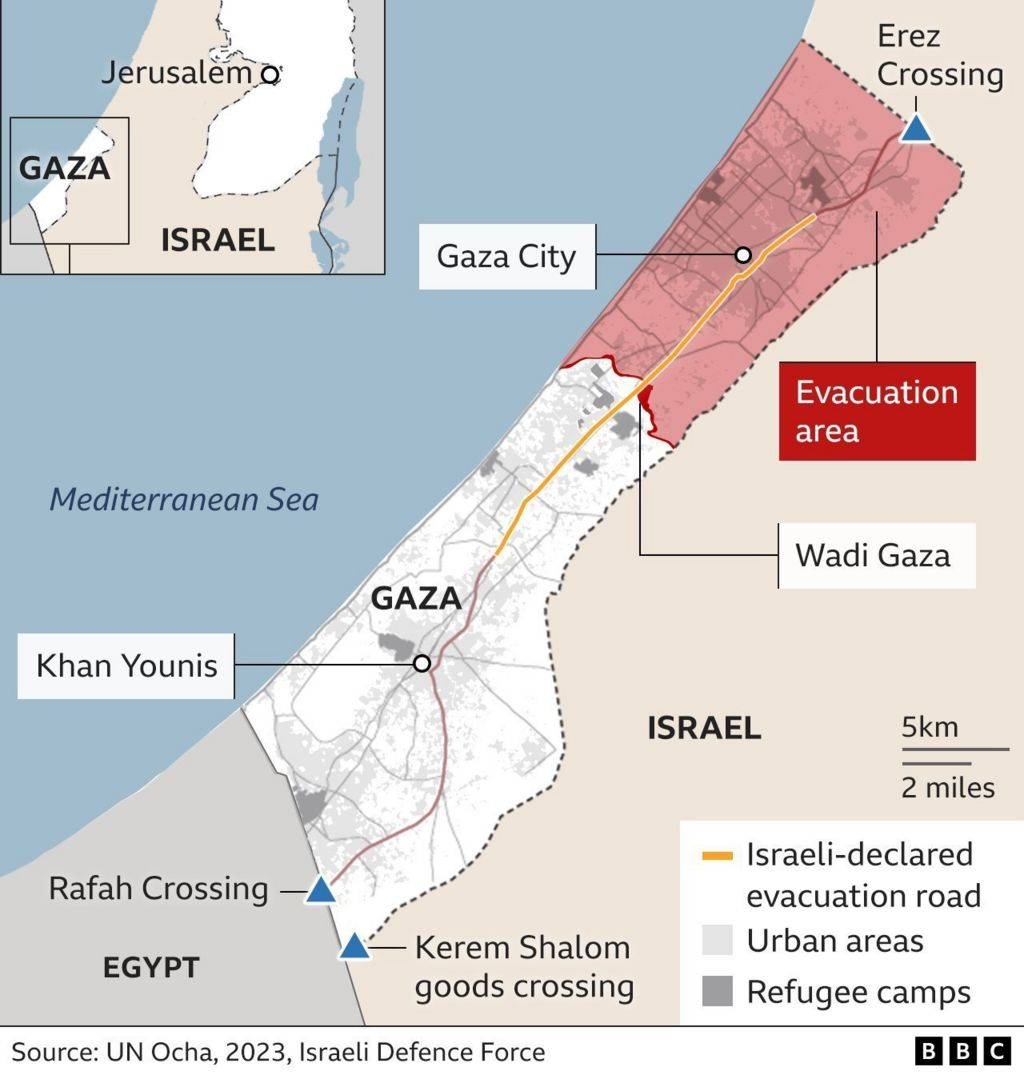
There are a variety of reasons why deliveries of aid have failed to address the shortages. First, many of the agencies which supply aid, such as the UN World Food Program, have stopped deliveries because it is impossible to provide security for the delivery workers. To get around this problem, many countries are now air-dropping aid into Gaza. Second, some Israelis are preventing the delivery of aid through the Kerem Shalom checkpoint in an attempt to decrease the food available to Gazans, a blockade that the Washington Post claims is supported by the IDF forces guarding the checkpoint. Finally, the main agency supporting the Palesdtinian people, the United Nations Relief and Works Agency (UNWRA) which has been supporting the Palestinian people since 1948, has been charged by Israel that some of its employees participated in the 7 October massacre and has suffered a dramatic drop off in support. According to Care International:
“UNRWA staff have faced near impossible conditions for months: in addition to the 158 UNRWA staff killed during the ongoing hostilities, at least 404 people in UNRWA shelters have been killed during the hostilities; almost 1,400 have been injured; and 155 UNRWA installations have been damaged. UNRWA workers continue to serve their community amid this unprecedented violence. The funding suspension will have wider regional implications that need to be carefully considered. In addition to Gaza, UNRWA operates in 4 other locations (West Bank- including East Jerusalem, Lebanon, Syria, Jordan) where it delivers critical services such as education and healthcare.”
The situation in Gaza is catastrophic and the deaths of the Palestinians at the aid delivery site raises serious questions about whether any outside aid is possible under current conditions. There will unqeustionably be an investigation into what happened, but that investigation will be conducted by the IDF itself. Aside from Palestidnian journalists, there are no outside news agencies that have been allowed into Gaza. Haaretz makes the point: “Since the war began, Israel and Egypt have largely barred foreign reporters from entering Gaza. Of the handful of journalists who have been granted access to Gaza, almost all of them were ’embedded’ with the Israeli army, which brings with it a long list of restrictions.” Moreover, many Palestinian journalists have been killed in the conflict. Haaretz continues: “The most recent tally from the New York-based Committee to Protect Journalists puts the number of journalists and media workers killed in the war at 99, according to their website. (This number includes two Israeli journalists, who were killed on October 7 during the Hamas attacks.)”.
Thus, we do not know what has actually happened in this war, aside from the fact that about 1200 Israelis were killed and approximately 200 hostages taken and over 30,000 Palestinians killed, the majority of which are women and children. Presumably, the Biden Administration has its own information sources, but the US response to the conflict is signiticantly at odds with the redponse of most other countries, including strong US allies. Fareed Zakaria assesses the US policy:
“The United States has repeatedly pressured Israel to make greater efforts to protect innocent civilians, but to little avail. Now it has been counseling against an invasion of Rafah, the city nestled close to Egypt where more than 1 million Palestinians have huddled together. Israeli Prime Minister Benjamin Netanyahu has promised to invade Rafah, whether another hostage deal is made or not.
“The result is that American policy on the Gaza war now appears hapless, ineffective and immoral. The image of U.S. officials wringing their hands about civilian casualties while providing ever-more weapons is grotesque. The image of a president of the United States mumbling words such as ‘indiscriminate’ and ‘over the top‘ to describe Israel’s bombings suggests weakness and passivity.
“Part of the problem is that in trusting the Israeli government, Biden is trusting Netanyahu, an exceptionally clever politician who knows how to handle American presidents expertly and has done so for decades. This time, Bibi has outsmarted, outmaneuvered and outplayed Biden.”
We all need to be far better informed about what has happened in the Gaza Strip since last October. Without information that is independent of the warring parties, we are all allowing the tragedy to continue without respite for the innocents.
 World Politics News